We need your help to keep divisive politics out of Texas’ classrooms.
From now until May 14th, the State Board of Education is accepting public comments on its proposed curriculum changes.
The SBOE has proposed removing Thomas Jefferson from a part of the curriculum. They are also planning to exclude references to Hispanics who fought Santa Anna and died at the Alamo.
During the primaries, Texans voted against the most extreme and hyper-political SBOE candidates, sending a clear message about their approach of injecting politics into our classrooms.
Last month, I called on Rick Perry to ask his appointed chair of the SBOE to either send changes back to expert review teams or delay the vote until new board members are seated.
Perry’s response has been to say that he’s not going to “try to outsmart” the SBOE. He declined to show leadership, refusing to ask his appointed chair of SBOE to rein in the hyper-political curriculum amendment process.
Our next governor should be a leader who ensures our schools prepare young Texans for college and their careers. I am committed to improving education and working for our future.
Thank you for taking the time to weigh in.
Sincerely,
Bill White
P.S. If you would like to send your comments directly to the SBOE, click here.
Spread the word; friends don't allow friends to repeat history.
Dr. Diane Ravitch, one of the principal education theorists behind the No Child Left Behind Act, will speak twice in Dallas over the next two days — telling how NCLB is not working
Both public events, tonight at 7:00 p.m., and Thursday at the Dallas Institute of Culture and Humanities, are sponsored by the Dallas Institute.
Note that registration is required for tonight’s session:
To All Staff RE: The Dallas Institute of Culture and Humanities presents: Education Forum: What Makes a Good Education?
Two Public Events: Wednesday, April 28, at 7 p.m., and Thursday, April 29, at 7 p.m.
Wednesday, April 28, 2010, 7 p.m. Evening Forum and Book Signing at the Booker T. Washington High School for the Performing and Visual Arts Montgomery Arts Theater, 2501 Flora Street, Dallas, 75201
Keynote Speaker: Dr. Diane Ravitch, Education Historian
In this age of productivity models and minimum standards, the topic of a good education often
gets lost, but it evokes the century-long quarrel between the practical and the academic
curricula in our public discourse. Today, if we want to build a school system that will serve our
youth not only in their schooling but throughout life, we need to place what makes a good education
at the center of our discussion.
Beginning this conversation during our inaugural Education Forum are two noted authorities in the teaching profession: Dr. Diane Ravitch and Dr. Louise Cowan
Dr. Diane Ravitch, one of the nations leading education historians and author of the
#1 bestselling book on education, The Death and Life of the Great American School System: How Testing and Choice Are Undermining Education.
In it, Dr. Ravitch explains why she is recanting many of the views she held as U.S. Assistant Secretary of Education. Based on the data, she claimed in a recent interview on The Diane Rehm show, the remedies are not working and will not give us the educated citizens that we all want. Dr. Ravitch will explore what makes a good education and how to fulfill our commitment to a democratic future.
Dr. Louise Cowan, a Founding Fellow of the Dallas Institute and former dean at the University of Dallas, created the Institutes nationally recognized Teachers Academy programs from her vision of what makes a good education. For 27 years, these programs have challenged area school teachers to assume their full authority and responsibility as teaching professionals.
SEATING FOR THE EVENING FORUM IS LIMITED – ADMISSION BY RESERVATION ONLY
Teachers Admission – $15 / General Admission – $25
Deadline to register is noon, Wednesday, April 28.
If you’re teaching world history, or art, or government, or environmental science, or geography, this might be a great blog to track.
Senegal is a very interesting place. Note on the map how it completely surrounds its neighbor nation of The Gambia.
Senegal, map courtesy of the U.S. Federal Aviation Administration (FAA)
France held the nation as a colony once upon a time, from 1850 to independence of the Mali Federation in 1960 — one of the national languages is French, but regional languages are numerous, Wolof, Soninke, Seereer-Siin, Fula, Maninka, and Diola. The Mali Federation was short-lived, and Senegal broke off in August of 1960.
If you listen to NPR, you’ve probably heard their reporter signing off in that distinct way she does, “Tthis is Ofeibea Quist-Arcton, for NPR, in Dah-KAHHH!” (Not to be confused with Dacca, Pakistan).
The French colonies of Senegal and the French Sudan were merged in 1959 and granted their independence as the Mali Federation in 1960. The union broke up after only a few months. Senegal joined with The Gambia to form the nominal confederation of Senegambia in 1982, but the envisaged integration of the two countries was never carried out, and the union was dissolved in 1989. The Movement of Democratic Forces in the Casamance (MFDC) has led a low-level separatist insurgency in southern Senegal since the 1980s, and several peace deals have failed to resolve the conflict. Nevertheless, Senegal remains one of the most stable democracies in Africa. Senegal was ruled by a Socialist Party for 40 years until current President Abdoulaye WADE was elected in 2000. He was reelected in February 2007, but has amended Senegal’s constitution over a dozen times to increase executive power and weaken the opposition, part of the President’s increasingly autocratic governing style. Senegal has a long history of participating in international peacekeeping and regional mediation.
The country is tropical, hot and humid. Geographically, it is low, rolling plains.
Dakar is about as far west as one can go on the African continent. (See the map inset — Senegal is in dark green).
Senegal has iron ores, and phosphorus (ancient bird droppings?). It’s not a rich nation, but it’s better off than many developing countries.
Adkins is in for a great adventure, no?
Africa, showing Senegal - CIA Factbook
Spread the word; friends don't allow friends to repeat history.
Jeff Danziger cartoon, for the New York Times Syndicate, on Texas State Board of Education “changes” to Texas social studies texts.
People for the American Way have joined the fight for good education in Texas, pushing better social studies education standards. The Texas State Board of Education will conduct final votes on social studies standards in May.
Grotesque slashes damaged social studies standards in the last round of amendments. Conservatives will probably try to keep secret their proposed changes, offering a flurry of last-minute amendments carefully designed to gut serious education and make the standards work as indoctrination for young conservatives instead.
PFAW has good reason to fear. Here’s their letter. from PFAW President Michael Keegan:
Dear People For Supporter,
Thomas Jefferson banned in Texas schools? Maybe… if the Right has its way. The fight is still on to keep absurd changes out of the Texas social studies textbook standards, with the final standards set to be adopted by the Texas State Board of Education (SBOE) on May 21.
Right-wing members of the SBOE are using the textbook standards in Texas to rewrite history in a way that could impact students across the U.S., tossing out facts in favor of propaganda like:
America is a Christian country, founded on “Biblical principles.”
Conservative icons from Ronald Reagan to Newt Gingrich, Phyllis Schlafly, the Moral Majority and even Sen. Joseph McCarthy are history’s “good guys,” but progressives and progressive values are at odds with what it means to be “American.”
Words like “democracy” (sounds like “Democrat!”) have nothing to do with America — we’re a Republic — In fact, “capitalism” has sort of a negative connotation to some, so they want that word to be universally replaced with “free market.”
Some of the major contributions of Thomas Jefferson — arguably America’s greatest thinker — are on the chopping block, as are the contributions of other important figures not favored by the zealots on the Texas State Board of Education, like Cesar Chavez and Thurgood Marshall. (Who’s next? Martin Luther King? FDR?)
Texas is just ground zero for what is clearly a national effort. We need to make sure that whatever standards are adopted in Texas, they do not affect the social studies textbooks used by students in other states.
The Texas State Board of Education traditionally has tremendous power in determining the content of textbooks not only for Texas students but for students across the U.S. Texas reviews and adapts textbook standards for the major subjects every six years, and because of the size of the state’s market, textbook publishers often print books consistent with the Texas standards. Last year, they attracted national ridicule for trying to inject creationism into science textbooks. This year, they’re voting on social studies standards.
The right-wing majority on the State Board wants indoctrinate Texas students into this new perverse revisionist history. PFAW is supporting our allies on the ground in Texas who are working to make sure students have the chance to learn history as it occurred, not how the Far Right wish it had happened. But we need to do all we can to make sure this is not exported to other states and school districts as well. Help us take extremism out of textbook decision making and let our children learn the truth in the classroom.
“Follow the Money” is a video summarizing the results from the project by Northwestern University grad students Daniel Grady and Christian Thiemann. Using data from the website Where’s George?, they have been able to track the movement of U.S. paper currency. What can you learn from this? That there are natural borders within the U.S. that don’t necessarily follow state borders, and it can also be used to predict the spread of disease because it maps movement of people within the U.S.
From Maria Popova on BrainPickings.org: This may sound like dry statistical uninterestingness, but the video visualization of the results is rather eye-opening, revealing how money — not state borders, not political maps, not ethnic clusters — is the real cartographer drawing our cultural geography. The project was a winner at the 2009 Visualization Challenge sponsored by the National Science Foundation and AAA.
I am forever grateful for that nameless White female, who, in her clunky shoes and calf-length tweed skirts, passed out poems on mimeograph paper to her first-grade students. When talking to students myself, I often tell the story of the very prim and ebony Mrs. Covington who challenged her junior high school English class to memorize “Invictus” before telling us who had authored the poem.
Words to teach by. “Invictus?” You know it, even if you don’t think you do.
Out of the night that covers me,
Black as the pit from pole to pole,
I thank whatever gods may be
For my unconquerable soul.
In the fell clutch of circumstance
I have not winced nor cried aloud.
Under the bludgeonings of chance
My head is bloody, but unbowed.
Beyond this place of wrath and tears
Looms but the Horror of the shade,
And yet the menace of the years
Finds and shall find me unafraid.
It matters not how strait the gate,
How charged with punishments the scroll,
I am the master of my fate:
I am the captain of my soul.
At the age of 12, Henley became a victim of tuberculosis of the bone. A few years later, the disease progressed to his foot, and physicians announced that the only way to save his life was to amputate directly below the knee. It was amputated at the age of 25. In 1867, he successfully passed the Oxford local examination as a senior student. In 1875, he wrote the “Invictus” poem from a hospital bed. Despite his disability, he survived with one foot intact and led an active life until his death at the age of 53.
Signe Wilkinson, Philadelphia Daily News, March 17, 2010 - Texas education board cuts Enlightenment from curriculum
Signe Wilkinson cartoons for the Philadelphia Daily News. She won a Pulitzer for political cartoons in 1992, the first woman to win that award (about time!).
Spread the word; friends don't allow friends to repeat history.
Mike Luckovich on Texas education board gutting social studies standards, March 18 or 20, 2010 - Atlanta Journal-Constitution
I found this brilliant Mike Luckovich cartoon from March 18, just in time for the anniversary of Paul Revere’s ride, and the anniversity of Longfellow’s poem, “Paul Revere’s Ride.” What will SBOE members be reading for poetry to their kids, on April 18?
Spread the word; friends don't allow friends to repeat history.
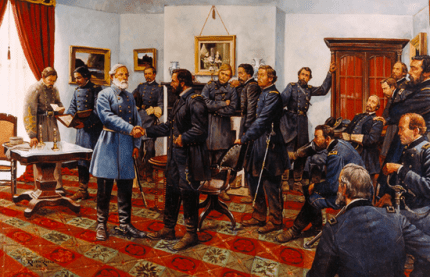
But of course, we studied the Civil War in our U.S. history classes last fall, in the first six weeks, as a review of what the students were supposed to get in 8th grade.
In your classroom, how do you deal with anniversaries when they are out of the current course of study? How have you seen it done well?
The Surrender, by Keith Rocco – image from National Park Service, via Pillar to Post
Tomorrow, April 14, Mission Specialists Dottie Metcalf-Lindenburger is scheduled to talk with students at Eastern Guilford High School in North Carolina, and all of the 71,000 students in Eastern Guilford School District.
Caption from NASA: STS-131 Mission Specialist Dorothy Metcalf-Lindenburger, attired in a training version of her shuttle launch and entry suit, poses for a photo prior to the start of an ingress/egress training session in the Space Vehicle Mock-up Facility at NASA's Johnson Space Center. Photo Credit: NASA
Metcalf-Lindenburger is one of three teachers selected in 2004 as astronauts. NASA is committed to help education out. After the Challenger disaster, and the death of “teacher in space” Christa McAuliffe, NASA finally determined to make teachers into astronauts rather than fly “civilians.”
Haley Miller
Guilford Public Schools, Guilford, N.C.
336-370-3200 millerh3@gcsnc.com
April 12, 2010
MEDIA ADVISORY : M10-048
Orbiting Space Shuttle Astronauts — Including Former Teacher — Call North Carolina Students
WASHINGTON — Astronauts orbiting 220 miles above Earth will speak with students in Gibsonville, N.C., on Wednesday, April 14. The call with the students and space shuttle Commander Alan Poindexter and Mission Specialists Dottie Metcalf-Lindenburger, Stephanie Wilson and Clay Anderson will take place at 1:06 p.m. EDT at Eastern Guilford High School in Gibsonville.
Eastern Guilford High School is hosting students from Eastern Guilford Middle School, Gibsonville Elementary, McLeansville Elementary, Rankin Elementary and Sedalia Elementary for the downlink. The school also will broadcast the event to the entire Guilford County Schools district, which serves more than 71,000 students.
The astronauts launched Monday, April 5, aboard space shuttle Discovery from NASA’s Kennedy Space Center in Florida. During the 13-day mission to the International Space Station, the crew will deliver science experiments and supplies; take three spacewalks to switch out a gyroscope on the station’s truss, or backbone; install a spare ammonia storage tank and return a used one; and retrieve a Japanese experiment from the station’s exterior.
Metcalf-Lindenburger is one of three teachers selected to fly as shuttle mission specialists in the 2004 Educator Astronaut Class. She operates the shuttle’s robotic arm. Without robotics, major accomplishments like building the station, repairing satellites in space and exploring other worlds would not be possible.
Students have been preparing for the downlink by conducting NASA engineering design challenges and implementing agency robotics resources and activities into K-12 classrooms. A science, technology, engineering and math, or STEM, club was organized to increase participation and interest, particularly by female students.
The school’s guidance department also is collaborating with local universities to help students investigate and explore STEM opportunities beyond graduation. During follow up in-district workshops in April and May, a NASA Aerospace Education Services Program specialist will demonstrate how to access and use NASA resources in K-12 curricula.
Eastern Guilford High School employee Michael Woods, a former Aerospace Education Services Project specialist at NASA’s Goddard Space Flight Center in Greenbelt, Md., and the agency’s Langley Research Center in Hampton, Va., is leading the downlink effort. In December 2009, NASA awarded Guilford County Schools a two-year grant of nearly $1 million to help middle and high school teachers develop science lessons using the space agency’s content.
The event is part of a series with educational organizations in the U.S. and abroad to improve teaching and learning in science, technology, engineering and mathematics. The in-orbit call is part of Teaching From Space, a NASA project that uses the unique environment of human spaceflight to promote learning opportunities and build partnerships with the kindergarten through 12th grade education community.
NASA Television will air video of the astronauts during the downlink. For NASA TV downlink, schedule and streaming video information, visit:
Here’s another opportunity to put real, cutting edge technology in your classroom. In fact, your kids could probably invent all sorts of new uses for it.
Have you even heard of this stuff? Can you use it, live, with the equipment you’ve got?
Blaise Aguera y Arcas of MicroSoft demonstrated augmented-reality maps using the power of Bing maps, Flickr, Worldwide Telescope, Video overlays and Photosynth, to an appreciative and wowed audience at TEDS:
My prediction: One more advance in computer technology that classrooms will not see in a timely or useful manner.
But have you figured out how to use this stuff in your geography, history, economics or government classes? Please tell us about it in comments. Give examples and links, please.
Pulitzer Prize-winner Tom Toles in the Washington Post, March 19, 2010
It’s pretty embarrassing when the State Board of Education’s actions leave Texas open to jokes about whether Texans remember the Alamo. Remembering the Alamo is as much a Texas monument or icon as anything else — maybe moreso.
Tom Toles demonstrates why Texas should be embarrassed by the Texas State Board of Education’s work on social studies standards.
Spread the word; friends don't allow friends to repeat history.
Clay Bennett, Chattanooga Times-Free Press, March 16, 2010
Bennett remains one of my favorite cartoonists today. His work is incisive, intelligent, and persuasive to the side of reason and light almost all of the time. Why hasn’t he won a Pulitzer yet?
Bennett is generally a powerful supporter of U.S. education; see the two other recent cartoons, below the fold.
Or, until that account is unsuspended by the forces supporting Donald Trump: Follow @FillmoreWhite, the account of the Millard Fillmore White House Library
We've been soaking in the Bathtub for several months, long enough that some of the links we've used have gone to the Great Internet in the Sky.
If you find a dead link, please leave a comment to that post, and tell us what link has expired.
Thanks!
Retired teacher of law, economics, history, AP government, psychology and science. Former speechwriter, press guy and legislative aide in U.S. Senate. Former Department of Education. Former airline real estate, telecom towers, Big 6 (that old!) consultant. Lab and field research in air pollution control.
My blog, Millard Fillmore's Bathtub, is a continuing experiment to test how to use blogs to improve and speed up learning processes for students, perhaps by making some of the courses actually interesting. It is a blog for teachers, to see if we can use blogs. It is for people interested in social studies and social studies education, to see if we can learn to get it right. It's a blog for science fans, to promote good science and good science policy. It's a blog for people interested in good government and how to achieve it.
BS in Mass Communication, University of Utah
Graduate study in Rhetoric and Speech Communication, University of Arizona
JD from the National Law Center, George Washington University


 Posted by Ed Darrell







 Millard Fillmore's Bathtub