Flash mob honored Millard Fillmore’s 211th birthday in Moravia, New York

January 7, 2013

Jeff Kramer, who usually is a a humor columnist, in the Syracuse, New York, Post-Standard:

Millard Fillmore flash mob commemorating birthday is a snow-smashing success

Published: Monday, January 10, 2011, 6:00 AM

Kramer sisters lead flash mob dance in honor of Millard Fillmore's 211th Birthday, Moravia, New York

Peter Chen / The Post-Standard More than 50 people followed the dance moves of the Kramer sisters, Miranda, 10, and Lily, 8, Friday at a flash mob in the parking lot of Moravia’s Modern Market. They danced to “Birthday” by the Beatles to celebrate former US President Millard Fillmore’s birthday, which was on Jan. 7, 1800. Fillmore was born in Moravia. The girls are the daughters of The Post-Standard humor columnist Jeff Kramer.

Moravia, NY — You know your legacy is in trouble when your biggest claim to fame is having a bathtub installed in the White House, and even that’s a lie.

So it has always been with Millard Fillmore. Americans remember their 13th president as mediocre, wishy-washy and fat — if they remember him at all.

Still, a president is a president, and for a few minutes this past Friday, even Millard found his posthumous mojo. At least 50 people gathered in his hometown of Moravia for a flash mob birthday boogie choreographed and led by my daughters Miranda, 10, and Lily, 8. The event was organized by me as part of my New Year’s resolution to reach out to techno-savvy young people before one of them remotely shuts off my oxygen.

Everyone was in a great mood. “Happy Birthday, Millard!” the crowd shouted after churning up the slush in the parking lot of Modern Market with a dazzling display of grapevines, sprinklers, funky chickens and more.

Among the celebrants was Mr. Jan Hunsinger, a history/government teacher at Moravia High School. He brought a group of students to be part of the gala, plying them with extra credit.

“Thanks for doing this,” Hunsinger said to me. At least I think he said it. Truth is I didn’t take notes. Note-taking is Old Media (lame) and poor flash mob etiquette. The whole point of a flash mob is to convene en masse as directed by viral media, commit a planned public act and disperse. The last thing you want is some mainstream media dork asking questions like “Can you spell your name for me again?” and “How does this flash mob change your perceptions of Millard Fillmore?”

I also learned that Millard took Peru’s side when American entrepreneurs were stealing that country’s bird droppings for fertilizer. Instead of coming to the aid of the American businessmen, Fillmore insisted that no one should take Peru’s bird turds without Peru’s permission. Peru was deeply grateful, and America gained international cred. A statue of Fillmore was erected in Peru. Predictably, it became obscured by the very substance he had helped to protect.

Moravia High School Students at Millard Fillmore's 211th birthday bash in Moravia, New York, - Syracuse Post-Standard

Caption from the Syracuse Post-Standard; photo by Peter Chen / The Post-Standard – Moravia High School students (left to right) Amy Richards, 16, a junior; Melinda Heath, 16, a junior; Gabrielle Amos, 17, a junior; and Mattea Hilliard, 16, a sophomore, took part in a flash mob in the parking lot of Moravia’s Modern Market on Friday.

That’s all I have to say about Fillmore for now. I’m grateful to him, Moravia, my girls, the nice lady who bought them flowers and to everyone who made the flash mob rock. I’ll close with Fillmore’s inspiring last words, uttered as he was being fed soup.

“The nourishment is palatable,” he said. Then he died.

Here’s hoping that somewhere up there in that great bathtub in the sky, Millard — happily stuffed with palatable nourishment — was looking down on us last Friday and smiling.

Jeff Kramer’s humor column runs Mondays in CNY. E-mail him at jeffmkramer@gmail.com.


Fillmore wasn’t a total washout as President, contrary to his reputation.  Among other things, he was the guy who dispatched Commodore Perry to Japan, to open that reclusive nation to trade, and to stop them from executing random sailors from America washed up on their shores.  In a direct way, we might say Fillmore was responsible for World War II in the Pacific — once awakened to the thrills and advantages of international trade, Japan went after it with a vengeance, and then after empire.  That is to say the opening of Japan was momentous; history and commerce would never be the same again, in the Pacific.

And that quote, “The nourishment is palatable.”  Fillmore probably didn’t say that.  Even in death his words get little respect.  The story of Fillmore’s death in the New York Times mentioned that he had been ill, and that at what turned out to be his last meal, some soup, Fillmore had said it was okay.  The paper reported that Fillmore had said that the nourishment was palatable.  Someone, later, put quotes around the reporter’s words, and made them Fillmore’s.  You’d think someone would remember him for the Peruvian guano remarks instead, no?  (Gee, I’m not sure Mr. Kramer described that episode accurately.)


Hey! Geography teachers, especially Texas geography teachers

January 4, 2013

News from the Texas Alliance for Geography Education — read the whole newsletter, I’ve copied it all without cutting:

TAGE Blast for 4 January 2013
http://www.geo.txstate.edu/tage/

Overview

  • New Teacher Resources
  • How to Track a Bill
  • Upcoming Workshops and TAGE Events
  • Webinar Series on Southeast Asia
  • TAGE Awarded Two New Grants

*********************************************
To read more, visit http://www.geo.txstate.edu/tage/

New Teacher Resources

Thanks to generous support from the National Geographic Education Foundation, TAGE has created new resources for geography teachers. A huge thank you to Dr. Brock Brown, Dr. Jeff Lash, Linda Hammon, and our Teacher Consultants for their help with creating these resources. Visit our new Teacher Materials page at  http://www.geo.txstate.edu/tage/resources/teacher-materials.html, for videos, podcasts, new eoc sample questions, teaching handbooks, and lesson plans.

83rd Texas Legislature – How to Track a Bill

You can create a personal bill list and receive e-mail notification as the status changes on bills you chose to watch.

Visit http://www.capitol.state.tx.us/MnuMyTLO.aspx and create a log-in.

After you have logged-in, you can either choose Bill Lists or Alerts, and add the bill to track. For example, “HB 85” and click Add Bill.

Read more about HB 85 in the December newsletter.

TAGE will continue to track education legislation, and work in support of geographic education in Texas.

Upcoming Workshops

January 26, Region 4, 6th Annual Social Studies Conference, 8:30-3:30 pm, http://www.esc4.net/default.aspx?name=ss.events
February 7-8, Huntsville, Geography Conference: Bridging World Geography, http://www.escweb.net/tx_esc_06/catalog/calendar.aspx?date=2/1/2013
April 6, San Marcos, The Geography of Southeast Asia, more information coming soon on the TAGE website

June 11-13, San Marcos, Social Studies Supervisors Summer Institute: Teaching Geography Concepts, more information coming soon on the TAGE website

Webinar Series on Southeast Asia

Did you know that Southeast Asia has a population over 600 milion? This culturally diverse region encompasses a pivotal position in the world economy. Join Dr. Frederick Day in exploring various geographic issues related to Southeast Asia in TAGE’s new, free webinar series featuring this interesting and diverse region.

February 5th, 4:15-4:45: Physical Geography of Southeast Asia

February 12th, 4:15-4:45: Economic Development in Southeast Asia

February 26th, 4:15-4:45: Environmental Degradation in Southeast Asia

TAGE Awarded Two New Grants
TAGE is pleased to announce that we have recently received two grants to create a World Geography curricula unit focusing on Southeast Asia. Grants have been awarded by the National Geographic Education Foundation and a second grant by Humanities Texas. TAGE will create an online teaching unit complemented by videos and professional development webinars. Keep an eye on our calendar to learn more about the new and exciting opportunities related to teaching geography and Southeast Asia in the coming months.

2013 Grosvenor Teacher Fellow program – Deadline January 8th
National Geographic Education Programs and Lindblad Expeditions are pleased to announce the 2013 Grosvenor Teacher Fellow program. This professional development opportunity is named in honor of Gilbert M. Grosvenor, Chairman Emeritus National Geographic Society and Education Foundation. The program is designed to give current K-12 classroom teachers and informal educators from the 50 U.S. states, Canada, the District of Columbia, and Puerto Rico the opportunity to extend Grosvenor’s legacy of excellence in geographic education. Selected educators will travel aboard the ship National Geographic Explorer in June, July or August 2013 to Norway, Arctic Svalbard, Iceland, Greenland or the Canadian High Arctic. While aboard, Fellows will share the importance of geo-literacy with fellow travelers, develop activities to bring back to their classrooms, and have an adventure of a lifetime. Prior to the expedition, all 2013 Grosvenor Teacher Fellows will travel to Washington, D.C. on April 25-28th with all expenses covered to participate in a pre-trip workshop sponsored by Google, National Geographic, and Lindblad Expeditions. Check out the Grosvenor Teacher Fellow Program application, which is now live on our website:
http://education.nationalgeographic.com/education/program/grosvenor-teacher-fellow/?ar_a=1.

Worried about the World and U.S. History STAAR™ Exams?
Refresh your content knowledge of World and U.S. History … in 15 Minutes!

15 Minute History is a FREE podcast—with supplementary resources and primary documents—about World and U.S. History. 15 Minute History is a collaboration between Hemispheres, the international outreach consortium at the University of Texas at Austin, and Not Even Past, an outreach project of the Department of History at the University of Texas at Austin.

Featuring the minds and talent of the award-winning faculty and graduate students of the University of Texas at Austin, the topic of each episode is drawn directly from the World History and U.S. History TEKS, and contains background information and a quick primer on the subject.

Each episode is accompanied by primary documents to analyze with your students, and suggested resources for further reading and research. In just 15 minutes, you can refresh your knowledge of World and U.S. History—for FREE!

Children’s Map Competition Opportunity – Deadline February 15
Entries in the U.S. are not due until February 15, but it might be a good holiday-time project for classrooms to get started on. All of the instructions for participation can be accessed in this post from the NG Education blog.

NGS: New AP Human Geography Portal
National Geographic Education has created a portal on the NatGeoEd.org website for AP Human Geography teachers to visit for teaching and learning resources, including classroom activities, videos, maps, background reading material, and more. The new portal organizes content from National Geographic Education by each of the major topics taught in the AP Human Geography course. The collection will grow over time as new content aligning to the course topics is published online.

Click here to view: AP Human Geography Portal

If you teach social studies in Texas, you really ought to subscribe to this newsletter.

Texas Alliance for Geographic Education
Department of Geography
Texas State University
601 University Drive
San Marcos, TX 78666
http://www.geo.txstate.edu/tage/


“Honk if you love someone”

January 1, 2013

Nice video, by a high school kid, about a silly project that has nice effects.  Profound effects?  Who knows?

Tip of the old scrub brush to Patrick Larkin, who happens to be Burlington Public Schools Assistant Superintendent for Learning (not that his opinions are shared by his employer, no matter how much they should be), who blogs at Learning in Burlington.  Also, a tip of the scrub brush to Daniel Pink, who may know the film maker.

Did you honk?


Remember: December 30 is Hubble Day

December 29, 2012

Get ready to look up!

Edwin Hubble.

Edwin Hubble. (Photo credit: snaphappygeek)

At Millard Fillmore’s Bathtub, for several years we’ve celebrated Hubble Day on December 30.

On December 30, 1924, Edwin Hubble announced he’d discovered other galaxies in distant space. Though it may not have been so clear at the time, it meant that, as a galaxy, we are not alone in the universe (whether we are alone as intelligent life is a separate question). It also meant that the universe is much, much bigger than most people had dared to imagine.

December 30, 2012 is the 82nd anniversary of the announcement.  When dealing with general science illiteracy, it’s difficult to believe we’ve been so well informed for more than eight decades.  In some quarters, news travels more slowly than sound in the vacuum of space.

I find hope in many places.  Just a few weeks ago the Perot Museum of Nature and Science opened in downtown Dallas.  It’s the old Dallas Museum of Science and Natural History, once cramped into a bursting building in historic Fair Park, now expanded into a beautiful new building downtown, and keeping the Fair Park building, too.  Considering the strength of creationism in Texas, the mere fact that private parties would put up $185 million for a museum dedicated to hard science.

Displays in the Perot border on brilliance at almost every stop.  Stuffy museum this is not — it’s designed to spark interest in science and engineering in kids, and I judge that it succeeds, though we need to wait 20 years or so to see just exactly what and who it inspires.

We visited the Perot last night.  As I was admiring a large map of the Moon, a family strolled by, and a little girl I estimate to be 8 or 9 pointed to the Moon and asked her maybe-30-something father where humans landed.  I had been working to see whether the very large photo showed any signs of activity — but the father didn’t hesitate, and pointed to the Sea of Tranquility.  “There,” he said.  The man was not old enough to have been alive at the time; I’d wager most of my contemporaries would hesitate, and maybe have to look it up.  Not that guy.

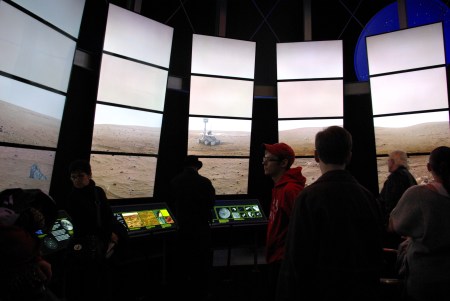
Visitors to the Perot Museum of Nature and Science, Dallas

On 32 flat-panel video displays hooked together to make one massive display, visitors to the Perot Museum of Nature and Science view Mars as our new Mars Rover’s friend might see it, in a section of the museum devoted to astronomy, physics, astronomy and planetary exploration. Photo by Ed Darrell; use encouraged with attribution.

Still, kids today need this museum and the knowledge and excitement it imparts.  Last July I accompanied a group of Scouts from Troop 355 to summer camp in Colorado, to Camp Cris Dobbins in the foothills just east of Colorado Springs.  Near lights out one night I hiked the half-mile to our campsite admiring the Milky Way and other bright displays of stars that we simply do not get in light-polluted Dallas County.  I expected that our older Scouts would have already started on the Astronomy merit badge, but the younger ones may not have been introduced.  So I asked how many of them could find the Milky Way.  Not a hand went up.

“Dowse the lights, let’s have a five minute star lesson,” I said.  we trekked out to a slight opening in the trees, and started looking up.  I had just enough time to point out the milky fog of stars we see of our own galaxy, when one of the Scouts asked how to tell the difference between an airplane and a satellite.  Sure enough, he’d spotted a satellite quietly passing overhead — and just to put emphasis on the difference, a transcontinental jet passed over flying west towards Los Angeles or San Francisco.

Then, when we were all looking up, a meteoroid streaked from the south across almost the whole length of the visible Milky Way.  Teenaged kids don’t often go quiet all at once, but after the oohs and aahs we had a few moments of silence.  They were hooked already.  Less than five minutes in, they’d seen the Milky Way, found the Big Dipper, seen a satellite, a jet, and a shooting star.

Perfection!

Edwin Hubble’s discovery can now be the stuff of elementary school science, that the blobs in the sky astronomers had pondered for a century were really galaxies like our own, which we see only through a faint fuzz we call the Milky Way.

Do kids get that kind of stuff in elementary school?  Not enough, I fear.

We named a great telescope after the guy; shouldn’t we do a bit more to celebrate his discovery?

More:


There was an armed deputy at Columbine High; his story

December 21, 2012

Deputy Sheriff Neil Gardner, talking about his experience at the Columbine High School shootings in Colorado.

More:  

Denver - Columbine High School 097

Denver – Columbine High School Hope Memorial Library – Photo credit: travellingzenwolf


Prisons, or schools? Prisons, or mental health care? Prisons, or freedom?

December 19, 2012

Here’s one from a maybe-odd source, but with relatively good citations.

If we have limited money to spend in government, can we put spending on a balance to see where it should be spent?  This is one example out of many pending before the U.S. Congress and state legislatures, today — right now, and for the coming several months.  When you hear elected representatives say “we must cut spending to reduce deficits,” you need to understand that their proposal is to cut spending for education, for job training, for employment assistance, for unemployment payments, for health care, for mental health care, for drug rehabilitation programs, but generally NOT for incarceration programs.  In short, they are saying we must cut off the education of poor kids, to build jails to house them if they run afoul of the criminal justice system after being unable to get the education and training to get a job that will produce the income that would have made them great parents and taxpayers.

If we have limited money to spend in government, can we put spending on a balance to see where it should be spent?

  • Prisons, or schools?
  • Prisons, or mental health care?
  • Prisons, or drug rehabilitation?
  • Justice, or incarceration?
No Justice For All poster, prisons vs. education - OnlineJusticeDegree.com

From OnlineJusticeDegree.com; check references listed on the chart.

What do you think?

More:


Education, unions, guns and Superman: A few random thoughts

December 18, 2012

Here, I’ve been quiet for a few days on these issues.  I like to have more facts before forming opinions.  Others don’t feel so constricted, though, and one of the key lessons of life we must learn over and over is that too often we must act without knowing all the facts we’d wish to know.

Ryan Houck, Broken Pencil for Bach

Borrowed art: A Broken Pencil for Bach, drawing by Ryan Houck

This is one of those times.  In Michigan, the governor has been presented bills which he has signed which take away rights of teachers to stand up for themselves, part of a long-standing GOP war on education and teachers.  He has other bills intended to legalize carrying guns in schools, which he has not yet signed.   In several states, legislatures gear up for sessions starting early next year, with pre-filed bills to put the screws to teachers, cut back education spending, take money from public schools and give it to private groups under a pretext of improving education (I say pretext because all research indicates the public schools perform better, but I digress).  In Congress, the GOP demands cuts to health care, mental health care, education, roads, aid to any workers, employed, under-employed or unemployed, and especially in payments to people in poverty or otherwise in economic distress (“no pain to others, no GOP gain”).

Highlighting the intentional sloth the GOP insists on in government, Hurricane/Tropical Storm Sandy hammered one of our nation’s largest cities and most important regions for technology, manufacturing, business, finance and news, and the GOP opposes federal aid to speed up recovery; and in Newtown, Connecticut, a man with learning difficulties and/or behavioral issues broke into an elementary school over-armed with human-killling automatic and semi-automatic weapons legally purchased and legally owned, with which he had legally trained, and murdered 26 people, including 20 children.

My few random thoughts:

  • The unions demonized in Michigan, Texas and Wisconsin, saved children’s lives in Newtown.  (Yes, teachers; cops and firefighters, too.)
  • The teachers who “don’t deserve the pay they get,” according to many speakers in the public fora, laid down their lives in Newtown.
  • Teachers who ask for parental support, chaperones for a trip to the art gallery, a working copier, a full set of books for the students, a working grading machine, enough pencils so every kid can write, a working projector and ten minutes to set it up — and too often don’t get any of that, let alone ten minutes for a body break — now are asked by the crazy gun lobby to arm themselves and take on other beneficiaries of crazy gun lobbyists in the halls of the schools.
  • Waiting for Superman” was a film about how teachers are animals, teachers unions are monsters.  Turns out Superman was already teaching first grade, in Newtown, but is demonized by the filmmakers as someone or something else.
  • Maybe we should rethink who are the monsters, who is Superman, and who deserves our support.  Superman’s already in our schools — what are we waiting for?  Somehow I doubt that Superman’s merely showing up will be enough to resolve the issues and “fix” our schools.

What are your thoughts?

More, and related material:


Teacher video: No, Texas can’t secede

December 11, 2012

Another video from super teacher CGPGrey, right up our Texas alley, on the issue of Texas secession:

Minor error:  No provision I can find in any Texas Constitution to allow Texas to split.  Language to allow a territory to split into as many as five states was pretty standard for new U.S. territories organized during the 19th century; but that didn’t carry over to the Texas Constitution approved by Congress, not in a unilateral way.  One needs to recall that when Texas entered the Union, it carried with it lands that eventually became parts of New Mexico, Colorado, Oklahoma and Wyoming — which was part of the scruff with Mexico, which led to the U.S.-Mexico war of 1846 to 1848.

Still a teacher from another state demonstrates a much clearer conception of Texas history and state and federal law than some of the nutcases in Texas.  That so many Texans hold so many false perceptions of law and Texas history is an indictment of Texas education, and Texas’s governor and legislature.

You also should check out:

And, while we’re thinking about it, did you ever comment on the Digital Aristotle concept, which first introduced this blog to Mr. Grey?

More:


Two Alcotts, and the Concord transcendentalists – November 29

November 29, 2012

April is the cruelest month, and November the most disagreeable.

Students of literature might recognize something in that sentence.

English: Headshot of Louisa May Alcott (Novemb...

Louisa May Alcott (November 29, 1832 – March 6, 1888), American novelist, at age 20 – image from Wikipedia

Interesting coincidence:  Louisa May Alcott was born on November 29, 1832; her father, Amos Bronson Alcott, was born on November 29, 33 years earlier.

Do high school literature students find them interesting, even? Or do the students learn about transcendentalism only because they know “it’s on the test?”

American Memory at the Library of Congress holds history for each day of the year.  The entry for November 29 notes and chronicles the dual births of the Alcotts, and discusses the transcendentalist movement — with a lot of good links for teachers or students.

My hope is that more teachers of history will use more literature in their courses.  While Texas standards on history say little about transcendentalism, the reality is that it is difficult to understand America and its development from 1800 to the Civil War, without understanding transcendentalism.  Would America have gone to war over slavery and states rights, but for this movement in literature and social theory?

What can students learn about life in America from reading the Alcotts’ books?

Cribbed entirely from the American Memory LOC site, this is a self-contained literature and history unit by itself [links in the text all from the good people at the Library of Congress]:

English: Photograph of American educator and p...

American educator and philosopher Amos Bronson Alcott (1799-1888), father of the literary Alcott girls. From the NYPL Digital Gallery via Wikipedia

Daughter of the Transcendentalists

“November is the most disagreeable month in the whole year,” said Margaret, standing at the window one dull afternoon, looking out at the frostbitten garden.

“That’s the reason I was born in it,” observed Jo pensively, quite unconscious of the blot on her nose.

“If something very pleasant should happen now, we should think it a delightful month,” said Beth, who took a hopeful view of everything, even November.

“I dare say, but nothing pleasant ever does happen in this family,” said Meg, who was out of sorts….

“My patience, how blue we are!” cried Jo…. “Oh, don’t I wish I could manage things for you as I do for my heroines!…I’d have some rich relation leave you a fortune unexpectedly….”

“Jo and I are going to make fortunes for you all. Just wait ten years, and see if we don’t,” said Amy, who sat in a corner making mud pies, as Hannah called her little clay models of birds, fruit, and faces.   Louisa May Alcott, Little Women, Chapter 15

Louisa May Alcott, the second daughter of Amos Bronson Alcott, teacher and transcendentalist philosopher, and Abigail May, social worker and reformer, was born in the “disagreeable month” of November, just like her literary creation Jo March, the rambunctious heroine of Little Women.

On November 29, 1832, Amos Bronson Alcott wrote his mother of his joy in “the birth of a second daughter on my own birth-day.” Convinced of the importance of early childhood, Bronson Alcott continued to keep a regular journal of each of his four daughters’ growth and activities. Shortly before her second birthday, Louisa’s father wrote of her:

Louisa…manifests uncommon activity and force of mind at present…by force of will and practical talent, [she] realizes all that she conceives.…Bronson Alcott, November 5, 1834.
The Journals of Bronson Alcott, (Boston: Little, Brown and Company, 1938), page 47.

During Louisa’s early years, her father’s innovative Temple School in Boston failed, as did the family’s experiment with communal living with a group of transcendentalist mystics at Fruitlands, an early eighteenth-century farmhouse.

A happier time began after the family settled at Hillside House, later Nathaniel Hawthorne’s residence, which he renamed the Wayside, in Concord, Massachusetts. There, the Alcotts found a sympathetic community and like-minded friends. Louisa and her sisters were always welcome to participate in the conversations of the poets, philosophers, and reformers that made up their parents’ circle.

Bridge surrounded by trees
The Old Bridge, Concord, Massachusetts, 1900.
Touring Turn-of-the-Century America: Photographs from the Detroit Publishing Company, 1880-1920

The Alcott girls enjoyed the natural beauty of Concord, boating on the river, ice skating on Walden Pond, and running free in the surrounding fields and woods. Henry David Thoreau was one of Louisa’s instructors when she was a young girl. In one of his fanciful lessons, he taught her that a cobweb was a “handkerchief dropped by a fairy.” As a teenager, Louisa enjoyed borrowing books from Ralph Waldo Emerson‘s collection and delighted in conversing with the “sage of Concord.”

For the most part, the Alcotts taught their daughters at home. Daily journal-keeping formed a significant part of the home curriculum. Louisa and her sisters each wrote a weekly journal in which they recorded family events and published their literary and artistic endeavors. The girls and their neighbors formed a dramatic society, and the Hillside barn became the local theater where they performed the Louisa’s melodramatic plays.

Although their home and community life was rich, the family remained financially impoverished. Of necessity, all family members pitched in to support the family, with the daughters working as teachers, companions, and domestics. Besides their paid labors, they contributed their time and talents to the abolition movement, the women’s suffrage movement, and to the relief of those poorer than themselves.

Louisa resolved early on to earn money to relieve the hardship of her mother’s life. Gradually, she began earning a reliable income from stories and sketches published in and from dime-novel thrillers, including published under the pseudonym “A. M. Barnard.” Her first book of stories, , was published in 1855.

View of a hospital ward
Patients in Ward K of Armory Square Hospital,
Washington, D.C.,
August, 1865.
Selected Civil War Photographs, 1861-1865

During the Civil War, Louisa served as a nurse at a Union Army hospital in Washington, D.C. There, she kept careful journals which she published later as Hospital Sketches. A severe bout of typhoid fever brought her home to Concord an invalid. It is thought that she was treated with mercury for her fever, as were many others who became ill during this period. Mercury poisoning was apparently the cause of the slow debilitation that led to her death twenty years later.

In 1868, at the suggestion of her publisher, Louisa wrote a “story for girls” that was to bring her lasting fame, Little Women; or Meg, Jo, Beth, and Amy, based on the experiences of her own family. Little Women was an immediate success. It was followed the next year by a second volume with the same title, subtitled, “Part Second,” and in subsequent years, by two sequels, Little Men and Jo’s Boys.

During the 1870s, Alcott and her mother were deeply involved in the women’s suffrage movement, canvassing door-to-door encouraging women to register to vote. In 1879, Louisa registered as the first woman to vote in the Concord school committee election.

Suffragette in a group of men
Help Us to Win the Vote, 1914.
By Popular Demand: “Votes for Women” Suffrage Pictures, 1850-1920

Louisa’s later years were financially secure and her family was able to live comfortably and pursue their many intellectual and artistic interests at their second home in Concord, Orchard House. Her last years, however, were shadowed by the deaths of two of her sisters and her brother-in-law. As the sole support of her parents, sisters, and her nephews and niece, she became overburdened with work and ill health. Louisa May Alcott died, two days after her father, on March 6, 1888, at the age of fifty-six.

House nestled in an orchard
The Orchard House, Concord, Home of the Alcotts,
Concord, Massachusetts, 1900.
Touring Turn-of-the-Century America: Photographs from the Detroit Publishing Company, 1880-1920

Father of the “Little Women”

Woman…is helping herself to secure her place in a better spirit and manner than any we [men] can suggest or devise,…it becomes us to take, rather than proffer Consels [sic], readily waiting to learn her wishes and aims, as she has so long and so patiently deferred to us.Letter from A. Bronson Alcott to Elizabeth Cady Stanton
Concord, Massachusetts, May 4, 1869.
The Letters of A. Bronson Alcott (Ames, Iowa: Iowa State University Press, 1969), p. 471.

On November 29, 1799, Amos Bronson Alcott, educator, philosopher of American Transcendentalism, and father of the original “Little Women”—Anna, Louisa, Elizabeth, and May Alcott—was born in Wolcott, Connecticut. The son of a poor flax farmer, Alcott was almost completely self-educated. As a young man, Alcott worked as a peddler, handyman, and gardener, pursuing a self-selected course of readings in English and German literature and philosophy.

In 1830, Alcott journeyed to Boston to attend a series of lectures on abolition. There he met Samuel Joseph May, Unitarian minister, and his sister Abigail “Abba” May, a teacher and social worker. On May 23, 1830, Alcott and Abba May were married. During the next several years, the Alcotts were forced to move several times, as Bronson’s experimental schools were abandoned as financially unsuccessful.

During this period, the couple’s four daughters were born and Alcott continued to develop his lifelong habit of journal-writing, chronicling the daily events in the development of his children. At the basis of his educational theory was his belief that “early education is the enduring power” in the formation of the imagination and moral life of the human being.

Exterior of Tremont Temple
Tremont Temple,
Boston, Massachusetts,
c 1900.
Touring Turn-of-the-Century America: Photographs from the Detroit Publishing Company, 1880-1920

On September 22, 1834, Alcott opened his famous Temple School, located in the Masonic Temple on Tremont Street in Boston, where he put into effect many of his innovative educational theories. His assistant, Elizabeth Palmer Peabody, who went on to found the first kindergarten in the United States, published the plan of the school the next year in her book Record of a School.

Alcott believed that learning should be a pleasant experience for children, and that the classroom environment should be beautiful. He built the classroom furniture himself and allowed the children to decorate the room with pictures and plants and to arrange their desks in a manner pleasing to themselves.

Alcott emphasized the cultivation of the virtues of self-discipline, self-expression, and charity. A form of democratic classroom government was instituted. His curriculum included physical education, dance, art, music, nature study, and daily journal-writing. He acquired a juvenile library and also encouraged the children to read classic adult works such as Bunyan’s Pilgrim’s Progress, Spenser’s Faerie Queene, Milton’s Paradise Lost, and the poems of Wordsworth and Coleridge.

The school was, at first, very successful, and attracted a number of well-connected students. However, Alcott’s inability to compromise on his ideals eventually led to its failure as well. In 1835, the last remaining pupils were withdrawn from the school due to Alcott’s insistence on permitting the attendance of a black child.

Exterior of a house
Wayside, the Home of Hawthorne, Concord, Massachusetts, [formerly Hillside, home of the Alcotts], c1901.
Touring Turn-of-the-Century America: Photographs from the Detroit Publishing Company, 1880-1920

With the financial assistance of Ralph Waldo Emerson, the Alcotts moved to Hillside House in Concord, Massachusetts. Emerson also paid for Alcott’s trip to England to visit a school founded upon his theories. Alcott returned with a new friend, Charles Lane, a mystic transcendentalist, with whom he embarked on a new experiment, that of communal living at the farm they purchased, Fruitlands, an early eighteenth-century farmhouse.

The experiment in communal living was Alcott’s least successful adventure and proved a great hardship to his wife and children. The experience was later satirized by his daughter Louisa in her story, “Transcendental Wild Oats.” After the farm’s complete failure, the Alcotts returned to Concord, where the family renewed congenial friendships and developed a happy family life, in spite of their constant struggle with poverty.

I have had some faithful readings, during these January days—all of Carlyle including his translations—all of Goethe that came within my reach…. I have found refreshment, too, in Conversing with some little Children who pass the day in my study.… there is begotten in me the liveliest sense of my…duty of Teaching again.A. Bronson Alcott, Letter to Charles Lane, January 1846,
The Letters of A. Bronson Alcott, (Ames, Iowa: Iowa State University Press, 1969), 124.

A path into a grove of trees
Path to School of Philosophy,
Concord, Massachusetts,
c[between 1910-20].
Touring Turn-of-the-Century America: Photographs from the Detroit Publishing Company, 1880-1920

Always notable for his humility, modesty, and his serene and happy spirit, Alcott continued to develop his educational ideas, teaching his children at home, and giving occasional “conversations.” These talks were directed parlor seminars in which he led a Socratic form of dialogue, in return for a small stipend. Eventually, Alcott’s seminars gained a popular following. They were especially well-attended on his tours in the West.

Exterior of the School of Philosophy
School of Philosophy,
Concord, Massachusetts,
c[between 1910-20].
Touring Turn-of-the-Century America: Photographs from the Detroit Publishing Company, 1880-1920

In his later years, Alcott’s daughter Louisa’s financial success as a writer enabled the family to purchase not only necessities, but a few luxuries as well. The family moved to Orchard House where Alcott established the Concord Summer School of Philosophy in a converted barn on the property. Alcott’s School of Philosophy was a gathering center for the Transcendentalists and flourished until shortly after his death in 1888.

Discover more about Alcott and the Concord Transcendentalists in American Memory:

More:


Can videos make you teacher of the year? Paul Andersen’s Montana science videos

November 25, 2012

There’s a great story here — maybe more than one.

For “Origin of Species Day,” November 24, the anniversary of the 1859 publication of Charles Darwin’s most famous book, Paul Andersen sent out this Tweet:

Who is Paul Andersen?  He’s Montana’s Teacher of the Year (for what year, I don’t know).  He teaches science in Bozeman, at Bozeman High.

Plus, he’s produced 224 videos, most of them on science issues.  They’re short, they’re informative, and they work.  Salman Khan, not yet — but here’s one more piece of the great big puzzle, how do we marry education and technology.

Where does he offer continuing education for teachers on how to produce videos?  Why isn’t Texas paying big money to him to get him to do that, to teach Texans how to use YouTube to teach?

Andersen’s on the right path, and he’s running hard.  Teachers, are you paying attention?

(By the way, I’d quibble a bit on his history — I think Darwin did a fair deal of experimentation on evolution, breeding pigeons for a decade, among other things.  But Andersen’s use of stickleback evolution is very good; the little fishies have been observed to speciate in the wild, and then to duplicate that speciation in captivity, thereby confirming what was observed out in the lakes.  Thank you sticklebacks!)

Very quickly this gets into serious territory.

Look, I’m an out of the loop teacher in Dallas, Texas — and for all its money and size and importance, Texas is mostly a cultural and educational backwater.   It’s not that there aren’t great people in education here, or no great resources — we are shackled to an ancient political system that puts more value on fealty to not-quite-superordinate ideas than on cutting edge education, or mass educational attainment.  There is a powerful anti-intellectual stream in Texas politics that believes a hobbled education system will not threaten the political, social or cultural order.  Too many Texans take great solace in that, covertly or overtly.

As a nation, we are engaged in a series of great education experiments, using our children as testing subjects, as guinea pigs.  How does video fit into making education work better?

Here we’ve got Paul Andersen and his science videos.

Despite my grousing about his not being in Texas, he is active in national circles where the serious questions get asked about how to use video, and other technologies.

A YouTube Education Summit on October 18 and 19 got Andersen out of Montana, where Andersen ran into C. G. P. Grey, another guy who uses video.

Grey responded with this ode to a “digital Aristotle“:

Links and other information Grey offered:

Some thoughts on teachers, students and the Future of Education.
The book kid me is holding in the video is The Way Things Work. If there’s a bookish child in your life, you should get them a copy: http://goo.gl/QdreH

Also I don’t think that the idea of Digital Aristotle is sci-fi, but if you *do* want to read the sci-fi version, I highly recommend The Diamond Age: http://goo.gl/uvbx6

Thanks to YouTube EDU for bringing me out: http://www.youtube.com/education

And Angela for arranging the whole show: http://www.youtube.com/aresearchbug

And Jessica for her amazing note artwork: http://www.youtube.com/seppyca

Full credits and more info at: http://cgpgrey.squarespace.com/blog/digital-aristotle-thoughts-on-the-future-…

CGPGrey T-Shirts available from DFTBA: http://dftba.com/product/10m/CGP-Grey-Logo-Shirt

Twitter: http://twitter.com/#!/cgpgrey

Google+: http://plus.google.com/115415241633901418932/posts

Facebook: http://www.facebook.com/pages/Greys-Blog/193301110697381

Andersen replied, questioning how well a digital Aristotle can work, since it takes Aristotle out of the equation:

Links Andersen promised:

Paul Andersen reflects on Digital Aristotle, his trip to the YouTube Edu summit, and the future of education

Digital Aristotle: Thoughts on the Future of Education:
http://www.youtube.com/watch?v=7vsCAM17O-M

60 Minutes episode on Sal Khan:
http://www.cbsnews.com/video/watch/?id=7401696n

Classroom Game Design at TEDxBozeman:
http://www.youtube.com/watch?v=4qlYGX0H6Ec

Blended Learning Cycle:
http://www.youtube.com/watch?v=-apJDi7cx9o

Game on, ladies and gentlemen.  Which one is closer to being right? 

There you go, from evolution, to evolution of teaching and education.  What’s the selection tool for quality education?  Which species of learning will survive to reproduce?

Your thoughts in comments, please.

More:


Rhodes Scholars, U.S. class of 2013

November 24, 2012

I’ve been delayed in noting the U.S. Rhodes Scholars class of 2013.  The Rhodes Trust announced the group earlier this month, on November 17.

Rhodes Scholars get two years of study, usually, at Oxford University, in a rigorous program.  The program was set up by Cecil Rhodes, the developer of Africa, in his will.  He provided enough money to fund a program that annually selects 32 students of great leadership potential and very well-rounded education from the U.S., and a similar number in each of 13 other jurisdictions.

English: Cecil Rhodes makes peace with the Nde...

Cecil Rhodes makes peace with the Ndebele, Matobo Hills in present-day Zimbabwe, 1896. Zimbabwe was formerly known as Rhodesia. Sketch by Robert Baden-Powell (the founder of the international Scouting movement) (Wikipedia)

Over the years this program trained many of our best leaders and most accomplished people in several areas.  Rhodes Scholars include many of the world’s most accomplished people.  I find it interesting, and inspiring, to see who won the most recent awards, what they’ve done so far in their young lives, and what they plan to do.

Do you know any of these people?  Do any come from your home town, or your alma mater?  Got a story about your Rhodes Scholar studies, or your work with Rhodes Scholars (are you Robert Reich?)?

Below is the press release from the Rhodes Trust’s U.S. arm, and then profiles of the U.S. winners (with photos this year!).

The press release:

WASHINGTON, DC/November 17, 2012 – Elliot F. Gerson, American Secretary of the Rhodes Trust, today announced the names of the thirty-two American men and women chosen as Rhodes Scholars representing the United States. Rhodes Scholarships provide all expenses for two or three years of study at the University of Oxford in England, and may
allow funding in some instances for four years. Mr. Gerson called the Rhodes Scholarships, “the oldest and best known award for international study, and arguably the most famous academic award available to American college graduates.” They were created in 1902 by the Will of Cecil Rhodes, British philanthropist and African colonial pioneer. The first class
of American Rhodes Scholars entered Oxford in 1904; those elected today will enter Oxford in October 2013.

Rhodes Scholars are chosen in a two-stage process. First, candidates must be endorsed by their college or university. This year approximately 1700 students sought their institution’s endorsement; 838 were endorsed by 302 different colleges and universities. Committees of Selection in each of 16 U.S. districts then invite the strongest applicants to appear before them for interview. Gerson said, “applicants are chosen on the basis of the criteria set down in the Will of Cecil Rhodes. These criteria are high academic achievement, integrity of character, a spirit of unselfishness, respect for others, potential for leadership, and physical vigor. These basic characteristics are directed at fulfilling Mr. Rhodes’s hopes that the Rhodes Scholars would make an effective and positive contribution throughout the world. In Rhodes’ words, his Scholars should ‘esteem the performance of public duties as their highest aim.'”

Applicants in the United States may apply either through the state where they are legally resident or where they have attended college for at least two years. The district committees met separately, on Friday and Saturday, November 16 and 17, in cities across the country.

Each district committee made a final selection of two Rhodes Scholars from the candidates of the state or states within the district. Two-hundred twelve applicants from 88 different colleges and universities reached the final stage of the competition, including 12 that had never before had a student win a Rhodes Scholarship.

The thirty-two Rhodes Scholars chosen from the United States will join an international group of Scholars chosen from fourteen other jurisdictions around the world. In addition to the thirty-two Americans, Scholars are also selected from Australia, Bermuda, Canada, the nations of the Commonwealth Caribbean, Germany, Hong Kong, India, Jamaica, Kenya, New Zealand, Pakistan, Southern Africa (South Africa, plus Botswana, Lesotho, Malawi, Namibia and Swaziland), Zambia, and Zimbabwe. Approximately 80 Scholars are selected worldwide each year, usually including several who have attended American colleges and universities but who are not U.S. citizens and who have applied through their home country.

With the elections announced today, 3,292 Americans have won Rhodes Scholarships, representing 314 colleges and universities. Since 1976, women have been eligible to apply and 473 American women have now won the coveted scholarship. This year, men constituted 55% of the applicant pool and 53% of those who reached the final stage of the
competition. Just over 1900 American Rhodes Scholars are living in all parts of the U.S. and abroad.

The value of the Rhodes Scholarship varies depending on the academic field and the degree (B.A., master’s, doctoral) chosen. The Rhodes Trust pays all college and university fees, provides a stipend to cover necessary expenses while in residence in Oxford as well as during vacations, and transportation to and from England. Mr. Gerson estimates that the
total value of the Scholarship averages approximately US$50,000 per year, and up to as much as US$200,000 for Scholars who remain at Oxford for four years in certain departments.

[The press release continues:  “The full list of the newly elected United States Rhodes Scholars, with the states from which they were chosen, their home addresses, and their American colleges or universities, follows. Brief profiles follow the list.”  Here we have included only the profiles.]

Profiles of the U.S. Rhodes Scholars-elect class of 2013 — (These profiles include several of the at-large Rhodes Scholars-elect — for ease of edting, I have not removed them (heck, take a look and see what the leaders from other parts of the world look like).  The list of only the 32 U.S. winners can be found here.):

Rhodes Scholars-elect class of 2013

Clayton P. Aldern

Clayton P. Aldern

Minnesota, 2013

Current place of residence: Cedar

University: Brown University

Other information: Clayton is a senior at Brown where he majors in neuroscience. His work focuses on visual information processing and decision-making, and toward a better understanding of how human memory functions.  Clay is also active as a peer advisor, a journalist, as editor-in-chief of a magazine of the Brown Daily Herald, and is committed to increasing scientific literacy in American culture.  He also conducts research on treatment access for post-traumatic stress disorder and traumatic brain injury patients.

Juliet Elizabeth Allan

Juliet Elizabeth Allan

Georgia, 2013

Current place of residence: Atlanta

University: University of Georgia

Other information: Juliet graduated from the University of Georgia in 2012, with bachelors degrees in Arabic, international affairs and economics, and a masters in international policy. Elizabeth’s interests focus on U.S. policy in the middle east and north Africa. She has studied in Morocco, at Oxford, as well as in Peru, Germany, China, India and South Korea. She is co-director of a tutoring and mentoring program for low income students that includes 200 volunteers, and is also a long-distance runner and white water rafter.

James Bonifacio

James Bonifacio

New Zealand, 2013

Current place of residence: Christchurch

University: University of Canterbury

Current/ recent course: Bachelor of Science in Mathematics and Physics (2011) / Bachelor of Science in Mathematics and Physics (Honours)

Other information: James is completing his Honours year in Maths and Physics. Fascinated by science from a young age, the focus of his interest now lies in theoretical physics. Alongside his own drive for understanding how the world works, James is passionate about teaching and inspiring others to learn, both fellow students and through volunteering at a local primary school and Refugee Homework Centre.  A black belt in Taekwondo – he won Gold in the 2011 New Zealand Black Belt Championships and Silver in the 2012 South Island Championships – James  enjoys the discipline physical challenge brings. He is currently training for the Coast to Coast World Multi-Sport Championship to be held in New Zealand in February 2013. Longer-term he aspires to contribute to the collective understanding of mankind through the study of theoretical physics.

Jennifer M. Bright

Jennifer M. Bright

New York, 2013

Current place of residence: Manhattan

University: Yale University

Other information: Jennifer is a senior at Yale majoring in ethics, politics and economics. Jenny has focused on the legal, medical, economic and political aspects of urban public health policy. She has interned for New York Lawyers for the Public Interest, the New York Academy of Medicine and in the New York City Mayor’s office. She is also editor-in-chief of the Yale Undergraduate Law Review and the president of the Yale Urban Collective.

Joy A. Buolamwini

Joy A. Buolamwini

Tennessee, 2013

Current place of residence: Cordova

University: Georgia Institute of Technology

Other information: Joy graduated from the Georgia Institute of Technology in 2012 where she majored in computer science. She is now at the Carter Center working on global mobile surveying tools. An entrepreneur who has founded or co-founded three businesses, she has established a mobile data system for use in Ethiopia, and a digital teaching tool for schools in developing countries. Joy also helped develop a program using a robotic teddy bear to help the recognition ability of autistic children. She has won a Fulbright for work in Zambia where she will work to expand access to education.

David M. Carel

David M. Carel

Pennsylvania, 2013

Current place of residence: Penn Valley

University: Yale University

Other information: David is a senior at Yale where he majors in economics. He cofounded an education technology start-up and performs as lead drummer in a West African dance troup and as an instructor in Rukdan Israeli dancing. He has become a leading advocate relating to HIV/AIDS, including as president of an AIDS coalition at Yale and as a national board member of the Student Global AIDS campaign. He has done extensive work at the community level in a small town in KwaZulu Natal, South Africa, the country of his parents’ birth. He is fluent in Zulu and Hebrew.

Louis Chambers

Louis Chambers

New Zealand, 2013

Current place of residence: Dunedin

University: University of Otago

Current/ recent course: Bachelor of Arts / Bachelor of Laws (Honours) Conjoint

Other information: Louis is completing his Honours in Law and his BA in Economics, with Environmental Management.  Alongside his legal studies, Louis’s love of debating won him the 2011 Australian Law Students Association Mooting Competition; he serves as President and Adjudicator for the University of Otago Debating Society and has co-founded Law for Change to inspire students and young professionals to pursue public interest legal careers. Louis is National Co-ordinator of Generation Zero, a youth advocacy organisation promoting international thinking on climate change issues. For relaxation, Louis enjoys mountain biking, running, snowboarding, rock climbing and more. Longer-term Louis hopes to contribute to environmental and climate change policy, whether via government or NGO.

Natasha Chilundika

Natasha Chilundika

Zambia, 2013

Current place of residence: Lusaka

University: University of Zambia

Current/recent course: Bachelor of Science in Agricultural Studies (2011)

Other information: Since completing her BSc in Agricultural Economics, Natasha has worked as a research assistant seeking to promote the interests of agricultural smallholder farming in the private sector. Whilst at University she served as Administrative Secretary for the University of Zambia Students Union Sports Council (UNZASU) and as Volleyball Team representative.  In her free time now Natasha enjoys dancing, and is closely involved in her local church. Longer term she envisages a policy role, influencing national approaches to economic policy with a view to alleviating poverty.

Aidan C. de B. Daly

Aidan C. de B. Daly

New York, 2013

Current place of residence: Manhattan

University: Harvard University

Other information: Aidan is a senior at Harvard majoring in computer science, with a minor in molecular and cellular biology. Aidan has done research internships at Harvard in quantum computational chemistry, at NYU in DNA computing, and at the American Museum of Natural History in population genetics. He has developed an iPhone app for field scientists, directed video productions, is a book illustrator, is co-captain of the Harvard kendo club, and was coxswain on the varsity lightweight crew.

Christopher B. Dobyns

Christopher B. Dobyns

Maryland/DC, 2013

Current place of residence: Highland, Maryland

University: Cornell University

Other information: Christopher is a senior at Cornell where he majors in African Studies with minors in Inequality Studies and Law and Society. Kit is a Udall Scholar who has studied Kiswahili and Zulu, taught English in Rwanda, worked at an orphanage in Tanzania, developed a curriculum for South Africa’s National Council for Persons with Physical Disabilities, and created a curriculum on human rights abuses for a high school in Rwanda. He also founded a company that distributes low-cost energy in rural Nigeria and founded a nonprofit that provides consulting to social entrepreneurs.

Alyssa Fitzpatrick

Alyssa Fitzpatrick

South Australia, 2013

Current place of residence: Adelaide

University: University of Adelaide

Current/ recent course: Bachelor of Medicine and Bachelor of Surgery

Other information: Alyssa is in the final year of her medical degree. During the course of her degree she took electives in Vietnam and in Oxford and found both experiences profoundly influential in different ways. Apart from her studies, Alyssa serves as Chair of Insight, the global health group of the University of Adelaide, and served as Publicity Officer for the Australian Medical Students’ Association’s Global Health Committee.  Alyssa enjoys and performs classical and contemporary ballet and performs with, and is on the executive of, the Adelaide University Medical Orchestra. Beyond Oxford, in the shorter term, she hopes to train in Obstetrics and Gynaecology and, in the longer term, to work within the global health arena from both a medical and public health perspective.

Amanda J. Frickle

Amanda J. Frickle

Montana, 2013

Current place of residence: Billings

University: The College of Idaho

Other information: Amanda graduated from The College of Idaho in 2012 where she majored in political economy and in history, and graduated summa cum laude.  Amanda has been very active politically, a leader in the Obama campaign in Montana, as student body president, as president of the Gay-Straight Student Alliance, and as an advocate for LGBT rights.  She has also worked for the Idaho ACLU, an executive officer on the feminist majority alliance, and has petitioned for sustainable environmental practices.  Much of her academic work has been in gender studies.

Julian B. Gewirtz

Julian B. Gewirtz

Connecticut, 2013

Current place of residence: Hamden

University: Harvard University

Other information: Julian is a senior at Harvard majoring in history. Elected as a junior to Phi Beta Kappa, his secondary field is English and he has won prizes for his poetry. Fluent in Mandarin, his senior thesis is on the influence of western economists on Chinese reform. Julian is publisher of the Harvard Advocate, writes for the Huffington Post on China-related topics, and is a columnist for the Harvard Crimson. He also founded and directed a program that connects U.S. and Chinese young people, and has worked for Facebook, and for Alibaba in China.

Rhiana E. Gunn-Wright

Rhiana E. Gunn-Wright

Illinois, 2013

Current place of residence: Oak Lawn

University: Yale University

Other information: Rhiana graduated from Yale in 2011 with majors in African American studies and women’s gender and sexuality studies. She now works at the Institute for Women’s Policy Research in Washington, DC. Rhiana’s senior thesis won prizes from both of her departments. Her interests focus on the complex causes of inequality, poverty, and disadvantage. She has been extremely active in community service, working for the Yale Women’s Center, New Haven school children, grandmothers caring for children orphaned by HIV-AIDS in Uganda, and in Chicago for wards of the state. In Washington, she works as a health outreach volunteer with sex workers.

Margaret C. Hayden

Margaret C. Hayden

Maine, 2013

Current place of residence: Brunswick

University: Stanford University

Other information:  Margaret is a senior at Stanford where she majors in human biology and ethics in society. Her honors thesis is on the ethical implications of biological conceptions of mental illness and personhood. She has published two papers, has served as a patient advocate, and is passionate about the medical, sociological, political and moral contexts of mental illness. She is also a varsity squash player and a varsity sailor.

Christian H. Heller

Christian H. Heller

North Dakota, 2013

Current place of residence: Beulah

University: United States Naval Academy

Other information: Christian is a senior at the United States Naval Academy, where he majors in history and minors in Arabic. He has interned at the U.S. Army War College and at the Office of Naval Intelligence. His academic work is focused to enable him to develop a broad understanding of the middle east. He is passionate about physical fitness, a marathoner and an amateur body builder; he is proud that he lost 115 pounds to attend the Naval Academy and to serve in the military. He has done submarine training, and attended the Marine Corps selection program at Quantico.

Allan J. Hsiao

Allan J. Hsiao

Kentucky, 2013

Current place of residence: Louisville

University: Harvard University

Other information: Allan is a senior at Harvard with majors in economics and east Asian studies. Elected as a junior to Phi Beta Kappa, Allan is editor-in-chief of the Harvard Asia Quarterly, a professional academic journal, and the only undergraduate on its editorial board, senior editor of the Harvard Health Policy Review and of the Harvard Global Health Review. Allan was also an executive producer and director of the Identity 2012 Fashion Show, and president and co-founder of the Harvard actuarial society. He has attended a summit for young leaders in China, and has studied in Korea and Japan.

Kiley F. Hunkler

Kiley F. Hunkler

Missouri, 2013

Current place of residence: Glendale

University: United States Military Academy

Other information: Kiley is a senior at the United States Military Academy where she majors in engineering psychology. She has the highest academic average in her department and is one of a small number of seniors endorsed to attend medical school directly out of West Point, which will now be deferred until after her course at Oxford. She is a battalion commander and is captain of the women’s lacrosse team. Kiley has interned at Walter Reed and worked at regional hospitals in Ghana.

Micah A. Johnson

Micah A. Johnson

Ohio, 2013

Current place of residence: Canton

University: Yale University

Other information: Micah is a senior at Yale where he majors in molecular biophysics and biochemistry and psychology with a neuroscience concentration. Micah was elected as a junior to Phi Beta Kappa and won the Hunt Lyman prize as the outstanding junior at Yale intellectually and socially. His academic focus has been on brain disorders. He has done research on Parkinson’s disease and worked in Ghana to design and develop a plan to improve mental health care. He founded a program at Yale that assists in public health programs in Latin America, and is executive editor of the Yale Journal of Medicine and Law. He is also a professional magician and was the international junior champion in close-up magic.

Rachel R. Kolb

Rachel R. Kolb

New Mexico, 2013

Current place of residence: Los Ranchos

University: Stanford University

Other information: Rachel graduated from Stanford in English in 2012, and with a minor in human biology. She is now a candidate at Stanford for an M.A. in English. Elected as a junior to Phi Beta Kappa, she is managing editor of the Leland Quarterly and an opinion columnist for The Stanford Daily. She has been active with Christian ministries and in disability advocacy. She has won numerous prizes for her writing and has for two years been president of the Stanford equestrian team, representing Stanford in the national finals. She is deaf; her Rhodes interview included the use of a sign interpreter.

Catherine Laporte-Oshiro

Catherine Laporte-Oshiro

California – North, 2013

Current place of residence: Larkspur

University: Yale University

Other information: Catherine is a senior at Yale majoring in ethics, politics and economics. Her concentration is on Chinese state capitalism and she aspires to a career in public service related to China. She has studied Mandarin in Beijing and interned with a non-profit organization in Hong Kong and taught English in Nanjing. She also served as president of the Yale undergraduate economics association. She is team captain of the Yale Fed Challenge Team, analyzing the state of the U.S. economy. Cate also served as an economics intern for Senator Dianne Feinstein and has been active in the Yale Political Union.

Christopher Linegar

Christopher Linegar

Diocesan College, Rondebosch 2013

Current place of residence: Cape Town

University: University of Cape Town

Current/ recent course: Bachelor of Science in Mechatronics

Other information: Chris is completing the final year of his degree on a bursary from Denel Dynamics.  His thesis project has been selected to be presented at the SAIEE National Competition later this year.  Serving as Web Editor at UCT’s Varsity Newspaper, he was extensively involved in promoting the growth of online student media at UCT, and has initiated several internships in journalism and web development.  Building on his experiences tutoring Maths and Physics, Chris is pursuing an outreach initiative aimed at making electronic learning resources available to underprivileged school pupils across South Africa.  For recreation, he is an avid photographer and enjoys mountain biking.  Chris envisages a career in autonomous robotics, through which he hopes to encourage students to aspire to higher levels of robotics research in South Africa.

Benjamine Y. Liu

Benjamine Y. Liu

Connecticut, 2013

Current place of residence: Westlake Village, California

University: Yale University

Other information: Benjamine graduated from Yale last year with a major in biology. He is now studying for an M.Phil. in computational biology at Cambridge University on a Mellon Fellowship. Ben also won a Goldwater Scholarship and Yale College’s highest honor, the Alpheus Henry Snow prize, for intellectual achievement and character. He has extensive public health experience, including in China, the Dominican Republic, and England, and has many publications in neuroscience. He also launched a musical and educational program in the Los Angeles County jails.

Dakota E. McCoy

Dakota E. McCoy

Pennsylvania, 2013

Current place of residence: Wexford

University: Yale University

Other information: Dakota is a senior at Yale where she majors in ecology and evolutionary biology. Cody is a Goldwater Scholar, a member of Phi Beta Kappa, and won the Frances Gordon Brown prize for intellectual distinction, leadership and service. She has several peer reviewed publications and has done research projects in ecology, primate cognition and evolutionary biology. She is a member of the varsity track and field team, where she throws the javelin and runs hurdles—and is in Yale’s top 10 of all time in each discipline. She also volunteers for the Special Olympics and sings a capella.

Rachel M. Myrick

Rachel M. Myrick

North Carolina, 2013

Current place of residence: Charlotte

University: University of North Carolina at Chapel Hill

Other information: Rachel is a senior at the University of North Carolina at Chapel Hill, where she majors in political science and global studies and minors in creative writing. Elected to Phi Beta Kappa as a junior, she has written for the undergraduate law journal and extensively for a student magazine. Rachel is also the student body vice president and chair of the student advisory committee to the chancellor. She also designed a cultural enrichment program for children at a domestic violence shelter in Belize.

Kiron Neale

Kiron Neale

Trinidad & Tobago, 2013

Current place of residence: San Fernando

University: University of the West Indies

Current/ recent course: Bachelor of Science  (2012)

Other information: Kiron majored in Geography and Environment & Natural Resource Management, completing his BSc with First Class Honours. Kiron won the Caribbean Academy of Sciences Studentship to present his undergraduate dissertation on alternative fuel sources at the Caribbean Academy of Sciences General Meeting and Conference in November 2012. He currently works as an Associate Professional in the Environmental Policy and Planning Division of the Trinidad and Tobago Ministry of the Environment and Water Resources. Beyond his academic and personal commitment to the environment, Kiron’s interests  embrace the visual arts, and sport of many kinds; as a track athlete he was the 60m and 300m silver medallist at the University of Alberta Campus games, where he spent a semester on exchange.  Longer term, Kiron wishes to contribute to environmental policy development in the wider Caribbean.

Geoffrey Pascoe

Geoffrey Pascoe

Victoria, 2013

Current place of residence: Victoria

University: Monash University

Current/ recent course: Bachelor of Computer Science (Honours) (2011)/ Bachelor of Mechatronics Engineering and Bachelor of Science

Other information: Geoffrey is currently completing his studies, and does so as a Dean’s Scholar of the Faculty of Engineering. Academically, Geoff’s interests tend toward mobile robotics and he hopes to contribute – at Oxford and perhaps beyond – to transformative changes in technology in the field of transportation.  Alongside his studies, Geoff has indulged his other passion, politics, serving both as President of the Monash University Liberal Club and a member of the Executive Committee of the Young Liberal Movement of Victoria. As a change from robotics and politics, Geoff umpires for the Victorian Football League Senior Squad. Whilst Geoff is unclear of the exact path his future career will take, he is clear that he will be working on ideas and technologies that impact people’s lives for good.

Laura Pittman

Laura Pittman

Newfoundland, 2013

Current place of residence: St John’s

University: Memorial University of Newfoundland

Current/ recent course: Bachelor of Engineering

Other information: Laura is the final year of her Bachelor’s in Mechanical Engineering. Whilst on campus, she has served as Vice President of the Engineering Students’ Society, Director of Languages and Volunteers for the Canadian Federation of Engineering Student 2011 Congress, and as a participant on the Atlantic Council of Engineering Students. She was chosen to represent the university as one of twenty-five Memorial Ambassadors. Laura has also been closely involved in a programme to introduce school girls to engineering. Following these community projects and in addition to highly successful research and employment placements, she was awarded the Canadian Association for Co-operative Education Student of the Year Prize for 2011. Laura is a High School volleyball coach, and plays volleyball and football. She plays the piano and violin, and dances. Longer term, Laura hopes to combine her interests in biomechanics with socially responsible business enterprise.

Kameel Premhid

Kameel Premhid

KwaZulu-Natal, 2013

Current place of residence: Durban

University: University of KwaZulu-Natal

Current/ recent course: Bachelor of Arts in Legal Studies and Political Science (2010) / Bachelor of Laws (LLB)

Other information: Kameel’s twin passions are politics and law, with particular focus on the relationship between government, civil society, and the international community. An active member of the Democratic Alliance since 2004, Kameel served as Chief Whip for the KZN Youth Parliament (2008-2010), and continues to serve as elected Branch Committee Member for one of the Durban Wards.  A keen debater, Kameel won 2nd Best Individual Speaker at the Pan-African Universities’ Debating Championships in Bulawayo, 2011; was invited to serve as an Independent Judge in the 2012 World Universities’ Debating Championships and has a long history of coaching young people in KwaZulu-Natal Schools’ Debating Association.

Daniel A. Price

Daniel A. Price

California – North, 2013

Current place of residence: Grass Valley

University: University of California, Berkeley

Other information: Daniel is a senior at the University of California, Berkeley, where he will graduate with two B.S. degrees, one in bioengineering, and one in electrical engineering and computer sciences. He also has a major in physics. He has done research in medical robotics at Johns Hopkins, and at Berkeley to develop a new imaging modality known as magnetic particle imaging. He aspires to a career applying his interests in medical devices and medical robotics to address global health care needs.

Vinesh Rajpaul

Vinesh Rajpaul

South African College School, Newlands, 2013

Current place of residence: Cape Town

University: University of Cape Town

Current/ recent course: Bachelor of Science in Physics & Applied Mathematics (2009) / Bachelor of Science in Applied Mathematics (Honours) (2010) / Master of Science in Astrophysics

Other information: Vinesh completed his BA at UCT with First Class Honours and is now working on a research-based Master’s in Astrophysics, with a focus on exoplanetary science.  He has already authored a number of peer-reviewed publications in this area. He is passionate about improving educational opportunities for young people in Southern Africa and in 2010 he raised funds to establish a merit scholarship for students from poor backgrounds, to encourage and recognise hard work and academic excellence, and has volunteered for the Red Cross Children’s Hospital in Cape Town since 2006.  For light relief, Vinesh enjoys language (French), literature and music (piano), “dabbles” in art and photography (with international recognition), and enjoys a number of outdoor activities, including running, cycling and hiking. Beyond Oxford, Vinesh would like to establish an exoplanet research group in South Africa and hopes to contribute, longer-term, to the development of education policy in South Africa.

Joseph W. Riley

Joseph W. Riley

Tennessee, 2013

Current place of residence: Athens

University: University of Virginia

Other information: Joseph is a senior at the University of Virginia where he majors in Chinese, and is in the honors program in government and foreign affairs. A Truman Scholar, and a Jefferson Scholar, Joe is ranked the number one Army cadet in the national ROTC. He is coauthoring a book on Sino-American relations and has done field research on Chinese mineral extraction industries in Africa. He has attended 101st Airborne Division Air Assault school, and Army Airborne Infantry school, and founded an organization to raise money for the Wounded Warrior Fund and to help bridge the civil military divide.

Mubeen A. Shakir

Mubeen A. Shakir

Oklahoma, 2013

Current place of residence: Oklahoma City

University: University of Oklahoma

Other information: Mubeen is a senior at the University of Oklahoma where he majors in biochemistry. Dedicated to a career in medicine, particularly oncology, he has interned at Columbia University and at the University of Oklahoma Medical Research Foundation and in its departments of pediatrics and urology. He has also worked in a program for entrepreneurs where he is developing an iPod application to detect concussions in collision sports. Mubeen also co-founded an education program for underprivileged youth in Oklahoma and tutors for children and teens in the Oklahoma Muslim community, and is an opinion columnist for the student newspaper.

David Sherwood

David Sherwood

Western Australia, 2013

Current place of residence: Perth

University: University of Western Australia

Current/ recent course: Bachelor of Science (2011)/ Bachelor of Science in Chemistry (Honours)

Other information: Dave is currently completing his degree in chemistry.  Whilst at UWA, he won research placements at Monash University and the Paul Scherrer Institut, Switzerland; and won the Fogarty Foundation Scholarship.  He has remained closely involved with the Foundation’s on-going programmes to provide tutoring for disadvantaged high school students. Profoundly influenced by what he saw of unequal access to high quality education, in 2011 Dave established a not-for-profit company to organise tutoring for over 500 primary school students at 11 remote schools. For relaxation, Dave plays competitive sport – soccer, netball, badminton –  and enjoys camping and water sports. Longer-term Dave hopes to contribute to broad educational reform, ensuring that an individual’s life prospects are not restricted by their place of birth.

Edward Stace

Edward Stace

New Zealand, 2013

Current place of residence: Dunedin

University: University of Otago

Current/ recent course: Bachelor of Medical Science (Honours) (2009)/ Bachelor of Medicine and Bachelor of Surgery

Other information: Edward will complete his medical studies in the coming year. During the course of his medical degree, he took a year out to undertake research on Bone Banking, graduating BMedSc with First Class Honours.  A keen sportsman, he was invited to join the New Zealand Rowing Squad but declined in favour of his studies.  Instead, he joined the Territorial Army where he was promoted, this year, to Lieutenant. He continues his sporting involvement, hiking, running and playing rugby; this year he won first place in the Army’s Twin Peaks Battle Tab.  Alongside competitive sport, he is a jazz trumpeter.  He hopes to continue medical research at Oxford and, longer-term, he envisages a career in medicine, with the aim of influencing national approaches to preventative medicine and public health.

Evan R. Szablowski

Evan R. Szablowski

California – South, 2013

Current place of residence: Bakersfield

University: United States Military Academy

Other information: Evan is a senior at the United States Military Academy where he majors in mathematics. He has also studied at Al-Akhawayn University in Morocco, and worked on projects encouraging entrepreneurship in Ethiopia, and on emerging markets in the Czech Republic. Evan is also a triathlete, conducts a West Point choir, and was a member of the first American team ever to win the Sandhurst military competition.

Helen Taylor

Helen Taylor

Paul Roos Gymnasium, Stellenbosch, 2013

Current place of residence: Stellenbosch

University: Stellenbosch University

Current/ recent course: Bachelor of Arts in Law (2009) / Bachelor of Arts in English (Honours) (2011); Bachelor of Laws (LLB)

Other information: Helen graduated Cum Laude in Law and in English (Honours) and is now completing her LLB. At Stellenbosch, Hockey has taken a back seat in favour of her studies and of her interest in music. An accomplished pianist and violinist, she also teaches the violin and performs in a professional music group based in Cape Town, Camerata Tinta Barocca.  Earlier this year, Helen attended a Summer School at King’s College, London, exposing her to the internal workings of the Royal Courts of Justice and the Old Bailey. This experience has confirmed her longer-term aspirations to become an advocate or a judge. Helen is keenly interested in the place of justice in law, particularly in the field of human rights law.

Jacob Taylor

Jacob Taylor

New South Wales, 2013

Current place of residence: Sydney

University: The University of Sydney

Current/ recent course: Bachelor of Arts in Languages with combined Honours in Social Anthropology and Chinese Studies (2010)

Other information:  Jacob’s interest in how culture takes hold of our bodies and minds has led him towards a keen interest in the emerging field of neuroanthropology.  Having completed his degree in 2010, Jacob has combined meanwhile his interests in rugby and China as a member of the Partnership Development Team of the Australia-China Youth Dialogue, and as the China Consultant and Liaison for the Australian Rugby Union.  Alongside his career as Vice-Captain of the national Rugby Sevens team, Jacob has established the Engaging China Project which seeks to promote the study of the Chinese language in Australian schools.  Longer-term, Jacob hopes to contribute to the growing body of knowledge in neuroanthropology, before seeking to influence more broadly the incorporation of empathic knowledge into the way we educate, govern, and do business worldwide.

Vincent F. Taylor

Vincent F. Taylor

Jamaica, 2013

Current place of residence: Kingston

University: University of the West Indies

Current/ recent course: Bachelor of Science in Computer Science and Electronics (2011) / Master of Philosophy in Computer Science

Other information: Vincent completed his BSc with First Class Honours and is currently researching the scope of wireless sensor network security. He has used his talents in electronics to assist in the design and development of websites for charities such as the I Believe Initiative. He combines this with a passion for amateur radio as a webmaster of the Jamaica Amateur Radio Association. Vincent also represents the Department of Computing on the Faculty of Science and Technology Graduate Students’ Social Events Committee, and has won the Professor Sir Kenneth Hall Award for Excellence in Philanthropy for his extra-curricular activities. During his leisure time, he enjoys middle-distance running and weightlifting, and amateur astronomy.  Long-term Vincent envisages contributing to technological advancement in developing countries.

Joseph W. Thiel

Joseph W. Thiel

Idaho, 2013

Current place of residence: Boise

University: Montana State University

Other information: Joseph is a senior at Montana State University where he majors in chemical engineering; he will also get a B.A. in liberal studies, with a focus on politics, philosophy and economics. He is the only student representative on the Board of Regents of the Montana University System. Joe was the vice president of Engineers Without Borders at Montana State and served as a student senator. He has done summer work related to the storage of spent nuclear fuel and in biofilms engineering. He is keenly interested in international development and worked in western Kenya on an engineering project to provide water to rural primary schools.

Maka B Tounkara

Maka B Tounkara

Zambia, 2013

Current place of residence: Lusaka

University: University of Zambia

Current / recent course: Bachelor of Arts in Economics (2012)

Other information: Maka won the Citi Bank Scholarship for best overall final year student in economics, and graduated this year with Distinction. During the course of his degree he served as Vice President of the University of Zambia (UNZ) Business and Economics Association and was elected Business and Finance Chairperson for the Council of Hall Representatives. Maka also contributed to a scheme to raise awareness and understanding of HIV within the University community. By way of recreation, Maka is a keen football player. Maka is working currently as an Intern in the Budget Office of the Ministry of Finance and as a Staff Development Fellow in the economics department at UNZ.  Longer term, Maka envisages a career as an academic engaged in policy work.

Andrew Trotter

Andrew Trotter

Queensland, 2013

Current place of residence: Brisbane, Australia

University: Queensland University of Technology / Australian National University

Current/ recent course: Bachelor of Arts and Bachelor of Laws (2011) / Graduate Diploma in Legal Practice (2012)

Other information: Andrew completed his BA with Distinction and LLB with First Class Honours in 2011.  Whilst at QUT, he was awarded the Golden Key Asia-Pacific Outstanding Achievement Academic Award (2010), the Tom Cain Trophy for Outstanding  Achievement (2011) (Best Mooter) and the Tom Cain Trophy for Outstanding Achievement (2011).  Apart from academic study and debating, Andrew played cricket, acquired fluency in French and Japanese, conversational Spanish and a useful level of Mandarin. Having completed the GLDP at ANU earlier this year, Andrew is now working as Associate to the Hon Justice Atkinson at the Supreme Court of Queensland.  Beyond Oxford, Andrew hopes practice at the Australian bar, whilst continuing to engage in research and law reform to improve the quality of criminal and human rights law.

Katie D. Whitcombe

Katie D. Whitcombe

Arizona, 2013

Current place of residence: Mesa

University: United States Naval Academy

Other information: Katie is a senior at the United States Naval Academy where she majors in Chinese. She is tied for first is her class in academic order of merit, and is in the top 2% in overall order of merit, and is Brigade Character Development Officer. Katie’s primary interests lie in working with the peoples of the western and southwestern Pacific. She is on the varsity track and field team where she sprints and hurdles. She also plays the flute and is a dancer. She co-founded Operation Wounded Warrior on her campus, and volunteered last summer in the Philippines to work with girls victimized by human trafficking.

Georgianna H. Whiteley

Georgianna H. Whiteley

Minnesota, 2013

Current place of residence: Wayzata

University: Luther College

Other information: Georgianna is a senior at Luther College where she majors in chemistry and minors in biology. Annie has done research on Maasai traditional medicine and the distillation of plant oils for that community’s economic development. She has also worked on projects at the nanoscience and nanotechnology institute at the University of Iowa. She is active as a youth mentor, and in Habitat for Humanity and other community projects. She is a varsity tennis player.

Benjamin B.H. Wilcox

Benjamin B.H. Wilcox

Illinois, 2013

Current place of residence: Winnetka

University: Harvard University

Other information: Benjamin is a senior at Harvard majoring in history, with a focus on Latin America and the United States. Elected to Phi Beta Kappa as a junior, he has done policy and community work with a Brazilian NGO, and his senior thesis relates to race and Brazilian history. Ben is also president of the Harvard-Radcliffe chorus, active in the international relations community, and has written for the Harvard Crimson and the Harvard Political Review. A cyclist, Ben has also logged 10,000 miles pedaling across North America and Europe.

Rachel M. Woodlee

Rachel M. Woodlee

South Carolina, 2013

Current place of residence: Greer

University: Wofford College

Other information: Rachel is a senior at Wofford College where she majors in business economics and Chinese language and culture. Rachel is fluent in Mandarin, and a junior member of Phi Beta Kappa. She is captain of Wofford’s Division I volleyball team. She has traveled in several regions of China, lived with a family in Tibet, and has also studied in Peru and India.

Nina M. Yancy

Nina M. Yancy

Texas, 2013

Current place of residence: DeSoto

University: Harvard University

Other information: Nina is a senior at Harvard majoring in social studies. Nina has interned in the British House of Commons, for CNN, and for the Center for American Political Studies. She has been a teacher and director of Citystep, an organization that provides dance instruction to low income youth, and worked with developmentally challenged youth in Peru. She is also a member of the Harvard Ballet Company and a choreographer for the Expressions Dance Company. While in high school, her family lost their home in Hurricane Katrina. Nina was recently chosen to be the first class marshal of her graduating class.

Phillip Z. Yao

Phillip Z. Yao

New Jersey, 2013

Current place of residence: North Caldwell

University: Harvard University

Other information: Phillip is a senior at Harvard where he majors in physics and minors in philosophy. Phil is passionate about expanding access to education and technology and has mentored in New York City’s Prep for Prep program, worked in the New York City Mayor’s office on a new computer science curriculum, and founded a virtual library that will reach over a million students in India with Pratham while on a summer fellowship. Phil was chair of education policy on the Harvard Undergraduate Council for two years, and continues to contribute to its education committee. He is also for a third year on the University’s educational policy committee, which comprises deans and department chairs, with oversight on undergraduate educational policy. Phil is also a pianist and a poet.

Daniel W. Young

Daniel W. Young

Virginia, 2013

Current place of residence: Charlottesville

University: Cornell University

Other information: Daniel is a senior at Cornell majoring in philosophy and minoring in South Asian studies. He spent last spring semester in Nepal conducting research for his senior thesis on the social activism on Dalit (“untouchable”) castes. His work in philosophy is focused on the intersection of normative ethics and political theory. Daniel is active in the Cornell prison education program, offering liberal arts courses to men in maximum and medium security prisons. He is also active in Cornell’s outdoor education program and sings with the Cornell glee club.

Qili (Cherry) Xu

Qili (Cherry) Xu

Hong Kong, 2013

Current place of residence: Hong Kong

University: The University of Hong Kong

Current/ recent course: Bachelor of Laws (LLB) (2012) / Postgraduate Certificate in Laws (PCLL)

Other information: Cherry completed her LLB with First Class Honours, graduating first in her year, and will complete the PCLL this year. She is a senior editor of the Hong Kong Journal of Legal Studies, and represented her university in the 2012 Philip C Jessup International Law Moot Court Competition. Following participation in a voluntary programme at the Thai / Myanmar border, Cherry leads a media project to help raise awareness for legal and political activism in the area. For light relief, she enjoys literature, music, photography, and drawing. Her passion for law is borne of a keen sense of justice, and she hopes to develop this in the future as a barrister in Hong Kong and China.

More:


Steve Schafersman, Texas State Board of Education District 15

November 6, 2012

District 15 for the Texas State Board of Education covers 77 counties in Texas’s northern Panhandle.  It’s oil (Midland), cotton, Texas prairie and small towns, and lots of schools, and some surprisingly good colleges and universities.

Texas State Board of Education District 15, TFN image

Texas State Board of Education District 15, TFN image – “District Overview
District 15 is huge, covering all of northwestern Texas. It is also arguably the most Republican SBOE district, giving more than 74 percent of the vote to Sen. John McCain in the 2008 presidential election and more than 70 percent to Gov. Rick Perry in the 2010 gubernatorial race.”

It’s a district where science plays a big role, and should play a bigger one.  The 15th includes those lands in Texas where the Dust Bowl got started, where unwise plowing based on inaccurate readings of climate contributed to one of the greatest man-made natural resources disasters in all of history.  It’s the home of Texas Tech University, where members of the chemistry faculty created a wine industry based on the chemistry of grape selection and fermentation, and where geologists learn how to find oil.

This area leads Texas in wind power generation, a considerable factor in the state that leads the nation in wind power generation.

In short, science, engineering and other technical disciplines keep this area economically alive, and vital at times.

Of the two candidates, Democrat Steve Schafersman is a scientist, and a long-time, staunch defender of science education (what we now cutely call “STEM” subjects:  Science, Technology, Engineering and Math).  If the race were decided by a test in STEM subjects, Schafersman would be the winner.  Schafersman lives in Midland.

The GOP candidate in the race is religiously anti-science, Marty Rowley of Amarillo.  As a good-ol’-boy, former pastor, he’s got a lot of support from the usual suspects.  Rowley’s views on science, technology, engineering and mathematics run contrary to the business and farming interests of his entire district.  Do his supporters look to the future?

Do you vote in Midland, Lubbock, Amarillo, Dalhart, Abilene, San Angelo, Dallam County, Tom Greene County, Cooke County or Montague County?  You need to vote for Steve Shafersman.  Do your children a favor, do your schools a favor, and do your region of Texas a favor, and vote for the guy who works to make education good.

Shafersman is the better-qualified candidate, and probably among the top two or three people with experience making the SBOE work well, in the nation.  He deserves the seat, and Texas needs him.

More:

Steve Schafersman campaign flier:

Shafersman for Texas State Board of Education District 15

Schafersman for Texas State Board of Education District 15 – click image for larger version


Robert Townsend, Up the Organization

October 30, 2012

Web 2.0 asked for recommendations for books on leadership.  I’m sure I swamped them.

One that almost no one today has read should be required reading of every new school principal, and any principal who hasn’t read it yet:  Robert Townsend‘s Up the Organization.  It’s a great book, with very short chapters — each chapter can be consumed within ten minutes.  It’s also loaded with the kind of leadership advice that seems to be beaten out of education “leaders” before they ever get close to a real position of leadership.

I found a blog, LeadingBlog, probably a commercial outlet for a consulting organization, that mentioned the 2007 reissue of the book and carried several pithy quotes from it.  Heck, if most principals practiced just these few points of leadership, their faculties would be astonished.

Up the Organization

Up the Organization

Cover of Robert Townsend’s Up the Organization: How to Stop the Corporation from Stifling People and Strangling Profits

Jossey-Bass has released a commemorative edition of Robert Townsend’s (1920-1998) leadership classic, Up the Organization: How to Stop the Corporation from Stifling People and Strangling Profits. Originally published in 1970, this candid and provocative book deserves to be re-read every year. Here’s a sample of Townsend’s straightforward and practical advice:

On People: Why spend all that money and time on the selection of people when the people you’ve got are breaking down from under-use. Get to know your people. What they do well, what they enjoy doing, what their weaknesses and strengths are, and what they want and need to get from their job. And then try to create an organization around your people, not jam your people into those organization-chart rectangles.

On Delegation: Many people give lip service, but few delegate authority in important matters. And that means all they delegate is dog-work. A real leader does as much dog-work for his people as he can: he can do it, or see a way to do without it, ten times as fast. And he delegates as many important matters as he can because that creates a climate in which people grow.

On Leadership: True leadership must be for the benefit of the followers, not the enrichment of the leaders. In combat, officers eat last. Most people in big companies today are administered, not led. They are treated as personnel, not people.

On Rewards: Rewarding outstanding performance is important. Much more neglected is the equally important need to make sure that the underachievers don’t get rewarded. This is more painful, so it doesn’t get done very often.

AVISOn Compromise:Compromise is usually bad. It should be a last resort. If two departments or divisions have a problem they can’t solve and it comes up to you, listen to both sides and then, unlike Solomon, pick one or the other. This places solid accountability on the winner to make it work.

Robert Townsend served as the president and chairman of Avis Rent-a-Car from 1962 to 1965 during its celebrated turnaround. You may remember the infamous the “We Try Harder” advertising campaign that helped to transform it into a world-class organization.

See if you can find the book in your school or local library.


Practice, even with failure, more important than talent – update

October 25, 2012

WordCrafter.net links to this story from an excellent page on picking a topic for an essay — English teachers, social studies teachers, you should probably make this page a part of your syllabus for essays, really.  A few teachers use the page, and when they assign essays this post starts rising in the hit count.

But that was five years ago.  There’s more information, and even an update at Stanford Magazine.  So, we’ll update here, too:

Carol Dweck, author of Mindset

Carol Dweck, Stanford University

Every teacher needs to get familiar with the work of Carol Dweck. She’s a Stanford psychologist who is advising the Blackburn Rovers from England’s Premier League, on how to win, and how to develop winning ways.

Your students need you to have this stuff.

A 60-year-old academic psychologist might seem an unlikely sports motivation guru. But Dweck’s expertise—and her recent book, Mindset: The New Psychology of Success—bear directly on the sort of problem facing the Rovers. Through more than three decades of systematic research, she has been figuring out answers to why some people achieve their potential while equally talented others don’t—why some become Muhammad Ali and others Mike Tyson. The key, she found, isn’t ability; it’s whether you look at ability as something inherent that needs to be demonstrated or as something that can be developed.

What’s more, Dweck has shown that people can learn to adopt the latter belief and make dramatic strides in performance. These days, she’s sought out wherever motivation and achievement matter, from education and parenting to business management and personal development. [emphasis added]

I can’t do justice here, in short form, to Dweck’s work described by Marina Krakovsky.  See this story in Stanford Magazine [2007].

Update from Stanford Magazine:

Psychology professor Carol Dweck has spent her career figuring out why some people give up in the face of failure while others are motivated to learn from their mistakes and improve. It’s all about fixed mindsets versus growth mindsets (“The Effort Effect,” March/April 2007)

Now Dweck has formed Mindset Works, which “helps human beings reach their full potential.” Its signature product is Brainology, software developed by Dweck and educational researcher Lisa S. Blackwell and now available at www.brainology.us following successful pilots in the United States and abroad. The program aims to motivate middle school and high school students to do better in all their subjects by teaching them how the brain works and how to boost their intelligence.

Also, no discussion of this topic can be complete without at least a mention of Malcolm Gladwell‘s work.  In a recent book, Outliers, Gladwell notes what has come to be called the “10,000 hour rule.”  Gladwell observed that most experts were made by practice at a skill, rather than talent — and that mastery was achieved after about 10,000 hours of practice.  Wikipedia describes the idea Gladwell outlines:

A common theme that appears throughout Outliers is the “10,000-Hour Rule”, based on a study by Anders Ericsson. Gladwell claims that greatness requires enormous time, using the source of The Beatles’ musical talents and Gates’ computer savvy as examples.[3] The Beatles performed live in Hamburg, Germany over 1,200 times from 1960 to 1964, amassing more than 10,000 hours of playing time, therefore meeting the 10,000-Hour Rule. Gladwell asserts that all of the time The Beatles spent performing shaped their talent, and quotes Beatles’ biographer Philip Norman as saying, “So by the time they returned to England from Hamburg, Germany, ‘they sounded like no one else. It was the making of them.'”[3] Gates met the 10,000-Hour Rule when he gained access to a high school computer in 1968 at the age of 13, and spent 10,000 hours programming on it.[3]

Does Gladwell mention Dweck’s work?  Is Dweck’s work confirmed by Ericsson’s?  There’s a lot of room for discussion there, especially in an essay.

For writing, for writing essays, practice provides dramatic improvement for students — that much is certain.

More:


Gradient Sun, NASA video for classroom use

October 21, 2012

Real science often is more fantastic that the stuff people make up. Haldane was right.

Still shot from NASA solar gradient video

Not the Sun you’re used to seeing.

In a century our studies of the Sun progressed from the deep calculations based on erroneous assumptions of what our star is make of  (Lord Kelvin‘s calculations on how long the iron in the Sun would take to cool to its present color), to today’s solar studies, in which nearly every moment of the Sun’s life is recorded through a half dozen different sensors, by satellites and telescopes and whatever other means we have to capture data from the Sun’s burning.

It’s hard science — but it borders on art, too, doesn’t it?  Watch this:

Gradient Sun [HD Video], originally uploaded by NASA Goddard Photo and Video.

What’s going on here?

Via Flickr:

Watching a particularly beautiful movie of the sun helps show how the lines between science and art can sometimes blur. But there is more to the connection between the two disciplines: science and art techniques are often quite similar, indeed one may inform the other or be improved based on lessons from the other arena. One such case is a technique known as a “gradient filter” – recognizable to many people as an option available on a photo-editing program. Gradients are, in fact, a mathematical description that highlights the places of greatest physical change in space. A gradient filter, in turn, enhances places of contrast, making them all the more obviously different, a useful tool when adjusting photos. Scientists, too, use gradient filters to enhance contrast, using them to accentuate fine structures that might otherwise be lost in the background noise. On the sun, for example, scientists wish to study a phenomenon known as coronal loops, which are giant arcs of solar material constrained to travel along that particular path by the magnetic fields in the sun’s atmosphere. Observations of the loops, which can be more or less tangled and complex during different phases of the sun’s 11-year activity cycle, can help researchers understand what’s happening with the sun’s complex magnetic fields, fields that can also power great eruptions on the sun such as solar flares or coronal mass ejections.

The images here show an unfiltered image from the sun next to one that has been processed using a gradient filter. Note how the coronal loops are sharp and defined, making them all the more easy to study. On the other hand, gradients also make great art. Watch the movie to see how the sharp loops on the sun next to the more fuzzy areas in the lower solar atmosphere provide a dazzling show.

NASA/Goddard Space Flight Center

NASA/Goddard Space Flight Center

To download this video go to: svs.gsfc.nasa.gov/goto?11112

NASA image use policy.

NASA Goddard Space Flight Center enables NASA’s mission through four scientific endeavors: Earth Science, Heliophysics, Solar System Exploration, and Astrophysics. Goddard plays a leading role in NASA’s accomplishments by contributing compelling scientific knowledge to advance the Agency’s mission.

Follow us on Twitter

Like us on Facebook

Find us on Instagram

Teachers ought to figure out how to use this in classrooms — and I don’t mean astronomy, physics and chemistry only.  Can you find a use for this film in geography?  History? English and literature?

Sometime shortly after World War II scientists captured film of a mass coronal ejection from the Sun.  You probably can imagine the film I’m remembering.  That snippet found its way into films students saw in science, geography, chemistry, biology (“this is our Sun, from which all living things get energy, through photosynthesis”), and probably a half dozen other subjects.  It was spectacular, and it was just about all that was available for classroom use, then.  Students now probably have never seen it.  Worse, my experience is that students in high school generally have very little familiarity with the science projects carried out by agencies like NASA and the National Science Foundation, and they know very little about the Sun, or the Moon and other planets.

Teachers, the state isn’t going to help you put this into your classrooms.  Can you figure out some way to get it in?

More: