Only in small towns, where leaders have time to think . . .

April 7, 2011

Years ago when I staffed a U.S. senator’s office, one of my tasks was to look through all the weekly newspapers in the state.    Back then subscriptions were cheap, and most senators would take out a subscription to these weeklies more to flatter the editors and publishers than to read.  We put them to use, first checking to see whether the clipping services were getting all the clips (mostly), and then on a hunch, to see what issues were raging in the state, well below the radar of the big city daily newspapers and broadcast outlets.

You can learn a lot.

Many of those old weekly newspapers are gone, now, victims to local populations that turn over in every recession, and to electronic news gathering services — and to general alienation:  People are not so sure they want to know what their neighbors are up to, these days.  Heck, many people aren’t sure they want to know their neighbors.

My own electronic news gatherers occasionally pull out something to think about from a minor news outlet.  For example, below is an opinion piece out of the Carrboro Citizen from Dan Coleman, a member of the town council in Carrboro, North Carolina.  I gather from the paper it is rather close to Chapel Hill, the home of the University of North Carolina (I haven’t checked a map).

But look at what this guy says.  He questions the wisdom of Adam Smith.  Adam Smith! It appears Coleman wasn’t led astray by all those Adam Smith neckties that were so popular in the Reagan administration.  He questions the true need for profits from corporations, and he wonders if there isn’t a higher duty for a corporation.

How many others like Dan Coleman are there, out there in America, relatively sane on all other accounts, and thinking?

How many bottom lines do we really need?

April 7, 2011 | Posted in: Opinion | 0 Responses

By Dan Coleman

Did you know that Carrboro’s Town Code incorporates a principle devised by Shell Oil? That’s right, the same Shell Oil that has been accused of human rights violations in Nigeria, including summary execution, crimes against humanity, torture, inhumane treatment and ­collaborating in the execution of Nigerian activist Ken Saro-Wiwa. The same Shell Oil that has despoiled the Niger delta and was responsible for the largest freshwater oil spill ever.

With a record like this, it is little wonder that Shell came up with one of the corporate world’s more effective public relations concepts of recent years: the Triple Bottom Line (TBL), also known as People, Planet, Profit. It’s as if Shell was saying, sure you can criticize our environmental and humanitarian record but don’t forget, we have to make a profit.

Efforts to value people have dogged profiteering for over a century. The late 19th and early-to-mid-20th centuries were marked by many thousands of strikes by workers, more than 1,400 in the year 1886 alone. Many of these were met by violent strikebreakers backed up at times by military force. This is a struggle that continues in 2011 in Wisconsin and other states.

William Blake, Biography Online

William Blake

Through the efforts of these men and women, much of value was created: the weekend, workplace-safety standards, health care for workers, vacation and sick leave, etc. And each of these was wrested from the one bottom line that corporate America really cares about.

Despite William Blake offering the image of “dark satanic mills” as far back as 1804, the environmental impacts of industrial capitalism began to be understood with Rachel Carson’s 1962 publication of The Silent Spring. Within a decade, there was Earth Day, the Environmental Protection Agency, the Clean Water Act and much more, each a challenge to the profit-focused priorities of capital.

Given the pre-eminent importance of profit-maximization, it is not surprising that corporations touting the Triple Bottom Line often oppose measures to combat global warming, oppose workers’ rights and oppose regulatory mechanisms to protect the health of people and planet.

History has taught us that Adam Smith was wrong when he offered the justification for prioritizing profit that “by pursuing his own interest [the businessman] frequently promotes that of the society more effectually than when he really intends to promote it.” If Smith were correct, companies like Shell would not have such a devastating impact on society and nature. In part, this impact results from profit being measured in a short timeframe, a year or even a quarter of a year, while sustainability requires a vision spanning, as the Iroquois put it, as much as seven generations.

But Smith was right that profit ought to serve human well-being. Therefore, it must be understood within an ethical system that places people and planet first. This holds true for the vague term “stakeholder value” that some, including Carrboro, use instead of profit. Who are the stakeholders if not people and planet?
The TBL offers nothing to help us navigate the inevitable contradictions between profit on the one hand and people/planet on the other. But, really, why should we have any social or political bottom lines at all?

It was social ecologist Murray Bookchin who bemoaned the cultural turn to the “grubby language” of the market economy, which has “replaced our most hallowed moral and spiritual expressions. We now ‘invest’ in our children, marriages, and relationships. … We live in a world of ‘trade-offs’ and we ask for the ‘bottom line’ of any emotional ‘transaction.’”

There are a variety of frameworks that speak to a more fundamental commitment to the well-being of all life. In an 1854 speech, Chief Seattle offered the notion of a web of life: “Humankind has not woven the web of life. We are but one thread within it. Whatever we do to the web, we do to ourselves.”

Aldo Leopold, in Arizona

Aldo Leopold, in Arizona, Arizona State Parks image

A century after Chief Seattle, Aldo Leopold articulated his land ethic in Sand County Almanac, “A thing is right when it tends to preserve the integrity, stability and beauty of the biotic community. It is wrong when it tends otherwise.” The biotic community, of course, includes humans.

We need the ability to truly place people and planet first and to reject the false, self-serving homilies offered by those who spread pavement and poverty in pursuit of the almighty dollar. Rather than seek simplistic nostrums, we may have to take the time to look hard at each decision, and bring a clear ethical sensibility, like that of Seattle or Leopold, to bear.

Dan Coleman is a member of the Carrboro Board of Aldermen.

Coleman may want to check the provenance of the Chief Seattle quote — but the thought is solid.

What do you think?


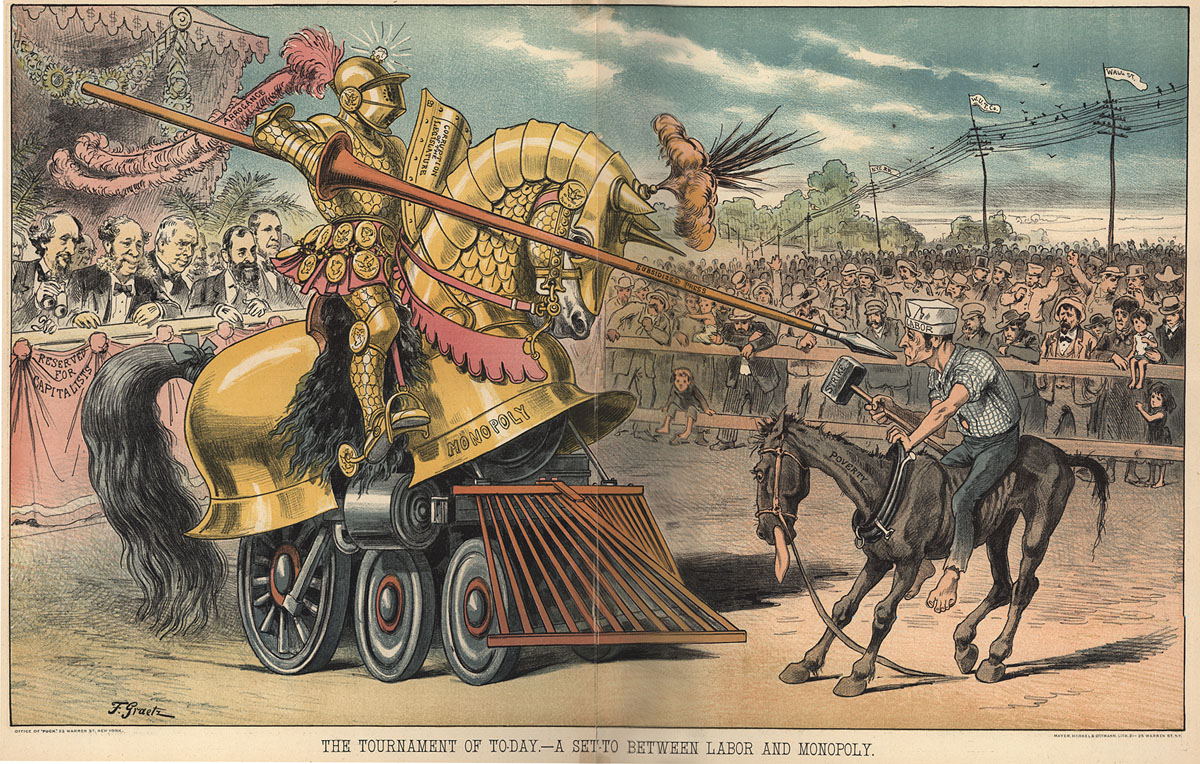
Then and now: Capitalism vs. Labor 1883, and today

April 2, 2011

Alas, it’s almost exactly the same now as then:

"Tournament of Today:  A set-to between Labor and Monopoly," Cartoon by Frederick Graetz, Puck Magazine, August 1, 1883 (from files of Georgia State University); click image for a larger view at Georgia State

“Tournament of Today: A set-to between Labor and Monopoly,” Cartoon by Frederick Graetz, Puck Magazine, August 1, 1883 (from files of Georgia State University); click image for a larger view at Georgia State

Information on the cartoon, from SuperITCH: Frederick Graetz, a chromolithograph that was the center spread for Puck Magazine‘s issue of August 1, 1883.  Monopolists portrayed are, from left to right, “businessman, financier and telecommunications pioneer Cyrus Field; railroad tycoon William Vanderbilt; shipbuilding magnate John Roach; financier, railroad mogul, and speculator Jay Gould; and an unknown monopolist.”  Some might say that the “unknown monopolist” bears a striking resemblance to one of the Koch brothers, but that’s fanciful thinking.

Cartoon - Labor vs Monopoly, Graetz, Puck 8-1-1883 (GSU image)

Labor vs Monopoly – click on this image for a larger version of this historic Puck Magazine cartoon

Tip of the old scrub brush to One Penny Sheet’s “condemned to repeat” feature.

More:


Science ethics: Ten biggest science paper retractions of 2010

January 18, 2011

Science uses a tough system to correct errors and prevent frauds.  Peer-review makes it difficult to get a paper into a journal, period, let alone one with hoaxed-up data or conclusions.  Still, out of the tens of thousands of serious science papers published each year, a few sneak through that shouldn’t, sometimes due to researcher error, sometimes due mix-ups in peer review, sometimes — rarely — due to outright fraud.

In the past 15 months political action to fight global warming took huge hits around December 2009 when a few thousand e-mails were hacked from computers at the Hadley Climate Research Unit in England, one of the leading groups in climate research that indicates a warming Earth.   Critics of Hadley made great hay about how the alleged wrong-doing in the e-mails meant that all climate research was wrong, or at least questionable.

So, I was greatly interested to stumble across this article in The Scientist, which lists what that magazine calls the “Top Retractions of 2010” — papers retracted for errors and ethical reasons.

None of the top retractions had anything to do with climate research.  One of the most under-reported stories of 2010 was that the claims of error and fraud by climate scientists were, themselves, hoaxes.  Looking at the list of top retractions, unless you were really looking for the climate papers, you might never notice.

Most of the retractions were in medicine and health.  Several were in cancer research.  False science in climate studies does not appear to be a major problem, measured by retractions.

Those who accuse climate scientists falsely don’t really have anything to retract in a formal sense.  They did no science work that was published.

When do people wake up and realize that global warming is a real problem, and we shouldn’t be fooled by political smears of the scientists who discover the data?


Republicans in trouble in Texas

August 18, 2010

Four years ago, while few were watching, Democrats took every county post in Dallas County, Texas, previously a bastion of Republican votes.  Not even normally-Democratic-leaning Harris County (Houston, nor Bexar County (San Antonio), went so blue.

In Corpus Christi in July, Democrats were wowed by a slate of powerful state-wide off candidates — Bill White, very successful, pro-business Mayor of Houston nominated for governor, a firebrand of a woman named Linda Chavez-Thompson to make Lt. Gov. David Dewhurst sweat and run from debates, and Hector Uribe for Texas Land Commissioner, and others. White is leading Gov. Rick Perry in fundraising.

The rest of the state is waking up, too.  A blog at the Austin American-Statesman looked around the ethical challenges to Texas Republicans, and figured out that the Texas House of Representatives could very well go Democratic.

Lots to get to today as [Joe] Driver takes a hit, we learn more about the state’s budget problems and thousands of prison workers could be out of work.

While the split between 77 Republicans and 73 Democrats in the Texas House is close enough that there has always been a legitimate battle for partisan control in 2010, most objective observers have long said Republicans are likely to keep a House majority heading into next year. For one thing, it’s a Republican year, and for another, GOP groups seem better-organized and better-funded than usual, and for another, we already know of one seat (Wichita Falls) that is likely to switch from Democrat to Republican because of an incumbent’s retirement.

Well, this thing just got more interesting.

Jay Root of the Associated Press reports in this morning’s papers that Rep. Joe Driver, an 18-year-legislator, has been getting reimbursements from the state for legislative-related travel and other expenses paid by his campaign, to the tune of $17,431.

From Root’s story: “A north Texas state representative who rails against the evils of runaway government spending admitted Monday that he has pocketed thousands of dollars in taxpayer money for travel expenses that his campaign had already funded. Rep. Joe Driver, R-Garland, faced with findings from an investigation by The Associated Press, acknowledged in an interview that for years he has been submitting the same receipts — for luxury hotels, airline tickets, meals, fees and incidentals — to both his campaign and to the Texas House of Representatives. He has also been collecting thousands of dollars in state mileage reimbursements for travel in vehicles for which his campaign has shelled out more than $100,000 since 2000. The AP’s review of hundreds of pages of state and campaign travel records found that Driver double-billed for at least $17,431.55 in travel expenses, much of it at fancy out-of-state hotels, since 2005. The number could go higher, but House travel records before mid-2005 have already been destroyed. Driver has been in office for 18 years. The double-billing figure does not include the vehicle expenses.”

What’s almost as amazing as the story itself is Driver’s reaction to the findings. His initial effort at damage control made Linda Harper-Brown look like Karen Hughes.

“Now you’re scaring the heck out of me,” Driver told the AP, adding: “It pretty well screws my week.”

Ya think?

Later in the story, Driver says, “If I knew it was wrong, I wouldn’t have done it that way. I wouldn’t have done it just to make money.”

In Driver’s defense, he did warn us that he wasn’t a numbers guy.

Driver’s campaign actually did put out a real defense Monday night. Here it is, in its entirety:

“After reviewing the facts with ethics specialists in the Texas House it is clear that an inadvertent mistake was made in my campaign expenses.”

Republicans grow desperate.  Stay tuned to Texas, and send money to Democrats if you can.

Here’s Hector Uribe at the State Democratic Convention:


Making Boy Scouting a political football — shame on those outlets

July 27, 2010

When President Barack Obama met with a group of outstanding Boy Scouts in the Oval Office a few weeks ago to discuss policies affecting Scouting, and especially policies affecting children, teen agers and young adults in the U.S., very few conservative sites thought it important to cover.  Let’s be more precise:  No conservative Obama critics, nor much of anyone else, bothered to cover it.  I’d love to see links even of local media in the Scouts’ hometowns that printed a story or photo.

To the credit of the White House, neither did the press promote the meeting as a political point.  Scouting prefers not to be a political football, and Scouting policy asks that Scouts avoid even looking like politicking while in uniform. (Scouts are encouraged to participate in the political process, including through the three citizenship merit badges, which encourage Scouts to communicate their concerns about policy to elected representatives, while working for the merit badge and in the future as participating citizens.)

2010 is a grand year for Scouting.  It’s the centennial of Scouting’s coming to the United States.  There’s a special Scout Jamboree, being held at Fort A. P. Hill in Virginia (the last time the Jamboree will be held on federal property — that’s another story for another time).   It’s always fun when presidents come to the Jamboree and speak, but it’s not always possible.

But today, news comes that President Obama will send a video speech to the Scouts at the Jamboree, as has been done sometimes in the past.  Many of us are disappointed that President Obama will not appear in person; but some of us who have experience scheduling such things know that elected officials cannot make every appearance they would like to.  Presidential schedules in the modern world are particularly difficult; for an appearance at Fort A. P. Hill security must be imposed (even on a Scouting event), aircraft landing sites need to be arranged and secured . . . dealing with more than 30,000 Scouts becomes an onerous task.

Still, we’re disappointed.

Adding to that disappointment, comes now a group of harpy Obama critics, no friends of Scouting that I can determine, but anxious to claim this scheduling decision as some sort of snub to Scouting, and to the American flag.

Media Matters has the facts, and puts the scheduling stuff into perspective, “Overhyped conservative nonsense of the Day:  Obama hates the Boy Scouts.”  UpdateBlue Wave News has it in perspectiveWonkette’s satire, unfortunately, goes awry, but her heart and brain are in the right places.

The snub is by those critics who attempt to turn Scouting into a political football.  The insults are all from them.

Shame on them, collectively and individually:

Update: We’re going to have to add on a wing to accommodate the Wall of Shame:

Hmmmm.

I’ll wager none of those authors bothers to volunteer for Scouting.  I’d be surprised (and disappointed) to discover any were Scouts.  Scouting wouldn’t revoke their citizenship merit badges, but they’ve forgotten them, if they ever earned them.

Scouting faces severe hurdles these days, some of them I would say were placed by poobahs at the top of Scouting; these guys listed above are not helping.

Here are some tests to see which of these blogs and pundit outlets is friendly to Scouting:  Which of them covered the award, this morning of the Distinguished Eagle Scout Award to Tuskegee Airman Charles McGee?  Which of them covered the dedication of the U.S. Postal Service’s stamp honoring the Scouting Centennial, today?  As of this moment, I can find no media coverage of these things at all, even by local media.

Why do these pundits cover Scouting only when it gives them a chance to make an unfair shot at a politician they don’t like?  Seriously, who is doing disservice to Scouting, and the nation?

Good news about Scouting’s 100th Year, and the Jamboree:


Michael Mann exhonerated again: E-mail thieves still at large

July 2, 2010

News from Pennsylvania State University.  The second investigation of Michael Mann, to determine whether he did not adhere to the high ethical standards of research scientists in activities revealed by e-mails stolen from East Anglia University late last year, concluded that Mann acted honorably.

Via Deltoid:

Penn State investigation concludes:

The Investigatory Committee, after careful review of all available evidence, determined that there is no substance to the allegation against Dr. Michael E. Mann, Professor, Department of Meteorology, The Pennsylvania State University.

More specifically, the Investigatory Committee determined that Dr. Michael E. Mann did not engage in, nor did he participate in, directly or indirectly, any actions that seriously deviated from accepted practices within the academic community for proposing, conducting, or reporting research, or other scholarly activities.

The decision of the Investigatory Committee was unanimous.

The person or persons who hacked into the computers at East Anglia University remain at large.

More:


Just in case you thought any climate contrarian remains sane . . .

February 2, 2010

Which of these would be accurate in showing the insanity, but not so sharp as to raise the hackles of the climate contrarians?

  • “Contrarians think Antarctic unworthy of protection”
  • “Denialists criticize efforts to keep Antarctic clean”
  • “Climate change critics’ brains have left the building”

Read these stories, and tell me.

The Intergovernmental Panel on Climate Change (IPCC) noted the delicate condition of the Antarctic with regard to its two main industries, fishing and tourism.  IPCC AR4 noted that the tourism industry takes steps to protect Antarctic environments made more vulnerable by melting.  (Footnote here; actual flyer here, assessment document here in Microsoft Word .doc format)

Contrarians come unglued, here at ClimateQuotes.com, and here at Air Vent.

It’s clear that the contrarians don’t have much experience in heavy documentation.  If you follow the links they provide, you quickly get to the paper provided by the tourist industry noting their precautions to prevent contamination, provided to meet a request by scientists from the Australian team, and based on information well vetted to the point that it includes substantial excerpts from what appears to be a peer-reviewed journal on the types of solutions suitable for decontaminating foreign boots in the Antarctic (Polar Record, vol. 41, no. 216, Jan. 2005, p. 39-45; it is actually the official journal of the Scott Polar Research Institute at Cambridge, UK).  There is astounding and commendable attention to detail, much more than the contrarians can grok, it appears.

More troubling to the Boy Scout in me is the contrarians’ contempt for what is, really, Leave No Trace Camping carried to an Antarctic tourist stop.  This is part of the environment protection credo of the Boy Scouts and Girl Scouts, and it is sound policy that everyone should be teaching their children.

What is wrong with that?  Why do the contrarians mock wise policies?  Why do they make false claims against what amounts to good Scouting?

Leave No Trace logo

Contratians disapprove of the ethics of environmental stewardship?

One implicit complaint is that the footnote does not provide evidence of damage from climate change, in the Antarctic.  It’s clear that the critics have not followed the footnote path to see why the boot cleaning poster and directive were issued, nor to see what is the research or official government action that prompted the tourist companies to implement the procedure.

It appears in a section of the IPCC reports on effects of warming on industries in affected areas.  Only two industries are noted in the Antarctic, fishing and tourism.  After establishing the increased chance of problem organisms, including micro-organisms, showing up in Arctic and Antarctic areas as the areas warm, and after noting two plagues that killed penguins recently, from micro-organisms, the IPCC paper notes that concern to prevent such tragedies have so far required only boot decontamination, and it offers a link to the flyer provided by an Antarctic tour operators group.

Got that?  To show that the tour operators are affected, IPCC cited the flyer put out by the tour operators showing how and why they were changing their operations.  It’s a minor, almost trivial point.

At no point did IPCC’s report claim this procedure as evidence of warming, or the effects of warming.  So the claims of the contrarians and denialists are completely off base, as they’d recognize except for their own shouting for the lynching of science to proceed.

Criticism of IPCC for noting the good stewardship techniques used in the Antarctic comprises more political smear than scientific enlightenment, by a huge factor.  Voodoo science from the contrarians begets voodoo criticism.

Contrarians lack wisdom in posing this complaint of theirs.  This is one more point IPCC got right, factually and ethically.  IPCC should be commended for that.

Wall of Shame (update added on February 7)

Outlets that cite the boot reference, falsely or stupidly, as some sort of flaw in the IPCC report, and thereby demonstrate malevolent intentions, and not scientific (“malice” for you Times v. Sullivan fans):


DDT propaganda machine

January 23, 2010

Media Check carries edited excerpts from a book by Daniel Gutstein from last year, Not A Conspiracy Theory: How Business Propaganda Hijacks Democracy (Key Porter, 2009) by Donald Gutstein, Key Porter (2009).

In the excerpted chapter Gutstein details how nefarious interest groups conspired to ruin the reputation of Rachel Carson and environmental protection activists with false claims about DDT and environmentalist aims.

The problem with the coverage of the DDT issue and with the eco-imperialism charge is that they are based on falsehoods that the media did not investigate. Former CBC-TV National News anchor Knowlton Nash once said that “…our job in the media… is to… provide a searchlight probing for truth through the confusing, complicated, cascading avalanche of fact and fiction.” In this case, the media let their audiences down; fiction prevailed over fact.

Despite what the pro-DDT organizations alleged, DDT was not banned for use in mosquito control and could continue to be used in 25 countries in malarial regions. In these countries, limited amounts of DDT can be sprayed on the inside walls of houses to combat malaria-carrying mosquitoes. “The environmental community is collaborating with the World Health Organization to ensure that the phase-out of the remaining uses of DDT does not undermine the battle against malaria and the well-being of people living in malarial zones,” the United Nations Environmental Programme reported when the treaty came into force.

Has anyone read the book?  Has anyone seen it?  (So what if it’s aimed at Canada?)

More thoughts:  Years ago, when Jan Brunvand first achieved some fame cataloging urban myths, it occurred to me that his books should be required reading in the very first survey classes in journalism school.   Maybe they should be required reading in political science, rhetoric, and philosophy, too.

Gutstein’s book would be a good reader for a class on reporting, or investigative reporting, or science reporting, or political reporting.  I’m not sure where it would fit in to a science curriculum, but I wish more scientists came out of undergraduate years aware that they can get hammered by these hoax-selling, axe-grinding disinformation machines.  All those reports about how Rachel Carson is the “murderer of millions?”  They coarsen dialog, they misinform, disinform and malinform the public.  They do great disservice to citizenship and voters, and ultimately, to our democratic institutions.

It’s not enough to have a counter, good-information plan.  These people must be convinced to stop.

More:


Chet Raymo on devils and angels of our own creation

December 26, 2009

Chet Raymo continues to read Linda Lear’s biography of Rachel Carson, and ponders:

Did Rachel Carson save songbirds (and humans) in Massachusetts and put babies at risk in Mozambique? Albert Schweitzer once said: “Man can hardly even recognize the devils of his own creation.” We are not that good at recognizing the angels, either. Let’s hope the current generation of young people has more success balancing the perils and blessings of technology than did those of us who lived through the dueling certainties of DDT and Silent Spring.

Add to FacebookAdd to NewsvineAdd to DiggAdd to Del.icio.usAdd to StumbleuponAdd to RedditAdd to BlinklistAdd to TwitterAdd to TechnoratiAdd to Furl


Investigative report: Climate science e-mails ugly, science is correct; “skeptics'” response even uglier

December 14, 2009

Associate Press put a team of five reporters on the e-mails purloined from the Hadley climate science group in England.  AP sought advice on interpreting the messages from other scientists involved in ethical science issues.

To the best of my knowledge, this is the only group that has gone through the entire mass to see what is really shown — more than a million words, the AP story estimated.

Veteran climate issue reporter Seth Borenstein wrote up the story:  Scientists in the heat of research and interpretation, on deadline with government policy makers, often attacked unfairly — one received death threats for his work on climate change.  Under those conditions, one might understand that the scientists were defensive and rude, in private, about their critics.  One of the critics harassed scientists with repeated FOI requests, then didn’t use the data.  In one case, a critic published a paper based on bad data — what the critics accused the scientists of doing.

But in the end, there was no pattern of data fixing.   Independent reviews today confirm that independently-generated studies confirm the warming the scientists wrote about.

Of course, that doesn’t stop the hecklers of the scientists from complaining, either about the science or the way it’s reported.  Rather than deal with the material AP reported, for example, warming blogger Anthony Watts attacked the reporter who wrote the story, complaining that he is “too close” to the story, since he seems to have been covering the story long enough that his e-mail appears in the purloined e-mails.

‘You can’t report the news because you know too much,’ is Watts’s complaint.

In the e-mail cited, Seth Borenstein wrote to some of the world’s best scientists in the field and asked their opinions about a paper making some contrary claims.

To Watts, seeking information from the experts is beyond the pale.  He calls it an ethical infraction.

Watts is unbound by such ethical rules, however, and so can make up stuff like this with abandon.  Watts’ charge is hooey, foul play, and stupid.  In the headline to his post, Watts wrote, “AP’s Seth Borenstein is just too damn cozy with the people he covers – time for AP to do something about it.”

That’s right, AP — it’s time Borenstein got a promotion for doing the legwork, honestly, that critics of the science have refused to do.  Borenstein’s reporting is important.  The story goes beyond mere repeating of press releases, beyond the mere “he-said/he-said” norm.  Borenstein, in unemotional, clear and cool terms, indicted the critics of warming, by factually reporting the events.  Give that man and his team a Pulitzer Prize.

Why shouldn’t reporters go to the experts?  Why shouldn’t they ask the opinions of all sides in a science debate?

Think about it for a moment:  Watts’s complaint is that Borenstein sought fairness in reporting on Watts’s side’s claim.  Because Borenstein refused to show the bias Watts wants, Watts went after Borenstein.

Could there be a more clear and dramatic illustration of why the scientists’ ire is raised by such silly criticism?

Watts quotes at length from the Associated Press Statement of News Values and Principles, slyly implying by doing so that Borenstein violated the rules somewhere.  Not so.

Watts worries about “getting too cozy with sources.”  Read his blog.  Watts prefers to be the source — but he also reports on the debate.

Watts would do well to read that AP ethical statement again, and take it to heart.

His charges are groundless, scurrilous in the light of the AP team’s going to great lengths to be fair to all sides.  Watts and other critics bank on people being shocked that scientists get angry.   Watts and his colleagues have campaigned across the web, on television and in print, to have these scientists tarred and feathered, and their science dismissed — though there is not handful of feathers to weigh against the mountains of evidence the scientists accumulated and published over the past 50 years.

Do not take my word for it.  Read the AP storyRead Watts’s rant.  Read the e-mails, if you wish (you can find them from my opinionated take on the flap).  Check with the scientists you know and trust on their views of the science done and reported.

I won a couple of minor investigative journalism awards in college.  I have been a member of the Society of Professional Journalists off and on since 1974 (not much since I quit doing that stuff full time).  I have worked with some of the best investigative journalists and Congressional investigators in my duties with the Senate.  I’ve been a member of the FOIA committees in Utah and Maryland.  I’ve lobbied in three states for freedom of information.  I know a little bit about investigative reporting and fairness.  And yes, IAAL.

Borenstein’s piece is solid and good.  In light of the firestorm Watts hopes to bring down on it, Borenstein’s article is a shining example of high ethics in journalism.  It deserves your reading.

If the critics had data denying warming, or denying human causation of warming, why are they hiding it so well?  If they have the data to prove the scientists are in error, why not publish it, instead of sniping at a wire service reporter who merely tells the story?

Critics don’t have the data to contest the hard work of the scientists.  They don’t have the data to make a case against either warming or human causation.  And now we all know.

Post Script:  Um, and , you know, it’s not like Borenstein hasn’t done some stuff over the years to make it look like he’s been on Watts’s side:  Stoat, Mooney’s Intersection, Island of Doubt.  Watts’ fit may put a gloss on Borenstein’s work that wasn’t there to begin with.

Help others investigate the facts:

Add to FacebookAdd to NewsvineAdd to DiggAdd to Del.icio.usAdd to StumbleuponAdd to RedditAdd to BlinklistAdd to TwitterAdd to TechnoratiAdd to Furl


Yeah, it’s ironic (hacked e-mails and global warming)

November 26, 2009

James’s Empty Blog:

It is hard to miss the irony in people eagerly poring through illegally-obtained private email, looking for ethical breaches by the writers! I’m sure we can all imagine the outrage if one of the emails revealed that a scientist had hacked into one of the sceptics’ computers and was reading all their correspondence. So a bit of perspective is called for here.

James Is A Scientist (IANAS), and he has much good stuff to say (read some of the other posts about the hacked e-mails while you’re there) — but you gotta wonder about a blog that follows such a post with this:

Prawns, Jules Berry

Prawns not in their native habitat. Probably Tastimus deliciousus

Tip of the old scrub brush to Stoat.


Purloined CRU e-mails on climate science: One scientist pleads for accuracy

November 24, 2009

Here is what he said.  Edward Cook, one of the world’s foremost authorities on ancient trees and how to learn from them (Dendrochronology),  wrote to Michael Mann, both men scientists involved in making their science understandable and available to the public and the International Panel on Climate Change (IPCC).  Both men thought their communication would be private, probably forever.  When no one is looking, this is what they say to one another:

From: Edward Cook <drdendro@xxxxxxxxx.xxx>
To: “Michael E. Mann” <mann@xxxxxxxxx.xxx>
Subject: Re: hockey stick
Date: Wed, 2 May 2001 15:25:41 -0400
Cc: tom crowley <tom@xxxxxxxxx.xxx>, esper@xxxxxxxxx.xxx, Jonathan Overpeck <jto@u.arizona.edu>, Keith Briffa <k.briffa@xxxxxxxxx.xxx>, mhughes@xxxxxxxxx.xxx, rbradley@xxxxxxxxx.xxx, p.jones@xxxxxxxxx.xxx, srutherford@xxxxxxxxx.xxx

Hi Mike,

No problem. I am quite happy to work this stuff through in a careful way and am happy to discuss it all with you. I certainly don’t want the work to be viewed as an attack on previous work such as yours. Unfortunately, this global change stuff is so politicized by both sides of the issue that it is difficult to do the science in a dispassionate environment. I ran into the same problem in the acid rain/forest decline debate that raged in the 1980s. At one point, I was simultaneous accused of being a raving tree hugger and in the pocket of the coal industry. I have always said that I don’t care what answer is found as long as it is the truth or at least bloody close to it.

Cheers,

Ed

This note appeared at the end of a rough-and-tumble debate over what data can be trusted, the motives of scientists involved, and how to make the best use of data collected, clear and unclear, in order to make an accurate portrayal of what is happening in our atmosphere.

I’ll wager no critic of these scientists bothered to quote this one today, nor will they.  In toto, the purloined e-mails show a devotion to science, and the requisite devotion to accuracy and ethical behaviors.  But in a political debate where television weathermen feel compelled to demonize scientists to promote their political beliefs, who can afford to look at the big picture?

My apologies to Dr. Cook for the purloining of the e-mail (though of course I had no role in the hacking); my appreciation to Dr. Cook for standing up for what’s right, damn the critics, when he th0ught no one was looking.

That’s the definition of character, isn’t it?

E-mail this:

Add to FacebookAdd to NewsvineAdd to DiggAdd to Del.icio.usAdd to StumbleuponAdd to RedditAdd to BlinklistAdd to TwitterAdd to TechnoratiAdd to Furl


Smoking guns in the CRU stolen e-mails: A real tale of real ethics in science

November 22, 2009

Climate skeptics fear that some climate scientists have cooked their data in order to produce a pre-ordained outcome from their research.  Many of these people are excited this weekend at the public release of e-mails purloined from Climate Research Unit at East Anglia University in England, from one of the leading climate research labs.  Every crank science and crackpot political site has a story touting the end of research on global warming.

Sure enough, with just a few minutes of searching the e-mails, I found references to ethical breaches in cooking of data, and a discussion about how to talk about  the data and the issue in public.

The paper involved is this one:

David H. Douglass, John R. Christy, Benjamin D. Pearsona and S. Fred Singer, “A comparison of tropical temperature trends with model predictions,” INTERNATIONAL JOURNAL OF CLIMATOLOGY, Int. J. Climatol. (2007).  Published online in Wiley InterScience (www.interscience.wiley.com) DOI: 10.1002/joc.1651

Unless you follow this issue closely, you probably don’t see the problem with publicizing the ethical breaches scientists thought they saw in this paper and its publication.  Also, if you are a “skeptic” who is chronically apoplectic over Al Gore’s success in informing people about climate change and winning prizes and making money, you may be thrilled that there is a scientist anywhere worried about ethical lapses by scientists involved in this controversy, and you can’t wait to see them brought to justice (cooking data is a federal crime in the U.S., if done with federal research money).

[Yes, I think there are ethical questions about publishing anything from these e-mails, let alone links so the viewing public can read them completely.  However, since much of this material has already been cherry picked and quote mined by political activists who hope to stop action to mediate and stop global warming, I think a good case can be made that, to be fair, we should look at the entire collection to see what they really reveal.  There may be criminal liability for some of the disclosures I’m discussing here — but that liability does not fall on the scientists who have been unfairly impugned in the last few days.  The liability falls instead on the critics of warming.  Let’s be fair.  In  a fair fight, truth wins.]

So, hold your high-fives and “I-told-you-sos” until you look at the data, at the information found.

One of the e-mails is quite explicit:

I think the scientific fraud committed by Douglass needs to be exposed. His co-authors may be innocent bystanders, but I doubt it.

Fraud?  Right there in front of everyone?  In the climate debate?

In the end, the scientists in the discussion determined not to hold a press conference to announce a finding of fraud, but instead to hunker down and work on publishing datasets that would contradict the alleged fraudulent paper, and establish their case with data instead of invective and press conferences.

They even declined to rush to inform the public of the fraud after a lengthy series of attempts to duplicate the results with well-known, accurate methods on accepted data:

Bottom line: Douglass et al. claim that “In all cases UAH and RSS satellite trends are inconsistent with model trends.” (page 6, lines 61-62). This claim is categorically wrong. In fact, based on our results, one could justifiably claim that THERE IS ONLY ONE CASE in which model T2LT and T2 trends are inconsistent with UAH and RSS results! These guys screwed up big time. [emphasis added by MFB]

Anthony Watts and others may be justified in asking that the scientists who wrote this fraudulent paper should be summarily dismissed, and in questioning why other scientists dallied in exposing the fraud.

But there is this to consider:  The paper in question is a paper critical of warming hypotheses, and it was co-authored by at least a couple of the most strident critics of Al Gore, James Hansen, the International Panel on Climate Change (IPCC).

The smoking gun was used to shoot down a hasty effort to brand climate-change critics as unprofessional and wrong.  The smoking gun was used to enforce the hard ethical rules of science:  Don’t speak until your data allow a fair conclusion.

The smoking gun e-mails show correct and careful behavior by the scientists who contributed to the IPCC report, but unethical behavior by the critics whose backers, we might assume, stole the e-mails in the first place, and published them without understanding the depth of moral character demonstrated by most scientists in the conduct of their professions.

Now, I have not analyzed every possible permutation of this thread, only those with the title shown.  I used the “Alleged CRU e-mails — searchable” cited by Anthony Watts and others.  I stumbled into the thread discussing the paper by “Douglass, et al.”  I then did a search for e-mails discussing “Douglass,” and limited it to the thread on this point.  I suspect there are other e-mails in that thread in which Douglass’s name is wholly missing, and which did not turn up  in the search.

Now you know the rest of the story.  Fred Singer is a leading denialist, one of the organizers of the political campaign to blunt the publication and discussion of evidence of global warming and what to do about it.  The Douglass, et al. paper under discussion was a key component of the denialists’ campaign in 2007.  The purloined e-mails point to unethical behaviors by the scientists on the anti-warming side, the so-called “skeptics.”

So, from a quick dive into the data we learn:

  1. Climate scientists talk like Boy Scouts trying to impress a Board of Review.
  2. Climate scientists are extremely careful with data.
  3. When they think no one is looking, climate scientists behave ethically.
  4. When they think have found a piece of fraud, climate scientists are careful to recheck their numbers several times and in several ways before saying anything.
  5. Instead of holding a press conference, climate scientists like to keep the fisticuffs in the confines of juried journals.
  6. Climate “skeptics” are full of themselves, and probably wrongly accuse climate scientists of fixing data.
  7. Fraud in climate science may occur, but generally on the side of those who argue against warming or who advocate inaction as a response.
  8. The claims of smoking guns that negate the case for doing something about global warming are most likely hoaxes.

Here are the texts I looked at:

Update, November 25, 2009: Be sure to check out these posts, at George Monbiot’s blog in the comments, at Stoat,  and here at the Bathtub. This is the best judgment on the affair, I think, from Our Kingdom at Open DemocracyRespect to any climate-deniers who invest all their pension funds in seashore hotels in the Maldives… otherwise, they should step aside, and let the work of saving the future begin.”

Smoke this:

Add to FacebookAdd to NewsvineAdd to DiggAdd to Del.icio.usAdd to StumbleuponAdd to RedditAdd to BlinklistAdd to TwitterAdd to TechnoratiAdd to Furl


Newtongate shakes anthropogenically-generated mathematics at the foundation

November 22, 2009

Satire, hoax, fact — how can we tell the difference?

Maybe more importantly, how can we tell early on that the “Climategate” kerfuffle, involving purloined, but otherwise dull e-mails from climate scientists, is nothing to worry about?

Look at history!  Remember Newtongate?  Read it here, at Carbon Fixated.

If you own any shares in companies that produce reflecting telescopes, use differential and integral calculus, or rely on the laws of motion, I should start dumping them NOW. The conspiracy behind the calculus myth has been suddenly, brutally and quite deliciously exposed after volumes of Newton’s private correspondence were compiled and published.

When you read some of these letters, you realise just why Newton and his collaborators might have preferred to keep them confidential. This scandal could well be the biggest in Renaissance science. These alleged letters – supposedly exchanged by some of the most prominent scientists behind really hard math lessons – suggest:

Conspiracy, collusion in covering up the truth, manipulation of data, private admissions of flaws in their public claims and much more.

But perhaps the most damaging revelations are those concerning the way these math nerd scientists may variously have manipulated or suppressed evidence to support their cause.

What kind of conspiracy keeps calculus being taught to innocent children today?  Exactly the same conspiracy that causes scientists to sound the alarms about climate change.

Tip of the old scrub brush to Tim Lambert at Deltoid.


What’s a journalist’s duty? Limbaugh ignores warning signs, punks himself

October 25, 2009

Millard Fillmore’s bathtub came out of a hoax story written in 1917 by one of America’s greatest cynics and writers, H. L. Mencken. Mencken lived to regret that he ever wrote the piece, after it was cited as fact by encyclopedias and critics of Fillmore’s presidency.

Mencken’s story holds a moral, a lesson for all critics of the American scene, and especially anyone who comments on political figures:  Verify everything.

Ernest Hemingway put it best, if crudely:   “The most essential gift for a good writer is a built-in, shock-proof, shit detector. This is the writer’s radar and all great writers have had it.”*

If a writer or reporter doesn’t have one of those devices built-in, he is likely to find himself up to his chin in it after having failed to detect it in time to avoid the plunge.

Rush Limbaugh is in it up to his chin right now, after following Michael Ledeen off the dock.

Faithful readers here — all dozen of ’em — may remember last January when we spotlighted a hoax at a blog called Jumping in Pools; the author claimed President Obama had ordered members our armed forces to take an oath of allegiance to Obama in place of their regular oath to the nation.

Orson Welles was on to something with his “War of the Worlds” broadcast.  In fact, after that first night of panic, the same script was used on other occasions, and people still got suckered in.  (Listen to the RadioLab feature on this phenomenon — it’s wonderful.)

It’s almost as if people were going around with signs on their backs that say “Lie to me, baby!”  Only, the people put the signs on their shirts and blouses themselves.

For whatever ill-thought, malicious reason, somebody invented an absolutely unbelievable hoax that President Obama asked the Pentagon to have military people swear allegiance to him, instead of the nation. Jumping in Pools posted it.

Jumping in Pools also listed it as satire, in tags.

But the hoax sucked in the gullible all over the web.

Limbaugh?  Ledeen?  Y’all would do well to read this blog, Millard Fillmore’s Bathtub.  You might have recognized the name of the blog, Jumping in Pools, that carried that phantasmagorical story about Barack Obama’s student essay, finally being released in part to Time Magazine’s Joe Klein.

Yahoo!’s Buzz Up explained the story, with links you ought to check out:

It must have seemed so perfect. An obscure blogger unearths some pages of President Obama’s college thesis. The report supposedly comes from big-time journalist Joe Klein of Time magazine. And the thesis has some real gems: like Obama’s disdain for the Constitution.

The whole thing was nothing more than a satirical post on a humor blog. But Rush Limbaugh, who quoted from the supposed thesis on his radio show, sure wasn’t laughing. Here’s how it went down.

An unknown blogger picked up on a made-up post meant as a joke, which claimed that Joe Klein had gotten his hands on 10 pages of student Obama’s college thesis. Rush Limbaugh jumped on it, which immediately sparked Web searches on “obama thesis.”

Supposedly titled “Aristocracy Revisited,” the excerpt revealed the president had “doubts” about the “so-called founders.” Juicy. Except not true. Limbaugh discovered halfway through his show that he’d been had, but defended himself by saying basically the thesis felt true. Listen in to Rush’s mea sorta culpa.

Joe Klein finally jumped in, and called the report “nonsense” on his Swampland blog, and the blogger who thought the hoax was real also apologized.

Michael Ledeen writing at Pajamas Media was that “blogger who thought the hoax was real.”

Ledeen had the good grace to apologize (and in doing so reveal that he really should have been much more en garde):

The hoax/satire was written in August, so it’s not connected to any current event.  I cam across it on Twitter, read the blog, found it interesting, and posted on it.  I failed to notice that one of the tags was “satire.”

So he got me, and lots of others. It worked because it’s plausible.  I’ve done satirical pieces myself, and I know how they can take off.  I once wrote one that said that Bill Casey did not die, and was hiding in a bunker under the St Andrews golf course from which he was running Mikhail Gorbachev.  I thought it was obviously satirical, but it went like wildfire all over the world.  And that was in the days before the Internet.

So I should have picked up some hint, but I didn’t.  Shame on me.

But Limbaugh?  He railed on for more than half an hour on the evils of Obama revealed in the completely fictional essay; and then when he was alerted to the fact that it was a hoax, he didn’t apologize.  He said he was suckered in because the hoax was plausible, and Obama might have done such a thing.

“I know Obama thinks it,” Limbaugh said, purporting to channel the guy he despises only too openly.

I’m trying to suppress it, but Limbaugh’s actions remind me mightily of an old Cheech and Chong routine.  One wonders what Obama’s more rabid critics would not grant credence to.

Wall of Shame

What would Hemingway have reported?

Other thoughts:

  • Jonathan Last’s article for the Templeton Foundation’s In Character Journal wonders about how we choose what to believe, and whom.  The Dallas Morning News carried the article in the “Points” section this morning, but it’s not up on their website; look at the article at the Templeton Foundation site.

________
* I’m convinced he said it. I’m relying here on Elizabeth Dewberry’s contribution to The Cambridge Companion to Ernest Hemingway, “Hemingway’s Journalism and the Realist Dilemma,” on page 25.  She cites to an interview, but I’ve misplaced the rest of that note for the moment, and for some odd reason the page with the citation isn’t included on Google Books (the pain of internet research, to get to the information you need out of the haystack, and find that particular needle has been intentionally removed).  Read Dewberry, though, for a much longer and informative discussion about hoaxes and fakery in journalism, which is the problem discussed in this post.

Don’t let your friends be bamboozled, pass the word:


Add to FacebookAdd to NewsvineAdd to DiggAdd to Del.icio.usAdd to StumbleuponAdd to RedditAdd to BlinklistAdd to TwitterAdd to TechnoratiAdd to Furl