Quote of the Moment: Churchill’s Iron Curtain speech

March 19, 2007

Winston Churchill delivering the "Iron Curtain" speech, Westminster College, Fulton, Missouri, March 5, 1946 - Photo by George Skadding

Winston Churchill delivering the “Iron Curtain” speech, Westminster College, Fulton, Missouri, March 5, 1946 – Photo by George Skadding

“From Stettin in the Baltic to Trieste in the Adriatic, an iron curtain has descended across the Continent. Behind that line lie all the capitals of the ancient states of Central and Eastern Europe. Warsaw, Berlin, Prague, Vienna, Budapest, Belgrade, Bucharest and Sofia, all these famous cities and the populations around them lie in what I must call the Soviet sphere, and all are subject in one form or another, not only to Soviet influence but to a very high and, in many cases, increasing measure of control from Moscow.”

Sir Winston S. Churchill, in a speech at Westminster College, Fulton, Missouri, on March 5, 1946, titled “The Sinews of Peace.”

Some historians mark the beginning of the Cold War from this speech, in which a respected world leader first spelled out the enormous stakes at issue, and also pointed out that Russian, communist totalitarian governments were replacing more democratic governments in nations only recently freed from the spectre of Nazi rule, in World War II.

Oh, why not: Below the fold is the speech in its entirety, from the transcript at the Churchill Centre. Read the rest of this entry »


Quote of the Moment: Teddy Roosevelt on beating depression

March 14, 2007

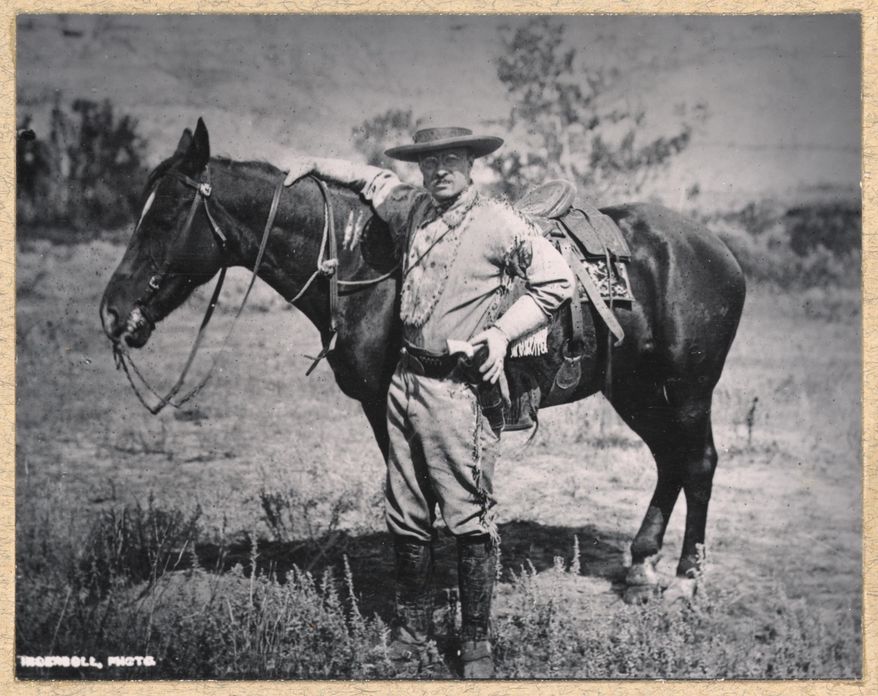
After the same-day deaths in 1884 of his beloved wife Alice, in childbirth, and his mother, who lived with the family, Teddy Roosevelt went into a depression. To beat the depression, he moved to South Dakota and became a cowboy, a very good cowboy.

TR with horse, in the Dakotas

Black care rarely sits behind a rider whose pace is fast enough.

— Attributed to Teddy Roosevelt by David McCullough, on the frontispiece for McCullough’s biography of Roosevelt, Mornings on Horseback (Simon & Schuster, 1981).

Save


Quote of the Moment: Charles Darwin, noble monkey ancestors

March 13, 2007

Charles Darwin, image from Deviant Art; Artwork : www.davidrevoy.com

Charles Darwin, image from Deviant Art; Artwork : http://www.davidrevoy.com

For my own part I would as soon be descended from that heroic little monkey, who braved his dreaded enemy in order to save the life of his keeper, or from that old baboon, who, descending from the mountains, carried away in triumph his young comrade from a crowd of astonished dogs — as from a savage who delights to torture his enemies, offers up bloody sacrifices, practices infanticide without remorse, treats his wives like slaves, knows no decency, and is haunted by the grossest superstitions.

– Charles R. Darwin,
The Descent of Man,
1871, ch. 6


Turning Point Presentations: Nixon’s “Checkers” speech

October 7, 2006

During one of my phase-shift transitions between universities and public schools yesterday, I caught a snippet of a commentary that I thought was on Richard Nixon’s 1952 speech that kept him on the ticket with Dwight Eisenhower. Public reaction was reported to be overwhelmingly warm, the Eisenhower-Nixon ticket won the 1952 election, won again in 1956, and Nixon eventually took the presidency for his own in 1968.

Shouldn’t that speech be considered one of the greater presentations of the 20th century, at least? It probably should, especially when we consider what history might have looked like had Nixon left the ticket — no Nixon nomination in 1960 against John Kennedy, no later Nixon presidency, Nixon continuing in the Senate . . . gee, which path is more gloomy?

The Checkers speech does not wear well, I think. Reading it today, I see the origins of smear campaign tactics and diversionary tactics that mar so much of today’s election campaigns and policy discussions.

This all comes up because the transcripts of the famous 1977 interview series newsman/comedian David Frost did with Nixon is the basis for a new play in London, “Frost/Nixon” by Peter Morgan, with Frank Langella playing Nixon and Michael Sheen as Frost — a play that is already being made into a movie for Universal Pictures by Academy Award winning director Ron Howard, but after a Broadway run in 2007.

Nixon’s mea culpa answer to Frost on the entirety of the Watergate scandal — “I made so many mistakes” — in the NPR piece voiced by Langella, sounded exactly like Nixon. I mistakenly thought it a recording of the Checkers speech, hearing just a snippet. The Frost/Nixon interviews would probably never have been necessary, had the Checkers speech not been a success. Surely there is a direct line from the Checkers speech to Nixon’s attempt to revive his reputation in the Frost interviews.

Watergate on Broadway, with a movie in the works, should offer good opportunities especially for high school history teachers to bring Watergate to a new generation. Too many people today fail to understand the depth of the damage done to Constitutional institutions in that crisis, and how lucky our nation was to have survived it. There are many lessons there for us in our current Constitutional crisis.

A lesson awaits, also, in the career of David Frost, who crossed from news to comedy and back. Many kids today use comedians as their chief source of political news. We should not be surprised — but let us hope that today’s comedians have as much a sense of public duty as David Frost did in 1977, even while using his public service interview to revive his own career.

Sometimes free markets work spectacularly, don’t they?


Berlin Wall’s 45th

August 13, 2006

August 13, 2006, is the 45th “anniversary” of the erection of the Berlin Wall, the totem of the Cold War that came down in 1989, pushing the end of the Cold War. Residents of Berlin awoke on this day in 1961 to find the communist government of East Germany erecting what would become a 96-mile wall around the “western quarters” of the city — not so much to lay siege to the westerners (that had been tried in 1948, frustrated by the Berlin Airlift) as to keep easterners from “defecting” to the West. The Brandenburg Gate was closed on August 14, and all crossing points were closed on August 26.

From 1961 through 1991 1989, teachers could use the Berlin wall as a simple and clear symbol for the differences between the communist Eastern Bloc, the Soviet Union and her satellite states, and the free West, which included most of the land mass of Germany, England, France, Italy, the United States and other free-market nations — the North Atlantic Treaty Organization (NATO) countries. I suspect most high school kids today know very little about the Wall, why it was there, and what its destruction meant, politically.

This era of history is generally neglected in high school. Many courses fail to go past World War II; in many courses the Cold War is in the curriculum sequenced after the ACT, SAT and state graduation examinations, so students and teachers have tuned out.

But the Wall certain had a sense of drama to it that should make for good lessons. When I visited the wall, in early 1988, late at night, there were eight fresh wreaths honoring eight people who had died trying to cross the Wall in the previous few weeks (in some places it was really a series of walls with space in between to make it easier for the East German guards to shoot people trying to escape) — it’s an image I never forget. Within a year after that, East Germans could travel through Hungary to visit the West, and many “forgot” to return. Within 18 months the wall itself was breached.

The Wall was a great backdrop for speeches, too — President John F. Kennedy visited Berlin in June 1963, and expressed his solidarity with the walled-in people of both West and East Berlin, with the memorable phrase, “Ich bin ein Berliner, which produced astounding cheers from the tens of thousands who came to hear him. There are a few German-to-English translators who argue that some of the reaction was due to the fact that “Berliner” is also an idiomatic phrase in Berlin for a bakery confection like a jelly doughnut — so Kennedy’s words were a double entendre that could mean either “I am a citizen of Berlin,” or “I am a jelly doughnut.”  [Be sure to see the comments below, from Vince Treacy (9/28/2010).]  Ronald Reagan went to the same place Kennedy spoke to the Berlin Wall, too, to the Brandenburg Gate, in his famous June 1987 speech which included a plea to the Soviet Union’s Premier Mikhail Gorbachev: “Mr. Gorbachev, tear down this wall!”
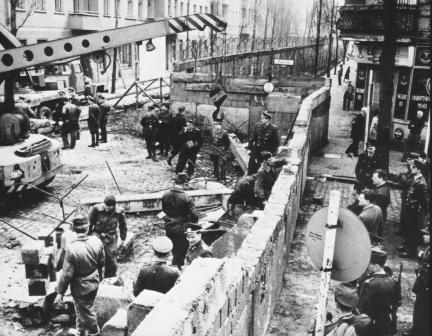
Construction of the Berlin Wall, photol collected by Corey S. Hatch

Construction of the Berlin Wall in August 1961 –photo from University of Utah, by Corey Hatch.

Update March 9, 2007: Berlin Airlift information and lesson plans are available from the Truman Library, here, here and here.

Update November 9, 2009: Notes on the 20th anniversary of the fall of the Wall

Please share this post:

Add to FacebookAdd to NewsvineAdd to DiggAdd to Del.icio.usAdd to StumbleuponAdd to RedditAdd to BlinklistAdd to TwitterAdd to TechnoratiAdd to Furl