Quote of the moment encore: Hillary Clinton, on being a Cubs fan

October 26, 2015

Today is the birthday of Hillary Rodham Clinton, born October 26, 1948.

Secretary of State Hillary Rodham Clinton

Secretary of State Hillary Rodham Clinton – Topnews image

Happy birthday, Hillary!

Without citation, Robert A. Nowlan’s Born This Day lists this as something Clinton said:

Being a Cubs fan prepares you for life — and Washington.

Still true, in 2015.

Didn’t the Cubbies have a great year, though?

Yes, this is mostly an encore post. Fighting ignorance requires patience.

Yes, this is mostly an encore post. Fighting ignorance requires patience.


Who said it? ‘Better to die on your feet, than live on your knees’

October 22, 2015

A Tweet from Tim Fargo reminded me of a collection of leadership quotes I put together years ago, and of the digging I did on one particular quote urging action rather than capitulation:

https://twitter.com/alphabetsuccess/status/657054791672176640

That was the quote I got to, but it’s only attributed to to Zapata so far as I know. I started with the quote cited to Franklin Roosevelt’s speech when he got an honorary Doctor of Laws from Oxford in 1941, when Britain badly needed such inspiration to fight on, in a war for freedom in which the U.S. was not yet actively engaged:

We, too, born to freedom, and believing in freedom, are willing to fight to maintain freedom. We, and all others who believe as deeply as we do, would rather die on our feet than live on our knees.

Franklin Delano Roosevelt (1882-1945), upon receiving the degree of Doctor of Civil Law from Oxford University, June 19, 1941; special convocation ceremony held at Harvard University, with FDR’s remarks delivered by secretary to the President, Major General Edwin M. Watson

One of a set of ten postcards printed by the Spanish Red Cross, the subjects shown, favor the republican cause. | Spanish. | Wolfsonian Exhibit: Library Vestibule Complement to: Revolutionary Tides, the Art of the Political Poster, 1914-1989; February 25 - August 24, 2006.

One of a set of ten postcards printed by the Spanish Red Cross, the subjects shown, favor the republican cause. | Spanish. | Wolfsonian Exhibit: Library Vestibule Complement to: Revolutionary Tides, the Art of the Political Poster, 1914-1989; February 25 – August 24, 2006. [Untranslated from Spanish:] Dolores Ibarruri (Pasionaria): Representante de Asturias en el Parlamento de España y figura destacadísima entre las mujeres de la Revolución; Spain Cruz Roja. | Garcia, A. (illustrator.) | Edit. R. Molero (publisher)

When I checked it in the then-current Bartlett’s Quotations I learned it was a common expression during the Spanish Civil War, and attributed to a radio propagandist on the Republican side. It’s likely FDR and his research aides knew that.

It is better to die on your feet than to live on your knees.

Dolores Ibårruri, “La Pasionaria” (1895-1989), Speech in Paris, September 3, 1936

Checking that one out, I found a reference to Mexico’s revolutionary Zapata, whose work was likely familiar to the Spanish Republicans.

Mejor morir a pie que vivir en rodillas.
Men of the South! It is better to die on your feet than to live on your knees!

Emiliano Zapata (c. 1877-1919), attributed

That’s as far as I took it 20 years ago. Can we get a better attribution, or find Zapata’s likely inspiration, if there is one?

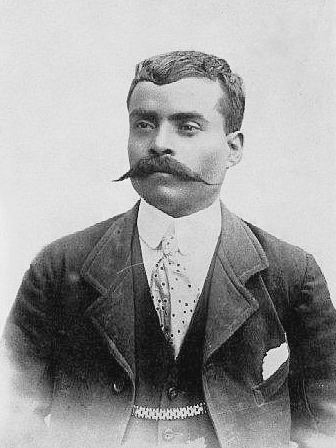
Mexico revolutionary Emiliano Zapata, studio portrait perhaps in 1914. Wikipedia image

Mexico revolutionary Emiliano Zapata, studio portrait perhaps in 1914. Wikipedia image

N.B.: Looked for a photo of FDR at Oxford, but quickly discovered he was nowhere near England on June 19, 1941 — hadn’t thought he would be with the Battle of Britain not really over. Found references to Watson’s delivering of the speech at Harvard, but little else. Good people at the FDR Library’s Pare Lorentz Center confirm that FDR was at the White House the entire day. There’s a story there, about the awarding of the degree.

Update 2017: It was not George Washington.

Especially in 2017, would you do us the favor of saying in comments how you got to this article? Thank you.

Save


Mike Mansfield’s been gone 14 years

October 5, 2015

Senate Majority Leader Mike Mansfield, D-Montana

Senate Majority Leader Mike Mansfield, D-Montana; oil on canvas by Aaron Shikler, 1978 – Wikimedia image

Mike Mansfield was born on March 16, 1903.  Best boss I ever had.

Mansfield died 14 years ago on this day, October 5. Rarely a day goes by I don’t read the newspaper and think we could sure use a few more people like him today.  He’s been gone 14 years, and I miss him. I hope I’m not alone in that.

Robert A. Nowlan’s Born This Day attributed this quote to Mansfield:

After all, even a politician is human.

Laconic as he was, Mansfield didn’t say anything more meaty than that?

Read about Mansfield at the Bathtub, here.  Mansfield died on October 5, 2001.  He is interred at  Arlington National Cemetery in a soldier’s grave, reflecting his unique view of the world from an ordinary grunt soldier. Mansfield served as a Seaman in the U.S. Navy, enlisting at the age of 14; he served then as a Private in the U.S. Army; then he served as a private in the U.S. Marine Corps. His history proved a delightful prelude when, as Majority Leader of the U.S. Senate,  he met with the Joint Chiefs of Staff at the Pentagon on issues of soldiers’ welfare.

At our current sad time, when the political agenda of activist republic destroyers includes bitterly working hard to wipe out the history of great men like Mansfield, it’s important we remember him.

English: Senate desk X, used by Democratic lea...

This is a photo of one of the rarest views of history one can see, visible only to those few people who get onto the floor of the U.S. Senate, and only if someone opens a desk for them.  One of the more interesting, odd, and sentimental traditions developed in the U.S. Senate is the signing of the desks.  Sometime in the 19th century senators began signing the inside of the desks they were assigned to on the Senate floor.  Sometimes a desk gets associated with a particular state and a senator from that class; sometimes a desk get associated with family (Sens. John, Ted and Robert Kennedy, for example).  Here is Senate desk X, used by Democratic leaders (Joseph T. Robinson, Alben W. Barkley, Scott W. Lucas, Ernest McFarland, Lyndon B. Johnson, Mike Mansfield, Robert Byrd, George J. Mitchell, Tom Daschle and Harry Reid) (Photo credit: Wikipedia)

More:

Mike Mansfield on the cover of Time Magazine, March 20, 1964. This cover story reminds us that the Democrats were a fractious majority in the 1960s, which lends an even greater patina to Mansfield's reputation as a wrangler of Senators and the Senate Majority, at one of the most productive times in Congress's history, a sharp comparison to 2015.

Mike Mansfield on the cover of Time Magazine, March 20, 1964. This cover story reminds us that the Democrats were a fractious majority in the 1960s, which lends an even greater patina to Mansfield’s reputation as a wrangler of Senators and the Senate Majority, at one of the most productive times in Congress’s history, a sharp comparison to 2015.


Yes, this is mostly an encore post. Fighting ignorance requires patience.

Yes, this is mostly an encore post. Fighting ignorance requires patience.


September 23, 1858: DON’T wash your hands!

September 23, 2015

Ignaz Semmelweiss

Dr. Ignaz Semmelweis

This is one of the classic stories of public health, an issue that most U.S. history and world history texts tend to ignore, to the detriment of the students and the classroom outcomes.

This is the story as retold by Christopher Cerf and Victor Navasky in The Experts Speak:

In the 1850s a Hungarian doctor and professor of obstetrics named Ignaz Semmelweis [pictured at left] ordered his interns at the Viennese Lying-in Hospital to wash their hands after performing autopsies and before examining new mothers. The death rate plummeted from 22 out of 200 to 2 out of 200, prompting the following reception from one of Europe’s most respected medical practitioners:

“It may be that it [Semmelweis’ procedure] does contain a few good principles, but its scrupulous application has presented such difficulties that it would be necessary, in Paris for instance, to place in quarantine the personnel of a hospital during the great part of a year, and that, moreover, to obtain results that remain entirely problematical.”

Dr. Charles Dubois (Parisian obstetrician), memo to the French Academy
September 23, 1858

Semmelweiss’ superiors shared Dubois’ opinion; when the Hungarian physician insisted on defending his theories, they forced him to resign his post on the faculty.

Gotta wonder what Dr. Dubois would make of the suits and sanitation procedures required today for health professionals who treat Ebola victims.

More: 

Yes, this is mostly an encore post. Fighting ignorance requires patience.

Yes, this is mostly an encore post. Fighting ignorance requires patience.


Quote of the moment: John Adams, nation must have public schools, paid by the people

September 10, 2015

What would John Adams have said about charter schools?

Adams was quite clear, during his lifetime, that a nation should be known by the good people its good schools produce. No, not private schools: Adams insisted the schools must be open to the public, and funded by the people. Public schools, not private contractors brought in at public expense.

Do you think Adams changed his mind after his death?

Here’s the letter Adams sent to a regular correspondent, John Jebb, on September 10, 1785, 230 years ago today. Capitalization, spelling punctuation, insertions and grammar, as in the original; highlighting added:

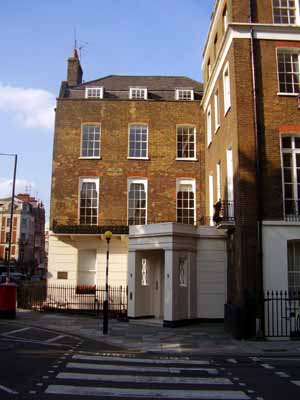
John Adams' residence at Grosvenor Square, in London

John Adams’ residence at Grosvenor Square, in London; presumably, his letter to John Jebb took form in this house. Long in use by U.S. Ambassadors to England, it is in 2015 the office complex of former British Prime Minister Tony Blair, envoy for The Quartet.  Image from London Cyberpunk Tourist Guide

the social science will never be much improved untill the People unanimously know and Consider themselvs as the fountain of Power and untill they shall  know how to manage it Wisely and honestly. reformation must begin with the \Body of the/ People which can be done only, to affect, in their Educations. the Whole People must take \upon/ themselvs the Education of the Whole People and must be willing to bear the expences of it. there should not be a district of one Mile square without a school in it, not founded by a Charitable individual but maintained at the expence of the People themselv[s] they must be taught to reverence themselvs instead of adoreing their servants their Generals Admirals Bishops and Statesmen — Instead of Admiring so extravegantly a Prince of Orange, we Should admire the Botavian Nation which produced him. Instead of Adoring a Washington, Mankind should applaud the Nation which Educated him. If Thebes owes its Liberty and Glory to Epaminandas, She will loose both when he dies, and it would have been as well if she had never enjoyed a taste for either: but if the Knowledge the Principles the Virtues and Capacities of the Theban Nation produced an Epaminandas, her Liberties and Glory will remain when he is no more: and if an analogous system of Education is Established and Enjoyed by the Whole Nation, it will produce a succession of Epaminandas’s, the Human Mind naturally exerts itself to form its Character according to the Ideas of those about it.

♦  Letter from John Adams to John Jebb, September 10, 1785, from Grosvenor Square, London

It’s a warning from the past: Do we like freedom? Then we must educate our children well, in public schools, to understand the public interest and their role in preserving and bettering the state. Can any presidential candidate expound on the issue, let alone the man, with any sing of erudition?

Tip of the old scrub brush to Diane Ravitch’s Blog.

More:

John Adams High School, a public school in South Bend, Indiana.

John Adams High School, a public school in South Bend, Indiana. According to the Michiana Schools site, ” John Adams High School is a public school located in South Bend, Indiana right across the street from Indiana University South Bend. Adam’s mascot is the eagle and their school colors are scarlet, blue and white. Adams has a very successful mock trail team. The school was established in 1940. They have around 2,000 students every year, making it the second largest school in the Michiana area.”

Yes, this is mostly an encore post. Fighting ignorance requires patience.

Yes, this is mostly an encore post. Fighting ignorance requires patience.


“Damn the torpedoes” Day: Battle of Mobile Bay, August 5, 1864

August 5, 2015

Julius O. Davidson's painting (published by Louis Prang) of the Battle of Mobile Bay, August 5, 1864.

Julius O. Davidson’s painting (published by Louis Prang) of the Battle of Mobile Bay, August 5, 1864.

It was 151 years ago today:  Especially with the excellent help of Tom Petty, whose 1979 album “Damn the Torpedoes” propelled him to stardom, the phrase “Damn the torpedoes!” remains one of the most used phrases out of history.

Just try to find someone who can tell you who first said it, and what the circumstances were. It’s a sign that history instruction is not what it should be on some matters.

August 5 marks the 151st anniversary of the Battle of Mobile Bay in 1864, when the Union Navy under the command of Admiral David Farragut took Mobile from Confederate forces.

U.S. Heritage Protection Services — a division of the National Park Service — gives a straight up, unemotional description of the fight, which was a key victory for the Union, shutting down much of the Confederacy’s ability to trade with foreign nations and supply its army:

Photograph from circa 1855-1865 of then-Rear Admiral David Glasgow Farragut, the commander of the Union forces at the Battle of Mobile Bay, and the man to who is attributed the famous line,

Photograph from circa 1855-1865 of then-Rear Admiral David Glasgow Farragut, the commander of the Union forces at the Battle of Mobile Bay, and the man to who is attributed the famous line, “Damn the Torpedoes!”

Other Names: Passing of Forts Morgan and Gaines

Location: Mobile County and Baldwin County

Campaign: Operations in Mobile Bay (1864)

Date(s): August 2-23, 1864

Principal Commanders: Adm. David G. Farragut and Maj. Gen. Gordon Granger [US]; Adm. Franklin Buchanan and Brig. Gen. Richard L. Page [CS]

Forces Engaged: Farragut’s Fleet (14 wooden ships and 4 monitors) and U.S. army forces near Mobile [US]; Buchanan’s Flotilla (3 gunboats and an ironclad), Fort Morgan Garrison, Fort Gaines Garrison, and Fort Powell Garrison [CS]

Estimated Casualties: 1,822 (US 322; CS 1,500)

Description: A combined Union force initiated operations to close Mobile Bay to blockade running. Some Union forces landed on Dauphin Island and laid siege to Fort Gaines. On August 5, Farragut’s Union fleet of eighteen ships entered Mobile Bay and received a devastating fire from Forts Gaines and Morgan and other points.  After passing the forts, Farragut forced the Confederate naval forces, under Adm. Franklin Buchanan, to surrender, which effectively closed Mobile Bay. By August 23, Fort Morgan, the last big holdout, fell, shutting down the port. The city, however, remained uncaptured.

Results(s): Union victory

World War I recruiting poster showing Admiral David Farragut lashed to the mast of his ship, and offering the quote for which Farragut is famous.

World War I recruiting poster showing Admiral David Farragut lashed to the mast of his ship, and offering the quote for which Farragut is famous. Image from the collection of the Library of Congress, via Wikipedia

Nota bene:

  • Was Farragut lashed to the rigging? Wikipedia’s listing:An anecdote of the battle that has some dramatic interest has it that Farragut was lashed to the mast during the passage of Fort Morgan. The image it brings to mind is of absolute resolve: if his ship were to be sunk in the battle, he would go down with her. The truth is more prosaic; while he was indeed lashed to the rigging of the mainmast, it was a precautionary move rather than an act of defiance. It came about after the battle had opened and smoke from the guns had clouded the air. In order to get a better view of the action, Farragut climbed into Hartford‘s rigging, and soon was high enough that a fall would certainly incapacitate him and could have killed him. Seeing this, Captain Drayton sent a seaman aloft with a piece of line to secure the admiral. He demurred, saying, “Never mind, I am all right,” but the sailor obeyed his captain’s orders, tying one end of the line to a forward shroud, then around the admiral and to the after shroud.[50]Later, when CSS Tennessee made her unsupported attack on the Federal fleet, Farragut climbed into the mizzen rigging. Still concerned for his safety, Captain Drayton had Flag-Lieutenant J. Crittenden Watson tie him to the rigging again.[51] Thus, the admiral had been tied to the rigging twice in the course of the battle.
  • Did Farragut actually say, “Damn the torpedoes, full speed ahead?  Mobile Bay had been mined by the Confederates, to hold off exactly the sort of Union attack Farragut mounted. Mines, in that time, were known as “torpedoes,” not the underwater-missiles made famous by World War II movies.  Farragut had an iron-clad ship, Tecumseh, under his command leading the attack; legend holds that other ships slowed to allow Tecumseh to cross them and move ahead.  Farragut asked why the attack was slowing, and upon hearing that they feared torpedoes (mines), he later was reputed to have said “Damn the torpedoes,” and urged moving at all speed.  Did he say, “full speed ahead?”  Accounts differ on that, even in legend.  In one version he shouted to the ship Brooklyn, “Go ahead!”  That’s unlikely in the din of sailing, coupled with the din of battle.  Another account has him shouting (vainly) to the Hartford, “Four bells, Captain Drayton.”  Yet another version, that almost makes sense, has him shouting to the Metacomet, which was lashed to the Hartford’s side, “Go ahead, Jouett, full speed.”  The entire quote must be listed as attributed, and the only part most versions agree on is “Damn the torpedoes.”  A World War I recruiting poster probably inscribed the quote into history (see the poster in this post).  Alas, Tecumseh hit a torpedo early in the battle, and sank, killing most of its crew.
  • Political importance:  Coupled with Gen. William Tecumseh Sherman‘s March Across Georgia, and the Fall of Atlanta, the Battle of Mobile Bay gave credence to the idea that the fortunes of the Civil War had turned in the Union’s favor.  This victory probably contributed greatly to the re-election of President Abraham Lincoln against opponents who urged simply ending the war without victory.
  • Mobile Bay was an important port? Mobile Bay stands as a monument to poor soil conservation practices, today.  Maps of the battle show a much larger bay than exists today; since 1864, silting from the river has filled in the bay, making it much less useful, and much less important to shipping.
H. H. Lloyd & Co's 1861 map of Mobile Bay, Alabama

1861 map of Mobile Bay: “H.H. Lloyd & Co’s Campaign Military Charts Showing The Principal Strategic Places Of Interest. Engraved Expressly To Meet A Public Want During The Present War. Compiled From Official Data By Egbert L. Viele, Military and Civil Engineer; and Charles Haskins. Published Under The Auspices Of The American Geographical And Statistical Society. Entered … 1861 by H.H. Lloyd & Co. H.H. Lloyd & Co’s Military Charts. Sixteen Maps On One Sheet.”

LandSat image of Mobile Bay, from NASA, 2003 (via Wikipedia)

LandSat image of Mobile Bay, from NASA, 2003 (via Wikipedia).  The Northern Bay is almost completely silted in by the Mobile River and others.

Whether Admiral David G. Farragut actually said, “Damn the torpedoes!” the phrase remains an often-used quotation to urge action in the face of uncertainty, hopefully, to victory.  Farragut’s forces won the Battle of Mobile Bay on August 5, 1864, a key maritime battle of the Civil War.  Whatever he said, it must have been inspiring.

What torpedoes are you damning today?

More:

This is an encore post.

This is an annual event. Much of this is an encore post.


Leader to the bone: Eisenhower’s astonishing D-Day leadership example, “Blame . . . is mine alone”

June 6, 2015

It is a model of leadership, an example more leaders should follow — though few do. It’s one more example of the high caliber leadership Dwight Eisenhower demonstrated throughout his life. In it’s imperfections, handwritten, it should take your breath away.  Eisenhower was a leader down to the bone.

So again, today, on the 71st anniversary of the D-Day invasion, we remember.

Eisenhower's unused statement on the failure of D-Day

Eisenhower’s contingency statement, in case D-Day failed – image from the National Archives

This quote actually isn’t a quote. It was never said by the man who wrote it down to say it. It carries a powerful lesson because of what it is.

In preparing for the D-Day invasion, Supreme Allied Commander Dwight Eisenhower carefully contemplated what would happen if the invasion failed.  What if the Germans repulsed the Allies, and no foothold was established to re-take the main body of Europe from the Germans?

Ike’s answer is a model of leadership:  He would take the blame.  Regardless what happened, Ike took full responsibility for the failure, giving credit to the soldiers who would have sacrificed in vain, perhaps their lives.

The Bathtub recently posted Gen. Dwight Eisenhower’s “order of the day” to the troops about to conduct the Allied invasion of Normandy — D-Day — to establish the toehold in Europe the Allies needed to march to Berlin, and to end World War II in Europe. As a charge to the troops, it was okay — Eisenhower-style words, not Churchill-style, but effective enough. One measure of its effectiveness was the success of the invasion, which established the toe-hold from which the assaults on the Third Reich were made.
eisenhower-with-paratrooper-eve-of-d-day.jpg

Photo shows Eisenhower meeting with troops of the 101st Airborne Division, 502nd Parachute Infantry Regiment, on the eve of the invasion. It was these men whose courage he lauded.

When Eisenhower wrote his words of encouragement to the troops, and especially after he visited with some of the troops, he worried about the success of the operation. It was a great gamble. Many of the things the Allies needed to go right — like weather — had gone wrong. Victory was not assured. Defeat strode the beaches of Normandy waiting to drive the Allies back into the water, to die.

Eisenhower wrote a second statement, a shorter one. This one was directed to the world. It assumed the assault had failed. In a few short sentences, Eisenhower commended the courage and commitment of the troops who, he wrote, had done all they could. The invasion was a chance, a good chance based on the best intelligence the Allies had, Eisenhower wrote. But it had failed.

The failure, Eisenhower wrote, was not the fault of the troops, but was entirely Eisenhower’s.

He didn’t blame the weather, though he could have. He didn’t blame fatigue of the troops, though they were tired, some simply from drilling, many from war. He didn’t blame the superior field position of the Germans, though the Germans clearly had the upper hand. He didn’t blame the almost-bizarre attempts to use technology that look almost clownish in retrospect — the gliders that carried troops behind the lines, sometimes too far, sometimes killing the pilots when the gliders’ cargo shifted on landing;  the flotation devices that were supposed to float tanks to the beaches to provide cover for the troops (but which failed, drowning the tank crews and leaving the foot soldiers on their own); the bombing of the forts and pillboxes on the beaches, which failed because the bombers could not see their targets through the clouds.

There may have been a plan B, but in the event of failure, Eisenhower was prepared to establish who was accountable, whose head should roll if anyone’s should.

Eisenhower took full responsibility.

Our landings in the Cherbourg-Havre area have failed to gain a satisfactory foothold and I have withdrawn the troops. My decision to attack at this time and place was based upon the best information available. The troop, the air [force] and the navy did all that bravery and devotion to duty could do. If any blame or fault attaches to the attempt, it is mine alone.

Who in the U.S. command would write such a thing today?  Who else in history would have written such a thing?  Is there any indication that Julius Caesar, Alexander the Great, Attila the Hun, Genghis Khan, or any other commander of a great army in  a world-turning invasion, considered how to save and perhaps salve the reputation of his troops, though they had failed?

Leadership is more than just positive thinking.

  • The message may also be viewed here. Yes, it’s incorrectly dated July 5 — should have been June 5.  In history, little is perfect.  We can excuse his slip of the pen, considering what else he had on his mind.


More:

General Eisenhower speaks with members of the ...

Another  angle of the meeting with the troops:  General Eisenhower speaks with members of the 101st Airborne Division on the evening of 5 June 1944.  Wikipedia image

This is mostly an encore post.


“Eyes of the world are upon you” – Ike’s orders to the troops for D-Day, June 5, 1944

June 6, 2015

Wikimedia caption and data: General Dwight D. Eisenhower addresses American paratroopers prior to D-Day.

Wikimedia caption and data: General Dwight D. Eisenhower addresses American paratroopers prior to D-Day. “Gen. Dwight D. Eisenhower gives the order of the Day. ‘Full victory-nothing less’ to paratroopers in England, just before they board their airplanes to participate in the first assault in the invasion of the continent of Europe.” Eisenhower is meeting with US Co. E, 502nd Parachute Infantry Regiment (Strike) of the 101st Airborne Division, photo taken at Greenham Common Airfield in England about 8:30 p.m. on June 5, 1944. The General was talking about fly fishing with his men as he always did before a stressful operation. Memoir by Lt Wallace C. Strobel about this photo (seen wearing the number 23 around his neck): http://www.historyaddict.com/Ike502nd.html U.S. Army photo via the Library of Congress; U.S. Army photographer unknown.

Soldiers, Sailors, and Airmen of the Allied Expeditionary Force: You are about to embark upon the Great Crusade, toward which we have striven these many months. The eyes of the world are upon you.

– Order of the Day, 6 June, 1944 (some sources list this as issued 2 June)

(This is mostly an encore post.)


Quote of the moment: FDR on government shutdowns

February 24, 2015

One wag, who didn’t want to discuss things after all, referred me to President Franklin Roosevelt’s message to the National Federal of Federal Employees (NFFE), of August 16, 1937 (from the American Presidency Project at the University of California – Santa Barbara (UCSB)).  The wag asked me to confess that FDR was anti-union, and that Wisconsin Gov. Scott “Ahab” Walker had acted in Roosevelt’s path in Walker’s assaults on the unions of policemen, firefighters and teachers in Wisconsin.

I demurred, and pointed out instead that Walker went after the unions despite their having NOT struck, that Walker refused to bargain in good faith, or bargain at all.  I pointed out that Walker had failed in his duty, in the view of FDR.

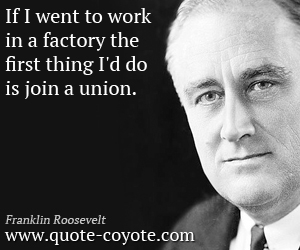
President Franklin Delano Roosevelt

President Franklin Delano Roosevelt, in 1936 (Checking to see whether, when and where FDR said that; Robert Reich says he did.)

It’s a good way to send wags packing on Twitter, I’ve learned.  They don’t like to read or think, and they certainly don’t want anyone pointing out that they may have misinterpreted something. Anything.

NFFE had invited Roosevelt to speak at their Twentieth Jubilee Convention; Roosevelt sent a letter declining the invitation. In declining, Roosevelt noted he opposed strikes by government employees.  No doubt there is more history there that deserves our attention.  We can get to it later.

Here’s the meat of FDR’s letter:

Particularly, I want to emphasize my conviction that militant tactics have no place in the functions of any organization of Government employees. Upon employees in the Federal service rests the obligation to serve the whole people, whose interests and welfare require orderliness and continuity in the conduct of Government activities. This obligation is paramount. Since their own services have to do with the functioning of the Government, a strike of public employees manifests nothing less than an intent on their part to prevent or obstruct the operations of Government until their demands are satisfied. Such action, looking toward the paralysis of Government by those who have sworn to support it, is unthinkable and intolerable. It is, therefore, with a feeling of gratification that I have noted in the constitution of the National Federation of Federal Employees the provision that “under no circumstances shall this Federation engage in or support strikes against the United States Government.”

What do you think Roosevelt would have made of the current and last “do nothing” GOP blocs in Congress?  (Or should we say “blocks?”)

Doesn’t this describe Republicans in Congress today?

” . . . intent on their part to prevent or obstruct the operations of government until their demands are satisfied. Such action, looking toward the paralysis of Government by those who have sworn to support it, is unthinkable and intolerable.”

Is it too much to ask Republicans in Congress to be at least as loyal to the U.S. as the unionized government employees who pledged not to shut down the government?

More:


Misquote of the moment: Magellan didn’t say it, but it’s still brilliant, “shadow on the Moon”

February 21, 2015

An anonymous portrait of Ferdinand Magellan, 16th or 17th century (The Mariner's Museum Collection, Newport News, VA) Legend:

An anonymous portrait of Ferdinand Magellan, 16th or 17th century (The Mariner’s Museum Collection, Newport News, VA) Legend: “Ferdinan[dus] Magellanus superatis antarctici freti angustiis clariss.” (Fedinand Magellan, you overcame the famous, narrow, southern straits.)

From Wikiquote:

  • The Church says that the Earth is flat, but I know that it is round. For I have seen the shadow of the earth on the moon and I have more faith in the Shadow than in the Church.
    • This quotation is often found on the internet attributed to Magellan, but never with a source, and no English occurrence prior to its use by Robert Green Ingersoll in his essay “Individuality” (1873) has been located. Thus, it it most likely spurious. In that essay Ingersoll states:

It is a blessed thing that in every age some one has had individuality enough and courage enough to stand by his own convictions, — some one who had the grandeur to say his say. I believe it was Magellan who said, “The church says the earth is flat; but I have seen its shadow on the moon, and I have more confidence even in a shadow than in the church.” On the prow of his ship were disobedience, defiance, scorn, and success.

Where did Ingersoll get that thought? Wouldn’t he claim it as his own, had he invented it?

And, is it true? Can we tell anything by the Earth’s shadow on the Moon?  EarthSky.org discusses the reality, when can we really see the Earth’s shadow?  Turns out, we don’t have to wait for a lunar eclipse. More, is this false attributing perhaps the source of the old, incorrect claim that many in the days of Columbus thought the Earth to be flat, and not spherical?

Wikiquote, and the rest of us, need more sleuthing on this one.

More:


Quote of the moment, for politics at the end of 2014: Ebenezer Scrooge, “darkness is cheap”

December 23, 2014

Roberto Innocenti, Scrooge on a dark staircase

Ebenezer Scrooge, up a dark staircase; “Darkness was cheap, and Scrooge liked it.” Illustration by Roberto Innocenti, via Pinterest.

Quote of the moment (an encore post for the season, with a bit of context thrown in later):

Darkness is cheap, and Scrooge liked it.

– Charles Dickens, A Christmas Carol, Stave 1

I think of that line of Dickens’s often when  I read of the celebrations of calumny that pass as discourse in Republican politics these days. Although, with the 2008 renewing of Limbaugh’s contract, it may no longer be true that his particular brand of darkness is cheap.

Cheap or not, darkness remains dark.

John Leach, Scrooge meets Ignorance and Want

Scrooge meets Ignorance and Want, the products of his stinginess (drawing by John Leech, 1809-1870)


Drawing by John Leech (1809-1870), to illustrate Charles Dickens’ A Christmas Carol. Work in the public domain (available at WikiSource).

Here is the sentence Dickens put before the quote, to add a little context; Scrooge was climbing a very large, very dark staircase.

Half-a-dozen gas-lamps out of the street wouldn’t have lighted the entry too well, so you may suppose that it was pretty dark with Scrooge’s dip.

Up Scrooge went, not caring a button for that. Darkness is cheap, and Scrooge liked it.

Speaking of darkness, a longer excerpt from Dickens’s story:

‘Forgive me if I am not justified in what I ask,’ said Scrooge, looking intently at the Spirit’s robe, ‘but I see something strange, and not belonging to yourself, protruding from your skirts. Is it a foot or a claw?’

‘It might be a claw, for the flesh there is upon it,’ was the Spirit’s sorrowful reply. ‘Look here.’

From the foldings of its robe, it brought two children; wretched, abject, frightful, hideous, miserable. They knelt down at its feet, and clung upon the outside of its garment.

‘Oh, Man! look here. Look, look, down here!’ exclaimed the Ghost.

They were a boy and girl. Yellow, meagre, ragged, scowling, wolfish; but prostrate, too, in their humility. Where graceful youth should have filled their features out, and touched them with its freshest tints, a stale and shrivelled hand, like that of age, had pinched, and twisted them, and pulled them into shreds. Where angels might have sat enthroned, devils lurked, and glared out menacing. No change, no degradation, no perversion of humanity, in any grade, through all the mysteries of wonderful creation, has monsters half so horrible and dread.

Scrooge started back, appalled. Having them shown to him in this way, he tried to say they were fine children, but the words choked themselves, rather than be parties to a lie of such enormous magnitude.

‘Spirit! are they yours?’ Scrooge could say no more.

‘They are Man’s,’ said the Spirit, looking down upon them. ‘And they cling to me, appealing from their fathers. This boy is Ignorance. This girl is Want. Beware them both, and all of their degree, but most of all beware this boy, for on his brow I see that written which is Doom, unless the writing be erased. Deny it!’ cried the Spirit, stretching out its hand towards the city. ‘Slander those who tell it ye! Admit it for your factious purposes, and make it worse. And bide the end!’

‘Have they no refuge or resource?’ cried Scrooge.

‘Are there no prisons?’ said the Spirit, turning on him for the last time with his own words. ‘Are there no workhouses?’ The bell struck twelve.

Scrooge looked about him for the Ghost, and saw it not. As the last stroke ceased to vibrate, he remembered the prediction of old Jacob Marley, and lifting up his eyes, beheld a solemn Phantom, draped and hooded, coming, like a mist along the ground, towards him.

A Christmas Carol, Stave 3

Christmas is a festival to celebrate light, what many Christians call “the light of the world?” If so, let us work to stamp out the darkness which the unrepentant Scrooge so dearly loved.

Darkness may be cheap, but it is not good.  Light a candle, and run into the darkness, spreading light. We need more light.

More:


December 2: Millard Fillmore’s Guano Day!

December 1, 2014

Why December 2?

(You couldn’t make this stuff up if you were Monty Python.)

English: Millard Fillmore White House portrait

Millard Fillmore’s White House portrait, via Wikipedia

President Millard Fillmore, in the State of the Union Address, December 2, 1850

Peruvian guano has become so desirable an article to the agricultural interest of the United States that it is the duty of the Government to employ all the means properly in its power for the purpose of causing that article to be imported into the country at a reasonable price. Nothing will be omitted on my part toward accomplishing this desirable end. I am persuaded that in removing any restraints on this traffic the Peruvian Government will promote its own best interests, while it will afford a proof of a friendly disposition toward this country, which will be duly appreciated.

Did any other U.S. President spend so much time thinking about guano?  Did any president ever mention it in a State of the Union Address?  The curious case of Millard Fillmore, Seer, just grows.

Guano, or bird poop (and its relative, bat poop), contains phosphorus, which is an essential element for life.  Consequently, it turns out to be a key ingredient in effective agricultural fertilizers.  In international competition for supremacy in farming and farm exports, guano became a key resource to fight over, in the 19th century.

It’s almost safe to say the fights were economic; but guano did play a key role in wars in South America (see Andrew Leonard’s article, noted below).

Fillmore figured out that the substance had great importance, coupled that with the rather esoteric knowledge that sea birds tended to deposit guano in great abundance on certain islands, often unoccupied, and ordered the U.S. Navy to claim islands found to contain guano deposits that were not claimed by other nations.

By the American Civil War, the importance of phosphorus to the production of gun powder became an issue for the armies of the North and South.  Millard Fillmore had set the stage for the North to win an important advantage in gun powder production, just one of many that led to the defeat of the South.

It’s one more thing we should thank Millard Fillmore for doing. Our study of history should inform us that it is, indeed, important for politicians to understand the importance of guano.

Fillmore knew his guano.

Take a moment on December 2 to toast Millard Fillmore’s prescience, on Guano Day!

More:  


December 1, 1955: “Why do you push us around?” Rosa Parks asked the cop. (Anyone know the answer?)

December 1, 2014

Mrs. Rosa Parks asked a question of the policeman who arrested her for refusing to move to the back of the bus. In 2014, it’s a chilling question, to which we have no good answer.

Rosa Parks being fingerprinted, Library of Congress

Mrs. Parks being fingerprinted in Montgomery, Alabama; photo from New York World-Telegram & Sun Collection, Library of Congress

Rosa Parks: “Why do you push us around?”

Officer: “I don’t know but the law is the law and you’re under arrest.”

From Rosa Parks with Gregory J. Reed, Quiet Strength
(Grand Rapids, MI: Zondervan Pub. House, 1994), page 23.

Photo: Mrs. Parks being fingerprinted in Montgomery, Alabama; photo from New York World-Telegram & Sun Collection, Library of Congress

Today in History at the Library of Congress provides the simple facts:

On the evening of December 1, 1955, Rosa Parks, an African American, was arrested for disobeying an Alabama law requiring black passengers to relinquish seats to white passengers when the bus was full. Blacks were also required to sit at the back of the bus. Her arrest sparked a 381-day boycott of the Montgomery bus system and led to a 1956 Supreme Court decision banning segregation on public transportation.

Rosa Parks made a nearly perfect subject for a protest on racism. College-educated, trained in peaceful protest at the famous Highlander Folk School, Parks was known as a peaceful and respected person. The sight of such a proper woman being arrested and jailed would provide a schocking image to most Americans. Americans jolted awake.

Often lost in the retelling of the story are the threads that tie together the events of the civil rights movement through the 1940s, 1950s and 1960s. As noted, Parks was a trained civil rights activist. Such training in peaceful and nonviolent protest provided a moral power to the movement probably unattainable any other way. Parks’ arrest was not planned, however. Parks wrote that as she sat on the bus, she was thinking of the tragedy of Emmet Till, the young African American man from Chicago, brutally murdered in Mississippi early in 1955. She was thinking that someone had to take a stand for civil rights, at about the time the bus driver told her to move to allow a white man to take her seat. To take a stand, she kept her seat.

African Americans in Montgomery organized a boycott of the Montgomery bus system. This was also not unique, but earlier bus boycotts are unremembered. A bus boycott in Baton Rouge, Louisiana, earlier in 1955 did not produce nearly the same results.

The boycott organizers needed a place to meet, a large hall. The biggest building in town with such a room was the Dexter Street Baptist Church. At the first meeting on December 5, it made sense to make the pastor of that church the focal point of the boycott organizing, and so the fresh, young pastor, Rev. Dr. Martin Luther King, Jr., was thrust into civil rights organizing as president, with Ralph Abernathy as program director. They called their group the Montgomery Improvement Association (MIA). When their organizing stretched beyond the city limits of Montgomery, the group became the Southern Christian Leadership Conference.

Litigation on the boycott went all the way to the Supreme Court (Browder v. Gale). The boycotters won. The 381-day boycott was ended on December 21, 1956, with the desegregation of the Montgomery bus system.

Sources for lesson plans and projects:

Yes, this is mostly an encore post.  Fighting ignorance requires patience.

Yes, this is mostly an encore post. Fighting ignorance requires patience.


Tip of the old scrub brush to Slacktivist, who gave this post a nice plug.


“Damn the torpedoes” at 150: Battle of Mobile Bay, August 5, 1864

August 5, 2014

Julius O. Davidson's painting (published by Louis Prang) of the Battle of Mobile Bay, August 5, 1864.

Julius O. Davidson’s painting (published by Louis Prang) of the Battle of Mobile Bay, August 5, 1864.

It was 150 years ago today:  Especially with the excellent help of Tom Petty, whose 1979 album “Damn the Torpedoes” propelled him to stardom, the phrase “Damn the torpedoes!” remains one of the most used phrases out of history.

Just try to find someone who can tell you who first said it, and what the circumstances were. It’s a sign that history instruction is not what it should be on some matters.

August 5 marks the 150th anniversary of the Battle of Mobile Bay in 1864, when the Union Navy under the command of Admiral David Farragut took Mobile from Confederate forces.

U.S. Heritage Protection Services — a division of the National Park Service — gives a straight up, unemotional description of the fight, which was a key victory for the Union, shutting down much of the Confederacy’s ability to trade with foreign nations and supply its army:

Photograph from circa 1855-1865 of then-Rear Admiral David Glasgow Farragut, the commander of the Union forces at the Battle of Mobile Bay, and the man to who is attributed the famous line,

Photograph from circa 1855-1865 of then-Rear Admiral David Glasgow Farragut, the commander of the Union forces at the Battle of Mobile Bay, and the man to who is attributed the famous line, “Damn the Torpedoes!”

Other Names: Passing of Forts Morgan and Gaines

Location: Mobile County and Baldwin County

Campaign: Operations in Mobile Bay (1864)

Date(s): August 2-23, 1864

Principal Commanders: Adm. David G. Farragut and Maj. Gen. Gordon Granger [US]; Adm. Franklin Buchanan and Brig. Gen. Richard L. Page [CS]

Forces Engaged: Farragut’s Fleet (14 wooden ships and 4 monitors) and U.S. army forces near Mobile [US]; Buchanan’s Flotilla (3 gunboats and an ironclad), Fort Morgan Garrison, Fort Gaines Garrison, and Fort Powell Garrison [CS]

Estimated Casualties: 1,822 (US 322; CS 1,500)

Description: A combined Union force initiated operations to close Mobile Bay to blockade running. Some Union forces landed on Dauphin Island and laid siege to Fort Gaines. On August 5, Farragut’s Union fleet of eighteen ships entered Mobile Bay and received a devastating fire from Forts Gaines and Morgan and other points.  After passing the forts, Farragut forced the Confederate naval forces, under Adm. Franklin Buchanan, to surrender, which effectively closed Mobile Bay. By August 23, Fort Morgan, the last big holdout, fell, shutting down the port. The city, however, remained uncaptured.

Results(s): Union victory

World War I recruiting poster showing Admiral David Farragut lashed to the mast of his ship, and offering the quote for which Farragut is famous.

World War I recruiting poster showing Admiral David Farragut lashed to the mast of his ship, and offering the quote for which Farragut is famous. Image from the collection of the Library of Congress, via Wikipedia

Nota bene:

  • Was Farragut lashed to the rigging? Wikipedia’s listing:An anecdote of the battle that has some dramatic interest has it that Farragut was lashed to the mast during the passage of Fort Morgan. The image it brings to mind is of absolute resolve: if his ship were to be sunk in the battle, he would go down with her. The truth is more prosaic; while he was indeed lashed to the rigging of the mainmast, it was a precautionary move rather than an act of defiance. It came about after the battle had opened and smoke from the guns had clouded the air. In order to get a better view of the action, Farragut climbed into Hartford‘s rigging, and soon was high enough that a fall would certainly incapacitate him and could have killed him. Seeing this, Captain Drayton sent a seaman aloft with a piece of line to secure the admiral. He demurred, saying, “Never mind, I am all right,” but the sailor obeyed his captain’s orders, tying one end of the line to a forward shroud, then around the admiral and to the after shroud.[50]Later, when CSS Tennessee made her unsupported attack on the Federal fleet, Farragut climbed into the mizzen rigging. Still concerned for his safety, Captain Drayton had Flag-Lieutenant J. Crittenden Watson tie him to the rigging again.[51] Thus, the admiral had been tied to the rigging twice in the course of the battle.
  • Did Farragut actually say, “Damn the torpedoes, full speed ahead?  Mobile Bay had been mined by the Confederates, to hold off exactly the sort of Union attack Farragut mounted. Mines, in that time, were known as “torpedoes,” not the underwater-missiles made famous by World War II movies.  Farragut had an iron-clad ship, Tecumseh, under his command leading the attack; legend holds that other ships slowed to allow Tecumseh to cross them and move ahead.  Farragut asked why the attack was slowing, and upon hearing that they feared torpedoes (mines), he later was reputed to have said “Damn the torpedoes,” and urged moving at all speed.  Did he say, “full speed ahead?”  Accounts differ on that, even in legend.  In one version he shouted to the ship Brooklyn, “Go ahead!”  That’s unlikely in the din of sailing, coupled with the din of battle.  Another account has him shouting (vainly) to the Hartford, “Four bells, Captain Drayton.”  Yet another version, that almost makes sense, has him shouting to the Metacomet, which was lashed to the Hartford’s side, “Go ahead, Jouett, full speed.”  The entire quote must be listed as attributed, and the only part most versions agree on is “Damn the torpedoes.”  A World War I recruiting poster probably inscribed the quote into history (see the poster in this post).  Alas, Tecumseh hit a torpedo early in the battle, and sank, killing most of its crew.
  • Political importance:  Coupled with Gen. William Tecumseh Sherman‘s March Across Georgia, and the Fall of Atlanta, the Battle of Mobile Bay gave credence to the idea that the fortunes of the Civil War had turned in the Union’s favor.  This victory probably contributed greatly to the re-election of President Abraham Lincoln against opponents who urged simply ending the war without victory.
  • Mobile Bay was an important port? Mobile Bay stands as a monument to poor soil conservation practices, today.  Maps of the battle show a much larger bay than exists today; since 1864, silting from the river has filled in the bay, making it much less useful, and much less important to shipping.
H. H. Lloyd & Co's 1861 map of Mobile Bay, Alabama

1861 map of Mobile Bay: “H.H. Lloyd & Co’s Campaign Military Charts Showing The Principal Strategic Places Of Interest. Engraved Expressly To Meet A Public Want During The Present War. Compiled From Official Data By Egbert L. Viele, Military and Civil Engineer; and Charles Haskins. Published Under The Auspices Of The American Geographical And Statistical Society. Entered … 1861 by H.H. Lloyd & Co. H.H. Lloyd & Co’s Military Charts. Sixteen Maps On One Sheet.”

LandSat image of Mobile Bay, from NASA, 2003 (via Wikipedia)

LandSat image of Mobile Bay, from NASA, 2003 (via Wikipedia).  The Northern Bay is almost completely silted in by the Mobile River and others.

Whether Admiral David G. Farragut actually said, “Damn the torpedoes!” the phrase remains an often-used quotation to urge action in the face of uncertainty, hopefully, to victory.  Farragut’s forces won the Battle of Mobile Bay on August 5, 1864, a key maritime battle of the Civil War.  Whatever he said, it must have been inspiring.

What torpedoes are you damning today?

More:

This is an encore post.

This is an annual event. Much of this is an encore post.


Quote of the moment: Frankfurter, on due process

July 9, 2014

Supreme Court Justice Felix Frankfurter, The Collection of the Supreme Court of the United States (Artist: Gardener Cox).  Born Vienna, Austria, 1894. Died 1965.

Supreme Court Justice Felix Frankfurter, The Collection of the Supreme Court of the United States (Artist: Gardener Cox). Born Vienna, Austria, 1894. Died 1965. Associate Justice, 1939-1962

It is now the settled doctrine of this Court that the Due Process Clause embodies a system of rights based on moral principles so deeply imbedded in the traditions and feelings of our people as to be deemed fundamental to a civilized society as conceived by our whole history. Due Process is that which comports with the deepest notions of what is fair and right and just.

♦  Justice Felix Franfurter, dissenting in
Solesbee v. Balkcom, 339 U.S. 9, 16 (1950)