Navy Day 2014, October 27 – Fly your flag today

October 27, 2014

1945 Navy Day poster. NHHC Photograph Collection, NH 72280-KN (Color) via CrashMacDuff

1945 Navy Day poster. NHHC Photograph Collection, NH 72280-KN (Color) via CrashMacDuff

Navy Day, October 27, is designated in the U.S. Flag Code as one of those days Americans may, or should, fly our flags.

History of Navy Day from the U.S. Department of Defense:

Navy Day was established on October 27, 1922 by the Navy League of the United States. Although it was not a national holiday, Navy Day received special attention from President Warren Harding. Harding wrote to the Secretary of the Navy Edwin Denby:

“Thank you for your note which brings assurance of the notable success which seems certain to attend the celebration of Navy Day on Friday, October 27, in commemoration of past and present services of the Navy. From our earliest national beginnings the Navy has always been, and deserved to be, an object of special pride to the American people. Its record is indeed one to inspire such sentiments, and I am very sure that such a commemoration as is planned will be a timely reminder.”

“It is well for us to have in mind that under a program of lessening naval armaments there is a greater reason for maintaining the highest efficiency, fitness and morale in this branch of the national defensive service. I know how earnestly the Navy personnel are devoted to this idea and want you to be assured of my hearty concurrence.”

October 27 was suggested by the Navy League to recognize Theodore Roosevelt’s birthday. Roosevelt had been an Assistant Secretary of the Navy and supported a strong Navy as well as the idea of Navy Day. In addition, October 27 was the anniversary of a 1775 report issued by a special committee of the Continental Congress favoring the purchase of merchant ships as the foundation of an American Navy.

Navy Day was last observed on Oct. 27, 1949.

But, of course, it’s still designated in the Flag Code.

More:


Fly your flag today: Columbus Day, 2014

October 13, 2014

Feel free to put your political brickbats in comments.

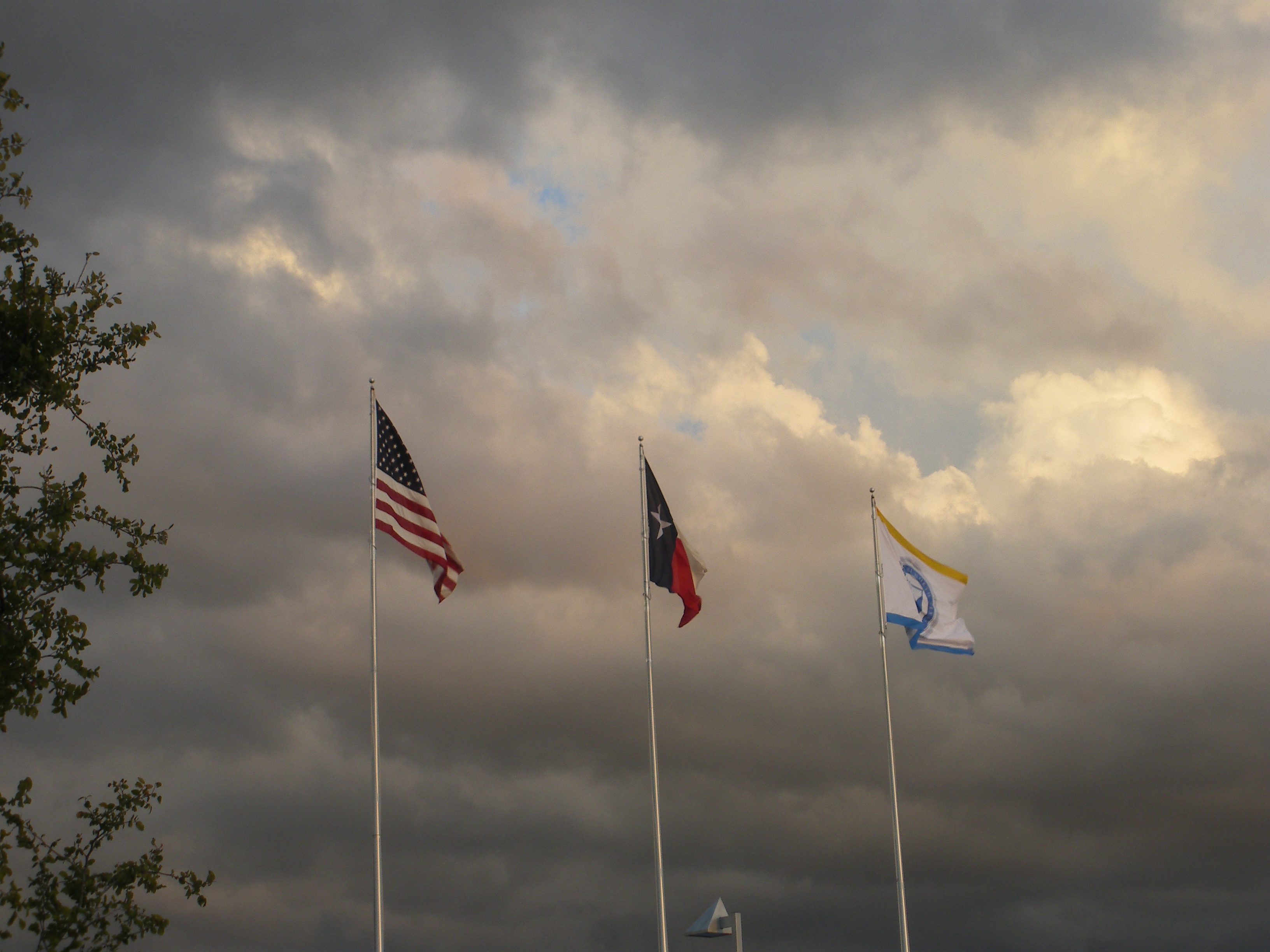
U.S., Texas and University of North Texas at Dallas flags flying on campus, with storm clouds to the South. Photo by Ed Darrell; use encouraged with attribution.

U.S., Texas and University of North Texas at Dallas flags flying on campus, with storm clouds to the South. Photo by Ed Darrell; use encouraged with attribution.

October 12 is the traditional, old calendar date upon which Columbus’s journals show he “discovered” land west of the Atlantic, after sailing from Spain. (Surely there is an explanation for why the date was not altered to conform with the new calendar, but I digress.)  In the finite wisdom of Congress, the holiday is designated on the “second Monday of October,” in order to promote three-day weekends and avoid holidays in the middle of the week.

The U.S. Flag Code urges Americans to fly their U.S. flags in honor of certain days.  Columbus Day is a traditional (since the 19th century) holiday (especially for descendants of Italian immigrants), and one of the score of dates denoted in the Flag Code.

Fly your flag today.

More:

Or, if you’re in South Dakota, fly your flag for Native American Day.


2014’s Constitution Day – Fly your flag

September 17, 2014

Happy Constitution day!  (Remember to fly your flag today.)

Have you read the U.S. Constitution lately?

Contrary to what your local Tea Party claims, it hasn’t changed.  But most people need a refresher from time to time.

First page of the U.S. Constitution, National Archives and Records Administration photo

First page of the U.S. Constitution, National Archives and Records Administration photo

Okay, maybe that’s a little tough to read.  Check out the on-line display of the National Archives and Records Administration in the Charters of Freedom section:

More:


Rotunda for the charters of Freedom at Nationa...

Rotunda for the charters of Freedom at National Archives (NARA) building in Washington, D.C. Here displayed are the Declaration of Independence, the Bill of Rights, and the U.S. Constitution. (Photo credit: Wikipedia)

This is an encore post.

This is an encore post.


Patriot Day, September 11, 2014: Fly your flag at half staff today

September 11, 2014

U.S. flag at half-staff, in Brighton, New York

U.S. flag at half-staff, in Brighton, New York

To honor those who died on September 11, 2001, flags in the U.S. fly at half-staff on September 11.  Known as Patriot Day, the date is not in the Flag Code, but is listed in a separate law.

In the United States, Patriot Day, observed as the National Day of Service and Remembrance, occurs on September 11 of each year in memory of the 2,977 killed in the 2001 September 11 attacks.

To further honor the dead, and survivors, many people participate in a day of service to others.

President Barack Obama issued a proclamation ordering all federal facilities to fly flags at half-staff:

PATRIOT DAY AND NATIONAL DAY OF SERVICE AND REMEMBRANCE, 2014

– – – – – – –

BY THE PRESIDENT OF THE UNITED STATES OF AMERICA

A PROCLAMATION

America will never forget the September tragedy that shook our Nation’s core 13 years ago.  On a day that began like so many others, a clear blue sky was pierced by billowing black smoke as a wave of grief crashed over us.  But in one of our darkest moments, we summoned strength and courage, and out of horrible devastation emerged the best of our humanity.  On this solemn anniversary, we pause in remembrance, in reflection, and once again in unity.

On September 11, 2001, nearly 3,000 men, women, and children — friends and neighbors, sisters and brothers, mothers and fathers, sons and daughters — were taken from us with a heartbreaking swiftness and cruelty.  As we come together once more to mourn their loss, we also recall how the worst terrorist attack in our history brought out the true character of the American people.  Courageous firefighters rushed into an inferno, brave rescue workers charged up stairs, and coworkers carried others to safety.  Americans in distant cities and local towns united in common purpose, demonstrating the spirit of our Nation; people drove across the country to volunteer, donors lined up to give blood, and organizations collected food and clothing.  And in our Nation’s hour of need, millions of young Americans raised in a time of peace volunteered to don the uniforms of our country’s military and defend our values around the world.

As we remember all those we lost on that day and the Americans who made the ultimate sacrifice in the wars that followed, we must strive to carry forward their legacy.  On this National Day of Service and Remembrance, we take up their unfinished work and pay tribute to their lives with service and charity.  Through these acts and quiet gestures, we can honor their memory and reclaim our sense of togetherness.  I encourage all Americans to visit www.Serve.gov or www.Servir.gov to learn more about service opportunities across our country.

In the face of great terror, some turned to God and many found comfort in family and friends — but all Americans came together as one people united not only in our grief, but also in our determination to stand with one another and support the country we love.  Today and all days, we remember the patriots who endure in the hearts of our Nation and their families who have known the awful depths of loss.  In their spirit, let us resolve to move forward together and rededicate ourselves to the ideals that define our Union as we work to strengthen our communities and better our world.

By a joint resolution approved December 18, 2001 (Public Law 107-89), the Congress has designated September 11 of each year as “Patriot Day,” and by Public Law 111-13, approved April 21, 2009, the Congress has requested the observance of September 11 as an annually recognized “National Day of Service and Remembrance.”

NOW, THEREFORE, I, BARACK OBAMA, President of the United States of America, do hereby proclaim September 11, 2014, as Patriot Day and National Day of Service and Remembrance.  I call upon all departments, agencies, and instrumentalities of the United States to display the flag of the United States at half-staff on Patriot Day and National Day of Service and Remembrance in honor of the individuals who lost their lives on September 11, 2001.  I invite the Governors of the United States and its Territories and interested organizations and individuals to join in this observance.  I call upon the people of the United States to participate in community service in honor of those our Nation lost, to observe this day with appropriate ceremonies and activities, including remembrance services, and to observe a moment of silence beginning at 8:46 a.m. Eastern Daylight Time to honor the innocent victims who perished as a result of the terrorist attacks of September 11, 2001.

IN WITNESS WHEREOF, I have hereunto set my hand this  tenth day of September, in the year of our Lord two thousand fourteen, and of the Independence of the United States of America the two hundred and thirty-ninth.

BARACK OBAMA

Do you plan any special service today?


September 9, California Statehood Day; Golden Staters, fly your flags!

September 8, 2014

U.S. Flag Code guidelines list specific days Americans should fly U.S. flags, and generically, urges people in states to fly flags on their state’s day of achieving statehood.

It’s fun to read through the list of statehood dates and ponder just how such a date is calculated (consider the first 13 colonies and their becoming states); but however it was calculated, September 9 is California’s day.

U.S. and California flags flying from the same flagpole.

U.S. and California flags flying from the same flagpole.

Fly your flags, California.

3-cent stamp honoring California's statehood centennial, in 1950.  Image from Rockhounds.com

3-cent stamp honoring California’s statehood centennial, in 1950. Image from Rockhounds.com

California was the 31st state admitted; 31-star flags were in use until Minnesota’s statehood in 1858.  Here’s a unique design on the 31-star motif:

31-start flag with stars arranged in

31-star flag with stars arranged in “Great Star” constellation suggested by War of 1812 Navy hero Samuel Reid, a wearer of the Congressional Medal of Honor. Reid urged 13 stripes instead of 15, which Congress accepted; but he also urged the Great Star design, which was not accepted. Placement of stars in the field remained unencumbered by rules until the Eisenhower administration. Photo from Jeff R. Bridgman Antiques.


September is a flag-waving month

September 7, 2014

U.S. flag displayed in the National Center for the Constitution, Philadelphia.  Photo by Jeffrey M. Vinocur, via Wikimedia. Constitution Day is September 17.

U.S. flag displayed in the National Center for the Constitution, Philadelphia. Photo by Jeffrey M. Vinocur, via Wikimedia. Constitution Day is September 17.

Flag flying dates in September?  Three more (you flew your flag for Labor Day, right?):

  • September 9, for California statehood
  • September 11, for Patriot Day (not listed in the U.S. Flag Code, but encouraged in other law. Public Law No. 107-89)
  • September 17,for Constitution Day

Ready?

More:

Trivia note:  The U.S. flag is not mentioned in the U.S. Constitution.


Remember to fly your flag for Labor Day 2014, September 1

August 30, 2014

Still important in 2014: Fly your flag for American labor, Monday.

Free Labor Will Win, poster from 1942, (Library of Congress)

Poster from the Office of War Information, 1942

(Okay, you may fly your flag all weekend — especially if you’re a union member.  We get the whole weekend, but Labor Day itself is Monday.)

Labor Day 2014 in the United States is a federal holiday, and one of those days Americans are urged to fly the U.S. flag.

“Free Labor Will Win,” the poster said, encouraging a theme important during World War II, when unions were encouraged to avoid strikes or any action that might interrupt work to build the “arsenal of democracy” believed necessary to win the war.  Labor complied, the war was won, and organized labor was the stronger for it. In 2012, some have difficulty remembering when all Americans knew that our future rides on the backs of organized labor.

The poster was issued by the Office of War Information in 1942, in full color. A black-and-white version at the Library of Congress provides a few details for the time:

Labor Day poster. Labor Day poster distributed to war plants and labor organizations. The original is twenty-eight and one-half inches by forty inches and is printed in full color. It was designed by the Office of War Information (OWI) from a photograph especially arranged by Anton Bruehl, well-known photographer. Copies may be obtained by writing the Distribution Section, Office of War Information [alas, you can’t get a copy from the Office of War Information in 2012]

Even down here in deepest, darkest-right-to-work Texas, patriots fly their flags to honor Labor today. It’s heartening.

Flags fly all around in 1882 at the first Labor Day Parade in New York City’s Union Square; lithograph from USC’s Dornsife History Center, via Wikipedia, artist unidentified

This is partly an encore post, a Labor Day tradition.

More, Other Resources:

This is an encore post.

This is an encore post, a Labor Day tradition.


Nashville Scouts demonstrate proper flag folding

July 11, 2014

Of course you know how to fold a flag.  Right?

A group of Nashville Boy Scouts demonstrate for some Cub Scouts and a local news program, the proper methods.

Did they get it right?

Joshua Maxwell is a reporter with Nashville’s NBC affiliate, WSMV Channel 4; Scouts come from Troop 1914.

Published on Jul 2, 2014

My first on Air segment with WSMV Channel4. The Boy Scouts are teaching me and some Cub Scouts how to fold the American Flag.

More:


July 4, 1826: Astonishing coincidences on the 50th anniversary of the Declaration

July 4, 2014

You know the story, don’t you? If you don’t, you should commit this one to memory.  It’s not fiction, and if you proposed it for fiction, the editors would reject it as too improbable, or too sappy, a tug on your heartstrings and tear ducts.  It’s true, better than the faux patriot fiction we often get on July 4.

July 4, 2014, is the 238th anniversary of the announcement of the Declaration of Independence.  I hope you’re thinking about how you’ll fly the flag this weekend in honor of the Declaration of Independence.

The resolution proposed by Richard Henry Lee calling for independence of the 13 colonies passed the Continental Congress on July 2, 1776.  The Declaration would be Thomas Jefferson’s crowning achievement, outshining even his presidency and the Louisiana Purchase.   John Adams wrote to his wife, Abigail, that July 2 would forever be marked by patriotic displays.

But the Declaration itself, which gave teeth to the resolution, was adopted two days later on July 4.  That has come to be the day we celebrate.

Detail, John Trumbull's Signing of the Declaration of Independence - Theodor Horydczak photo, Library of Congress

Detail, John Trumbull’s Signing of the Declaration of Independence – The committee of five presents the Declaration of Independence to John Hancock, the President of the Second Continental Congress; from left, the committee is John Adams, Robert Livingston, Roger Sherman, Thomas Jefferson, and Ben Franklin.  Theodor Horydczak photo, Library of Congress

Adams didn’t miss a beat.  Who quibbles about a couple of days when the celebrating is so good?

Adams and Jefferson were two of the five-member committee the Congress had tasked to write a declaration.  Adams and Ben Franklin quickly determined to leave it up to Jefferson, who had a grand flair with words, and who had just written a couple of stirring documents for Virginia.  Roger Sherman and Robert Livingston, the other two members, went along.  And so it was that the Declaration of  Independence is almost completely the work of Thomas Jefferson.

Adams and Jefferson became friends only later, when they both served the nation at war as ambassadors to France, and then for Adams, to England.  A widower, Jefferson was taken in by Abigail Adams who worried about him.  After the war, Jefferson was in England when Adams was to meet King George III in a grand ceremony in which the king would accept the credentials of all the ambassadors of foreign nations to England.  As the king strode down the line, each ambassador or delegation would bow, the king would acknowledge them, the papers would be passed, and the king would move on.  Adams and Jefferson bowed.  King George moved on, ignoring them completely.

In such a case of such a snub, the snubbed foreigners usually made a quick exit.  Adams and Jefferson did not.  They stood at attention as if the king had treated them like all the rest, reversing the snub.  From the beginning, Americans and the United States pushed for more practical, reasonable, and compassionate government and relations.  Standing together, against the snub of the British King one more time, Adams and Jefferson formed a silent bond that held them the rest of their lives.

Back in America in peacetime, and both members of the administration of George Washington, Adams and Jefferson fell out.  Secretary of State Jefferson favored a more limited federal government; Vice President Adams favored a more powerful one.  By the end of Washington’s second term, party politics had been well developed.  Adams defeated Jefferson in the election of 1796.  As was the law then, Jefferson was vice president as the runner-up vote getter in the electoral college; but Adams kept Jefferson out of all government affairs.  Perhaps because he didn’t have Jefferson to help, Adams’s presidency did not go well.  In the rematch election in 1800, one of  the bitterest election fights ever, Jefferson’s party defeated Adams.  The gleeful Democratic-Republican electors all voted one ballot for Jefferson, the presidential candidate, and one ballot for Aaron Burr, the party’s vice presidential candidate.

Alas, that produced a tie vote in the electoral college.  Adams’s party, the Federalists, still held the House of Representatives before the new Congress came in.  A tie vote goes to the House for decision.  They could not bring themselves to vote for Jefferson, and the deadlock continued for 37 ballots.  Finally Jefferson’s former friend but now arch-enemy Alexander Hamilton intervened, explaining that Burr was clearly the greater scoundrel, and the House elected Jefferson.  Adams slunk out of town, avoiding the inauguration.

It wasn’t until after 1809 when Benjamin Rush hoodwinked Jefferson into writing to Adams, and Adams to Jefferson, that the two became friendly again.  For the next 17 years Jefferson and Adams carried on perhaps the greatest series of correspondence in history between two great minds.  Letters went out almost daily, from Monticello, Virginia,  to Braintree, Massachusetts, and from Braintree to Monticello.  They discussed the weather, their families, old times, farming — but especially the republic they had been most instrumental in creating, and how it might be preserved, and made to prosper.  Eventually the letters became harder to read, both because their eyesight was failing, and because their penmanship deteriorated, too.

The ideas, however, flowed like a great river of freedom.  Perhaps this correspondence was the river flowing justice the prophet Amos foretold.

Letter from Thomas Jefferson to John Adams, August 15th, 1820 - Library of Congress image

Letter from Thomas Jefferson to John Adams, August 15th, 1820. From The Thomas Jefferson Papers at the Library of Congress, Thomas Jefferson Papers Series 1. General Correspondence. 1651-1827. Library of Congress image

Both men took ill early in 1826.  This was a landmark year, 50 years since the Declaration of Independence.  In Massachusetts, a grand display of fireworks was planned to cap off a day of feasting and celebration.  Adams hoped he might attend.  In Virginia, a week before, it became clear Jefferson was too ill to venture even as close as Charlottesville for the celebration.  Jefferson sent his regrets to invitations from several celebrations.  Jefferson slept through most of July 3, but awoke about 9:00 p.m., and asked, “This is the fourth?”  It was not.  These are the last significant, recorded words of Jefferson.  He awoke at about 4:00 a.m. on the Fourth of July, 1826, but could not make a rally.  He died at 12:50 in the afternoon.

Adams, too, was too ill to attend the celebrations.  In the late afternoon or early evening of the Fourth, he awoke, and heard the celebration in the town.  Almost as if he had worked just to live to see that particular day, he checked the date.  Realizing he was near the end, happy that he’d seen 50 years after the Declaration, and unaware of the events a few hours earlier that day in Virginia, Adams said, “Thomas Jefferson still survives.”  Adams, too, died on July 4, 1826.

Fly your flag July 4th. Remember John Adams and Thomas Jefferson.  Remember their great work in creating the nation that protects our freedoms today.  Remember their great friendship.  Write a letter to a good friend you’ve not written to lately.

It is Independence Day, a day created and celebrated by great men like John Adams and Thomas Jefferson.  Their spirit survives in us, as we celebrate, and if we remember why we celebrate as friends.

More:


Fly your flag today! July 4, 2014, 238th anniversary of the public reading of the Declaration of Independence

July 4, 2014

It’s a day of tradition — oddly enough, since we are in reality a very new nation, and Lee’s resolution to declare independence from Britain came on July 2.

A soak in Millard Fillmore’s Bathtub is nothing if not a steeping in tradition.  Fly your flag today, to celebrate the independence of the American colonies of Britain.

Fourth of July: NPR has already read the Declaration of Independence (or will soon, if you’re up early), PBS is ready to broadcast the Capitol Fourth concert  (maybe a rebroadcast is available, if you’re off at your own town’s fireworks — check your local listings), your town has a parade somewhere this weekend, or a neighboring community does, and fireworks are everywhere.

At the White House, traditionally, new citizens are sworn in — often people who joined our armed forces and fought for our nation, before even getting the privileges of citizenship.  Fireworks on the Capital Mall will be grand, with the White House hosting a few thousand military people and their families from some of the best views.  Traditionally, five photographers, chosen by lottery, get to shoot photos of the fireworks from the windows of the Washington Monument; will that occur, with the Monument shut down from public view for repair from the earthquake?

There will be great fireworks also in Baltimore Harbor over Fort McHenry, the fort whose siege inspired Francis Scott Key to write the “Star-spangled Banner” from his boat in the harbor, in 1814. Firworks will frighten the bluebirds nesting at Yorktown National Battlefield.  I suspect there will be a grand display at Gettysburg, on the 150th anniversary of the end of that battle. July 4, 1863, also marked the end of the Siege of Vicksburg; tradition holds that Vicksburg did not celebrate the 4th of July for 83 years after that. I’ll wager there will be fireworks there tonight.  In Provo, Utah, the city poobahs will have done all they can to try to live up to their self-proclaimed reputation as having the biggest Independence Day celebration in the nation.  The celebration in Prescott, Arizona, is muted by the tragic deaths of 19 Hot Shot firefighters last week; will drought halt the fireworks, too?  There will be fireworks around the Golden Gate Bridge, in Anchorage, Alaska, reflecting on the waters of Pearl Harbor, and probably in Guam, American Samoa, and the Northern Marianas Islands.

Fireworks on the Fourth is a long tradition — a tradition that kept John Adams and Thomas Jefferson alive, until they both died on the 50th anniversary of the Declaration of Independence, in 1826, the sounds of the fireworks letting Adams know the celebration had begun (Adams erroneously celebrated that Jefferson, the Declaration’s author, still lived, unable to know Jefferson had passed just hours earlier).

Remember to put your flag up today.

Astronaut Eugene Cernan and the U.S. Flag -- Apollo 17 on the Moon (NASA photo)

Last flag on the Moon: Astronaut Eugene Cernan and the U.S. Flag — Apollo 17 on the Moon (NASA photo)

If you’re not on the Moon, here are some tips on flag etiquette, how to appropriately fly our national standard.

Also:

Lunar Reconnaissance Orbiter photo of the Apollo 17 landing site.

Lunar Reconnaissance Orbiter photo of the Apollo 17 landing site. NASA caption: Apollo 17 Lunar Module Challenger descent stage comes into focus from the new lower 50 km mapping orbit, image width 102 meters. Credit: NASA/GSFC/Arizona State University

This is mostly an encore post, but I so love that photo of the flag with the Earth in the distance.

Happy birthday, Kathryn!

Fireworks in Duncanville, Texas, for July 4

Fireworks in Duncanville, Texas, for July 4 — Kathryn Knowles’s birthday. We’re always happy the town chimes in with the celebratory spirit.

Tip of the old scrub brush to Thomas Jefferson, Richard Henry Lee, John Adams, Benjamin Franklin, Roger Sherman, Robert Livingston, and the cast of thousands of patriots including George Washington.


Reminder: How to fly the flag on July 4 in 2014

July 4, 2014

Every kid should learn this stuff by third grade, but it’s clear from what we see that they don’t.

Flag flying in front of U.S. Capitol (East side) LOC photo

Flag flying at the eastern front of the U.S. Capitol. Library of Congress photo

So here’s a quick review of dos and don’ts for display and behavior toward the U.S. flag on this most flag-worthy of days, the 4th of July. With a few comments.

1. Fly your flag, from sunup to sundown. If you’re lucky enough to have a flagpole, run the flag up quickly. Retire it slowly at sunset. Then go see fireworks.

2. Display flags appropriately, if not flown from a staff. If suspended from a building or a wall, remember the blue field of stars should always be on the flag’s right — the “northwest corner” or left as you look at it. Do not display a flag flat, parallel to the ground.

3. Salute the flag as it opens the 4th of July parade. In a better world, there would be just one U.S. flag at the opening of the parade, and the entire crowd would rise as it passes them in a great patriotic, emotional wave — civilians with their hands over their hearts, hats off; people in uniform saluting appropriately with hats on. It’s likely that your local parade will not be so crisp. Other entries in the parade will have flags, and many will be displayed inappropriately. A true patriot might rise and salute each one — but that would look silly, perhaps even sillier than those sunshine patriots who display the flag inappropriately. Send them a nice letter this year, correcting their behavior. But don’t be obnoxious about it.

4. Do not display the flag from a car antenna, attached to a window of a car, or attached in the back of a truck. That’s against the Flag Code, which says a flag can only be displayed attached to the right front fender of a car, usually with a special attachment. This means that a lot of the National Guard entries in local parades will be wrongly done, according to the flag code. They defend the flag, and we should not make pests of ourselves about it. Write them a letter commending their patriotism. Enclose the Flag Code, and ask them to stick to it next time. Innocent children are watching.

5. Do not dishonor the flag by abusing it or throwing it on the ground. It’s become popular for a local merchant to buy a lot of little plastic flags and pass them out to parade goers. If there is an advertisement on the flag, that is another violation of the Flag Code. The flag should not be used for commercial purposes. I have, several times, found piles of these flags on the ground, dumped by tired people who were passing them out, or dumped by parade goers who didn’t want to carry the things home. It doesn’t matter if it’s printed on cheap plastic, and made in China — it is our nation’s flag anyway. Honor it. If it is worn, dispose of it soberly, solemnly, and properly.

That’s probably enough for today. When the Flag Desecration Amendment passes — if it ever does — those parade float makers, National Guard soldiers, and merchants, can all be jailed, perhaps. Or punished in other ways.  And wouldn’t that be silly and unproductive?

Until that time, our best hope is to review the rules, obey them, and set examples for others.

Have a wonderful 4th of July! Fly the flag. Read the Declaration of Independence out loud. Love your family, hug them, and feed them well. That’s part of the Pursuit of Happiness that this day honors. It is your right, your unalienable right. Use it wisely, often and well.

Happy birthday, Kathryn!

More, and Additional Resources:


Flag Day 2014 – Fly your flag June 14! Oh, and sing!

June 13, 2014

Of course, you’re ready to fly your Stars and Stripes on Saturday, June 14, right?

Again, I’m on the road.  But Flag Day 2014 is a biggie — 2014 also the bicentennial of the night (in September) the British invaded Baltimore — the Battle of Baltimore, and the Battle of Baltimore Harbor, during the War of 1812.  On that night, Georgetown, D.C., lawyer Francis Scott Key negotiated the release of a physician the British captured during their raid on Washington, D.C., and environs.  But, the British officers didn’t want Key to be able to reveal what he might have learned about their next target, Baltimore.  So they put Key on a boat to watch as they invaded Baltimore, trying to capture the fort that guarded the harbor, Fort McHenry.

Yes, THAT battle.  Key saw the flag at the fort flying, under extreme bombardment, at sunset.  The bombardment continued through night.  At dawn, on September 14, 1814, Key saw that the massive flag at Fort McHenry still flew, meaning the British invasion failed.

He was inspired to write poem, “The Defense of Fort McHenry.”  You know the opening line:

“O! Say can you see by the dawn’s early light, what so proudly we hailed at the twilight’s last gleaming?”

History by Zim has a more detailed account — and this photo, noted as probably the first photograph of that same flag.

From History by Zim:

From History by Zim: “This is the first known photograph of the American flag taken on June 21, 1873 by George Henry Preble. The flag was flown over Fort McHenry in Baltimore, Maryland during an infamous battle between the British and the United States during the War of 1812. Photo Credit: National Star-Spangled Banner Centennial, Baltimore, Maryland, September 6 to 13, 1914.”

Flag Day, June 14th, marks the anniversary of the resolution passed by the Second Continental Congress in 1777, adopting the Stars and Stripes as the national flag.

Fly your flag today. This is one of the score of dates upon which Congress suggests we fly our U.S. flags.

Flag Day 1916, parade in Washington, D.C. - employees of National Geographic Society march - photo by Gilbert Grosvenor

Flag Day 1916, parade in Washington, D.C. – employees of National Geographic Society march – photo by Gilbert Grosvenor

The photo above drips with history. Here’s the description from the National Geographic Society site:

One hundred and fifty National Geographic Society employees march in the Preparedness Parade on Flag Day, June 14, in 1916. With WWI underway in Europe and increasing tensions along the Mexican border, President Woodrow Wilson marched alongside 60,000 participants in the parade, just one event of many around the country intended to rededicate the American people to the ideals of the nation.

Not only the anniversary of the day the flag was adopted by Congress, Flag Day is also the anniversary of President Dwight Eisenhower’s controversial addition of the words “under God” to the Pledge of Allegiance in 1954.

(Text adapted from “:Culture: Allegiance to the Pledge?” June 2006, National Geographic magazine)

The first presidential declaration of Flag Day was 1916, by President Woodrow Wilson. Wilson won re-election the following November with his pledge to keep America out of World War I, but by April of 1917 he would ask for a declaration of war after Germany resumed torpedoing of U.S. ships. The photo shows an America dedicated to peace but closer to war than anyone imagined. Because the suffragettes supported Wilson so strongly, he returned the favor, supporting an amendment to the Constitution to grant women a Constitutional right to vote. The amendment passed Congress with Wilson’s support and was ratified by the states.

The flags of 1916 should have carried 48 stars. New Mexico and Arizona were the 47th and 48th states, Arizona joining the union in 1913. No new states would be added until Alaska and Hawaii in 1959. That 46-year period marked the longest time the U.S. had gone without adding states, until today. No new states have been added since Hawaii, more than 49 years ago. (U.S. history students: Have ever heard of an essay, “Manifest destiny fulfilled?”)

150 employees of the National Geographic Society marched, and as the proud CEO of any organization, Society founder Gilbert H. Grosvenor wanted a photo of his organization’s contribution to the parade. Notice that Grosvenor himself is the photographer.

I wonder if Woodrow Wilson took any photos that day, and where they might be hidden.

History of Flag Day from a larger perspective, from the Library of Congress:

Since 1916, when President Woodrow Wilson issued a presidential proclamation establishing a national Flag Day on June 14, Americans have commemorated the adoption of the Stars and Stripes by celebrating June 14 as Flag Day. Prior to 1916, many localities and a few states had been celebrating the day for years. Congressional legislation designating that date as the national Flag Day was signed into law by President Harry Truman in 1949; the legislation also called upon the president to issue a flag day proclamation every year.

According to legend, in 1776, George Washington commissioned Philadelphia seamstress Betsy Ross to create a flag for the new nation. Scholars debate this legend, but agree that Mrs. Ross most likely knew Washington and sewed flags. To date, there have been twenty-seven official versions of the flag, but the arrangement of the stars varied according to the flag-makers’ preferences until 1912 when President Taft standardized the then-new flag’s forty-eight stars into six rows of eight. The forty-nine-star flag (1959-60), as well as the fifty-star flag, also have standardized star patterns. The current version of the flag dates to July 4, 1960, after Hawaii became the fiftieth state on August 21, 1959.

Fly your flag with pride today.

Elmhurst Flag Day 1939, DuPage County Centennial - Posters From the WPA

Elmhurst flag day, June 18, 1939, Du Page County centennial / Beauparlant.
Chicago, Ill.: WPA Federal Art Project, 1939.
By the People, For the People: Posters from the WPA, 1936-1943

This is an encore post, from June 14, 2009, and other previous Flag Days.

More, and Other Voices:


Memorial Day 2014: Fly your flag, with proper etiquette

May 26, 2014

Caption from Wikipedia:  Pearl Harbor, Hawaii (May 31, 2004) - Sailors assigned to ships based at Pearl Harbor bring the flag to half-mast over the USS Utah Memorial on Ford Island in honor of Memorial Day May 31, 2004. U.S. Navy photo

Caption from Wikipedia: Pearl Harbor, Hawaii (May 31, 2004) – Sailors assigned to ships based at Pearl Harbor bring the flag to half-mast over the USS Utah Memorial on Ford Island in honor of Memorial Day May 31, 2004. U.S. Navy photo

Monday, May 26, 2014, is Memorial Day in the U.S.  It’s the day we honor soldiers who died, either fighting to defend the nation, or after.

Because it honors the dead, the flag-flying rules differ slightly.

If you’re flying your flag from a staff that allows raising and lowering, the flag should be posted at half-staff in the morning at sunrise.  At noon, the flag goes to full-staff position.

Usual flag-raising rules apply: Going up the staff, the flag rises briskly.  Coming down, it sinks slowly.

Before going to the half-staff position to honor the dead, the flag should be raised briskly to the top of the pole, and then brought down slowly to half-staff. At noon, again, the flag rises briskly.  And at retreat, at sundown, the flag comes down slowly.

Most Americans have a flag that attaches to the wall of a residence, or in other ways is not capable of raising and lowering.  In that case, simply post the the flag.

More: 


Fly your flag May 17, 2014, for Armed Forces Day

May 17, 2014

Poster for Armed Forces Day 2014. Download images, here.

Poster for Armed Forces Day 2014. Download images, here.

Armed Forces Day is the third Saturday in May, May 17th in 2014.

New machines on the poster this year!

See President Obama’s proclamation of Armed Forces Day 2014 here.

A bit of history, as we’ve noted earlier:  After President Truman’s administration brought the management of the armed forces under the umbrella of one agency, the Department of Defense, Truman moved also to unite what had been a separate day of honor for each of the branches of the military, into one week capped by one day for all uniformed defense services.

On August 31, 1949, Secretary of Defense Louis Johnson announced the creation of an Armed Forces Day to replace separate Army, Navy and Air Force Days. The single-day celebration stemmed from the unification of the Armed Forces under one department — the Department of Defense. Each of the military leagues and orders was asked to drop sponsorship of its specific service day in order to celebrate the newly announced Armed Forces Day. The Army, Navy and Air Force leagues adopted the newly formed day. The Marine Corps League declined to drop support for Marine Corps Day but supports Armed Forces Day, too.

In a speech announcing the formation of the day, President Truman “praised the work of the military services at home and across the seas” and said, “it is vital to the security of the nation and to the establishment of a desirable peace.” In an excerpt from the Presidential Proclamation of Feb. 27, 1950, Mr. Truman stated:

Armed Forces Day, Saturday, May 20, 1950, marks the first combined demonstration by America’s defense team of its progress, under the National Security Act, towards the goal of readiness for any eventuality. It is the first parade of preparedness by the unified forces of our land, sea, and air defense.

Celebrations like Armed Forces Day offer good opportunities to promote history. I suspect that the day’s coming always in the middle of May suppresses some of the teaching moment value, as teachers make a final push for end of course tests, finals, and in high schools, for graduation — and as many colleges are already out for the summer. Good materials are available that can be sprinkled throughout a course.

Photograph of President Truman and other digni...

President Truman and other dignitaries on the reviewing stand during an Armed Forces Day parade, (left… – NARA – 200222 (Photo credit: Wikipedia) (Is that Eisenhower on the left?)

For example, this list of world-wide events at the first Armed Forces Day, in 1950, gives a good picture of four years into the Cold War, and would make a good warm-up exercise or even an entire lesson, or offer opportunities for projects:

The first Armed Forces Day came at a time of increased world tensions, political volatility and communist aggression. Some notable events that marked America’s first Armed Forces Week were as follows:

  • Bolivian police broke up “alleged” revolutionary communist-led general strike in LaPaz.
  • Two U. S. government buildings in Canton, China were taken over by the Chinese Communist Government. The buildings were U. S. property acquired prior to the Communist takeover.
  • The Burmese Army recaptured the city of Prome, a strategic communist-rebel stronghold.
  • Nicaraguans elect General Anastasio Somoza to a regular six-year term as president.
  • French and West German governments expected to talk shortly on the merger of the coal and steel industries of the two countries.
  • Communist China lifted the ban on daylight shipping along the Yangtze River due to the decline of Nationalist air activity.
  • Norway receives first US military aid in the form of two Dakota planes.
  • U. N. Secretary General Trygive Lie seeks West’s acceptance of Red China in the U. N.
  • Iran announced close range news broadcasts to the Soviet Union with $56,000 worth of Voice of America equipment.
  • Cuba celebrated the 48th anniversary of the establishment of its republic.
  • The Red Cross celebrated its 69th birthday.
  • Britain ended rationing of all foods except meats, butter, margarine, and cooking fat.
  • The U. S. Congress voted to extend the draft. “A Bill to extend registration and classification for the Draft until June 24, 1952 passed the House 216-11.”
  • The Allied Command announced it would “ease” the burden of occupation on Austria and would name civilian high commissioners to replace present military high commissioners.
  • Soviet authorities in Berlin withdrew travel passes of the U.S. and British military missions stationed at Potsdam in the Soviet zone of occupation.
  • The Soviets returned 23 East German industrial plants to East German authorities. The plants had been producing exclusively for the benefit of reparations to the USSR.
  • Twenty-eight Soviet vessels, consisting of tugs, trawlers, and supply ships remained in the English Channel as the Western Alliance prepared for air and naval maneuvers. Observers noted that many of them carried rollers at their sterns for trawling nets although no nets were visible.
  • Pravda denounced Armed Forces Day, calling it the militarization of the United States. “The hysterical speeches of the warmongers again show the timeliness of the appeal of the Permanent Committee of Peace Partisans that atomic weapons be forbidden.”
  • Western Powers renewed their promise to help Mid-Eastern states resist communism. They also announced an agreement to sell arms to Israel as well as to the Arabs.

Veterans Day honors veterans of wars, and those who served in the past; Memorial Day honors people who died defending the nation; Armed Forces Day honors those men and women serving today.  Service with two wars, in an “all volunteer” military, is a rough go, especially in times of federal budget cuts.  Say a good word about active duty military on Saturday, will you?

Armed Forces Day 1952, DOD Archives photo

A photo from Defense archives, of Armed Forces Day 1952 — also on May 17; DOD caption: QUOTING BENJAMIN FRANKLIN – Servicemen and women comprise this poster, which features cautionary words of Benjamin Franklin. (AFD-1952) [Franklin quote:  Let us beware of being lulled into a dangerous security, and of being weakened by internal contentions and divisions . . . of neglect in military exercises and discipline, and in providing stores of arms and munitions of war, for . . . the expenses required to prevent war are much lighter than those that will, if not prevented, be necessary to maintain it.  Benjamin Franklin, 1784.  Franklin’s words were in a letter to Charles Thomson, the Secretary of the 2nd Continental Congress, on May 13, 1784, written from his station in Passy, France.]

More:


Why is the US flag displayed on the wrong side of basketball backboards?

March 16, 2014

Odd.

Watching the Big 10 Men’s Basketball tournament (Michigan vs. Michigan State) — it was the game that was on, my best chance short of internet to get news of PAC-12 and Mountain West conference results — and I looked at the backboard.

Someone thought college basketball needed to make a patriotic display beyond the usual hoo-haw, I suppose.  “Let’s put U.S. flag decals on the glass backboards.”  Nice little touch.  Every photograph of a ball going through the hoop, every shot of a fight for a rebound or to block a shot at the hoop, and there’s that little U.S. flag, reminding us of something.

In displaying the U.S. flag, the U.S. Flag Code notes that the flag should always be on its own right, or to the left of the audience facing it (See 4 U.S. Code § 7 (k)).

In that arena in Indianapolis, the flag is on the right.  Here’s a still photo from USA Today from an earlier game.

  Brian Spurlock-USA TODAY Sports  Mar 14, 2014; Indianapolis, IN, USA; Michigan Wolverines react as the Illinois Fighting Illini miss the potential winning shot at the buzzer in the quarterfinals of the Big Ten college basketball tournament at Bankers Life Fieldhouse. Michigan defeats Illinois 65-64. Mandatory Credit: Brian Spurlock-USA TODAY Sports

Caption of AP photo: Brian Spurlock-USA TODAY Sports Mar 14, 2014; Indianapolis, IN, USA; Michigan Wolverines react as the Illinois Fighting Illini miss the potential winning shot at the buzzer in the quarterfinals of the Big Ten college basketball tournament at Bankers Life Fieldhouse. Michigan defeats Illinois 65-64. Mandatory Credit: Brian Spurlock-USA TODAY Sports

Looking for an image of the Indianapolis backboard, I came across this image from the 2012 NBA finals.

Ball stuck in Game 5 of NBA finals between Miami and Oklahoma City; note flag decal on right. AP photo

AP caption: A ball is stuck between the backboard and basket during the first half of Game 5 of the NBA finals basketball series between the Oklahoma City Thunder and the Miami Heat, Thursday, June 21, 2012, in Miami (AP Photo by Lynne Sladky) [Note flag decal on right.]

This error of flag display has been around for at least two years.  What’s up with that?

Those who advocate amending the Constitution to make it a crime to desecrate the flag probably don’t anticipate jailing the entire NCAA or NBA.  Maybe we should revise the flag code, to be more reasonable.

More: