Michigan governor’s office continues practice honoring fallen soldiers

June 23, 2011

Michigan’s Gov. Rick Snyder chose to continue the practice of his predecessor, Gov. Jennifer Granholm, in ordering flags to be flown at half-staff throughout the state to honor a Michigan soldiers killed in Afghanistan and Iraq.

Good on him.

Description: Description: Description: cid:image001.png@01CC318F.8A7F61B0

Flags to be lowered Monday, June 27
for Private First Class Brian J. Backus

LANSING, Mich. – Gov. Rick Snyder ordered U.S. flags throughout the state to be lowered to half-staff in honor of Private First Class Brian J. Backus on Monday, June 27. Flags should be returned to full-staff on Tuesday, June 28.

Backus, 21, of Harbor Beach, died June 18 in Kandahar province, Afghanistan, of wounds suffered when insurgents attacked his unit with small arms fire.

“Pfc. Backus served our country with bravery and courage.  My thoughts and prayers are with his family and friends at this time of great sorrow,” Snyder said.

Backus was assigned to the 2nd Battalion, 87th Infantry Regiment, 3rd Brigade Combat Team, 10th Mountain Division of Fort Drum, New York. His awards include the National Defense Service Medal, the Afghanistan Campaign Medal, the Global War on Terrorism Service Medal, the Army Service Ribbon and the Combat Medical Badge. Backus deployed with his unit in March 2011 to Afghanistan in support of Operation Enduring Freedom.

The funeral service and arrangements are pending.

When flown at half-staff or half-mast, the U.S. flag should be hoisted first to the peak for an instant and then lowered to the half-staff or half-mast position. The flag should again be raised to the peak before it is lowered for the day.

This message was sent on Thursday, June 23, 2011 at 12:28 p.m.


Flag Day, 2011: Fly your flag today

June 14, 2011

June 14th marks the anniversary of the resolution passed by the Second Continental Congress in 1777, adopting the Stars and Stripes as the national flag.

Fly your flag today. This is one of the score of dates upon which Congress suggests we fly our flags.

Flag Day 1916, parade in Washington, D.C. - employees of National Geographic Society march - photo by Gilbert Grosvenor

Flag Day 1916, parade in Washington, D.C. - employees of National Geographic Society march - photo by Gilbert Grosvenor

The photo above drips with history. Here’s the description from the National Geographic Society site:

One hundred and fifty National Geographic Society employees march in the Preparedness Parade on Flag Day, June 14, in 1916. With WWI underway in Europe and increasing tensions along the Mexican border, President Woodrow Wilson marched alongside 60,000 participants in the parade, just one event of many around the country intended to rededicate the American people to the ideals of the nation.

Not only the anniversary of the day the flag was adopted by Congress, Flag Day is also the anniversary of President Dwight Eisenhower’s controversial addition of the words “under God” to the Pledge of Allegiance in 1954.

(Text adapted from “:Culture: Allegiance to the Pledge?” June 2006, National Geographic magazine)

The first presidential declaration of Flag Day was 1916, by President Woodrow Wilson. Wilson won re-election the following November with his pledge to keep America out of World War I, but by April of 1917 he would ask for a declaration of war after Germany resumed torpedoing of U.S. ships. The photo shows an America dedicated to peace but closer to war than anyone imagined. Because the suffragettes supported Wilson so strongly, he returned the favor, supporting an amendment to the Constitution to grant women a Constitutional right to vote. The amendment passed Congress with Wilson’s support and was ratified by the states.

The flags of 1916 should have carried 48 stars. New Mexico and Arizona were the 47th and 48th states, Arizona joining the union in 1913. No new states would be added until Alaska and Hawaii in 1959. That 46-year period marked the longest time the U.S. had gone without adding states, until today. No new states have been added since Hawaii, more than 49 years ago. (U.S. history students: Have ever heard of an essay, “Manifest destiny fulfilled?”)

150 employees of the National Geographic Society marched, and as the proud CEO of any organization, Society founder Gilbert H. Grosvenor wanted a photo of his organization’s contribution to the parade. Notice that Grosvenor himself is the photographer.

I wonder if Woodrow Wilson took any photos that day, and where they might be hidden.

History of Flag Day from a larger perspective, from the Library of Congress:

Since 1916, when President Woodrow Wilson issued a presidential proclamation establishing a national Flag Day on June 14, Americans have commemorated the adoption of the Stars and Stripes by celebrating June 14 as Flag Day. Prior to 1916, many localities and a few states had been celebrating the day for years. Congressional legislation designating that date as the national Flag Day was signed into law by President Harry Truman in 1949; the legislation also called upon the president to issue a flag day proclamation every year.

According to legend, in 1776, George Washington commissioned Philadelphia seamstress Betsy Ross to create a flag for the new nation. Scholars debate this legend, but agree that Mrs. Ross most likely knew Washington and sewed flags. To date, there have been twenty-seven official versions of the flag, but the arrangement of the stars varied according to the flag-makers’ preferences until 1912 when President Taft standardized the then-new flag’s forty-eight stars into six rows of eight. The forty-nine-star flag (1959-60), as well as the fifty-star flag, also have standardized star patterns. The current version of the flag dates to July 4, 1960, after Hawaii became the fiftieth state on August 21, 1959.

Fly your flag with pride today.

Elmhurst Flag Day 1939, DuPage County Centennial - Posters From the WPA

Elmhurst Flag Day 1939, DuPage County Centennial - Posters From the WPA

Elmhurst flag day, June 18, 1939, Du Page County centennial / Beauparlant.
Chicago, Ill.: WPA Federal Art Project, 1939.
By the People, For the People: Posters from the WPA, 1936-1943

This is an encore post, from June 14, 2009


Memorial Day 2011 – Please fly your flag to honor our fallen heroes

May 30, 2011

Flags at DFW National Cemetery - IMGP4169 photo by Ed Darrell

U.S. flags wave at DFW National Cemetery, May 30, 2010. Photo by Ed Darrell

Our local Rotary Club provides a U.S. flag planted in your yard for flag-flying events from Memorial Day through Labor Day, for an annual subscription of about $15.00. Local groups, including especially Boy Scouts, Cub Scouts and Girl Scouts, take a route and plant the flags.

As a consequence, our town is loaded with flags on a weekend like this one.

But even if you don’t subscribe to a flag service, please remember to fly your flag today.

Memorial Day honors people who died in defense of the nation. Armed Forces Day honors those who serve currently, celebrated the third Saturday in May. Veterans Day honors the veterans who returned.

On Memorial Day itself, flags on poles or masts should be flown at half-staff from sunrise to noon. At noon, flags should be raised to full-staff position.

When posting a flag at half-staff, the flag should be raised to the full-staff position first, with vigor, then slowly lowered to half-staff; when retiring a flag posted at half-staff, it should be raised to the full staff position first, with vigor, and then be slowly lowered. Some people attach black streamers to stationary flags, though this is not officially recognized by the U.S. Flag Code.

On Memorial Day, 3:00 p.m. local time is designated as the National Moment of Remembrance.

Memorial Day traditionally came on May 30, but now comes on the last Monday in May.  In 2011 the last Monday happens to be May 30, a nice blend of tradition and formal law.

US flag on home in NC Outer Banks

Flag flies at a home in North Carolina's Outer Banks


Fly your flag today: Armed Forces Day 2011, May 21

May 21, 2011

Armed Forces Day honors those Americans who are, today, protecting our freedom, under arms, in the U.S. military services.

Veterans Day honors those who protected us in the past.  Memorial Day honors those who died in our nation’s service, and those veterans who have passed on.  Armed Forces Day honors and celebrates living Americans, to whom we owe immediate thanks.

Fly your flag today in their honor.  Today is Armed Forces Day 2011.

The slogan on this year’s poster:  Our Troops, and Those Supporting Them Back Home, Are United in Strength.

Poster for Armed Forces Day 2011, May 21

2011 Armed Forces Day poster

Previously, in Millard Fillmore’s Bathtub:


A salute to Medal of Honor winner Rodolfo Hernandez

April 1, 2011

No television cameras.  No professional photographers.  An employee of American Airlines, Andres Otero, standing by, caught the event, probably with his phone camera.

Here’s the picture, published in the obscure Queens Gazette:

Congressional Medal of Honor Winner Rodolfo Hernandez March 25, 2011.  Photo by Andres Otero, American Airlines

Congressional Medal of Honor Winner Rodolfo Hernandez received a salute from active duty military, as he boarded an American Airlines flight to Washington, D.C., for Medal of Honor Day, March 25. Photo by Andres Otero, American Airlines

[Click through to the Queens Gazette for a larger image.]

The rest of the story?

California-native Corporal Rodolfo P. Hernandez served in the U.S. Army, and saw action in the Korean conflict.  He and his unit came under attack near Wontong-ni, Korea, on May 31, 1951.  Here’s the citation, from the Congressional Medal of Honor Society:

Cpl. Hernandez, a member of Company G, distinguished himself by conspicuous gallantry and intrepidity above and beyond the call of duty in action against the enemy. His platoon, in defensive positions on Hill 420, came under ruthless attack by a numerically superior and fanatical hostile force, accompanied by heavy artillery, mortar, and machine gun fire which inflicted numerous casualties on the platoon. His comrades were forced to withdraw due to lack of ammunition but Cpl. Hernandez, although wounded in an exchange of grenades, continued to deliver deadly fire into the ranks of the onrushing assailants until a ruptured cartridge rendered his rifle inoperative. Immediately leaving his position, Cpl. Hernandez rushed the enemy armed only with rifle and bayonet. Fearlessly engaging the foe, he killed 6 of the enemy before falling unconscious from grenade, bayonet, and bullet wounds but his heroic action momentarily halted the enemy advance and enabled his unit to counterattack and retake the lost ground. The indomitable fighting spirit, outstanding courage, and tenacious devotion to duty clearly demonstrated by Cpl. Hernandez reflect the highest credit upon himself, the infantry, and the U.S. Army.

Congressional Medal of Honor awardee Cpl. Rodolfo P. Hernandez - CMOHS image

Congressional Medal of Honor awardee Cpl. Rodolfo P. Hernandez - Congressional Medal of Honor Society image

Cpl. Hernandez received the Congressional Medal of Honor on April 21, 1962.

No, I had not heard of Medal of Honor Day, either.

Here are some details from MedalofHonorNews.com, so you can get a head start on next year’s observation:

Sunday, March 13, 2011

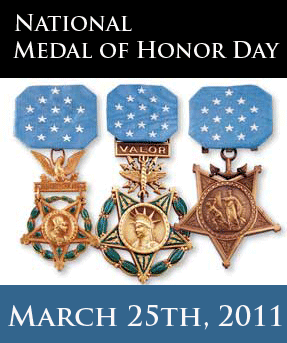
National Medal of Honor Day: Let’s not forget our heroes on March 25th, 2011


National Medal of Honor Day is officially observed on March 25th. The Medal of Honor is the highest distinction that can be awarded by the President, in the name of the Congress, to members of the Armed Forces who have distinguished themselves conspicuously by gallantry and intrepidity at the risk of their lives above and beyond the call of duty.

“This holiday should be one of our most revered. Unfortunately all too many Americans are not even aware of its existence.” Home of Heroes

The date of March 25th was chosen because the first Medals of Honor were awarded to members of Andrew’s Raiders on March 25, 1863, for their actions during the “Great Locomotive Chase.”

Col. Robert Howard (USA Ret.) president of the Congressional Medal of Honor Society on National Medal of Honor Day states:

“Hard times ask us to put a greater good before our own interests. It is sometimes physically or emotionally painful. Yet throughout history, you will find common men and women who fought selflessly in a variety of ways for something so much larger than just their own benefit.

Today, we’re fighting terrorism and the spread of tyranny. We’re challenged by market upheaval, joblessness and perhaps hunger. But the human spirit is resilient and can withstand more than sometimes we are able to immediately comprehend.

It’s up to each of us to not lay and wait for better days, but instead look for opportunities to make the lives of those around us better. National Medal of Honor Day is not a celebration. It is a solemn time to reflect on the freedom we enjoy, its price, and how our own bravery can improve the world around us.”

Home of Heroes, a premier resource of Medal of Honor information on the internet suggests:

“National Medal of Honor day is celebrated in some communities, however for the most part the occasion comes and goes with little notice. As a patriotic American there are a few things you can do to commemorate this day:

  • Fly your flag with pride and patriotism on this day.
  • Remember our heroes. As a gesture of your appreciation, why not take just a few moments in the week prior to National Medal of Honor Day to mail a “Thank You” card to one of our living Medal of Honor recipients. You can find a list of the living as well as information on writing to them among the pages of the Home of Heroes website or contact the Congressional Medal of Honor Society who will forward the letter to the Medal of Honor Recipient.
  • Inform your local media. Most newspapers aren’t even aware that this special day exists. Why not tip your local media to the occasion. Before you do, check out the Home of Heroes database for Medal of Honor recipients from your city and state as well as any who might be buried in your city. This information can give your media a “local angle” that can increase the probability that they will consider doing a story to remind Americans of our heroes.
  • If there is a Medal of Honor recipient buried in your home town, get a school class, scout troop, or other youth organization to “adopt a grave site”.

Please visit the Home of Heroes website and the Educational Resources section of Medal of Honor News.

Also read our upcoming article: Lesson plans for History and Social Studies teachers on National Medal of Honor Day, March 25th, 2011


Fly your flag for President’s Day, 2011

February 21, 2011

Fly your flag today.

White House at night

White House with U.S. flag at night; photo by Keith Stanley, kestan.com

Residents of the United States celebrate Presidents Day today, a holiday that grew out of celebrations of the birthdays of both George Washington (February 22, 1732) and Abraham Lincoln (February 12, 1809), both of whom were born in February (under the “new” Gregorian calendar).

President’s Day is one of a score of dates Congress recognized in the Flag Code as appropriate for patriotic display of the U.S. flag.

Note: Keith Stanley sells his photos, including this one of the White House at night. You can view this one, and many more, and purchase copies, at Mr. Stanley’s website.


September 11, Patriot Day — Fly Your Flag Today

September 11, 2010

Americans are urged to fly flags today, at half-staff, in honor of patriots and those who died in the attacks on the U.S. on September 11, 2001.

According to Cornell University’s Legal Information Institute, the law says:

§ 144. Patriot Day

(a) Designation.— September 11 is Patriot Day.

(b) Proclamation.— The President is requested to issue each year a proclamation calling on—

(1) State and local governments and the people of the United States to observe Patriot Day with appropriate programs and activities;
(2) all departments, agencies, and instrumentalities of the United States and interested organizations and individuals to display the flag of the United States at halfstaff on Patriot Day in honor of the individuals who lost their lives as a result of the terrorist attacks against the United States that occurred on September 11, 2001; and
(3) the people of the United States to observe a moment of silence on Patriot Day in honor of the individuals who lost their lives as a result of the terrorist attacks against the United States that occurred on September 11, 2001.

Patriot Day formerly occurred earlier in the year; information on flag flying has not been added to the Flag Code portions of U.S. law, and consequently this news gets missed.

Fly your flag today, at half-staff. Remember when flying a flag at half-staff, it is first raised to full staff, then slowly lowered to the half-staff position. When the flag is retired at the end of the day, it should again be crisply raised to the full-staff position before being lowered.

A flag attached to a pole that does not allow a half-staff position should be posted as usual.

A National Day of Service

September 11 is also designated as a national day of service, under the Edward M. Kennedy Serve America Act, Public Law 111-13 (April 21, 2009). The Corporation for National and Community Service is charged with encouraging appropriate service in honor of the day and in honor of those who died.

National Day of Service and Remembrance

Date(s): September 11, 2010
Location: National

Description
On April 21, 2009, President Barack Obama signed legislation that for the first time officially established September 11 as a federally recognized National Day of Service and Remembrance.

By pledging to volunteer, perform good deeds, or engage in other forms of charitable service during the week of 9/11, you and your organization will help rekindle the remarkable spirit of unity, service and compassion shared by so many in the immediate aftermath of the attacks. And you’ll help create a fitting, enduring and historic legacy in the name of those lost and injured on 9/11, and in tribute to the 9/11 first responders, rescue and recovery workers, and volunteers, and our brave military personnel who continue to serve to this day.

Check in your own community to find opportunities for service projects.


Michigan’s flags at half-staff for 9/11 remembrance

September 10, 2010

From Michigan Gov. Jennifer Granholm:

September 9, 2010

Granholm Encourages Citizens to Observe September 11, National Day of Service and Remembrance

LANSING – Governor Jennifer M. Granholm is encouraging Michigan citizens to observe the National Day of Service and Remembrance on Saturday by lowering flags and observing a moment of silence in tribute to victims and heroes of the September 11 terrorist attacks on the United States .  In April 2009, President Obama signed the Edward M. Kennedy Serve America Act, which officially recognized September 11 as a National Day of Service and Remembrance. Saturday marks the ninth anniversary of the attacks.

In compliance with an executive order issued by Governor Granholm, flags will be flown at half-staff Saturday in remembrance of those who lost their lives on September 11, 2001.  Granholm also encouraged citizens to observe a moment of silence on Saturday at 8:46 a.m., the time the first plane crashed into the North Tower at the World Trade Center .

“Let us all observe a moment of silence to reflect on and remember the tragedy of September 11,” Granholm said.  “In our reflections, let us honor the memories of the victims and heroes of that day and keep their loved ones in our thoughts and prayers.”

Executive Order 2006-10 provides for the lowering of flags to honor those who lost their lives on September 11, 2001, and is consistent with federal law which designates September 11 of each year Patriot Day.  For more information on the proclamation designating each September 11 Patriot Day, visit the Michigan Department of Military and Veterans Affairs website at www.michigan.gov/dmva

When flown at half-staff or half-mast, the United States flag should be hoisted first to the peak for an instant and then lowered to the half-staff or half-mast position.  The flag should again be raised to the peak before it is lowered for the day.  Procedures for flag-lowering were detailed by Governor Granholm in Executive Order 2006-10.

Governor Granholm will volunteer at a Habitat for Humanity event in East Lansing on Saturday in recognition of the National Day of Service.

For information on volunteer opportunities across the state, visit the Michigan Community Service Commission at www.michigan.gov/volunteer or www.serve.gov

# # #


What about the crazy, militant Christians?

September 9, 2010

Pastor Joe Leavell, recently a frequent bather in Millard Fillmore’s Bathtub, reports on the crazy — it doesn’t involve burning anybody’s scripture, but it’s pretty offensive.

Not sure if you heard about the first army chaplain to have been killed since the 70s, but he was killed on Aug. 30th in Afghanistan. Several pastors I know knew him as a personal dear friend – a true American hero who loved God, loved the troops he served, and gave his life going above and beyond to be with them.

Guess who will be there protesting his funeral? Westboro Baptist Church – protesting the funeral of a Baptist chaplain! The only way it ties in to this discussion is the “should factor”, but I’m sorry – I just had to voice that this sort of stuff is so disgraceful and makes me so upset – especially when our soldiers are dying to give them the freedom to protest at their funerals! :-( For shame!

Here’s the news article:
kktv.com/military/headlines/102406419.html

At KKTV’s site the story is very short; here it is the complete article:

Posted: 9:54 PM Sep 7, 2010
Reporter: KKTV News
Email Address: news@kktv.com

A controversial Baptist Church group from Kansas says they’ll be in Southern Colorado to protest at a funeral for an army chaplain who was killed in Afghanistan.

Captain Dale Goetz died August 30 in Afghanistan. He’s the first army chaplain to die in combat since 1970.

A funeral has been set for Thursday at Fort Carson, and that’s where the Westboro Baptist Church says they’ll be as well to protest.

Members of the church have repeatedly protested the acceptance of homosexuals by picketing at the funerals of fallen soldiers.

It’s very controversial move.

11 News is asking what do you think about the planned demonstration? We’d like to hear from you. Just comment on this story on the 11 news Facebook page or here on kktv.com.

Time Magazine’s blog carries more details of Pastor Goetz’s life and an interesting tribute to the value of military chaplains in war.

He [Goetz] acknowledged that Muslim concerns over what they perceive as a degenerate Western culture can drive some Muslims toward terror. “As Americans we repudiate the practice of the terrorist,” he said. “Though I disagree with their practice, I do understand their complaints against western society.” Goetz wondered if Americans are devoted to something so much that they would willingly die for it. “Our love for freedom is worth dying for,” he concluded, “and many have gone before us to preserve this freedom.”

Read more: http://swampland.blogs.time.com/2010/09/03/army-chaplain-dale-goetz-rip/#ixzz0z25p1eqN

(South Dakota will fly flags at half-staff today, September 9,  in Goetz’s honor. See also the post at Urban Grounds.)

Early in the U.S. involvement in World War II Americans had to put up with those factions who had argued that the U.S. should intervene on Germany’s side in Europe.  But I don’t recall that the pro-Germany groups kept up their protests much after Germany declared war on the U.S.  In the long arc of the history of our wars in Afghanistan and Iraq, America’s longest-ever wars, does a sense of history and honor smack the crazies in Christian pulpits in the head to make them think?

Our Constitution’s strength proves itself over and over, as courts have ruled that Westboro Baptist has the right to make these protests.  Their continued exercise of that right is a testament against the lack of a national education system and against the virtue of religion in the failure of common decency of the tiny band of protesters.  Al Queada draws strength from the protests of the Westboro crew, and al Quaeda draws recruits from the actions of the Florida band who plans to burn scriptures.

Walt Kelly’s Pogo observed, “We has met the enemy, and he is us.”

Update: You couldn’t make this stuff up if you tried:  The Westboro Baptist group is angry that their burning of a Qur’an many months ago didn’t get them more attention.  I am reminded that James Earl Ray and Timothy McVeigh both expressed disappointment that their work didn’t get more attention and sympathetic action, too.


Labor Day 2010 – Fly your flag!

September 6, 2010

Free Labor Will Win, poster from 1942, (Library of Congress)

Poster from the Office of War Information, 1942

It’s Labor Day 2010 in the United States, a federal holiday, and one of those days Americans are urged to fly the U.S. flag.

The poster was issued by the Office of War Information in 1942, in full color.  A black-and-white version at the Library of Congress provides a few details:

Labor Day poster. Labor Day poster distributed to war plants and labor organizations. The original is twenty-eight and one-half inches by forty inches and is printed in full color. It was designed by the Office of War Information (OWI) from a photograph especially arranged by Anton Bruehl, well-known photographer. Copies may be obtained by writing the Distribution Section, Office of War Information


They’re all our kids

July 29, 2010

Which kid is yours?

Scouts at the Arena Show, Day 3, 2010 National Jamboree

Scouts at the Arena Show, Day 3, 2010 National Jamboree - "Scouts carry in American flags to start the opening arena show in Ft. A.P. Hill, Va., Tuesday July 27, 2010. Photo by Daniel Giles" (from Flickr stream)

All of them.


July 4, 2010 – Fly your flag today

July 4, 2010

Fourth of July:  NPR has already read the Declaration of Independence, PBS has the Capitol Fourth concert this evening (8:00 p.m. Eastern — check your local listings), your town has a parade somewhere this weekend, and fireworks are everywhere.

Remember to put your flag up today.

Astronaut Eugene Cernan and the U.S. Flag -- Apollo 17 on the Moon (NASA photo)

Last flag on the Moon: Astronaut Eugene Cernan and the U.S. Flag -- Apollo 17 on the Moon (NASA photo)

Also:

Lunar Reconnaissance Orbiter photo of Apollo 17 landing site

Lunar Reconnaissance Orbiter photo of Apollo 17 landing site


Patriotic shame of Corpus Christi, Texas

July 2, 2010

Flag in Corpus Christi, Texas, at corner of Staples and Craig - photo by Ed Darrell - IMGP4383

This flag needs to be retired. Will some patriot step up to the job?

Leaving Corpus Christi can be a trial.  It’s at least a 15 mile drive from the American Banking Center to Interstate 37, if you go by the Starbucks on Staples to get coffee for the drive back to Dallas.  (It’s a 100-yard drive otherwise.)

Tourist that I am I drove Staples all the way back, to see the nitty-gritty of the town.

Must it be this gritty?

The flag above, if it can still be considered a flag, struggles to honor our nation at the corner of Staples and Craig Streets.  Clearly this is not a flag that is retired at sundown, as the U.S. flag code urges.  It looks as though it has been flying there for at least a year.  Perhaps it has flown since September 11, 2001.  Perhaps it has flown since the War of 1812.

When a flag becomes tattered, it should be mended, appropriate for a symbol of our nation.  When it can no longer be repaired, it should be retired, according to the Congressional Research Service Report for Congress — The United States Flag:  Federal Law Related to Display and Associated Questions (pages 11 and 12):

Destruction of Worn Flags

The Flag Code states:

The flag, when it is in such condition that it is no longer a fitting emblem for display, should be destroyed in a dignified way, preferably by burning.*  The act is silent on procedures for burning a flag. It would seem that any procedure which is in good taste and shows no disrespect to the flag would be appropriate. The Flag Protection Act of 1989,38 struck down albeit on grounds unrelated to this specific point,39 prohibited inter alia “knowingly” burning of a flag of the United States, but excepted from prohibition “any conduct consisting of disposal of a flag when it has become worn or soiled.”

4 U.S.C. § 8(k).

Do we have any readers in Corpus Christi?  Could you drop by the shop where this flag is flown sometime through the week, and ask them to retire the flag, as an act of honor for our nation?

Thank you.


Something to think about as you get your flag ready to fly for July 4

July 2, 2010

This is mostly an encore post, from last year.

July 4th is the 234th anniversary of the announcement of the Declaration of Independence.  I hope you’re thinking about how you’ll fly the flag this weekend in honor of the Declaration of Independence.

The resolution proposed by Richard Henry Lee calling for independence of the 13 colonies passed the Continental Congress on July 2, 1776.  The Declaration would be Thomas Jefferson’s crowning achievement, outshining even his presidency and the Louisiana Purchase.   John Adams wrote to his wife, Abigail, that July 2 would forever be marked by patriotic displays.

But the Declaration itself, which gave teeth to the resolution, was adopted two days later on July 4 — and that has come to be the day we celebrate.

Detail, John Trumbull's Signing of the Declaration of Independence - Theodor Horydczak photo, Library of Congress

Detail, John Trumbull's Signing of the Declaration of Independence - The committee of five presents the Declaration of Independence to John Hancock, the President of the Second Continental Congress; from left, the committee is John Adams, Robert Livingston, Roger Sherman, Thomas Jefferson, and Ben Franklin. Theodor Horydczak photo, Library of Congress

Adams didn’t miss a beat.  Who quibbles about a couple of days when the celebrating is so good?

Adams and Jefferson were two of the five-member committee the Congress had tasked to write a declaration.  Adams and Ben Franklin quickly determined to leave it up to Jefferson, who had a grand flair with words, and who had just written a couple of stirring documents for Virginia.  Roger Sherman and Robert Livingston, the other two members, went along.  And so it was that the Declaration of  Independence is almost completely the work of Thomas Jefferson.

Adams and Jefferson became friends only later, when they both served the nation at war as ambassadors to France, and then for Adams, to England.  A widower, Jefferson was taken in by Abigail Adams who worried about him.  After the war, Jefferson was in England when Adams was to meet King George III in a grand ceremony in which the king would accept the credentials of all the ambassadors of foreign nations to England.  As the king strode down the line, each ambassador or delegation would bow, the king would acknowledge them, the papers would be passed, and the king would move on.  Adams and Jefferson bowed.  King George moved on, ignoring them completely.

In such a case of such a snub, the snubbed foreigners usually made a quick exit.  Adams and Jefferson did not.  They stood at attention as if the king had treated them like all the rest, reversing the snub.  From the beginning, Americans and the United States pushed for more practical, reasonable, and compassionate government and relations.

Back in America in peacetime, and both members of the administration of George Washington, Adams and Jefferson fell out.  Secretary of State Jefferson favored a more limited federal government; Vice President Adams favored a more powerful one.  By the end of Washington’s second term, party politics had been well developed.  Adams defeated Jefferson in the election of 1796.  As was the law then, Jefferson was vice president as the runner-up vote getter in the electoral college; but Adams kept Jefferson out of all government affairs.  Perhaps because he didn’t have Jefferson to help, Adams’s presidency did not go well.  In the rematch election in 1800, one of  the bitterest fights ever, Jefferson’s party defeated Adams.  The gleeful Democratic-Republican electors all voted one ballot for Jefferson, the presidential candidate, and one ballot for Aaron Burr, the party’s vice presidential candidate.

Alas, that produced a tie vote in the electoral college.  Adams’s party, the Federalists, still held the House of Representatives before the new Congress came in.  A tie vote goes to the House for decision.  They could not bring themselves to vote for Jefferson, and the deadlock continued for 37 ballots.  Finally Jefferson’s former friend but now arch enemy Alexander Hamilton intervened, explaining that Burr was clearly the greater scoundrel, and the House elected Jefferson.  Adams slunk out of town, avoiding the inauguration.

It wasn’t until after 1809 when Benjamin Rush hoodwinked Jefferson into writing to Adams, and Adams to Jefferson, that the two became friendly again.  For the next 17 years Jefferson and Adams carried on perhaps the greatest series of correspondence in history between two great minds.  Letters went out almost daily, from Monticello, Virginia,  to Braintree, Massachusetts, and from Braintree to Monticello.  They discussed the weather, their families, old times, farming — but especially the republic they had been most instrumental in creating, and how it might be preserved, and prosper.  Eventually the letters became harder to read, both because their eyesight was failing, and because their penmanship deteriorated, too.

The ideas, however, flowed like a great river of freedom.

Letter from Thomas Jefferson to John Adams, August 15th, 1820 - Library of Congress image

Letter from Thomas Jefferson to John Adams, August 15th, 1820. From The Thomas Jefferson Papers at the Library of Congress, Thomas Jefferson Papers Series 1. General Correspondence. 1651-1827. Library of Congress image

Both men took ill early in 1826.  This was a landmark year, 50 years since the Declaration of Independence.  In Massachusetts, a grand display of fireworks was to cap off a day of feasting and celebration.  Adams hoped he might attend.  In Virginia, a week before, it became clear Jefferson was too ill to venture even as close as Charlottesville for the celebration.  Jefferson slept through most of July 3, but awoke about 9:00 p.m., and asked, “This is the fourth?”  It was not.  These are the last significant, recorded words of Jefferson.  He awoke at about 4:00 a.m. on the Fourth of July, 1826, but could not make a rally.  He died at 12:50 in the afternoon.

Adams, too, was too ill to attend the celebrations.  In the late afternoon or early evening of the Fourth, he awoke, and heard the celebration in the town.  Almost as if he had worked just to live to see that particular day, he checked the date.  Realizing he was near the end, happy that he’d seen 50 years after the Declaration, and unaware of the events earlier that day in Virginia, Adams said, “Thomas Jefferson still survives.”  Adams, too, died on July 4, 1826.

Fly your flag July 4th. Remember John Adams and Thomas Jefferson.  Remember their great work in creating the nation that protects our freedoms today.  Remember their great friendship.  Write a letter to a good friend you’ve not written to lately.

It is Independence Day this Sunday.  Their spirit survives in us, as we celebrate, and if we remember why we celebrate.


1943 conflict: Flag, First Amendment’s Establishment Clause

June 14, 2010

Historic irony: On Flag Day in 1943, the U.S. Supreme Court issued its decision in the case of West Virginia vs. Barnette.

Billy Gobitis explained why he would not salute the U.S. flag, November 5, 1935 - Library of Congress collection

Image 1 - Billy Gobitas explained why he would not salute the U.S. flag, November 5, 1935 - Library of Congress collection

The case started earlier, in 1935, when a 10-year-old student in West Virginia, sticking to his Jehovah’s Witness principles, refused to salute the U.S. flag in a state-required pledge of allegiance. From the Library of Congress:

“I do not salute the flag because I have promised to do the will of God,” wrote ten-year-old Billy Gobitas (1925-1989) to the Minersville, Pennsylvania, school board in 1935. His refusal, and that of his sister Lillian (age twelve), touched off one of several constitutional legal cases delineating the tension between the state’s authority to require respect for national symbols and an individual’s right to freedom of speech and religion.

The Gobitas children attended a public school which, as did most public schools at that time, required all students to salute and pledge allegiance to the flag of the United States. The Gobitas children were members of the Jehovah’s Witnesses, a church that in 1935 believed that the ceremonial saluting of a national flag was a form of idolatry, a violation of the commandment in Exodus 20:4-6 that “thou shalt not make unto thee any graven image, nor bow down to them. . . .” and forbidden as well by John 5:21 and Matthew 22:21. On 22 October 1935, Billy Gobitas acted on this belief and refused to participate in the daily flag and pledge ceremony. The next day Lillian Gobitas did the same. In this letter Billy Gobitas in his own hand explained his reasons to the school board, but on 6 November 1935, the directors of the Minersville School District voted to expel the two children for insubordination.

The Watch Tower Society of the Jehovah’s Witnesses sued on behalf of the children. The decisions of both the United States district court and court of appeals was in favor of the right of the children to refuse to salute. But in 1940 the United States Supreme Court by an eight-to-one vote reversed these lower court decisions and ruled that the government had the authority to compel respect for the flag as a key symbol of national unity. Minersville v. Gobitis [a printer’s error has enshrined a misspelling of the Gobitas name in legal records] was not, however, the last legal word on the subject. In 1943 the Supreme Court by a six-to-three vote in West Virginia State Board of Education v. Barnette, another case involving the Jehovah’s Witnesses, reconsidered its decision in Gobitis and held that the right of free speech guaranteed in the First Amendment to the Constitution denies the government the authority to compel the saluting of the American flag or the recitation of the pledge of allegiance.

There had been strong public reaction against the Gobitis decision, which had been written by Justice Felix Frankfurter (1882-1965). In the court term immediately following the decision, Frankfurter noted in his scrapbook that Justice William O. Douglas (1898-1980) told him that Justice Hugo LaFayette Black (1886-1971) had changed his mind about the Gobitis case. Frankfurter asked, “Has Hugo been re-reading the Constitution during the summer?” Douglas replied, “No–he has been reading the papers.”1 The Library’s William Gobitas Papers showcase the perspective of a litigant, whereas the abstract legal considerations raised by Gobitis and other cases are represented in the papers of numerous Supreme Court justices held by the Manuscript Division.

1. Quoted in H. N. Hirsch, The Enigma of Felix Frankfurter (New York: Basic Books, 1981), 152.

John E. Haynes and David Wigdor, Manuscript Division

Second page, Billy Gobitiss explanation of why he will not salute the U.S. flag - Library of Congress

Second page, Billy Gobitas's explanation of why he will not salute the U.S. flag: "I do not salute the flag not because I do not love my country but I love my country and I love God more and I must obey His commandments." - Library of Congress

Supreme Court justices do not often get a chance to reconsider their decisions. For example, overturning Plessy vs. Ferguson from 1896 took until 1954 in Brown v. Topeka Board of Education. In the flag salute/pledge of allegiance cases Justice Hugo Black had a change of mind, and when a similar case from West Virginia fell on the Court’s doorstep in 1943, the earlier Gobitis decision was reversed.

Writing for the majority, Justice Robert H. Jackson said:

If there is any fixed star in our constitutional constellation, it is that no official, high or petty, can prescribe what shall be orthodox in politics, nationalism, religion, or other matters of opinion, or force citizens to confess by word or act their faith therein. If there are any circumstances which permit an exception, they do not now occur to us.

Jehovah’s Witnesses, and all other Americans, thereby have the right to refuse to say what they and their faith consider to be a vain oath.

And that, boys and girls, is what the First Amendment means.

Resources: