As on every federal holiday, citizens and residents of the U.S. should fly their U.S. flags today, on the holiday marking the birth of the Rev. Dr. Martin Luther King, Jr.
Rev. King, and the U.S. flag. (No information on place or time of photo; please feel free to lend light and facts.)
President William Howard Taft signing the bill that made New Mexico a state, in 1912. (Other people in the photo, I have not yet identified). Image from OldPicture.com
New Mexico became the 47th member of the Union on January 6, 1912. New Mexicans should fly their U.S. flags today in honor of statehood, the U.S. Flag Code urges.
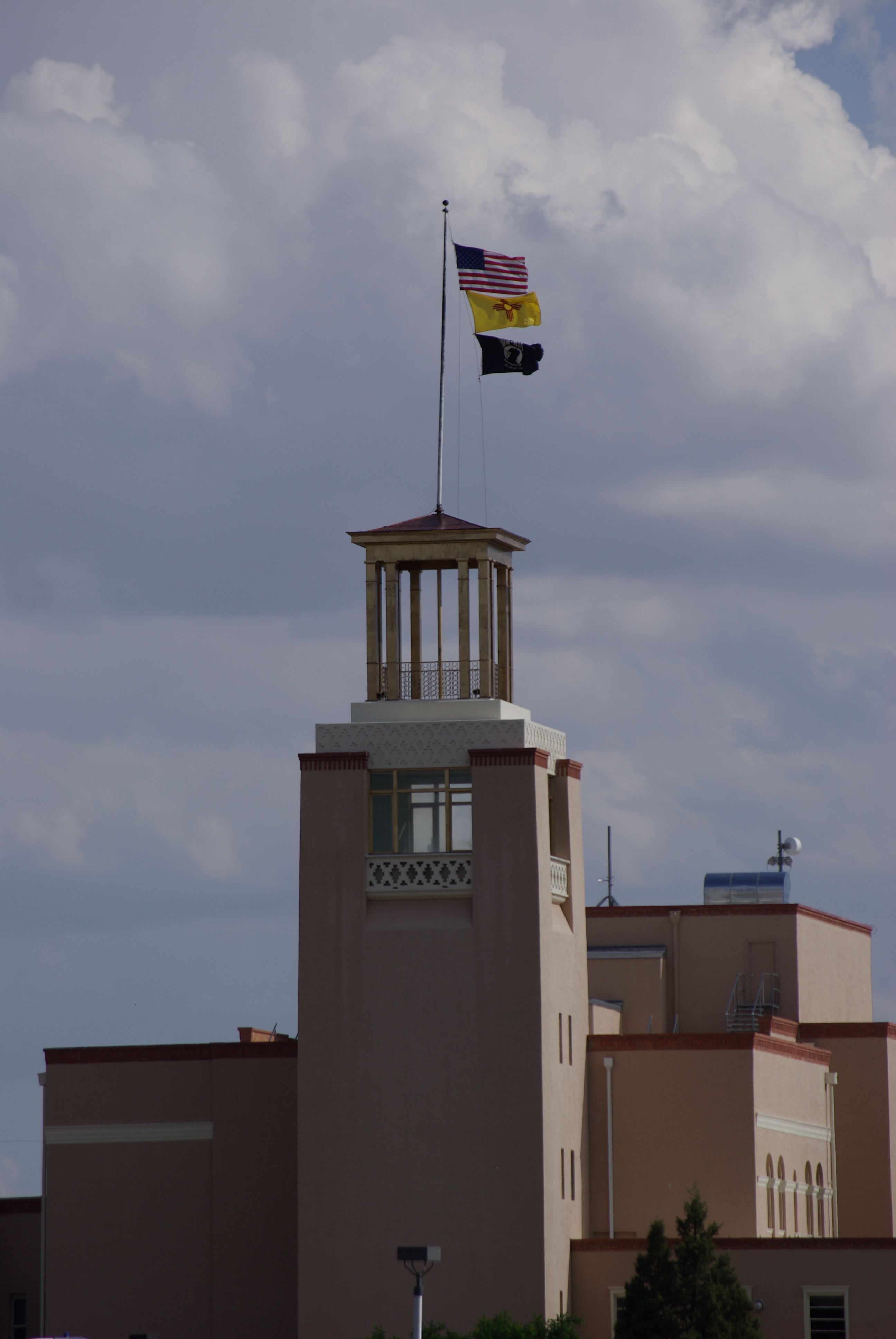
U.S. and New Mexico flags fly from the state education administration building in Santa Fe, 2014. The third flag is the U.S. POW/MIA flag.
I don’t think Statehood Day is a big deal in New Mexico. New Mexicans love art, though, and statehood and history of the land and the peoples who live there are celebrated throughout Santa Fe and New Mexico. The New Mexico Art Museum features a lot about history.
The New Mexico State Capitol is one of the more unique in the U.S. There is no grand dome. Instead, the building is a large, circular structure, a giant kiva, honoring New Mexico’s ancient residents and ancestors.
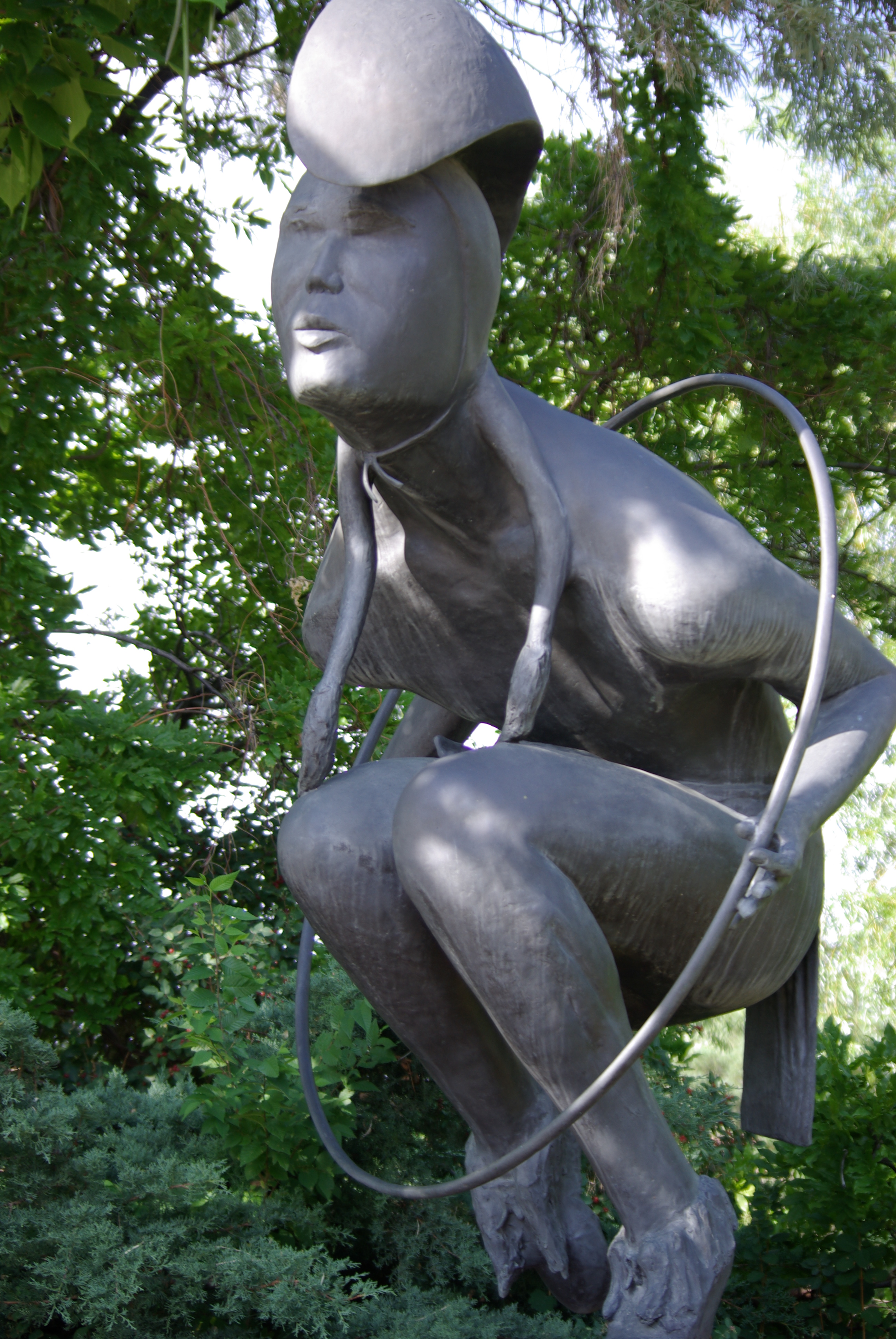
“Emergence,” a representation of the creation of the present Earth and people, by Michael A. Naranjo, 2000. Part of the massive collection of New Mexico Art at the State Capitol — this one outside the building itself.
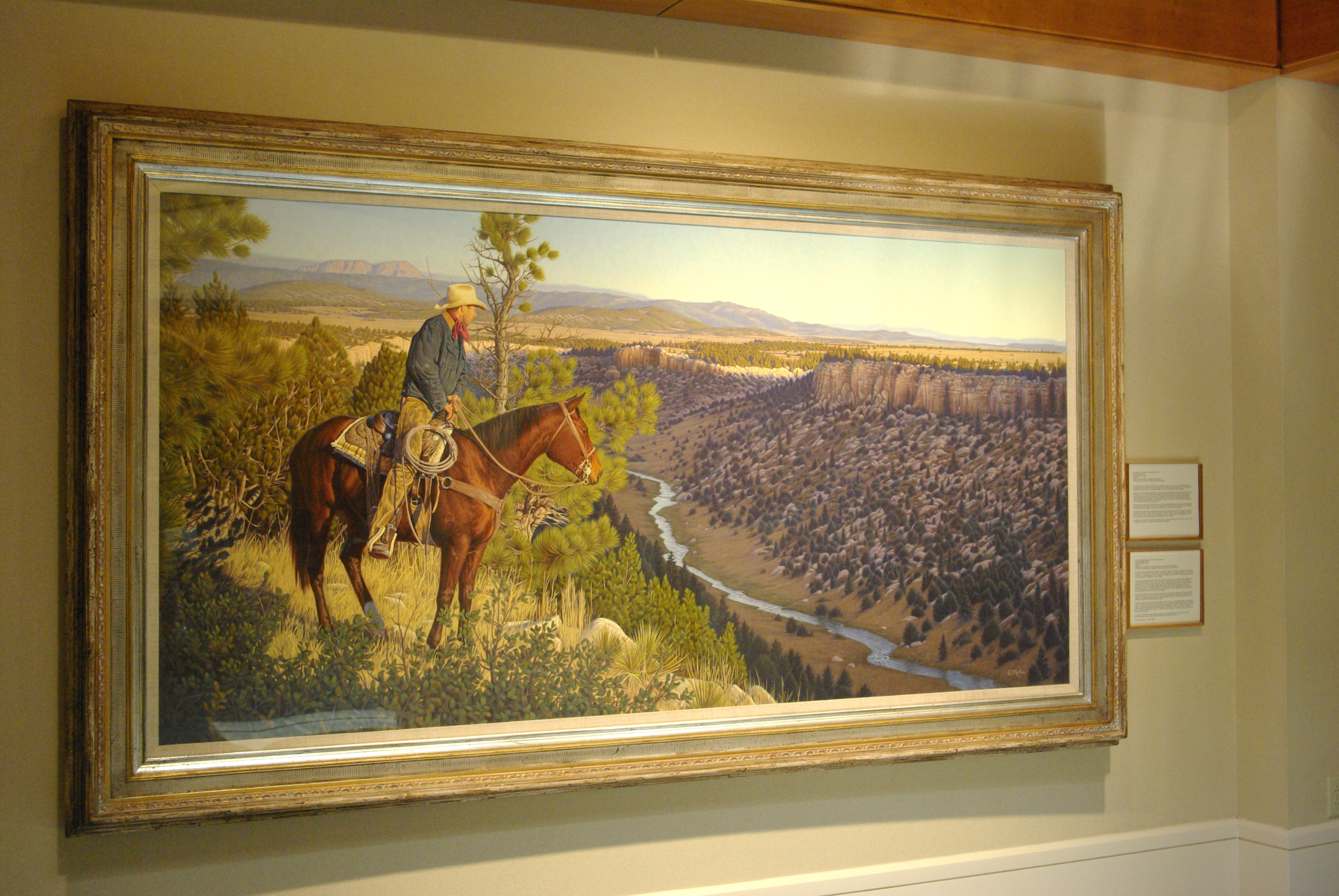
Simple Pleasures of New Mexico, stunning painting in acrylic by Gary Morton, 1992
If you’re in Santa Fe, plan to spend a half of a day, at least, looking at the Capitol and its art collections. There are more than 400 pieces on display, sculpture, paintings, mixed media, and more. It’s a world class gallery, free for the browsing. Much of the art packs a powerful emotional punch, too, such as the sculpture outside the building honoring the vanished native tribes of North America.
USPS stamp honoring the centennial of New Mexico’s statehood, in 2012. The stamp features a representation of the beauty of the state found in its desert hills and mountains. VirtualStampClub.com
Spread the word; friends don't allow friends to repeat history.
South entrance (main) to the Utah State Capitol, with U.S. and Utah flags flying on the single flag poll, and the snow-dusted Wasatch Mountains in the background. Utah State Law Library photo.
Utah joined the Union on January 4, 1896. It had been a 49-year slog to statehood for Deseret, the Mormon settlement in the Desert. The size had been pared down, so it would not be the biggest state, incorporating parts of what is now Nevada, Arizona, Oregon, Idaho, Colorado and New Mexico. New capitals had been tried and cast aside (Fillmore, Utah). Democratic Party rule was broken when LDS church authorities went door-to-door, calling every other family to the Republican Party, and party parity. The Mormon Church abandoned polygamy, and adopted a state constitution that gave the vote to women.
Iowans may fly their flags today in celebration of the anniversary of Iowa statehood. Iowa’s admission to the Union came on December 28, 1846; Iowa was the 29th state admitted.
“Millions of acres. Iowa and Nebraska. Land for sale on 10 years credit by the Burlington & Missouri River R. R. Co. at 6 per ct interest and low prices.” Poster advertising land in Iowa, circa 1872, from the Burlington & Missouri River Railroad Co. – Library of Congress Printed Ephemera Collection; Portfolio 134, Folder 13; via Wikipedia
American Flag, Spencer, Iowa, 1996 – caption from the National Geographic Society: A man rolls up U.S. flags at the end of the Clay County Fair in Spencer, Iowa. “Although the population of Spencer is only about 12,000, the fair draws some 300,000 visitors. Once a year, rising from the endless flatness of the Iowa countryside, a crowd forms—to stroll, to hear big country music acts like the Statler Brothers, to sell a grand champion boar, to buy a new silo.” (Photographed on assignment for, but not published in, “County Fairs,” October 1997, National Geographic magazine) Photograph by Randy Olson; copyright National Geographic Society
President Obama paid respects to those who died at Pearl Harbor on a visit in 2011; White House caption: President Barack Obama places a wreath at the USS Arizona Memorial, part of the World War II Valor in the Pacific National Monument, in Pearl Harbor, Hawaii, Dec. 29, 2011. (Official White House Photo by Pete Souza)
From the White House:
Presidential Proclamation — National Pearl Harbor Remembrance Day, 2014
NATIONAL PEARL HARBOR REMEMBRANCE DAY, 2014
– – – – – – –
BY THE PRESIDENT OF THE UNITED STATES OF AMERICA
A PROCLAMATION
On the morning of December 7, 1941, Japanese planes thundered over Hawaii, dropping bombs in an unprovoked act of war against the United States.The attack claimed the lives of more than 2,400 Americans.It nearly destroyed our Pacific Fleet, but it could not shake our resolve.While battleships smoldered in the harbor, patriots from across our country enlisted in our Armed Forces, volunteering to take up the fight for freedom and security for which their brothers and sisters made the ultimate sacrifice.On National Pearl Harbor Remembrance Day, we pay tribute to the souls lost 73 years ago, we salute those who responded with strength and courage in service of our Nation, and we renew our dedication to the ideals for which they so valiantly fought.
In the face of great tragedy at Pearl Harbor — our first battle of the Second World War — our Union rallied together, driven by the resilient and unyielding American spirit that defines us.The millions of Americans who signed up and shipped out inspired our Nation and put us on the path to victory in the fight against injustice and oppression around the globe.As they stormed the beaches of Normandy and planted our flag in the sands of Iwo Jima, our brave service members rolled back the tide of tyranny in Europe and throughout the Pacific theater.Because of their actions, nations that once knew only the blinders of fear saw the dawn of liberty.
The men and women of the Greatest Generation went to war and braved hardships to make the world safer, freer, and more just.As we reflect on the lives lost at Pearl Harbor, we remember why America gave so much for the survival of liberty in the war that followed that infamous day.Today, with solemn gratitude, we recall the sacrifice of all who served during World War II, especially those who gave their last full measure of devotion and the families they left behind.As proud heirs to the freedom and progress secured by those who came before us, we pledge to uphold their legacy and honor their memory.
The Congress, by Public Law 103-308, as amended, has designated December 7 of each year as “National Pearl Harbor Remembrance Day.”
NOW, THEREFORE, I, BARACK OBAMA, President of the United States of America, do hereby proclaim December 7, 2014, as National Pearl Harbor Remembrance Day. I encourage all Americans to observe this solemn day of remembrance and to honor our military, past and present, with appropriate ceremonies and activities.I urge all Federal agencies and interested organizations, groups, and individuals to fly the flag of the United States at half-staff this December 7 in honor of those American patriots who died as a result of their service at Pearl Harbor.
IN WITNESS WHEREOF, I have hereunto set my hand this fifth day of December, in the year of our Lord two thousand fourteen, and of the Independence of the United States of America the two hundred and thirty-ninth.
BARACK OBAMA
If your flag staff doesn’t have a half-staff ability, fly the flag anyway.
If you’re wondering: no, this flag-flying date has not been added to the Flag Code; but according to the law, it will recur every year.
Illinois entered the Union on December 3, 1818. The twenty-first state takes its name from the Illinois Confederation—a group of Algonquian-speaking tribes native to the area. An Algonquian word, “Illinois” means “tribe of superior men.”
Remnants of a much earlier Algonquin civilization thought the most sophisticated prehistoric society north of Mexico, are preserved at the Cahokia Mounds State Historic Site in the southwestern part of the state.
French explorers Louis Jolliet and Jesuit Father Jacques Marquette entered the Illinois region in 1673. Control of the territory passed to Great Britain in 1763. When the United States acquired the land that became Illinois Territory in 1783, most European settlers there were of French descent. In 1788, the Continental Congress received information concerning the inhabitants of the Illinois area. “There are sundry French settlements on the river Mississippi within the tract,” the committee reported:
Near the mouth of the riverKaskaskies, there is a village which appears to have contained near eighty families from the beginning of the late revolution. There are twelve families in a small village at la Prairie duRochers, and near fifty families—the Kahokia village. There are also four or five families at fort Chartres and St. Philips, which is five miles farther up the river. The heads of families in those villages appear each of them to have had a certain quantity of arable land allotted to them, and a proportionate quantity of meadow and of woodland or pasture. The Committee…referred the memorial of George Morgan…respecting a tract of land in the Illinois, June 20, 1788. Documents from the Continental Congress and Constitutional Convention, 1774-1789
Twenty years later, Congress organized the Illinois Territory. Pioneers from Kentucky, Virginia, and Tennessee settled the southern part of the territory, while New Englanders ventured to northern Illinois via the Erie Canal.
Land of Lincoln, the state slogan, pays homage to famous son Abraham Lincoln. Born in Kentucky, Lincoln came to Illinois in 1830. He was instrumental, along with his colleagues in the Illinois legislature, in moving the state capital from Vandalia to Springfield. Settling there in 1837, Lincoln married socially prominent resident Mary Todd, practiced law, and built the political career that brought him the presidency in 1861.
Chicago, a minor trading post at the southwestern tip of Lake Michigan until the 1830s, developed into a railroad hub and industrial center. After the Civil War, industrialization attracted a new wave of immigrants. People from all over the U.S. and the world ventured to Chicago to work in the meat-packing and steel industries. Even the Great Conflagration of 1871 failed to prevent the Windy City from becoming one of the largest urban centers in the country. It remains the third most populous city and metropolitan area in the United States.
Search on Illinois in Map Collections to view a number of small towns in the state. See, for example, an 1880 map of Elgin, an 1869 map of Moline, or an 1869 map of Urbana.
Search on Jolliet or Marquette in France in America both in the interpretive text and collections sections to learn more about these explorers and the settlement of the West.
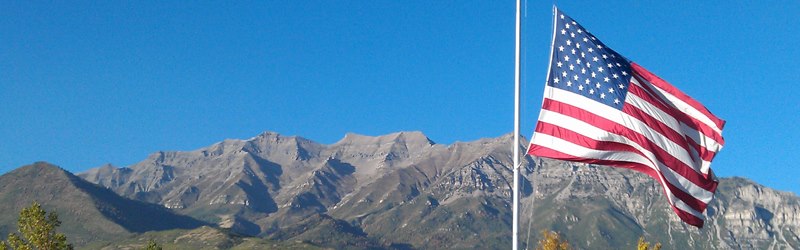
Mt. Timpanogos and the U.S. flag. Photo by Bob Walker of Orem, Utah; from Orem, circa September 2012. That’s Mt. Baldy on the left. This site is about six miles from our old home in Pleasant Grove, Utah, where we celebrated a few dozen Thanksgivings.
Americans load up this particular holiday with significance, often for no particular reason. As a holiday, it is really rather uniquely American. There were feasts of thanksgiving from time to time throughout recorded history, but most often they were one-shot affairs, after a particular event.
In America, Americans eagerly seized on the idea of one day set aside “to give thanks,” both with the religious overtones some wanted to see, and with the commercial overtones others wanted, especially during the Great Depression. In our 238th year since the Declaration of Independence, the 225th year since the Constitution was enacted, we come to Thanksgiving as a major period of travel to old family homesteads, to Thanksgiving as a period of genuine thanks to American troops fighting in foreign lands half a world away, and as a commercial celebration that sucks the sobriety and spirituality out of all but the most dedicated of profiteers, or bargain hunters.
In the early 20th century, some people sent greeting cards for Thanksgiving; this is a tradition overtaken by Christmas, Hanukkah and New Years cards, today. (Image from HubPages, unknown year — credit for cards, “Images courtesy VintageHolidayCrafts.com“
Thanksgiving often stumbled into controversy. George Washington issued proclamations calling for a day of thanks, but struck out all references to Christianity. Some president’s issued similar proclamations up to the Civil War, When Abraham Lincoln used the holiday as a time to remind Americans that they had a lot to be thankful for, partly as a means to keep Americans focused on the war to be won, and keep supporting troops in the field. During the Great Depression, Franklin D. Roosevelt juggled dates for Thanksgiving, moving it earlier in November to create a longer Christmas shopping season, hoping to stimulate sales, and thereby push America further out of the Depression.
In 2001 George W. Bush urged Americans to go shopping so terrorists would know America was not defeated by the attack on the World Trade Center, knowing that a stimulus to the economy would help garner support for other policies.
Children riding large turkeys, waving American flags, made popular images in several years of the early 20th century.
2012 saw controversy over Big Box stores and other major, national retailers pushing their post- Thanksgiving, Christmas sales, into Thanksgiving day itself. Is this fair to employees? Is this too much emphasis on purchasing, and too little emphasis on family and giving thanks?
In 2014, we have the same arguments about Big Box stores pushing “Black Friday” into the holiday, and even more arguments about Christmas creep reducing the importance of Thanksgiving to Americans.
You can be sure of one thing: It’s probably safe to fly your American flag on Thanksgiving, as Congress suggested. It won’t make your turkey more moist or your pumpkin pie taste any better. It won’t boost your sales, if you’re a retailer, nor find you a bargain, if you’re a shopper.
If you have the flag, it costs nothing. Flying the flag makes no particular religious statement, supports no particular political party, supports no one’s favorite football team. Flying the flag earns you nothing, usually.
But as a free act of patriotism, support for our nation, and our troops, and a demonstration that even after a divisive election, we’re all one nation, it’s a pretty good deal.
Navy Day was established on October 27, 1922 by the Navy League of the United States. Although it was not a national holiday, Navy Day received special attention from President Warren Harding. Harding wrote to the Secretary of the Navy Edwin Denby:
“Thank you for your note which brings assurance of the notable success which seems certain to attend the celebration of Navy Day on Friday, October 27, in commemoration of past and present services of the Navy. From our earliest national beginnings the Navy has always been, and deserved to be, an object of special pride to the American people. Its record is indeed one to inspire such sentiments, and I am very sure that such a commemoration as is planned will be a timely reminder.”
“It is well for us to have in mind that under a program of lessening naval armaments there is a greater reason for maintaining the highest efficiency, fitness and morale in this branch of the national defensive service. I know how earnestly the Navy personnel are devoted to this idea and want you to be assured of my hearty concurrence.”
October 27 was suggested by the Navy League to recognize Theodore Roosevelt’s birthday. Roosevelt had been an Assistant Secretary of the Navy and supported a strong Navy as well as the idea of Navy Day. In addition, October 27 was the anniversary of a 1775 report issued by a special committee of the Continental Congress favoring the purchase of merchant ships as the foundation of an American Navy.
Navy Day was last observed on Oct. 27, 1949.
But, of course, it’s still designated in the Flag Code.
Feel free to put your political brickbats in comments.
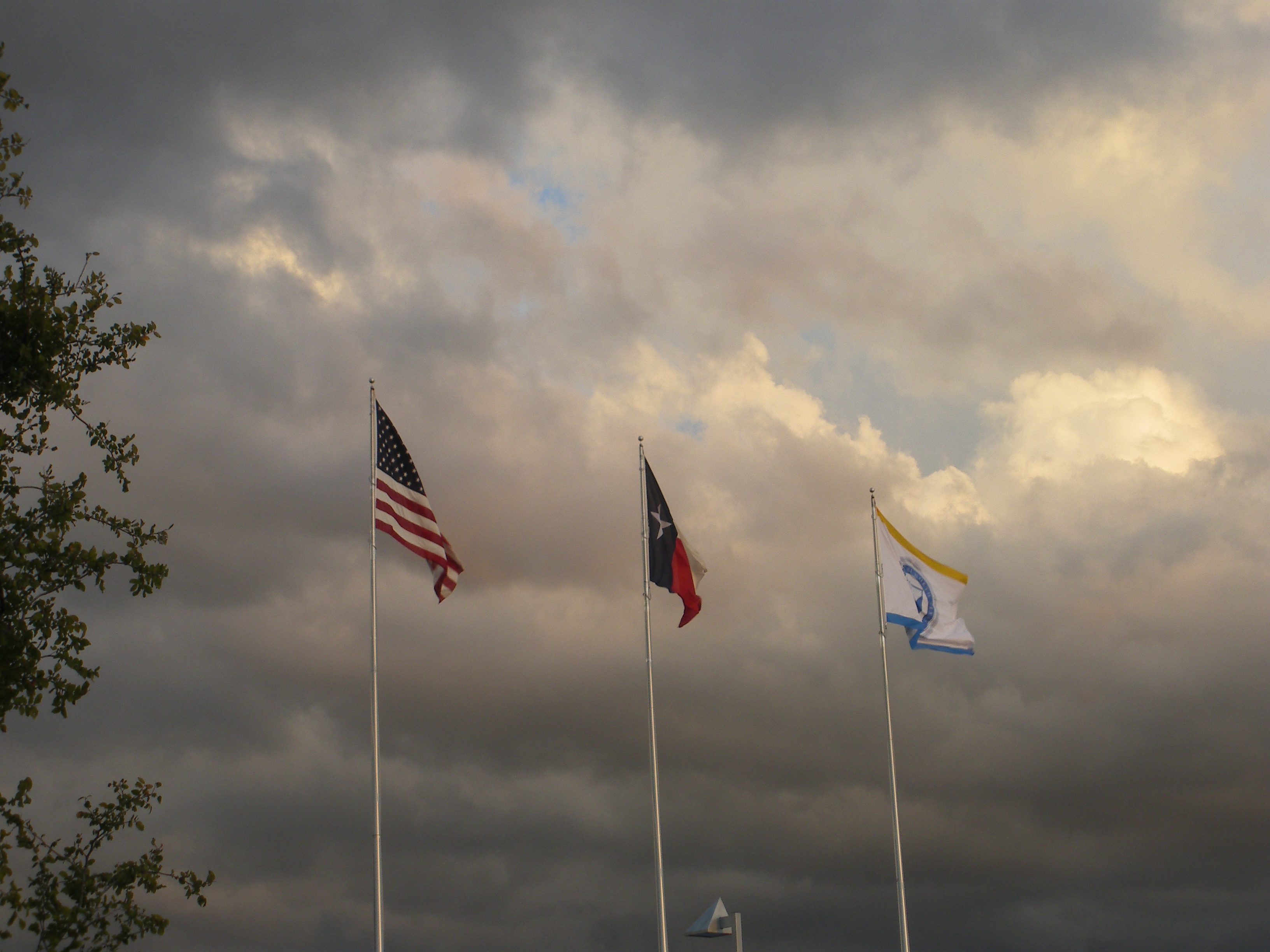
U.S., Texas and University of North Texas at Dallas flags flying on campus, with storm clouds to the South. Photo by Ed Darrell; use encouraged with attribution.
October 12 is the traditional, old calendar date upon which Columbus’s journals show he “discovered” land west of the Atlantic, after sailing from Spain. (Surely there is an explanation for why the date was not altered to conform with the new calendar, but I digress.) In the finite wisdom of Congress, the holiday is designated on the “second Monday of October,” in order to promote three-day weekends and avoid holidays in the middle of the week.
The U.S. Flag Code urges Americans to fly their U.S. flags in honor of certain days. Columbus Day is a traditional (since the 19th century) holiday (especially for descendants of Italian immigrants), and one of the score of dates denoted in the Flag Code.
Amendments 11 through 27 — notice that, although not ratified until 1991, the 27th Amendment was in the package of amendments proposed by James Madison in 1789, a package of twelve proposed amendments, of which ten were ratified within a few months to become the Bill of Rights
Rotunda for the charters of Freedom at National Archives (NARA) building in Washington, D.C. Here displayed are the Declaration of Independence, the Bill of Rights, and the U.S. Constitution. (Photo credit: Wikipedia)
In the United States, Patriot Day, observed as the National Day of Service and Remembrance, occurs on September 11 of each year in memory of the 2,977 killed in the 2001 September 11 attacks.
To further honor the dead, and survivors, many people participate in a day of service to others.
PATRIOT DAY AND NATIONAL DAY OF SERVICE AND REMEMBRANCE, 2014
– – – – – – –
BY THE PRESIDENT OF THE UNITED STATES OF AMERICA
A PROCLAMATION
America will never forget the September tragedy that shook our Nation’s core 13 years ago. On a day that began like so many others, a clear blue sky was pierced by billowing black smoke as a wave of grief crashed over us. But in one of our darkest moments, we summoned strength and courage, and out of horrible devastation emerged the best of our humanity. On this solemn anniversary, we pause in remembrance, in reflection, and once again in unity.
On September 11, 2001, nearly 3,000 men, women, and children — friends and neighbors, sisters and brothers, mothers and fathers, sons and daughters — were taken from us with a heartbreaking swiftness and cruelty. As we come together once more to mourn their loss, we also recall how the worst terrorist attack in our history brought out the true character of the American people. Courageous firefighters rushed into an inferno, brave rescue workers charged up stairs, and coworkers carried others to safety. Americans in distant cities and local towns united in common purpose, demonstrating the spirit of our Nation; people drove across the country to volunteer, donors lined up to give blood, and organizations collected food and clothing. And in our Nation’s hour of need, millions of young Americans raised in a time of peace volunteered to don the uniforms of our country’s military and defend our values around the world.
As we remember all those we lost on that day and the Americans who made the ultimate sacrifice in the wars that followed, we must strive to carry forward their legacy. On this National Day of Service and Remembrance, we take up their unfinished work and pay tribute to their lives with service and charity. Through these acts and quiet gestures, we can honor their memory and reclaim our sense of togetherness. I encourage all Americans to visit www.Serve.gov or www.Servir.gov to learn more about service opportunities across our country.
In the face of great terror, some turned to God and many found comfort in family and friends — but all Americans came together as one people united not only in our grief, but also in our determination to stand with one another and support the country we love. Today and all days, we remember the patriots who endure in the hearts of our Nation and their families who have known the awful depths of loss. In their spirit, let us resolve to move forward together and rededicate ourselves to the ideals that define our Union as we work to strengthen our communities and better our world.
By a joint resolution approved December 18, 2001 (Public Law 107-89), the Congress has designated September 11 of each year as “Patriot Day,” and by Public Law 111-13, approved April 21, 2009, the Congress has requested the observance of September 11 as an annually recognized “National Day of Service and Remembrance.”
NOW, THEREFORE, I, BARACK OBAMA, President of the United States of America, do hereby proclaim September 11, 2014, as Patriot Day and National Day of Service and Remembrance. I call upon all departments, agencies, and instrumentalities of the United States to display the flag of the United States at half-staff on Patriot Day and National Day of Service and Remembrance in honor of the individuals who lost their lives on September 11, 2001. I invite the Governors of the United States and its Territories and interested organizations and individuals to join in this observance. I call upon the people of the United States to participate in community service in honor of those our Nation lost, to observe this day with appropriate ceremonies and activities, including remembrance services, and to observe a moment of silence beginning at 8:46 a.m. Eastern Daylight Time to honor the innocent victims who perished as a result of the terrorist attacks of September 11, 2001.
IN WITNESS WHEREOF, I have hereunto set my hand this tenth day of September, in the year of our Lord two thousand fourteen, and of the Independence of the United States of America the two hundred and thirty-ninth.
BARACK OBAMA
Do you plan any special service today?
Spread the word; friends don't allow friends to repeat history.
U.S. flag displayed in the National Center for the Constitution, Philadelphia. Photo by Jeffrey M. Vinocur, via Wikimedia. Constitution Day is September 17.
Flag flying dates in September? Three more (you flew your flag for Labor Day, right?):
September 9, for California statehood
September 11, for Patriot Day (not listed in the U.S. Flag Code, but encouraged in other law. Public Law No. 107-89)
(Okay, you may fly your flag all weekend — especially if you’re a union member. We get the whole weekend, but Labor Day itself is Monday.)
Labor Day 2014 in the United States is a federal holiday, and one of those days Americans are urged to fly the U.S. flag.
“Free Labor Will Win,” the poster said, encouraging a theme important during World War II, when unions were encouraged to avoid strikes or any action that might interrupt work to build the “arsenal of democracy” believed necessary to win the war. Labor complied, the war was won, and organized labor was the stronger for it. In 2012, some have difficulty remembering when all Americans knew that our future rides on the backs of organized labor.
The poster was issued by the Office of War Information in 1942, in full color. A black-and-white version at the Library of Congress provides a few details for the time:
Labor Day poster. Labor Day poster distributed to war plants and labor organizations. The original is twenty-eight and one-half inches by forty inches and is printed in full color. It was designed by the Office of War Information (OWI) from a photograph especially arranged by Anton Bruehl, well-known photographer. Copies may be obtained by writing the Distribution Section, Office of War Information [alas, you can’t get a copy from the Office of War Information in 2012]
Even down here in deepest, darkest-right-to-work Texas, patriots fly their flags to honor Labor today. It’s heartening.
Flags fly all around in 1882 at the first Labor Day Parade in New York City’s Union Square; lithograph from USC’s Dornsife History Center, via Wikipedia, artist unidentified
13-year-old paperboy Chester Kahapea happily hawks a commemorative edition of the Honolulu Star-Bulletin with the headline showing the state had achieved statehood after the U.S. House of Representatives passed the law authorizing Hawaii as a state. Star-Bulletin photo by Murray Befeler.
Specimen copy of the ballot used by Hawaiians in a June 27, 1959, plebiscite to approve conditions of statehood. Image from Hawaii Magazine, 2009
After the U.S. annexed Hawaii in 1898 (in action separate from the Spanish-American War) attempts at getting Hawaii admitted as a state got rolling. After World War II, with the strategic importance of the islands firmly implanted in Americans’ minds, the project picked up some steam. Still, it was 14 years after the end of the war that agreements were worked out between the people of Hawaii, the Hawaiian royal family, Congress and the executive branch. The deal passed into law had to be ratified by a plebiscite among Hawaiian citizens. The proposition won approval with 94% of votes in favor.
Other than the tiny handful of loudmouth birthers, most Americans today are happy to have Hawaii as a state, the fifth richest in the U.S. by personal income. The nation has a lot of good and great beaches, but the idea of catching sun and surf in Hawaii on vacation might be considered an idealized part of the American dream.
From Prologue, the blog of the National Archives: This petition, rolled onto a wooden spool, was signed by 116,000 supporters of Hawaii statehood and presented to the U.S. Senate on February 26, 1954. (RG 46, Records of the U.S. Senate)
U.S. postage stamp issued in 2009 commemorating the 50th anniversary of Hawaii’s admission to the union.
Contrast the first class postage price above with the airmail postage price of this stamp issued in 1959 — August 21, 1959 7¢ Rose Hawaii Statehood stamp. Wikipedia image
Every kid should learn this stuff by third grade, but it’s clear from what we see that they don’t.
Flag flying at the eastern front of the U.S. Capitol. Library of Congress photo
So here’s a quick review of dos and don’ts for display and behavior toward the U.S. flag on this most flag-worthy of days, the 4th of July. With a few comments.
1. Fly your flag, from sunup to sundown. If you’re lucky enough to have a flagpole, run the flag up quickly. Retire it slowly at sunset. Then go see fireworks.
2. Display flags appropriately, if not flown from a staff. If suspended from a building or a wall, remember the blue field of stars should always be on the flag’s right — the “northwest corner” or left as you look at it. Do not display a flag flat, parallel to the ground.
3. Salute the flag as it opens the 4th of July parade. In a better world, there would be just one U.S. flag at the opening of the parade, and the entire crowd would rise as it passes them in a great patriotic, emotional wave — civilians with their hands over their hearts, hats off; people in uniform saluting appropriately with hats on. It’s likely that your local parade will not be so crisp. Other entries in the parade will have flags, and many will be displayed inappropriately. A true patriot might rise and salute each one — but that would look silly, perhaps even sillier than those sunshine patriots who display the flag inappropriately. Send them a nice letter this year, correcting their behavior. But don’t be obnoxious about it.
4. Do not display the flag from a car antenna, attached to a window of a car, or attached in the back of a truck. That’s against the Flag Code, which says a flag can only be displayed attached to the right front fender of a car, usually with a special attachment. This means that a lot of the National Guard entries in local parades will be wrongly done, according to the flag code. They defend the flag, and we should not make pests of ourselves about it. Write them a letter commending their patriotism. Enclose the Flag Code, and ask them to stick to it next time. Innocent children are watching.
5. Do not dishonor the flag by abusing it or throwing it on the ground. It’s become popular for a local merchant to buy a lot of little plastic flags and pass them out to parade goers. If there is an advertisement on the flag, that is another violation of the Flag Code. The flag should not be used for commercial purposes. I have, several times, found piles of these flags on the ground, dumped by tired people who were passing them out, or dumped by parade goers who didn’t want to carry the things home. It doesn’t matter if it’s printed on cheap plastic, and made in China — it is our nation’s flag anyway. Honor it. If it is worn, dispose of it soberly, solemnly, and properly.
That’s probably enough for today. When the Flag Desecration Amendment passes — if it ever does — those parade float makers, National Guard soldiers, and merchants, can all be jailed, perhaps. Or punished in other ways. And wouldn’t that be silly and unproductive?
Until that time, our best hope is to review the rules, obey them, and set examples for others.
Have a wonderful 4th of July! Fly the flag. Read the Declaration of Independence out loud. Love your family, hug them, and feed them well. That’s part of the Pursuit of Happiness that this day honors. It is your right, your unalienable right. Use it wisely, often and well.
Or, until that account is unsuspended by the forces supporting Donald Trump: Follow @FillmoreWhite, the account of the Millard Fillmore White House Library
We've been soaking in the Bathtub for several months, long enough that some of the links we've used have gone to the Great Internet in the Sky.
If you find a dead link, please leave a comment to that post, and tell us what link has expired.
Thanks!
Retired teacher of law, economics, history, AP government, psychology and science. Former speechwriter, press guy and legislative aide in U.S. Senate. Former Department of Education. Former airline real estate, telecom towers, Big 6 (that old!) consultant. Lab and field research in air pollution control.
My blog, Millard Fillmore's Bathtub, is a continuing experiment to test how to use blogs to improve and speed up learning processes for students, perhaps by making some of the courses actually interesting. It is a blog for teachers, to see if we can use blogs. It is for people interested in social studies and social studies education, to see if we can learn to get it right. It's a blog for science fans, to promote good science and good science policy. It's a blog for people interested in good government and how to achieve it.
BS in Mass Communication, University of Utah
Graduate study in Rhetoric and Speech Communication, University of Arizona
JD from the National Law Center, George Washington University


 Posted by Ed Darrell









 Millard Fillmore's Bathtub
