Veterans Day 2014 – Fly your flag today

November 11, 2014

Veterans Day in the U.S. falls on November 11, the date of the armistice that ended hostilities in World War I.  Under the U.S. flag code, and specific presidential proclamations, it is one of those days U.S. residents get called to fly their flags.

Veterans Day poster for 2014, from the U.S. Veterans Administration

Veterans Day poster for 2014, from the U.S. Veterans Administration

President Barack Obama issues a proclamation on Veterans Day every year.

Presidential Proclamation — Veterans Day, 2014

VETERANS DAY, 2014
– – – – – – –
BY THE PRESIDENT OF THE UNITED STATES OF AMERICA

A PROCLAMATION

Since the birth of our Nation, American patriots have stepped forward to serve our country and defend our way of life.  With honor and distinction, generations of servicemen and women have taken up arms to win our independence, preserve our Union, and secure our freedom.  From the Minutemen to our Post-9/11 Generation, these heroes have put their lives on the line so that we might live in a world that is safer, freer, and more just, and we owe them a profound debt of gratitude.  On Veterans Day, we salute the Soldiers, Sailors, Airmen, Marines, and Coast Guardsmen who have rendered the highest service any American can offer, and we rededicate ourselves to fulfilling our commitment to all those who serve in our name.

Today, we are reminded of our solemn obligation:  to serve our veterans as well as they have served us.  As we continue our responsible drawdown from the war in Afghanistan and more members of our military return to civilian life, we must support their transition and make sure they have access to the resources and benefits they have earned.  My Administration is working to end the tragedy of homelessness among our veterans, and we are committed to providing them with quality health care, access to education, and the tools they need to find a rewarding career.  As a Nation, we must ensure that every veteran has the chance to share in the opportunity he or she has helped to defend.  Those who have served in our Armed Forces have the experience, skills, and dedication necessary to achieve success as members of our civilian workforce, and it is critical that we harness their talent.

Across our country, veterans who fought to protect our democracy around the globe are strengthening it here at home. Once leaders in the Armed Forces, they are now pioneers of industry and pillars of their communities.  Their character reflects our enduring American spirit, and in their example, we find inspiration and strength.

This day, and every day, we pay tribute to America’s sons and daughters who have answered our country’s call.  We recognize the sacrifice of those who have been part of the finest fighting force the world has ever known and the loved ones who stand beside them.  We will never forget the heroes who made the ultimate sacrifice and all those who have not yet returned home.  As a grateful Nation, let us show our appreciation by honoring all our veterans and working to ensure the promise of America is within the reach of all who have protected it.

With respect for and in recognition of the contributions our service members have made to the cause of peace and freedom around the world, the Congress has provided (5 U.S.C. 6103(a)) that November 11 of each year shall be set aside as a legal public holiday to honor our Nation’s veterans.

NOW, THEREFORE, I, BARACK OBAMA, President of the United States of America, do hereby proclaim November 11, 2014, as Veterans Day.  I encourage all Americans to recognize the valor and sacrifice of our veterans through appropriate public ceremonies and private prayers.  I call upon Federal, State, and local officials to display the flag of the United States and to participate in patriotic activities in their communities. I call on all Americans, including civic and fraternal organizations, places of worship, schools, and communities to support this day with commemorative expressions and programs.

IN WITNESS WHEREOF, I have hereunto set my hand this seventh day of November, in the year of our Lord two thousand fourteen, and of the Independence of the United States of America the two hundred and thirty-ninth.

BARACK OBAMA

More:


Navy Day, October 27, 2014 — fly your flag

October 17, 2014

Navy Day poster from unidentified year. Navy Day is October 27 of each year.  508th Parachute Infantry Regiment image

Navy Day poster from unidentified year. Navy Day is October 27 of each year. 508th Parachute Infantry Regiment image

Navy Day comes on October 27th, one of the increasing number of October “Fly Your Flag Today” dates, and one of the score designated in the U.S. Flag Code.


September 9, California Statehood Day; Golden Staters, fly your flags!

September 8, 2014

U.S. Flag Code guidelines list specific days Americans should fly U.S. flags, and generically, urges people in states to fly flags on their state’s day of achieving statehood.

It’s fun to read through the list of statehood dates and ponder just how such a date is calculated (consider the first 13 colonies and their becoming states); but however it was calculated, September 9 is California’s day.

U.S. and California flags flying from the same flagpole.

U.S. and California flags flying from the same flagpole.

Fly your flags, California.

3-cent stamp honoring California's statehood centennial, in 1950.  Image from Rockhounds.com

3-cent stamp honoring California’s statehood centennial, in 1950. Image from Rockhounds.com

California was the 31st state admitted; 31-star flags were in use until Minnesota’s statehood in 1858.  Here’s a unique design on the 31-star motif:

31-start flag with stars arranged in

31-star flag with stars arranged in “Great Star” constellation suggested by War of 1812 Navy hero Samuel Reid, a wearer of the Congressional Medal of Honor. Reid urged 13 stripes instead of 15, which Congress accepted; but he also urged the Great Star design, which was not accepted. Placement of stars in the field remained unencumbered by rules until the Eisenhower administration. Photo from Jeff R. Bridgman Antiques.


Fly your flag for Labor Day 2014

September 1, 2014

Remember to fly your flag today for Labor Day, to honor all laborers, and especially those in the union movement to whom we owe gratitude for the concepts and reality of safe work places, good pay, benefits (including health benefits), and vacations.

Members of the Silver Platers and Metal Polishers Union carry a large flag in Rochester’s (New York) 1918 Labor Day Parade. A poster depicting Uncle Sam can be seen to the rear of the marchers. Albert R. Stone Photo Collection, Monroe County Library System

Members of the Silver Platers and Metal Polishers Union carry a large flag in Rochester’s (New York) 1918 Labor Day Parade. A poster depicting Uncle Sam can be seen to the rear of the marchers. Photograph by Albert R. Stone, Albert R. Stone Photo Collection, Monroe County Library System

2014 notes the 100th anniversary of the Ludlow, Colorado Massacre.  Labor Day should give us all pause to consider those who lost their lives campaigning for good wages, for decent working hours, for good and safe working conditions, and for the right of workers to negotiate collectively the companies who employ them for these things.

Have a good Labor Day.  Celebrate with family and coworkers.  Kick off the 2014 elections.

And remember.

Monument in Haymarket Square, Chicago, noting the 1886 Haymarket Riot and the workers who died or were murdered later.

Monument in Haymarket Square, Chicago, noting the 1886 Haymarket Riot and the workers who died or were murdered later. Photo by TRiver on flickr, Creative Commons license, via AtlasObscura.

More:


July 4, 1826: Astonishing coincidences on the 50th anniversary of the Declaration

July 4, 2014

You know the story, don’t you? If you don’t, you should commit this one to memory.  It’s not fiction, and if you proposed it for fiction, the editors would reject it as too improbable, or too sappy, a tug on your heartstrings and tear ducts.  It’s true, better than the faux patriot fiction we often get on July 4.

July 4, 2014, is the 238th anniversary of the announcement of the Declaration of Independence.  I hope you’re thinking about how you’ll fly the flag this weekend in honor of the Declaration of Independence.

The resolution proposed by Richard Henry Lee calling for independence of the 13 colonies passed the Continental Congress on July 2, 1776.  The Declaration would be Thomas Jefferson’s crowning achievement, outshining even his presidency and the Louisiana Purchase.   John Adams wrote to his wife, Abigail, that July 2 would forever be marked by patriotic displays.

But the Declaration itself, which gave teeth to the resolution, was adopted two days later on July 4.  That has come to be the day we celebrate.

Detail, John Trumbull's Signing of the Declaration of Independence - Theodor Horydczak photo, Library of Congress

Detail, John Trumbull’s Signing of the Declaration of Independence – The committee of five presents the Declaration of Independence to John Hancock, the President of the Second Continental Congress; from left, the committee is John Adams, Robert Livingston, Roger Sherman, Thomas Jefferson, and Ben Franklin.  Theodor Horydczak photo, Library of Congress

Adams didn’t miss a beat.  Who quibbles about a couple of days when the celebrating is so good?

Adams and Jefferson were two of the five-member committee the Congress had tasked to write a declaration.  Adams and Ben Franklin quickly determined to leave it up to Jefferson, who had a grand flair with words, and who had just written a couple of stirring documents for Virginia.  Roger Sherman and Robert Livingston, the other two members, went along.  And so it was that the Declaration of  Independence is almost completely the work of Thomas Jefferson.

Adams and Jefferson became friends only later, when they both served the nation at war as ambassadors to France, and then for Adams, to England.  A widower, Jefferson was taken in by Abigail Adams who worried about him.  After the war, Jefferson was in England when Adams was to meet King George III in a grand ceremony in which the king would accept the credentials of all the ambassadors of foreign nations to England.  As the king strode down the line, each ambassador or delegation would bow, the king would acknowledge them, the papers would be passed, and the king would move on.  Adams and Jefferson bowed.  King George moved on, ignoring them completely.

In such a case of such a snub, the snubbed foreigners usually made a quick exit.  Adams and Jefferson did not.  They stood at attention as if the king had treated them like all the rest, reversing the snub.  From the beginning, Americans and the United States pushed for more practical, reasonable, and compassionate government and relations.  Standing together, against the snub of the British King one more time, Adams and Jefferson formed a silent bond that held them the rest of their lives.

Back in America in peacetime, and both members of the administration of George Washington, Adams and Jefferson fell out.  Secretary of State Jefferson favored a more limited federal government; Vice President Adams favored a more powerful one.  By the end of Washington’s second term, party politics had been well developed.  Adams defeated Jefferson in the election of 1796.  As was the law then, Jefferson was vice president as the runner-up vote getter in the electoral college; but Adams kept Jefferson out of all government affairs.  Perhaps because he didn’t have Jefferson to help, Adams’s presidency did not go well.  In the rematch election in 1800, one of  the bitterest election fights ever, Jefferson’s party defeated Adams.  The gleeful Democratic-Republican electors all voted one ballot for Jefferson, the presidential candidate, and one ballot for Aaron Burr, the party’s vice presidential candidate.

Alas, that produced a tie vote in the electoral college.  Adams’s party, the Federalists, still held the House of Representatives before the new Congress came in.  A tie vote goes to the House for decision.  They could not bring themselves to vote for Jefferson, and the deadlock continued for 37 ballots.  Finally Jefferson’s former friend but now arch-enemy Alexander Hamilton intervened, explaining that Burr was clearly the greater scoundrel, and the House elected Jefferson.  Adams slunk out of town, avoiding the inauguration.

It wasn’t until after 1809 when Benjamin Rush hoodwinked Jefferson into writing to Adams, and Adams to Jefferson, that the two became friendly again.  For the next 17 years Jefferson and Adams carried on perhaps the greatest series of correspondence in history between two great minds.  Letters went out almost daily, from Monticello, Virginia,  to Braintree, Massachusetts, and from Braintree to Monticello.  They discussed the weather, their families, old times, farming — but especially the republic they had been most instrumental in creating, and how it might be preserved, and made to prosper.  Eventually the letters became harder to read, both because their eyesight was failing, and because their penmanship deteriorated, too.

The ideas, however, flowed like a great river of freedom.  Perhaps this correspondence was the river flowing justice the prophet Amos foretold.

Letter from Thomas Jefferson to John Adams, August 15th, 1820 - Library of Congress image

Letter from Thomas Jefferson to John Adams, August 15th, 1820. From The Thomas Jefferson Papers at the Library of Congress, Thomas Jefferson Papers Series 1. General Correspondence. 1651-1827. Library of Congress image

Both men took ill early in 1826.  This was a landmark year, 50 years since the Declaration of Independence.  In Massachusetts, a grand display of fireworks was planned to cap off a day of feasting and celebration.  Adams hoped he might attend.  In Virginia, a week before, it became clear Jefferson was too ill to venture even as close as Charlottesville for the celebration.  Jefferson sent his regrets to invitations from several celebrations.  Jefferson slept through most of July 3, but awoke about 9:00 p.m., and asked, “This is the fourth?”  It was not.  These are the last significant, recorded words of Jefferson.  He awoke at about 4:00 a.m. on the Fourth of July, 1826, but could not make a rally.  He died at 12:50 in the afternoon.

Adams, too, was too ill to attend the celebrations.  In the late afternoon or early evening of the Fourth, he awoke, and heard the celebration in the town.  Almost as if he had worked just to live to see that particular day, he checked the date.  Realizing he was near the end, happy that he’d seen 50 years after the Declaration, and unaware of the events a few hours earlier that day in Virginia, Adams said, “Thomas Jefferson still survives.”  Adams, too, died on July 4, 1826.

Fly your flag July 4th. Remember John Adams and Thomas Jefferson.  Remember their great work in creating the nation that protects our freedoms today.  Remember their great friendship.  Write a letter to a good friend you’ve not written to lately.

It is Independence Day, a day created and celebrated by great men like John Adams and Thomas Jefferson.  Their spirit survives in us, as we celebrate, and if we remember why we celebrate as friends.

More:


Fly your flag today! July 4, 2014, 238th anniversary of the public reading of the Declaration of Independence

July 4, 2014

It’s a day of tradition — oddly enough, since we are in reality a very new nation, and Lee’s resolution to declare independence from Britain came on July 2.

A soak in Millard Fillmore’s Bathtub is nothing if not a steeping in tradition.  Fly your flag today, to celebrate the independence of the American colonies of Britain.

Fourth of July: NPR has already read the Declaration of Independence (or will soon, if you’re up early), PBS is ready to broadcast the Capitol Fourth concert  (maybe a rebroadcast is available, if you’re off at your own town’s fireworks — check your local listings), your town has a parade somewhere this weekend, or a neighboring community does, and fireworks are everywhere.

At the White House, traditionally, new citizens are sworn in — often people who joined our armed forces and fought for our nation, before even getting the privileges of citizenship.  Fireworks on the Capital Mall will be grand, with the White House hosting a few thousand military people and their families from some of the best views.  Traditionally, five photographers, chosen by lottery, get to shoot photos of the fireworks from the windows of the Washington Monument; will that occur, with the Monument shut down from public view for repair from the earthquake?

There will be great fireworks also in Baltimore Harbor over Fort McHenry, the fort whose siege inspired Francis Scott Key to write the “Star-spangled Banner” from his boat in the harbor, in 1814. Firworks will frighten the bluebirds nesting at Yorktown National Battlefield.  I suspect there will be a grand display at Gettysburg, on the 150th anniversary of the end of that battle. July 4, 1863, also marked the end of the Siege of Vicksburg; tradition holds that Vicksburg did not celebrate the 4th of July for 83 years after that. I’ll wager there will be fireworks there tonight.  In Provo, Utah, the city poobahs will have done all they can to try to live up to their self-proclaimed reputation as having the biggest Independence Day celebration in the nation.  The celebration in Prescott, Arizona, is muted by the tragic deaths of 19 Hot Shot firefighters last week; will drought halt the fireworks, too?  There will be fireworks around the Golden Gate Bridge, in Anchorage, Alaska, reflecting on the waters of Pearl Harbor, and probably in Guam, American Samoa, and the Northern Marianas Islands.

Fireworks on the Fourth is a long tradition — a tradition that kept John Adams and Thomas Jefferson alive, until they both died on the 50th anniversary of the Declaration of Independence, in 1826, the sounds of the fireworks letting Adams know the celebration had begun (Adams erroneously celebrated that Jefferson, the Declaration’s author, still lived, unable to know Jefferson had passed just hours earlier).

Remember to put your flag up today.

Astronaut Eugene Cernan and the U.S. Flag -- Apollo 17 on the Moon (NASA photo)

Last flag on the Moon: Astronaut Eugene Cernan and the U.S. Flag — Apollo 17 on the Moon (NASA photo)

If you’re not on the Moon, here are some tips on flag etiquette, how to appropriately fly our national standard.

Also:

Lunar Reconnaissance Orbiter photo of the Apollo 17 landing site.

Lunar Reconnaissance Orbiter photo of the Apollo 17 landing site. NASA caption: Apollo 17 Lunar Module Challenger descent stage comes into focus from the new lower 50 km mapping orbit, image width 102 meters. Credit: NASA/GSFC/Arizona State University

This is mostly an encore post, but I so love that photo of the flag with the Earth in the distance.

Happy birthday, Kathryn!

Fireworks in Duncanville, Texas, for July 4

Fireworks in Duncanville, Texas, for July 4 — Kathryn Knowles’s birthday. We’re always happy the town chimes in with the celebratory spirit.

Tip of the old scrub brush to Thomas Jefferson, Richard Henry Lee, John Adams, Benjamin Franklin, Roger Sherman, Robert Livingston, and the cast of thousands of patriots including George Washington.


Texas Statehood, December 29, 1845 – 168 years ago

December 29, 2013

texas our texas

U.S. and Texas flags at the Texas Capitol – photo: jmtimages

168 years ago today: Rub your pet armadillo’s belly, slaughter the fatted longhorn, crank up the barbecue pit with the mesquite wood, put Willie Nelson and Bob Wills on the mp3 player, put the “Giant” DVD on the television, and raise your glass of Big Red, Dr. Pepper, or Lone Star Beer (or Pearl, or Shiner Bock, or Llano Wine).

U.S. Flag Code rules urge flying the U.S. flag on the anniversary of a state’s joining the Union — even as much as that will frost the tiny band of desperate Texas secessionists.  (Will the secessionists fly the Texas flag at half-staff?)

Texas was admitted to the union of the United States of America on December 29, 1845.

President Polk's authorization to affix Great Seal of the U.S. to Texas Statehood documents

President Polk’s Authorization to Affix the Great Seal to Texas Statehood documents – Texas Memorial Museum, University of Texas at Austin

The text of Polk’s message:

I hereby authorize and direct the Secretary of State to affix the Seal of the United States to an authenticated copy of “an act to extend the laws of the United States over the State of Texas and for other purposes” approved Dec. 29, 1845 dated this day, and signed by me and for so doing this shall be his warrant.

James K. Polk
Washington, Dec. 29, 1845

Seal of the U.S. affixed to Texas Statehood Proclamation

Great Seal of the United States of America, affixed to the Texas Statehood Proclamation – image from State Archives Division, Texas State Library

Resources:

More:

Much of this post appeared here before; it’s an annual event, after all.


Veterans Day ceremony at Arlington National Cemetery, 2013

November 11, 2013

President Obama Honors Veterans at Arlington National Cemetery on Veterans Day. November 11, 2013.


Fly your flag today! July 4, 2013, 237 years since the Declaration of Independence

July 4, 2013

It’s a day of tradition — oddly enough, since we are in reality a very new nation, and Lee’s resolution to declare independence from Britain came on July 2.

A soak in Millard Fillmore’s Bathtub is nothing if not a steeping in tradition.  Fly your flag today, to celebrate the independence of the American colonies of Britain.

Fourth of July: NPR has already read the Declaration of Independence (or will soon, if you’re up early), PBS is ready to broadcast the Capitol Fourth concert  (maybe a rebroadcast is available, if you’re off at your own town’s fireworks — check your local listings), your town has a parade somewhere this weekend, or a neighboring community does, and fireworks are everywhere.

At the White House, traditionally, new citizens are sworn in — often people who joined our armed forces and fought for our nation, before even getting the privileges of citizenship.  Fireworks on the Capital Mall will be grand, with the White House hosting a few thousand military people and their families from some of the best views.  Traditionally, five photographers, chosen by lottery, get to shoot photos of the fireworks from the windows of the Washington Monument; will that occur, with the Monument shut down from public view for repair from the earthquake?

There will be great fireworks also in Baltimore Harbor over Fort McHenry, the fort whose siege inspired Francis Scott Key to write the “Star-spangled Banner” from his boat in the harbor, in 1814. Firworks will frighten the bluebirds nesting at Yorktown National Battlefield.  I suspect there will be a grand display at Gettysburg, on the 150th anniversary of the end of that battle. July 4, 1863, also marked the end of the Siege of Vicksburg; tradition holds that Vicksburg did not celebrate the 4th of July for 83 years after that. I’ll wager there will be fireworks there tonight.  In Provo, Utah, the city poobahs will have done all they can to try to live up to their self-proclaimed reputation as having the biggest Independence Day celebration in the nation.  The celebration in Prescott, Arizona, is muted by the tragic deaths of 19 Hot Shot firefighters last week; will drought halt the fireworks, too?  There will be fireworks around the Golden Gate Bridge, in Anchorage, Alaska, reflecting on the waters of Pearl Harbor, and probably in Guam, American Samoa, and the Northern Marianas Islands.

Fireworks on the Fourth is a long tradition — a tradition that kept John Adams and Thomas Jefferson alive, until they both died on the 50th anniversary of the Declaration of Independence, in 1826, the sounds of the fireworks letting Adams know the celebration had begun (Adams erroneously celebrated that Jefferson, the Declaration’s author, still lived, unable to know Jefferson had passed just hours earlier).

Remember to put your flag up today.

Astronaut Eugene Cernan and the U.S. Flag -- Apollo 17 on the Moon (NASA photo)

Last flag on the Moon: Astronaut Eugene Cernan and the U.S. Flag — Apollo 17 on the Moon (NASA photo)

If you’re not on the Moon, here are some tips on flag etiquette, how to appropriately fly our national standard.

Also:

Lunar Reconnaissance Orbiter photo of Apollo 17 landing site

Lunar Reconnaissance Orbiter photo of Apollo 17 landing site

This is mostly an encore post, but I so love that photo of the flag with the Earth in the distance.

Happy birthday, Kathryn!

Fireworks in Duncanville, Texas, for July 4

Fireworks in Duncanville, Texas, for July 4 — Kathryn Knowles’s birthday. We’re always happy the town chimes in with the celebratory spirit.

Tip of the old scrub brush to Thomas Jefferson, Richard Henry Lee, John Adams, Benjamin Franklin, Roger Sherman, Robert Livingston, and the cast of thousands of patriots including George Washington.


Fly your flag today? Remembering D-Day, 1944 – 69 years ago

June 6, 2013

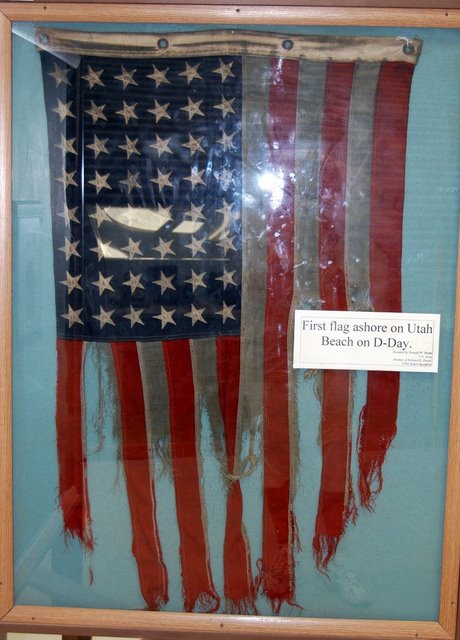
First Flag on Utah Beach, June 6, 1944

First Flag on Utah Beach, June 6, 1944 – Photo by Mark Wainwright

Today is the 69th anniversary of the Invasion of Normandy in World War II, a date generally called D-Day.  I usually get at least one e-mail request:  No, you don’t have to fly your flag.  This is not one of the days designated by Congress for flag-flying.

But you may fly your flag, and probably, you should.  If there are any D-Day veterans in your town, they’ll appreciate it.

This is mostly an encore post.


Fly your flag today! July 4, 2012

July 4, 2012

Fourth of July: NPR has already read the Declaration of Independence, PBS is ready to broadcast the Capitol Fourth concert  (maybe a rebroadcast is available, if you’re off at your own town’s fireworks — check your local listings), your town has a parade somewhere this weekend, or a neighboring community does, and fireworks are everywhere.

Remember to put your flag up today.

Astronaut Eugene Cernan and the U.S. Flag -- Apollo 17 on the Moon (NASA photo)

Last flag on the Moon: Astronaut Eugene Cernan and the U.S. Flag — Apollo 17 on the Moon (NASA photo)

Also:

Lunar Reconnaissance Orbiter photo of Apollo 17 landing site

Lunar Reconnaissance Orbiter photo of Apollo 17 landing site

This is mostly an encore post, but I so love that photo of the flag with the Earth in the distance.

Happy birthday, Kathryn!

Tip of the old scrub brush to Thomas Jefferson, Richard Henry Lee, John Adams, Benjamin Franklin, Roger Sherman, Robert Livingston, and the cast of thousands of patriots including George Washington.


President Obama’s Memorial Day message

May 26, 2012

Remember to fly your flag Monday.  Heck, you can fly it all weekend if you wish.


Veterans Day coming November 11 — remember to fly your flag

November 8, 2011

Friday is Veterans Day, one of the score of “fly your flag” dates recommended in law.

Are you ready?  Here’s this year’s poster, from the Veterans Administration (click to get a link for a high resolution version):

Veterans Day poster for 2011 - Veterans Administration

Veterans Day poster for 2011 - Veterans Administration; click image to go to VA site for high resolution version to print

Get your flag out, ready to fly.  Check your local newspaper for times of your local Veterans Day Parades.  Take a look at the VA’s video on the day, below, and make plans to help a vet throughout the year.


Veterans Day Video — History.com

November 11, 2010

President Barack Obama and First Lady Michelle Obama took on the cause of veterans as a special cause of this administration.  In this public service announcement from the History Channel, Michelle Obama and Dr. Jill Biden, wife of Vice President Joe Biden, urge honor to 24.9 million veterans.

November 11 is Veterans Day, a U.S. federal holiday dedicated to honoring veterans who served honorably in war or peacetime.

Vodpod videos no longer available.

Veterans Day Video — History.com, posted with vodpod


Veterans Day 2010 — why not volunteer to help veterans other days, too?

November 7, 2010

Video from the Veterans Administration:

More: