Fresh from the garden: Bat faced cuphea

July 10, 2011

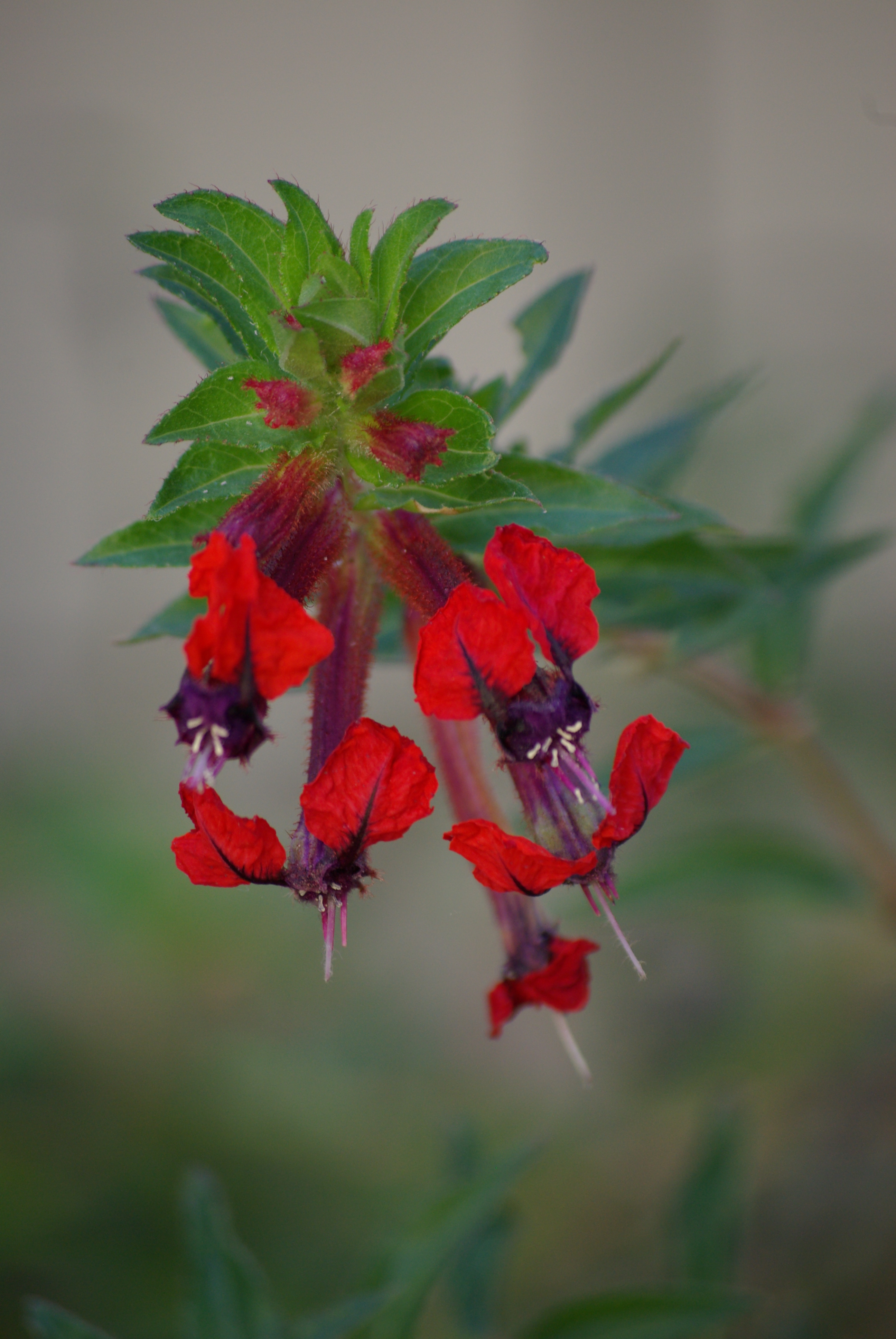
Bat-faced cuphea in Kathryn's garden

On a pedestal? Kathryn's potted bat-faced cuphea stands out when the mid-morning sun bathes it, but the yard in back still hovers in the shade of the live oak. Horticultural design by Kathryn Knowles; photo by Ed Darrell

Kathryn’s bat faced cuphea (Cuphea llavea) has graced our garden for several years with this particular plant, or its seedlings.  It attracts butterflies and hummingbirds with regularity.

It gets its name because each blossom resembles the face of a tiny bat.

Bat faced cuphea in Kathryn's garden, IMGP5294

Each blossom of bat faced cuphea resembles the face of a bat.


Cicada killers, 2011 edition

July 6, 2011

It’s slower population growth than in the past, but earlier, too.

In earlier years we’ve had cicada killer wasps — cicada hawks, in some parlance — as early as July 7.  Rains fell all spring in 2010, which discouraged the emergence of cicadas and their predators.  First certified sighting in our backyard did not occur until July 18.

Cicada Killer, with cicada - photo by Ronald F. Billings, Texas Forest Service, Bugwood.org

Cicada Killer, with cicada - photo by Ronald F. Billings, Texas Forest Service, Bugwood.org, via University of Delaware Cooperative Extension

We had modified a planter, and that may have killed some of the larvae.  Generally 2010 was a slow year for the large wasps.  My guess is that they were less active locally because the ground remained wet through July and into August.  I still get e-mails asking about how to get rid of them, and I still recommend watering the spots you want them to leave.  The females sting and paralyze a cicada, then plant that cicada in a tunnel underground with one wasp egg.  The young wasp hatches and feeds on the cicada, emerging usually the next summer to carry on the cycle (in a long summer, there may be a couple of hatchings, I imagine).  Females do not like to tunnel in wet ground, partly because it collapses on them, and I suspect wet ground is conducive to fungi and other pests that kill the eggs or hatchlings. Our wet weather kept them away last year.

I waited to say anything this year because I wanted more, but we saw the first cicada killer wasps this year on June 27, 2011, the earliest date we recorded here.  I had hoped to get a good photo, but that hasn’t happened yet.

Down at Colorado Bend State Park, the cicada killers greeted our arrival, much to the panic of the little kids in the campsite next door.  They were happy to learn the wasps don’t aim to sting them, and the kids actually watched them at work.  One of the wasps reminded me of just how much they like dry ground — she kept tunneling into the fire pit, unused now because of the fire bans that cover 252 of Texas’s 254 counties.  Covering the holes, putting objects over the holes, nothing could dissuade her from using that site.  I hope for the sake of the larvae that they hatch soon, and get out, before someone builds a fire in the pit.  Some of the cicadas in that area hit 110 decibels at least, and they badly need the discipline of a force of cicada killers, if you ask me.

Prowling the yard this morning I found two more emergence holes.  The wasps leave a smaller hole than the cicadas, so I’m pretty sure they are back in force.

Nature, red in tooth and claw, the poets say.  Or in this case, moist in sting.

It’s summer.  By the weather, it’s late summer.   Hello, cicada killers, Sphecius speciosa.

Earlier at Millard Fillmore’s Bathtub:

More:


Butterflies are free, to move about the country

October 24, 2010

Great mysteries of science, history and spirit call to us:  How do the monarch butterflies do it?

Monarch butterflies (Danaus plexippus) fly north from their enclave in Mexico every spring, stopping to lay eggs on milkweed plants.  After a migration of several hundred miles, that first group that left Mexico dies off.  Their offspring hatch in a few days, devour the milkweed, make a chrysalis, metamorphose into butterflies, then fly farther north, where they repeat their parents’ behavior:  Lay some eggs, and die.  Within three generations, they’ve spread north into Canada.

Kathryn's butterfly plantings, October 2010 - photo by Ed Darrell

Inviting the monarchs in: You can see how Kathryn worked to attract butterflies. In this photo, you can see the butterfly weed (a milkweed), red Turk's cap, and blue ageratum especially for the monarchs.

Then the fourth generation does something so strange and wonderful people can’t stop talking about it:  They fly back to Mexico, to the same trees their great-great-great grandparents left.  There they sip some nectar, get some water, and spend a lot of time hanging in great globs, huddling over the winter, to start life for generations of monarch butterflies the next spring.

Sometimes in Texas in October, we can see clouds of monarch butterflies winging south.  If we’re lucky, they stop to visit our backyards and gardens, and we might provide some water and nectar to urge them homeward.  Kathryn, of course, plants the stuff the monarchs like, to help them, and to give us a chance to see them.

Monarch habitat in Mexico is under severe stress and threat.  Late storms and early freezes decimated monarch populations over the last decade [yes, that’s the proper use of “decimated;” look it up].  Human plantings are more critical to the monarch butterflies than ever before.

Two years ago Kathryn and I spent a September morning outside the library at Lawrence University, in Appleton, Wisconsin, watching monarchs sip nectar from local flowers for their journey.  Those same butterflies — we hope — passed through Texas a couple of weeks later.

Two weeks ago . . . well, see for yourself:

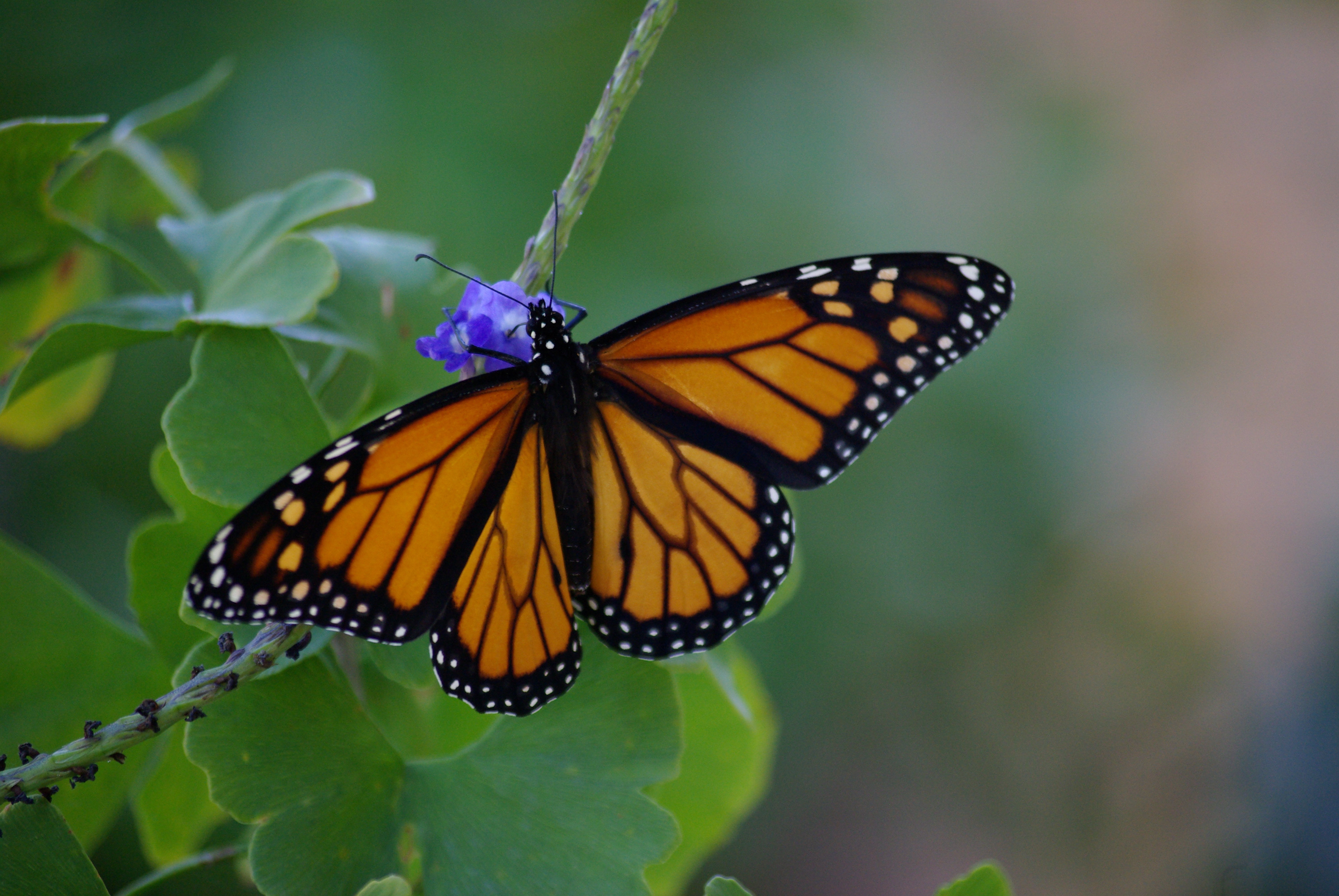
Monarch butterfly on blue porterweed, Dallas, TX October 2010 - photo by Ed Darrell IMGP5343

A monarch butterfly feeds on blue porterweed in Kathryn's garden, October 2010 - photo by Ed Darrell

Monarch butterfly on blue porterweed, Dallas, October 20101 - photo by Ed Darrell IMGP5347

. . . we're here with the camera, little guy, just open up those wings, please . . .

Monarch  butterfly on blue porterweed, Dallas, Texas October 2010 - photo by Ed Darrell IMGP5345

That's it! Beautiful! Have a safe trip, and come back next spring, will you?

Resources, more:

Conoclinium coelestinum


Eleanor Roosevelt: Didn’t like the description, “No good in a bed”

October 3, 2010

Eleanor Roosevelt, image from MedScape; at Pearl Harbor, 1943

Eleanor Roosevelt at Pearl Harbor in 1943 - image from MedScape

Is this story true? I’ve not been able to verify the quote — it’s a great story, and better if true. From MedScape Today, “The Case of the Well-known Woman with Unexplained Anemia”:

Although reserved, Roosevelt had a quiet sense of humor. When commenting about how she felt about having a rose named after her, she remarked: “I was very flattered . . . but not pleased with the description in the catalogue: no good in a bed, but fine up against a wall.”

Can anyone tell us when and where she said that?  Gardeners, can you confirm?  Can anyone find a photo of the rose, “Eleanor Roosevelt?”  (It’s probably a yellow rose, but I haven’t found a description.)

Eleanor Roosevelt teacup, First Ladies Library

Eleanor Roosevelt teacup, First Ladies Library

More:


Gulf fritillary on blue porterweed

August 9, 2010

Gulf fritillary on blue porterweed - photo by Ed Darrell - copy free with attribution IMGP4824

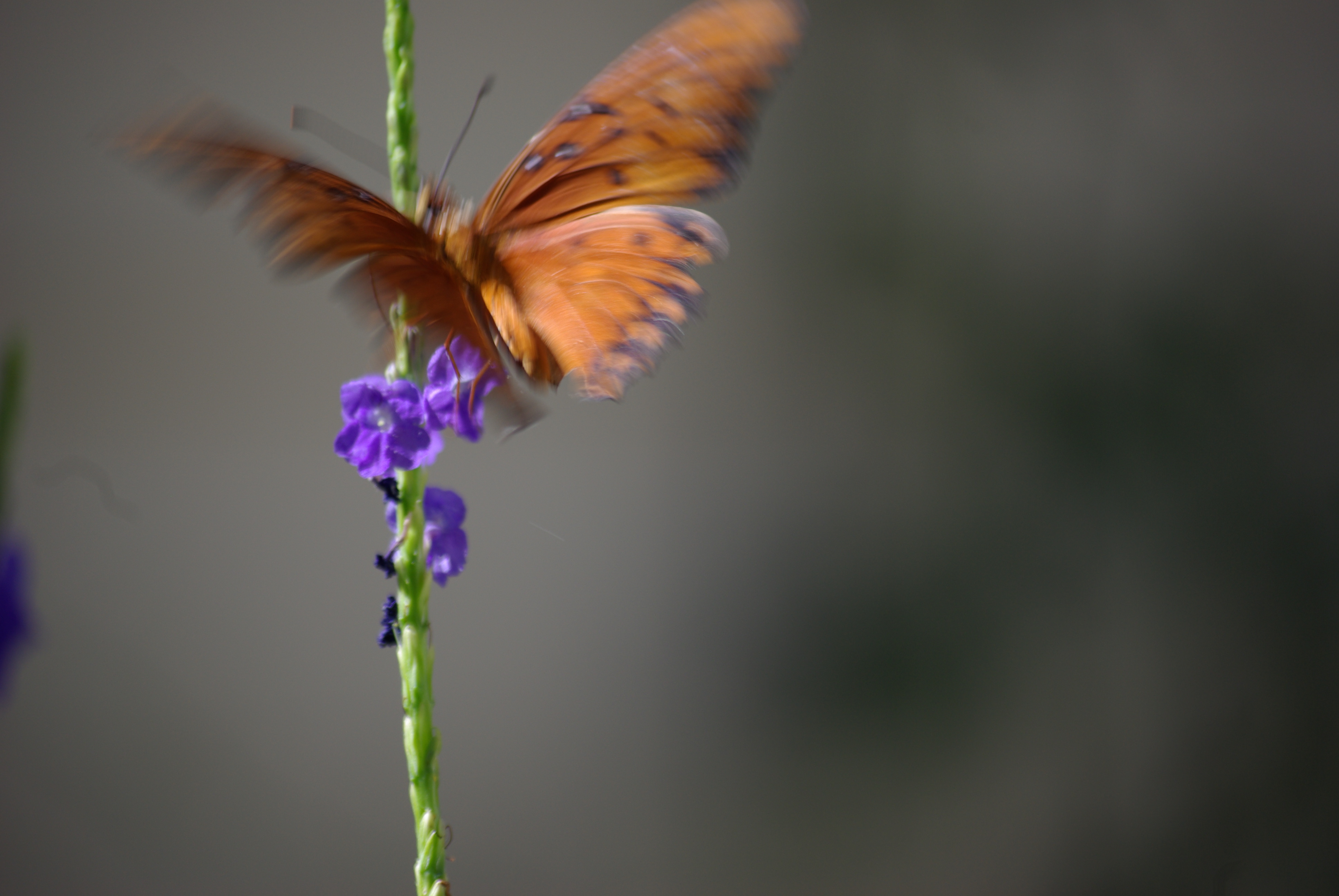
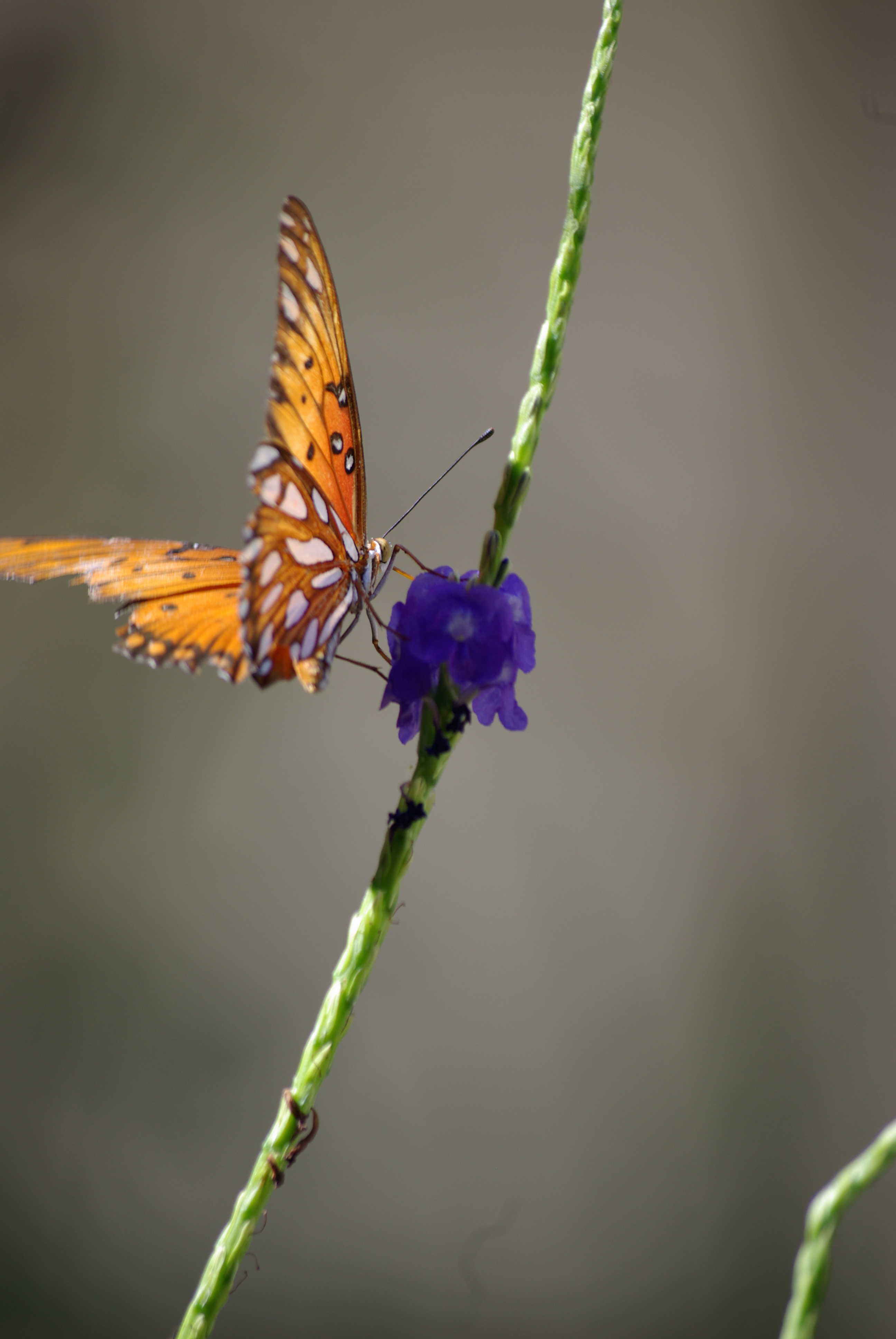
Gulf fritillary butterfly on blue porterweed, Dallas, Texas — photo by Ed Darrell — use free with attribution

A gulf fritillary (Agraulis vanillae (Linnaeus, 1758)) on blue porterweed, Stachytarpheta urticifolia, also known as blue rats tail, or nettleleaf velvetberry.  Dallas, Texas, August 9, 2010.

Gulf fritillary on blue porterweed - photo by Ed Darrell, use permitted with attribution IMGP4820

This fritillary hung around for a few minutes.

Kathryn plants butterfly-attracting plants — a concept that was new to me when she introduced it at our home in Cheverly, Maryland, with several plants that acted like butterfly magnets, to my astonished delight.  We first ran into the brilliant orange gulf fritillaries in 1988 or 1989 here in Dallas.  For the past few summers, fritillaries have not been frequent visitors in our yard.

Kathryn stepped up the butterfly plantings this spring, including passion vine (Passiflora incarnata).  The passion vine twines toward one of the bird feeders, but in the past week or so has been losing leaves — to caterpillars of the gulf fritillary, it turns out.  Blue porterweed attracts all sorts of butterflies, but the fritillaries have been rather common, no doubt hoping to give their progeny a little boost with the passion vine, their favored food.

Butterfly afficianadoes in Dallas are urged to plant milkweed and butterfly bush to help the monarchs, whose populations are stressed by the recent cold winter, dramatic reductions in habitat, and destruction of their sanctuary trees in Mexico where they migrate each winter.  But all butterflies could use some habitat help, I think.  The rewards are great.

Gulf fritillary on blue porterweed - photo by Ed Darrell, use permitted with attribution - IMGP4822

Gulf fritillary on blue porterweed, catching the morning sun

Gulf fritillary butterfly on blue porterweed - photo by Ed Darrell, use permitted with attribution - IMGP4823

Butterfly plantings will attract butterflies, guaranteed. Gulf fritillary enjoys some blue porterweed nectar.


First cicada killer sighting of 2010

July 19, 2010

Cicada killer wasps appeared as early as July 7, in our yard.  This year we had a cold winter, with snows that appear to have stymied even the nasty, invasive Argentine fire ant.  But June was dry and hot.  July came with rains, and cicada killers don’t like wet soil to dig in.

For that matter, we don’t have many cicadas, either.

Plus, we had to tear down a planter box attached to the dining room window, since it hid termites too well.  No doubt that planter had young from the cicada killers in it.

Early yesterday evening, as we finished dinner, we watched the house finches (Carpodacus mexicanus) escorting their young to the bird feeders, the cardinal “babies” (Cardinalis cardinalis) breaking out of their baby feathering, we looked for the family of red-bellied woodpeckers (Melanerpes carolinus) — and there it was:  One lone cicada hawk zooming across the patio, yellow-and-black striped abdomen standing out among the other paper wasps (almost certainly Sphecius speciosa).

They’re back!

Earlier at Millard Fillmore’s Bathtub:

More:


Snail zombies in our garden!

July 6, 2010

It became really apparent during the rains last week.

Snails crawl up the walls and plants around our patio, and appear to wait to die there.  We’ve moved them back down to the soil, and they climb up again.

Kathryn remarked at the army of snails on the garage wall, beneath a bird feeder . . . that was the clue.

I don’t think ours do that eye-stalk thing.  Worse for the parasites, most of the birds ignore the snails.

Tip of the old scrub brush to Kate at The Urban Primate.

MacDowell’s book kept me out of church for at least a decade.

In the later pages he talks about how many copies of the Bible there are, and he says that’s an indication of how accurate it is, and that it’s the truth.  That’s like saying any document I create becomes  more truthful the higher the number of Xerox copies I make.

I figured that was one of the stupidest claims ever made.  Maybe it was the crowd I was in with, but the more devout Christians (except for the Mormons, but that’s a different tale) swooned over the claim.  I thought that any belief system that was so devoid of logic, and which required adherents to abandon all reason, was foolish.

About five years ago I picked it up again when one of our youth ministers asked me about it, and I skimmed through it again looking for any cogent, careful and compelling argument.  Of course, this was long after law school and due diligence work in the law . . . I thought it more foolish than I had found it years before.

I summed it up this way for the youth minister:  If there were evidence, we wouldn’t need faith.  We call it a faith proudly, and we discuss the mysteries.  It’s a tragedy that MacDowell has been divorced from that sweet part of Christian discovery and leap of faith.  Were there evidence enough for a verdict, we’d not need faith, and it would be impossible to be anything other than an agnostic who has found the evidence.

Your mileage may differ, but if so, you need a tune-up.

Ed Darrell
Dallas


Lorrie Otto, environmental warrior

June 9, 2010

The Milwaukee Journal-Sentinel carries the news that Lorrie Otto has died.

When DDT spraying killed birds and bats in her yard, Lorrie Otto went to work to stop the destruction.  Otto won.  Someone should step up to take her place, in each of the things she did.

‘Nature Lady’ Otto helped lead DDT fight

Lorrie Otto leads Natural Landscape Tour in Milwaukee - Journal-Sentinel photo by Michael Sears

Caption from the Journal-Sentinel: Lorrie Otto (left) leads the "Natural Landscape Tour" along the banks of Lake Michigan in the 9700 block of N. Lake Drive. A video crew from NBC News photographed the event for a segment. Journal-Sentinel photo by Michael Sears

She began with natural yards, progressed to national causes

By Amy Rabideau Silvers of the Journal Sentinel

Posted: June 2, 2010

Lorrie Otto understood that it wasn’t nice to mess with Mother Nature.

And so the woman known as “the Nature Lady” planted her Bayside yard with native species and wildflowers – fighting for the right to keep her land natural and teaching others how to do the same. She rose to become an environmental warrior, a leader in the battle to ban DDT in Wisconsin and then nationally.

She shared her vision that average people could make a difference by eliminating the standard lawn for more ecological alternatives. The well-manicured lawn was not, she said, a healthy green space.

“They look like golf courses,” Otto once said, then corrected herself. “They look like cemeteries.”

Otto died of natural causes Saturday in Bellingham, Wash., where she moved in 2008 to be near her daughter. She was 90.

Otto served as a founder and leader with groups including Citizens Natural Resources Association of Wisconsin, the Riveredge Nature Center and Wild Ones. She became a nationally recognized naturalist and speaker, called “the godmother of natural landscaping.” Media credits include everything from Martha Stewart Living to “NBC Nightly News.”

“In recent years, a New Yorker article credited her and Rachel Carson for leading the movement,” said daughter Tricia Otto, referring to the author of the famous book “Silent Spring.”

Lorrie Otto, Milwaukee environmental activist, in 1999 - Milwaukee Sentinel-Journal photo

Milwaukee Journal-Sentinel photo: Lorrie Otto, shown in 1999, kept a lively prairie garden.

Otto was named to the Wisconsin Conservation Hall of Fame in 1999. The Schlitz Audubon Center’s annual natural yards tour is named in her honor.

“If suburbia were landscaped with meadows, prairies, thickets or forests, or combinations of these, then the water would sparkle, fish would be good to eat again, birds would sing and human spirits would soar,” Otto said.

She was born Mary Lorraine Stoeber, taking the name Lorrie after marriage. She grew up on a family dairy farm in Middleton and graduated from the University of Wisconsin in Madison.

During World War II, she saw an advertisement for the Women Airforce Service Pilots – what the ad called the “Cream of the Crop” – her daughter said.

“You had to be college-educated and have a pilot’s license,” Tricia said. “She went to the local airport and, with her own money, became a pilot.”

WASP pilots were civilians and the first women to fly American military planes. Just before she graduated, the war was coming to an end and the program quickly disbanded. She married her high school sweetheart, Owen Otto, and they settled in Bayside about 1952.

For Otto, the battles for natural landscaping and against DDT began in her own yard.

The former farm girl planted the family’s yard in a natural way, mostly to create “an enchanting place for my children to play.”

Soon Otto was confronting what she called “the lawn police” in Bayside. One day, a crew arrived and mowed part of her yard. She fought back, proving that her yard might look wild but that it did not contain weeds.

“She was so passionate,” Tricia said. “She would appear in court as an expert witness to defend someone whose yard was being persecuted.”

In the late 1950s, she learned of plans to develop the Fairy Chasm woodland area in her area. “She finally triumphed in 1969, when the Nature Conservancy purchased Fairy Chasm,” according to a copyrighted article by the National Wildlife Federation.

Those were also the days of routine DDT spraying, first to kill mosquitoes and then to kill the beetles destroying elm trees.

“Robins would go into convulsions. . . . I’d see the dead robins near the road,” she told The Milwaukee Journal in 1992. “Red bats would be dangling dead in the rosebushes.”

“She carried big bushel baskets of dead robins into village hall,” Tricia said. The official response ranged from indifferent to angry. “They said, ‘What do you want, lady, birds or trees?’ ”

Otto took the fight to the state level, finally deciding to sue. She contacted the Environmental Defense Fund, a fledgling out-of-state group that won a national reputation for action in Wisconsin. In 1970, Wisconsin banned the use of DDT. The federal ban was approved in 1972.

“She invited scientists from all over the country to her house, and they worked on the paper to present to Congress to get the ban on DDT,” said Dorothy Boyer, a friend and president of the Milwaukee North chapter of Wild Ones. “She had scientists sleeping in sleeping bags in her living room.”

Years later, she was still making new friends and encouraging others. One younger couple, Susannah and Lon Roesselet, began their own natural landscaping in Bayside a few years ago.

“One day the doorbell rang and this little white-haired woman was there, saying, ‘Hello, my name is Lorrie Otto,’ ” Susannah Roesselet said. “We knew about her. She stepped in and became our mentor. Our entire yard is now natural; she is everywhere. She’ll be missed, but she left her mark.”

When Otto finally had to leave her own home, she moved to Washington state to live with her daughter on a hundred acres of natural land.

“She was just having a ball,” Tricia said. “Living here, she said, you could believe the world was happy and whole.”

And Otto made plans for her own last plot of land, delighted to find a green burial cemetery and planting flowers on what would be her own grave. She will be buried without benefit of embalming or chemicals, returning to the earth she loved.

Otto is also survived by her sister, Betty Larson.

A Wisconsin gathering is being planned by friends.


Red eared sliders

May 31, 2010

Red-eared sliders, turtles at Texas Discovery Gardens - photo by Ed Darrell

Red-eared sliders cluster together to catch the sun on a spring day at Texas Discovery Gardens at Fair Park in Dallas. Photo by Ed Darrell, 2010

Red-eared sliders (Trachemys scripta elegans), a common aquatic turtle in the southern U.S., caught sunning themselves at the Texas Discovery Gardens at Fair Park in Dallas.


Hummingbird moth in the lavender at 6:00 a.m.

May 25, 2010

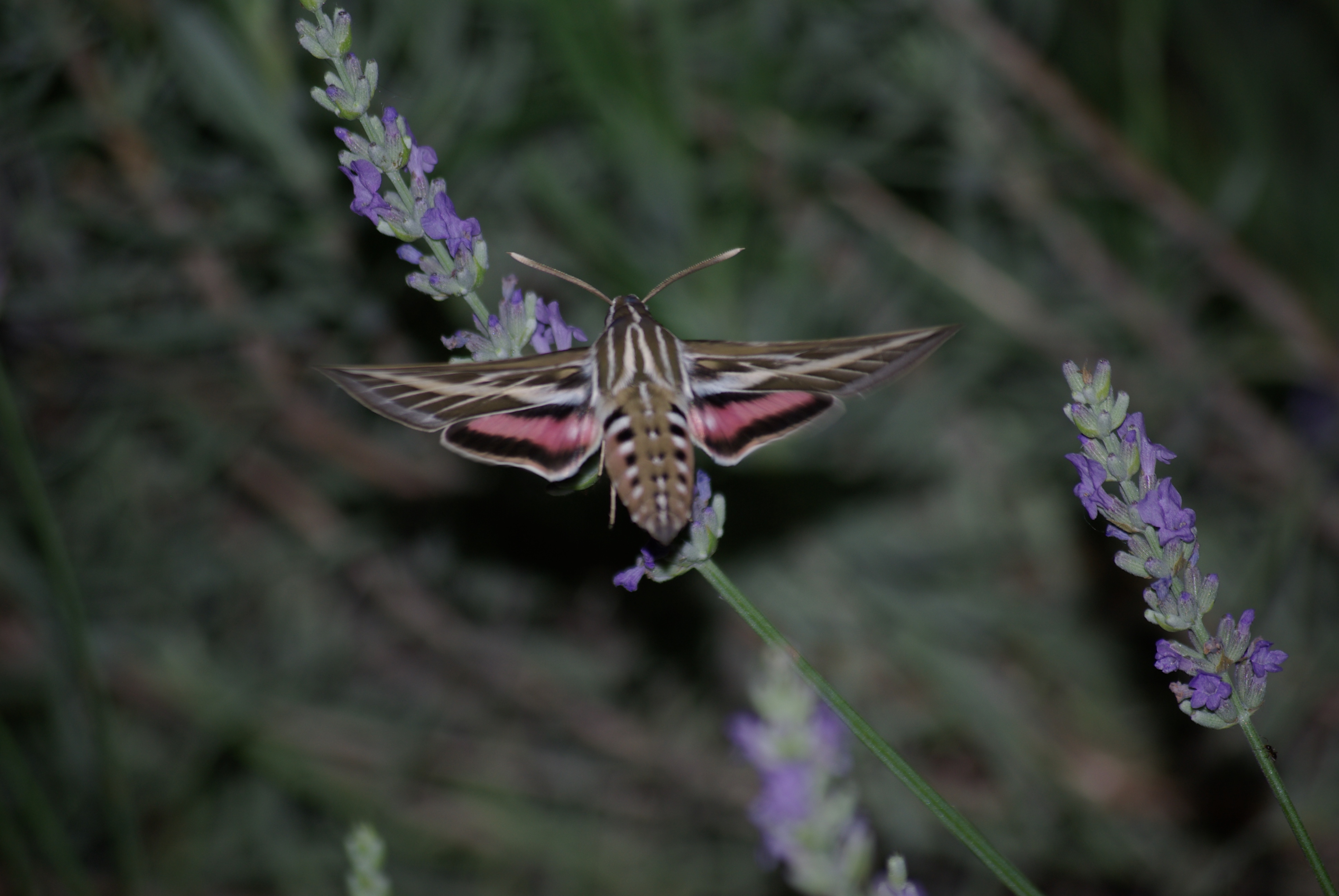
Hummingbird moth at the lavender, May 25, 2010

Hummingbird moth (Hyla lineata?) breakfasts at the lavender in the front yard - photo by Ed Darrell

Kathryn planted lavendar on the front walk.  It crowds the walk, so you have to brush by it coming in or going out of the house, and sometimes you get a great whiff of lavender.

On the way back from getting the newspaper this morning I was greeted by this hummingbird moth sipping its breakfast from the lavender blossoms.  It was too dark for natural lighting.  The flash froze the wings, and exposed colors that you can’t see as the little creature hovers.

Probably a Hyla lineata, no?

Hummingbird moth at the lavender, #2 - IMGP4107 - photo by Ed Darrell, all rights reservedHummingbird moth at the lavender, #2 - IMGP4107 - photo by Ed Darrell, all rights reserved

Hummingbird moth in the lavender in the morning


Maggie rose

July 22, 2009

Exquisite blooms of the "Maggie" rose (bourbon class) - in Kathryn Knowles' garden, summer 2009

Exquisite blooms of the "Maggie" rose (bourbon class) - in Kathryn Knowles' garden, summer 2009

Yes, I intended to leave the spent blossom there.  This is a real garden, where the flowers grow and fade.

Maggie is a “found” rose, robust in much of Texas, and a favorite of my wife’s.  The blossoms tend to glow, even at mid-day.  It will blossom all summer when it’s happy.  Maggie’s fragrance earns it a spot in Kathryn’s garden.

Maggie was one of five roses designated by Texas A&M’s horticulturists in 2005 for testing as one of a handful of roses easy to grow (read:  “difficult to kill, really”) in Texas.  Many rose varieties do not do well in southern heat and humidity — Maggie is one exception.

Maggie is a “found” Bourbon rose. It was collected in Louisiana by Dr. William Welch, Extension horticulturist from College Station. Maggie reaches 8 feet in height and 4 feet in width. Its flowers are medium red, very double, very fragrant, and it is a repeat bloomer. Researchers have found Maggie does best when trained on a pillar or fence. It is designated for zones 6-9.

“Arethusa, Jaune Desprez and Maggie are winter hardy throughout the entire state,” George said. “Bon Silene and Comtesse du Cayla, however, are winter hardy across most of the state except for Amarillo and the northern Panhandle area.”


Birds plant their favorite flowers

July 6, 2009

In our yard, after Mrs. Bathtub (Trophy Wife™) works her wonders in the garden, the soil will grow almost anything.

Birds, even, take advantage of that fact, seeding their favorite plants all over.  They are especially fond of sunflowers and pequin peppers.

If we didn’t use cooked peanuts, the blue jays would make this neighborhood one of the largest peanut fields in the world.

A bird-planted sunflower in Kathryn's garden - copyright 2009, Ed Darrell

A bird-planted sunflower in Kathryn's garden - copyright 2009, Ed Darrell


See? Cicada killer wasp

July 5, 2009

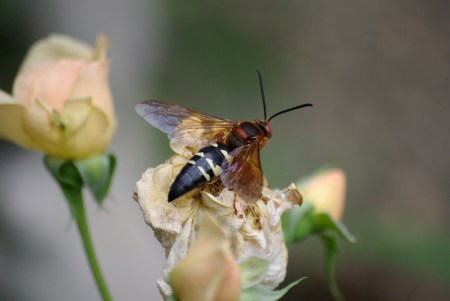
Got one in the camera sites this morning:

Cicada killer wasp and rose, Dallas, Texas, 7-5-2009 - image copyright 2009, Ed Darrell

Cicada killer wasp and rose, Dallas, Texas, 7-5-2009 - image copyright 2009, Ed Darrell (free use with attribution)