Teachers standing up for teachers, unions, and education: EDUSolidarity

March 15, 2011

Teaching is a lonely profession, oddly enough.  All too often teachers get stuck on an island away from other adults, away from socializing with colleagues even just a few feet away in the next room.  Different from most other professions, teachers in most schools are required to function without basic support for much of what they do, or with minimal support.

Consequently, teachers organizing to support teachers is difficult and too rare.

Unions become vital organizations to fight against unhealthy social isolation, to fight for teachers, to fight for education.

On March 22 union teachers in New York will wear red as an expression of solidarity with and support for teachers under attack in Wisconsin, Tennessee, Texas, Ohio, Indiana, and dozens of other places that we don’t know much about because, after all, brutal legislative attacks on teachers and teaching are so commonplace these days — “dog bites man” stories.

I was asked to join a group of bloggers who will blog on the importance of teaching, the importance of education, and why we support teacher unions on March 22.

If you teach and blog, will you join us?  If you had a teacher who made a difference in your life, and blog, will you join us?

Here’s an invitation from our group, EDUSolidarity:

edusolidarityIMAGE

Please join us!


As we all know, teachers and our unions, along with those of other public sector employees, face unprecedented attacks in the national media and from local and state governments. It is easy for politicians and the media to demonize the “unions” and their public faces; it is far more difficult to demonize the millions of excellent teachers who are proud union members. Those of us who are excellent teachers and who stand in solidarity with our unions are probably no stranger to the question “Well, why are you involved with the union if you’re a good teacher?” It’s time for us to stand up and answer that question loudly and clearly.

On Tuesday, March 22, teachers in NYC will wear red in solidarity with our brothers and sisters who are under attack in Wisconsin, Ohio, Indiana, Tennessee and elsewhere. We also stand with teachers in places like Idaho, California, and Texas who are facing massive layoffs. We would like to take this stand on the web as well. We encourage you to publish a piece on March 22 entitled “Why Teachers Like Me Support Unions.” In this piece, please explain your own reasons for being a proud union member and/or supporter. Including personal stories can make this a very powerful piece. It would be great to also explain how being a union member supports and enables you to be the kind of teacher that you are. We want these posts to focus not only on our rights, but also on what it takes to be a great teacher for students, and how unions support that.

After you have published your post, please share it through the form that will go live on March 22 at http://www.edusolidarity.us. Posts should also be shared on Twitter using the tag #edusolidarity.

In Solidarity,
Ken Bernstein – Social Studies, MD – teacherken
Anthony Cody – Science Instructional Coach, CA – Living in Dialogue
Ed Darrell – Social Studies, TX – Millard Fillmore’s Bathtub
Nancy Flanagan – Educational Consultant, MI – Teacher in a Strange Land
Jonathan Halabi – Math, NY – JD2718
Jamie Josephson – Social Studies, DC – Dontworryteach
Stephen Lazar – Social Studies/English, NY – Outside the Cave
Deborah Meier – Professor of Education, NY – Deborah Meier’s Blog
Doug Noon – Elementary, AK – Borderland
Kate Nowak – Math, NY – f(t)
Jose Vilson – Math, NY – The Jose Vilson


7 Billion: Are you typical? Year-long Nat Geo special reports

March 13, 2011

7 Billion: Are you typical?

Vodpod videos no longer available.

7 Billion: Are you typical? Year-long Nat Geo s…, posted with vodpod

I could see a bell-ringer in there somewhere.  Who do you think ought to see this thing?  What classes in public schools should see it, for what purpose?

I hope the year-long series lives up to the video.  I hope there are a lot more videos to go along with it.  As a piece of persuasive rhetoric, it does make a decent case for subscribing to National Geographic for a year.  How’s that for rhetorical criticism?


Legacy of deficits: Seen any good updates on these charts?

March 8, 2011

Going into discussions about the Republican-proposed America in Retreat Budget Act, I wonder about updates on facts and visuals.

Back in 2009, we had these informative charts, below — are there good updates on them, now?

How Trillion Dollar Deficits Were Created:

Graphic from the New York Times, June 10, 2006 accompanying an article by David Leonhardt

George W. Bush’s Legacy in a Pie Chart:

Sources of our Federal Deficits, 2009 - Matthew Yglesias, ThinkProgress

Sources of our Federal Deficits, 2009 – Matthew Yglesias, ThinkProgress

Got updates?


Interesting parent/teacher conference coming in Wisconsin

February 24, 2011

What do you want to bet Wisconsin Gov. David “Ahab” Walker will skip the conference with his son’s teacher next time?

(From the Wisconsin Democratic Party)

The woman, Leah Gustafson,  is very brave.  This is the sort of thing that invites local retaliation by administrators, without even consulting with the governor’s office.  Let’s hope her district’s administrators have a clear understanding of the law, and will back her right to state her views.

Heck, let’s hope they agree with her views.  If they don’t, they should get out of the business.

Tip of the old scrub brush to Michael A. Ryder.


Quote of the moment: Robert C. Lieberman, “Why the Rich Are Getting Richer: American Politics and the Second Gilded Age”

February 20, 2011

The U.S. economy appears to be coming apart at the seams.  Unemployment remains at nearly ten percent, the highest level in almost 30 years; foreclosures have forced millions of Americans out of their homes; and real incomes have fallen faster and further than at any time since the Great Depression.  Many of those laid off fear that the jobs they have lost — the secure, often unionized, industrial jobs that provided wealth, security and opportunity — will never return.  They are probably right.

Cover of Winner-Take-All Politics, by Jacob Hacker and Paul Pierson

Cover of Winner-Take-All Politics, by Jacob Hacker and Paul Pierson

And yet a curious thing has happened in the midst of all this misery.  The wealthiest Americans, among them presumably the very titans of global finance whose misadventures brought about the financial meltdown, got richer.  And not just a little bit richer; a lot richer.  In 2009, the average income of the top five percent of earners went up, while on average everyone else’s income went down.  This was not an anomaly but rather a continuation of a 40-year trend of ballooning incomes at the very top and stagnant incomes in the middle and at the bottom.  The share of total income going to the top one percent has increased from roughly eight percent in the 1960s to more than 20 percent today.

This what the political scientists Jacob Hacker and Paul Pierson call the “winner-take-all economy.”  It is not a picture of a healthy society.  Such a level of economic inequality, not seen in the United States since the eve of the Great Depression, bespeaks a political economy in which the financial rewards are increasingly concentrated among a tiny elite and whose risks are borne by an increasingly exposed and unprotected middle class.  Income inequality in the United States is higher than in any other advanced democracy and by conventional measures comparable to that in countries such as Ghana, Nicaragua, and Turkmenistan.

Robert C. Lieberman, reviewing the book Winner-Take-All Politics:  How Washington Made the Rich Richer — and Turned Its Back on the Middle Class, by Jacob S. Hacker and Paul Pierson, Simon and Schuster, 2010, 368 pages.  $27.00.; review appears in Foreign Affairs, January/February 2011, pp. 154-158.

More:


Quote of the moment: Thomas Jefferson’s admonishment to Rick Perry, Scott Walker, and the Tea Party, and their War on Education

February 18, 2011

Thomas Jefferson's view of education, from a mural at the Library of Congress

Thomas Jefferson’s view of Education illustrated in this mural by Ezra Winter — Thomas Jefferson’s view of Education is illustrated in this mural by Ezra Winter in the South Reading Room on the top floor of the Adams Building of the Library of Congress. Other murals dedicated to Jefferson decorate all of the reading room’s walls.

Above all things I hope the education of the common people will be attended to; convinced that on their good sense we may rely with the most security for the preservation of a due degree of liberty.

Thomas Jefferson, letter from Paris to James Madison, December 20,1787, stating Jefferson’s objections to the proposed U.S. Constitution

This quotation comes from a letter more popular among Tea Partiers and other troglodytes for Jefferson’s harsh words against “energetic government,” which he feared might result from the Constitution.  In the letter Jefferson said that he’d go with the will of the people if the document was ratified (it was).  In the end, Jefferson said, just be sure to educate “the common people,” and things would work out to protect liberty.

Wise words much ignored and abused in state capitals and the U.S. Capitol these days.

I’ll wager that among the millions who did not study this letter are Wisconsin Gov. Scott Walker, and Texas Gov. Rick Perry.  An uneducated populace is easier to cow, easier to control, and easier to enslave.

For a larger view of the mural, click on the thumbnail image.

Jefferson education views, mural at Libary of Congress, Adams Building


USAID policy statement on DDT and malaria control

February 16, 2011

USAID-paid tools and pesticides used to prevent malaria in a campaign coordinated with the government in Tanzania. USAID photo.

USAID-paid tools and pesticides used to prevent malaria in a campaign coordinated with the government in Tanzania. USAID photo.


The U.S. Agency for International Development (USAID) issued a statement on their support for the use of DDT, where appropriate.  I don’t have a date — if you know the date, please let me know — but for the record, here’s the statement.

Those who claim the U.S. discourages the use of DDT to the detriment of African and Asians, are incorrect in their claims, once again.

USAID Support for Malaria Control in Countries Using DDT

USAID and Malaria

USAID activities for malaria control are based on a combination of internationally-accepted priority
interventions and country-level assessments for achieving the greatest public health impact, most importantly, the reduction of child mortality (deaths).

Contrary to popular belief, USAID does not “ban” the use of DDT in its malaria control programs. From a purely technical point of view in terms of effective methods of addressing malaria, USAID and others have not seen DDT as a high priority component of malaria programs for practical reasons. In many cases, indoor residual spraying of DDT, or any other insecticide, is not cost effective and is very difficult to maintain. In most countries in Africa where USAID provides support to malaria control programs, it has been judged more cost-effective and appropriate to put US government funds into preventing malaria through insecticide-treated nets, which are every bit as effective in preventing malaria and more feasible in countries that do not have existing, strong indoor spraying programs.

USAID country missions provide support to national malaria control programs in about 21 countries in sub-Saharan Africa, where the burden of malaria deaths is the highest. This support covers a broad range of activities, according to local priorities, resource availability and complementary activities by other donors and multinational institutions in each country.

International efforts to fight malaria are largely coordinated by Roll Back Malaria (RBM), a global partnership that includes leaders from across Africa, African health institutions, the World Health Organization (WHO), UNICEF, World Bank, UNDP, multi-lateral agencies, international, national and local NGOs, and the private sector. USAID is a key RBM partner. RBM has identified three priority interventions to reduce deaths and illness from malaria. These are consistent with USAID ’s priority areas for investment in malaria. These are:

1. Insecticide-Treated Nets (ITNs) for young children and pregnant women.
2. Prompt and Effective Treatment with an anti-malarial drug within 24 hours of onset of fever
3. Intermittent Preventive Therapy (IPT) for pregnant women as a part of the standard ante –
natal services.

Each of these interventions is backed by solid evidence of effectiveness under program conditions and effective in reducing the sickness and death from malaria, especially in Africa. For example, proper use of ITNs can reduce overall child deaths by up to 30% and significantly reduce sickness in children and pregnant women.

DDT in Malaria Programs

DDT is only used for malaria control through the spraying of interior house walls – Indoor Residual Spraying, or (IRS). A number of other insecticides can also be used for IRS, and are in many countries when those alternative insecticides are safer and equally effective. IRS, when efficiently conducted in appropriate settings, is considered to be as efficacious as ITNs in controlling malaria.

In most countries in Africa where USAID provides support to malaria control programs, it has been judged more cost-effective and appropriate to put US government funds into other malaria control activities than IRS. USAID has funded non-IRS support to malaria control programs in countries in which DDT is being used, for example, Eritrea, Zambia, Ethiopia and Madagascar.

USAID regulations (22 CFR 216) require an assessment of potential environmental impacts of supporting either the procurement or use of pesticides in any USAID assisted project, but if the evidence assembled in preparing such an environmental review indicates that DDT is the only effective alternative and it could be used safely such as interior wall spraying undertaken with WHO application protocols, then that option would be considered. The U.S. government is signatory to the Stockholm Convention on Persistent Organic Pollutants (the POPS treaty), which specifically allows an exemption for countries to use DDT for public health use in vector control programs, as long as WHO guidelines are followed and until a safer and equally effective alternative is found. The US voted in favor of this exemption.

There are a few situations in which IRS with DDT is generally found to be appropriate. For example, in South Africa when certain mosquitoes developed resistance to the major alternative class of insecticides, the synthetic pyrethroids, DDT was used. Such situations are relatively rare, however, and demonstrate the value of the provisions of the POPs Treaty, which restrict and document use of DDT, but provide for its use when appropriate.

USAID Interventions

USAID is emphasizing prevention via mosquito nets dipped in pyrethriods – a synthetic insecticide originally found in chrysanthemums. USAID is supporting an innovative Africa regional public-private venture for the commercial distribution of ITNs. In 2003 USAID’s NetMark Project launched insecticide-treated net products in Zambia, Senegal, Ghana, and Nigeria selling more than 600,000 nets and 500,000 insecticide re-treatments during its first five months of operation. In 2004, NetMark will launch in at least five more countries in Africa.

USAID also invests in development of new tools for malaria control, particularly vaccine development and the response to increasing drug resistance. USAID is funding projects to discover and dispense new drugs such as Arteminisin-based combination therapies (ACT), which have proven to be more effective against malaria than the traditional drugs chloroquine and mefloquine. USAID also supports the development of new policies and strategies for use of these new therapies, as well as the improvement of both public and private health systems. Since 1998, the agency has aggressively supported the development of the combination therapy as a safe and effective alternative treatment.  In addition, USAID and its global partners in RBM are working to ensure sustained financing of the drugs. USAID has played a critical role in drawing attention to the spread of drug resistance in Africa and in assisting countries in effectively treating malaria, including the use of combination therapy.

In summary, USAID directs its support for malaria control programs based on evidence for maximum impact on reducing child deaths. Based on this criterion, for most countries with USAID support for malaria control in sub-Saharan Africa, indoor residual spraying (regardless of the choice of insecticide) has not been judged to be the most effective use of US government funds. USAID continues to plan its support for national malaria control programs in sub -Saharan Africa on a country by country basis, and will continue to strive to use US taxpayer funds as efficiently and effectively as possible with the most appropriate tools at our disposal to reduce deaths from malaria.

I suspect that statement is dated.  Here is a site at USAID that details the policy on DDT, malaria and mosquitoes, and includes a different statement under the same title as the above:

USAID and Malaria

USAID activities for malaria control are based on a combination of internationally accepted priority interventions and country-level assessments for achieving the greatest public health impact, most importantly, the reduction of child mortality (deaths).

USAID backs a comprehensive approach to prevent and treat malaria. This includes:

  • Spraying with insecticides (“indoor residual spraying,” or IRS) in communities: IRS is the organized, timely spraying of an insecticide on the inside walls of houses or dwellings. It is designed to interrupt malaria transmission by killing adult female mosquitoes when they enter houses and rest on the walls after feeding, but before they can transmit the infection to another person. IRS has been used for decades and has helped eliminate malaria from many areas of the world, particularly where the mosquitoes are indoor-resting and where malaria is seasonally transmitted. USAID and the President’s Malaria Initiative (PMI) activities include conducting environmental assessments, training spray teams, procuring insecticide and equipment, and developing and evaluating spraying activities.
  • Insecticide-treated mosquito nets (ITNs): Bednets treated with insecticide have been proved highly effective in killing mosquitoes. In addition, the netting acts as a protective barrier.  Consistently sleeping under an ITN can decrease severe malaria by 45 percent, reduce premature births by 42 percent, and cut all-cause child mortality by 17 to 63 percent. PMI is expanding access to free and highly subsidized nets while also creating commercial markets in African countries.
  • Lifesaving drugs: Artemisinin-based combination therapies (ACTs) are the most effective and rapidly acting drugs currently available for treating malaria.  PMI activities include purchasing ACT drugs; setting up management and logistics systems for their distribution through the public and private sectors; and training health care workers and community caregivers in their use.
  • Intermittent preventive treatment for pregnant women (IPTp): Each year, more than 30 million African women living in malaria-endemic areas become pregnant and are at risk for malaria. IPTp involves the administration of at least two doses of sulfadoxine-pyrimethamine (SP) to a pregnant woman through antenatal care services.  The treatment helps to protect pregnant women against maternal anemia and low birthweight, which contributes to between 100,000 and 200,000 infant deaths annually in Africa.  PMI activities include purchasing SP, training health care workers in administering the drug, and providing information about IPTp to pregnant women.

USAID and DDT

USAID supports indoor residual spraying (IRS) with DDT as an effective malaria prevention strategy in tropical Africa in those specific situations where it is judged to be the best insecticide for IRS both epidemiologically and entomologically and based on host-country policy. Its use for IRS to prevent malaria is an allowable exception under the Stockholm Convention – also known as the Persistent Organic Pollutants Treaty or POPs Treaty – when used in accordance with WHO guidelines and when safe, effective, and affordable alternatives are not available. For a variety of reasons, some countries do not conduct IRS or have not registered DDT for use in their malaria control programs.  The reasons may include the epidemiological situation of the country, the organizational capacity of the program, or in some cases, concerns related to their agricultural export market.  The Stockholm Convention aims to eventually end the use of all POPs, including DDT.

The determination of which of the WHO-approved insecticides to use for USAID’s IRS programs is made in coordination with the host-country malaria control program, with the primary objective of preventing as many malaria infections and deaths as possible.  That determination is based on cost-effectiveness; on entomological factors; on local building materials; and on host-country policy.  USAID adheres to strict environmental guidelines, approval processes, and procedures for the use of DDT and all other WHO-approved insecticides in its malaria control programs. As part of our environmental assessments and safer use action plans, we help countries build capacity for safe and judicious use of all chemicals used in their malaria control programs, including DDT

The fact is that DDT is more effective and less expensive than many other insecticides in many situations; as a result, it is a very competitive choice for IRS programs.   DDT specifically has an advantage over other insecticides when long persistence is needed on porous surfaces, such as unpainted mud walls, which are found in many African communities, particularly in rural or semi-urban areas.

USAID has never had a “policy” as such either “for” or “against” DDT for IRS.  The real change in the past two years has been a new interest and emphasis on the use of IRS in general – with DDT or any other insecticide – as an effective malaria prevention strategy in tropical Africa.  (Recent successful applications of IRS, particularly in the southern Africa region, have also contributed to the keen interest among donors and among African malaria control programs.)  For example, in Fiscal Year 2005, USAID supported less than $1 million of IRS in Africa, with programs utilizing insecticides purchased by the host government or another donor.  For fiscal year 2007, in the PMI and in other bilateral programs, USAID will support over $20 million in IRS programs in Africa, including the direct purchase of insecticides.  This dramatic increase in the scale of our IRS programs overall is the greatest factor in DDT’s recent prominence in USAID programs.

USAID Issue Briefs

President’s Malaria Initiative (PMI)

Tanks of pesticide (DDT?) used for Indoor Residual Spraying (IRS) against malaria in Africa bear the labels to indicate USAID paid for the tools and the pesticide, contrary to hoaxsters' claims.

Tanks of pesticide (DDT?) used for Indoor Residual Spraying (IRS) against malaria in Africa bear the labels to indicate USAID paid for the tools and the pesticide, contrary to hoaxsters’ claims.

Update: If you’re here from a religious discussion group that veered off into malaria and DDT, you’d do well to use this site’s search feature, and search for DDT.  Most of the statements from those favoring DDT in your discussion are pure, buncombe, junk science, as this site and several others reveal.


Watt’s Up puts collective hand into the fan – er, um, windmill

February 6, 2011

In the march to brand all non-fossil fuel use as politically incorrect (at least for those who deny global warming should get our policy making attention), the poobahs and commenters at Watts Up have outdone themselves in seeing conspiracies under the ice, mountains where there are molehills, and molehills where there are mountains.

If you wonder whether global warming deniers are biased, Watts’s blog just confessed.

We’re quite frozen in here in Texas, you know.  The unseasonable warm air (high pressure) over the Arctic that warms the sea and melts the ice also pushed the Arctic air south over the U.S.  Where that frigid air met wet air coming from the Gulf of Mexico, weather ensued (yeah, warming may have increased the amount of moisture, too — but that just makes the anti-warmists go blind, so we won’t say it).

Texas got hit with rolling power blackouts last week, when the cold weather increased demand for electricity and crimped the ability of several utilities to bring on power plants build to generate to meet such extra demands.  Some coal-fired plants were off-line, a couple froze up, and natural gas supplies were not in the right place at the right time, so some natural gas plants couldn’t fire up.

But Anthony Watts, seeing spooks behind every clump of Texas Bluestem (Big or Little), promptly got a post up blaming wind power turbines. His post’s headline gives you the whole story as Watts spun it:  “We Spent Billions on Wind Power… and All I Got Was a Rolling Blackout.”

If you’re wondering just what in the world he was thinking, you’d be demonstrating more common sense than the average global warming denier.

Freezing rain had been predicted, but not so much as Texas got.  The follow-up snow also surpassed predictions and expectations — for example, the “skiff to 1″ accumulation” predicted for Dallas turned into 5″ to 7″ through much of the area — stopping any hope that the ice might clear so schools could reopen.  Texas got slammed by the same enormous storm that slammed much of the Midwest and Northeast, with similar results.  For Super Bowl host cities Fort Worth, Arlington and Dallas, that created big problems.  Texas is not equipped to deal with much winter weather, let alone so much in so little time.

In cold weather, power plants fail.  Sometimes power lines fail when the plants stay up.  Sometimes it’s just a question of wheeling power from one part of a local, regional or national grids.  Sometimes the wheeling fails because a switch fails or . . . a failure of capacity can have myriad causes.  In the past, we covered for these problems with additional generating capacity, in excess of what might be needed at any point — mandated by state and local utility commissions to insure power at all times.

Texas deregulated electrical power more than a decade ago, too — which means that market forces govern what gets built and whether there is any emergency generating capacity.

Free enterprise cannot take any blame in the kingdom of those who deny climate and economics.  So when the rolling blackouts plagued Texas, the search for a scapegoat became frenetic.   The question was, who could take the blame that could cast what was perceived to be the most aspersional light on Al Gore, the case for global warming, and anything approaching “green energy?”

Ah, there’s the target!   Wind power.

Watts Up quickly claimed that Texas windmill-generated electricity had failed, if not in fact, then in economic hypothesis.  If the windmills didn’t fail themselves, it must be that the money invested in them could have been better invested in coal-fired power plants, or oil-fired plants, and the blame can be squarely laid at the feet of Michael Mann, or the UN’s IPCC, or Al Gore, or Rachel Carson, or John Muir, or Aeolus — or anyone other than the real trouble, the freakish weather.  Avoiding blame on the weather is important to denialists, because such “perfect storm” combinations come astonishingly close to the predictions of some global warming hypotheses.

So blame must be established, far from the house of warming denialists if possible.  Watts’ blog attacked windpower all through 2010; ignoring any rebuttals, all Watts had to do was point to his earlier published articles.

Days later the facts come out, as revealed in a lengthy investigative story published this morning in the Dallas Morning News with this lead:

The operators of Texas’ electricity grid blamed myriad problems at power plants across Texas for last week’s rolling blackouts.  But interviews and a review of documents by The Dallas Morning News reveal that the breakdown of a cluster of coal-fired power plants in Central Texas was at the heart of the problem.

These facts were known days ago.  In fact the second comment at Watts’ blog corrected the record:

Walt Stone says:

I believe it was two power plants, one coal and one gas fired.

http://fuelfix.com/blog/2011/02/02/whats-behind-the-blackouts-power-plants-not-designed-for-cold-weather/

Could Watts ever concede a possible error?  Not yet, not on his blog, nor anywhere else.  Texas electric grid officials said early they had coal-fired power plants down; they’ve stuck to that story.  Reporting by the state’s major newspapers and other news organizations has borne out that story.

Continuing their leading reporting on energy and environment issues, the Texas Tribune, an on-line publication by a non-profit group, specifically asked about wind power shortages as alleged by Watts:

TT: Were there problems with wind-power plants needing to be shut down for high winds or icing blades, and also did nuclear plants have any problems?

[Trip] Doggett [CEO of the Electricity Reliability Council of Texas (ERCOT)]: I’m not aware of any nuclear plant problems, and I’m not aware of any specific issues with wind turbines having to shut down due to icing. I would highlight that we put out a special word of thanks to the wind community because they did contribute significantly through this time frame. Wind was blowing, and we had often 3,500 megawatts of wind generation during that morning peak, which certainly helped us in this situation.

Is there any room for the wind nay-sayers to squirm on this?

One publication which should be keyed into the facts poked fun at Watts’ hypothesis, although in a subtle, implicit fashion.  Energy Tribune’s story by Philip E. Lewis, comparing Texas to King Canute, noted that Texas has bragged about its energy reliability and separateness from the rest of the state.  What to do in the next energy crisis?

But no worries, I have the perfect solution: Next time power plants are “tripping,” ERCOT (irony alert: Electric Reliability Council of Texas) should issue an order for the wind to blow harder in West Texas. If the wind is reluctant to comply, ERCOT should brook no nonsense and immediately escalate. Surely an order from the governor’s office will do the trick.

Based on little more than antipathy towards wind power, bloggers beginning with Anthony Watts started a hoax rumor that wind power is to blame for Texas’s electricity shortage problems.  Very little  basis could be found for such a claim, and in the days since the events, that little basis is evaporating.  It’s time to put that claim to bed.

Sorta post script:  I am aware of the claims at Meteorological Musings that wind generation is, somehow, to blame — if for no other reason than that it could not play Superman and bring a few thousand megawatts online with no notice to save the rest of the grid.  As best I can cipher it, the claim is that because not every wind generator was on line, wind generators should have been able to take up the slack.  Of course, no other energy source could step in to take up the slack, either, including those who were scheduled to do it.  I don’t put a lot of stock in the claim that we need to be particularly stern with wind generating companies when other generating companies fall down on the job.  For that matter, there is a Reuters article listed at Watts Up that said a wind shortage added to the problems, but it didn’t suggest in any way that a wind shortage caused the problems — and it’s from 2008, not 2011.  I don’t believe problems in 2008 contributed to blackouts in 2011.   I’m also aware that Energy Tribune is hostile to wind generated power.  Testimony contrary to interest . . .

More:

Tip of the old scrub brush to a commenter named Bryan Brown.


England? Britain? United Kingdom? Everything explained

February 4, 2011

Is it England, Britain or UK?  The explanation:

Tip of the old scrub brush to Joe Carter at First Things.


War on science – what else would you call it?

February 4, 2011

From Michael Tobis at Only In It For the Gold, an essential blog for Texans:

At the other end of Pennsylvania Avenue, Rand Paul proposes half a trillion in cuts to the US government, including:

  • National Oceanic And Atmospheric Administration (NOAA) is cut by $857 million.
  • NIH is cut by $5.8 billion.
  • DOE is completely defunded, with some nuclear-related tasks shifted to DOD.
  • NASA is cut by $4,500,000,000 (25%)
  • NSF is cut by $4,723,000,000. (62%)

Science? What science?

Cutting the federal budget is difficult.  Yes, we have a crisis in spending.  We also have many crises in education and in research, and many crises in our economy that are, each of them, rooted in a need for new research.

Is Rand Paul a complete fool?  Is he in league with Chinese Exceptionalists?  Are his ears made of tin?  Or is he a warrior against American knowledge and the American future?

This is a debate which needs facts, and people who can evaluate facts and arguments, and people with a vision for a future America — a good vision for a future America.

One gets the feeling that Rand Paul would have gone after the funding for Ben Franklin’s experiments — not because it would help the federal deficits, since Franklin funded his own work — but because he just doesn’t like science. ‘Why should we let Dr. Franklin take lightning from the gods?’ Rand might ask.  ‘Dr. Franklin should stay out of theology.’

And so the modern-day, real Rand Paul, blunders on, waging a War on Science.


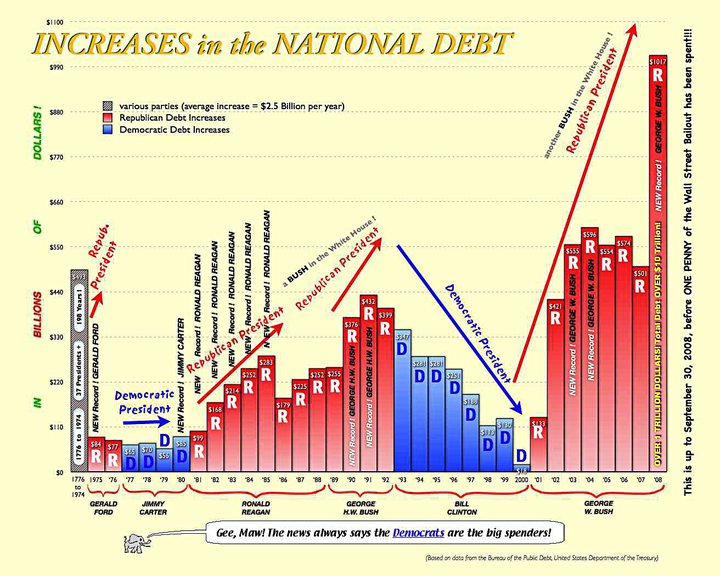
Charts conservatives hope you won’t see, that Tea Party members won’t read

January 30, 2011

Food for thought:

Increases in the national debt, by president since 1976

Increases in the national debt, by president since 1976 - I'm not sure the source; is it right?

Click the thumbnail for a larger version:

Increases in national debt to 2008

Increases in national debt to 2008

Gross national debt, by president:

Increases in gross national debt, by president

Increases in gross national debt, by president; z-facts via About.com

All this, and they want to lecture “liberals” on how government should be run?

Tip of the old scrub brush to Marion Young.


Dallas schools superintendent on Texas budget: “Worse than initially projected”

January 21, 2011

$9.8 billion in cuts to Texas education.

If the Chinese did this to us, we’d declare war. When Gray Davis proposed much smaller cuts in California, Californians recalled him from office.

But it’s Rick Perry and the Republicans.  Can anyone think of a good reason to treat them better?

Recall petition on Rick Perry, anyone?

Here’s the reaction from Dallas Independent School District Superintendent Michael Hinojosa:

A message from Superintendent of Schools Michael Hinojosa

First Budget Numbers Look Grim

The Texas Legislature convened this week and provided the first look at how the state’s budget crunch could impact public education. Unfortunately, things do not look good, and that is putting it mildly.

In fact, the scenario that was presented is even worse than was initially projected. Prior to this week’s legislative session, budget analysts had predicted that public education statewide would undergo cuts of approximately $5 billion during the next biennium. The number just presented to the Texas House of Representatives is closer to $9.8 billion.

Right now, various programs that have been fully or partially funded through state grants such as prekindergarten, summer school, teacher performance incentives, and technology infrastructure are not included in the new budget. In addition, current estimates place cuts to Dallas ISD at a staggering $180-$200 million during the next two years. Because 85 percent of the district’s budget goes to personnel, this means that we will have to look at reducing payroll.

Please note that this memorandum is not written to cause a panic. It is important, however, for you to understand that the state’s budget outlook is anything but rosy and funding for education will likely be reduced. It is too early to speculate where cuts in payroll will need to take place, but everything will likely be on the table.

Next week, the Senate will present its version of the budget, and it will likely be similar. At this point, the House version does not include tapping into the state’s Rainy Day Fund, which is still an option to lawmakers. It may be a couple of months before a clearer picture will emerge of how public education will be impacted by the budget.

Please know that I will make every effort to keep you informed throughout the budget process. I also can assure you that our trustees and I will do everything we can to impress upon lawmakers the important work that you do for the children of the Dallas Independent School District.

Thank you for your continued work on behalf of Dallas ISD students.


Texas Democrats mobilize against Foolish Five Budget Cuts

January 20, 2011

I get e-mail, some of it that offers hope.  This one came from Boyd Richie, chair of the Texas Democratic Party:

Dear fellow Democrat,

Earlier this week, the State House version of the budget proposal was set out in black and white.  The cost of ten years of Republican rule: a $27 billion budget deficit.

Governor Rick Perry wants Texans to believe the massive budget shortfall is simply the result of the recession – but this is not true.  The tax package the Republican-controlled legislature passed in 2006 created a permanent structural deficit that led to the budget crisis facing our state, and now they refuse to take responsibility.

Texas Democrats stand up for the interests of our working families.  We demand a quality education for our children because we know this is the key to their ability to compete for the good jobs of tomorrow.  However, these budget cuts place public education and other issues critical to Texas’ future economic security under attack.  They are short-sighted, hostile to our state’s children and elderly and bound to weaken employment and economic growth:

“The Foolish Five” Proposed Cuts

Jobs:

  • 9,600 state jobs eliminated that could cause the loss of 14,400 more jobs.  Economist Ray Perryman explained that every lost public sector job creates a “multiplier effect”, resulting in an additional 1.5 jobs lost.


  • $1.15 BILLION reduction in Closing the Gap programs, designed to attract students to study in fields that help Texas’ economy. These cuts will negate over one million new jobs and $122 billion in personal income that economist Perryman calculated these programs would create by 2030.

Children:

  • $9.8 BILLION in cuts from our public schools
  • Elimination of Pre-K Early Start and Early Childhood School Ready program funding, meaning that nearly 200,000 kids will be kicked off these important school-readiness programs.

Elderly:

  • $1.57 BILLION cut in nursing home payments

As Democrats, our numbers are down but we are not out – and we will fight these cuts every day on behalf of our working families.


Boyd L. Richie
Boyd L. Richie
Chairman
Texas Democratic Party

P.S. Don’t forget to join the Party Insider email list to receive the latest talking points on issues like the budget and other important priorities. Sign-up is quick and easy on the TDP website: http://www.txdemocrats.org/party-insider-sign-up/


Just how broken is the U.S. Senate?

January 3, 2011

Important question.

George Packer asked in back in August, in an article he wrote for The New Yorker, “The Empty Chamber.”

Illustration of U.S. Senators for New Yorker, August 2010

Illustration from The New Yorker. Caption from the magazine: “Sit and watch us for seven days,” one senator says of the deadlocked chamber. “You know what you’ll see happening? Nothing.” (Is there any Republican portrayed in this illustration?)

It’s troubling to me that back in August Packer could note a list of subjects critical to our nation that the Senate had been blocked from considering, and even after a “record setting” lame-duck session, all but one of those issues remain untouched.

Packer wrote:

On July 21st, President Obama signed the completed bill. The two lasting achievements of this Senate, financial regulation and health care, required a year and a half of legislative warfare that nearly destroyed the body. They depended on a set of circumstances—a large majority of Democrats, a charismatic President with an electoral mandate, and a national crisis—that will not last long or be repeated anytime soon. Two days after financial reform became law, Harry Reid announced that the Senate would not take up comprehensive energy-reform legislation for the rest of the year. And so climate change joined immigration, job creation, food safety, pilot training, veterans’ care, campaign finance, transportation security, labor law, mine safety, wildfire management, and scores of executive and judicial appointments on the list of matters that the world’s greatest deliberative body is incapable of addressing. Already, you can feel the Senate slipping back into stagnant waters.

Read more http://www.newyorker.com/reporting/2010/08/09/100809fa_fact_packer#ixzz19wpuFk4q

Only food safety got done, though a few judicial appointments squeaked through (less than two dozen).

Nuclear weapons: History and policy, in a poster

December 23, 2010

Wish I knew who created this poster, and how.  Some minor inaccuracies — can you find them?  Could you prevail on the Big Format Printer person at your school to print one of these full size for your U.S. history, world history or government class?

Nuclear Weapons, a poster

Nuclear Weapons, a poster

How about a similar poster for the Cold War?  Vietnam War?  Civil Rights Movement?  Gilded Age?

Tip of the old scrub brush to Kenny, cold in Pinggu.