Happy birthday, Ben Franklin!

January 17, 2008

Today is the 302nd anniversary of the birth of Ben Franklin (1706-1790).

At one time, this was the only day of the year on which a tornado had not been recorded in the U.S. Does anyone know: Is that still so?

Happy birthday, Ben. And, happy Ben’s birthday, America. We were lucky to have him.

Ben Franklin quote about history

Image and Quicktime Movie from Franklin Institute


Horace Mann schools – how many?

December 29, 2007

Education majors know he had something to do with creating modern public education. Ed.D.s probably know more about Horace Mann‘s actual life, actions and philosophy. Local school boards know enough to name a school after him from time to time.

But has anyone actually kept count? How many schools in the U.S. — or anywhere else — are named after Horace Mann? Is there a registry somewhere? We know of a few:

Antioch College continues to operate in accordance with the egalitarian and humanitarian values of Horace Mann. A monument including his statue stands in lands belonging to the college in Yellow Springs, Ohio with his quote and college motto “Be Ashamed to Die Until You Have Won Some Victory for Humanity.”

There are a number of schools in the U.S. named for Mann, including ones in Arkansas, Washington, D.C., Boston, Charleston, West Virginia, Marstons Mills, Massachusetts, Salem, Massachusetts, Redmond, Washington, Fargo, North Dakota, St. Louis, Missouri, Chicago, North Bergen, New Jersey and the Horace Mann School in Riverdale, New York. The University of Northern Colorado named the gates to their campus in his dedication, a gift of the Class of 1910.[9]

Horace Mann Arts & Science Magnet Middle School, Little Rock, Ark

If you know of a Horace Mann school, would you comment? Tell us about it, where it is, and how long it’s been there.

And if you know of a list of the schools, let us know.


Beginning of the American experiment in freedom

December 23, 2007

On December 23, 1783, Commander of the Continental Army, Gen. George Washington resigned his commission, to the Continental Congress sitting in Annapolis, Maryland. Washington modeled his actions on the life of Roman general and patriot Cincinnattus. (See especially this site, the Society of the Cincinnati)

John Trumbull painting of Washington resigning his commission

Washington had been thought to be in a position to take over the government and declare himself king, if he chose. Instead, at some cost to himself he personally put down a rebellion of the officers of the army who proposed a coup d’etat against the Continental Congress, angered that they had not been paid. Washington quietly asked that the men act honorably and not sully the great victory they had won against Britain. Then Washington reviewed the army, wrapped up affairs, journeyed to Annapolis to resign, and returned to his farm and holdings at Mount Vernon, Virginia.

Because Washington could have turned into a tyrant, it is reported that King George III of England, upon hearing the news of Washington’s resignation, refused to believe it. If the report were true, George is reported to have said, Washington was the greatest man who ever lived.

Washington’s resignation set precedent: Civilian government controlled the military; Americans served, then went back to their private lives and private business; Americans would act nobly, sometimes when least expected.

Read the rest of this entry »


Michael A. Field

December 11, 2007

Students and faculty at Devry University in Irving, Texas, and a few hundred others who knew him, lost a great friend when Michael Field died the day after Thanksgiving.

His memorial service last Saturday at Arlington’s Unity Church was filled with warmth and laughter as a dozen people remembered Michael’s verve and the joy with which he pursued knowledge, beneficial change, and good social interaction.

In my experience, psychologists come in three varieties: Crazy, eccentric, and real solid people. Michael was a pillar for a lot of people, able to be so solid because he enjoyed the crazy and eccentric, but was not controlled by it. I think the man never met a book or problem he didn’t relish in some way. No fewer than five people testified that Michael was, as a member of some group they nominally led, the guy who sparked great action. That was my experience, too.

It’s been nearly a decade since he left the board of a charitable institution we both served. I was lamenting that we had no one else like him when I learned of his death. Literally dozens of students at Devry told me how Dr. Field pushed them to be better and happier, when I taught there as an adjunct.

Listening at his service Saturday I was inspired again to climb back into the fray. The band of brothers is reduced — several bands, actually — but there is so much to do.

What have you done today to make the entire world better? Michael’s gone. We all have to work harder.

Smile while you do it, and enjoy the work.

Brief obituary below the fold. Read the rest of this entry »


Silvestre S. Herrera, first Arizonan to win Medal of Honor

December 1, 2007

From the East Valley Tribune, November 9, 2007:

World War II veteran Silvestre S. Herrera, left, is applauded Thursday by Dr. Connie Mariano, veteran and former White House physician. Mariano gave a speech honoring veterans at a ceremony in Scottsdale.

“HEROES SALUTE: World War II veteran Silvestre S. Herrera, left, is applauded Thursday by Dr. Connie Mariano, veteran and former White House physician. Mariano gave a speech honoring veterans at a ceremony in Scottsdale.”
Photo by Bettina Hansen, For the Tribune

For Veterans Day this year, they gathered in Scottsdale, Arizona — mostly local veterans. Among them was World War II vet Silvestre Herrera, who fought in France.

One by one, veterans took their turn shaking hands and exchanging nods of respect with war hero Silvestre S. Herrera, 91, as he stood proudly wearing his Medal of Honor around his neck.

About 40 people gathered in 90-degree heat in north Scottsdale admiring a presentation of colors and listening in reverence to a high school band play in honor of the upcoming Veterans Day.

“It was very touching,” said Jackie Wolf, executive sales director for Classic Residence at Silverstone, where the event took place Thursday on a breezy patio.

It was fitting, somber and joyful all at once. A lot of veterans, paying honor to all veterans. [More below the fold]

Read the rest of this entry »


Jefferson DeBlanc, teacher, Medal of Honor winner

November 28, 2007

Jefferson DeBlanc, Sr, at the WWII Memorial - Medal of Honor Winner

You can just see the kid trying to get the goat of the physics teacher:“Hey, Teach! What do you think 5Gs feel like when one of those fighter pilots pulls a real tight turn?”

And you can see the teacher at the chalkboard scribbling a formula the kid doesn’t want to know, and a smile creeping over his face.

“It’s nothing like hitting the shark-infested Pacific — salt water, and you’re wounded — and then being traded for a ten-pound sack of rice! That’ll get your gut more.”

And don’t you wonder, did the kids ever think to ask him his view of the campaign against the Japanese in the Solomon Islands, for help on their U.S. history exams? Did they ever think he might have some knowledge to share?

Jefferson DeBlanc would have shared wisdom certainly, though it’s uncertain he would have shared his war experiences as a fighter pilot. He died last Thursday in St. Martinville, Louisiana. He was 86. DeBlanc was the last surviving Medal of Honor winner from World War II in Louisiana. Col. Jefferson DeBlanc, Sr.

What a story!

The incident that earned Jefferson the nation’s highest military honor took place Jan. 31, 1943, during operations against Japanese forces off Kolombangara Island in the Solomon Islands.

A Japanese fleet was spotted headed toward Guadalcanal. U.S. dive bombers were sent to attack the fleet, with fighter aircraft deployed to protect the bombers. In a one-man Grumman Wildcat fighter, DeBlanc led a section of six planes in Marine Fighting Squadron 112, according to the citation that accompanied his Medal of Honor.

At the rendezvous point, DeBlanc discovered that his plane, which was dubbed “The Impatient Virgin,” was running out of fuel. If DeBlanc battled the Japanese Zero fighter planes, he would not have enough fuel to return to base. Two of his comrades, whose planes malfunctioned, turned back, according to a 1999 article in the New Orleans Times-Picayune.

“We needed all the guns we could get up there to escort those bombers,” DeBlanc said in the Times-Picayune article. “I figured if I run out of gas, I run out of gas. I figured I could survive a bailout. I had confidence in my will to survive. You’ve got to live with your conscience. And my conscience told me to go ahead.”

DeBlanc and the other pilots waged fierce combat until, “picking up a call for assistance from the dive bombers, under attack by enemy float planes at 1,000 feet, he broke off his engagement with the Zeros, plunged into the formation of float planes and disrupted the savage attack, enabling our dive bombers and torpedo planes to complete their runs on the Japanese surface disposition and withdraw without further incident,” the citation says.

Ultimately, DeBlanc shot down two float planes and three of the fighters. But a bullet ripped through DeBlanc’s plane and hit his instrument panel, causing it to erupt into flames. DeBlanc “was forced to bail out at a perilously low altitude,” according to the citation.

“The guy who shot me down, he saw me bail out,” DeBlanc said in a 2001 article in the State-Times/Morning Advocate of Baton Rouge, La.. “He knew I was alive. I knew they (the Japanese) were looking for me. But I’m not a pessimist. I knew I could survive. I was raised in the swamps.”

A Louisiana kid raised in the swamps, a Tuba City, Arizona, kid raised in a hogan on a reservation, a kid from Fredericksburg, Texas, a kid from Abilene, Kansas, another kid from Columbus, Ohio, a West Point graduate with a corn-cob pipe — the reality of the people who fought the war looks like a hammy line-up for one of the post-war movies about them. Maybe, in this case, there was good reason for the stereotypes.

After his plane was shot down in 1943, DeBlanc swam to an island and slept in a hut until he was discovered by islanders and placed in a bamboo cage. The man who gave a sack of rice for him was Ati, an islander whom DeBlanc later called a guardian angel, responsible for orchestrating his rescue by a U.S. Navy boat.

DeBlanc served a second tour of overseas service in Marine Fighting Squadron 22 in the Marshall Islands. By the end of his service, he had shot down nine enemy planes.

On Dec. 6, 1946, President Truman awarded DeBlanc the Medal of Honor. His other honors include the Distinguished Flying Cross, several awards of the Bronze Star and the Purple Heart. In 1972, after serving six years as commander at Belle Chasse Naval Air Station, DeBlanc retired from the Marine Corps Reserve.

Then, as if to make the model for Tom Brokaw’s later book, DeBlanc went back home to mostly-rural Louisiana, and made the world a much better place.

At home, DeBlanc earned two masters’ degrees in education from Louisiana State University in 1951 and 1963, and a doctorate in education from McNeese State University in 1973. For years, he taught in St. Martin parish and supervised teachers.

Just a normal guy to his kids, neighbors and students:

Despite the illustrious awards, [daughter] Romero [DeBlanc] remembers a loving father first and dedicated educator second.

“I was very close to my father,” she said. “I could always talk to him. He taught me to drive. He taught school. He was very friendly with his students. He would come into the classroom and say, ‘I lost the test.’ Then he would look around and find it in the trash can. Of course he placed it in the trash can. He had a great sense of humor.”

Surely DeBlanc’s passing should have been worthy of note on national television news programs, and in the larger national print media. There was a note on the obituary page of the Dallas Morning News, and the Los Angeles Times obituary cited above. But DeBlanc has not yet gotten the recognition he probably deserved. A young cornerback for the Washington Redskins also died over the weekend.

No room for heroes in the news?

Resources for Teachers:

Read the rest of this entry »


Grateful for heroes

November 22, 2007

As her physician I would have told her to stay down. As her parent, I don’t know what I would have done. As a bystander, after the fact, I can only admire the courage of this high school cross-country runner (from Fox News in Cleveland):

Claire [Markwardt] made it within forty feet of the finish line when her leg broke. She tried to get up, but it broke again.

“I knew I really couldn’t stay there and I didn’t wanna let my team down and I had gone that far, so there wasn’t really a point in laying there.” she said.

Amazingly, with a leg broken in several places, Claire crawled the rest of the way across the finish line. “It was my last race of my senior year and I didn’t know how my team was doing in the race, but I wanted us to be as high as we could.” she said.

Good write up about it at Education and Technology alerted me to the story. Surprisingly to me, Ray Ebersole writes:

When I was in my 20’s I was reading the print copy of SI, it was the only copy back then, when I read about a female high school track runner who broke her leg 100 yards from the finish of her race. She was the anchor for the 4×400 relay in a state meet and was leading by a lot when she broke her leg. Not wanting to let her teammates down she crawled to the finish line.

That high school girl inspired me to do a lot of things. She showed me what loyalty, courage and guts were all about. I never thought I would see anything like it again in my lifetime, but I see it everyday in the news.

Go see the examples he offers.

And be openly grateful we have such people among us.


Science history slips away: Ralph Alpher and Big Bang

September 20, 2007

Looking for something else in an old newspaper, I came across a small obituary for Ralph Alpher. Alpher died August 12, 2007, in Austin, Texas, at the home of his son, Dr. Victor S. Alpher.

Ralph Alpher, physicist who co-hypothesized the Big Bang

Ralph Alpher, physicist who co-hypothesized the Big Bang

Ralph Alpher gave us the Big Bang. We let him slip away, almost unnoticed. Odds are you don’t recall ever hearing of Alpher. Here’s your mnemonic: The alphabet paper.

In 1948, as a graduate student under George Gamow at the George Washington University, Alpher and Robert Herman of Johns Hopkins laid the groundwork for what would become Big Bang theory, calculating how matter could arise in the Universe. Gamow, exhibiting the sense of humor for which physicists are famous, listed the authors of the paper as Alpher, Bethe, Gamow and Herman — a play on the Greek alphabet’s first three letters (alpha, beta, gamma), and a joke invoking the name of the great physicist Hans Bethe. Bethe liked the joke, consulted on the paper, and the theory of Big Bang was published.

Ralph Alpher, in Florida, 2006; Alpher home page

The name “Big Bang” was applied a few years later; Sir Frederick Hoyle and his colleagues favored a “steady state” universe, and at the time both hypotheses could accurately predict most of what was observed, and neither could be disproven. Hoyle, hoping to poke ridicule at the competing hypothesis, belittled it as “a big bang.” The name stuck. The name misleads the unwary; the theory posits a rapid expansion at the beginning of the universe and time, but not an explosion, per se.

Alpher wrote the mathematical model; the model predicted Big Bang, and specifically, it predicted the cosmic background radiation that would have been left over; it was this background radiation, the “echo” of Big Bang, that Arno Penzias and Robert Wilson stumbled across in 1965. Robert H. Dicke had invested several years in trying to discover this signature, and had to explain to Penzias and Wilson what they had found. Penzias and Wilson won the Nobel Prize for their discovery; Dicke, Alpher, Herman and Gamow, did not get Nobel Prizes. This is generally regarded as one of the great miscarriages of justice in Nobel Prize awards, not that Penzias and Wilson did not deserve an award, but that the chief theorists and the man who unveiled the discovery were overlooked.

This is another story of rejection leading to great discovery; it is also a rather sad story of a momentous achievement, mostly overlooked through the years.

Alpher was the son of Jewish émigrés from the Russian pogroms. His high school achievements merited a scholarship to the Massachusetts Institute of Technology, in 1937. MIT had a rule at the time that scholarship recipients could not work outside the school. Alpher assisted his father in building houses in the Washington, D.C. area; the family had little money, and Alpher would be unable to pay room and board without working. Discussions with MIT broke down — the offer of a scholarship was withdrawn, according to most accounts when MIT discovered he was a Jew. As so many great people of the post World War II era, he enrolled at the George Washington University.

At GWU, Alpher found Gamow as a mentor, and much of the rest is history.

The New York Times:

The paper reported Dr. Alpher’s calculations on how, as the initial universe cooled, the remaining particles combined to form all the chemical elements in the world. This elemental radiation and matter he dubbed ylem, for the Greek term defining the chaos out of which the world was born.

The research also offered an explanation for the varying abundances of the known elements. It yielded the estimate that there should be 10 atoms of hydrogen for every one atom of helium in the universe, as astronomers have observed.

Months later, Dr. Alpher collaborated with Robert Herman of the Applied Physics Laboratory at Johns Hopkins University on a paper predicting that the explosive moment of creation would have released radiation that should still be echoing through space as radio waves. Astronomers, perhaps thinking it impossible to detect any residual radiation or still doubting the Big Bang theory, did not bother to search.

The Alpher-Bethe-Gamow paper, or αβγ paper, as explained by the American Institute of Physics:

When Alpher and Gamow prepared a paper on the subject, Gamow mischievously added the name of the noted nuclear physicist Hans Bethe to the list of authors so it would be called the “Alpher-Bethe-Gamow paper,” mimicking the “alpha-beta-gamma” of the first letters of the Greek alphabet. Unknown to Gamow, Bethe was a reviewer for the journal to which Gamow submitted the article. Bethe took it in good humor, later explaining, “I felt at the time that it was rather a nice joke, and that the paper had a chance of being correct, so that I did not mind my name being added to it.” Gamow also urged Herman to change his name to Delter to match delta, the next letter in the Greek alphabet. Despite Herman’s refusal, in a paper in a major scientific journal Gamow referred to “the neutron-capture theory…developed by Alpher, Bethe, Gamow and Delter.” Not least among his notable characteristics was his sense of humor.

Alpher continued in this work for a time, but joined General Electric’s labs in the 1950s. When he retired from GE, in 1986 he joined the faculty at Union College in Schenectady, New York, and taught there until 2004.

Alpher was largely overlooked for awards even while his theory was big news in astronomy and physics for the last 40 years of the 20th century. I regret that I was wholly unaware he was in Austin; how many other great contributors to science and history live among us, unrecognized, uncelebrated, and their stories unrecorded?

Alpher, Herman and Gamow - and the famous Cointreau bottle

Photo caption from AIP: A 1949 composite picture with Robert Herman on the left, Ralph Alpher on the right, and George Gamow in the center, as the genie coming out of the bottle of “Ylem,” the initial cosmic mixture of protons, neutrons, and electrons from which the elements supposedly were formed. [The Cointreau bottle from which the three drank a toast upon the acceptance of the paper, is now in the collection of the Smithsonian Institution.]

Alpher was an Eagle Scout. I wonder whether anyone has a history of his time in Scouting?

While the Nobel Prize eluded Alpher, he collected a host of other prestigious awards and honors. Earlier this year, President Bush announced that Alpher had been awarded the National Medal of Science, which is administered by the National Science Foundation and is the highest honor for science.

. . . [T]he citation reads in part:

“For his unprecedented work in the areas of nucleosynthesis, for the prediction that universe expansion leaves behind background radiation, and for providing the model for the Big Bang theory.”

Note from George Gamow, on confirmation of Big Bang Gamow’s humor again on display — an undated note from Gamow upon the confirmation of the Big Bang, with a punny reference to Steady State backer Sir Frederick Hoyle. Image from the American Institute for Physics.

Online sources for Ralph Alpher:

More:

Help others hear the echo:

Add to FacebookAdd to NewsvineAdd to DiggAdd to Del.icio.usAdd to StumbleuponAdd to RedditAdd to BlinklistAdd to TwitterAdd to TechnoratiAdd to Furl


Pete Seeger: Standing taller than his critics

September 10, 2007

Some people can’t let go of the past, and like the greedy chimpanzee who grasps the rice in the jar, and then is trapped when he cannot pull out his fist nor will he give up his prize to save his freedom, they trap themselves out of a good life.

Like this fellow, whose father’s dislike of an old political position of Pete Seeger kept them both from a good concert. He appears to agree with his father, though, thinking that somehow Seeger is responsible for the evils of Stalinism, and complaining that Seeger was tardy in making note of the fact that Stalin was evil. And Instapundit’s Glenn Reynolds agrees, profanely, and inaccurately, as I’ll explain below the fold. But heed this warning: I’m explaining at length.

Get a life, people! Pete Seeger did.

Read the rest of this entry »


Feynman, on the inconceivable nature of nature

August 27, 2007

NOVA had a couple of good programs on Richard Feynman that I wish I had — it had never occurred to me to look at YouTube to see what people might have uploaded.

I ran into this one:

Richard Feynman struck my consciousness with the publication of his quite humorous autobiography, Surely You’re Joking, Mr. Feynman. I thought it was a wonderful book, full of good character portraits of scientists as I saw them in my undergraduate days, only more famous ones. He followed that with What Do You Care What Other People Think?

By then, of course, Feynman was one of my heroes. His stories are useful in dozens of situations — his story of joining the samba bands in Rio testify to the joy of living, and the need for doing new things. Brazil was also the place he confronted the dangers of rote learning, when students could work equations perfectly for examples in the book — which they had memorized — but they couldn’t understand real world applications, such as describing how the sunlight coming off the ocean at Ipanema was so beautiful.

Feynman wrote about creationism, and about the dangers of voodoo science, in his now-famous essay on “Cargo cult science” — it’s so famous one has difficulty tracking down the facts to confirm the story.

Feynman’s stories of his wife, and her illness, and his love for her, were also great inspirations. Romance always gets me.

I failed to track him closely enough. During the run of the President’s Commission on Americans Outdoors, we had the misfortune of having scheduled a hearing in Orlando on January 30 (or maybe 29), 1986. We had hoped that the coincidental launch of the Space Shuttle Challenger on January 28 might boost our press response. Of course, the Challenger exploded. Our hearing went on as planned (we had a tough schedule to meet). The disaster affected our staff a lot, those who were in Florida, and the rest of us in Washington where many of us had been on the phone to Florida when the disaster occurred.

Feynman’s appointment to the commission studying the disaster was a brilliant move, I thought. Our schedule, unfortunately, kept me tied up on almost every day the Challenger commission met. So I never did walk the three blocks down the street to meet Feynman, thinking there would be other opportunities. He was already fatally ill. He died on February 15, 1988. I missed a chance of a lifetime.

We still have Feynman’s writings. We read the book aloud to our kids when they were younger. James, our youngest and a senior this year, read Surely You’re Joking again this summer, sort of a warmup to AP physics and his search for a college.

And we still have audio and video. Remembering Feynman makes even the most avidly atheist hope for an afterlife, just to get a chance to hear Feynman explain what life was really all about, and how the universe really works.

Other notes:

Tip of the old scrub brush to Charismatic Megafauna.


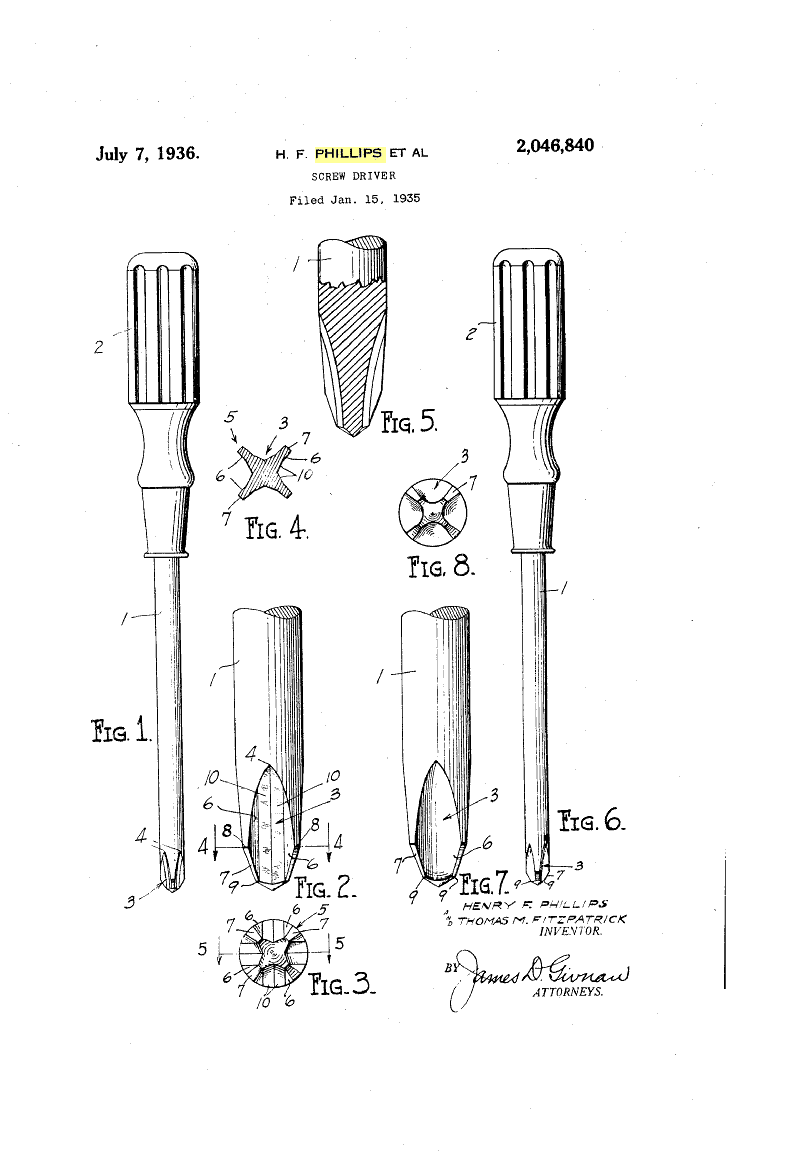
Henry F. Phillips — when do we celebrate?

August 10, 2007

Herny Phillips' patent for the Phillips screw and screwdriver (Google Patents)

Patent drawings for the Phillips screw and screwdriver, 1936

Only Crook in Town was alerted to the work of Henry F. Phillips by an alert and helpful librarian (well — aren’t they all?). She worries –January 15 is Martin Luther King, Jr., Day, and July 7 is the middle of the summer — what day would be appropriate to celebrate the invention and patenting of the Phillips Screwdriver? (If image above does not display, click the thumbnail picture at the end of the post.)

Ah, history teachers, you noticed that the drawing comes from Google’s files of patent applications. And now you wonder: What other wonderful illustrations can we legally rip off to use in class? Wonderful question — what do you find?

The Phillips screwdriver came along in time for World War II and the mass assembly of aircraft, and aircraft instrument panels. The Phillips screw head helped aircraft assemblers keep from scratching the black metal of the rest of the panel while securing instruments into the forms.

Read the rest of this entry »


When things get tough, the patriotic listen to Barbara Jordan

August 2, 2007

Whose voice do you hear, really, when you read material that is supposed to be spoken by God? Morgan Freeman is a popular choice — he’s played God at least twice now, racing George Burns for the title of having played God most often in a movie. James Earl Jones?

Statue of Barbara Jordan at the Austin, Texas, Airport

Statue of Rep. Barbara Jordan at the Austin, Texas airport that bears her name. Photo by Meghan Lamberti, via Accenture.com

For substance as well as tone, I nominate Barbara Jordan’s as the voice you should hear.

I’m not alone. Bill Moyers famously said:

When Max Sherman called me to tell me that Barbara was dying and wanted me to speak at this service, I had been reading a story in that morning’s New York Times about the discovery of forty billion new galaxies deep in the inner sanctum of the universe. Forty billion new galaxies to go with the ten billion we already knew about. As I put the phone down, I thought: it will take an infinite cosmic vista to accommodate a soul this great. The universe has been getting ready for her.

Now, at last, she has an amplifying system equal to that voice. As we gather in her memory, I can imagine the cadences of her eloquence echoing at the speed of light past orbiting planets and pulsars, past black holes and white dwarfs and hundreds of millions of sun-like stars, until the whole cosmic spectrum stretching out to the far fringes of space towards the very origins of time resonates to her presence.

Virgotext carried a series of posts earlier in the year, commemorating what would have been Jordan’s 71st birthday on February 21. (Virgotext also pointed me to the Moyers quote, above.)

Now, when the nation seriously ponders impeachment of a president, for the third time in just over a generation, Ms. Jordan’s words have more salience, urgency, and wisdom. It’s a good time to revisit Barbara Jordan’s wisdom, in the series of posts at Virgotext.

“There is no president of the United States that can veto that decision.”

“My faith in the Constitution is whole.”

“We know the nature of Impeachment. We’ve been talking about it a while now.”

“Indignation so great as to overgrow party interests.”

And finally:

The rest of the hearing remarks are all here. It’s a longer clip than the others but honestly, there is not a good place to cut it.

This is Barbara Jordan on the killing floor.

This was a woman who understands history, who illustrates time and again that we are, with every action, with every syllable, cutting the past away from the present.

She never mentions Nixon by name. There is the Constitution. There is the office of the Presidency. But Richard Nixon the president has already ceased to exist. By the time she finishes speaking, he is history.

“A President is impeachable if he attempts to subvert the Constitution.”

Also see, and hear:

Virgotext’s collection of Barbara Jordan stories and quotes is an excellent source for students on Watergate, impeachment, great oratory, and Barbara Jordan herself. Bookmark that site.

Barbara Jordan, in a pensive moment, in a House Committee room

Rep. Barbara Jordan sitting calmly among tension, at a House Committee meeting (probably House Judiciary Committee in 1974).

Update 2019: Here is the full audio of Barbara Jordan’s speech. It is still salient, and if you listen to it you will understand better what is going on in Congress today.

Barbara Jordan, Statement on the Articles of Impeachment, at AmericanRhetori.com.


D-Day – fly your flag if you wish

June 6, 2007

Normandy landing, June 6, 1944, from an LST

D-Day landing taken by Chief Photographer’s Mate (CPHOM) Robert F. Sargent of the United States Coast Guard (USCG) Greatest Generation D-day landing

June 6, 2007, is the 63rd anniversary of D-Day, the massive invasion of Normandy by the U.S., Canada and Britain, Free France and Poland, to start the push toward final defeat of Germany in World War II (more formally known as the Battle of Normandy). Germany’s defeat would come ten months later.

The day is not formally listed by law as a day to fly the U.S. flag. Citizens may fly the flag on any day. Many veterans’ groups urge flying the flag today, especially in honor of the thousands who gave their lives in the invasion.

On the Allied side, 29,000 U.S. soldiers, 5,000 Canadian soldiers, 11,000 United Kingdom soldiers,  died between June 6 and August 25, 1944, the formal end of the battle.  France lost more than 12,000 civilians in the fight for freedom, too.

  • Photo: Assault landing One of the first waves at Omaha Beach as photographed by Robert F. Sargent. The U.S. Coast Guard caption identifies the unit as Company E, 16th Infantry, 1st Infantry Division.

Ann Richards, you warned us

September 14, 2006


Former Texas Gov. Ann Richards, and a sample of a Texas barbecue rib. Photo by Elecro-Fish Media (Austin, Texas)

Ann Richards died yesterday. It’s sad for me to think what might have been, had she been able to hold off one more charge by the Texas Republicans, had she defeated George Bush in her second campaign for governor of Texas.

Gov. Richards was a gracious and graceful woman who was simply fun to know — while quietly and forcefully inspiring others to do good deeds. In a former time, a candidate who defeated someone like Richards would have the good sense to keep her in government in some capacity, just for her wisdom and experience. It will be a tribute to Richards when civility is returned to politics.

Ann Richards was a public school teacher, clearly of the highest caliber. We can only hope there are more like her teaching in Texas schools today.

Update, September 17, 2006: Molly Ivins, perhaps America’s best political columnist, was a close friend of Ann Richards. Her column well reflects the special qualities of Richards, why we will miss her so badly, and why we should worry that there are so few like her around today.