Social studies train wreck at Texas State Board of Education: Live! A Nation at Risk

January 13, 2010

Steve Schafersman will live blog the hearings on social studies standards before the Texas State Board of Education (SBOE) today, at Evo-Sphere.  Schafersman is president of Texas Citizens for Science, and a long-time activist for better education in Texas on all topics.

Rapid updates or live-blogging should be available at the blog of the Texas Freedom Network, TFN Insider.

It’s Item #6 on the SBOE agenda, with a title that tips off the trouble:

Item #6 — Public Hearing Regarding Proposed Revisions to 19 TAC Chapter 113, Texas Essential Knowledge and Skills for Social Studies, and Chapter 118, Texas Essential Knowledge and Skills for Economics with Emphasis on the Free Enterprise System and Its Benefits.

Schafersman e-mailed an introduction to the meeting:

Some say the Social Studies public testimony by the religious right, liberals, etc., then the SBOE debate, motions to amend, votes, etc. is a bigger circus than adopting the science standards. Judge for yourself. You can watch the entire circus, carnival, and sideshow on the webcast video at http://www.texasadm in.com/cgi- bin/tea.cgi

This is Texas democracy in action, when sullen and tight-lipped State Board members listen to public testifiers for 3 minutes each and profoundly ignore them since they already know what they are going to do. But I, at least, feel better after speaking so I don’t later feel responsible for the crappy amendments, changes, and policies that come out of this horrible Board because I did nothing. The proposed Social Studies standards written by the panels composed of teachers and professors are excellent (when have I heard this before), but the SBOE can’t wait to shamelessly impose their own Religious Right agenda on them.

You’ll recall that SBOE has at every possible turn disregarded the advice of famous and serious historians, respected free-market-advocating economists, geographers and educators on these standards.  Economists, for example, want Texas kids to learn about “capitalism,” since that’s what it’s called by economists and policy makers, and colleges.  SBOE thinks “capitalism” sounds too subversive, and wishes instead to require Texas kids to learn about “free enterprise” instead.

‘A rose by any other name’ you think, until you start thinking of how Texas kids do on standardized tests, college admission exams, and the punchline on the joke, about Texas kids being told not to study capitalism.  No siree, no capitalism in the fictional home of J. R. Ewing, never mind the real-life capitalists like T. Boone Pickens or H. Ross Perot (Jr. and Sr.).

In Dallas, the city prepares to name a street after Cesar Chavez, the great Hispanic union organizer and advocate for working Americans.  In Austin, SBOE works to strike all mentions of Chavez, because they dislike the politics of heroes of our ethnic minorities (soon to be a majority in Texas).  In Washington historians and policy-makers follow the legacy of Thurgood Marshall, the great civil rights attorney and first African-American to sit on the U.S. Supreme Court.  In Austin, SBOE thinks Marshall should be left out of history books.  Many of us suspect he’s anathema to the white right-wing in Austin:  A smart, successful and noble man of color.

Mel and Norma Gabler died years ago, but their history lingers in the halls of education policy in Austin.  It’s Shakespearean.

This is a massive battle.  David Barton worked for 30 years to gut history standards nationally to teach a history of America that never was, and as the official religionist appointee of the right-wing SBOE members, he stands on the brink of accomplishing much of the revisionism he’s advocated.  See the Texas Tribune story on the issue, “Hijacking History.”

Generally we shouldn’t negotiate with terrorists, Ronald Reagan said.  At the SBOE, we’ve put the terrorists in charge of history and economic curricula — if not the terrorist themselves, at least the terrorists’ camels’ noses.  Texas’s process has earned flashing red-light, claxon-sounding repeating of the words of Ronald Reagan’s Commission on Excellence in Education:  If a foreign nation did this to us, we’d consider it an act of war [excerpt below the fold].

Make no mistake about it.  SBOE’s goal is to roll back any of the reforms left from Reagan’s Commission’s work.  Our nation is more at risk from foreign competition than ever before.  SBOE plans to give away a bit more of our future to China, this week.

Our saving grace is the general incompetence of SBOE members to make significant reform in Texas’s wounded schools, reeling from unworkable and damaging requirements under the No Child Left Behind Act and a testing program that severely limits what can be taught in any social studies course other than those bastions of learning left in International Baccalaureate programs and Advanced Placement courses (estimates are that between 5% and 10% of Texas high school students can take one of those good courses).  Whatever silliness, craziness or lies SBOE orders to  be taught, it can’t be taught and tested well.  Inertia preventing change works to save America in this case.

In business, most CEOs at least appreciate the value of having good front-line employees who are the ones who really deliver the service or product and produce the profit of the enterprise (even if they don’t treat those employees so well as the employees deserve).  Education may be the last bastion of flogging the horse that should be pulling the cart instead.  In this case, having well-trained teachers in the classroom is the last hope for Texas, Texas parents and Texas students — and Texas’s economic future and future in liberty.  Teachers are the last defense of freedom in Texas.  Today SBOE will make another assault on the ramparts that protect the teachers in their work.

When will the French fleet arrive to lend aid?  Will it arrive at all?  And if it arrives, will Texas kids know better than to shoot at the ships?

Carol Haynes, who claims to have a doctorate in some discipline, told the board how to rewrite the standards to completely change the history of the civil rights movement in their last hearing on the topic.  According to Haynes, apparently, Dr. Martin Luther King, Jr., was opposed to civil rights and Barry Goldwater was in favor — the Board didn’t offer to correct her revisionism, but instead asked her to go beyond her three minutes in fawning acceptance. This appears to be SBOE’s approval of various Other Universe hypotheses offered by Star Trek, allowing any damned thing at all to be taught as history (except the right stuff).  Haynes is scheduled to testify again (#128), probably very late at night, but perhaps in time for the 10:00 p.m. Texas television news broadcasts.  Oy.

Excerpt from the Report of the Commission on Excellence in Education, A Nation at Risk, below the fold.

ae_summer2015mehta_opener-1100x736

Cover of A Nation at Risk: The Imperative for Educational Reform, the 1983 report that started the education reform mess. AFT graphic.

Stand up for your nation, it’s children and future; sound the alarm:

Add to FacebookAdd to NewsvineAdd to DiggAdd to Del.icio.usAdd to StumbleuponAdd to RedditAdd to BlinklistAdd to TwitterAdd to TechnoratiAdd to Furl


Read the rest of this entry »


Schafersman’s testimony on social studies standards, to Texas SBOE

January 13, 2010

Dr. Steve Schafersman will testify on proposed new standards for social studies in Texas public schools, at a hearing before the Texas State Board of Education (SBOE) scheduled for today, January 13, 2009.

Schafersman is president of Texas Citizens for Science and its driving force.  He’ll also live blog much of the hearing at his blog, Evo-Sphere.  You should probably watch TFN Insider, the blog of the Texas Freedom Network, too.

Schafersman’s testimony was released in advance, and reprinted below.

Public Testimony of
Steven D. Schafersman

Texas State Board of Education Public Hearing
Austin
, Texas; Wednesday, 2009 January 13

I am grateful for the opportunity to address you about Social Studies standards for which I am testifying as a private citizen. Tomorrow you will begin your work to adopt the new Social Studies TEKS. I closely read and evaluated the proposed Grade 8 Social Studies, High School U. S. History, U. S. Government, World History, and World Geography standards and found them to be quite satisfactory. The standards were extremely comprehensive, balanced, fair-minded, and honest. The members of the panels who wrote them did an outstanding job and I was very impressed by their knowledge and professionalism. I urge that you adopt these Social Studies standards without change.

My experience with this Board leads me to suspect that some of you don’t want to adopt these excellent standards–written by social studies curriculum experts and teachers–without change. After all, these standards were written by experts and some of you feel obliged to stand up to the experts. Some of you may want to change some of the standards to correspond to your own political and religious beliefs, such as the mistaken notions that the United States is a Christian nation, that we do not have a secular government, or that separation of church and state is a myth. Some of you may want to add more unnecessary information about Christian documents or Christian history in America. If some of you do wish to make such changes, I request that you restrain yourselves. Please resist the temptation to engage in the same behavior some of you exhibited last year when you perverted the Science standards and embarrassed the citizens of Texas by engaging in pseudoscientific anti-intellectual behavior. While the Texas State Board of Education has a long and proud history of anti-intellectualism, the economic conditions today demand that we stop that practice and return to professionalism and respect for academic achievement so that our children have a future in which they will use their minds to make a living in intellectual pursuits and not their limbs in a service economy.

During the adoption of the science standards, some Board members amended the Biology and Earth and Space Science standards by engaging in fast talking, omitting pertinent information about what was being changed, offering bogus “compromises” that were not really fair compromises, and referring to “experts” who were in fact pseudoscientists and not real experts at all. I hope to not witness the same behavior tomorrow but I am pessimistic. Two pseudo-historians, David Barton and Peter Marshall, were appointed as “experts” and there is plenty of evidence available that demonstrates that these two gentlemen are preachers and polemicists for their radical agendas, not legitimate history experts.

I urge the rational and conservative Board members–whom I hope still make up a majority of this Board–to resist proposed radical amendments that attempt to insert bogus histories of American exceptionalism, America’s presumed Christian heritage as the source of our liberties and Constitutional principles, and other historical myths perpetrated by the American Religious Right. I urge you to vote No to such radical amendments, not Abstain or your radical opponents will gain the same advantage that they enjoyed during the amendment process for the Science standards, where they were delighted when some of you abstained or did not vote since that made it easier for them to obtain majorities which allowed them to win several amendments that made changes detrimental to science education. Unlike last year, when you were prevented from consulting your legitimate Science experts during debate, please consult your genuine Social Studies experts, Texas Professors Kracht, Hodges, and de la Teja. Please try to avoid the same mistakes with the Social Studies adoption process that occurred with the Science standards adoption, so no one will be able to accuse you of being anti-intellectual.


Trouble at Texas Board of Education: Social studies

January 11, 2010

Here is a news rundown of stories on the Texas State Board of Education, who have been planning for a year now to mess up social studies standards for Texas public schools, this week.

Get on your horse and warn Texans:  The Idiots are coming to get your good schoolbooks:

Add to FacebookAdd to NewsvineAdd to DiggAdd to Del.icio.usAdd to StumbleuponAdd to RedditAdd to BlinklistAdd to TwitterAdd to TechnoratiAdd to Furl


Happy Birthday, Milly!

January 7, 2010

Millard Fillmore was born January 7, 1800. Had he lived, Millard Fillmore would be 210 years old today, and probably very cranky, and looking for a good book to read.

Millard Fillmore (unknown artist, circa 1840) - National Portrait Gallery

Millard Fillmore (unknown artist, circa 1840) - National Portrait Gallery

Would you blame him for being cranky?  He opened Japan to trade.  He got from Mexico the land necessary to make Los Angeles a great world city and the Southern Pacific a great railroad, without firing a shot.  Fillmore promoted economic development of the Mississippi River.  He managed to keep a fractious nation together despite itself for another three years.  Fillmore let end the practice of presidents using slaves to staff the White House (then called “the President’s Mansion”).

Then in 1852 his own party refused to nominate him for a full term, making him the last Whig to be president.  And to add insult to ignominy, H. L. Mencken falsely accused him of being known only for adding a bathtub to the White House, something he didn’t do.

As Antony said of Caesar, the good was interred with his bones — but Millard Fillmore doesn’t even get credit for whatever evil he might have done:  Fillmore is remembered most for being the butt of a hoax gone awry, committed years after his death.  Or worse, he’s misremembered for what the hoax alleged he did.

Even beneficiaries of his help promoting the Mississippi River have taken his name off their annual celebration of the eventFillmore has been eclipsed, even in mediocrity (is there still a Millard Fillmore Society in Washington?).

Happy birthday, Millard Fillmore.

Millard Fillmore was a man of great civic spirit, a man who answered the call to serve even when most others couldn’t hear it at all.  He was a successful lawyer, despite having had only six months of formal education (a tribute to non-high school graduates and lifelong learning).  Unable to save the Union, he established the University of Buffalo and the Buffalo and Erie County Historical Society.  And, it is said of him, that Queen Victoria said he was the most handsome man she had ever met.

A guy like that deserves a toast, don’t you think?

Resources:


Are you ready? Millard Fillmore’s birthday, January 7

January 6, 2010

Millard Fillmore turns 210 tomorrow.

Millard Fillmore in the 1850s, NY Times image, Wikimedia

Millard Fillmore in the 1850s, wondering about that birthday cake. Wikimedia, via New York Times image

How do you plan to celebrate?

Some are planning big fetes:

From 10:00AM to 3:00PM on Sun Jan 10, 2010.

Save the date! Cayuga-Owasco Lakes Historical Society will once again host a birthday party for Millard Fillmore on Sunday, January 10 from 10:00am to 3pm. The history museum at 14 West Cayuga Street will be open for visitors and will serve refreshments in honor of our 13th President’s birthday. This will be the last official function until March, 2010. Throughout December the house will be open on Mondays 9:00 am until noon. If you have not visited lately, the recently refurbished Fillmore Room features a timeline of his life and presidency as well as photos and memorabilia.  (From Auburnpub.com)

Tradition is on a glide path at the University of Buffalo, a school founded by Millard Fillmore; from the UB Media Center:

Media Advisory: UB to Commemorate 210th Birthday of Millard Fillmore

Release Date: January 6, 2010

BUFFALO, N.Y. — The University at Buffalo will uphold a longstanding winter tradition as it celebrates the 210th anniversary of the birth of Millard Fillmore, UB’s first chancellor and the 13th president of the United States, at a ceremony to be held at 10 a.m. Jan. 7 at Fillmore’s gravesite in Forest Lawn Cemetery.

The outdoor ceremony marking the 210th anniversary of Fillmore’s birth on Jan. 7, 1800, is hosted by UB, the Forest Lawn Group and the Buffalo Club. It is free and open to the public.

The commemoration address will be delivered by James A. Willis, UB executive vice president for university support services. Wreaths will be presented by Col. Timothy G. Vaughn, 107th Mission Support Group Commander, New York Air National Guard, representing the White House; Marc Adler, adjunct professor in Millard Fillmore College and immediate past president of the UB Alumni Association, representing UB; Charles M. Mitschow, president of the Buffalo Club; and Dean H. Jewett, chairman of the board of the Forest Lawn Group.

The invocation will be presented by The Rev. Joel Miller, minister of the Unitarian Universalist Church of Buffalo. The UB Police Color Guard will present the flags, and West Richter, a UB student and member of the UB Marching Band, will play taps.

A reception with refreshments will immediately follow in the Forest Lawn Chapel.

Fillmore helped establish UB, serving as its first chancellor from 1847 until his death in 1874. He also was instrumental in framing the charter transforming the Village of Buffalo into the City of Buffalo. He helped establish Buffalo General Hospital, the SPCA, the Buffalo Historical Society, the Fine Arts Academy, Buffalo Savings Bank, Buffalo’s public library system and the Buffalo Club. As a congressman, he secured funding to enlarge the Buffalo Harbor and expand the Erie Canal. Fillmore served as president from 1850 to 1853.

This year marks the 45th anniversary of UB’s stewardship of Fillmore’s service, but the tradition to honor Fillmore dates back to 1937. From 1937 until 1965, the ceremonies were staged by the City of Buffalo and the Buffalo Board of Education. The events were administered by Irving R. Templeton, a 1909 graduate of UB, who scheduled two programs annually on or near Jan. 7, one in City Hall and one in Forest Lawn.

The responsibility shifted to UB when Templeton died in 1965. Although UB participated in the Fillmore birthday commemoration during Templeton’s stewardship, the university took over the ceremonies and made it a community event starting in 1966.

Media arrangements: Charles Anzalone onsite at 440-8824.

According to Buffalo Rising!, tradition wins out at Forest Lawn, New York, too:

By Sandy Starks

Okay… the frenzy of holiday visits and activities are past, the decorations are put away, and the final game in regular season football has been played. The winter doldrums are about to set in, and what are we to do?

The Forest Lawn Cemetery Heritage Foundation has come up with programming that will help you get over the inevitable winter blues. We all love the Summer in the Cemetery tours the cemetery offered each year, so in 2010 the folks at Forest Lawn have decided to celebrate the winter season by hosting a four-part series of concerts and lectures to be held at the historic chapel, located in the heart of the cemetery.

On the second Sunday of each month, January through April, at 2PM, programs will include a mini concert, followed by a lecture on a topic related to Forest Lawn and the History of Buffalo. This Sunday January 10th, the topic will be The History of Music in Buffalo.

Music Librarian, Raya Lee, teams up with one of Buffalo’s favorite musical talents, Bruce Woody, to discuss how music evolved in Buffalo. The lecture includes information about the opening of the first music store in 1827, the first performance of super-star Jenny Lind in 1851, an overview featuring the greatest musical artists of the day, their stories, and the birth of the Buffalo Philharmonic Orchestra.

People featured in the lecture include Millard Fillmore, James P. Sheppard, owner of the first music store in Buffalo; Marian de Forest, Zorah Berry, and conductors John Lund and Charles Kuhn. Tunes, some we are familiar with such as “Shuffle off to Buffalo,” “Buffalo Gals,” and “Somewhere Over the Rainbow” (Harold Arlen), will be played throughout the lecture.

The series continues with a program on February 14th, with The Entertainers and Writers of Forest Lawn, presented by: Forest Lawn researcher, Patrick Kavanagh with a musical presentation performed by Buffalo musicians Billy McEwen and Joe Head.

Many of us know about Darwin Martin of the Larkin Soap Company but there is much to know about John Larkin and the company itself. The March 14th program, A Review of the Larkin Soap Company – A Man and His Products will familiarize us the dynamic Buffalo business. Larkin Enthusiast Jerry Puma will talk about the Larkin Soap Company and bring some of his Larkin collection for you to view. A musical presentation by The Docenko Brothers rounds out this fun yet informative day.

The series concludes on April 11th, with a talk by Author Laura Pederson (if you haven’t read the book Buffalo Gal yet, that is another way to beat the winter blues), talking about Smokestacks & Skyscrapers: A Lighthearted History of Buffalo. The musical presentation will be by Grace Stumberg, a rising Buffalo musical talent and student at Villa Maria College.

Admission is $15. Tickets may be purchased at Forest Lawn’s administration office, 1411 Delaware Avenue or by calling 716.885.1600. Ask about the discount that is available for all four programs.


Stubborn Birthers soldier on

January 4, 2010

Birther “Dr. Kate” sez there’s a case coming to a hearing in Pennsylvania that will go to the Supreme Court no matter how this hearing turns out.

Here’s the table of contents to Kerchner v. Obama. Here’s the full complaint, according to Dr. Kate.

Probably the best thing going for the plaintiffs is that Orly Taitz only appears by name in a bizarre accounting of everything ever said on the issue (except for the lack of evidence and reasons this case will fail which, oddly, isn’t included in the complaint; everything else is included).

I predict the case will be dismissed, but it may be dismissed with prejudice.  That is, if it really does come to a hearing.  Is that really possible?

Warn others so they don’t get trampled:

Add to FacebookAdd to NewsvineAdd to DiggAdd to Del.icio.usAdd to StumbleuponAdd to RedditAdd to BlinklistAdd to TwitterAdd to TechnoratiAdd to Furl


Edith Wharton on Facebook: What a horrible thought!

January 3, 2010

Nancy Sharon Colllins, reporting after her recent work at the Harry Ransom Center at the University of Texas, including reading some original letters and other writings of Edith Wharton, wonders what would be the effect on history and literary studies, had Edith Wharton used Facebook instead of keeping her journal and writing copious numbers of letters.

And that got me thinking: What if Edith Wharton had Facebooked? Had she lived in our time and communicated digitally, I wonder what her literature would be like. Looking at five days of cursive writing and personal letters made me realize that her compulsion to jot down her thoughts was no different than ours today when we tweet about what we had for lunch or share some fab link we just discovered. The difference between a letter written longhand and a Facebook post is that one takes a little bit longer (and leaves a more lasting trace), but the purpose is the same. Whether we live on a grand, Whartonian scale or a quieter, more ordinary one, we feel more significant when we share intimacies about ourselves with others.

There’s a good warm-up and/or journaling exercise in there for literature teachers.


Annals of Global Warming: Warming in the middle troposphere, cooling in the lower stratosphere, 1995-2007

January 2, 2010

This is a post out of history, from the good people at NASA’s Earth Observatory, on July 6, 2007.  For those of who are not climate scientists or particularly advanced in our acumen in dealing with the large datasets and complex mathematics of global warming, this Earth Observatory Image of the Day may improve understanding.

Atmospheric Temperature Trends, 1979-2005

Posted July 6, 2007

Atmospheric Temperature Trends, 1979-2005

Climate models predict that the build up of greenhouse gases should warm the lower layer of the atmosphere, called the troposphere, and cool the layer above it, the stratosphere. Greenhouse gases accumulate in the troposphere where they absorb energy radiated from the Earth and re-emit energy back to the surface. Because the gases trap heat in the lower parts of the atmosphere, the stratosphere cools down. This pattern of warming in the lower atmosphere and cooling in the stratosphere is a hallmark of greenhouse gas warming in global climate models.

These images show temperature trends in two thick layers of the atmosphere as measured by a series of satellite-based instruments between January 1979 and December 2005. The top image shows temperatures in the middle troposphere, centered around 5 kilometers above the surface. The lower image shows temperatures in the lower stratosphere, centered around 18 kilometers above the surface. Oranges and yellows dominate the troposphere image, indicating that the air nearest the Earth’s surface warmed during the period. The stratosphere image is dominated by blues and greens, indicating cooling.

Globally, the troposphere warmed, and the stratosphere cooled during this period. Local trends varied. The greatest tropospheric warming was in the Arctic, where warming is amplified as snow and ice melt. The Antarctic, on the other hand, showed cooling. Some researchers have explained the localized cooling as a side effect of the ozone hole on atmospheric circulation over Antarctica. Loss of ozone cools the stratosphere, a change which intensifies the vortex of winds that encircle the continent. The stronger vortex isolates the air over the continent, cooling the stratosphere even further. At different times of the year, the unusually cold air dips down from the stratosphere and into the troposphere.

The cooling trend in the stratosphere was probably not solely due to greenhouse gas warming at lower altitudes; loss of ozone also cools the stratosphere. In the stratosphere, two warm spots over Antarctica and the Arctic appear to defy the overall cooling trend. One explanation for these warm spots is that polar stratospheric temperatures can fluctuate widely. The poles, especially the Arctic, experience periodic events known as sudden stratospheric warmings, during which the vortex of winds that circles the poles breaks down. When this happens, the stratosphere can warm several tens of degrees Celsius in a few days. Although these events are more common in the Arctic, a significant sudden stratospheric warming also occurred in the Antarctic stratosphere in 2002 and may help explain the apparent warming trend. Whether the localized warming trend is significant is still uncertain.

The measurements were taken by Microwave Sounding Units and Advanced Microwave Sounding Units flying on a series of National Oceanic and Atmospheric Administration (NOAA) weather satellites. The instruments record microwave energy emitted from oxygen molecules in the atmosphere. Warmer molecules release more energy than cooler molecules, so scientists can measure the temperature of the atmosphere by recording the amount of microwave energy being emitted. Early analyses of these measurements showed little or no warming in the troposphere, where models predicted that warming should be occurring. For a time, these measurements caused some people to question the validity of global climate models and greenhouse gas warming. Scientists discovered, however, that the satellites carrying the microwave instruments had drifted in their orbits over time, so that more recent measurements were taken at a different time of day than older measurements. Once scientists accounted for this bias and other differences between the individual instruments, the measurements showed a warming trend in the troposphere, consistent with surface observations of rising global temperature.

Re-analysis of the satellite measurements answered one of the frequently asked questions about global warming: why didn’t the early satellite data show warming in the lower layer of the atmosphere? To read more on this topic, see Global Warming Questions & Answers, which addresses this and other common questions about global warming.

    Further reading

  • Global Warming Questions & Answers on the Earth Observatory.
  • Global Warming, a fact sheet published on the Earth Observatory.
  • Fu, Q., Johanson, C.M., Warren, S.G., Seidel, D.J. (2004, May 6). Contribution of stratospheric cooling to satellite-inferred tropospheric temperature trends. Nature, 429, 55-58.
  • Johanson, C.M., Fu, Q. (2007 June). Antarctic atmospheric temperature trend patterns from satellite observations. Geophysical Research Letters, 34, L12703.
  • Karl, T. R., Hassol, S. J., Miller, C. D., and Murray, W. L., editors. (2006). Temperature Trends in the Lower Atmosphere: Steps for Understanding and Reconciling Differences. A Report by the Climate Change Science Program and the Subcommittee on Global Change Research, Washington, DC. Accessed June 8, 2007.
  • Ramaswamy, V., Schwarzkopf, M.D., Randel, W.J., Santer, B.D., Soden, B.J., Stenchikov, G.L. (2006, Feb 24). Anthropogenic and natural influences in the evolution of lower stratospheric cooling. Science, 311, 1138-1141.
  • Remote Sensing Systems. (2007, June 12). Description of MSU and AMSU Data Products. Accessed July 5, 2007.

NASA image created by Jesse Allen, using data provided courtesy of Remote Sensing Systems. Caption information courtesy Carl Mears, Remote Sensing Systems, and Paul Newman and Joel Susskind NASA Goddard Space Flight Center.

Spread the historic word:

Add to FacebookAdd to NewsvineAdd to DiggAdd to Del.icio.usAdd to StumbleuponAdd to RedditAdd to BlinklistAdd to TwitterAdd to TechnoratiAdd to Furl


Millard Fillmore’s 1856 campaign poster, on the Native American Party ticket

December 31, 2009

Millard Fillmore 1856 campaign poster - Library of Congress

Notes from the Library of Congress:

MILLARD FILLMORE, AMERICAN CANDIDATE FOR PRESIDENT OF THE UNITED STATES.

CREATED/PUBLISHED
1856.

SUMMARY
A large woodcut proof for a campaign banner or poster for the Native American party’s 1856 presidential candidate. A bust portrait of Millard Fillmore appears in a roundel, flanked by allegorical figures of Justice (left) and Liberty (right). Both figures wear classical gowns and tiaras. Justice holds a large sword and scales, Liberty a staff and Phrygian cap and the Constitution. Atop the roundel perches an eagle, with American flags on either side. Below are a document “The Union” (left) and bundled fasces (right).

NOTES
Entered . . . 1856, by Baker & Godwin . . . New York.

The Library’s proof was deposited for copyright on July 10, 1856.

Published in: American political prints, 1766-1876 / Bernard F. Reilly. Boston : G.K. Hall, 1991, entry 1856-6.

Notice the striking resemblance to this 1860 campaign poster:

Poster for campaign of Abraham Lincoln for President, 1860 - Baker & Godwin, publisher; Library of Congress

Poster for campaign of Abraham Lincoln for President, 1860 - Baker & Godwin, publisher; Library of Congress

The Library of Congress notes:

SUMMARY: A print for a large campaign banner or poster for Republican presidential candidate Abraham Lincoln. It features a central roundel with a bust portrait of the candidate, flanked by standing deities Justice and Liberty. Justice (left) holds scales and a sword, while Liberty (right) holds the Constitution and a staff with Phrygian cap. An eagle with wings spread perches atop the roundel, behind which are several American flags on pointed staffs. Below the roundel a document “The Union” and a fasces lie on the ground. The image appears to have been printed from the same blocks (or a stereotype of them) as Baker & Godwin’s 1856 banner for Millard Fillmore (no. 1856-6). Only the central portrait has changed.

MEDIUM: 1 print on calendered paper : woodcut with letterpress ; image 39.3 x 55 cm.

CREATED/PUBLISHED: [New York] : Published and for sale by Baker & Godwin, Tribune Buildings, N.Y., c1860.

p


Climate change, and DDT: Monckton’s inconvenient and inaccurate history

December 31, 2009

Oh, Christopher Monckton raves on, and gullible or horribly ignorant journalists let him.  Maybe Michael Coren is both gullible and horribly ignorant.

Monckton’s grotesque errors of history suggest that he’s probably wrong on the science, too, considering that his studies were in the classics, and not science.  If he can’t get stuff right in his area of expertise, it’s almost impossible that he’d be right far afield.

I don’t know Coren’s other work, but the way he turned his microphone over to Monckton in the interview below is disturbing, with no challenge given to wild flights of imagination Monckton took, posed as history.  The Kennedy administration wasn’t that long ago; Rachel Carson’s book Silent Spring had a 40th anniversary edition that is still on the shelves.  Bald eagles, the national bird of the United States, climbed off the endangered species list just a few months ago with accompanying dozens of news stories that explained DDT had nearly wiped the species out.

Coren slept through all of that?  Monckton thought no one would remember the accurate history?

Monckton’s appearance on Michael Coren’s program on CTS (a Canadian network) obnoxiously slapped my browser.  You may recall I had checked out Monckton’s speech to an unquestioning group of students at a religious college in Minnesota.  At about the same time, he showed up on Coren’s program, saying much of the same things he’d said earlier in Minnesota.
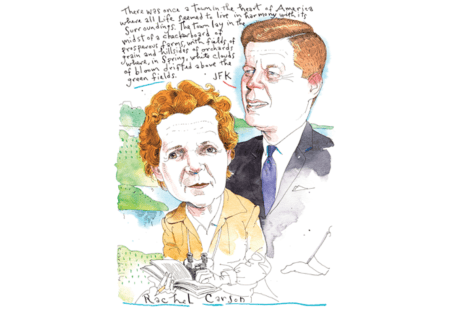
Rachel Carson persuaded President John Kennedy on her knowledge of oceans; it was the good science that hooked him. Illustration from Audubon Magazine: CARSON AND CAMELOT, Illustration by Joe Ciardiello

Rachel Carson persuaded President John Kennedy on her knowledge of oceans; it was the good science that hooked him. Illustration from Audubon Magazine: CARSON AND CAMELOT, Illustration by Joe Ciardiello

Have you ever interviewed a truly pathological liar?  Hoaxsters tell falsehoods, and the truly pathological ones keep exaggerating as they tell, testing the waters to see how much the audience will believe.  I think Monckton is one of those.

Consequently, the falsehoods grow grander as the hoaxster finds the audience gullibly lapping up the milk of human imagination.

Take this example, Monckton in part 5 of his interview comedy routine with Coren.  Coren doesn’t question any of the confabulations Monckton comes up with, apparently having been born after 1975 and never read much history of science or the enviornmental movement, and apparently having somehow missed the dozens of news stories in recent years on the recovery and removal from the Endangered Species List of the bald eagle and brown pelican, and recovery of osprey and peregrine falcons (does Canada have Google?  does Coren know how to use it?  does Coren have no producer, no fact checkers?)

Nor, apparently, does Monckton have any ability to control his ability to say patently offensive and absolutely impossible things to blame others.  Monckton blames Jackie Kennedy for killing 40 million kids with malaria; never mind that he’s wrong, he pushes on to call President Jack Kennedy “her foolish husband;” never mind that he’s got all his facts wrong, he proceeds to call William Ruckleshaus “an environmental nincompoop”:

[At 2:50 of the video]

LORD MONCKTON: I think it is particularly sad that what is essentially a scientific question has been politicized.  In Britain it’s different.  All parties have sort of gone along with the bedwetting theory.  They’ve all said, “Oh, yes!  We’re doomed!”

The Conservative Party — which is nominally the right-wing party, though now it’s kind of center-left, really — it has come out and said — in fact it has produced the stupidest document on climate change that I’ve ever seen, it’s even stupider than Al Gore’s film; it’s unbelievable how half-witted it is.  It isn’t universal that it’s right-left.

Certainly it is true to say that the left are more enthusiastic about this, worldwide, than anyone else.

But, you see, then, they’ve got it wrong before.  Let’s take the DDT example, where 41 years ago, Jackie Kennedy read Rachel Carson’s Silent Spring.  And the thesis of this book was that because of DDT and other chemicals we were pouring into the atmosphere, the world was going to be so grossly polluted that every species other than humankind would die, and then eventually we would die, too.  And it was all going to be terrible.

From where did Monckton get the idea that Jackie Kennedy read Carson’s book, and that she initiated action? Famously, President Kennedy took a question about DDT in one of his popular afternoon press conferences.  He said he had read the book, and that he was looking into it.

President Kennedy did in fact task his science advisers to check out the book.  The President’s Science Advisory Council (PSAC) reported on May 15, 1963.  They said Carson’s book was accurate, and that the government should act immediately to investigate harms from synthetic chemicals including DDT.

Carson didn’t write anything about ‘pouring chemicals into the atmosphere.’  One of the great concerns among wildlife biologists was the damage done in water — where, it turned out, DDT was quickly absorbed into all living things, which then multiplied the dosages of DDT several million times as it climbed up the trophic ladder (food chains).  The problem with DDT is that it doesn’t go into the air, or water, but is instead rapidly absorbed by living tissue.  DDT sprayed in an estuary is taken up by first-level producers, including zooplankton, phytoplankton and plants, as well as any other creature that happens by.  As these producers are consumed by creatures higher up the food chain, the dosage multiplies geometrically.

Carson didn’t whine as Monckton claims she did.  She coolly and calmly laid out the facts.  The facts were, and are, that DDT and its sister compounds pose serious dangers to living things.

And Jackie Kennedy read this, and shivered, and plucked at the sleeve of her husband — who was then President of the United States — and said:  “Look.  You’ve got to do something about this!  We’ve got to save the planet from DDT!”

Isn’t that a remarkable coincidence?  Jackie Kennedy’s husband was president of the United States! He always had such cute cuffs to tug on, too.  Monckton’s infantilizing the First Lady and President of the U.S. lacks the charm Monckton must think it adds.

Jackie Kennedy was a smart and capable woman, a journalist who went on to a long and successful career as an editor at a major publishing house.  Monckton’s disparaging of Mrs. Kennedy here is uncalled for, untoward, and ugly — and factually wrong.

I’m sure that if the president’s wife told him to look into an issue, he did.  She was not in the habit of being frivolous or silly.  There is film of President Kennedy at a press conference, being asked by a reporter if there is any official reaction on Carson’s book (hardly the pillow-side sleeve tug Monckton imagines); and anyone can check the presidential papers to see the report from the science advisors.  As we know now, Carson was right.  The Nobel winners  and others on the PSAC agreed.  Incidentally, they won their Nobels for hard research, not by writing letters to the editor of an publication from an organization that won a Nobel and then getting a sycophant to manufacture a replica Nobel, as Monckton claims with his dime-store “Nobel pin” (like a man whose mother refused to buy a deputy sheriff star for his cowboy games).

In his efforts to make the story entertainingly memorable, Monckton gives us the equivalent of passed gas in a crowded elevator.

But, Dear Reader — Dear God! — brace yourself:

And so Kennedy appointed a friend of his who was an environmental nincompoop, to take charge of the Environmental Protection Agency.

How can we know Monckton is lying? Well, John Kennedy died in November 1963.  The Environmental Protection Agency took form seven years later, in the administration of Richard Nixon, the man Kennedy defeated for the presidency in 1960.  John Kennedy was dead, and his younger brother suffered assassination, too.  Monckton’s English — U.S. history is not his forte.

So, EPA did not exist in John Kennedy’s life.  Unless Monckton claims Kennedy came back from the grave and wrested the pen from Nixon’s hand, it would have been impossible for Kennedy to appoint anyone to be in charge of the Environmental Protection Agency.

To whom is Monckton referring as director?  William Ruckelshaus, the old Republican political operator?  Monckton’s slip of the grip on history is so severe that it can’t be restored.  He’s so far out in fantasy land it’s difficult to tell.

But let’s take the next line:

Result:  Unfortunately; they banned DDT.

Ruckelshaus was Director of EPA when DDT was banned.  Ruckelshaus signed the documents.  Monckton could only be referring to Ruckelshaus.  To make his case for DDT, Monckton must bend time and all of politics.

And then, Monckton, of all people, refers to Ruckelshaus as a “nincompoop.” Um, Monck, this is one of the heroes of the Saturday Night Massacre, one of America’s better lawyers of that time or any time, a committed man of reason and solid environmental credentials.  If Ruckelshaus is an environmental nincompoop, Monckton is a lobotomized environmental pisant with a bad attitude.  (Regardless whatever he may be, Monckton has a bad attitude.)

We confront the reality here that Monckton is not engaging in any discussion about science, where simple facts of history got wrong can be subject to swift and gracious correction.  He’s off in Faux Propagandaland, making up nasty things to say as he bulldozes through the facts and truth, pushing them out of the way of his rant.  Facts, history and science be damned!, Monckton froths.  This is a crusade against the evils of socialism, and Monckton will carry on the war even when there are no socialists and no evil!  So what if they are not socialists!  Monckton will label them so and that will be that!

Oy.  Monckton’s so far out in left field at Wrigley that he’s in the bar across the street.

This was copied worldwide, because the left got going.  “Aha! We can show who’s boss!  We can ban DDT!”

Nope, sorry.  Sweden banned DDT, and then the U.S. banned DDT from use around babies, and then in 1972 the U.S. banned use of DDT in agriculture.  Most European nations eventually followed with tighter regulations.  History shows, however, that DDT was never banned in most of the world.  In the U.S., sadly, DDT manufacture for export continued until 1984 (to the day before the enactment of the Superfund bill), and DDT manufacture continues today in India and China.

Not only did the left not ban DDT around the world, no one did.

Not content to merely rape history and stuff its bloody body in a garbage can, Monckton then invents a whole new class of evil for environmentalists to do:

And of course a lot of them were in league with people who were producing chemicals other than DDT, which they wanted to replace, so they were making money out of it the usual — unfortunately the usual money-packed story, and inglorious story.

Got that?  He says Kennedy, though dead for nearly a decade, conspired to ban DDT so he could get kickbacks from companies who manufactured competing pesticides. And so did Ruckelshaus, one of the few men who stood up to Richard Nixon and refused to fire Archibald Cox.  Monckton says Ruckelshaus was crooked, and taking kickbacks from chemical companies.

So, they banned DDT.  Now, DDT is, in fact, safe enough you can eat it by the tablespoonful — I wouldn’t recommend that, but you can do that, it won’t hurt you if you do.  It’s completely harmless to humans.  It’s completely harmless to birdlife and animals.

In 1975 a committee of the House of Representatives asked for a history of EPA.  Among other topics, the DDT restrictions were discussed — here’s a 312-page document showing which harms were of greatest concern, and what was the science that backed the analysis of those harms.  It’s 312 pages that Monckton hopes you will never read.  He probably hopes it doesn’t even exist anymore.

By 1975 all the harms of DDT worried about by Rachel Carson 13 years before had been confirmed, with the slightly happy news that DDT is not a potent human carcinogen, but a weak one.

The only thing it’s harmful to is the anopheles mosquito, which is the vector that carries the falciparum parasite that causes malaria.  And to the aedes egyptii mosquito, which carries the yellow fever parasite.  It’s fatal — and really fatal — to both of them.

DDT acutely kills fish, birds and bats.  Had Monckton done his research, he’d have seen the plea from the U.S. Army to keep DDT available for poisoning bats in old, dilapidated barracks.  (EPA did not keep that use.)  DDT manufacturers bragged about how deadly the stuff was, in trying to make a case that it should be left on the market for unrestricted use.  40 years later, wild populations of bats are beginning to recover from collateral poisoning from DDT.  Bats fall into that branch of the animal kingdom known as mammals, where humans also fall.  Generally, if a poison is toxic to one mammal, it will be toxic to all others if dose is altered to consider body mass.  But also, if a substance is carcinogenic to one mammal, it will be cancer-causing to other mammals, too.

In mosquito control DDT is problematic.   It kills mosquitoes, but it also kills all other small creatures.  Especially, it kills those things that prey on mosquitoes — other insects, birds and arachnids, fish and small animals especially.  Since mosquitoes recover from DDT rather quickly, and predators take much longer to recover, this means an outdoor dose of DDT will result in a dramatic population explosion of malaria-carrying mosquitoes in a few weeks, as the mosquitoes recover more quickly than their predators do.

Monckton appears to think DDT is selective to mosquitoes.  DDT is a broad-scale killer, not selective in any way we know.

And the guy who invented it, who was German, got the Nobel Prize, because before DDT was introduced, a million people a year around the world, nearly all of them children, were dying of malaria.  It was one of the biggest killers.

Paul Muller won the Nobel in Medicine in 1948 for discovering that DDT kills insects.  But he was not the guy who invented the stuff more than 50 years earlier. Once again, where it’s easy to check facts, Monckton just doesn’t get the facts straight.

Before DDT was introduced, and for a long time thereafter, malaria killed about three million people annually.  When WHO conducted its eradication campaign, malaria deaths fell to about two million per year by the middle 1960s.  Once DDT use in that campaign was stopped, malaria death rates continued to fall to about a million a year today.  Malaria incidence and deaths rose in the 1980s when the malaria parasites themselves developed resistance to medicines used to treat and cure malaria in humans.

The chief barrier to lower malaria infection rates is education on barriers against mosquito exposure.  The chief barrier to lower malaria death totals is the development and delivery of pharmaceuticals to treat infected humans.  DDT is a panacea in neither theatre.

DDT came along and deaths fell to 50,000.

Monckton is flat out wrong.  He’s off by a factor of 20.  He’s making this stuff up.

We were on the point of wiping it out.

Flat out wrong again.  The World Health Organization (WHO) undertook a very ambitious program to eradicate malaria in the 1950s.  By the mid-1960s it was clear the program could not work:  In Africa, overuse of DDT (in agriculture) bred mosquitoes resistant to and immune to DDT.  Worse, in most of Subsaharan Africa, governments were not stable enough to have the discipline required to mount an effective campaign against the disease, knocking down the insect carriers briefly, then furiously treating humans with the disease so that when the mosquitoes returned there would be no pool of human infection from which to draw the disease.  This is all detailed in one of those fascinating New Yorker profiles of the legendary Fred Soper, by Macolm Gladwell.  For most of the world, we’ve never been to the point of wiping out malaria, and in those places where we’ve been successful in wiping out the disease, DDT was not the chief weapon.

When the left got in on the act — it’s exactly the same people:  the Environmental Defense Fund — you know — people who have got hundreds of millions of dollars in the bank!  Goodness knows where they get it from!  Foreign governments, possibly!  I don’t know!  I haven’t looked.  But it’s certainly an alarming question:  Are the environmental movements being backed by China or India so they won’t have to compete with us for natural resources because we will have shut our industry down.  It’s a question that the security services, I hope, are looking at, because it certainly worries me.

Monckton at his most scurrilous, and most distant from the facts.  Are environmental groups funded by China?  No.  In any case, the environmental groups don’t have nearly the funding of the pro-DDT groups, with their corporate funds. While we’re thinking about it, we should think about which side China would intervene on, were China to follow through on its historic reluctance to do anything about global warming.  Who is running around the world claiming we need to do nothing, and should do nothing?  Christopher Monckton.

If Monckton is worried about who is funding him, I’m sure the CIA and FBI would be happy to let him tell them about his well of money  he uses to frustrate the United Nations and treaty obligation of a hundred nations.  (Bill Dembski?  Are you still alive?  Why don’t you turn Monckton in — you’ve still got the number of Homeland Security, don’t you?)

Perhaps most egregious, or most funny, is this:  Environmental Defense has been a leader among all agencies, governmental and NGO, to urge the extremely limited use of DDT in indoor residual spraying – and yet, they are the one group Monckton complains about.

It’s a wonder to me that Monckton can figure out which part of his foot goes into his shoes first, in the mornings.  He has such a flair for getting the facts exactly wrong, and then getting into a dudgeon about his own error.  Monckton:  Not only wrong, but 180 degrees precisely wrong.

But there was the Environmental Defense Fund, and it came in and said, “Right, we’re going to press for a ban on DDT.” They succeeded.

The number of deaths went back up, from 50,000 a year to a million a year, and it stayed there for 40 years, while the likes of me were saying, “This is killing millions.  It ought to be stopped.  What on Earth is the World Health Organization doing?”

And eventually, just three years ago, on the 15th of September, 2006, Dr. Arata Kochi of the World Health Organization said, “Right.”  He said, “In this field, politics usually predominates.  Now we are going to take a stand on the science and the data.”  He ended the ban on DDT and declared that once again it would be the frontline of defense against the mosquito.

DDT has never been banned in most of the world — especially not in Africa.  WHO never banned DDT, they simply stopped using it when it ceased to be effective. Plus, you’ll recall from just a few paragraphs above, Environmental Defense (formerly EDF)  led the campaign to get DDT restored to use in IRS campaigns in Africa.

Monckton’s game is worse than blaming the messenger — he’s blaming the heroes.

COREN:  40 million people died . . .

MONCKTON:  Children!

COREN:   . . . because Jackie Kennedy read a silly book.

MONCKTON:  Yep.

COREN:   . . . and her foolish husband bought into it.

So, Coren’s bought Moncktons rude infantilizing of the Kennedys and all the false claims that went into it.  Anybody know how old Coren is?  Was he even alive in 1962?  If not, can he read?  Does he?  Carson’s book is out now in the 2002 40th anniversary edition, still available for anyone interested in the facts.

MONCKTON:  And then, the entire international left came in on the act.  And that was what did the damage.

And so the problem is that you have this political faction which likes to show who’s boss.  That’s the characteristic of the left.  They are instinctive interventionists.  And I know this is a little much of a political point, but it is unfortunately true that it was they who pushed the DDT ban.  And it was they who — to this day! — will say that David Suzuki and others who advocated this ban — and David Suzuki will tell you today that he regards this as one of the most successful campaigns he ever conducted.  That killed 40 million people, nearly all of them children. And it took 40 years before this decision could be reversed.  Why?  Because we had to wait until all the people responsible for the original decision had either retired or died, and were no longer in the way of doing the decent thing.

COREN:  Because they thought it was harmful to people, to animals . . .

MONCKTON:  They didn’t think any such thing.  It was purely to show who was boss.  There was never any scientific case for this.

Well, it’s in Canada, after all, so Monckton feels obligated to take a swipe at the most prominent local scientist who urges environmental protection.  David Suzuki was probably active in Canada on pesticide regulation, but of course he played only a tangential role in the U.S. action, which is what Monckton complains about here.  Suzuki was no personal confidante of the Kennedys.  Suzuki was 27 in 1963, probably completing graduate school.  Monckton’s swipe at Suzuki is almost completely gratuitous.

This is where the serious charges come.  Monckton accuses Carson, and all environmentalists, of ignoring human conditions.  He accuses us — he accuses you, since you were not active to stop the DDT ban — of being mass murderers, because, he claims, DDT would have been a safe and effective way to fight malaria, which has killed about a million people a year worldwide over the past 40 years.

Monckton is dead wrong.

First, malaria fighters stopped using DDT heavily in Africa in the early 1960s, years before any nation banned the substance.  There were three problems that contributed to the cessation of DDT use, as outlined by Malcolm Gladwell in his heavily researched and authoritative tribute to malaria fighter Fred Soper in The New Yorker:

  1. Many nations in Africa did have governments capable of conducting the regimented campaign necessary to successfully eradicate malaria — and in fact, most of the nations in Subsaharan Africa didn’t participate in the campaign at all.  Soper’s goal was to knock down mosquitoes for at least six months, and in that time cure malaria in every human.  When the mosquitoes came roaring back — as everyone in the program knew they would — there would be no pool of malaria in humans from which the mosquitoes could get infected.  The program was to break the chain of transmission required for the life cycles of the malaria parasites.  But that meant that governments had to have health care systems that could accurately diagnose malaria, and often which malaria parasite, and complete a cycle of treatment needed to flush the parasites out of the infected humans.  In the end, many entire nations simply did not participate.
  2. Malaria fighters were well aware of the race they were running:  Mosquitoes breed quickly, and consequently evolve quickly.  WHO’s malaria fighting teams understood it was a simply matter of time before mosquitoes became resistant or immune to DDT.  If that happened before malaria could be eradicated in a country or region, the game was over.  Resistance to DDT in mosquitoes started showing up as early as 1948 in Greece; by the 1960s several populations of mosquitoes were highly resistant.  (Today, every mosquito on Earth carries at least one of the two alleles that produces DDT immunity — and some carry as many as 60 copies of the two alleles, leaving them completely unaffected by DDT.)
  3. Industry didn’t get on board with the campaign.  Over-use of DDT out of doors by agricultural interests speeded the evolution of DDT-resistant mosquitoes.  Industrial use competed against, and ultimately frustrated, health care use of DDT.

Gladwell describes how WHO abandoned the eradication campaign with DDT as the key element, in the middle 1960s.  This was done not as a reaction to Carson’s book, but because the mosquitoes showed resistance.  Malaria fighters couldn’t build medical care in several nations at once while racing agriculture to use DDT.  WHO turned to other methods of fighting the parasites.

It’s important to note that WHO cannot dictate to nations what they do, nor did WHO ever “ban” DDT.  There are a lot of claims that there was pressure applied by environmentalists to get DDT use stopped, but the facts remain that DDT manufacture for export to Africa continued in the United States for more than a decade after DDT use was stopped in the U.S.  Manufacture of DDT moved to Africa and Asia — India and China make the stuff today.  Any African nation who wished to use DDT could have gotten it cheaply and in great quantity.

Second, there is no indication that DDT could have saved any more lives.  Simple mathematics tells the story:  The WHO eradication campaign reduced world-wide deaths from a high of 4 million annually, to about 2 million annually.  Each nation that eradicated malaria did so by raising incomes and improving the housing of poor people, making effective screening from mosquitoes the central part of the campaign.  Also, nations copied what the U.S. had done prior to the discovery that DDT killed insects:  They institute improved public health campaigns to educate people how to avoid being bitten, and to diagnose the disease and deliver knock-out pharmaceuticals quickly.

But, since heavy DDT use was stopped, the malaria rates continued to fall until recently.  Over the last decade, annual deaths numbered under a million, lower than when DDT use was at its greatest.  It’s impossible to square decreasing death rates with Monckton’s claim that DDT is a panacea against malaria, still.

Finally to this point of DDT and malaria, we have a conundrum:  Those nations who still use DDT, still have epidemic malaria.  If, as Monckton says, DDT is a miracle weapon against malaria, those nations that use DDT should be malaria-free.  If we think through the process, we see that malaria eradication is a much greater task that simply killing mosquitoes, and too complex to be cured simply by poisoning Africa and Africans.

Monckton ultimately tries to reduce the complex science, medical, geographical, political and education issues of malaria to a political question.  He accuses everyone who ever worked to reduce DDT use of being part of an out-of-control, monolithic and unthinking “left.”  It’s a popular idea among loud talkers from the right, including Monckton, Limbaugh, Rockwell, Hannity, the Hoover Institute, and most people who resist the science of global warming.  Monckton’s crude revisions of history away from accuracy might be justified as proper propaganda, if there were a noble political goal behind his work.  No noble goal can be discerned, latent or patent.

Many on the western left, in North America and Britain, urged tighter controls on DDT, especially once it became clear that the stuff was dangerous.  They got this from a long tradition of conservation in the U.S., for example, and not from any particular political orientation.  Fact is, the radical, socialist left who took over Russia and created the Soviet Union, who dominated Eastern Europe after World War II and who created the Peoples Republic of China, have always been unfriendly toward environmental protection, including the banning of DDT.  There was no ban on DDT use in the Soviet Union, nor in China.

Conservation, and the fight against pollution, is a product of western, capitalist nations.  It may be surprising news to a few, but the American conservation movement was led by people like John D. Rockefeller II, and Laurance Rockefeller, the Vanderbilts, and other people who were wealthy enough to have time to look around to see what was happening to America’s wild resources — or who appreciated the value of wilderness and conservation and the role it played in making America great.  Monckton is turning his back on one of the greater achievements of American capitalism, the strong desire to preserve the wild, and have clean air and clean water, for the health and benefit of all citizens.  Monckton completely shuns this great heritage of western civilization.  It’s quite astounding.

Ultimately, the decisions to reduce the use of, and now to phase out DDT (under 2001’s Persistent Organic Pesticides Treaty (POPs)) were scientific decisions.  In the U.S., the National Academy of Sciences wrote about DDT early on, noting (with an egregious typographical error) the great utility and benefit DDT provides to humans, but finally weighing the harmful effects and finding that they outweigh the benefits.  The number of assessments of DDT by august scientific and policy bodies is impressive, each deciding DDT had to go:  The 1958 U.S. Forest Service, the 1963 President’s Science Advisory Council, two federal courts in the U.S., the Food and Drug Administration in 1969, the U.S. Environmental Protection Agency in 1972, two more federal appellate courts ruling on the appropriateness and scientific soundness of EPA’s rule, the National Academy of Sciences, Congress under the Resource Conservation and Recovery Act (RCRA, the Superfund Act), and finally an international treaty between nearly 100 nations.  At each step science was the driving force.  At most steps, an absence of sound science would have made the ruling go the opposite way.

But all that is legal “mumbo-jumbo” to Monckton.  All that science is for naught, to Monckton’s classics trained mind.  What Monckton wants, Monckton should have, damn the facts, damn the courts, damn the scientists, damn history.

It’s really astonishing to add up the error Monckton piles on.

It’s the same with global warming.  There is no scientific case for this, either.  It’s the same people, trying to assert themselves in the same way.  They have succeeded, yet again, in getting the entire classe politique . . .

COREN:  I wish we had another hour.

So, with Monckton dead wrong or hallucinating on DDT, we should now trust him on global warming? No, we should not trust him on any issue.

Monckton will not understand those issues, either.  They are even more complex.

Update:  Monckton continues to smear the Kennedys in Australia, nearly two months later.

More:

Help others to remember history, so as not to be condemned to repeat it:

Add to FacebookAdd to NewsvineAdd to DiggAdd to Del.icio.usAdd to StumbleuponAdd to RedditAdd to BlinklistAdd to TwitterAdd to TechnoratiAdd to Furl


Let there be light: December 31, Bright Idea Day

December 31, 2009

Here it is, the invention that stole sleep from our grasp, made clubbing possible, and launched 50,000 cartoons about ideas:

The light bulb Thomas Edison demonstrated on December 31, 1879, at Menlo Park, New Jersey - Wikimedia image

The light bulb Thomas Edison demonstrated on December 31, 1879, at Menlo Park, New Jersey - Wikimedia image (GFDL)

The light bulb.  It’s an incandescent bulb.

It wasn’t the first bulb.  Edison a few months earlier devised a bulb that worked with a platinum filament.  Platinum was too expensive for mass production, though — and Edison wanted mass production.  So, with the cadre of great assistants at his Menlo Park laboratories, he struggled to find a good, inexpensive filament that would provide adequate life for the bulb.  By late December 1879 they had settled on carbon filament.

Edison invited investors and the public to see the bulb demonstrated, on December 31, 1879.

Thomas Edison in 1878, the year before he demonstrated a workable electric light bulb.  Library of Congress image

Thomas Edison in 1878, the year before he demonstrated a workable electric light bulb. CREDIT: Thomas Edison, head-and-shoulders portrait, facing left, 1880. Prints and Photographs Division, Library of Congress. Reproduction number LC-USZ62-98067

Edison’s successful bulb indicated changes in science, technology, invention, intellectual property and finance well beyond its use of electricity. For example:

  • Edison’s Menlo Park, New Jersey, offices and laboratory were financed with earlier successful inventions.  It was a hive of inventive activity aimed to make practical inventions from advances in science.  Edison was all about selling inventions and rights to manufacture devices.  He always had an eye on the profit potential.  His improvements on the telegraph would found his laboratory he thought, and he expected to sell the device to Western Union for $5,000 to $7,000.  Instead of offering it to them at a price, however, he asked Western Union to bid on it.  They bid $10,000, which Edison gratefully accepted, along with the lesson that he might do better letting the marketplace establish the price for his inventions.  Other inventive labs followed Edison’s example, such as the famous Bell Labs, but few equalled his success, or had as much fun doing it.
  • While Edison had some financial weight to invest in the quest for a workable electric light, he also got financial support, $30,000 worth, from some of the finance giants of the day, including J. P. Morgan and the Vanderbilts who established the Edison Light Company.
  • Edison didn’t invent the light bulb — but his improvements on it made it commercial.  “In addressing the question ‘Who invented the incandescent lamp?’ historians Robert Friedel and Paul Israel list 22 inventors of incandescent lamps prior to Joseph Wilson Swan and Thomas Edison. They conclude that Edison’s version was able to outstrip the others because of a combination of three factors: an effective incandescent material, a higher vacuum than others were able to achieve (by use of the Sprengel pump) and a high resistance lamp that made power distribution from a centralized source economically viable.”
  • Edison’s financial and business leadership acumen is partly attested to by the continuance of his organizations, today — General Electric, one of the world’s most successful companies over the past 40 years, traces its origins to Edison.

Look around yourself this evening, and you can find a score of ways that Edison’s invention and its descendants affect your life.  One of the more musing effects is in cartooning, however.  Today a glowing lightbulb is universally accepted as a nonverbal symbol for ideas and inventions.  (See Mark Parisi’s series of lightbulb cartoons, “Off the Mark.”)

Even with modern, electricity-saving bulbs, the cartoon shorthand hangs on, as in this Mitra Farmand cartoon.

Fusilli has an idea, Mitra Farmand, Fuffernutter

Brilliant cartoon from Mitra Farmand, Fuffernutter

Or see this wonderful animation, a video advertisement for United Airlines, by Joanna Quinn for Fallon — almost every frame has the symbolic lightbulb in it.

Other resources:

Patent drawing for Thomas Edison's successful electric lamp.  Library of Congress

Thomas Edison's electric lamp patent drawing and claim for the incandescent light bulb CREDIT: “New Jersey--The Wizard of Electricity--Thomas A. Edison's System of Electric Illumination,” 1880. Prints and Photographs Division, Library of Congress. Reproduction Number LC-USZ62-97960.


President Millard Fillmore, by John Sartain

December 31, 2009

John Sartain’s (1808-1897) engraving of Millard Fillmore as President, published by William Smith in Philadelphia, sometime between 1850 and 1853.  Image from the Library of Congress’s collection of portraits of the presidents.

President Millard Fillmore, by John Sartain - Library of Congress

President Millard Fillmore, engraving by John Sartain (1808-1897) - Library of Congress

January 7, 2009, is the 209th anniversary of the birth of Millard Fillmore.


Millard Fillmore’s birthday, January 7 – How will you celebrate in 2010?

December 30, 2009

In honor of Millard Fillmore’s birthday on January 7, I’ll post a collection of images of Fillmore and his administration that I’ve come across over the past year.  Though photography was invented in 1837, and though Fillmore was thought to be a handsome man, not many images of our 13th president survive on the internet.  For that matter, there is not a lot of good biographical information, either.

Many of these images come from the Library of Congress’s collections.

Millard Fillmore, Library of Congress Prints and Photographs Collection - Duval image

Millard Fillmore, undated lithograph, Library of Congress

The Library of Congress has one copy of a print of this image.  A note with the image says “Duval,” but little is known about it otherwise, at least to the Library of Congress.  No date is given.  Judging from the color of his hair, I think this may be an image done for his unsuccessful 1856 campaign.

Only a tiny handful of images of Fillmore show up regularly — this is not one of them.  I wonder whether my posting it here will have any effect in spreading its popularity.

Fillmore will perhaps always remain enigmatic, out of step with his own times in many ways, and forced to the edges of history by other events and people more in the mainstream.  Fillmore was born January 7, 1800, 24 days after the death of George Washington (d. December 14, 1799), and lived through the administration of Abraham Lincoln, and the Civil War.  Fillmore had some things in common with both of those great presidents, but no real dealings except for his opposition to Lincoln.

History uneasily deals with such men, who refuse to be put into pigeon holes.

Resources:


December 30 – Happy Hubble Day 2009!

December 30, 2009

Ultraviolet image of the Andromeda Galaxy, first known to be a galaxy by Edwin Hubble on December 30, 1924 - Galaxy Evolution Explorer image courtesy NASA

Ultraviolet image of the Andromeda Galaxy, first known to be a galaxy by Edwin Hubble on December 30, 1924 - Galaxy Evolution Explorer image courtesy NASA

Today is a good day to celebrate the universe in all it’s glory – December 30. This year, the International Year of Astronomy, makes it a double celebration.

On December 30, 1924, Edwin Hubble announced he’d discovered other galaxies in distant space.  Though it may not have been so clear at the time, it meant that, as a galaxy, we are not alone in the universe (whether we are alone as intelligent life is a separate question).  It also meant that the universe is much, much bigger than most people had dared to imagine.

Logo for International Year of Astronomy 2009 - Astronomy2009.org

Go to Astronomy2009.org

Below, mostly an encore post.

Last year for Hubble Day, Wired picked up on the story (with a gracious link to 2007’s post here at the Bathtub). Wired includes several links to even more information, a good source of information.  See Wired’s 2009 post here.

Hubble was the guy who showed us the universe is not only bigger than we imagined, it’s probably much bigger and much more fantastic than we can imagine. Hubble is the guy who opened our imaginations to the vastness of all creation.

How does one celebrate Hubble Day? Here are some suggestions:

  • Easier than Christmas cards: Send a thank-you note to your junior high school science teacher, or whoever it was who inspired your interest in science. Mrs. Hedburg, Mrs. Andrews, Elizabeth K. Driggs, Herbert Gilbert, Mr. Willis, and Stephen McNeal, thank you.
  • Rearrange your Christmas/Hanukkah/Eid/KWANZAA lights in the shape of the Andromeda Galaxy — or in the shape of any of the great photos from the Hubble Telescope (Andromeda Galaxy pictured above; Hubble images here)

    A few of the images from the Hubble Telescope

    A few of the images from the Hubble Telescope

  • Go visit your local science museum; take your kids along – borrow somebody else’s kids if you have to (take them along, too)
  • Spend two hours in your local library, just looking through the books on astronomy and the universe
  • Anybody got a good recipe for a cocktail called “The Hubble?” “The Andromeda?” Put it in the comments, please

The encore post, from 2007:

December 30, 1924, Edwin Hubble announced the results of his observations of distant objects in space.

PBS

Edwin Hubble - source: PBS

In 1924, he announced the discovery of a Cepheid, or variable star, in the Andromeda Nebulae. Since the work of Henrietta Leavitt had made it possible to calculate the distance to Cepheids, he calculated that this Cepheid was much further away than anyone had thought and that therefore the nebulae was not a gaseous cloud inside our galaxy, like so many nebulae, but in fact, a galaxy of stars just like the Milky Way. Only much further away. Until now, people believed that the only thing existing outside the Milky Way were the Magellanic Clouds. The Universe was much bigger than had been previously presumed.

Later Hubble noted that the universe demonstrates a “red-shift phenomenon.” The universe is expanding. This led to the idea of an initial expansion event, and the theory eventually known as Big Bang.

Hubble’s life offered several surprises, and firsts:

Hubble was a tall, elegant, athletic, man who at age 30 had an undergraduate degree in astronomy and mathematics, a legal degree as a Rhodes scholar, followed by a PhD in astronomy. He was an attorney in Kentucky (joined its bar in 1913), and had served in WWI, rising to the rank of major. He was bored with law and decided to go back to his studies in astronomy.

In 1919 he began to work at Mt. Wilson Observatory in California, where he would work for the rest of his life. . . .
Hubble wanted to classify the galaxies according to their content, distance, shape, and brightness patterns, and in his observations he made another momentous discovery: By observing redshifts in the light wavelengths emitted by the galaxies, he saw that galaxies were moving away from each other at a rate constant to the distance between them (Hubble’s Law). The further away they were, the faster they receded. This led to the calculation of the point where the expansion began, and confirmation of the big bang theory. Hubble calculated it to be about 2 billion years ago, but more recent estimates have revised that to 20 billion years ago.

An active anti-fascist, Hubble wanted to joined the armed forces again during World War II, but was convinced he could contribute more as a scientist on the homefront. When the 200-inch telescope was completed on Mt. Palomar, Hubble was given the honor of first use. He died in 1953.

“Equipped with his five senses, man explores the universe around him and calls the adventure Science.”

That news on December 30, 1924, didn’t make the first page of the New York Times. The Times carried a small note on February 25, 1925, that Hubble won a $1,000 prize from the American Academy for the Advancement of Science.

(Does anyone have a suitable citation for that video? Where did it come from? Who produced it? Is there more somewhere?)

Happy Hubble Day! Look up!

Resources:

Alert others to look up and toast Hubble:

Add to FacebookAdd to NewsvineAdd to DiggAdd to Del.icio.usAdd to StumbleuponAdd to RedditAdd to BlinklistAdd to TwitterAdd to TechnoratiAdd to Furl


Baltimore ponders where to put bust of Frank Zappa, symbol of freedom

December 29, 2009

Ending the Cold War brought no end of benefits to the U.S., including Baltimore’s little civic problem:  Where should Baltimore put a bust of Frank Zappa, donated by Lithuanians to his birth city in honor of his standing for freedom?

Frank Zappa bust, donated by Lithuanians, to City of Baltimore - Baltimore Sun photo

Striking bust of Frank Zappa donated to the City of Baltimore by Lithuanians, in honor of Zappa's representing freedom to Lithuanians during the Cold War

More than a year ago, Baltimore accepted a bust of Baltimore native Frank Zappa. Valued at $50,000, the bust was a gift from a Lithuanian Zappa fan club.

Since then, officials have been debating where to put it.

Why Zappa?  Why Baltimore?

His family lived in the 4600 block of Park Heights Ave., then moved to Edgewood in Harford County. Zappa’s father, a chemist and mathematician, had a job nearby at Aberdeen Proving Ground. They moved to California when Frank was 10.

Until they met last night, some members of the Baltimore Public Art Commission, which voted unanimously to accept the gift of the bronze sculpture – valued at about $50,000 – were also unaware of Zappa’s connection to Charm City.

However, the donors of the bust, who come from much farther afield – in fact, from a nation Zappa never visited – are well aware of his background.

“We’re honored to have a chance to present this Frank Zappa monument to the city of Baltimore,” said Saulius Paukstys, 43, the president of one of the biggest and arguably most dedicated Frank Zappa fan clubs in, of all places, the Republic of Lithuania. “As an artist, and much more than that, he has meant a great deal to the Lithuanian people.”

If Zappa has been something of an unknown prophet in his own land, people like Paukstys, a photographer, have long held him in high regard as a symbol of free expression in the post-Cold War former Soviet bloc.

“Before 1990, you have to remember, [Lithuanians] could not criticize society,” Paukstys said through an interpreter. “Frank Zappa was a voice of freedom.”

After 1990, when Western music became available in their home country, Paukstys and friends like Saulius Pilinkus, an art historian, often gathered to listen to Zappa’s music. The fan club they started eventually numbered more than 300. Most were well-educated aesthetes who appreciated the fact that Zappa was more than a rock-and-roll star: He was a symphonic composer, a fact that appealed to a people whose love of classical music is part of their history.

Zappa’s followers number in the millions in the U.S.  People who don’t see eye-to-eye on much of anything else agree on Zappa’s genius.  Even old sobersides California Judge Ben Davidian is a Zappa fan.  (He was especially fond of Zappa’s deeply philosophical question about a Salt Lake City fan’s letter:  “Suzy Creamcheese, what’s gotten into you?”)

Zappa’s bust will be one more very good reason to visit Baltimore, in addition to crab cakes, Babe Ruth’s house, the C&O Museum and Sabatino’s.