March 20, 2007

Soil erosion in Virginia, photo by W. C. Lowdermilk “Figure 15. — A formerly productive field in Virginia that has been cut to pieces by gully erosion. About 50 million acres of good farm land in the United States have been ruined for further practical cultivation by similar types of erosion.”
From Conquest of the Land through 7,000 Years, by W. C. Lowdermilk, its first director, a soil conservation publication of the U.S. Soil Conservation Service, first issued in about 1939:
When in Palestine in 1939, I pondered the problems of the use of the land through the ages. I wondered if Moses, when he was inspired to deliver the Ten Commandments to the Israelites in the Desert to establish man’s relationship to his Creator and his fellow men — if Moses had foreseen what was to become of the Promised Land after 3,000 years and what was to become of hundreds of millions of acres of once good lands such as I have seen in China, Korea, North Africa, the Near East, and in our own fair land of America — if Moses had foreseen what suicidal agriculture would do to the land of the holy earth — might not have been inspired to deliver another Commandment to establish man’s relation to the earth and to complete man’s trinity of responsibilities to his Creator, to his fellow men, and to the holy earth.
When invited to broadcast a talk on soil conservation in Jerusalem in June 1939, I gave for the first time what has been called an “Eleventh Commandment,” as follows: Thou shalt inherit the Holy Earth as a faithful steward, conserving its resources and productivity from generation to generation. Thou shalt safeguard thy fields from soil erosion, thy living waters from drying up, thy forests from desolation, and protect thy hills from overgrazing by thy herds, that thy descendants may have abundance forever. If any shall fail in this stewardship of the land, thy fruitful fields shall become sterile stony ground and wasting gullies, and thy descendants shall decrease and live in poverty or perish from off the face of the earth.
Spread the word; friends don't allow friends to repeat history.
 Leave a Comment » |
  Conservation, Dust Bowl, Environmental protection, Ethics, Geography - Physical, Geography - Political, History, Natural history, New Deal | Tagged: Conservation, Dust Bowl, Environmental protection, geography, History, New Deal, W. C. Lowdermilk |
  Permalink
 Posted by Ed Darrell
March 14, 2007
After the same-day deaths in 1884 of his beloved wife Alice, in childbirth, and his mother, who lived with the family, Teddy Roosevelt went into a depression. To beat the depression, he moved to South Dakota and became a cowboy, a very good cowboy.
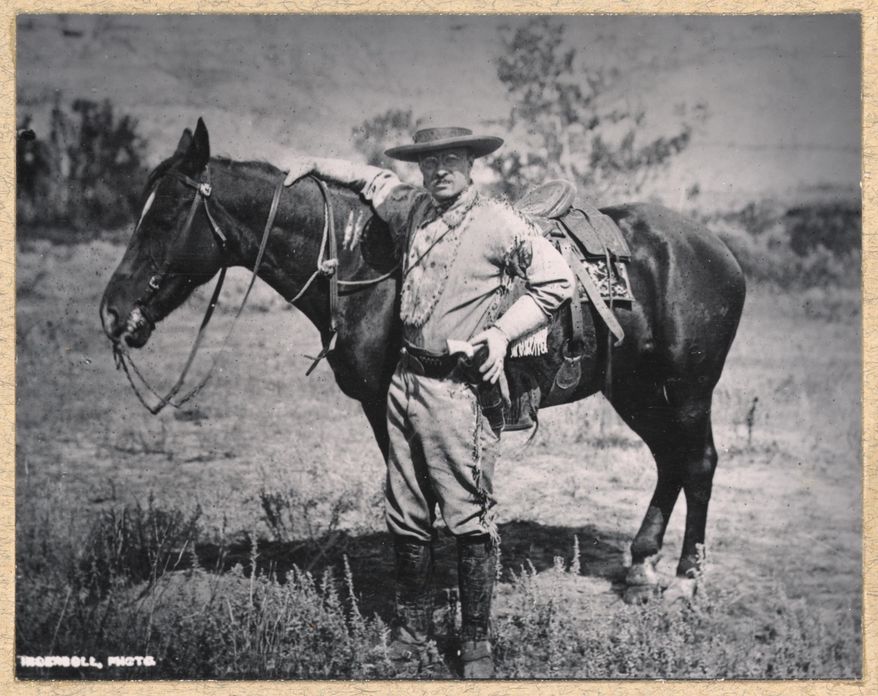
Black care rarely sits behind a rider whose pace is fast enough.
— Attributed to Teddy Roosevelt by David McCullough, on the frontispiece for McCullough’s biography of Roosevelt, Mornings on Horseback (Simon & Schuster, 1981).
Save
Spread the word; friends don't allow friends to repeat history.
6 Comments | Famous quotes, History, Quotes, Theodore Roosevelt | Tagged: Famous quotes, History, Quotes, Theodore Roosevelt | Permalink
Posted by Ed Darrell
March 13, 2007
For my own part I would as soon be descended from that heroic little monkey, who braved his dreaded enemy in order to save the life of his keeper, or from that old baboon, who, descending from the mountains, carried away in triumph his young comrade from a crowd of astonished dogs — as from a savage who delights to torture his enemies, offers up bloody sacrifices, practices infanticide without remorse, treats his wives like slaves, knows no decency, and is haunted by the grossest superstitions.
– Charles R. Darwin,
The Descent of Man, 1871, ch. 6
Spread the word; friends don't allow friends to repeat history.
Leave a Comment » | Darwin, Evolution, Good Quotes, History, Quotes | Tagged: Altruism, Darwin, Evolution, Famous quotes, History, Quotes | Permalink
Posted by Ed Darrell
March 9, 2007
1968 brought one chunk of bad news after another to Americans. The year seemed to be one long, increasingly bad disaster. In several ways it was the mark of the times between the feel-good, post-war Eisenhower administration and the feel-good-despite-the-Cold-War Reagan administration. 1968 was depressing.
What was so bad? Vietnam manifested itself as a quagmire. Just when Washington politicians predicted an end in sight, Vietcong militia launched a nationwide attack in South Vietnam on the Vietnamese New Year holiday, Tet, at the end of January. Civil rights gains stalled, and civil rights leaders came out in opposition to the Vietnam war. President Johnson fared poorly in the New Hampshire primary election, and eventually dropped out of the race for the presidency (claiming he needed to devote time to making peace in Vietnam). Labor troubles roiled throughout the U.S., including a nasty strike by garbage collectors in Memphis. It didn’t help to settle the strike that the sanitation workers were almost 100% African American, the leadership of Memphis was almost 100% white, and race relations in the city were not so good as they might have been – the strike attracted the efforts of the Southern Christian Leadership Conference, and Martin Luther King, Jr. – who was assassinated there in early April. In response, riots broke out in 150 American cities.
More below the fold, including the key confession to “penetration.” Read the rest of this entry »
Spread the word; friends don't allow friends to repeat history.
6 Comments | 1968, Dissent, Elections, Free speech, Freedom - Economic, Freedom - Political, Heroes, History, Hoaxes, Space exploration, Vietnam | Tagged: 1968, Confessions, Elections, freedom, History, Hoaxes, Lloyd Bucher, North Korea, Space exploration, USS Pueblo, Vietnam | Permalink
Posted by Ed Darrell
March 2, 2007
Independence from what? “Do you mean the Alamo stuff?”
March 2 formerly was celebrated widely in Texas. Today, not so much.
Marshall Doke, Dallas attorney and chairman of the Texas Historical Foundation lectures Texas educators and parents today, on what should be done, in an opposite-editorial page piece in the Dallas Morning News.
Our Texas story helps us learn from the great men and women of the past that the one element essential for success (and possibly survival) is character. In the words of John Quincy Adams in the movie Amistad, “Who we are is who we were.”
Pray Texans never forget.
What does Texas Independence Day commemorate, again?
Update: Looking for more material, teachers? Go here, to Grits for Breakfast. You’ll find a list of other blogs that discussed the event today, and over the past couple of years. Interesting views.
Spread the word; friends don't allow friends to repeat history.
1 Comment | History, Santayana's ghost, Texas | Tagged: History, Santayana's ghost, Texas | Permalink
Posted by Ed Darrell
January 22, 2007

Town Hall in Leuven, Belgium; image from Katholieke Universiteit Leuven
Did I really miss this last month? A television network in Belgium, RTBF, started out the morning reporting on the breakup of Belgium. Rather contrary to the rules of hoaxes set up by Orson Welles and the Mercury Theatre, no mention of a dramatization was made for at least a half-hour.
And of course, it was all a hoax. The network said they wanted to generate discussion about how Belgium works, etc., etc. Not everyone was happy with the kickoff to discussion.
I have no particular dog in that fight, though I’m fond of Belgium. My wife spent a year studying in Louvin (Louvain, Leuven) (before I knew her), and we have wonderful photos. My own business trip to Brussells was less than 24 hours, though we conducted our business in lightning fashion and were able to spend the evening in a wonderfully lit historic square sampling several brands of beer — okay, many brands. We all made it to the Oh-Dark-thirty airplane home the next morning (some in better shape than others).
It’s always an eye-opener to learn how little most people know about the country, though it plays a huge role in the European Union, in NATO, and in the history of the 20th century, especially World Wars I and II.
Now it appears even Belgians don’t know whether their nation would break up or not. Jacques Brel is no longer alive and well.
More:
Spread the word; friends don't allow friends to repeat history.
3 Comments | Current History, Geography - Political, History, Hoaxes, Humor, Music education, Travel | Tagged: Belgium, History, Hoaxes, Humor, Travel | Permalink
Posted by Ed Darrell
January 17, 2007

Ben Franklin on the cover of Time
Ben Franklin’s birthday is January 17. He was born in 1706.
The drama department at Pleasant Grove (Utah) High School put on Ayn Rand’s play, “The Night of January 16th” when I was an underclassman there. It’s an interesting play — a murder mystery played out in a courtroom, with a jury drawn from the evening’s audience. The play’s ending differs almost every night, with a different jury coming to slightly different conclusions. Suggested posters for the play asked, “Where were you the night of January 16th?”

Ayn Rand
Years later that question came back to me as I rushed my wife to the maternity room at Charlton Methodist Hospital with contractions coming in quick succession, with a few minutes left in January 16th. The question made a good mnemonic to remember the date of the birth of our second child. Only later did I recall that the day is also Ben Franklin’s birthday — Ben being an object of some study and significant space on my personal library shelf. Read the rest of this entry »
Spread the word; friends don't allow friends to repeat history.
7 Comments | Ben Franklin, Family, History, Personal | Tagged: Ayn Rand, Ben Franklin, Family, History, James Darrell, Personal, Tooth of Time | Permalink
Posted by Ed Darrell
January 14, 2007
A good guide to flag etiquette from the U.S. Congress is on-line now. Our Flag is a traditional publication Congress passes out in efforts to help education in history and patriotism (H.Doc 108-97).
Interest in proper etiquette for flag display increased recently — not enough by my calculation, but any increase is welcomed. Where is good information available?
This Congressionally-sponsored guide is basic and accurate. As a classroom resource or a piece of a Scout troop library, it’s a useful reference guide. It can be downloaded (it’s a .pdf), and printed out in color (56 pages).
The book includes many illustrations showing proper flag display. It also covers the history of the U.S. flag in good enough detail to get through most high school reports, and it features illustrations of flags of each of the states.
Congress in the past provided many publications on such topics for general public consumption and use in classrooms, but has cut back on free distribution of printed information since the early 1980s. One might be able to get a printed copy with a request to one’s local Member of the House of Representatives, or U.S. Senator.
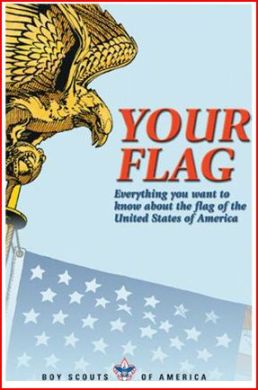
Boy Scouts of America version of the flag etiquette guide, Your Flag
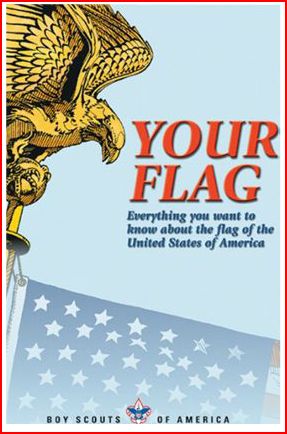
Another book I’ve found very useful is an official Boys Scouts of America publication of the almost the same name, Your Flag. It’s a graphic-novel type of publication — cartoons for every point to be made. It features deeper information on proper flag display. The book can be purchased at any local Boy Scout Council supply shop, or any other shop that stocks Scout literature. It can also be ordered from BSA’s national catalog, or online at Scoutstuff.org, for $7.9910.99plus shipping. Every Scout troop should have one of these, and it is also very useful for classroom libraries, for history and civics.
In either publication, one learns that there are not many ways to display a flag properly from a vehicle — improper displays include decals on windows, bumper stickers, flying them from the radio antenna, or attaching them to a window pole to be battered in freeway-speed winds.
One might hope these books get much broader circulation.
Spread the word; friends don't allow friends to repeat history.
22 Comments | Accuracy, Boy Scouts of America, Flag etiquette, Patriotism | Tagged: Accuracy, Boy Scouts of America, Flag etiquette, History, Patriotism, U.S. Flag | Permalink
Posted by Ed Darrell
January 10, 2007
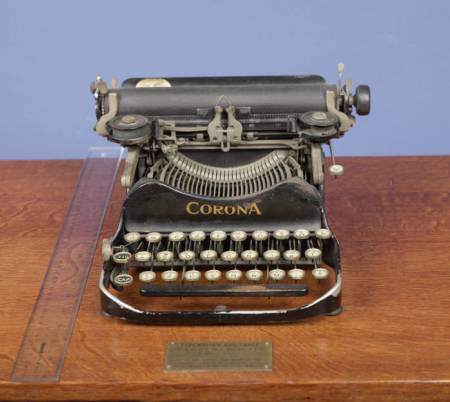
Mencken's Corona Typewriter, at the Mencken Room in the Enoch Pratt Library, Baltimore, Maryland
The typewriter that belonged to H. L. Mencken. Photo by the Enoch Pratt Free Library, Baltimore, Maryland. [Update, April 15, 2007: The photo has moved, and is restricted by copyright; you may follow the links to view the original photo of the typewriter, at the site of the Enoch Pratt Free Library. E.D.]
Was this the machine upon which Mencken composed the Millard Fillmore/Bathtub hoax? Perhaps. It was used prior to 1930.
Spread the word; friends don't allow friends to repeat history.
6 Comments | Fillmore's bathtub, H. L. Mencken, Hoaxes, Journalism, Newspapers | Tagged: Enoch Pratt Library, H. L. Mencken, History, Hoaxes, Journalism, Literature, Technology, Typewriters | Permalink
Posted by Ed Darrell
January 1, 2007
Gerald Ford was a very likable guy. Since his death last week, I have been impressed with the number of people who have stepped forward with different stories about how Ford was just a regular guy called to duty.
Researching the updating of the story about the sale of creationist books in the Grand Canyon, I stumbled into a press release from the National Park Service. It turns out that Ford is the only president ever to have worked as a National Park Ranger (well, the National Park Service itself has only been around since 1901, so that lets out about half the presidents from even the possibility — though, of course, Yellowstone was established in 1862 1872).
In the summer of 1936 Ford worked in Yellowstone National Park. He had duties that sound rather quaint and definitely antiquated today: Ford was a guard on the bear feeding truck. Bears have to fend for themselves in today’s National Parks. No, it’s not due to budget cuts in bear food. Bears do better as wild creatures, and so feeding was stopped to discourage them from becoming tame and dependent on humans.
Gerald Ford, ranger mensch.
Spread the word; friends don't allow friends to repeat history.
2 Comments | Boy Scouts of America, Current History, Gerald Ford, History, Leadership, National Parks, Natural history, Natural resources, Presidents | Tagged: Boy Scouts of America, Gerald Ford, History, Leadership, National Parks, Presidents | Permalink
Posted by Ed Darrell
December 28, 2006

Herbert Hoover, White House Portrait
Herbert Hoover is one of the great foils for U.S. history courses. The Great Depression is on national standards and state standards. Images from the dramatic poverty that resulted win the rapt attention of even the most calloused, talkative high school juniors. Most video treatments leave students wondering why President Hoover wasn’t tried for crimes against humanity instead of just turned out of office.
In most courses, Hoover is left there, and the study of Franklin Roosevelt‘s event-filled twelve years in office (with four elected terms) takes over the classroom. If Hoover is mentioned again at all in the course, it would likely be for his leading humanitarian work after World War II.
But there is, hiding out in California, the Hoover Institution. Hoover’s impact today? Well, consider some recent fellows of the Hoover Institution: Condaleeza Rice, Milton Friedman, George Shultz, E. D. Hirsch, Jr., Gary Becker, Diane Ravitch, Chester Finn. The Hoover Institution, “at Stanford University,” is the conservatives’ anchor in the intellectual and academic world.
Hoover’s legacy is being remade, constantly, through his post-Presidential establishment of an institution to promote principles of conservatism (and liberalism in its old, almost archaic education sense). The Hoover Institution has carried Hoover’s ideas and principles back into power.
Dallas has been wracked recently with the shenanigans and maneuvers around the work of Southern Methodist University to be named as the host for the George W. Bush Presidential Library. In a humorous headline last week the Dallas Morning News (DMN) said such a library could lead Dallas’s intellectual life in the future (the headline is different in the on-line version — whew!).
Humor aside, there is grist for good thought there. Read the rest of this entry »
Spread the word; friends don't allow friends to repeat history.
2 Comments | Business Ethics, Dissent, Economics, Franklin Roosevelt, Freedom - Economic, Freedom - Political, Great Depression, Herbert Hoover, History, Politics, Presidents | Tagged: Business Ethics, Economics, FDR, Franklin Roosevelt, freedom, George W. Bush Library, Gordon Lloyd, Great Depression, Herbert Hoover, History, Hoover Institution, Politics, Southern Methodist University, Two Faces of Liberalism | Permalink
Posted by Ed Darrell
December 10, 2006

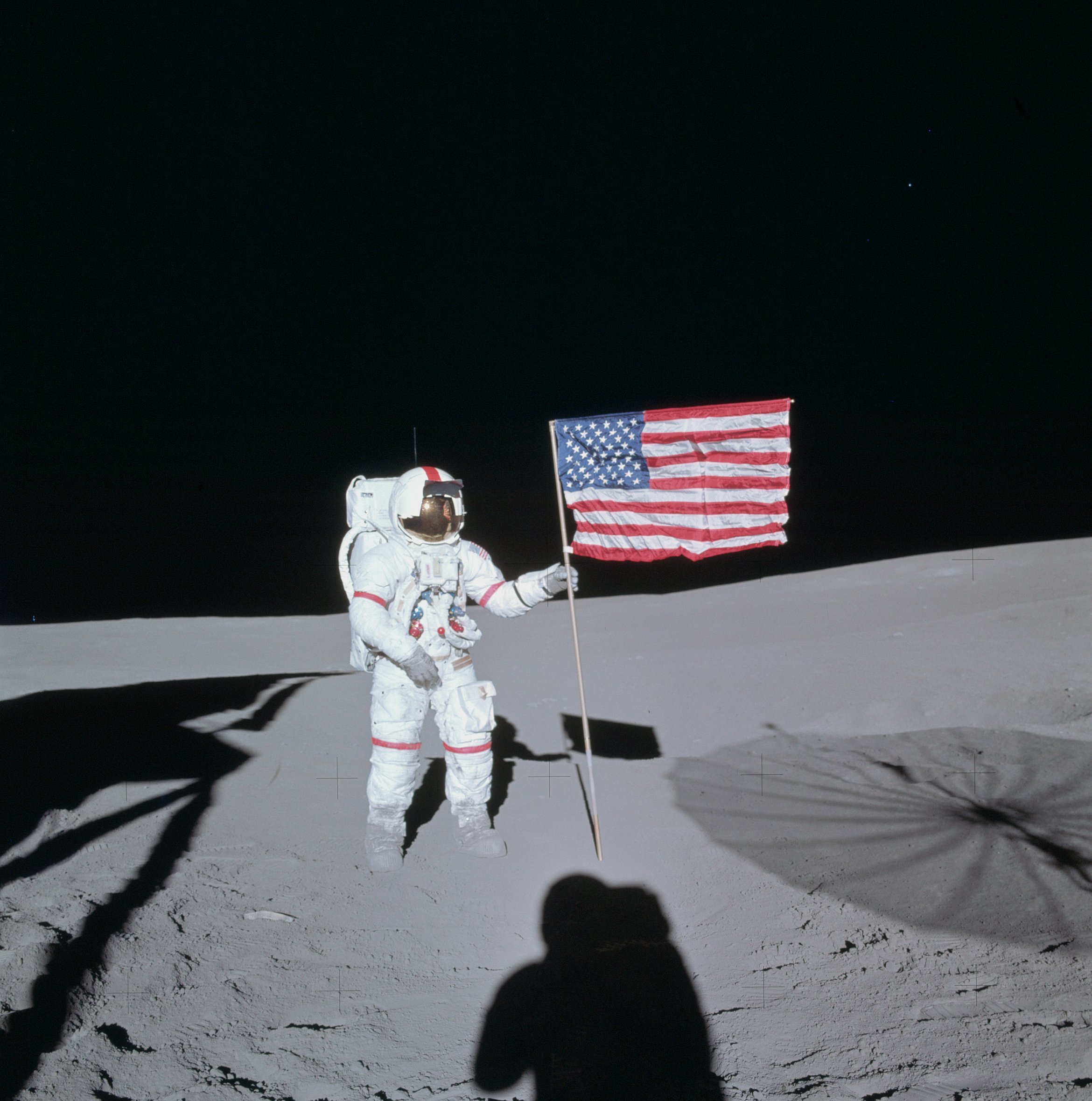
Photo from Apollo 14 Moon Mission
In a classroom discussion of “how do we know what we know” about history, another student brought up the allegations that the National Aeronautics and Space Administration (NASA) faked the manned Moon landings. That makes about a dozen times this year a kid has mentioned this claim (who thinks to start counting these things?). The kid was pretty unshakable in his convictions — after all, he said, how can a flag wave in a vacuum?
I usually mention a couple of things that the fake claimers leave out — that dozens, if not hundreds, of amateur astronomers tracked the astronauts on their way to the Moon, that many people intercepted the radio transmissions from the Moon, that one mission retrieved debris from an earlier unmanned landing, etc. Younger students who lack experience in serious critical thinking have difficulty with these concepts. They also lack the historic background — the last manned Moon landing occurred when their parents were kids, perhaps. They didn’t grow up with NASA launches on television, and the whole world holding its breath to see what wonders would be found in space.
Phil Plait runs a fine blog called Bad Astronomy. Five years ago he got fed up with the Fox Television program claiming the Moon landings were hoaxes, and he made a significant reply that should be in some hall of fame for debunking hoaxes. Since the claim that the Moon landings were hoaxes is, itself, a hoax, I have titled this “Debunking the Moon landing hoax hoax.”
In any case, if you’re wondering about whether the Moon landings were hoaxes, you need to see Phil Plait’s post. Phil writes:
From the very first moment to the very last, the program is loaded with bad thinking, ridiculous suppositions and utterly wrong science. I was able to get a copy of the show in advance, and although I was expecting it to be bad, I was still surprised and how awful it was. I took four pages of notes. I won’t subject you to all of that here; it would take hours to write. I’ll only go over some of the major points of the show, and explain briefly why they are wrong.
Also, consider these chunks of evidence, which Phil does not mention so far as I know:
First, the first Moon landing left a mirror on the surface, off of which Earth-bound astronomers may bounce laser transmissions in order to measure exactly the distance from the Earth to the Moon. Read the rest of this entry »
Spread the word; friends don't allow friends to repeat history.
20 Comments | Accuracy, Astronomy, History, Hoaxes, How do we know what we know, Moon, Reason, Science, Space exploration, Space Race, War on Science | Tagged: Apollo 11, Apollo Project, Astronomy, Bad Astronomy blog, Debunked Hoaxes, Flag on the Moon, History, Hoaxes, How do we know what we know, Jim Scotti, Moon, Moon Hoax, NASA, Phil Plait, Reason, Science, Space exploration, Space Race | Permalink
Posted by Ed Darrell
November 26, 2006
Generally there is just too much going on to follow all of it in the news, let alone understand it.
PanArmenian.net complains that historian Bernard Lewis’ being honored with the National Humanities Medal is a problem, labeling him a denier of the Armenian genocide. He was found to be so by a French court (does that increase his appeal to Bush?).
Lewis’ work is influential — here is a 2004 Washington Monthly piece by Newsweek correspondent Michael Hirsch, pointing out that Lewis is the guy who probably first coined the phrase “clash of civilizations” with regard to international relations with modern Islamic nations. Is he just one more Princeton University faculty member, like Ben Bernanke, who happens to have the ear of the President?
Teachers of history certainly should be familiar with the controversy over the Armenian genocide, its relation to post-World War I history, its salience in European politics today, and its effects on U.S. history (and especially U.S. literature — think William Saroyan, George Deukmejian, etc.). I admit I know very little about Lewis. I don’t know enough about him to make a judgment on whether the charges of the Armenian partisans are fair.
In my previous post I noted the rise of a superstar natural history prof, in England. Here in the U.S. the National Humanities Medal was awarded to nine people and one institution — one of the people is a Nobel Prize winner — and the news sank like a small, round stone in a small pond, without making much of a ripple.
If we can’t name some of the stars among historians and others in the humanities, are we doing our jobs? Are our newspapers and broadcasters doing their jobs if we don’t get this news?
Did President Bush honor a denier of the Armenian genocide? Our future relations with Islamic nations and peoples may depend on the answer. I don’t know. Do you?
Here is Lewis’ biography from the awards press release:
Bernard Lewis is considered by many to be the greatest living historian of the Muslim world. He has pursued his primary interest, the history of the Ottoman Empire, producing groundbreaking works including The Emergence of Modern Turkey, The Political Language of Islam, The Muslim Discovery of Europe, The Jews of Islam, and Islam and the West. His most recent publication is From Babel to Dragomans: Interpreting the Middle East. Other titles by Lewis: The Crisis of Islam: Holy War & Unholy Terror; What Went Wrong: The Clash Between Islam and Modernity in the Middle East; Western Impact and the Middle Eastern Response; A Middle East Mosaic: Fragments of Life, Letters and History; The Multiple Identities of the Middle East; and The Middle East: A Brief History of the Last 2,000 Years. Born in London, England, in 1916, Lewis became attracted to languages and history at an early age. Lewis’s interest in history was stirred thanks to his bar mitzvah ceremony, during which he received as a gift a book on Jewish history. He graduated in 1936 from the then School of Oriental Studies (SOAS, now School of Oriental and African Studies) at the University of London with a B.A. in history with special reference to the Near and Middle East, and obtaining his Ph.D. three years later, also from SOAS, specializing in the history of Islam. During the Second World War, Lewis served in the British Army in the Royal Armoured Corps and Intelligence Corps in 1940-41, and was then attached to a department of the Foreign Office. After the war he returned to SOAS, and in 1949 he was appointed to the new chair in Near and Middle Eastern history at the age of 33. In 1974 Lewis accepted a joint position at Princeton University and the Institute for Advanced Study, marking the beginning of the most prolific period in his research career. In addition, it was in the United States that Lewis became a public intellectual. After his retirement from Princeton in 1986 as the Cleveland E. Dodge Professor of Near Eastern Studies, Lewis held many visiting appointments. Lewis has been a naturalized citizen of the United States since 1982.
Spread the word; friends don't allow friends to repeat history.
3 Comments | Armenian genocide, Bogus history, History, History Revisionism, Holocaust denial, Politics, Voodoo history | Tagged: Armenian genocide, History, History Revisionism, Holocaust denial, Politics, Turkey, Voodoo history | Permalink
Posted by Ed Darrell
November 15, 2006
It’s amazing what is not available on video for use in the classroom.
Texas kids have to study the “Grito de Dolores” in the 7th grade — the “Cry from Dolores” in one translation, or the “Cry of Pain” in another (puns in Spanish! Do kids get it?). Father Miguel Hidalgo y Castillo made the speech on September 16, 1810, upon the news that Spanish authorities had learned of his conspiracy to revolt for independence. The revolution had been planned for December 8, but Hidalgo decided it had to start early.
This date is celebrated in Mexico as Independence Day. Traditionally the President of Mexico issues an update on the Grito, after the original bell that Father Hidalgo used is rung, near midnight.
Hidalgo himself was captured by the Spanish in 1811, and executed.
It’s a great story. It’s a good speech, what little we have of it (Hidalgo used no text, and we work from remembered versions).
Why isn’t there a good 10- to 15-minute video on the thing for classroom use? Get a good actor to do the speech, it could be a hit. Where is the video when we need it?
Statue of Father Hidalgo in Dolores, Mexico
Spread the word; friends don't allow friends to repeat history.
4 Comments | Education, History, History video sources, TAKS, TEKS, Texas | Tagged: Education, Father Hidalgo, freedom, Grito, History, Mexico, Mexico's Independence, Travel | Permalink
Posted by Ed Darrell
November 6, 2006

Inside the Thunderbirds Hangar at Nellis AFB, Airman 1st Class Michael Thayer, left, and Senior Airman David Prye demonstrate how to fold a U.S. flag. Photo by John Gurzinski, Las Vegas Review-Journal [Replacement photo]


Airman First Class Michael D’Ancona and Senior Airman Assad Pharr demonstrated how to properly fold an American flag during a special visit to Robbins Lane Elementary School in Syosset on May 23. (Syosset-Jericho Tribune, June 19, 2014; photo added here October 2014)
How did I miss this? The Las Vegas (Nevada) Review-Journal carried a story on July 4, 2006, on the Air Force’s efforts to replace the old, unofficial and misleading flag folding ceremony, with a new one. It has the script for the new ceremony.
The newspaper said:
Capt. Isham Barrett, Air Force action officer on Honor Guard policy, said the new script was developed because reference to the flag in the U.S. code “does not associate anything with any fold of the flag.”
“We don’t want to force a belief on somebody,” he said.
Barrett said the decision to develop a standardized script wasn’t prompted by someone complaining about religious connotations. “We can’t find anything in our files with regard to complaints,” he said.
Nevertheless, Christopher J. Andersen, an Army sergeant and member of the Military Association of Atheists and Freethinkers, wrote a letter in 2003, asking the U.S. Air Force Academy to remove the unofficial script from its Web site.
“In order to ensure this religious flag-folding ceremony is not portrayed as an official, government-sponsored flag-folding ceremony, I ask you to remove it from your .gov site,” wrote Andersen.
Andersen, who could not be reached last week, noted in his letter that the Air Force Academy removed the old script from its Web site after he complained.
Air Force leaders later set out to develop a script based on history rather than one that could be interpreted as contrary to the Establishment Clause of the First Amendment of the U.S. Constitution: “Congress shall make no law respecting an establishment of religion.”
Combined with the Free Exercise Clause — “or prohibiting the free exercise thereof” — they prohibit endorsement of a national religion or a preference for one over another. They also preclude dominance of religion over nonreligious philosophies, according to a 1994 Supreme Court majority opinion.
The new standardized script based on history was approved by Air Force leaders in July 2005 and first appeared in revised Honor Guard protocol manuals in January.
Three cheers for the Air Force (yes, I’m biased, for family reasons).
Tip of the old scrub brush to Linda Case.
Update October 22, 2014: The new, Air Force-approved script for a flag folding ceremony is at the Betsy Ross site. Use it in good patriotic spirit, and in the spirit of accurate history.
Spread the word; friends don't allow friends to repeat history.
9 Comments | Accuracy, Flag etiquette, History, Patriotism | Tagged: Accuracy, Flag etiquette, History, Patriotism, US Air Force | Permalink
Posted by Ed Darrell





 Millard Fillmore's Bathtub