October 11, 2006

Archibald M. Willard, “The Spirit of ’76,” one of the best-recognized icons of American patriotism; courtesy of the American Reserve Society Sons of the American Revolution (of which Willard was a member); Library of Congress data: “Yankee doodle 1776 “/ A.M. Willard. Creator(s): Clay, Cosack & Co., lithographer. Related Names: Willard, Archibald M., 1836-1918 , artist Ryder, James F., 1826-1904 , publisher Date Created/Published: Cleveland, Ohio : Pub. by J.F. Ryder, c1876.
Archibald M. Willard, “The Spirit of ’76,” one of the best-recognized icons of American patriotism; courtesy of the American Reserve Society Sons of the American Revolution (of which Willard was a member).
Scouters discuss issues of leadership and skill, a wide-ranging group of topics that pertain to Boy Scouting, on a list-server known as Scouts-L. I subscribe to the discussion, and at times have participated frequently in it. Looking over my own archives, I was amused to see that it was more than a decade ago that I addressed the issue of how to quell any need for a Constitutional Amendment on flag desecration.
The U.S. flag fascinated me from my early childhood. It always strikes me as unique among flags of nations, and I can truly say that I find it stirring to see it in good display. In court, in schools, in the Senate and executive branch of federal government, and in local government, I have had more than my share of occasions to participate in cermonies honoring the flag, or merely sit in contemplation of it during official proceedings. I always reflect on John Peter Zenger’s trial for telling the truth about the King’s governor of New York, and how our flag now means that we can tell the truth about our own government without fear of official reprisal.
I often reflect on the story of Virginia Hewlett, who was a member of the U.S. High Commissioner’s staff in the Philippines when Gen. MacArthur’s forces retreated, and who risked her life in order to strike the U.S. flag and prevent its capture by the Japanese. For this action she and several others were captured, tortured, and endured the war in a prison camp. When she was freed, to her husband and my old friend Frank Hewlett (who was a UPI war correspondent and later a Nieman Fellow and Washington correspondent for the Salt Lake Tribune), she weighed 78 pounds. Read the rest of this entry »
Spread the word; friends don't allow friends to repeat history.
 5 Comments |
  Flag etiquette, History, Patriotism, U.S. Constitution | Tagged: Constitutional Amendment, Flag etiquette, History, Patriotism |
  Permalink
 Posted by Ed Darrell
October 8, 2006

Cmdr. Lloyd Bucher and the Pueblo on the cover of Time Magazine, February 2, 1968 (substituted for the official portrait of Bucher, which is no longer available)
A good hoax? It could happen, right?
It did happen.
A U.S. spy ship, the U.S.S. Pueblo, under the command of Cmdr. Lloyd Bucher, was captured by North Korea on January 28, 1968 — the beginning of a very bad year in the U.S. that included Viet Cong’s Tet Offensive that revealed victory for the U.S. in Vietnam to be a long way off, the assassination of the Rev. Martin Luther King, Jr., the assassination of presidential candidate Sen. Robert F. Kennedy, riots during the Democratic National Convention in Chicago, a bitter election — and a wonderful television broadcast from astronauts orbiting the Moon on Christmas Eve.
North Korea held the crew of the Pueblo for eleven months. While holding the crew hostage — there was never any serious thought that the ship had in fact strayed into North Korean territorial waters, which might have lent some legitimacy to the seizure of the ship — North Korea (DPRK) tried to milk the event for all the publicity and propaganda possible. Such use of prisoners is generally and specifically prohibited by several international conventions. Nations make a calculated gamble when they stray from international law and general fairness.
To their credit, the crew resisted these propaganda efforts in ways that were particularly embarrassing to the North Koreans. DPRK threatened to torture the Americans, and did beat them — but then would hope to get photographs of the Americans “enjoying” a game of basketball, to show that the Americans were treated well. The crew discovered that the North Koreans were naive about American culture, especially profanity and insults. When posing for photos, the Americans showed what they told DPRK was the “Hawaiian good luck sign” — raised middle fingers. The photos were printed in newspapers around the world, except the United States, where they were considered profane. The indications were clear — the crew was dutifully resisting their captors. When the hoax was discovered, the Americans were beaten for a period of two weeks. Read the rest of this entry »
Spread the word; friends don't allow friends to repeat history.
39 Comments | 1968, Cold War, Heroes, History, History images, Hoaxes, Justice, Korea, veterans, Vietnam | Tagged: 1968, Cold War, Confessions, DPRK, History, Hoaxes, Lloyd Bucher, North Korea, Spying, USS Pueblo | Permalink
Posted by Ed Darrell
October 8, 2006
Nota bene: Be sure to see update, here.
First, there was the woman who squealed in class when I mentioned Travis County, the Texas county in which resides Texas’s capital city, Austin. She said later she had thought it was a fictional county. By the way, she asked, was the rest of the “Texas chainsaw massacre” story true, too? (I have never seen any of these movies; I understand the 2003 version was set in Hewitt, Texas, which is a real, small Texas town near Waco, between Dallas and Austin — but not in Travis County. I’m not sure what Travis County has to do with any of the movies.)

Victims of a real Texas chainsaw massacre: Victims await “processing” at a sawmill in Nacogdoches County. Photo by Ron Billings, Texas Forest Service.
Since then, in the last couple of weeks I have had at least a dozen requests to teach the history behind the movie, the “true story.” The movies are all highly fictionalized, I note. Perhaps I should plan a day to discuss real Texas murders, and just what fiction is, especially from Hollywood.
According to Snopes.com, one of my favorite debunking sites, there was never a Texas chainsaw massacre. There was a Wisconsin farmer who stole corpses from the local cemetery, and upon whom was based the earlier Alfred Hitchcock movie, Psycho. There was the chainsaw exhibit at Montgomery Ward seen by writer/director Toby Hooper, when he needed inspiration to finish a screen treatment. That’s about it.
But it’s nearing Halloween, and the studios in Hollywood hope to make money.
There are real Texas crimes that would be good fodder for movies, in the hands of intelligent and creative people. One wonders why more movies aren’t done on the real stories. Read the rest of this entry »
Spread the word; friends don't allow friends to repeat history.
120 Comments | Accuracy, Bogus history, History, How do we know what we know, Movies, Texas | Tagged: Accuracy, Bogus history, Hewitt Texas, History, Kent Biffle, Movies, Texas, Texas Chainsaw Massacre, Texas Mass Murders, Thomas Hewitt | Permalink
Posted by Ed Darrell
October 7, 2006
During one of my phase-shift transitions between universities and public schools yesterday, I caught a snippet of a commentary that I thought was on Richard Nixon’s 1952 speech that kept him on the ticket with Dwight Eisenhower. Public reaction was reported to be overwhelmingly warm, the Eisenhower-Nixon ticket won the 1952 election, won again in 1956, and Nixon eventually took the presidency for his own in 1968.
Shouldn’t that speech be considered one of the greater presentations of the 20th century, at least? It probably should, especially when we consider what history might have looked like had Nixon left the ticket — no Nixon nomination in 1960 against John Kennedy, no later Nixon presidency, Nixon continuing in the Senate . . . gee, which path is more gloomy?
The Checkers speech does not wear well, I think. Reading it today, I see the origins of smear campaign tactics and diversionary tactics that mar so much of today’s election campaigns and policy discussions.
This all comes up because the transcripts of the famous 1977 interview series newsman/comedian David Frost did with Nixon is the basis for a new play in London, “Frost/Nixon” by Peter Morgan, with Frank Langella playing Nixon and Michael Sheen as Frost — a play that is already being made into a movie for Universal Pictures by Academy Award winning director Ron Howard, but after a Broadway run in 2007.
Nixon’s mea culpa answer to Frost on the entirety of the Watergate scandal — “I made so many mistakes” — in the NPR piece voiced by Langella, sounded exactly like Nixon. I mistakenly thought it a recording of the Checkers speech, hearing just a snippet. The Frost/Nixon interviews would probably never have been necessary, had the Checkers speech not been a success. Surely there is a direct line from the Checkers speech to Nixon’s attempt to revive his reputation in the Frost interviews.
Watergate on Broadway, with a movie in the works, should offer good opportunities especially for high school history teachers to bring Watergate to a new generation. Too many people today fail to understand the depth of the damage done to Constitutional institutions in that crisis, and how lucky our nation was to have survived it. There are many lessons there for us in our current Constitutional crisis.
A lesson awaits, also, in the career of David Frost, who crossed from news to comedy and back. Many kids today use comedians as their chief source of political news. We should not be surprised — but let us hope that today’s comedians have as much a sense of public duty as David Frost did in 1977, even while using his public service interview to revive his own career.
Sometimes free markets work spectacularly, don’t they?
Spread the word; friends don't allow friends to repeat history.
4 Comments | Ethics, Famous quotes, History, Lesson plans, Movies, Presentations, Presidents, Quotes, Turning Points, Watergate scandal | Tagged: Ethics, Famous quotes, History, Lesson plans, Movies, Presentations, Presidents, Quotes, Richard M. Nixon, Watergate scandal | Permalink
Posted by Ed Darrell
September 23, 2006

In times of crisis and turmoil, Americans often turn to patriotic symbols for inspiration. Caption from the National Museum of American History (Smithosonian): Elmira Cornet Band, Civil War The song’s popularity increased enormously during the Civil War. Because the song extolled the national flag—a symbol of loyalty to the Union—Northerners enthusiastically embraced it as a patriotic anthem.
The scientist, science and science fiction writer Isaac Asimov at one time held the title for the most published human being ever. There were few topics he didn’t have a learned opinion on, and there were many areas of ignorance where a well-trained scientist with a drive to get at the facts could shed a lot of light. His path lighting was not always appreciated. He wrote a guide to the Bible that has earned disdain from many a Christian conservative, thought I suspect that their disdain is really a disguise for the fear that a secular Jew could know the text so well and challenge so many unwarranted, but common, assumptions.
To the surprise of some, Asimov was quite a patriot. His short piece on the four stanzas of the “Star-spangled Banner” demonstrate his patriotism and his love of history, while offering a bit of humor to make it all stick in your mind. I post a complete copy below the fold.
I have not yet found the original publication source for Asimov’s piece; if you know it, or find it, please let me know. I suspect there is copyright attribution to be made, too. I borrowed the text from an on-line source called The Purewater Gazette. Read the rest of this entry »
Spread the word; friends don't allow friends to repeat history.
11 Comments | 4th of July, Flag etiquette, History, Patriotism | Tagged: 4th of July, Accuracy, Flag etiquette, History, Isaac Asimov, Jingoism, Patriotism, Star-spangled Banner | Permalink
Posted by Ed Darrell
September 20, 2006
As a lifelong Boy Scout and Scouter, I have lived with flag etiquette so long as I can remember. One of the key parts of flag etiquette with the U.S. flag is the proper folding, done to allow the flag to unfurl neatly when hoisted on a lanyard. (I have earlier discussed the meaning of folding the flag, or rather, the lack of meaning, here, here, and here.)
Several people wrote to ask about etiquette for folding state flags. Whenever I’ve been involved in ceremonies involving state flags, we have used the same fold prescribed for the U.S. flag, for the same reason — it allows the flags to neatly unfurl when they are posted. I have found several sites that urge a different fold for state flags, to preserve some uniqueness of the U.S. flag folding, but of course, that rather avoids the fact that the method used for the U.S. flag is just old ship tradition.
It seemed likely to me that some state had a special fold, however — and sure enough, I’ve found one. Ohio’s flag is not a rectangle, but is instead a tapered banner with two tails. In 2005, as an Eagle Scout project, Ohio Scout Alex Weinstock from Ohio’s Junction City Troop 260 devised a folding method for Ohio’s flag that ends with with 17 folds — appropriate to Ohio’s being the 17th state admitted to the union.

The fold is not easy — flag professionals call it “tricky.” (See a diagram here, from the Muskingumm Valley Council, BSA, in .pdf.)
Ohio’s flag is the only one of the state flags that is not a rectangle. So far as I have found, it is the only one with any suggested method of folding that differs from the method used for the U.S. flag — but my searches may have missed an odd law here or there.
If you know of other special folding methods, please leave a note in comments, or e-mail me.
Spread the word; friends don't allow friends to repeat history.
23 Comments | Boy Scouts of America, Flag etiquette, History, Patriotism | Tagged: Boy Scouts of America, Flag etiquette, Flag protocol, Folding the flag, History, Ohio, Patriotism | Permalink
Posted by Ed Darrell
September 14, 2006

Former Texas Gov. Ann Richards, and a sample of a Texas barbecue rib. Photo by Elecro-Fish Media (Austin, Texas)
Ann Richards died yesterday. It’s sad for me to think what might have been, had she been able to hold off one more charge by the Texas Republicans, had she defeated George Bush in her second campaign for governor of Texas.
Gov. Richards was a gracious and graceful woman who was simply fun to know — while quietly and forcefully inspiring others to do good deeds. In a former time, a candidate who defeated someone like Richards would have the good sense to keep her in government in some capacity, just for her wisdom and experience. It will be a tribute to Richards when civility is returned to politics.
Ann Richards was a public school teacher, clearly of the highest caliber. We can only hope there are more like her teaching in Texas schools today.
Update, September 17, 2006: Molly Ivins, perhaps America’s best political columnist, was a close friend of Ann Richards. Her column well reflects the special qualities of Richards, why we will miss her so badly, and why we should worry that there are so few like her around today.
Spread the word; friends don't allow friends to repeat history.
1 Comment | Heroes, History, Leadership, Politics, Teaching, Texas | Tagged: Ann Richards, Biography, Heroes, History, Leadership, Molly Ivins, Politics, Texas | Permalink
Posted by Ed Darrell
August 13, 2006
August 13, 2006, is the 45th “anniversary” of the erection of the Berlin Wall, the totem of the Cold War that came down in 1989, pushing the end of the Cold War. Residents of Berlin awoke on this day in 1961 to find the communist government of East Germany erecting what would become a 96-mile wall around the “western quarters” of the city — not so much to lay siege to the westerners (that had been tried in 1948, frustrated by the Berlin Airlift) as to keep easterners from “defecting” to the West. The Brandenburg Gate was closed on August 14, and all crossing points were closed on August 26.
From 1961 through 1991 1989, teachers could use the Berlin wall as a simple and clear symbol for the differences between the communist Eastern Bloc, the Soviet Union and her satellite states, and the free West, which included most of the land mass of Germany, England, France, Italy, the United States and other free-market nations — the North Atlantic Treaty Organization (NATO) countries. I suspect most high school kids today know very little about the Wall, why it was there, and what its destruction meant, politically.
This era of history is generally neglected in high school. Many courses fail to go past World War II; in many courses the Cold War is in the curriculum sequenced after the ACT, SAT and state graduation examinations, so students and teachers have tuned out.
But the Wall certain had a sense of drama to it that should make for good lessons. When I visited the wall, in early 1988, late at night, there were eight fresh wreaths honoring eight people who had died trying to cross the Wall in the previous few weeks (in some places it was really a series of walls with space in between to make it easier for the East German guards to shoot people trying to escape) — it’s an image I never forget. Within a year after that, East Germans could travel through Hungary to visit the West, and many “forgot” to return. Within 18 months the wall itself was breached.
The Wall was a great backdrop for speeches, too — President John F. Kennedy visited Berlin in June 1963, and expressed his solidarity with the walled-in people of both West and East Berlin, with the memorable phrase, “Ich bin ein Berliner,“ which produced astounding cheers from the tens of thousands who came to hear him. There are a few German-to-English translators who argue that some of the reaction was due to the fact that “Berliner” is also an idiomatic phrase in Berlin for a bakery confection like a jelly doughnut — so Kennedy’s words were a double entendre that could mean either “I am a citizen of Berlin,” or “I am a jelly doughnut.” [Be sure to see the comments below, from Vince Treacy (9/28/2010).] Ronald Reagan went to the same place Kennedy spoke to the Berlin Wall, too, to the Brandenburg Gate, in his famous June 1987 speech which included a plea to the Soviet Union’s Premier Mikhail Gorbachev: “Mr. Gorbachev, tear down this wall!”
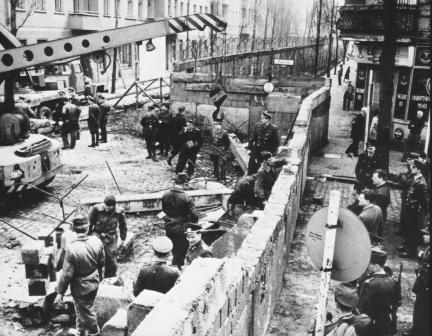
Construction of the Berlin Wall in August 1961 –photo from University of Utah, by Corey Hatch.
Update March 9, 2007: Berlin Airlift information and lesson plans are available from the Truman Library, here, here and here.
Update November 9, 2009: Notes on the 20th anniversary of the fall of the Wall
Please share this post:


Spread the word; friends don't allow friends to repeat history.
27 Comments | Cold War, Democracy, Economics, Famous quotes, Free market economics, Freedom - Political, Geography - Political, History | Tagged: Berlin Wall, Cold War, Democracy, Economics, Famous quotes, Free market economics, freedom, geography, History | Permalink
Posted by Ed Darrell
July 29, 2006

Navy caption: SAN DIEGO (April 2, 2007) – Aviation Support Equipment Technician 3rd Class Danny Ly, Storekeeper Seaman Joe Jackson and Electronics Technician Timothy Swartz fold the American flag on the flight deck aboard nuclear-powered aircraft carrier USS Nimitz (CVN 68). Nimitz Carrier Strike Group (CSG), embarked Carrier Air Wing (CVW) 11 and Destroyer Squadron Group (DESRON) 23 are deploying to support operations in U.S. Central Command area of responsibility. U.S. Navy photo by Mass Communication Specialist 2nd Class Jeremiah Sholtis (RELEASED) – Wikimedia image
Earlier I wrote about a flag-folding ceremony that is making the internet rounds. I noted that much of the claimed mythology is, um, ahistoric.
There is no particular meaning attached to folding the flag. Comments noted that the ceremony making the internet rounds is posted at the website of the American Legion. I wrote to the Legion’s public relations department, but have heard nothing back. Generally, the information on flag etiquette at that site is solid. Only the flag-folding ceremony material is not top-notch. I would be happy were the Legion to add a note that the ceremony is a sample ceremony. Several sites mention that the ceremony comes “from the U.S. Air Force Academy.” One site even had a link, but the link was dead. I did find a few sources that explained further. The Air Force Academy web site may have featured a flag-folding ceremony at one point, perhaps even the one being passed around. One of the more popular ceremonies featured had been written by one of the chaplains at USAFA. As happens in the military, someone got concerned about the accuracy of the claims, and the ceremony was pulled. However, Air Force color guards had used the ceremony, and there was demand for something to say during the folding of the U.S. flag, at some ceremonies.
Below the fold, at some length, I reprint the “official” story.
Read the rest of this entry »
Spread the word; friends don't allow friends to repeat history.
19 Comments | Accuracy, Bad Quotes, Flag etiquette, History, Patriotism | Tagged: Accuracy, Bad Quotes, Flag etiquette, History, Patriotism, USS Nimitz | Permalink
Posted by Ed Darrell
July 19, 2006
Update, March 24, 2007: Be sure to see the updated flag ceremony, which you can find through this post on the news of the its release.
Yes, the flag amendment is dead, again. Yes, the Fourth of July is past. False history continues to plague the U.S. flag, however. When my wife forwarded to me the post below, it was the fourth time I had gotten it, recently. Bad history travels fast and far. Let’s see if we can steer people in a better direction with real facts.

A flag folding at a funeral for a military person carries great weight, without any script at all. Wikimedia image from DOD release: Members of the U.S. Navy Ceremonial Guard fold the American flag over the casket bearing the remains of sailors killed in the Vietnam War during a graveside interment ceremony at Arlington National Cemetery on May 2, 2013. Lt. Dennis Peterson, from Huntington Park, Calif.; Ensign Donald Frye, from Los Angeles; and Petty Officers 2nd Class William Jackson, from Stockdale, Texas, and Donald McGrane, from Waverly, Iowa, were killed when their SH-3A Sea King helicopter was shot down on July 19, 1967, over Ha Nam Province, North Vietnam. All four crewmembers were assigned to Helicopter Squadron 2.
Here is the post as it came to me each time — I’ve stripped it of the sappy photos that are occasionally added; note that this is mostly whole cloth invention:
Did You Know This About Our Flag
Meaning of Flag Draped Coffin.
All Americans should be given this lesson. Those who think that America is an arrogant nation should really reconsider that thought. Our founding fathers used God’s word and teachings to establish our Great Nation and I think it’s high time Americans get re-educated about this Nation’s history. Pass it along and be proud of the country we live in and even more proud of those who serve to protect our “GOD GIVEN” rights and freedoms.
To understand what the flag draped coffin really means……
Read the rest of this entry »
Spread the word; friends don't allow friends to repeat history.
28 Comments | 1776, 4th of July, Accuracy, Bogus history, Boy Scouts of America, Flag ceremony, Flag etiquette, Freedom - Political, History, Patriotism | Tagged: 1776, Accuracy, Bogus history, Boy Scouts of America, Flag etiquette, Flag Folding, Flage Ceremony, Fourth of July, History, Hoaxes, Patriotism, U.S. Flag | Permalink
Posted by Ed Darrell
July 3, 2006
History is a study of what happened and why. Often, high school and college studies of history are ruined by rote memorization of a long list of dates with a couple of words describing an event. That is not history. Often, studies of history are ruined through unreliable sources.
H. L. Mencken, the famous newspaper columnist from Baltimore, wrote a column published December 28, 1917, about the history of the bathtub, specifically that it was rare in the U.S., and how President Millard Fillmore introduced it to the White House, thereby making bathtubs and bathing popular. The column was brilliant, and it was a complete fabrication, a hoax. Within two years, however, Mencken’s column had found its way to reference books, encyclopedias, and bad history books. Here is Mencken’s original column: “A Neglected Anniversary.” [3/19/2009 – that link is dead; see Mencken’s column here.] You can read a history of the hoax and its spread at this site, Millard Fillmore’s Bathtub.
It’s a great story, about a do-nothing president, the press, and errors of history. To know the story, dates are unimportant. No one cares what years Fillmore was actually in office, no one cares exactly when Mencken’s column was published. Knowing lists of dates has never stopped a bad historian from reciting the erroneous claim that Millard Fillmore introduced the concept of bathing in a bathtub to the White House.
But now you know better.
This site is dedicated to knowing history, especially U.S. history, better.
Thank you for visiting. Noodle around, see what articles are here, leave some comments if you care to. Especially, if you find errors, leave a note of correction.
Spread the word; friends don't allow friends to repeat history.
23 Comments | Bogus history, Fillmore's bathtub, Hoaxes, Journalism, Millard Fillmore, Presidents | Tagged: Accuracy, bathtub, Bogus history, H. L. Mencken, History, Hoaxes, Journalism, Millard Fillmore | Permalink
Posted by Ed Darrell





 Millard Fillmore's Bathtub