Misquoting the founders, still: Jefferson didn’t say banking is the end of America

May 20, 2015

He may have believed something similar, but Jefferson did not say this:

Quote, maybe edited, falsely attributed to Thomas Jefferson; gathered from Twitter, 2015

Quote, maybe edited, falsely attributed to Thomas Jefferson; gathered from Twitter, 2015

I’m not sure who originated the poster.  They probably had good intentions.

But turn to the Monticello website, the scholars who track Jefferson’s words most closely, in February 2012.

Quotation: “The end of democracy and the defeat of the American Revolution will occur when government falls into the hands of lending institutions and moneyed incorporations.”

Sources consulted:

  1. Papers of Thomas Jefferson: Digital Edition
  2. Thomas Jefferson: Papers collection in Hathi Trust Digital Library
  3. Retirement Papers

Earliest known appearance in print: 19941

Earliest known appearance in print, attributed to Thomas Jefferson: see above

Status:  This exact quotation has not been found in the writings of Thomas Jefferson.  It may be a mistaken amalgamation of the author’s comments in the above 1994 reference with a real Jefferson quotation.  Jefferson wrote in 1825 to William Branch Giles of “vast accession of strength from their younger recruits, who having nothing in them of the feelings or principles of ’76 now look to a single and splendid government of an Aristocracy, founded on banking institutions and monied in corporations under the guise and cloak of their favored branches of manufactures commerce and navigation, riding and ruling over the plundered ploughman and beggared yeomanry.”2  Chomsky’s 1994 book quotes Jefferson’s 1825 letter to Giles and then comments that “[Jefferson] warned that that would be the end of democracy and the defeat of the American revolution.”

Jefferson didn’t like the idea of the marriage of banks, rich people and control of government policy.  Jefferson scholar Anna Berkes commented at the Monticello site:

Yes, I’ve quoted this letter myself above – I’m seeing that quote a lot lately. The full sentence as it appeared in Jefferson’s letter is, “I hope we shall take warning from the example and crush in it’s birth the aristocracy of our monied corporations which dare already to challenge our government to a trial of strength, and to bid defiance to the laws of their country.” The letter was first published in Ford’s Writings of Thomas Jefferson in 1892 (see http://hdl.handle.net/2027/uc2.ark:/13960/t3pv6bn68?urlappend=%3Bseq=93 – the edition you link to is a 1904 commemorative edition of Ford), and the polygraph copy is also online: http://hdl.loc.gov/loc.mss/mtj.mtjbib022651.

Anna Berkes
February 29, 2012 – 4:24pm

In any case, it’s not the end of our democratic republic yet! Get out there and organize, and vote.

Jefferson always offered good advice.

Jefferson's advice on quotes found on the internet

Jefferson’s advice on quotes found on the internet


Armed Forces Day 2015, May 16 – Fly your flag

May 15, 2015

Armed Forces Day poster for 2015

Armed Forces Day poster for 2015. Click on image to download high-quality, poster-quality files to print

Armed Forces Day is the third Saturday in May. This year it falls on May 16.

The U.S. Flag Code designates Armed Forces Day as one day for all Americans to fly their flags, in honor of those men and women presently serving in any of the Armed Forces.

Activities to honor active duty and active reserve forces occur in hundreds of communities across the nation.  Check your local papers.

And remember to fly your flag.

A bit of history, as we’ve noted earlier:  After President Truman’s administration brought the management of the armed forces under the umbrella of one agency, the Department of Defense, Truman moved also to unite what had been a separate day of honor for each of the branches of the military, into one week capped by one day for all uniformed defense services.

On August 31, 1949, Secretary of Defense Louis Johnson announced the creation of an Armed Forces Day to replace separate Army, Navy and Air Force Days. The single-day celebration stemmed from the unification of the Armed Forces under one department — the Department of Defense. Each of the military leagues and orders was asked to drop sponsorship of its specific service day in order to celebrate the newly announced Armed Forces Day. The Army, Navy and Air Force leagues adopted the newly formed day. The Marine Corps League declined to drop support for Marine Corps Day but supports Armed Forces Day, too.

In a speech announcing the formation of the day, President Truman “praised the work of the military services at home and across the seas” and said, “it is vital to the security of the nation and to the establishment of a desirable peace.” In an excerpt from the Presidential Proclamation of Feb. 27, 1950, Mr. Truman stated:

Armed Forces Day, Saturday, May 20, 1950, marks the first combined demonstration by America’s defense team of its progress, under the National Security Act, towards the goal of readiness for any eventuality. It is the first parade of preparedness by the unified forces of our land, sea, and air defense.

Celebrations like Armed Forces Day offer good opportunities to promote history. I suspect that the day’s coming always in the middle of May suppresses some of the teaching moment value, as teachers make a final push for end of course tests, finals, and in high schools, for graduation — and as many colleges are already out for the summer. Good materials are available that can be sprinkled throughout a course.

Photograph of President Truman and other digni...

President Truman and other dignitaries on the reviewing stand during an Armed Forces Day parade, (left… – NARA – 200222 (Photo credit: Wikipedia) (Is that Eisenhower on the left?) (Update: Yep! From Wikimedia: Left to right, Gen. Dwight D. Eisenhower, Secretary of Defense Louis Johnson, President Truman, Adm. William Leahy.

For example, this list of world-wide events at the first Armed Forces Day, in 1950, gives a good picture of four years into the Cold War, and would make a good warm-up exercise or even an entire lesson, or offer opportunities for projects:

The first Armed Forces Day came at a time of increased world tensions, political volatility and communist aggression. Some notable events that marked America’s first Armed Forces Week were as follows:

  • Bolivian police broke up “alleged” revolutionary communist-led general strike in LaPaz.
  • Two U. S. government buildings in Canton, China were taken over by the Chinese Communist Government. The buildings were U. S. property acquired prior to the Communist takeover.
  • The Burmese Army recaptured the city of Prome, a strategic communist-rebel stronghold.
  • Nicaraguans elect General Anastasio Somoza to a regular six-year term as president.
  • French and West German governments expected to talk shortly on the merger of the coal and steel industries of the two countries.
  • Communist China lifted the ban on daylight shipping along the Yangtze River due to the decline of Nationalist air activity.
  • Norway receives first US military aid in the form of two Dakota planes.
  • U. N. Secretary General Trygive Lie seeks West’s acceptance of Red China in the U. N.
  • Iran announced close range news broadcasts to the Soviet Union with $56,000 worth of Voice of America equipment.
  • Cuba celebrated the 48th anniversary of the establishment of its republic.
  • The Red Cross celebrated its 69th birthday.
  • Britain ended rationing of all foods except meats, butter, margarine, and cooking fat.
  • The U. S. Congress voted to extend the draft. “A Bill to extend registration and classification for the Draft until June 24, 1952 passed the House 216-11.”
  • The Allied Command announced it would “ease” the burden of occupation on Austria and would name civilian high commissioners to replace present military high commissioners.
  • Soviet authorities in Berlin withdrew travel passes of the U.S. and British military missions stationed at Potsdam in the Soviet zone of occupation.
  • The Soviets returned 23 East German industrial plants to East German authorities. The plants had been producing exclusively for the benefit of reparations to the USSR.
  • Twenty-eight Soviet vessels, consisting of tugs, trawlers, and supply ships remained in the English Channel as the Western Alliance prepared for air and naval maneuvers. Observers noted that many of them carried rollers at their sterns for trawling nets although no nets were visible.
  • Pravda denounced Armed Forces Day, calling it the militarization of the United States. “The hysterical speeches of the warmongers again show the timeliness of the appeal of the Permanent Committee of Peace Partisans that atomic weapons be forbidden.”
  • Western Powers renewed their promise to help Mid-Eastern states resist communism. They also announced an agreement to sell arms to Israel as well as to the Arabs.

Veterans Day honors veterans of wars, and those who served in the past; Memorial Day honors people who died defending the nation; Armed Forces Day honors those men and women serving today.  Service with two wars, in an “all volunteer” military, is a rough go, especially in times of federal budget cuts.  Say a good word about active duty military on Saturday, will you?

Armed Forces Day 1952, DOD Archives photo

A photo from Defense archives, of Armed Forces Day 1952 — also on May 17; DOD caption: QUOTING BENJAMIN FRANKLIN – Servicemen and women comprise this poster, which features cautionary words of Benjamin Franklin. (AFD-1952) [Franklin quote:  Let us beware of being lulled into a dangerous security, and of being weakened by internal contentions and divisions . . . of neglect in military exercises and discipline, and in providing stores of arms and munitions of war, for . . . the expenses required to prevent war are much lighter than those that will, if not prevented, be necessary to maintain it.  Benjamin Franklin, 1784.  Franklin’s words were in a letter to Charles Thomson, the Secretary of the 2nd Continental Congress, on May 13, 1784, written from his station in Passy, France.]

More:

Yes, this is mostly an encore post. Fighting ignorance requires patience.

Yes, this is mostly an encore post. Fighting ignorance requires patience.


Especially this year: Fly your flag May 15 for Peace Officers Memorial Day

May 12, 2015

Eden Prairie, Minnesota, May 15, 2013: Eden Prairie officers participated in the tradition of standing guard at the Minnesota Law Enforcement Memorial on the state capitol grounds. The officers stood for twenty minutes, then after the guard duty change, the officers left their posts, rang the memorial bell and stated the name of a Minnesota officer who was killed in the line of duty. This ritual continued every twenty minutes with officers from departments across the state during the 24-hour vigil.

Eden Prairie, Minnesota, May 15, 2013: Eden Prairie officers participated in the tradition of standing guard at the Minnesota Law Enforcement Memorial on the state capitol grounds. The officers stood for twenty minutes, then after the guard duty change, the officers left their posts, rang the memorial bell and stated the name of a Minnesota officer who was killed in the line of duty. This ritual continued every twenty minutes with officers from departments across the state during the 24-hour vigil.

We remember fallen policemen on May 15, every year since 1962 nationally.

This year, the remembrance probably has more meaning, in New York City, throughout Mississippi, and in dozens more states and communities where policemen were killed in the line of duty.

Here is the proclamation from President Obama on Police Officers Memorial Week, and how to fly the flag on Peace Officers Memorial Day, May 15 (Friday).

May 08, 2015

Presidential Proclamation — Peace Officers Memorial Day and Police Week, 2015

PEACE OFFICERS MEMORIAL DAY AND POLICE WEEK, 2015

– – – – – – –

BY THE PRESIDENT OF THE UNITED STATES OF AMERICA

A PROCLAMATION

Each May, our Nation salutes the American women and men who put their lives on the line every day to maintain public safety and hold accountable those who break the law. On Peace Officers Memorial Day and during Police Week, we recognize all those who have dedicated their lives to this vital task. With heavy hearts, we mourn the heroes taken from us only because they chose to serve, and we rededicate ourselves to carrying forward their noble legacy.

Our law enforcement officers have extraordinarily tough jobs. They regularly work in dangerous environments and in difficult, high-tension situations. And they often face challenges deeply rooted in systemic problems and broader social issues. These professionals serve to protect their communities and strengthen their Nation, and they deserve to go home safely to their loved ones at the end of each shift. As President, I am committed to making sure America’s dedicated police officers receive the support and recognition they have earned, and to doing all I can to protect those who protect us.

One important way to make policing safer and more effective is by continuing to enhance relations and trust between law enforcement and the neighborhoods they serve. This will make it easier and safer for police officers to do their jobs, and it will strengthen the places we live and work. This important task will require our Nation — our communities, our law enforcement, and our leaders at every level — to come together to commit to meeting this challenge and moving our country forward, block by block and neighborhood by neighborhood. As President, I firmly believe it is within our power to make progress in our time, and I am dedicated to partnering with all those who are willing to do this necessary work.

My Administration is taking concrete steps to implement the commonsense, pragmatic recommendations my Task Force on 21st Century Policing put forward based on input from law enforcement personnel as well as criminal justice experts, community leaders, and civil liberties advocates. And we are engaging with local jurisdictions so they can begin to make the changes that will help ensure that police officers and their communities are partners in battling crime and that everyone feels safe on and off the job.

Our Nation’s police officers are mentors in our schools, familiar faces on the corner, and pillars of our communities. They keep our borders secure and our roads safe, and in times of crisis, they rush toward tragedy. They are hardworking mothers, fathers, daughters, and sons who have dedicated their lives to public service, working every day to build a brighter future for their families and their Nation. Their selfless commitment and daily sacrifice represent what is possible for every city, town, and reservation in America, and our country has an enormous opportunity to lift up the very best law enforcement personnel as examples — not just to other officers, but to all who aspire to lives of good citizenship. This week and every week, let us remember the patriots who laid down their lives for ours and honor all who strive to make our Nation more safe, more free, and more just.

By a joint resolution approved October 1, 1962, as amended (76 Stat. 676), and by Public Law 103-322, as amended (36 U.S.C. 136-137), the President has been authorized and requested to designate May 15 of each year as “Peace Officers Memorial Day” and the week in which it falls as “Police Week.”

NOW, THEREFORE, I, BARACK OBAMA, President of the United States of America, do hereby proclaim May 15, 2015, as Peace Officers Memorial Day and May 10 through May 16, 2015, as Police Week. I call upon all Americans to observe these events with appropriate ceremonies and activities. I also call on the Governors of the United States and its Territories, and appropriate officials of all units of government, to direct that the flag be flown at half-staff on Peace Officers Memorial Day. I further encourage all Americans to display the flag at half-staff from their homes and businesses on that day.

IN WITNESS WHEREOF, I have hereunto set my hand this eighth day of May, in the year of our Lord two thousand fifteen, and of the Independence of the United States of America the two hundred and thirty-ninth.

BARACK OBAMA

Check your local newspapers and municipal police websites for memorial services near you.

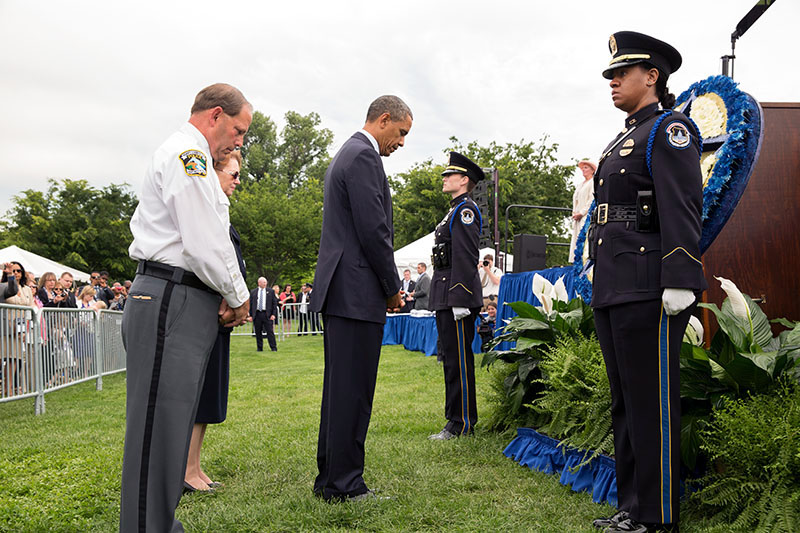
White House caption from 2013 ceremony: President Barack Obama bows his head after placing a flower in a wreath during the National Peace Officers Memorial Service, an annual ceremony honoring law enforcement who were killed in the line of duty in the previous year, at the U.S. Capitol in Washington, D.C. May 15, 2013. Chuck Canterbury, National President, Fraternal Order of Police and Linda Hennie, President, FOP Auxiliary stand with the President. (Official White House Photo by Pete Souza)

White House caption from 2013 ceremony: President Barack Obama bows his head after placing a flower in a wreath during the National Peace Officers Memorial Service, an annual ceremony honoring law enforcement who were killed in the line of duty in the previous year, at the U.S. Capitol in Washington, D.C. May 15, 2013. Chuck Canterbury, National President, Fraternal Order of Police and Linda Hennie, President, FOP Auxiliary stand with the President. (Official White House Photo by Pete Souza)

Save

Save


Feynman at the Nobel Awards Dinner

May 12, 2015

Photos tell a thousand stories.

Richard Feynman at the Nobel Awards dinner after receiving his prize in Physics.  Who is the woman to Feynman's right?

Richard Feynman at the Nobel Awards dinner after receiving his prize in Physics. Who is the woman to Feynman’s right? Found on Pinterest

Richard P. Feynman won his Nobel in Physics, in 1965, shared with Sin-Itiro Tomonaga and Julian Schwinger.

The Nobel Foundation said:

The Nobel Prize in Physics 1965 was awarded jointly to Sin-Itiro Tomonaga, Julian Schwinger and Richard P. Feynman “for their fundamental work in quantum electrodynamics, with deep-ploughing consequences for the physics of elementary particles”.

In its description of his award, the Foundation pointed to the now-famous Feynman Diagrams.

Introduced the Feynman Diagrams

Following the successes of the theory of relativity and quantum mechanics, a first relativistic theory was formulated for the interaction of charged particles with electromagnetic fields. However, in the work of reformulating the theory, Richard Feynman made contributions to a new quantum electrodynamics, in particular in 1948, he introduced so called Feynman diagrams, a graphical representation of interactions between different particles. These diagrams facilitate calculations of interaction probabilities.

Who is the woman next to Feynman?

More:

  • Yesterday, May 11, was Feynman Day; see why we need to mark our calendars for next year!

Ooops! Missed Feynman Day, May 11! How will we make it up?

May 12, 2015

Got busy, got distracted, fighting allergies . . . and I missed posting for Feynman Day!

Is it ever the wrong time to celebrate the interesting life and remarkable achievements of Richard Feynman?

Here’s the post I should have done yesterday, in Feynman’s honor, and for our enjoyment:

May 11 is the anniversary of the birth of Richard Feynman (born 1918, died 1988).

Richard Feynman

Richard Feynman. Borrowed from Luciano’s Tumblr, LikeaPhysicist

Feynman’s birthday falls on Statehood Day for Minnesota.  You can fly your flag for both causes, if you wish, Minnesota’s statehood AND Feynman’s birthday.  No proclamation will issue from the White House, but you can fly your flag any day.

Why Feynman Day?  To celebrate invention, physics, interesting characters, and that essential, American quality of je ne sais quoi.

In addition to his winning the Nobel Prize for Quantum Electrodynamics (QED), Feynman popularized the critique of science and other enterprises with what we now call Cargo Cult science, or education, or whatever, where people follow the dance steps, but without the rhythm and music.

Those two things alone would make him a remarkable man.  But, like a product offered for $19.95 as a good buy in a 2:00 a.m. infomercial, with Feynman, there’s more.  With Feynman, there is always more.

I got alerted to Feynman in the first days of the old Quality Paperback Book Club, when they featured his new memoir, Surely You’re Joking, Mr. Feynman!  QPBC was hot on the book, and with a title like that, how could I resist?  When I got the book a week or so later, I read it within two days, while attending law school and working full time.  I remember Feynman.

Norton published the book — and their description, alone, should make you want to read it:

A New York Times bestseller—the outrageous exploits of one of this century’s greatest scientific minds and a legendary American original.

In this phenomenal national bestseller, the Nobel Prize­-winning physicist Richard P. Feynman recounts in his inimitable voice his adventures trading ideas on atomic physics with Einstein and Bohr and ideas on gambling with Nick the Greek, painting a naked female toreador, accompanying a ballet on his bongo drums and much else of an eyebrow-raising and hilarious nature.

All true, and that’s not even the half of the outrageousness, all done with great good humor, about a life lived in great good humor through what should have been a memorable age, but often was just terrifying.

I think sometimes that Feynman’s calm, alone, borne of that great good humor and insatiable curiosity,  may have gotten us through the birth of the atomic age and the Cold War.

Feynman was a giant, and we don’t revere him enough.  Consider:

  • Feynman’s high school sweetheart, Arlene, came down with tuberculosis.  He married her, and took her with him to New Mexico to make the atom bombs.  The stories of her confinement to a hospital, and the laborious trekking he had to make between Los Alamos and her bedside in Santa Fe, are touching, and heartbreaking.  It is one of the great love stories of the 20th century, certainly, and perhaps for all time.  It also provided the title for his second memoir, What Do You Care What Other People Think?
  • Every single, college-age man should read Feynman’s stories of how to date, and how to seduce women.  His approach was unique, and endeared him to women — in legend, to many women.  Feynman’s dating must have been part of the inspiration for the comedy series, “Big Bang Theory.”  Feynman’s stories are better.  (Heck, it’s even the subject of a popular, classic XKCD comic — probably only Feynman and Einstein among Nobel-winning physicists have made so much money for so many cartoonists.)
US postage stamp featuring Richard Feynman

US postage stamp featuring Richard Feynman

  • Yeah, he’s already been featured on a postage stamp, see at right.  That’s not good enough for Feynman, though — the U.S. Postal Service created a special cancellation stamp for Feynman, featuring a version of his Feynman Diagrams.

    A special postal cancel was authorized by the USPS (United States Postal Service) to honor the 80th birthday of Richard Feynman. This cancel was used in Lake Worth, Florida. For this special day the post office was renamed “Feynman Station.”

    Feynman Commemorative Cancel Feynman Diagram

    The Feynman Diagram used for the postal cancel on this envelope depicts what is known as a “bubble process.” It shows a high energy particle, for example, a cosmic ray (a) from a distant supernova, which emits a high energy photon, for example, a gamma ray (b). The photon, in turn, creates a particle (c) and an anti-particle (d) that exists for a brief moment and then recombines.

    As Feynman liked to point out, an anti-particle is the same thing as a particle with negative energy traveling backward in time (which is why the arrow at (d) points backwards, i.e. to the left). So you could say the photon created only one particle that, at first, traveled forward in time (the bottom semi-circle) and then reversed and went back in time (the top semi-circle) and annihilated itself! By inventing diagrams like this, Richard Feynman made it much easier to understand what is going on in the interactions between sub-atomic particles without getting lost in tremendous amounts of tedious math

  • Working at Los Alamos on the Manhattan Project, Feynman developed a keen appreciation for bureaucracy and all its follies.  His vexations for the security managers are also legendary.  Here’s a quick version of one story — he asked friends and family to write to him in code, but to not include a key to the code, so he’d have to crack the code to read the letter.  Feynman could do it, but the security people couldn’t.  Hilarity ensued.
  • Feynman developed a love for the still-relatively unknown, landlocked Asian nation of Tannu Tuva.  It’s just the sort of place to appeal to a character like Feynman — so obscure most atlases didn’t, and don’t, show it at all — seemingly consumed by the Soviet Union, but held in a special status.  Home of throat singing — and almost impossible to get to.  During the Cold War, Feynman struck up correspondence with people in Tuva, to the concern of Soviet and American intelligence agencies, who seemed not to understand someone might do such thing out of curiosity.  Feynman hoped to travel there to visit new friends, but his final bouts of cancer took him before it was possible.  Tuva, famous among philatelists only, perhaps, honored Feynman with postage stamps and postcards.
  • Just try to find a photo of Feynman not smiling. The man was a joy to be around, for most people, most of the time.
  • Quantum electro dynamics?  No, I can’t explain it, either — but his work had a lot to do with how particles wobble.  I remember that because, according to Feynman, he got the inspiration for the work for which he won the Nobel while spinning plates, like a Chinese acrobat on the Ed Sullivan Show, to the delight of students in the Cornell University cafeteria, and the shock and horror of the food service people.  Who else has yet confessed to such an inspiration for a Nobel?

There’s more — a lot more.  Feynman outlined our current generation of computer memory devices — in 1959.  No, he didn’t patent the idea.  He did patent an idea for a nuclear-powered spacecraft.  Another delightful story.

Feynman in an Apple ad

Feynman was featured in print and broadcast ads for Apple — not one, but two (did anyone else get that honor from Apple?). “Think Different.” This is one of Apple Computer’s most successful advertising campaigns. The theme of the campaign is one that celebrates figures in history who changed the world by thinking differently. Richard Feynman was among the chosen figures.

Feynman served on the board that approved science books for the California school system — his stories of that work will shock some, but it will make others shake their heads as they recognize the current crop of cargo-cultists and political bullies who dominate textbook approval processes, knowing nothing at all about what they are doing, or why.

No, I didn’t forget his brilliant work on the commission that studied the Challenger disaster, for NASA. There’s so much stuff to glorify!

In history, Feynman should be remembered much as we remember Thomas Jefferson, as a renaissance man in his time, a man who put great intellect to great work for his nation and all humanity.

Feynman's second Apple ad

The second Apple ad featuring Richard Feynman. An excerpt from Apple Computer’s campaign commercial: “Here’s to the crazy ones, the misfits, the rebels, the troublemakers, the round pegs in the square holes, the ones who see things differently. They’re not fond of rules and they have no respect for the status quo. You can quote them, disagree with them, glorify or vilify them… about the only thing you can’t do is ignore them, because they change things, they push the human race forward; and while some may see them as the crazy ones, we see genius, because the people who are crazy enough to think they can change the world are the ones who do.”

The sages say we shouldn’t have regrets, but I do have one.  When the Challenger Commission was meeting in Washington, D.C., I was working on another commission up the street.  I knew Feynman was ill, but our work was important, and we’d heard his disease was in remission.  I didn’t goof off a day and go to any of the hearings to see him, to get an autograph, to meet the man.  I though I’d have other opportunities to do that.  Now I regret not having met him in person.

In print, and in film, I know him well.  In our family, reading Feynman is something everybody does.  Feynman’s memoir was one of the last books I read to our son, Kenny, as he was growing up, and growing into reading on his own.  Even reading about Feynman, together, was an adventure.  Our son, James, took us into the real physics of Feynman, and though I struggle with it more than James, we still read Feynman, for humor, and physics.

What would be appropriate ways to mark Feynman’s birth?  At some future date, I hope we’ll have public readings of his books, showings of the documentaries about him, recreations of his lectures, perhaps.  And then everyone can get in a circle, beating drums and singing about getting some orange juice, before sending postcards to our friends in Tuva.

Richard Feynman, we still need you, and miss you dearly.

Tannu Tuva

Tuva’s capital is the delightfully-named Kyzyl. From this map, can you figure out where Tuva is, or how to get there — without Google, or Bing?

Tuva postcard honoring Richard Feynman

Tuva postcard, in honor of Richard Feynman — who loved to drum.

There will always be “More” about Richard Feynman, if we’re lucky:

Have a great Feynman Day!

Much of this is an encore post.


Letter to IVCC: Please correct history of DDT

May 11, 2015

Screen capture of IVCC's introductory film, explaining benefits of mosquito bednets and the need for new pesticides to replace those now in use, to which mosquitoes have developed resistance and immunity.

Screen capture of IVCC’s introductory film, explaining benefits of mosquito bednets and the need for new pesticides to replace those now in use, to which mosquitoes have developed resistance and immunity.

Text of an e-mail I sent to the non-profit vector control group IVCC at the Liverpool School of Tropical Medicine.  “Vector” is the fancy name for “disease-carrying arthropod,” usually an insect.

Dear IVCC,

Generally your website is very useful.  I am happy to recommend it for most people, for most purposes.

However, I’ve discovered errors in history you need to correct. On this page: Highlights of vector-borne disease history | IVCC

You say:

1962: Rachel Carson publishes Silent Spring; a powerfully written book arguing that DDT is not safe. The reaction is immediate in several US states: DDT is banned. A nation-wide ban follows ten years later.

When Rachel Carson’s book Silent Spring hit the shelves, it caused outrage.

Carson’s engaging and populist style meant the book appealed to many ordinary people, not just scientists. Carson used the scientific evidence of many researchers to argue that DDT can kill animals, cause bird populations to decline and lead certain pests to proliferate. Workers who handled the chemical suffer health problems and exposed fish got liver cancer. She also found evidence of DDT in mother’s breast milk and in the bodies of babies. Several US states immediately banned the use of DDT as a pesticide and for crops. In 1972, the USA banned it outright.

But there was a problem. DDT was and is the most effective means of reducing malaria incidences, particularly in developing countries. DDT is cheap, effective, easily stored and transported and relatively safe for the person spraying. It does not have to be applied very often and provides the best means of protection possible. But how could the USA promote DDT through its aid programmes if DDT was a banned chemical at home?

In 2000, a worldwide ban on DDT nearly ensued but it was stopped at the last minute. Today, DDT is still produced in China and India and available globally for use uniquely in anti-malarial efforts.

I find that to be an inaccurate history, and one that falsely contributes to the idea that scientists, the World Health Organization, and African malaria fighters are fools.

In 1972, the U.S. Environmental Protection Agency issued an order banning DDT from use on crops. The order specifically worked around then-current U.S. law which would have required an absolute ban on DTT, or “outright” as you call it.  But the U.S. action was not “outright.”

EPA Administrator William Ruckelshaus fully appreciated the utility of DDT for fighting insect vectors of disease. The regulation banned ONLY crop use, and specifically exempted from ban the use of DDT to fight insect vectors — in the U.S., as well as world wide.  See this article, and follow the links for the actual text of the regulation:  Oh, look: EPA ordered DDT to be used to fight malaria in 1972!

You can see EPA’s action also did not ban manufacturing in the U.S.  Many scientists in the U.S. saw this as a bow to chemical manufacturers who would have lost money invested in manufacturing plants.  Production of DDT in the U.S. continued, almost exclusively for export, until 1984.  In 1984, there were exports of 300 tons of DDT from the U.S.

DDT remains a deadly toxin, one that kills indiscriminately in the wild.  It is not at all clear to me that the POPs Treaty negotiations were speeding to a complete ban on the stuff — but in any case, a special carve out was created to allow DDT use to continue, to fight disease.   That amendment was proposed first in early negotiations — not a “last-minute” change of mind.

DDT was never “the most effective means of reducing malaria incidences;” it was a key part of WHO’s eradication program, precisely because it is so toxic, and precisely because it is long-lasting, the two key features that make it a “persistent organic pollutant.” DDT only works when coupled with a program of medical care to cure humans of the disease while mosquito populations are temporarily knocked down — a point you recognize at other places on your website.  Alone, DDT sets a stage for malaria to come roaring back, as soon as the DDT effectiveness wears off due to wall washing, painting or time, and when the mosquitoes come roaring back resistant to DDT, they will spread any malaria left in the population of humans.

I hope you can make corrections.  There is a widespread, well-funded effort to claim DDT is perfectly harmless to humans, that evil scientists and environmentalists prevailed on WHO and nations to stop using DDT, that the complete cessation of DDT use led to a massive expansion of malaria, and that therefore we should ignore scientists, environmentalists, NGOs and anyone else like the Liverpool School of Tropical Medicine, who advocate doing anything other than massive DDT spraying campaigns to fight malaria.

Please don’t contribute to that political and science hoax campaign.

Sincerely,

Ed Darrell
Dallas, Texas

We’ll see whether anyone is awake and tending the message box at IVCC in Liverpool.  I hope the project is not dormant.

Fighting malaria requires accurate information if malaria fighters are to be able to outsmart malaria, which has outsmarted humans for a half-million years.

IVCC’s film of introduction:

More:

[Not sure why WordPress wants this post to show up on May 11’s schedule, when I posted in on May 21.  Haven’t figured out how to fix it; so I’ve reposted this closer to when it was written.  FYI.]


Fly your flags today in Minnesota: 157th Minnesota Statehood Day, May 11

May 11, 2015

Flag etiquette following the U.S. Flag Code urges Americans to fly U.S. flags on the day of statehood for the state in which you reside.

Minnesota joined the Union on May 11, 1858.

Minnesota Capitol Chandelier, lit for Statehood Day, May 11.

Caption from the Minneapolis Star-Tribune: The Minnesota Capitol chandelier was illuminated today, May 10, 2013 in celebration of Statehood Day. It has 92 bulbs surrounded by 40,000 crystal beads strung together and was recently painstakingly cleaned and refurbished. The fixture is traditionally lit once per year on Statehood Day. Minnesota became a part of the United States as Minnesota Territory in 1849, and became the 32nd U.S. state on May 11, 1858.

At the Library of Congress’s outstanding American Memory site, a much more detailed history of Minnesota statehood is featured on “Today in History,” reproduced here in its entirety:

The Star of the North

facade of a domed building
Capitol Building, exterior, St. Paul, MN
St. Paul, Minnesota 1902
American Landscape and Architectural Design, 1850-1920

On May 11, 1858, Minnesota became the 32nd state admitted into the Union. Minnesota’s application for statehood was submitted to President James Buchanan in January, but became entangled with the controversial issue of Kansas statehood, delaying it for several months until it was finally approved by Congress.

Known as the “Land of 10,000 Lakes,” or “Star of the North,” Minnesota is the northern terminus of the Mississippi River’s traffic and the westernmost point of an inland waterway which extends through the Great Lakes and, with the St. Lawrence Seaway, to the Atlantic Ocean.

The Ojibwa (Chippewa) and Dakota (Sioux) were among the tribal peoples who first made this land their home. For them state borders were non-existent, and their territory extended far beyond what is today Minnesota. The French claimed this region from the mid-1600s to the mid-1700s, developing a strong fur trade but ceding lands east of the Mississippi to Britain. The U.S. acquired the area and its rich natural resources through the Treaty of Paris (1783), and the Louisiana Purchase (1803).

U.S. administration of the northwest lands formally began with the 1787 passage of the Northwest Ordinance. The ordinance, one of the most important pieces of legislation passed by the Continental Congress, set out the requirements for a territory to become a state. The American Memory collection Continental Congress and the Constitutional Convention, 1774-1789 features a discussion of the Incorporation of the Western Territories. For additional information on England’s yielding of land west of the Appalachian Mountains, see the Today in History feature on the Surrender of Fort Sackville. A representation of Fort Sackville is accessible on The George Rogers Clark National Historic Park site.

From the 1820s on, protected the growth of the area now called Minnesota. During the Civil War, the fort served as a training center for thousands of young Minnesota volunteers who joined the Union Army. Twenty-four thousand soldiers who trained at the fort fought in the Union Army, serving gallantly at Gettysburg or during the Indian Outbreak. Once a military outpost at the edge of a small settlement, Fort Snelling is now located at the center of Minnesota’s “Twin Cities”—Minneapolis and St. Paul.

wheat bundle stacks
Wheat Bundle Stacks, Fosston, Minnesota, circa 1900.
The Northern Great Plains, 1880-1920

a horse in a farming rig in a field
Horse powered threshing rig, Blue Earth, Minnesota, 1898.
The Northern Great Plains, 1880-1920

Until the second half of the nineteenth century, immigration into Minnesota was slow. However, as the value of the state’s woodlands and fertile prairie was realized, settlers poured into the region with New England lumbermen leading the way. Between 1850 and 1857, the state population skyrocketed from 6,077 to over 150,000. As a large state with land for homesteading, Minnesota attracted immigrants from Norway, Sweden, Finland, and those seeking to own land in the United States. An 1878 brochure published by the Minnesota State Board of Immigration, describes the many reasons for moving to the state.

19th century advertisements to get people to move to Minnesota. Library of Congress images

19th century advertisements to get people to move to Minnesota. Library of Congress images; see description and link details below

Advertisement for a steamboat company
Northern Line Packet Co.,
Advertisement for a steamship company in The Minnesota Guide. A Handbook of Information for the Travelers, Pleasure Seekers and Immigrants…, 1869.
Pioneering the Upper Midwest: Books from Michigan, Minnesota, and Wisconsin, ca. 1820-1910

Still a leader in farming, lumbering, milling, and medical research, Minnesota is also an important center for the printing industry and a major producer of iron ore. Its largest city, Minneapolis, is home to the University of Minnesota, numerous museums, and theaters such as the Tyrone Guthrie Theater and the Walker Arts Center, and the world’s largest cash grain market.

St. Paul is the state capital.

Bird's eye view of Duluth
Bird’s Eye View of Duluth, Minnesota, copyright 1914.
Taking the Long View, 1851-1991

More:

U.S. and Minnesota flags flying together. Minnesota state flag photo by AlexiusHoratius - Own work. Licensed under Creative Commons, via Wikipedia

U.S. and Minnesota flags flying together. Minnesota state flag photo by AlexiusHoratius – Own work. Licensed under Creative Commons, via Wikipedia

Yes, this is mostly an encore post. Fighting ignorance requires patience.

Yes, this is mostly an encore post. Fighting ignorance requires patience.


Fly your flag for Victory Europe Day, May 8, 2015 – 70th anniversary

May 8, 2015

Yes, you should be flying your flag today for Victory Europe Day (VE Day)!

Caption from Pinterest, World War Items: A huge American flag unfurled in New York’s Herald Square on VE Day on May 8, 1945. This 80x160 foot flag was hung from the eighth floor balcony of Macy’s New York department store, covering the façade from 34th and 35th Streets along Broadway. Beneath it were placed a set of British, Chinese, French and Russian flags, held by two giant mailer fists. (AP Photo)

Caption from Pinterest, World War Items: A huge American flag unfurled in New York’s Herald Square on VE Day on May 8, 1945. This 80×160 foot flag was hung from the eighth floor balcony of Macy’s New York department store, covering the façade from 34th and 35th Streets along Broadway. Beneath it were placed a set of British, Chinese, French and Russian flags, held by two giant mailer fists. (AP Photo)

VE Day is not one listed in the Flag Code for flying the colors, but in most years there is a proclamation from the President urging that we do fly the flag.

This year President Obama noted the 70th anniversary of VE Day with his weekly message:


Cinco de Mayo: NOT Mexico’s Independence Day; should Confederate sympathizers celebrate?

May 5, 2015

(Mostly an encore post, from 2009, with updates)

You thought Cinco de Mayo was Independence Day for Mexico?

No, it’s not.

History.com has a nice explanation, with a nice little video

NPR’s blogs explain: “Cinco de Mayo: Whose holiday is it, anyway?”

“It ain’t about the Margaritas: The real meaning of Cinco de Mayo,” at NPR’s The Takeaway.

Perhaps the U.S. should celebrate the day, too, at least in those states who were not in the old Confederacy. On May 5, 1862, Mexicans under the command of 33 year old Commander General Ignacio Zaragoza Seguín stopped the quick advance of superior French forces trying to invade Mexico to take it over, at the Battle of Puebla. While France did eventually defeat Mexican forces (after getting 30,000 men in reinforcements), the spirit of May 5 inspired Mexicans to continue to fight for freedom. And ultimately, Mexican forces overpowered and captured the French forces and Emperor Maximilian, who was executed.

Thus ended a great hope for the Confederacy, that a French-supported Mexican Army would lend aid to the Confederates in their struggle to secede from the Union.

It is one of the great what-ifs of history: What if France had kept Mexico, and what if French-led Mexican forces backed up the Confederate Army, as Confederates and the French hoped?

One thing is rather sure: Had that happened, and had the Confederacy been successful, we wouldn’t be celebrating Cinco de Mayo in Texas today.

What do the scholars of Lincoln have to add?

Battle of Puebla, Wikimedia (artist?)

Battle of Puebla, Wikimedia (artist?)

Mexican Independence Day is September 16.

_______________________________________

Update: A reader sends a note that Seguin was a Texan. So the Mexican hero of the Battle of Puebla was a Texan. You couldn’t make this stuff up — real history is always more interesting than fiction.


What dates do we fly the flag in May?

May 2, 2015

"Allies Day, May 1917" -- 1917 oil on canvas by Childe Hassam; National Gallery of Art, Washington, D.C.

“Allies Day, May 1917” — 1917 oil on canvas by Childe Hassam; National Gallery of Art, Washington, D.C. Allies Day is no longer celebrated.

May has three days designated for flying the U.S. flag out of the specific days mentioned in the U.S. Flag Code, and three statehood days, when residents of those states should fly their flags.

Interestingly, the three designated days all float, from year to year:

  • Mother’s Day, second Sunday in May (May 10, in 2015)
  • Armed Forces Day, third Saturday in May (May 16)
  • Memorial Day, the last Monday in May (May 25)

Residents of these states celebrate statehood; South Carolina and Wisconsin share May 23:

  • Minnesota, May 11 (1858, the 32nd state)
  • South Carolina, May 23 (1788, the 8th state)
  • Wisconsin, May 23 (1848, the 30th state)
  • Rhode Island, May 29 (1790, the last of the 13 original colonies to ratify the Constitution)

This year President Obama issued a proclamation calling on citizens to fly the flag on May 1, Law Day (I missed that one).

May 8 marks the 70th anniversary of Victory in Europe Day, the day the Axis Powers in Europe surrendered at the end of World War II.  Some years that day is marked by a proclamation calling for flag flying.  (You may fly your flag then even if Congress and the President do nothing.)

In recent years President Obama has proclaimed May 15 as Peace Officers Memorial Day, with flags to fly at half-staff. We might expect another such declaration in 2015.

May 22 is National Maritime Day, under a Joint Resolution from Congress from 1933. President Obama may be expected to proclaim that day as a day to fly the flag, too.

Gee, eleven events on ten days to fly the U.S. flag.  May could be quite busy for flag fliers.

  1. Law Day, May 1
  2. Victory in Europe Day, May 8
  3. Mothers Day, May 10
  4. Minnesota Statehood, May 11
  5. Peace Officers Memorial Day, May 15 (half-staff flags)
  6. Armed Forces Day, May 16
  7. National Maritime Day, May 22
  8. South Carolina Statehood, AND Wisconsin Statehood, May 23
  9. Memorial Day, May 25
  10. Rhode Island Statehood, May 29

True story: Yellow Rose of Texas saved Texas at the Battle of San Jacinto

April 21, 2015

This is mostly an encore post, for the 179th anniversary of the Battle of San Jacinto.

After suffering crushing defeats in previous battles, and while many Texian rebels were running away from Santa Anna’s massive army — the largest and best trained in North America — Sam Houston’s ragtag band of rebels got the drop on Santa Anna at San Jacinto, on April 21, 1836. Most accounts say the routing of Santa Anna’s fighting machine took just 18 minutes.

San Jacinto Day is April 21. Texas history classes at Texas middle schools should be leading ceremonies marking the occasion — but probably won’t since it’s coming near the end of the state-mandated testing which stops education cold, in March.

Surrender of Santa Anna, Texas State Preservation Board

Surrender of Santa Anna, painting by William Henry Huddle (1890); property of Texas State Preservation Board. The painting depicts Santa Anna being brought before a wounded Sam Houston, to surrender.

San Jacinto Monument brochure, with photo of monument

The San Jacinto Monument is 15 feet taller than the Washington Monument

How could Houston’s group have been so effective against a general who modeled himself after Napoleon, with a large, well-running army? In the 1950s a story came out that Santa Anna was distracted from battle. Even as he aged he regarded himself as a great ladies’ man — and it was a woman who detained the Mexican general in his tent, until it was too late to do anything but steal an enlisted man’s uniform and run.

That woman was mulatto, a “yellow rose,” and about whom the song, “The Yellow Rose of Texas” was written, according story pieced together in the 1950s.

Could such a story be true? Many historians in the 1950s scoffed at the idea. (More below the fold.) Read the rest of this entry »


No, Earth Day does not celebrate Lenin, who was anti-environmentalist – 2015 debunking of the annual Earth Day/Lenin hoax

April 20, 2015

This is mostly an encore post, repeated each year on April 22 and Earth Day — sad that it needs repeating; anti-environmentalists don’t appear to learn much, year to year.  (Yes, some of the links may be dated; if you find one not working, please let me know in comments.)

You could write it off to pareidolia, once.

Like faces in clouds, some people claimed to see a link. The first Earth Day, on April 22, 1970, coincided with Lenin’s birthday. There was no link — Earth Day was scheduled for a spring Wednesday, when the greatest number of college students would be on campus.

Link to permanent Earth Day site, at EarthDay.org

Link to permanent Earth Day site, at EarthDay.org

Now, years later, with almost-annual repeats of the claim from the braying right wing, it’s just a cruel hoax.  It’s as much a hoax on the ill-informed of the right, as anyone else. Many of them believe it.

No, there’s no link between Earth Day and the birthday of V. I. Lenin:

One surefire way to tell an Earth Day post is done by an Earth Day denialist: They’ll note that the first Earth Day, on April 22, 1970, was an anniversary of the birth of Lenin.

Coincidentally, yes, Lenin was born on April 22 (new style calendar; it was April 10 on the calendar when he was born — one might accurately note that Lenin’s mother always said he was born on April 10).

It’s a hoax. There is no meaning to the first Earth Day’s falling on Lenin’s birthday — Lenin was not prescient enough to plan his birthday to fall in the middle of Earth Week, a hundred years before Earth Week was even planned.

About.com explains why the idea of a link between Earth Day and Lenin is silly:

Does Earth Day Promote Communism?
Earth Day 1970 was initially conceived as a teach-in, modeled on the teach-ins used successfully by Vietnam War protesters to spread their message and generate support on U.S. college campuses. It is generally believed that April 22 was chosen for Earth Day because it was a Wednesday that fell between spring break and final exams—a day when a majority of college students would be able to participate.

U.S. Sen. Gaylord Nelson, the guy who dreamed up the nationwide teach-in that became Earth Day, once tried to put the whole “Earth Day as communist plot” idea into perspective.

“On any given day, a lot of both good and bad people were born,” Nelson said. “A person many consider the world’s first environmentalist, Saint Francis of Assisi, was born on April 22. So was Queen Isabella. More importantly, so was my Aunt Tillie.”

April 22 is also the birthday of J. Sterling Morton, the Nebraska newspaper editor who founded Arbor Day (a national holiday devoted to planting trees) on April 22, 1872, when Lenin was still in diapers. Maybe April 22 was chosen to honor Morton and nobody knew. Maybe environmentalists were trying to send a subliminal message to the national subconscious that would transform people into tree-planting zombies. One birthday “plot” seems just about as likely as the other. What’s the chance that one person in a thousand could tell you when either of these guys were born.

My guess is that only a few really wacko conservatives know that April 22 is Lenin’s birthday (was it ever celebrated in the Soviet Union?). No one else bothers to think about it, or say anything about it, nor especially, to celebrate it.

Certainly, the Soviet Union never celebrated Earth Day. Nor was Lenin any great friend of the environment.  He stood instead with the oil-drillers-without-clean-up, with the strip-miners-without-reclamation, with the dirty-smokestack guys.  You’d think someone with a bit of logic and a rudimentary knowledge of history could put that together.

Gaylord Nelson, Living Green image

Inventor of Earth Day teach-ins, former Wisconsin Governor and U.S. Senator Gaylord Nelson

The REAL founder of Earth Day, Wisconsin’s U.S. Sen. Gaylord Nelson, usually recognized as the founder and father of Earth Day, told how and why the organizers came to pick April 22:

Senator Nelson chose the date in order to maximize participation on college campuses for what he conceived as an “environmental teach-in.” He determined the week of April 19–25 was the best bet; it did not fall during exams or spring breaks, did not conflict with religious holidays such as Easter or Passover, and was late enough in spring to have decent weather. More students were likely to be in class, and there would be less competition with other mid-week events—so he chose Wednesday, April 22.

In his own words, Nelson spoke of what he was trying to do:

After President Kennedy’s [conservation] tour, I still hoped for some idea that would thrust the environment into the political mainstream. Six years would pass before the idea that became Earth Day occurred to me while on a conservation speaking tour out West in the summer of 1969. At the time, anti-Vietnam War demonstrations, called “teach-ins,” had spread to college campuses all across the nation. Suddenly, the idea occurred to me – why not organize a huge grassroots protest over what was happening to our environment?

I was satisfied that if we could tap into the environmental concerns of the general public and infuse the student anti-war energy into the environmental cause, we could generate a demonstration that would force this issue onto the political agenda. It was a big gamble, but worth a try.

At a conference in Seattle in September 1969, I announced that in the spring of 1970 there would be a nationwide grassroots demonstration on behalf of the environment and invited everyone to participate. The wire services carried the story from coast to coast. The response was electric. It took off like gangbusters. Telegrams, letters, and telephone inquiries poured in from all across the country. The American people finally had a forum to express its concern about what was happening to the land, rivers, lakes, and air – and they did so with spectacular exuberance. For the next four months, two members of my Senate staff, Linda Billings and John Heritage, managed Earth Day affairs out of my Senate office.

Five months before Earth Day, on Sunday, November 30, 1969, The New York Times carried a lengthy article by Gladwin Hill reporting on the astonishing proliferation of environmental events:

“Rising concern about the environmental crisis is sweeping the nation’s campuses with an intensity that may be on its way to eclipsing student discontent over the war in Vietnam…a national day of observance of environmental problems…is being planned for next spring…when a nationwide environmental ‘teach-in’…coordinated from the office of Senator Gaylord Nelson is planned….”

Nelson, a veteran of the U.S. armed services (Okinawa campaign), flag-waving ex-governor of Wisconsin (Sen. Joe McCarthy’s home state, but also the home of Aldo Leopold and birthplace of John Muir), was working to raise America’s consciousness and conscience about environmental issues.

Lenin on the environment? Think of the Aral Sea disaster, the horrible pollution from Soviet mines and mills, and the dreadful record of the Soviet Union on protecting any resource. Lenin believed in exploiting resources and leaving the spoils to rot in the sun, not conservation; in practice there was no environmental protection, but instead a war on nature, in the Soviet Union.

So, why are all these conservative denialists claiming, against history and politics, that Lenin’s birthday has anything to do with Earth Day?

Can you say “propaganda?” Can you say “political smear?”

2015 Resources and Good News:

2014 Resources and Good News:

2013 Resources and Good News:

Good information for 2012:

Good information from 2011:

Good information from 2010:

2014’s Wall of Shame:

2013 Wall of Shame:

Wall of Lenin’s Birthday Propaganda Shame from 2012:

Wall of Lenin’s Birthday Propaganda Shame from 2011:

Wall of Lenin’s Birthday Propaganda Shame from 2010:

Spread the word. Have you found someone spreading the hoax, claiming Earth Day honors Lenin instead? Give us the link in comments.


César Chávez Day, 2015

March 31, 2015

features a portrait of Cesar against a background of empty grape fields. It was painted by illustrator Robert Rodriguez from a 1976 photo,

Postage stamp honoring Cesar Chavez in 2003. “The stamp features a portrait of Cesar against a background of empty grape fields. It was painted by illustrator Robert Rodriguez from a 1976 photo,” according to the Cesar Chavez Foundation.

President Obama declared March 31, 2015, César Chávez Day, as he did in 2014.  Here’s the press release version of the proclamation.

For Immediate Release                                                         March 30, 2015

Presidential Proclamation — Cesar Chavez Day, 2015

CÉSAR CHÁVEZ DAY, 2015

– – – – – – –

BY THE PRESIDENT OF THE UNITED STATES OF AMERICA
A PROCLAMATION

For more than two centuries, the arc of our Nation’s progress has been shaped by ordinary people who have dedicated their lives to the extraordinary work of building a more perfect Union.  It is a story of achievement and constant striving that has found expression in places where America’s destiny has been decided — in Seneca Falls, Selma, and Stonewall, and in the golden fields of California where an American hero discovered his mighty voice.  Today, we honor César Chávez and his lifetime of work to make our country more free, more fair, and more just, and we reaffirm the timeless belief he embodied:  those who love their country can change it.

A son of migrant workers and a child of the Great Depression, César Chávez believed every job has dignity and every person should have the chance to reach beyond his or her circumstances and realize a brighter future.  When no one seemed to care about the farm workers who labored without basic protections and for meager pay to help feed the world, César Chávez awakened our Nation to their deplorable conditions and abject poverty — injustices he knew firsthand.  He organized, protested, fasted, and alongside Dolores Huerta, founded the United Farm Workers.  Slowly, he grew a small movement to a 10,000-person march and eventually a 17-million-strong boycott of table grapes, rallying a generation around “La Causa” and forcing growers to agree to some of the first farm worker contracts in history.  Guided by a fierce commitment to nonviolence in support of a righteous cause, he never lost faith in the power of opportunity for all.

As a Nation, we know the struggle to live up to the principles of our founding does not end with any one victory or defeat.  After César Chávez fought for higher wages, he pushed for fresh drinking water, workers’ compensation, pension plans, and protection from pesticides.  He strove every day for the America he knew was possible.  Today, we must take up his work and carry forward this great unfinished task.

When immigrants labor in the shadows, they often earn unfair wages and their families and our economy suffer — that is one reason why we have to fix our broken immigration system and why I keep calling on the Congress to enact comprehensive immigration reform.  We need to continue to defend the collective bargaining rights countless individuals have fought so hard for and ensure our economy rewards hard work with a fair living wage, paid leave, and equal pay for equal work.

César Chávez knew that when you lift up one person, it enriches a community; it bolsters our economy, strengthens our Nation, and gives meaning to the creed that out of many, we are one.  As we celebrate his life, we are reminded of our obligations to one another and the extraordinary opportunity we are each given to work toward justice, equal opportunity, and a better future for every one of our sisters and brothers.

NOW, THEREFORE, I, BARACK OBAMA, President of the United States of America, by virtue of the authority vested in me by the Constitution and the laws of the United States, do hereby proclaim March 31, 2015, as César Chávez Day.  I call upon all Americans to observe this day with appropriate service, community, and education programs to honor César Chávez’s enduring legacy.

IN WITNESS WHEREOF, I have hereunto set my hand this thirtieth day of March, in the year of our Lord two thousand fifteen, and of the Independence of the United States of America the two hundred and thirty-ninth.

[signed] BARACK OBAMA

No call for a flying of flags, but you may certainly fly your Old Glory, if you wish.

More: 


Encore: Campaigning Obama visited the Dubliner on St. Patrick’s Day, 2012

March 17, 2015

(This is a slightly-edited encore post, for St. Patrick’s Day — I like the Corrigan Brothers’ droll tune.)

I’d forgotten about the birthers’ greatest nightmare — Obama’s got Irish blood in him!

Democratic Underground features a series of photos of President Obama with an Irish cousin at one of my favorite old haunts in Washington, the Dubliner.

President Barack Obama drinks a Guinness with his ancestral cousin from Moneygall Ireland Henry Healy, center, and the owner of the pub in Moneygall Ireland, Ollie Hayes, right, at The Dubliner Restaurant and Pub and Restaurant on St. Patrick's Day, Saturday, March 17, 2012, in Washington (Official White House Photo by Pete Souza)

President Barack Obama drinks a Guinness with his ancestral cousin from Moneygall Ireland Henry Healy, center, and the owner of the pub in Moneygall Ireland, Ollie Hayes, right, at The Dubliner Restaurant and Pub and Restaurant on St. Patrick’s Day, Saturday, March 17, 2012, in Washington (Official White House Photo by Pete Souza)

Many great memories of the Dubliner, including its own great business success.

In 1974, when I interned at the Senate, the Dubliner was just a small bar on the first floor of the Commodore Hotel.  Rocky Johnson of Sen. Mike Gravel‘s office, one of my roommates, introduced me to Guinness.  The Dubliner was the most reliable source in D.C. at the time.  The bartender was a guy named Paddy.  It was never crowded — and they had good fish and chips with a fine, imported malt vinegar. I wasn’t exactly a regular, but I made several a lot of visits.

Ironically, for my summer job later that year with the Louis August Jonas Foundation, we had a trip to D.C. planned with about 16 “boys from abroad” and the designated hotel was the Commodore — it was cheap and met our needs, being close to the Capitol.  I was asked to chaperone, and happily went.   So Freddy Jonas, the great benefactor of the foundation and Camp Rising Sun, and I could sneak down to the Dubliner for a nightcap after the boys were asleep.  Michael Greene, the foundation’s executive director at the time, warned me that Freddy would always ask if you wanted a second drink, but Freddy would not take one himself — and so, of course, neither should staffers.

One night while Freddy and I were capping off the evening we ran into a friend from my interning, Avis Ortner, a former rodeo barrel rider who had starred in a Kodak commercial series, and who worked in a Washington law firm.  She and Freddy struck it off very nicely.  I was surprised at how much Freddy knew about horses, and the questions he had about rodeo riding.  At some point in the evening he asked me if I were going to have a second drink, and of course I declined.  “Well, you only live once.  Avis and I are having a second one, and you should join us.”  People who knew Freddy well still don’t believe me when I tell them the story.  But it’s true.  It’s the magic of the Dubliner.  [Is Avis still cleaning up at bridge in D.C.? [Yes!]]

I was back in D.C. in 1975, again with the Jonas Foundation bunch, and again at the Commodore.  The Dubliner had a successful year, and had taken over the small cafe/dining room next door to bar.

In 1976 I visited again, and after a very successful year the Dubliner kicked out the gift shop of the hotel and opened a second bar there.  It was crowded on weekends.

In 1979 I moved to D.C.  Within a couple of years the Dubliner bought out the Commodore.  You couldn’t get a seat at the bar most nights.  St. Patrick’s Day 1980 the line wrapped around the block, and though the place never had a great or large stage, the live act was the Clancy Brothers with Tommy Makem, if I recall correctly.

Reconstruction and massive redecorating made the hotel into a great stop, and a sometimes pricey room.  Eventually the bar company sold the hotel, but kept the location for the bar.  After Kathryn and I got married, we’d walk over to the Dubliner for lunch at least a couple of times a month, and the fish and chips at the Dubliner got better.  I may have done in half the cod from the Grand Banks all by myself.

We’ve been in Texas now since 1987.  I miss the Dubliner.  Have been able to make it back only a couple of times.  Obama’s lucky he could get in, on St. Patrick’s Day.  I hope he appreciates his luck.

Yes, this is mostly an encore post.  Fighting ignorance requires patience.

Yes, this is mostly an encore post. Fighting ignorance requires patience.


March 16, Freedoms Day 2015 – How to celebrate James Madison?

March 16, 2015

Celebrations of James Madison, who was born on March 16, 1751, fall to second tier, a paragraph if we’re lucky in your local newspaper’s “today in history” feature.

March 16 is not a holiday.  It’s not even a Flag Flying Day (though, if you left your flag up for March 15th’s anniversary of Maine’s statehood . . . no one would notice).

Secretary of State James Madison, who won Marb...

Secretary of State James Madison, who won Marbury v. Madison, but lost Judicial review. Photo: Wikipedia

Should we leave James Madison out of our celebrations of history with such vengeance?

Madison left a great legacy.  The question is, how to honor it, and him?

  • Madison is known popularly, especially for elementary school history studies (the few that are done anymore), as the Father of the Constitution.  It’s fitting:  Madison engaged in a great, good conspiracy with George Washington and Alexander Hamilton to get the convention to “amend” the Articles of Confederation and create a better, probably stronger, national government.  But Washington stayed behind the scenes, and pulled very few strings Madison didn’t tell him to pull. Hamilton’s support from New York was weak; while Hamilton played a hugely important role in getting the convention called, and in getting New York to ratify the Constitution with the creation of the Federalist Papers project, the day-to-day operation of the convention and direction of the political forces to make it work, fell to Madison.
  • Madison’s notes on the Philadelphia convention give us the best record of the then-secret proceedings. 

    English: James Madison, fourth president of th...

    Notice the error in this caption:  “James Madison, fourth president of the United States wrote the Constitution at his estate near Orange Virginia, called Montpelier. Pictured here after an extensive renovation.” Photo from Wikipedia.  (James Madison didn’t write the Constitution; it was hammered out in Philadelphia, not Montpelier; the patriot and rake Gouverneur Morris wrote out the final draft.)

  • Madison devised the scheme of getting conventions to ratify the Constitution, instead of colonial/state legislatures.  He had Patrick Henry in mind.  Henry opposed any centralized government for the colonies, to the point that he refused to attend the Philadelphia convention when he was appointed a delegate; by the end of the convention, Henry was off to another term as governor where he hoped to orchestrate the defeat of ratification of the constitution in the Virginia legislature.  Madison circumvented that path, but Henry still threw up every hurdle he could.  (Henry organized the anti-federalist forces in the Virginia Convention, and hoping to kill the Constitution, called it fatally flawed for having no bill of rights; when Madison’s organizing outflanked him, especially with a promised to get a bill of rights in the First Congress, Henry blocked Madison’s election to the U.S. Senate, and organized forces to stop his popular election to the U.S. House.  That failed, ultimately, and Madison pushed the legislative package that became the Bill of Rights).
  • Andrew Hamilton started writing a series of newspaper columns, with John Jay, to urge New York to ratify of the Constitution; but after Jay was beaten nearly to death by an anti-federalist mob, Hamilton invited Madison to step in and help.  Madison ended up writing more than Hamilton and Jay put together, in that collection now known as The Federalist Papers.
  • Madison backed down George Mason, and got the great defender of citizens’ rights to add religious freedom to the Virginia Bill of Rights, in 1776.  Religious freedom and freedom of conscience became a life-long crusade for Madison, perhaps moreso than for Thomas Jefferson.
  • A sort of protege of Thomas Jefferson, Madison pushed much of Jefferson’s democratic and bureaucratic reforms through the Virginia legislature, into law.  Especially, it was Madison who stoppped Patrick Henry’s plan to have Virginia put preachers on the payroll, and instead pass Jefferson’s Statute for Religious Freedom into law in 1786.
  • Madison wrote the best defense of American religious freedom in the Memorial and Remonstrance, a petition to the Virginia legislature to get Jefferson’s bill passed.
  • Madison sponsored and passed more Constitutional Amendments than anyone else in history.  We have 27 amendments to our Constitution.  Madison pushed through the first 10, now known as the Bill of Rights.  In the original package proposed out of Congress were a dozen amendments.  One of those became salient again in the late 20th century, and was finally ratified in 1992 — the 27th Amendment.  Madison is the author of 11 of the 27 amendments, including the first ten and the last one.
  • Yeah, James Madison was the defendant in Marbury v. Madison; he made history even when he didn’t do anything
  • Madison is the only president to face enemy gunfire while president, commanding troops on the frontlines during the British invasion of Washington in 1814.
  • Madison took over the creation of the University of Virginia when Jefferson’s death prevented his following through.
  • Madison’s record as an effective, law-passing legislator is rivaled only by Lyndon Johnson among the 43 people we’ve had as president.  Both were masters at get stuff done.
  • Madison is the ultimate go-to-guy for a partner In his lifetime, to the great benefit of his partners, he collaborated with George Washington to get the convention in Philadelphia; he collaborated with Ben Franklin to get Washington to be president of the Philadelphia convention, without which it could not have succeeded; he collaborated with Hamilton on the Constitution and again on the Federalist papers; he collaborated with Jefferson to secure religious freedom in 1776, 1786, and 1789; Madison collaborated with Jefferson to establish our party political system (perhaps somewhat unintentionally), and to get Jefferson elected president; Madison collaborated with Jefferson and Jay to make the Louisiana Purchase; Madison took James Monroe out of the Patrick Henry camp, and brought Monroe along to be a great federalist democrat, appointing Monroe Secretary of State in Madison’s administration, and then pushing Monroe to succeed him as president.  Also, Madison was a prize student of the great John Witherspoon at what is now Princeton; Witherspoon took Madison, studying for the clergy, and convinced him God had a greater calling for him than merely to a pulpit.

As the ultimate Second Man — when he wasn’t the First Man — Madison’s role in history should not be downplayed, not forgotten.

March 16 is Madison’s birthday (“new style”).

What would be fitting ways to celebrate Madison’s life and accomplishments, on his birthday?  Nothing done so far in the history of the Republic adequately honors this man and his accomplishments, nor begins to acknowledge the great debt every free person owes to his work.

Still, there are encouraging stirrings.

(Dolley Madison?  There are two topics for other, lengthy discussions — one on their marriage, and how they worked together; one on Dolley, a power in her own right.)

Previously, at Millard Fillmore’s Bathtub:

More:

Yes, this is mostly an encore post.  Fighting ignorance requires patience.

Yes, this is mostly an encore post. Fighting ignorance requires patience.