Texas secessionists ecstatic . . . over what, they don’t know

November 30, 2012

Not sure how I got on the mailing list, but I’ll take it.

Texas bugs out on the U.S., by Paul Windle

Graphic for the New York Times, by Paul Windle

To those who commented here that the Texas secessionists are joking, and the petition means nothing at all, please note the e-mail I got today from Roxanna M.  Roxanna is the thoughtful person behind the petition AGAINST the Texas secession petition.  Heed what she says:

Hey friends!

I want to thank each of you again!  I’ve received so many emails, and I am going to be getting back to everyone, but I work two jobs so it will take me a bit.  But thank you all for your interest and your support.  It’s amazing.  There are a couple people, though, that have sent emails calling me some not-so-nice names.  I will not be responding to you, aside from this.  Thanks for being engaged and interested enough to respond, though.

I have had quite a few requests about how many signatures we have so far.  As of today this petition has 13,011 signatures. [Emphasis added here] I think we’re off to a pretty good start!  This is my first petition, so I am open to any suggestions or ideas any of you have.

I checked the “We the People” petition the day I sent out the other email, and yes, at that time the number was 117,889.  I checked it twice.  The number at that time was accurate.  It may be more now.  Unfortunately, my roommate also sends me random text messages when they get more signatures on the petition.  He was very excited when they hit 100,000.

Here’s where you can find the petition to secede:
https://petitions.whitehouse.gov/petition/peacefully-grant-state-texas-withdraw-united-states-america-and-create-its-own-new-government/BmdWCP8B

It’s actually at 118,203 as of today.

I honestly have no idea how they plan on Texas to go it alone.  There’s a lot of boasting about the our economy and how it’s the best, but I haven’t seen or heard a concrete plan as of yet.  I have heard hints that if Texas isn’t granted a peaceful secession then this could end up another Civil War.  I certainly hope not, and tend to ignore those comments, but things like that are being said.

I do not have a Facebook page for the petition.  I have posted links on Facebook, like on Formidable Republican Opposition’s page.  If anyone wants to start one, feel free!  Just let me know and I’ll send out an email with the link.  I’ve gone to a couple forums for Texas Democrats/Independents and posted links as well.  But, like I said, I’m new at this, and I work two jobs, so if any of you have ideas I’m happy to hear them.

I know that I made some grammar mistakes in the petition, and I apologize.  Unfortunately, once someone signed it (besides me), it wouldn’t let me revise it.  So yeah.  We’ll make do, hopefully.

For those of you who would like to read a bit on the secession petition:

Star-Telegram article
http://www.star-telegram.com/2012/11/20/4429851/a-peaceful-texas-secession-would.html

Examiner article with links of sites supporting Texas secession:
http://www.examiner.com/article/texas-secession-petition-response-white-house-deadline-nears-1

Any other questions, comments, concerns, just let me know.  You all are absolutely fantastic!  Thanks so much! [Note this is the petition AGAINST secession.]
http://signon.org/sign/texans-against-secession?mailing_id=7220&source=s.icn.em.cr&r_by=6253019

Many of those who signed and advocate Texas secession appear to lack an idea of scale, as well as any idea about how government works in a constitutional federal republic.

118,000 signatures from Texas?  Wholly apart from the not-really-joking suggestion that at least 50,000 of those come from Oklahoma, that’s less than the population of rural-to-suburban, southern Dallas County.  Duncanville, Desoto, Cedar Hill, and Lancaster, and all the unincorporated nodules at sea in the area, can’t get Dallas County to pay much attention to them, let alone Texas, let alone the U.S. Congress to consider letting such a tiny group secede.  Compare the 118,000 with more than 3 million Texans who voted for Obama, consider the most of the more-than 3 million who voted for Romney and consider themselves proud citizens of the U.S. who would never consider secession, and at least ten million other Texans who think secession is a stupid idea, and you get a clue as to how inconsequential 118,000 people can be.

Please consider the facts; as John Mashey suggests, and as Roxanna warns, let the secessionists make their case, and tally the costs and benefits.  It’s not a pleasant tally:

  • Gov. Rick Perry opposes the idea, dismisses it as silly and says to move on — he’s otherwise a rather randyesque maverick who loves to slam the federal government if it’ll get him a few votes or a case of beer, or a favor from a businessman.  Truth be told, Perry still thinks he can be president of the U.S., which would be impossible were Texas to secede, and even unlikely were secessionists to get any traction from the state government.
  • On straight up accounting, federal income taxes versus direct aid from the federal government to Texas, Texas is modestly a payer rather than a taker of federal largesse.  However, that accounting does not include the several Air Force Bases, Navy installations, major Army and Marine facilities, Houston’s NASA Control Center, and other federal establishments in the state.  Texas pays almost nothing for border protection, for example, while it costs billions just along the Texas-Mexico border; Texas cannot protect its own borders without the U.S.  Texas is an economic shell waiting to collapse, without the U.S.  That does not account for the several dozens of Fortune 500 companies headquartered in Texas, who would have to move out, to stay domestic corporations.  This includes Exxon-Mobil, AT&T, Frito Lay, and dozens of others.
  • If anyone in the Texas Lege thinks it’s a good idea, they’ve got the good sense to keep quiet about it.  Texas needs federal money to balance its budget, and the Texas Constitution requires a balanced budget.  As a nation, Texas would have to borrow big time, probably spend into deficits (as responsible nations do from time to time) — that is not a popular idea among Texas conservatives, who would be the most likely supporters of secession.
  • With no one in the state government supporting the idea, 117,000 signatures on a petition is about the number of Texans Rick Perry snubs his nose at on a daily basis.  The Great State of Texas is not a signatory to any secession idea.  Congress won’t agree anyway, but especially Congress won’t act contrary to the State of Texas’s wishes.
  • While the First Amendment specifically protects American citizens’ right to petition for redress of grievances, there is no process set by which that is done on such issues, really.  Notice this petition is really just a letter of suggestion to the President, and not any requirement for any action.  Obama likes to listen to citizens (no comment on previous people holding his position, of course); this “We the People” process is a public outreach effort by the Obama administration.  Their promise is, if there is a serious issue, they’ll work to answer questions.  The informal process is, on any issue, serious or not, they’ll answer if there are more than 25,000 people who ask (“sign the petition”).  By gathering 117,000 signatures, those people have earned the right, under Obama’s magnanimity, for a letter.  That letter will probably say, “Sorry you’re disappointed, but we will continue to be the united states, in the United States of America.”
  • Were it a petition to Congress, there is still no requirement for any action. The Constitution forbade Congress from even discussing action against slavery for 20 years after the document became effective, Article II Section 9.  During that time, thousands of Americans petitioned Congress to end slavery.  Congress noted the receipt of those petitions somewhere, and did nothing.  After 1808, Congress received thousands of other petitions, and while taking note of them, rarely did anything about them.  We have a right to petition the government for redress of grievances, and that prevents us from being thrown into jail for pointing out the government is screwing up.  But that right ends with the petition.  There is no right of any response, nor are such petitions considered demands that government actually act.  Secessionists seem almost giddy that if they get a bunch of signatures, secession is a reality.  That’s some potent moonshine, but it’s no more than moonshine talking.

John Mashey suggested in another thread that secessionists should start running the numbers now.  They might learn from people who wanted the Iron Curtain to fall, for more than 40 years.  They seriously thought about how to fix things, and in much of Eastern Europe, once the oppressive communist regimes fell, serious people stepped up to make serious reforms in government, and some good stuff resulted — see the Czech Republic, Germany’s reunification, the economic boom and increased liberty in Poland, and the great increase in business in Estonia, for examples.  In sharp contrast, the Muslim Brotherhood complained about Egypt’s government for 50 years.  But when that government fell (not much thanks to the Muslim Brotherhood), it turned out they had not thought about how to actually run a nation; after more than a shaky year and a questionable election, the government is still wracked by demonstrations by nominal allies of the government, asking reforms of actions the former Muslim Brotherhood member President Morsi has already taken.

For good government to work, first, government must work.  Texas secessionists have not even thought through a secession process, let alone how to make things work afterward.

But Roxanna notes secessionists have given little thought to any serious next step, even of just getting a letter from President Obama.  Roxanna hasn’t seen any analysis, nor has anyone else.

Take Mashey’s suggestion, secessionists, and start running the numbers.  It will help you avoid disappointment soon, in the near-future, and perhaps for the rest of your life.

Yesterday Kathryn and I toured the National Memorial in Oklahoma City.  It is a grim, curt and hard reminder that political discontent can drive malcontents to horrific action.  Secessionists need to rein in their rabid nationalism before it destroys their patriotism.  Timothy McVeigh had a plan to try to cut things asunder, but nothing else other than ill-intent.

More: 


Cliffhanger avoidance, from Robert Reich

November 30, 2012

Economist/policy wonk/good guy Robert Reich sends along notes on the discussions in Washington (at his Facebook site, and at his personal site) (links added here for your benefit and ease of use):

Robert Reich

Rhodes Scholar, former Secretary of Labor and UC Berkeley Prof. Robert Reich

Apparently the bidding began this afternoon. According to the Wall Street Journal (which got the information from GOP leaders), Tim Geithner met with Republican leaders and made the following offer:

— $1.6 trillion in additional tax revenues over the next decade, from limiting tax deductions on the wealthy and raising tax rates on incomes over $250,000 (although those rates don’t have to rise as high as the top marginal rates under Bill Clinton)

— $50 billion in added economic stimulus next year

— A one-year postponement of pending spending cuts in defense and domestic programs

— $400 billion in savings over the decade from Medicare and other entitlement programs (the same number contained in the President’s 2013 budget proposal, submitted before the election).

— Authority to raise the debt limit without congressional approval.

The $50 billion in added stimulus is surely welcome. We need more spending in the short term in order to keep the recovery going, particularly in light of economic contractions in Europe and Japan, and slowdowns in China and India.

But by signaling its willingness not to raise top rates as high as they were under Clinton and to cut some $400 billion from projected increases in Medicare and other entitlement spending, the White House has ceded important ground.

Republicans obviously want much, much more.

The administration has taken a “step backward, moving away from consensus and significantly closer to the cliff, delaying again the real, balanced solution that this crisis requires,” said Senate Minority Leader Mitch McConnell (R., Ky.) in a written statement. “No substantive progress has been made” added House Speaker John Boehner (R., Ohio).

No surprise. The GOP doesn’t want to show any flexibility. Boehner and McConnell will hang tough until the end. Boehner will blame his right flank for not giving him any leeway — just as he’s done before.

It’s also clear Republicans will seek whatever bargaining leverage they can get from threatening to block an increase in the debt limit – which will have to rise early next year if the nation’s full faith and credit is to remain intact.

Meanwhile, the White House has started the bidding with substantial concessions on tax increases and spending cuts.

Haven’t we been here before? It’s as if the election never occurred – as if the Republicans hadn’t lost six or seven seats in the House and three in the Senate, as if Obama hadn’t won reelection by a greater number of votes than George W. Bush in 2004.

And as if the fiscal cliff that automatically terminates the Bush tax cuts weren’t just weeks away.

But if it’s really going to be a repeat of the last round, we might still be in luck. Remember, the last round resulted in no agreement. And no agreement now may be better than a bad agreement that doesn’t raise taxes on the wealthy nearly enough while cutting far too much from safety nets most Americans depend on.

If Republicans won’t budge and we head over the fiscal cliff, the Clinton tax rates become effective January 1 – thereby empowering the White House and Democrats in the next congress to get a far better deal.

Watch that space.

It’s especially interesting to me how House Minority Leader Nancy Pelosi (D-California) and Senate Majority Leader Harry Reid (D-Nevada) will work to get a solution, if the GOP continues its blockade to almost all action.

More:


Birthday of Twain and Churchill: Happy Whiskey and Cigar Day 2012!

November 30, 2012

Mark Twain, afloat

Mark Twain aboard a ship, somewhere. Place and photographer unknown (at least to MFB). Young Samuel Clemens apprenticed to be a Mississippi river boat pilot, and held a fascination for water-going vessels his entire life. His pilot years are documented, and analyzed, in Life on the Mississippi.

November 30 is the birthday of Mark Twain (1835), and Winston Churchill (1874).

In 2012, we have the benefit of having had a couple of years to digest Twain’s Autobiography, and we have the benefit of new scholarship and a major new book on Churchill, William Manchester’s and Paul Reid’s The Last Lion.

Twain had a comment on the Texas Education Agency and State Board of Education:

In the first place God made idiots. This was for practice. Then He made School Boards.

Following the Equator; Pudd’nhead Wilson‘s New Calendar

The Nobel literature committees were slow; Twain did not win a Nobel in Literature; he died in 1910. Churchill did win, in 1953.

Both men were aficionados of good whiskey and good cigars. Both men suffered from depression in old age.

Both men made a living writing, early in their careers as newspaper correspondents. One waged wars of a kind the other campaigned against. Both were sustained by their hope for the human race, against overwhelming evidence that such hope was sadly misplaced.

churchill-time-cover-man-of-the-year-1941.jpg

Winston S. Churchill, Time Magazine’s Man of the Year for 1941, copyright 1941 by Time Magazine. Churchill’s career was built much on his work as First Lord of the Admiralty, a position he took in 1911.  While he was the goat of the Battle of the Dardanelles (and had to resign as a result), his earlier work to switch Britain’s Navy to oil power from coal, and to use airplanes in combat, kept the British Navy as an important and modern military organization through World War II.

Both endured fantastic failures that would have killed other people, and both rebounded.

Each possessed a great facility with words, and wit, and frequently said or wrote things that people like to remember and repeat again.

Both of them rank near the top of the list of people to whom almost any quote will be attributed if the quote is witty and the speaker can’t remember, or doesn’t know, who actually said it.

Both men are worth study. And wouldn’t you really love to have had them over to dinner?

Twain, on prisons versus education:

Every time you stop a school, you will have to build a jail. What you gain at one end you lose at the other. It’s like feeding a dog on his own tail. It won’t fatten the dog.” – Speech, November 23, 1900

Churchill on the evil men and nations do:

“No One Would Do Such Things”

“So now the Admiralty wireless whispers through the ether to the tall masts of ships, and captains pace their decks absorbed in thought. It is nothing. It is less than nothing. It is too foolish, too fantastic to be thought of in the twentieth century. Or is it fire and murder leaping out of the darkness at our throats, torpedoes ripping the bellies of half-awakened ships, a sunrise on a vanished naval supremacy, and an island well-guarded hitherto, at last defenceless? No, it is nothing. No one would do such things. Civilization has climbed above such perils. The interdependence of nations in trade and traffic, the sense of public law, the Hague Convention, Liberal principles, the Labour Party, high finance, Christian charity, common sense have rendered such nightmares impossible. Are you quite sure? It would be a pity to be wrong. Such a mistake could only be made once—once for all.”

—1923, recalling the possibility of war between France and Germany after the Agadir Crisis of 1911, in The World Crisis,vol. 1, 1911-1914, pp. 48-49. (Obviously, and sadly, Churchill was wrong — twice wrong.)

Image of Twain aboard ship – origin unknown. Image of Winston S. Churchill, Time Magazine’s Man of the Year for 1941, copyright 1941 by Time Magazine.

More on Mark Twain

More on Winston Churchill

Orson Welles, with Dick Cavett, on Churchill, his wit, humor and grace (tip of the old scrub brush to the Churchill Centre):

Yeah, mostly this is an encore post from past years.

More, contemporary reports from 2012:


Ready for November 30? Humidor set? Liquor stocked?

November 29, 2012

November 30 is the birthday of Mark Twain (or Samuel Clemens), and of Winston Spencer Churchill.

A good study of American history could be achieved merely in studying the chronicle of the lives of these two men, even though Churchill was British.  A good study of American history, or world history, cannot be had without familiarity with both of them, and why they are important.

Prime Minister Winston Churchill gives the &qu...

Prime Minister Winston Churchill gives the “Victory” sign to crowds in London on Victory in Europe Day. Wikipedia image

Both were writers, of travelogues and geographical romps, of history, though Twain is chiefly known as a fiction writer.  Both were great humorists, often funny, often sharply witty with bon-mots that shone a highlight on some human foible or forgotten-but-shouldn’t-be point of history.

Both of them loved good whiskey, and a good cigar.

(I should have more to say about each of these men, especially having visited with Churchill in Wisconsin, Fulton, Missouri, and Washington, D.C., and with Twain in his hometown of Hannibal, Missouri, and Washington, D.C., in the past few months.  But I also will attend a funeral for a friend, and I will get a good night’s sleep; get a shot of whiskey, a good cigar if your cardiologist lets you have one on occasion, and toast them whether I write any more or not.)

So, how will you celebrate the anniversary of the births of Mark Twain and Winston Churchill, on November 30?

I wonder how they celebrate in Hannibal, and in Fulton?

Twain in Old Crow ad

Mark Twain was featured in an ad for Old Crow Whiskey, unknown year. Twain wrote, “Total abstinence is so excellent a thing that it cannot be carried to too great an extent. In my passion for it I even carry it so far as to totally abstain from total abstinence itself.” (Autograph inscription in album to Mrs. Rutherford B. Hayes, reported in The Washington Post, June 11, 1881)

More:


Two Alcotts, and the Concord transcendentalists – November 29

November 29, 2012

April is the cruelest month, and November the most disagreeable.

Students of literature might recognize something in that sentence.

English: Headshot of Louisa May Alcott (Novemb...

Louisa May Alcott (November 29, 1832 – March 6, 1888), American novelist, at age 20 – image from Wikipedia

Interesting coincidence:  Louisa May Alcott was born on November 29, 1832; her father, Amos Bronson Alcott, was born on November 29, 33 years earlier.

Do high school literature students find them interesting, even? Or do the students learn about transcendentalism only because they know “it’s on the test?”

American Memory at the Library of Congress holds history for each day of the year.  The entry for November 29 notes and chronicles the dual births of the Alcotts, and discusses the transcendentalist movement — with a lot of good links for teachers or students.

My hope is that more teachers of history will use more literature in their courses.  While Texas standards on history say little about transcendentalism, the reality is that it is difficult to understand America and its development from 1800 to the Civil War, without understanding transcendentalism.  Would America have gone to war over slavery and states rights, but for this movement in literature and social theory?

What can students learn about life in America from reading the Alcotts’ books?

Cribbed entirely from the American Memory LOC site, this is a self-contained literature and history unit by itself [links in the text all from the good people at the Library of Congress]:

English: Photograph of American educator and p...

American educator and philosopher Amos Bronson Alcott (1799-1888), father of the literary Alcott girls. From the NYPL Digital Gallery via Wikipedia

Daughter of the Transcendentalists

“November is the most disagreeable month in the whole year,” said Margaret, standing at the window one dull afternoon, looking out at the frostbitten garden.

“That’s the reason I was born in it,” observed Jo pensively, quite unconscious of the blot on her nose.

“If something very pleasant should happen now, we should think it a delightful month,” said Beth, who took a hopeful view of everything, even November.

“I dare say, but nothing pleasant ever does happen in this family,” said Meg, who was out of sorts….

“My patience, how blue we are!” cried Jo…. “Oh, don’t I wish I could manage things for you as I do for my heroines!…I’d have some rich relation leave you a fortune unexpectedly….”

“Jo and I are going to make fortunes for you all. Just wait ten years, and see if we don’t,” said Amy, who sat in a corner making mud pies, as Hannah called her little clay models of birds, fruit, and faces.   Louisa May Alcott, Little Women, Chapter 15

Louisa May Alcott, the second daughter of Amos Bronson Alcott, teacher and transcendentalist philosopher, and Abigail May, social worker and reformer, was born in the “disagreeable month” of November, just like her literary creation Jo March, the rambunctious heroine of Little Women.

On November 29, 1832, Amos Bronson Alcott wrote his mother of his joy in “the birth of a second daughter on my own birth-day.” Convinced of the importance of early childhood, Bronson Alcott continued to keep a regular journal of each of his four daughters’ growth and activities. Shortly before her second birthday, Louisa’s father wrote of her:

Louisa…manifests uncommon activity and force of mind at present…by force of will and practical talent, [she] realizes all that she conceives.…Bronson Alcott, November 5, 1834.
The Journals of Bronson Alcott, (Boston: Little, Brown and Company, 1938), page 47.

During Louisa’s early years, her father’s innovative Temple School in Boston failed, as did the family’s experiment with communal living with a group of transcendentalist mystics at Fruitlands, an early eighteenth-century farmhouse.

A happier time began after the family settled at Hillside House, later Nathaniel Hawthorne’s residence, which he renamed the Wayside, in Concord, Massachusetts. There, the Alcotts found a sympathetic community and like-minded friends. Louisa and her sisters were always welcome to participate in the conversations of the poets, philosophers, and reformers that made up their parents’ circle.

Bridge surrounded by trees
The Old Bridge, Concord, Massachusetts, 1900.
Touring Turn-of-the-Century America: Photographs from the Detroit Publishing Company, 1880-1920

The Alcott girls enjoyed the natural beauty of Concord, boating on the river, ice skating on Walden Pond, and running free in the surrounding fields and woods. Henry David Thoreau was one of Louisa’s instructors when she was a young girl. In one of his fanciful lessons, he taught her that a cobweb was a “handkerchief dropped by a fairy.” As a teenager, Louisa enjoyed borrowing books from Ralph Waldo Emerson‘s collection and delighted in conversing with the “sage of Concord.”

For the most part, the Alcotts taught their daughters at home. Daily journal-keeping formed a significant part of the home curriculum. Louisa and her sisters each wrote a weekly journal in which they recorded family events and published their literary and artistic endeavors. The girls and their neighbors formed a dramatic society, and the Hillside barn became the local theater where they performed the Louisa’s melodramatic plays.

Although their home and community life was rich, the family remained financially impoverished. Of necessity, all family members pitched in to support the family, with the daughters working as teachers, companions, and domestics. Besides their paid labors, they contributed their time and talents to the abolition movement, the women’s suffrage movement, and to the relief of those poorer than themselves.

Louisa resolved early on to earn money to relieve the hardship of her mother’s life. Gradually, she began earning a reliable income from stories and sketches published in and from dime-novel thrillers, including published under the pseudonym “A. M. Barnard.” Her first book of stories, , was published in 1855.

View of a hospital ward
Patients in Ward K of Armory Square Hospital,
Washington, D.C.,
August, 1865.
Selected Civil War Photographs, 1861-1865

During the Civil War, Louisa served as a nurse at a Union Army hospital in Washington, D.C. There, she kept careful journals which she published later as Hospital Sketches. A severe bout of typhoid fever brought her home to Concord an invalid. It is thought that she was treated with mercury for her fever, as were many others who became ill during this period. Mercury poisoning was apparently the cause of the slow debilitation that led to her death twenty years later.

In 1868, at the suggestion of her publisher, Louisa wrote a “story for girls” that was to bring her lasting fame, Little Women; or Meg, Jo, Beth, and Amy, based on the experiences of her own family. Little Women was an immediate success. It was followed the next year by a second volume with the same title, subtitled, “Part Second,” and in subsequent years, by two sequels, Little Men and Jo’s Boys.

During the 1870s, Alcott and her mother were deeply involved in the women’s suffrage movement, canvassing door-to-door encouraging women to register to vote. In 1879, Louisa registered as the first woman to vote in the Concord school committee election.

Suffragette in a group of men
Help Us to Win the Vote, 1914.
By Popular Demand: “Votes for Women” Suffrage Pictures, 1850-1920

Louisa’s later years were financially secure and her family was able to live comfortably and pursue their many intellectual and artistic interests at their second home in Concord, Orchard House. Her last years, however, were shadowed by the deaths of two of her sisters and her brother-in-law. As the sole support of her parents, sisters, and her nephews and niece, she became overburdened with work and ill health. Louisa May Alcott died, two days after her father, on March 6, 1888, at the age of fifty-six.

House nestled in an orchard
The Orchard House, Concord, Home of the Alcotts,
Concord, Massachusetts, 1900.
Touring Turn-of-the-Century America: Photographs from the Detroit Publishing Company, 1880-1920

Father of the “Little Women”

Woman…is helping herself to secure her place in a better spirit and manner than any we [men] can suggest or devise,…it becomes us to take, rather than proffer Consels [sic], readily waiting to learn her wishes and aims, as she has so long and so patiently deferred to us.Letter from A. Bronson Alcott to Elizabeth Cady Stanton
Concord, Massachusetts, May 4, 1869.
The Letters of A. Bronson Alcott (Ames, Iowa: Iowa State University Press, 1969), p. 471.

On November 29, 1799, Amos Bronson Alcott, educator, philosopher of American Transcendentalism, and father of the original “Little Women”—Anna, Louisa, Elizabeth, and May Alcott—was born in Wolcott, Connecticut. The son of a poor flax farmer, Alcott was almost completely self-educated. As a young man, Alcott worked as a peddler, handyman, and gardener, pursuing a self-selected course of readings in English and German literature and philosophy.

In 1830, Alcott journeyed to Boston to attend a series of lectures on abolition. There he met Samuel Joseph May, Unitarian minister, and his sister Abigail “Abba” May, a teacher and social worker. On May 23, 1830, Alcott and Abba May were married. During the next several years, the Alcotts were forced to move several times, as Bronson’s experimental schools were abandoned as financially unsuccessful.

During this period, the couple’s four daughters were born and Alcott continued to develop his lifelong habit of journal-writing, chronicling the daily events in the development of his children. At the basis of his educational theory was his belief that “early education is the enduring power” in the formation of the imagination and moral life of the human being.

Exterior of Tremont Temple
Tremont Temple,
Boston, Massachusetts,
c 1900.
Touring Turn-of-the-Century America: Photographs from the Detroit Publishing Company, 1880-1920

On September 22, 1834, Alcott opened his famous Temple School, located in the Masonic Temple on Tremont Street in Boston, where he put into effect many of his innovative educational theories. His assistant, Elizabeth Palmer Peabody, who went on to found the first kindergarten in the United States, published the plan of the school the next year in her book Record of a School.

Alcott believed that learning should be a pleasant experience for children, and that the classroom environment should be beautiful. He built the classroom furniture himself and allowed the children to decorate the room with pictures and plants and to arrange their desks in a manner pleasing to themselves.

Alcott emphasized the cultivation of the virtues of self-discipline, self-expression, and charity. A form of democratic classroom government was instituted. His curriculum included physical education, dance, art, music, nature study, and daily journal-writing. He acquired a juvenile library and also encouraged the children to read classic adult works such as Bunyan’s Pilgrim’s Progress, Spenser’s Faerie Queene, Milton’s Paradise Lost, and the poems of Wordsworth and Coleridge.

The school was, at first, very successful, and attracted a number of well-connected students. However, Alcott’s inability to compromise on his ideals eventually led to its failure as well. In 1835, the last remaining pupils were withdrawn from the school due to Alcott’s insistence on permitting the attendance of a black child.

Exterior of a house
Wayside, the Home of Hawthorne, Concord, Massachusetts, [formerly Hillside, home of the Alcotts], c1901.
Touring Turn-of-the-Century America: Photographs from the Detroit Publishing Company, 1880-1920

With the financial assistance of Ralph Waldo Emerson, the Alcotts moved to Hillside House in Concord, Massachusetts. Emerson also paid for Alcott’s trip to England to visit a school founded upon his theories. Alcott returned with a new friend, Charles Lane, a mystic transcendentalist, with whom he embarked on a new experiment, that of communal living at the farm they purchased, Fruitlands, an early eighteenth-century farmhouse.

The experiment in communal living was Alcott’s least successful adventure and proved a great hardship to his wife and children. The experience was later satirized by his daughter Louisa in her story, “Transcendental Wild Oats.” After the farm’s complete failure, the Alcotts returned to Concord, where the family renewed congenial friendships and developed a happy family life, in spite of their constant struggle with poverty.

I have had some faithful readings, during these January days—all of Carlyle including his translations—all of Goethe that came within my reach…. I have found refreshment, too, in Conversing with some little Children who pass the day in my study.… there is begotten in me the liveliest sense of my…duty of Teaching again.A. Bronson Alcott, Letter to Charles Lane, January 1846,
The Letters of A. Bronson Alcott, (Ames, Iowa: Iowa State University Press, 1969), 124.

A path into a grove of trees
Path to School of Philosophy,
Concord, Massachusetts,
c[between 1910-20].
Touring Turn-of-the-Century America: Photographs from the Detroit Publishing Company, 1880-1920

Always notable for his humility, modesty, and his serene and happy spirit, Alcott continued to develop his educational ideas, teaching his children at home, and giving occasional “conversations.” These talks were directed parlor seminars in which he led a Socratic form of dialogue, in return for a small stipend. Eventually, Alcott’s seminars gained a popular following. They were especially well-attended on his tours in the West.

Exterior of the School of Philosophy
School of Philosophy,
Concord, Massachusetts,
c[between 1910-20].
Touring Turn-of-the-Century America: Photographs from the Detroit Publishing Company, 1880-1920

In his later years, Alcott’s daughter Louisa’s financial success as a writer enabled the family to purchase not only necessities, but a few luxuries as well. The family moved to Orchard House where Alcott established the Concord Summer School of Philosophy in a converted barn on the property. Alcott’s School of Philosophy was a gathering center for the Transcendentalists and flourished until shortly after his death in 1888.

Discover more about Alcott and the Concord Transcendentalists in American Memory:

More:


Parkland Hospital weathered the crises – November 27, 1963

November 27, 2012

Dallas County Judge Clay Jenkins* wrote a piece for the Dallas Morning News, published November 25, 2012, describing the qualities he hopes the search committee will find in a new leader for Dallas County’s massive medical care institution, Parkland Hospital“Parkland needs an inspiring servant leader.”

Parkland Hospital, Dallas - Dallas Business Journal image

Parkland Hospital, Dallas – Dallas Business Journal image

For more than a decade the hospital has been hammered by a massive load of charity cases, including tens of thousands of people forced to used the emergency room for primary care because they cannot get into the health care system in other ways.  Such crowds, such budget pressures, such pressures on staff, force mistakes.  Parkland has not been immune.

Parkland emergency room wait times for non-critical care are legendary.  I’ve had students miss most of a week waiting for care there.  At the same time, I’ve had students return to class in what I considered record time after being patched up from problematic baby deliveries, auto accidents, and gunshot wounds.

Problems in billing and record keeping for Medicaid and Medicare forced the resignation of a long-time hospital director.  Much of the past two years have been crisis mode for the hospital, laboring frantically not to lose its federal funding (Dallas County underfunds the hospital as a matter of tax-restraint policy).

Friends tell me morale is not great.

I stumbled into this letter at a great site for historical items, Letter of Note.  In times of crisis, those appointed or anointed to lead may do several things to rally workers to do their best, to carry an institution through the tough times.

I wager this letter, in 1963, did more to build Parkland Hospital as a quality institution than all the audits, investigations, and exhortations to abide by federal policy and stop losing money, in the past decade.  What do you think?

November 27, 1963, was less than a week after the assassination of President John F. Kennedy, who died in a Parkland operating room, the wounding of Texas Gov. John Connally, who was operated on in another operating room, and the shooting of presumed assassin Lee H. Oswald, who also got care at Parkland at his death.

We were not found wanting, thank you letter to employees of Parkland Hospital, Dallas, Nov. 27, 1963

We were not found wanting, thank you letter to employees of Parkland Hospital, Dallas, Nov. 27, 1963; (Source: Dallas Observer; Image via Wired.) (Click for larger image)

Transcript, from the Dallas Observer, via Wired, via Letters of Note:

Transcript [links added here]

DALLAS COUNTY HOSPITAL DISTRICT
Office Memorandum
November 27, 1963

To: All Employees

At 12:38 p.m., Friday, November 22, 1963, President John F. Kennedy and Texas’ Governor John Connally were brought to the Emergency Room of Parkland Memorial Hospital after being struck down by the bullets of an assassin.

At 1:07 p.m., Sunday, November 24, 1963, Lee. H. Oswald, accused assassin of the late president, died in an operating room of Parkland Memorial Hospital after being shot by a bystander in the basement of Dallas’ City Hall. In the intervening 48 hours and 31 minutes Parkland Memorial Hospital had:

1. Become the temporary seat of the government of the United States.

2. Become the temporary seat of the government of the State of Texas.

3. Become the site of the death of the 35th President.

4. Become the site of the ascendency of the 36th President.

5. Become site of the death of President Kennedy’s accused assassin.

6. Twice become the center of the attention of the world.

7. Continued to function at close to normal pace as a large charity hospital.

What is it that enables an institution to take in stride such a series of history jolting events? Spirit? Dedication? Preparedness? Certainly, all of these are important, but the underlying factor is people. People whose education and training is sound. People whose judgement is calm and perceptive. People whose actions are deliberate and definitive. Our pride is not that we were swept up by the whirlwind of tragic history, but that when we were, we were not found wanting.

(Signed)

C. J. Price
Administrator

The people of Parkland Hospital in 2012 will bring it through the current, slower series of jolting events, I predict.

When that happens, will the administrator think to thank them?

More:

_____________

* In Texas, the lead commissioner in the county commissions is called “judge.”  To distinguish between this executive branch judge and court judges, judges of courts are usually identified by the court in which they preside.  Clay Jenkins is the leader of the Dallas County Commission.


Department of Interior finally settled the Native American trust case

November 27, 2012

Here’s a headline that shouldn’t be buried in lame duck Congress folderol nor holiday news doldrums:  The U.S. Department of Interior (DOI) and plaintiffs in the Cobell case reached a settlement that the court has approved. This is the end of litigation — parties hope — on the long-running saga of government mismanagement of trust accounts held by the Bureau of Indian Affairs (BIA) for the benefit of Native Americans, over the last century.

Billions of dollars went missing to bad accounting.

Elouise Cobell met with President Barack Obama in the Oval Office, 2010

Elouise Cobell met with President Barack Obama in the Oval Office, in December 2010, after the passage and signing of the Claims Resolution Act of 2010.

Wikipedia has a concise, but thorough enough description of the case and its predecessors:

Cobell v. Salazar (previously Cobell v. Kemp- thorne and Cobell v. Norton and Cobell v. Babbitt) is a class-action lawsuit brought by Native American representatives against two departments of the United States government. The plaintiffs claim that the U.S. government has incorrectly accounted for the income from Indian trust assets, which belong to individual Native Americans (as beneficial owners) but are managed by the Department of the Interior (as the legal owner and fiduciary trustee). The case was filed in the United States District Court for the District of Columbia. The original complaint asserted no claims for mismanagement of the trust assets, since such claims could only properly be asserted in the United States Court of Federal Claims.

Arguments, appeals and deeper investigation strung the case out; lead plaintiff Elouise Cobell, a member of the Blackfoot Tribe, did not live to see the end of the case (she died in 2011).

It’s difficult to judge whether justice has been served in this case, and that judgment may not be ripe for many years.  Ending the litigation should create some hope for better conditions on Indian Reservations, and for Native Americans across the nation.  Especially the education benefits of the law required to settle the case, could provide a foundation for future prosperity of the affected tribes and people.

DOI announced the settlement in a press release November 26 (links in the body of the release added here):

Salazar Announces Final Steps on Cobell Litigation and Implementation of Settlement


Settlement includes land consolidation program to help promote tribal self-determination and strengthen economic development

11/26/2012

WASHINGTON, D.C. – Secretary of the Interior Ken Salazar today lauded the final approval of the Cobell settlement and outlined steps that Interior will take to help implement the historic $3.4 billion settlement. The settlement resolves a long-running class action lawsuit regarding the U.S. government’s trust management and historical accounting of individual American Indian trust accounts. It became final on November 24, 2012, following action by the Supreme Court and expiration of the appeal period.

“With the settlement now final, we can put years of discord behind us and start a new chapter in our nation-to-nation relationship,” said Salazar. “Today marks another historic step forward in President Obama’s agenda of reconciliation and empowerment for Indian Country and begins a new era of trust administration.”

The settlement includes a $1.5 billion fund to be distributed to class members for accounting and potential trust fund and asset mismanagement claims. The settlement also includes a $1.9 billion fund for a land consolidation program that allows for the voluntary sale of individual land interests that have “fractionated,” or split among owners, over successive generations. Fractionated land can have many owners – sometimes hundreds or more – diminishing the land’s value and making it difficult for individuals to use the land for agriculture, business development, or housing from which tribes can benefit. Up to $60 million of the $1.9 billion fund may be set aside to provide scholarships for American Indians and Alaska Natives to attend college or vocational school.

“This marks the historic conclusion of a contentious and long running period of litigation,” said Hilary Tompkins, Solicitor for the Department of the Interior. “Through the hard work and good will of plaintiffs, Interior and Treasury officials and Department of Justice counsel, we are turning a new page and look forward to collaboratively working with Indian country to manage these important funds and assets.”

Payments to Claimants
The Claims Administrator will now begin overseeing disbursement of the $1.5 billion to nearly 500,000 class members. The court previously approved GCG, Inc., as the Claims Administrator. The Department of the Treasury will transfer the $1.5 billion to an account at JP Morgan Chase, a bank approved by the court. Per the terms of the settlement agreement, Interior’s Office of the Special Trustee (OST) has assisted GCG with its database by supplying contact information of individual class members from its records.

“We will continue to work with GCG to ensure it has the information it needs to make expeditious and accurate payments,” Deputy Secretary of the Interior David J. Hayes said. “At the same time, we’re focused on making meaningful improvements to our trust administration so that we’re more transparent, responsive and accountable in managing these substantial funds and assets.”

Trust Land Consolidation Program
The Department of the Interior will use $1.9 billion from the Trust Land Consolidation Fund to acquire interests in trust and restricted lands that have “fractionated” over successive generations since the 1880s.

Individual owners will be paid fair market value for such interests with the understanding that the acquired interests will remain in trust and be consolidated for beneficial use by tribal communities. Interested sellers may convey their fractional interests on a voluntary basis. Currently, there are over 2.9 million fractional interests owned by approximately 260,000 individuals.

While the settlement was pending, Interior held a series of consultation meetings with tribes in 2011 to ensure that this landmark program incorporates tribal priorities and promotes tribal participation in reducing land fractionation in a timely and efficient way. These discussions informed a draft land consolidation plan released in February of 2012. Interior is incorporating public comments and expects to release an updated plan by the end of the year for additional consultation.

“The land consolidation program is our chance to begin to solve a fractionation problem that has plagued Indian country for decades,” said Interior Assistant Secretary of Indian Affairs Kevin K. Washburn. “We are anxious to get started. We know that Interior’s continued outreach through consultations with Indian Country is a crucial component to accomplishing truly open government-to-government communication”

Congress approved the Cobell settlement on November 30, 2010 as part of the Claims Resolution Act of 2010. President Obama signed the legislation on December 8, 2010. The district court approved the Cobell settlement on August 4, 2011 and it has been upheld through the appeals process.

For additional information about the individual class-action payments, please contact GCG, Inc. at 1-800-961-6109 or via email at Info@IndianTrust.com

For additional information on the Trust Land Consolidation Program, please visit http://www.doi.gov/cobell/index.cfm

More:

  • Page in memory of Elouise Cobell, the lead plaintiff in the case — who died in 2011; President Obama described Ms. Cobell, and the litigation, in remembering her:  ¶”As treasurer of the Blackfeet Nation, Elouise spoke out when she saw that the federal government had failed to account for billions of dollars that it owed to hundreds of thousands of her fellow Native Americans. In 1996, she filed suit, and for 15 years, tirelessly led a legal battle, with seven trials, 10 appeals, and dozens of published decisions. She fought her battle not just in the courts, but in the halls of Congress before finally securing justice for more than 300,000 American Indians and Alaska Natives in the form of a $3.4 billion settlement.  ¶”The agreement reached in Cobell v. Salazar marked the largest government class-action settlement in our nation’s history. The scholarship fund this settlement established will give more Native Americans access to higher education. Tribes will have more control over their own lands. Elouise’s tireless efforts strengthened the government-to-government relationship with Indian country, and a generation of Native Americans and all Americans has seen the promise of justice realized.  ¶”Last December, I had the privilege to meet with Elouise in the Oval Office prior to signing into law a bill to make things right. The Claims Resolution Act of 2010 is a direct result of the settlement that bears her name. It is proof of an enduring American idea – that change is always possible.”

Can videos make you teacher of the year? Paul Andersen’s Montana science videos

November 25, 2012

There’s a great story here — maybe more than one.

For “Origin of Species Day,” November 24, the anniversary of the 1859 publication of Charles Darwin’s most famous book, Paul Andersen sent out this Tweet:

Who is Paul Andersen?  He’s Montana’s Teacher of the Year (for what year, I don’t know).  He teaches science in Bozeman, at Bozeman High.

Plus, he’s produced 224 videos, most of them on science issues.  They’re short, they’re informative, and they work.  Salman Khan, not yet — but here’s one more piece of the great big puzzle, how do we marry education and technology.

Where does he offer continuing education for teachers on how to produce videos?  Why isn’t Texas paying big money to him to get him to do that, to teach Texans how to use YouTube to teach?

Andersen’s on the right path, and he’s running hard.  Teachers, are you paying attention?

(By the way, I’d quibble a bit on his history — I think Darwin did a fair deal of experimentation on evolution, breeding pigeons for a decade, among other things.  But Andersen’s use of stickleback evolution is very good; the little fishies have been observed to speciate in the wild, and then to duplicate that speciation in captivity, thereby confirming what was observed out in the lakes.  Thank you sticklebacks!)

Very quickly this gets into serious territory.

Look, I’m an out of the loop teacher in Dallas, Texas — and for all its money and size and importance, Texas is mostly a cultural and educational backwater.   It’s not that there aren’t great people in education here, or no great resources — we are shackled to an ancient political system that puts more value on fealty to not-quite-superordinate ideas than on cutting edge education, or mass educational attainment.  There is a powerful anti-intellectual stream in Texas politics that believes a hobbled education system will not threaten the political, social or cultural order.  Too many Texans take great solace in that, covertly or overtly.

As a nation, we are engaged in a series of great education experiments, using our children as testing subjects, as guinea pigs.  How does video fit into making education work better?

Here we’ve got Paul Andersen and his science videos.

Despite my grousing about his not being in Texas, he is active in national circles where the serious questions get asked about how to use video, and other technologies.

A YouTube Education Summit on October 18 and 19 got Andersen out of Montana, where Andersen ran into C. G. P. Grey, another guy who uses video.

Grey responded with this ode to a “digital Aristotle“:

Links and other information Grey offered:

Some thoughts on teachers, students and the Future of Education.
The book kid me is holding in the video is The Way Things Work. If there’s a bookish child in your life, you should get them a copy: http://goo.gl/QdreH

Also I don’t think that the idea of Digital Aristotle is sci-fi, but if you *do* want to read the sci-fi version, I highly recommend The Diamond Age: http://goo.gl/uvbx6

Thanks to YouTube EDU for bringing me out: http://www.youtube.com/education

And Angela for arranging the whole show: http://www.youtube.com/aresearchbug

And Jessica for her amazing note artwork: http://www.youtube.com/seppyca

Full credits and more info at: http://cgpgrey.squarespace.com/blog/digital-aristotle-thoughts-on-the-future-…

CGPGrey T-Shirts available from DFTBA: http://dftba.com/product/10m/CGP-Grey-Logo-Shirt

Twitter: http://twitter.com/#!/cgpgrey

Google+: http://plus.google.com/115415241633901418932/posts

Facebook: http://www.facebook.com/pages/Greys-Blog/193301110697381

Andersen replied, questioning how well a digital Aristotle can work, since it takes Aristotle out of the equation:

Links Andersen promised:

Paul Andersen reflects on Digital Aristotle, his trip to the YouTube Edu summit, and the future of education

Digital Aristotle: Thoughts on the Future of Education:
http://www.youtube.com/watch?v=7vsCAM17O-M

60 Minutes episode on Sal Khan:
http://www.cbsnews.com/video/watch/?id=7401696n

Classroom Game Design at TEDxBozeman:
http://www.youtube.com/watch?v=4qlYGX0H6Ec

Blended Learning Cycle:
http://www.youtube.com/watch?v=-apJDi7cx9o

Game on, ladies and gentlemen.  Which one is closer to being right? 

There you go, from evolution, to evolution of teaching and education.  What’s the selection tool for quality education?  Which species of learning will survive to reproduce?

Your thoughts in comments, please.

More:


“I, Pencil,” updated and animated — and not so offensive as I expected

November 23, 2012

Every economics teacher knows that old Leonard Read piece, “I, Pencil.”   It’s a good, practical demonstration of the concept of Adam Smith’sinvisible hand,” free markets, and the way economies put stuff together for sale without a government agency issuing instructions, written by Read in 1958, for the Foundation for Economic Education, a once-free-market economic think tank that recently made an unexpected (by me) lurch to the radical right.

The essay is dated, though, for high school kids today.  Most of the stuff Read properly assumed people knew something about, is left out of modern curricula in elementary and middle school, so a high school teacher must do remedial work in mining, international trade, lumbering, manufacturing, chemistry and metallurgy, just to make the thing make sense.  Where we used to learn about pencils in first or second grade, my students in recent years labor under the misconception that pencil leads are made out of lead, and I have to explain to them that graphite is a form of carbon.  They don’t know cedar from pine, or mahogany, they don’t know copper from tin from zinc from steel, and they think rubber has always been synthetic.

Imagine my surprise on this:  I got an e-mail touting an animated, YouTube update of Read’s essay. It’s not bad, even though it’s from the Competitive Enterprise Institute, which is neither competitive, nor an institute, but is instead a propaganda arm of crazy right-wing wackoes.

Whoever made this film appears not to have had much interference from the CEI poobahs.

Am I missing something? Is this film more right-wing than I see?

I worry that I missed something, or that the producers of this movie wove a spell over the usual radical near-fascist groups.  This movie has been touted in recent days by almost all of the usual crypto-black-shirt think puddles, American Enterprise Institute, the unreasoning Reason magazine from the so-called libertarian view, the cartoonish Glen Beck effluent pipe The Blaze, the Coors family’s Heritage Foundation, the offensively-named Lexicans, the biased Cafe Hayek (which is often a good read anyway, so long as you don’t take them seriously on any science issue),  the sanctuary for authoritarian-leaning victims of lobotomy Hot Air, and even that publication from the propaganda organization, The Daily Capitalist — in short, it’s been plugged by organizations covering the entire political spectrum from Y to Z, the far right end of the alphabet.

Maybe they didn’t watch it? 

For today’s teenagers, someone should do a couple of updates.  “I, SmartPhone” and “I, Tablet Computer” could include lessons in government regulation of radio spectrum and how such regulation allows public safety functions and air traffic control to exist alongside great profit-seeking groups, and how such developments would be impossible without government regulation. There would also be a section on the mining and milling of rare Earths, of ores like Coltan, which would introduce the concept of blood or conflict diamonds and ores, the collapse of order in unregulated areas like Congo and Somalia, slave labor as in Pakistan and China.  “I, Fast Food Breakfast” could include side lessons in importing of orange juice from Brazil and other nations, artificially-flavored syrups from China and the threat from climate change to U.S. maple tree farmers, and meat from Australia and Argentina, along with the ideas of food safety regulation on eggs and egg products by USDA and FDA.  “I, Burrito” could include lessons in cultural diffusion and migrant farm workers who pick the tomatoes . . .

By the way, the fact that pencil leads are graphite (and clay), and not lead, should not be taken to mean that pencil manufacturers came up with a kid-safe product on their own; lead in the paint on pencils was enough to worry the health officials, until regulation got different paints used.

We need a classroom guide on Read’s piece and this new movie that seriously discusses the need for regulation in pencil manufacture, from the safety of the saws used to cut the trees, and in the mills, to the anti-child labor provisions of the graphite and rubber import agreements, to the forest regulation and research necessary to keep the incense cedar wood in production, through the anti-deforestation requirements on rubber plantations and the regulation of lead in the paint.  The movie is good, much less right-wing than those groups who fawn over it, but still in need of some real-world economic reality.

More:


Happy Origin of Species Day! (November 24)

November 23, 2012

Tomorrow, November 24, 2012, marks the 153rd anniversary of a day that quietly changed all of science, should have changed much of theology, and brought much of the world into the future, though many people don’t know it yet.

It’s a Saturday this year — so let’s be a day early, to get informed and involved the people who don’t check their calendars on the weekends.

On November 24, 1859, Charles Darwin’s book was published, On the Origin of Species.

Title page, 1859 edition of Darwin's Origin of Species - University of Sydney/Wikimedia image

Title page, 1859 edition of Darwin’s Origin of Species – image from the University of Sydney via Wikimedia image

How to celebrate?  You could read a summary of Ernst Mayr’s shorthand version of Darwin’s theory, and understand it really for the first time  (I hope not the first time, but there are a lot of people who really don’t understand what Darwin said — especially among critics of evolution):

Darwin’s theory of evolution is based on key facts and the inferences drawn from them, which biologist Ernst Mayr summarised as follows:[3]

  • Every species is fertile enough that if all offspring survived to reproduce the population would grow (fact).
  • Despite periodic fluctuations, populations remain roughly the same size (fact).
  • Resources such as food are limited and are relatively stable over time (fact).
  • A struggle for survival ensues (inference).
  • Individuals in a population vary significantly from one another (fact).
  • Much of this variation is inheritable (fact).
  • Individuals less suited to the environment are less likely to survive and less likely to reproduce; individuals more suited to the environment are more likely to survive and more likely to reproduce and leave their inheritable traits to future generations, which produces the process of natural selection (inference).
  • This slowly effected process results in populations changing to adapt to their environments, and ultimately, these variations accumulate over time to form new species (inference).
Darwin's original sketch of a "tree of life," from Darwin's journals

Charles Darwin’s 1837 sketch, his first diagram of an evolutionary tree from his First Notebook on Transmutation of Species (1837) on view at the the Museum of Natural History in Manhattan. Interpretation of handwriting: “I think case must be that one generation should have as many living as now. To do this and to have as many species in same genus (as is) requires extinction . Thus between A + B the immense gap of relation. C + B the finest gradation. B+D rather greater distinction. Thus genera would be formed. Bearing relation” (next page begins) “to ancient types with several extinct forms.”  Wikimedia image

This is mostly an encore post — hey, it’s a history blog — with tips of the old scrub brush justified to Larry Moran and P. Z. Myers, and especially Eugenie Scott and the National Center for Science Education.

More:


Again: Thomas Nast’s “Uncle Sam’s Thanksgiving”

November 22, 2012

November 1869, in the first year of the Grant administration — and Nast put aside his own prejudices enough to invite the Irish guy to dinner, along with many others.

(Click for a larger image — it’s well worth it.)

Thomas Nast's "Uncle Sam's Thanksgiving," 1869 - Ohio State University's cartoon collection

Thomas Nast’s “Uncle Sam’s Thanksgiving,” 1869 – Ohio State University’s cartoon collection, and HarpWeek

As described at the Ohio State site:

 “Uncle Sam’s Thanksgiving Dinner” marks the highpoint of Nast’s Reconstruction-era idealism. By November 1869 the Fourteenth Amendment, which secures equal rights and citizenship to all Americans, was ratified. Congress had sent the Fifteenth Amendment, which forbade racial discrimination in voting rights, to the states and its ratification appeared certain. Although the Republican Party had absorbed a strong nativist element in the 1850s, its commitment to equality seemed to overshadow lingering nativism, a policy of protecting the interests of indigenous residents against immigrants. Two national symbols, Uncle Sam and Columbia, host all the peoples of the world who have been attracted to the United States by its promise of self-government and democracy. Germans, African Americans, Chinese, Native Americans, Germans, French, Spaniards: “Come one, come all,” Nast cheers at the lower left corner.

One of my Chinese students identified the Oriental woman as Japanese, saying it was “obvious.”  The figure at the farthest right is a slightly cleaned-up version of the near-ape portrayal Nast typically gave Irishmen.

If Nast could put aside his biases to celebrate the potential of unbiased immigration to the U.S. and the society that emerges, maybe we can, too.

Hope your day is good; hope you have good company and good cheer, turkey or not.  Happy Thanksgiving.

More:  Earlier posts from Millard Fillmore’s Bathtub


Dallas honors assassin’s second victim, policeman J. D. Tippit

November 21, 2012

Forty-nine years.

That’s how long it took people in Dallas to get around to erecting a memorial for police officer J. D. Tippit, killed in the line of duty on November 22, 1963.

07-27-2011 Colo Bend to 6th Floor, Pentax K-10 158 - 10th & Patton in Oak Cliff, where J. D. Tippitt died

Residential street in Oak Cliff, a section of Dallas, Texas, where police officer J. D. Tippit died on November 22, 1963; photo from July 27, 2011.  Officer Tippit was discovered about the location of the Crime Watch sign.

For the first 20 years, most people probably thought the idea too raw, to mark the place where Officer Tippit died.  More recently people complained that there was no other memorial to Tippit, whose actions may well have smoked out the assassin of President John F. Kennedy that day.

With pressure from the Dallas Police Department, and assists from the Dallas Independent School District, the marker was installed on school property at the intersection, across the street from the spot where Tippit was shot.

Tippit died near the intersection of 10th Street and Patton Street, in Oak Cliff, a section of Dallas across the Trinity River from downtown.

Dallas Police Officer J. D. Tippit's patrol car, on E. 10th St, in Dallas, on November 22, 1963

Wikipedia caption to Warren Commission photo: Dallas Police Officer J. D. Tippit’s patrol car, on E. 10th St, in Dallas, on November 22, 1963 – now via Mary Farrell Foundation.

Dallas ISD’s Adamson High School is about two blocks away, to the northwest; the campus has been expanded to come within a block of the site.  The marker sits next to tennis courts recently installed by the district, in a small park cut out from the athletic complex.  Dallas ISD acquired many of the residences in the area.  Renovations in the past two years included closing part of 10th Street west of Patton.

A brighter though still-somber mood pervaded the marker’s dedication on November 20, 2012.  About 200 people gathered for the ceremony, including a lot of police officers and school officials.

Roy Appleton described it at a blog of the Dallas Morning News:

Brad Watson, a reporter for WFAA-TV, Channel 8, questioned the lack of recognition for Tippit in a broadcast two years ago. Michael Amonett, then president of the Old Oak Cliff Conservation League, took up the cause, with help from Farris Rookstool III, a Kennedy assassination historian.

The school district provided the land. And the Texas Historical Foundation donated $5,000 to the project.

The crowd of about 200 people Tuesday included Tippit’s widow Marie; his children, Allan, Brenda and Curtis Tippit; his sister Joyce DeBord; other family members; and police officers past and present.

Standing and sitting under a cloudless sky, they watched members of the Adamson ROTC present the colors, heard the Dallas police choir sing God Bless America and listened while speakers praised the slain officer and his family.

Watson covered the ceremony for his station.  The ceremony might be noted for its lack of higher dignitaries; it was a working cop’s ceremony, with Dallas Police Chief David Brown being the top rank present.

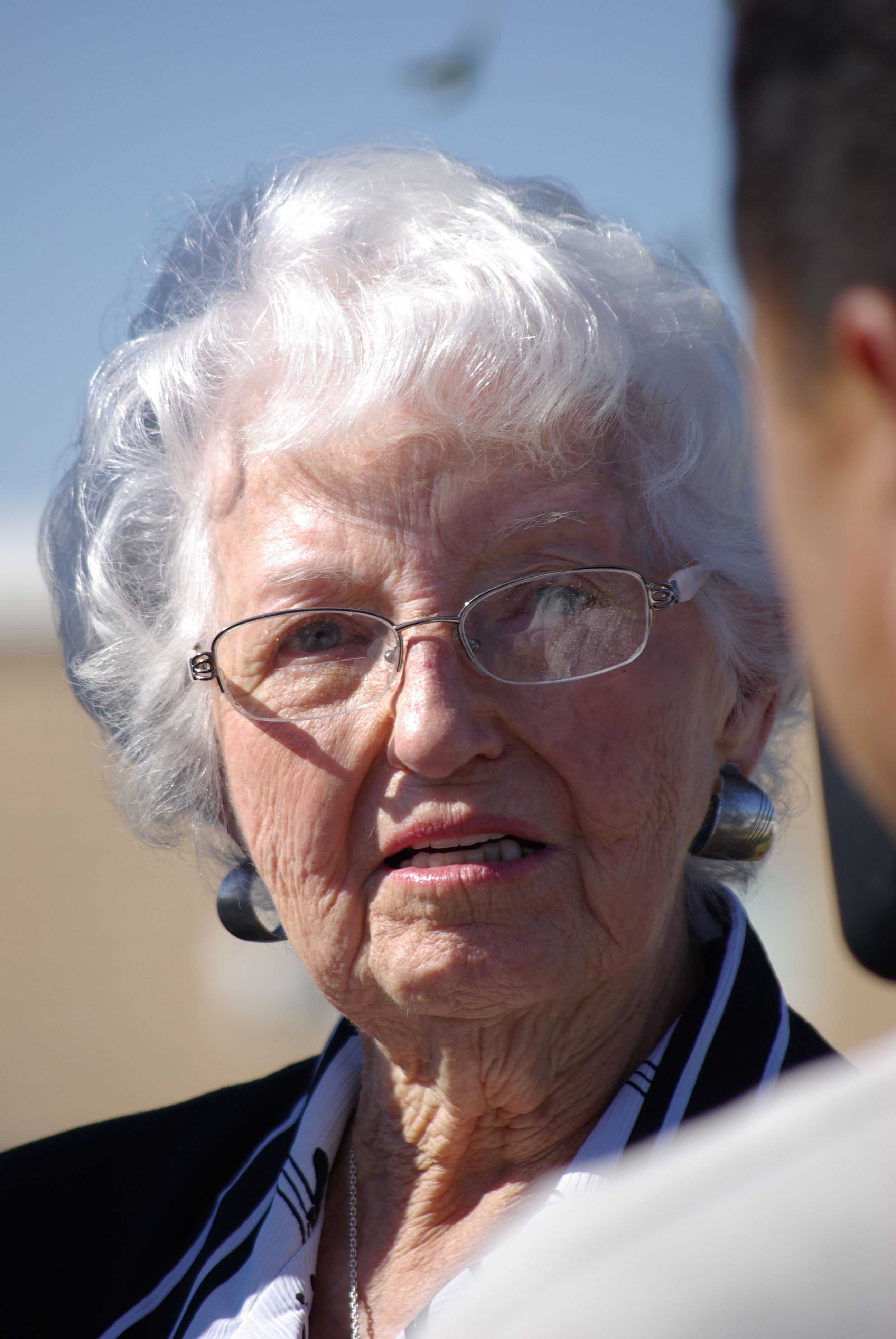
2012-11-20 Tippitt Memorial 013  Marie Tippit answers questions, dedication of marker to her late husband, J. D. Tippit - photo by Ed Darrell, use permitted with attribution

Marie Tippit, officer Tippit’s widow, answered questions from a reporter Tuesday at the dedication of the marker to her husband. Photos by Ed Darrell except where noted.

2013 is the 50th anniversary of the assassination of President John F. Kennedy, in Dallas.  Proponents wanted to get the tribute to Officer Tippit installed in time for the anniversary year.  Particularly with the aid of scholars at the 6th Floor Museum, tourists and historians have been retracing routes taken that day 50 years ago, the parade route of President Kennedy from Love Field, with the emergency reroute to Parkland, and the route Oswald is thought to have used to flee after the shooting, from the Texas School Book Depository, through the bus station, across the Trinity River to his boarding house in Oak Cliff, and from there to the Texas Theater where he was captured.

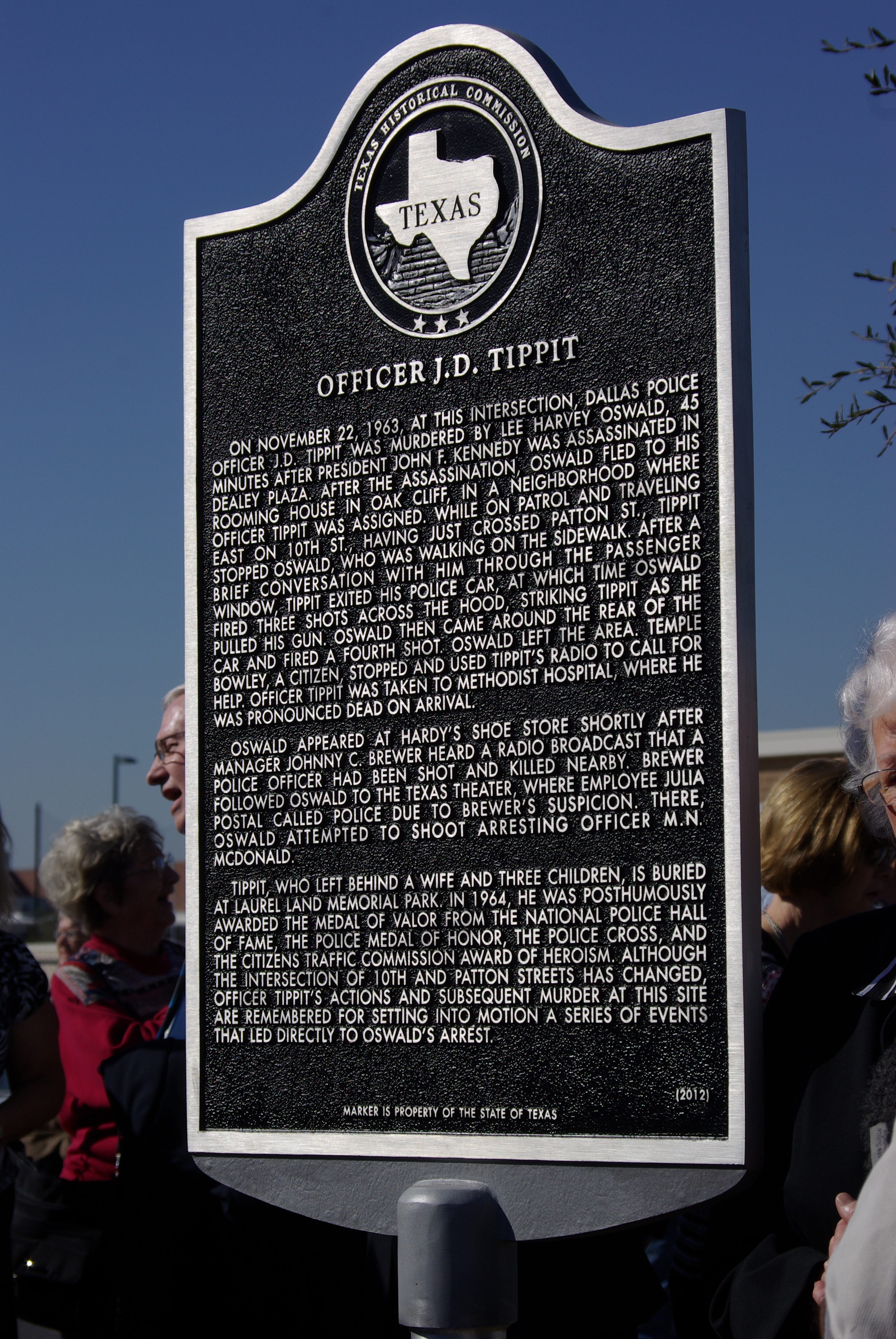
2012-11-20 Tippitt Memorial 017 plaque honoring J. D. Tippit, photo by Ed Darrell
Plaque from the Texas Historical Commission explaining the history of the spot in Oak Cliff where Officer Tippit confronted suspected assassin Lee Oswald.

Particular striking in this history is the role played by ordinary citizens — Officer Tippit on his rounds, witnesses in the surrounding homes and the people who used Tippit’s radio to notify Dallas Police of Tippit’s shooting (in an era before cell phones, and probably before most local phone lines even had Touch Tone™ dialing), the alert salesman at the now-defunct Hardy’s shoe store, and the ticket seller at the Texas Theater who phoned police after Oswald stiffed the theater on a ticket price.

2012-11-20 Home and Tippitt Memorial 036 Street sign at 10th and Patton, site of confrontation between Lee Oswald and Officer Tippit - photo by Ed Darrell

Even the street signs and stop signs have been updated at 10th and Patton, the site of the new historical marker.

Hardy’s Shoe Store was a Quinceanera dress shop in 2011 and may have gone through other incarnations since 1963.   Assassination histories note that students playing hooky from W. H. Adamson or Sunset High Schools were in the Texas Theater when Oswald was arrested, though most of them ran out to avoid being questioned by police and outed for having skipped school.  Adamson’s campus is greatly expanded recently.

But for the intervention of ordinary citizens along the path, it is entirely conceivable that the assassin of the president of the United States might have gone undetected long enough to dispose of evidence that linked him to the crime, or escaped from the country.

My students over the past five years, all residents of Oak Cliff, knew very little about the Kennedy assassination, nor especially the links to Oak Cliff.  We need to do a better job as parents, teachers, newspapers, broadcast organizations, community associations and municipal government, in preserving and commemorating our local histories.

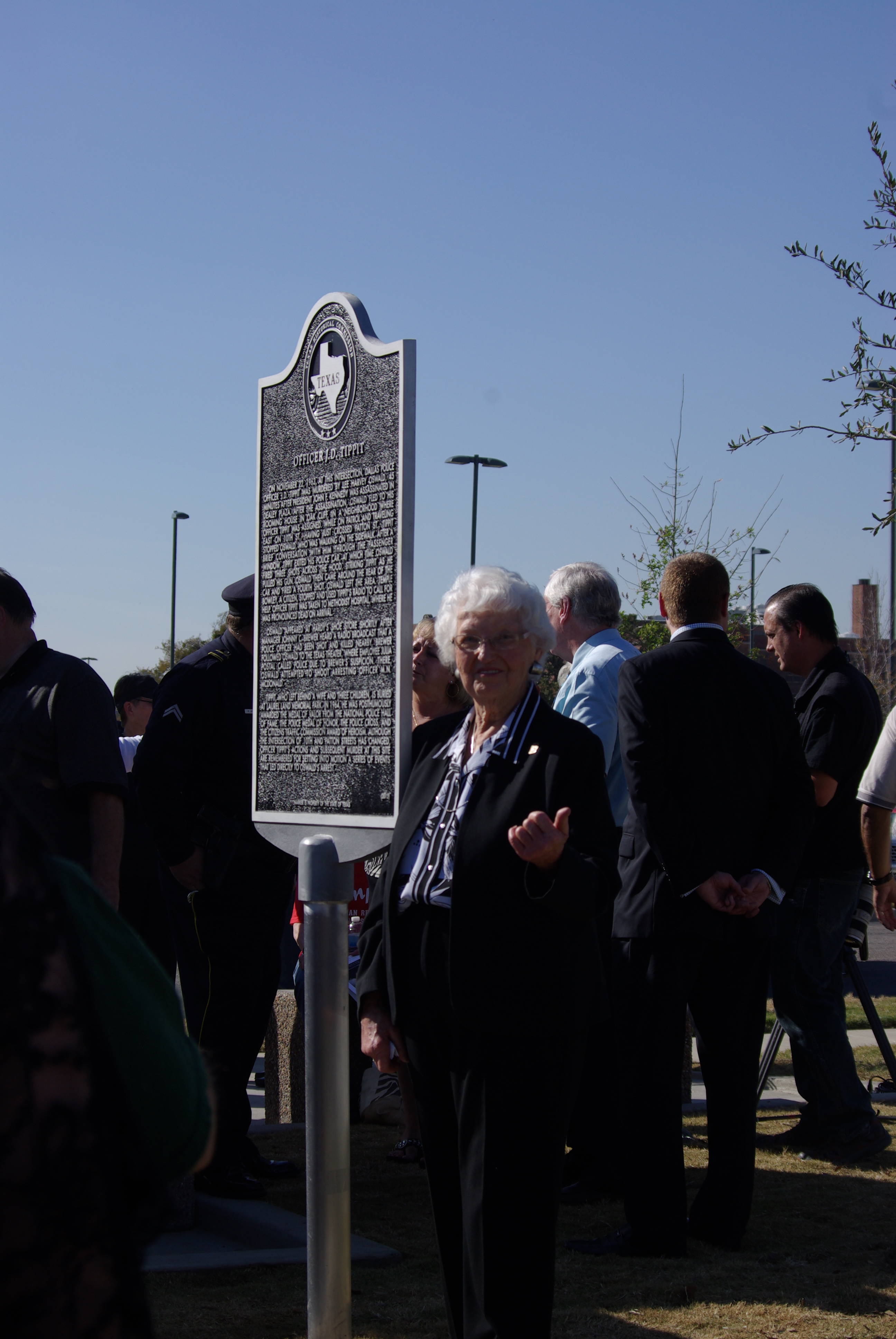
2012-11-20 Tippitt Memorial 019 Marie Tippit next to the memorial plaque to her husband, Officer J. D. Tippit

Marie Tippit standing next to the historical marker for her husband, J. D. Tippit, at the marker’s dedication, November 20, 2012.

2012-11-20 Tippitt Memorial 030 crowd devoid of dignitaries - Brad Watson at right

Other than the police chief and a couple of Dallas ISD board members, the crowd was pleasantly devoid of dignitaries; it’s a monument to a working man doing his job. WFAA Channel 8 reporter Brad Watson is the tallest man on the right; his reports several months ago spurred the action to carve out the memorial site from Dallas ISD-acquired land, greatly boosting the work to get a marker put up.

2012-11-20 Tippitt Memorial 037 Dallas Police cruiser 2012, at site of 1963 shooting - photo by Ed Darrell

History of technology: Compare this photograph of two Dallas police with the photo of Officer Tippit’s car earlier in this post. This squad car comes equipped with full-time dash-mounted cameras, instant radio and computer links; police also carry their own personal communication devices, such as the pink smartphone being used to photograph another officer. The car itself carries the phone number for emergency calls, and some carry the URL of the Dallas Police website. The traditional lights atop the car in Dallas have been updated to LEDs, which did not exist in 1963. How many other significant changes in technology can be found in these photos?

2012-11-20 Tippitt Memorial 039 10th St at Patton, Oak Cliff, Texas, at Tippit ceremony 11-20-2012 - photo by Ed Darrell

Dallas school district construction changed much of the neighborhood over the past five years; note the absence of trees shading the street that were present in 1963; they may have been elms struck down by blight decades ago.  Compare this photo with the first photo in this post, taken about 16 months earlier.

More:


Americans love George Washington’s nose

November 19, 2012

Looked at a lot of statues and busts in the past year.  One of the things that intrigues me is the way people interact with sculpture, particularly the ways and places people touch sculpture.

At Mount Vernon, Americans have a fondness for George Washington’s nose:

06-23-2012 TAH Mt Vernon 094 George's nose, Avard Fairbanks bust, photo copyright by Ed Darrell

Avard Fairbanks‘ very large bust of George Washington invites touching by visitors at the Mount Vernon Visitors Center; people touch his nose.  Photo by Ed Darrell; use allowed with attribution, some rights reserved.

Other copies of the bust exist around the country, by Utah sculptor Avard Fairbanks.  If I’m correct on the provenance, this one was placed at Salt Lake International Airport for the nation’s bicentennial, then was obtained by George Washington University (one of my alma maters, by the way), and was loaned by GWU to the Ladies of Mount Vernon. (No wonder the thing looked so familiar to me . . . it’s been following me around for years.  I wonder when it gets to Texas, or upstate New York.)

A bust of George Washington on the campus of G...

Bust of George Washington on the campus of George Washington University — same one? (Photo credit: Wikipedia)

Displayed at the main entrance to the visitors center at Mt. Vernon, the bust is at a level that people can touch it, and they do.

It’s fun to watch people who stop to look at the bust.  Almost inevitably they look a bit awed by it.  Then, if they take a minute, they look it up and down, and put out their hand to touch George’s nose.

Almost as if they consider George Washington a good luck charm, and a touch of his nose might rub some luck off onto them.  It’s rubbing the nose shiny, an interesting way Americans pay tribute to our first president.

More:

06-23-2012 TAH Mt Vernon 093 Avard Fairbanks bust, George Washington - photo by Ed Darrell, use with attribution encouraged

The bust is quite imposing; people who pause to study it, however, overcome their reticence, and reach out to touch the First President.


Quote of the moment: What John Adams DID NOT SAY about Congress

November 15, 2012

It’s a great line, an almost-Mark Twain-ism that makes people of all political strips smile.  It’s attributed to John Adams:

I have come to the conclusion that one useless man is called a disgrace; that two are called a law firm; and that three or more become a Congress!

There’s a problem: John Adams didn’t say it.

It’s a line from the 1969 Broadway musical comedy 1776!

The character John Adams in the play said it.

Playwright Peter Stone, Theatrical Rights image

Playwright Peter Stone wrote the witticism attributed to John Adams.  Theatrical Rights image

We should more accurately attribute it to the play’s book’s author, Peter Stone.

What John Adams did not say about Congress, Peter Stone wrote.  Such wit deserves proper attribution.

Mention of “law firms” gives away the origin’s being much later than Adams’s — Adams died, as you know, on July 4, 1826, the 50th anniversary of the Declaration of Independence.   “Law firms” is 20th century language.

A day after Fulbright & Jaworski LLC announced a merger with Norton Rose, one might almost wish that law firms would be just three people.  Norton Rose Fulbright starts out with 3,800 lawyers in 55 offices around the world.  [Conflict of interest note:  My spouse works at Fulbright & Jaworski.]  The distaste with lawyers in the Stone quote also doesn’t ring to the times of the American Revolution.  Good lawyer jokes probably existed then, but they didn’t really rise until the lawyerly pettifogging of the 19th century — see Dickens’ Mr. Bumble in Chapter 51 of Oliver Twistor the entire text of Bleak House, for examples.   Twain joked about Congress, but a joke about both Congress and lawyers probably was rare before 1910.  (I am willing to be disabused of this idea, if I am wrong . . . comments are open.)

Wikiquote’s rapid improvement provides us with a good check on whether Adams said it — Wikiquote points us clearly to Peter Stone instead.

Stone died in 2003, much underappreciated if you ask me.  Stone might be said to be among the greatest ghost speechwriters in history based on 1776! alone,  creating lines for John Adams, Ben Franklin and Thomas Jefferson — three of the greatest authors and (sometimes reluctant) speakers of their day, and of all history.  Stone’s plays include Titanic and Two by Two, his screenplays include Charade, Arabesque, Mirage, The Taking of Pelham 123, and Father Goose.

More:


One more time: No, Texas cannot secede; no, Texas can’t split itself (2012 edition)

November 13, 2012

Someone in Texas, I swear, sells do-it-yourself-at-home lobotomy kits.  Worse, about 50,000 Texans buy the kits every year, and give themselves a self-lobotomy.  Then, when something happens in national politics or something else that doesn’t please them, having put an ice pick through that part of the brain that carries reason and self-control, and scrambled it, they start spouting nonsense about “Texas ought to secede.”

Texas splits from union, trespasses on Mexico

If Texas seceded from the U.S., would it be trespassing on Mexico?

This issue heated up last just after President Barack Obama took office and stopped the national slide into recession; Texans got ticked off that Obama hadn’t let them slip down the bung hole, and the Tea Party was born to push and make sure no one stopped such a slide in the future.  Rick Perry, our peripatetic occasional governor and head coyote persecutor, threw gasoline on the fire.  I posted this explanation back then.

Comes the 2012 election, Democrats and other supporters of Obama rise up and re-elect him.  One of the previously mentioned fools found a feature President Obama’s team added to the White House website, whereby anyone can start a petition on a subject; Obama being the fair-minded man these fools claim he is not, Obama and his team said they’d answer any petition that got more than 25,000 signatures.  Several people started petitions asking for secession.

Think about that for a moment.  They’re appealing to President Obama to let them secede, because they don’t like Obama’s reelection.  Compounding the irony, they’re using a citizen-feedback system designed by Obama’s team.

But then the pro-secession, anti-Obama people threw all sense to the wind.  This process is almost outside official channels.  While Congress will accept petitions, there’s no guarantee that these petitions will go to Congress — only that the Obama White House will answer the petition in some form.

More than a few of the signers are convinced that if they hit the magic number of 25,000 signatures, the action becomes semi-official and will get real consideration.  Here’s news:  You might get a letter from President Obama.  Won’t that please them no end?

Gov. Perry already disowned the current round of zaniness.  It interferes with the zaniness in the run-up to the bi-annual Texas State Legislature meeting, for which “prefiling” of bills started this week.  Even and perhaps especially political zanies can handle only so much zaniness at one time — they’ve hit their zenith of zaniness for 2012.

But the bloggers and Facebookers still jump up and down.  Now, Dear Reader, you are a person of some intelligence:  You don’t think evolution is “from the pit of Hell,” you vaccinate your children and get an annual flu shot, you haven’t been abducted by alien spaceships recently, you worry that your home insurance will continue to climb until we act as a nation to stop air pollution that causes climate change, you understand Hawaii has been a state since 1960 and so a man born there after that, or at any time after annexation in 1898, is a U.S. citizen eligible to be U.S. president, and you don’t fear the UN is going to come take your golf course away (especially since golf-loving Barack Obama is our president); so I warn you, those yahoos who forgot entirely about the Civil War and think they might get a chance to secede from the U.S. and NASCAR just by putting their name on an internet petition, are not going to believe you, nor will they grant any credence to the facts outlined below, as to just why Texas cannot and will not secede.

But, here’s the explanation, anyway:

_________________________________________________________________________________________________

Rick Perry put his foot into something during one of the Astro-turf “tea parties” on April 15 [2009].  Someone asked him about whether Texas should secede from the United States, as a protest against high taxes, or something.

The answer to the question is “No, secession is not legal.  Did you sleep through all of your U.S. history courses?  Remember the Civil War?”

Alas, Perry didn’t say that.

Instead, Perry said it’s not in the offing this week, but ‘Washington had better watch out.’

He qualified his statement by saying the U.S. is a “great union,” but he said Texans are thinking about seceding, and he trotted out a hoary old Texas tale that Texas had reserved that right in the treaty that ceded Texas lands to the U.S. in the switch from being an independent republic after winning independence from Mexico, to statehood in the U.S.

So, rational people want to know:  Does Perry know what he’s talking about?

No, he doesn’t.  Bud Kennedy, columnist for the Fort Worth Star-Telegram (still one of America’s great newspapers despite the efforts of its corporate owners to whittle it down), noted the error and checked with Gov. Perry’s history instructors at Texas A&M and his old high school, both of which said that Perry didn’t get the tale from them.  (Score one for Texas history teachers; rethink the idea about letting people run for state office without having to pass the high school exit history exam.)

A&M professor Walter L. Buenger is a fifth-generation Texan and author of a textbook on Texas’ last secession attempt. (The federal occupation lasted eight years after the Civil War.)

“It was a mistake then, and it’s an even bigger mistake now,” Buenger said by phone from College Station, where he has taught almost since Perry was an Aggie yell leader.

“And you can put this in the paper: To even bring it up shows a profound lack of patriotism,” Buenger said.

The 1845 joint merger agreement with Congress didn’t give Texas an option clause. The idea of leaving “was settled long ago,” he said.

“This is simple rabble-rousing and political posturing,” he said. “That’s all it is.  . . .  Our governor is now identifying himself with the far-right lunatic fringe.”

Three false beliefs about Texas history keep bubbling up, and need to be debunked every time.  The first is that Texas had a right to secede; the second is that Texas can divide itself into five states; and the third is that the Texas flag gets special rights over all other state flags in the nation.

Under Abraham Lincoln’s view the Union is almost sacred, and once a state joins it, the union expands to welcome that state, but never can the state get out.  Lincoln’s view prevailed in the Civil War, and in re-admittance of the 11 Confederate states after the war.

The second idea also died with Texas’s readmission.  The original enabling act (not treaty) said Texas could be divided, but under the Constitution’s powers delegated to Congress on statehood, the admission of Texas probably vitiated that clause.  In any case, the readmission legislation left it out.  Texas will remain the Lone Star State, and not become a Five Star Federation. (We dealt with this issue in an earlier post you probably should click over to see.)

Texas’s flag also gets no special treatment.  I cannot count the number of times I’ve heard Texans explain to Boy Scouts that the Texas flag — and only the Texas flag — may fly at the same level as the U.S. flag on adjacent flag poles.  Under the flag code, any flag may fly at the same level; the requirement is that the U.S. flag be on its own right.

Gov. Perry is behind Sen. Kay Bailey Hutchison in polling of a head-to-head contest between the two to see who will be the Republican nominee for governor in 2010 — Hutchison is gunning to unseat Perry.  He was trying to throw some red meat to far-right conservative partisans who, he hopes, will stick by him in that primary election.

Alas, he came off throwing out half-baked ideas instead.  It’s going to be a long, nasty election campaign.  [Yeah, those two paragraphs are dated; they are here as historical footnote.]

_____________

Update [2009]: A commenter named Bill Brock (the Bill Brock?) found the New York Times article from 1921 detailing John Nance Garner’s proposal to split Texas into five.  Nice find!

Another update: How much fuss should be made over the occasional wild hare move for some state to secede?  Probably not much.  A few years ago Alaska actually got a referendum on the ballot to study secession.  The drive to secede got nowhere, of course.  I was tracking it at the time to see whether anyone cared.  To the best of my knowledge, the New York Times never mentioned the controversy in Alaska, and the Washington Post gave it barely three paragraphs at the bottom of an inside page.

Texas has a slightly grandiose view of itself. TM Daily Post image

Texas has a slightly grandiose view of itself. TM Daily Post image

More and Related Information: