How do we know? Who invented Santa Claus? Who really wrote “Account of a Visit from St. Nicholas?”

December 22, 2011

The annual retelling, a Christmas tradition; an encore post from 2007

Thomas Nast invented Santa Claus? Clement C. Moore didn’t write the famous poem that starts out, “‘Twas the night before Christmas, and all through the house . . . ?”

The murky waters of history from Millard Fillmore’s Bathtub soak even our most cherished ideas and traditions.

But isn’t that part of the fun of history?

Santa Claus delivers to Union soldiers, "Santa Claus in Camp" - Thomas Nast, Harper's Weekly, Jan 3, 1863

Thomas Nast’s first published drawing featuring Santa Claus; for Harper’s Weekly, “A Journal of Civilization,” January 3, 1863 Nast portrayed the elf distributing packages to Union troops: “Santa Claus in camp.” Nast (1840-1904) was 23 when he drew this image.

Yes, Virginia (and California, too)! Thomas Nast created the image of Santa Claus most of us in the U.S. know today. Perhaps even more significant than his campaign against the graft of Boss Tweed, Nast’s popularization of a fat, jolly elf who delivers good things to people for Christmas makes one of the great stories in commercial illustration. Nast’s cartoons, mostly for the popular news publication Harper’s Weekly, created many of the conventions of modern political cartooning and modeled the way in which an illustrator could campaign for good, with his campaign against the graft of Tammany Hall and Tweed. But Nast’s popular vision of Santa Claus can be said to be the foundation for the modern mercantile flurry around Christmas.

Nast is probably ensconced in a cartoonists’ hall of fame. Perhaps he should be in a business or sales hall of fame, too. [See also Bill Casselman’s page, “The Man Who Designed Santa Claus.]

Nast’s drawings probably drew some inspiration from the poem, “Account of a Visit from St. Nicholas,” traditionally attributed to Clement C. Moore, a New York City lawyer, published in 1822. The poem is among the earliest to describe the elf dressed in fur, and magically coming down a chimney to leave toys for children; the poem invented the reindeer-pulled sleigh.

Modern analysis suggests the poem was not the work of Moore, and many critics and historians now attribute it to Major Henry Livingston, Jr. (1748-1828) following sleuthing by Vassar College Prof. Don Foster in 2000. Fortunately for us, we do not need to be partisans in such a query to enjoy the poem (a complete copy of which is below the fold).

The Library of Congress still gives Moore the credit. When disputes arise over who wrote about the night before Christmas, is it any wonder more controversial topics produce bigger and louder disputes among historians?

Moore was not known for being a poet. The popular story is that he wrote it on the spur of the moment:

Moore is thought to have composed the tale, now popularly known as “The Night Before Christmas,” on December 24, 1822, while traveling home from Greenwich Village, where he had bought a turkey for his family’s Christmas dinner.

Inspired by the plump, bearded Dutchman who took him by sleigh on his errand through the snow-covered streets of New York City, Moore penned A Visit from St. Nicholas for the amusement of his six children, with whom he shared the poem that evening. His vision of St. Nicholas draws upon Dutch-American and Norwegian traditions of a magical, gift-giving figure who appears at Christmas time, as well as the German legend of a visitor who enters homes through chimneys.

Again from the Library of Congress, we get information that suggests that Moore was a minor celebrity from a well-known family with historical ties that would make a good “connections” exercise in a high school history class, perhaps (”the link from Aaron Burr’s treason to Santa Claus?”): (read more, below the fold)

Clement Moore was born in 1779 into a prominent New York family. His father, Benjamin Moore, president of Columbia University, in his role as Episcopal Bishop of New York participated in the inauguration of George Washington as the nation’s first president. The elder Moore also administered last rites to Alexander Hamilton after he was mortally wounded in a tragic duel with Aaron Burr.

A graduate of Columbia, Clement Moore was a scholar of Hebrew and a professor of Oriental and Greek literature at the General Theological Seminary in Manhattan. [See comment from Pam Bumsted below for more on Moore.] He is said to have been embarrassed by the light-hearted verse, which was made public without his knowledge in December 1823. Moore did not publish it under his name until 1844.

Tonight, American children will be tucked in under their blankets and quilts and read this beloved poem as a last “sugarplum” before slipping into dreamland. Before they drift off, treat them to a message from Santa, recorded by the Thomas Edison Company in 1922.

Santa Claus Hides in Your Phonograph
By Arthur A. Penn, Performed by Harry E. Humphrey.
Edison, 1922.
Coupling date: 6/20/1922. Cutout date: 10/31/1929.
Inventing Entertainment: The Motion Pictures and Sound Recordings of the Edison Companies

Listen to this recording (RealAudio Format)

Listen to this recording (wav Format, 8,471 Kb)

But Henry Livingston was no less noble or historic. He hailed from the Livingtons of the Hudson Valley (one of whose farms is now occupied by Camp Rising Sun of the Louis August Jonas Foundation, a place where I spent four amazing summers teaching swimming and lifesaving). Livingston’s biography at the University of Toronto site offers another path for a connections exercise (”What connects the Declaration of Independence, the American invasion of Canada, the famous poem about a visit from St. Nick, and George W. Bush?”):

Henry Livingston Jr. was born in Poughkeepsie, New York, on Oct. 13, 1748. The Livingston family was one of the important colonial and revolutionary families of New York. The Poughkeepsie branch, descended from Gilbert, the youngest son of Robert Livingston, 1st Lord of Livingston Manor, was not as well off as the more well-known branches, descended from sons Robert and Philip. Two other descendants of Gilbert Livingston, President George Walker Herbert Bush and his son, President-Elect George W. Bush, though, have done their share to bring attention to this line. Henry’s brother, Rev. John Henry Livingston, entered Yale at the age of 12, and was able to unite the Dutch and American branches of the Dutch Reformed Church. At the time of his death, Rev. Livingston was president of Rutgers University. Henry’s father and brother Gilbert were involved in New York politics, and Henry’s granduncle was New York’s first Lt. Governor. But the law was the natural home for many of Henry’s family. His brother-in-law, Judge Jonas Platt, was an unsuccessful candidate for governor, as was his daughter Elizabeth’s husband, U.S. Supreme Court Justice Smith Thompson. Henry’s grandson, Sidney Breese, was Chief Justice of the Illinois Supreme Court.

Known for his encyclopedic knowledge and his love of literature, Henry Livingston was a farmer, surveyor and Justice of the Peace, a judicial position dealing with financially limited criminal and civil cases. One of the first New Yorkers to enlist in the Revolutionary Army in 1775, Major Henry Livingston accompanied his cousin’s husband, General Montgomery, in his campaign up the Hudson River to invade Canada, leaving behind his new wife, Sarah Welles, and their week-old baby, on his Poughkeepsie property, Locust Grove. Baby Catherine was the subject of the first poem currently known by Major Livingston. Following this campaign, Livingston was involved in the War as a Commissioner of Sequestration, appropriating lands owned by British loyalists and selling them for the revolutionary cause. It was in the period following Sarah’s early death in 1783, that Major Livingston published most of his poems and prose, anonymously or under the pseudonym of R. Ten years after the death of Sarah, Henry married Jane Patterson, the daughter of a Dutchess County politician and sister of his next-door neighbor. Between both wives, Henry fathered twelve children. He published his good-natured, often occasional verse from 1787 in many journals, including Political Barometer, Poughkeepsie Journal, and New-York Magazine. His most famous poem, “Account of a Visit from St. Nicholas,” was until 2000 thought to have been the work of Clement Clarke Moore (1779-1863), who published it with his collected poems in 1844. Livingston died Feb. 29, 1828.

More on Henry Livingston and his authorship of the Christmas poem here.
Thomas Nast, Merry Old Santa Claus, Harper's Weekly, Jan 1, 1881

Our views of Santa Claus owe a great deal also to the Coca-Cola advertising campaign. Coca-Cola first noted Santa’s use of the drink in a 1922 campaign to suggest Coke was a year-round drink (100 years after the publication of Livingston’s poem). The company’s on-line archives gives details:

In 1930, artist Fred Mizen painted a department store Santa in a crowd drinking a bottle of Coke. The ad featured the world’s largest soda fountain, which was located in the department store of Famous Barr Co. in St. Louis, Mo. Mizen’s painting was used in print ads that Christmas season, appearing in The Saturday Evening Post in December 1930.

1936 Coca-Cola Santa cardboard store display

1936 Coca-Cola Santa cardboard store display

  • 1936 Coca-Cola Santa cardboard store display
1942 original oil painting - 'They Remembered Me'

1942 original oil painting - ‘They Remembered Me’

Archie Lee, the D’Arcy Advertising Agency executive working with The Coca-Cola Company, wanted the next campaign to show a wholesome Santa as both realistic and symbolic. In 1931, The Coca-Cola Company commissioned Michigan-born illustrator Haddon Sundblom to develop advertising images using Santa Claus — showing Santa himself, not a man dressed as Santa, as Mizen’s work had portrayed him.

  • 1942 original oil painting – ‘They Remembered Me’

For inspiration, Sundblom turned to Clement Clark Moore’s 1822 poem “A Visit From St. Nicholas” (commonly called “‘Twas the Night Before Christmas”). Moore’s description of St. Nick led to an image of Santa that was warm, friendly, pleasantly plump and human. For the next 33 years, Sundblom painted portraits of Santa that helped to create the modern image of Santa — an interpretation that today lives on in the minds of people of all ages, all over the world.

Santa Claus is a controversial figure. Debates still rage among parents about the wisdom of allowing the elf into the family’s home, and under what conditions. Theologians worry that the celebration of Christmas is diluted by the imagery. Other faiths worry that the secular, cultural impact of Santa Claus damages their own faiths (few other faiths have such a popular figure, and even atheists generally give gifts and participate in Christmas rituals such as putting up a decorated tree).

For over 100 years, Santa Claus has been a popular part of commercial, cultural and religious life in America. Has any other icon endured so long, or so well?

________________________
Below:
From the University of Toronto Library’s Representative Poetry Online

Major Henry Livingston, Jr. (1748-1828)

Account of a Visit from St. Nicholas

1 ‘Twas the night before Christmas, when all thro’ the house,
2 Not a creature was stirring, not even a mouse;
3 The stockings were hung by the chimney with care,
4 In hopes that St. Nicholas soon would be there;
5 The children were nestled all snug in their beds,
6 While visions of sugar plums danc’d in their heads,
7 And Mama in her ‘kerchief, and I in my cap,
8 Had just settled our brains for a long winter’s nap –
9 When out on the lawn there arose such a clatter,
10 I sprang from the bed to see what was the matter.
11 Away to the window I flew like a flash,
12 Tore open the shutters, and threw up the sash.
13 The moon on the breast of the new fallen snow,
14 Gave the lustre of mid-day to objects below;
15 When, what to my wondering eyes should appear,
16 But a miniature sleigh, and eight tiny rein-deer,
17 With a little old driver, so lively and quick,
18 I knew in a moment it must be St. Nick.
19 More rapid than eagles his coursers they came,
20 And he whistled, and shouted, and call’d them by name:
21 “Now! Dasher, now! Dancer, now! Prancer, and Vixen,
22 “On! Comet, on! Cupid, on! Dunder and Blixem;
23 “To the top of the porch! to the top of the wall!
24 “Now dash away! dash away! dash away all!”
25 As dry leaves before the wild hurricane fly,
26 When they meet with an obstacle, mount to the sky;
27 So up to the house-top the coursers they flew,
28 With the sleigh full of Toys — and St. Nicholas too:
29 And then in a twinkling, I heard on the roof
30 The prancing and pawing of each little hoof.
31 As I drew in my head, and was turning around,
32 Down the chimney St. Nicholas came with a bound:
33 He was dress’d all in fur, from his head to his foot,
34 And his clothes were all tarnish’d with ashes and soot;
35 A bundle of toys was flung on his back,
36 And he look’d like a peddler just opening his pack:
37 His eyes — how they twinkled! his dimples how merry,
38 His cheeks were like roses, his nose like a cherry;
39 His droll little mouth was drawn up like a bow.
40 And the beard of his chin was as white as the snow;
41 The stump of a pipe he held tight in his teeth,
42 And the smoke it encircled his head like a wreath.
43 He had a broad face, and a little round belly
44 That shook when he laugh’d, like a bowl full of jelly:
45 He was chubby and plump, a right jolly old elf,
46 And I laugh’d when I saw him in spite of myself;
47 A wink of his eye and a twist of his head
48 Soon gave me to know I had nothing to dread.
49 He spoke not a word, but went straight to his work,
50 And fill’d all the stockings; then turn’d with a jerk,
51 And laying his finger aside of his nose
52 And giving a nod, up the chimney he rose.
53 He sprung to his sleigh, to his team gave a whistle,
54 And away they all flew, like the down of a thistle:
55 But I heard him exclaim, ere he drove out of sight –
56 Happy Christmas to all, and to all a good night.

Online text copyright © 2005, Ian Lancashire for the Department of English, University of Toronto. Published by the Web Development Group, Information Technology Services, University of Toronto Libraries. Be sure to visit this site for more information on this poem, on Maj. Livingston, and on poetry in general.

Nota bene: By no means should readers assume that I’m saying the authorship of “A Visit from St. Nicholas” is settled. There remains much controversy, and many people convinced that Moore was, indeed, the author. See this comment from an earlier posting, for example.


More misunderstanding of the case against DDT

December 21, 2011

Well-meaning but misinformed dog breeder Terrierman (a guy who goes by the handle PBurns, too)  is just the latest to fall victim to false and nearly false claims about DDT and its effects on birds.

One of the claims made by pro-DDT and anti-environmental protection, anti-science groups is that DDT is not the bad guy in bird deaths.  The late DDT-nut Gordon Edwards said DDT had nothing to do with eagle deaths, and pointed to the 300-year decline in eagle populations from the time European settlers began shooting at them.  This idea has been touted by the chief junk science purveyor, Steven Milloy, and by many others over the years.

So, in one of his several posts slamming eagle conservation efforts that include stopping the use of DDT, Terrierman said:

What’s the story? Simple: that Bald Eagles and Osprey were pushed to the edge of extinction by DDT.

Not True.

Actually, that is true.  Terrierman got it wrong.  DDT was, indeed, threatening the very existence of the bald eagle.  While it is true that there were other pressures, some long-standing, it is also true that once those problems were cleared, DDT still barred the recovery of the eagle, plus other species like osprey, peregrine falcons, and brown pelicans.

What is the story?  The story is that eagles have been under assault since Europeans found America.  By 1900, eagle populations across North America were dramatically and drastically reduced.  A federal law in 1918 made it illegal to shoot eagles, but it had little effect.  A tougher law passed in 1940 finally got some traction.

But eagle recovery didn’t take off.  In the late 1940s and early 1950s bird watchers, and bird counters like those volunteers who contribute to the annual Audubon Christmas Bird Count, noticed that young eagles disappeared.  Simply, adult, breeding eagles were not able to produce young who survived to migrate, mature, and breed later.

The culprit was DDT.  DDT kills young eagles in three ways, known in the 1960s.  It poisons them so they cannot grow in the egg.  It poisons them so they die after a period of growth.  It poisons them so they are unable to eat and digest properly, so they die shortly after they hatch.

DDT can also screw up the sexual organs of young birds, so they are unable to breed — perhaps a fourth way DDT kills young, by simply preventing their creation.

Then, in the 1970s, we found another way DDT kills species:  DDT makes the eagle hens unable to form competent eggshells.  The young die because the eggs cannot survive incubation.

DDT also kills adult eagles, especially migrating birds.  DDT accumulates in fat tissues, those fats that migrating birds burn.  When the birds migrate, the DDT comes out, and it can literally stop the heart or brain of the bird in flight.  (It kills bats the same way.)  Birds lost in migration rarely get found for necropsy.   The bird count simply falls, the population sinks one individual closer to extinction.

Does the dog breeder know all of this?  I can’t tell — I tried to correct his errors at his blog site, but after I provided a link to an article that showed DDT appears to be harming California condors as well — in a post he has censored in moderation and which will never see the light of day at Terrierman, I predict — it’s clear he’s not up to gentle correction.

One more blog from which I am banned from telling the facts.

PBurns, if you’re bold enough to comment here, your comments won’t be censored (so long as not profane).  We need robust discussion, and I encourage it.

Below the fold — my final post to Terrierman, which he won’t allow through moderation.

Read the rest of this entry »


SkepticGate II: Fizzled assault on science

December 19, 2011

Skepticgate cartoon from the Houston Chronicle, 2009

This Anderson cartoon from the Houston Chronicle in 2009 gets the facts right, but sadly, is still accurate

Remember the pathetic, disgusting attempt to derail the climate talks in Durban, just a few days ago?  The “climate skeptics”™ dumped a bunch more private e-mails from the scientists who work on climate. (Stolen e-mails, here; be prepared to be bored, with no smoking guns, no cold guns, no guns at all.)

Unless one thinks the self-proclaimed skeptics are James Bond nemesis enough to actually hope for the end of the world (as opposed to just being monumentally, stupidly misled), their train still can’t get back on the tracks.  Revealing that someone among them has stolen more e-mails than previously known, didn’t help.  Here is a list of just how bad the derailment has been for the denialists:

  1. No great world-changing agreement, but the climate talks in Durban, South Africa, produced a consensus that a massive treaty is not coming soon, and that action to save the planet can’t wait for guys in suits who defer by people like Ralph Hall to do the right thing.  Generally, the comity at Durban is bad for the denialists — Christopher Monckton went into full panic mode, suggesting the language of the agreement available isn’t the whole story and something else — something sinister — is really going on.  (One wonders how Monckton can stand to turn out the lights at night.)  They can’t tell the difference between their burro and a burrow, and with Ralph Hall leading them they’re likely to find the edge of the cliff and leave it before they realize just how far up they are and how far they have to fall.  (Skeptic/denialist Judith Curry carried a rundown of headlines from Durban, with links — remember her bias.)
  2. British authorities raided the digs of a skeptic blogger, seizing his computer upon which he got the first round of stolen e-mails.  It’s unlikely the raidee is guilty of much beyond making the stolen stuff public (is that a crime in Britain?), but one hopes Britain’s crime fighters have access to cyber trackers who may be able to learn more from the signatures on the posts.  Searches have been noticed for other bloggers, including Jeff Id at the Air Vent, but warrants and actual searches haven’t taken place yet.
  3. One paper in climate science was officially retracted — alas for the denialists, it was one of theirs.  Plagiarism and rank error in the so-called Wegman Report to a committee of the U.S. House of Representatives prompted the call-back.  John Mashey’s gumshoe work in the libraries of academe lent a new shine to the word “scholarship.”  Republicans have yet to admit the paper’s errors.  (
  4. Texas Congressman Ralph Hall granted a rare interview, and spoke out about climate change.  He revealed that he doesn’t know much about one of the hottest issues facing the committee he chairs, and what little he knows, is wrong.  Cue the Kin Hubbard/Mick Jagger duet.
  5. Skeptics actually completed a research project and prepared it for publication.  A group at Berkeley, with funding from conservative warming denialists like the Koch brothers, and featuring the work and cooperation of leading anti-science people like Anthony Watts, took on the challenge of looking at temperatures reported from weather stations, especially in the U.S., and especially those Anthony Watts had targeted as providing unduly warm and inaccurate readings that skewed all of the science of global warming.  The not-loudly-mentioned target, of course, was the “hockey stick” graph.  Alas for the skeptics, the Berkeley Earth Surface Temperature (BEST) study produced results that verify the accuracy of measurements that show warming, and which suggest the IPCC-published hockey stick is accurate enough that it deserves credence.  Anthony Watts promptly disavowed all his own work on the project.
  6. Meanwhile, warming continued unabated by almost every measure.  Galileo could say:  Eppure, lei si scalda!

One question we need to be asking is why the incidents around the stolen e-mails are known as “Climategate” in the circles of warming denialists.  The thieves in this case came from the ranks of the so-called skeptics, and the release of the e-mails was done on the blogs of those who deny warming, or human causation, or human ability to mitigate at all.  (Fox News got it bass ackwards, of course — wondering whether the government is somehow complicit in hiding information, while all the information is public and almost all of the private communication is public.  At Fox, they don’t even get Homer Simpson doh! moments of understanding — that’s how bad it is in Denialville.)

Not climategate, but skepticgate -- follow the money cartoon

So far no one’s listening to the bear on this one — follow the money, and bring the criminals to justice.

It’s really SkepticGate, with a more-than two-year coverup and continuing, and the recent release is SkepticGate II.

Denialists, and even those who question global warming on legitimate grounds, must be frustrated.  Nothing they do stops the world from warming.  As the massive wave of evidence demonstrating the Earth warms and humans share the blame turns to a tsunami, even policy makers (Ralph Hall excepted) look for solutions to warming problems.  It’s so bad for the skeptics that even the old trick of stealing e-mails from the scientists, the trick that helped fog up the Copenhagen proceedings, did almost nothing to the Durban talks.  While no treaty came out, none was expected — but the sudden action in the last couple of days of the conference to get action despite the continued interference by climate skeptics  and their political allies, must have caught them off guard.

Now the cops are after them, too.

Happy Hanukkah, Merry Christmas, Cool KWAANZA, Ebullient Edwin Hubble Looking Up Day, Happy New Year!


Encore quote of the moment: Robert Kennedy on what really matters

December 18, 2011

This is borrowed from Harry Clarke (with a few minor corrections in the text):

Robert F. Kennedy speech at the University of Kansas, Lawrence, March 18, 1968

Robert F. Kennedy speech at the University of Kansas, Lawrence, March 18, 1968 - Photo by George Silk, Time-Life Pictures/Getty Images

RFK said this in 1968. In a speech I heard today it was quoted and it stirred me.

Too much and for too long, we seem to have surrendered personal excellence and community value in the mere accumulation of material things. Our Gross National Product, now, is over eight hundred billion dollars a year, but that GNP — if we judge the United States of America by that — that GNP counts air pollution and cigarette advertising and ambulances to clear our highways of carnage. It counts special locks for our doors and the jails for the people who break them. It counts the destruction of the redwoods and the loss of our natural wonder in chaotic sprawl. It counts napalm and it counts nuclear warheads, and armored cars for the police to fight the riots in our cities. It counts Whitman’s rifle and Speck’s knife, and the television programs which glorify violence in order to sell toys to our children.

Yet the Gross National Product does not allow for the health of our children, the quality of their education, or the joy of their play. It does not include the beauty of our poetry or the strength of our marriages, the intelligence of our public debate or the integrity of our public officials. It measures neither our wit nor our courage, neither our wisdom nor our learning, neither our compassion nor our devotion to our country; it measures everything, in short, except that which makes life worthwhile. And it can tell us everything about America except why we are proud that we are Americans.

Kennedy delivered these words in an address at the University of Kansas, Lawrence, Kansas, on March 18, 1968.

Here’s a video production from the Glaser Progress Foundation which includes an audio recording of the speech:

More resources:

Most of this post appeared originally here in 2009.  We need the reminder.


Obama’s right: Saving the nation is not “class warfare”

December 17, 2011

Ross Eisenbrey laid it out at the blog of the Economics Policy Institute:

The most important part of [President Obama’s] speech in Kansas was probably his attack on the “collective amnesia” that allows some people to continue advocating the Bush administration’s tax cuts for the rich, despite their clear history of failure as a spur to job creation. Obama said:

“Remember in those years, in 2001 and 2003, Congress passed two of the most expensive tax cuts for the wealthy in history. And what did it get us? The slowest job growth in half a century. Massive deficits that have made it much harder to pay for the investments that built this country and provided the basic security that helped millions of Americans reach and stay in the middle class — things like education and infrastructure, science and technology, Medicare and Social Security.”

The president pointed out the folly of pursuing the same kinds of failed “you’re on your own” economic policies that got us into the worst recession in 75 years. Weak regulation helped cause the Great Recession. Why would anyone expect the same policies to get us out?

“Remember that in those same years, thanks to some of the same folks who are now running Congress, we had weak regulation, we had little oversight, and what did it get us? Insurance companies that jacked up people’s premiums with impunity and denied care to patients who were sick, mortgage lenders that tricked families into buying homes they couldn’t afford, a financial sector where irresponsibility and lack of basic oversight nearly destroyed our entire economy.

We simply cannot return to this brand of ‘you’re on your own’ economics if we’re serious about rebuilding the middle class in this country.”

Unsurprisingly, the right wing media, led by Fox News, wants to take us right back to the kind of Bushonomics that crashed the economy in 2007. Progressive taxation doesn’t sit well with Fox’s high-income anchors, let alone its billionaire owner, Rupert Murdoch. As our friends at Media Matters document nicely, Fox immediately launched a broadside against the president and the notion of tax fairness, misquoting him when it was convenient, and accusing him of class warfare and socialism.

One might almost lament that Obama lacks opposition in the primaries; debates featuring Republicans drive sane thought off of the news pages.  None of the Republican candidates appears to subscribe to the free enterprise economics of Milton Friedman and/or Paul Samuelson, for example.  The radical right wing, experimental economics bandied about in the debates stands perpendicular to free market economics as practiced successfully in the U.S. and other places over the past 40 years — but with every Republican candidate so far out on the radical economic scale, it might appear to a non-careful reader that they speak Mainstream.

Wholly apart from the disastrous economics of “off-budget” warfare given to us by Republicans, the policies of Republicans gave us an economic disaster in 2008.  As a nation we have not moved far enough to correct those errors, and now Republicans block the action of the consumer protection agency designed to prevent another housing bubble to burst America’s economic dreams.

Polls show Americans don’t think Obama deserves a second term.  I find it hard to believe that a majority of voters will choose to go back to the disaster that Obama hasn’t been able to fix, however.  Americans are not quite that stupid, I hope.


Schneider on global warming, Parts 1, 3 and 4

December 12, 2011

Earlier I posted a video of Stanford’s late Dr. Stephen Schneider in a meeting with Australian climate “skeptics.”  It was one of a four-part series, Part 2, to be precise.

Here are the other parts.  They are excerpted from an Australian television program, “Insight,” taped in June 2010.

Part 1:

Links promised in the video above can be found below the fold.
764

Part 2 is here, in a previous post.

Part 3:

742

Part 4:

479

Read the rest of this entry »


Stephen Schneider explains global warming so even a “skeptic” can get it

December 12, 2011

Impressive.  Schneider explains, to Australian “skeptics,” how CO2 accumulates in the atmosphere, why that’s bad, what the urban heat island effect is and why it does not negate temperature measures that show global warming.  He savages the argument about CO2’s “logarithmic” absorption characteristics negating scientists’ findings.

Sadly, Dr. Schneider died a few weeks after this was taped in 2010.

This is, I see, part 2 of a 4 part series.  Hmmm.  WhHere are the other parts?.


Annals of Global Warming: It didn’t start with the hockey stick . . .

December 12, 2011

Peter Sinclair comes through with a good explanation of the history of concern about global warming — how the warming trend was discovered.

It wasn’t scientists trying to get government grants.  It was the U.S. Air Force, trying to beat the commies and keep America safe for democracy and, ironically, safe for dissent from such applications of science.


9,996

Real history couldn’t be published as fiction, which is one way we can tell real history from the stuff that gets made up.  In the story told in this video, note carefully the serendipity of figuring out the CO2 issues:  Who could invent a story about warfare leading to the discovery of global warming?  As with the coincidence of John Adams and Thomas Jefferson both dying on the 50th anniversary of the Declaration of Independence, no editor of fiction would accept it as believable.

More:

Why we worry, why policy makers are involved:  Carbon Emissions, 2000 – from WorldMapper, with a serendipitous tip of the old scrub brush to Petra Tschakert at Penn State.

Carbon emissions 2000, from worldmapper.org - creative commons license

Carbon Emissions 2000, from worldmapper.org - creative commons license

Carbon Emissions 2000 © Copyright 2006 SASI Group (University of Sheffield) and Mark Newman (University of Michigan). “We welcome use of our maps under the Creative Commons conditions by educational, charitable and other non-profit organisations.”

Japan and U.S. team up on new topographic map of the world

December 9, 2011

This will strike a note of joy in the heart of every Boy Scout and every orienteer in the world:  The U.S. and Japan have teamed up for new, super-accurate topographic maps.

Here’s the NASA press release:

RELEASE : 11-351

NASA, Japan Release Improved Topographic Map Of Earth

WASHINGTON — NASA and Japan released a significantly improved version of the most complete digital topographic map of Earth on Monday, produced with detailed measurements from NASA’s Terra spacecraft.

The map, known as a global digital elevation model, was created from images collected by the Japanese Advanced Spaceborne Thermal Emission and Reflection Radiometer, or ASTER, instrument aboard Terra. So-called stereo-pair images are produced by merging two slightly offset two-dimensional images to create the three-dimensional effect of depth. The first version of the map was released by NASA and Japan’s Ministry of Economy, Trade and Industry (METI) in June 2009.

“The ASTER global digital elevation model was already the most complete, consistent global topographic map in the world,” said Woody Turner, ASTER program scientist at NASA Headquarters in Washington. “With these enhancements, its resolution is in many respects comparable to the U.S. data from NASA’s Shuttle Radar Topography Mission (SRTM), while covering more of the globe.”

The improved version of the map adds 260,000 additional stereo-pair images to improve coverage. It features improved spatial resolution, increased horizontal and vertical accuracy, more realistic coverage over water bodies and the ability to identify lakes as small as 0.6 miles (1 kilometer) in diameter. The map is available online to users everywhere at no cost.

“This updated version of the ASTER global digital elevation model provides civilian users with the highest-resolution global topography data available,” said Mike Abrams, ASTER science team leader at NASA’s Jet Propulsion Laboratory in Pasadena, Calif. “These data can be used for a broad range of applications, from planning highways and protecting lands with cultural or environmental significance, to searching for natural resources.”

The ASTER data cover 99 percent of Earth’s landmass and span from 83 degrees north latitude to 83 degrees south. Each elevation measurement point in the data is 98 feet (30 meters) apart.

NASA and METI are jointly contributing the data for the ASTER topographic map to the Group on Earth Observations, an international partnership headquartered at the World Meteorological Organization in Geneva, Switzerland, for use in its Global Earth Observation System of Systems. This “system of systems” is a collaborative, international effort to share and integrate Earth observation data from many different instruments and systems to help monitor and forecast global environmental changes.

ASTER is one of five instruments launched on Terra in 1999. ASTER acquires images from visible to thermal infrared wavelengths, with spatial resolutions ranging from about 50 to 300 feet (15 to 90 meters). A joint science team from the United States and Japan validates and calibrates the instrument and data products. The U.S. science team is located at JPL.

NASA, METI, Japan’s Earth Remote Sensing Data Analysis Center (ERSDAC), and the U.S. Geological Survey validated the data, with support from the U.S. National Geospatial-Intelligence Agency and other collaborators. The data are distributed by NASA’s Land Processes Distributed Active Archive Center at the U.S. Geological Survey’s Earth Resources Observation and Science Center in Sioux Falls, S.D., and by ERSDAC in Tokyo.

Users of the new version of the ASTER data products are advised that while improved, the data still contain anomalies and artifacts that will affect its usefulness for certain applications.

Data users can download the ASTER global digital elevation model at:

https://lpdaac.usgs.gov/or

http://www.ersdac.or.jp/GDEM/E/4.html

For more information about NASA’s Terra mission, visit:

http://www.nasa.gov/terra

– end –

New topographical map of Earth from Ministry of Economy, Trade, and Industry (METI) of Japan and the United States National Aeronautics and Space Administration (NASA)

New topographical map of Earth released October 17, 2011, from the Ministry of Economy, Trade, and Industry (METI) of Japan and the United States National Aeronautics and Space Administration (NASA)

Save


Bill of Rights Day, Thursday, December 15, 2011

December 8, 2011

I get e-mail from friends — especially for you, teachers:

Hi Ed,

As you get ready for the holidays, I wanted to send you a few reminders to wrap up the semester.

First – Bill of Rights day in next Thursday, December 15th! Be sure to check out the variety of fun and engaging activities to help you celebrate on our website! Resources include our new SMART Board activity, Fight For Ur Rights; a classroom pledge to read the Bill of Rights; rank your rights activity; free classroom lessons; trivia questions; and a quiz about the Constitution and Bill of Rights; and more!

Second – Registration for our spring one-day seminars is underway! Locations include Albuquerque, Phoenix, Newark, New York, Boston, and more; visit our website for a complete schedule with our dates and locations this spring, and to register.  Space is limited so register today!

Third – Did you know we have stocking stuffers? Give the gift of knowledge in stocking-sized Pocket Constitutions, Bill of Rights Wallet Cards, and our newest resource, America: The Quiz Game. Hurry! Order by December 16th to receive by Christmas.

Fourth – Remember all Being an American Essay Contest submissions are due on December 15th!

Happy Holidays,

Jason

Jason Ross, Ph.D.
Vice President of Education Programs
Bill of Rights Institute


Religious freedom for students in public schools — what is the law?

December 7, 2011


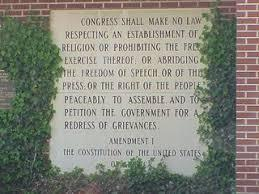
It's engraved in stone. The First Amendment, at the entrance to the Bremen Public Library in Bremen, Indiana. The Bremen Public Library serves the citizens of German Township in Marshall County, Indiana. Photo from Bremen Library.

It’s engraved in stone. The First Amendment, at the entrance to the Bremen Public Library in Bremen, Indiana. The Bremen Public Library serves the citizens of German Township in Marshall County, Indiana. Photo from Bremen Library.


President Clinton directed the Secretary of Education and the Attorney General to inform  each school district in America about the law on religious freedom in public schools.  This was the law in 2000 when Clinton left office, and it still is the law.  This statement is still accurate. [And if that site stays weird or doesn’t work for you, check it out here at the 5th Circuit U.S. Court of Appeals.]

UNITED STATES DEPARTMENT OF EDUCATION
THE SECRETARY


“…Schools do more than train children’s minds. They also help to nurture their souls by reinforcing the values they learn at home and in their communities. I believe that one of the best ways we can help out schools to do this is by supporting students’ rights to voluntarily practice their religious beliefs, including prayer in schools…. For more than 200 years, the First Amendment has protected our religious freedom and allowed many faiths to flourish in our homes, in our work place and in our schools. Clearly understood and sensibly applied, it works.”

President Clinton
May 30, 1998


Dear American Educator,

Almost three years ago, President Clinton directed me, as U.S. Secretary of Education, in consultation with the Attorney General, to provide every public school district in America with a statement of principles addressing the extent to which religious expression and activity are permitted in our public schools. In accordance with the President’s directive, I sent every school superintendent in the country guidelines on Religious Expression in Public Schools in August of 1995.

The purpose of promulgating these presidential guidelines was to end much of the confusion regarding religious expression in our nation’s public schools that had developed over more than thirty years since the U.S. Supreme Court decision in 1962 regarding state sponsored school prayer. I believe that these guidelines have helped school officials, teachers, students and parents find a new common ground on the important issue of religious freedom consistent with constitutional requirements.

In July of 1996, for example, the Saint Louis School Board adopted a district wide policy using these guidelines. While the school district had previously allowed certain religious activities, it had never spelled them out before, resulting in a lawsuit over the right of a student to pray before lunch in the cafeteria. The creation of a clearly defined policy using the guidelines allowed the school board and the family of the student to arrive at a mutually satisfactory settlement.

In a case decided last year in a United States District Court in Alabama, (Chandler v. James) involving student initiated prayer at school related events, the court instructed the DeKalb County School District to maintain for circulation in the library of each school a copy of the presidential guidelines.

The great advantage of the presidential guidelines, however, is that they allow school districts to avoid contentious disputes by developing a common understanding among students, teachers, parents and the broader community that the First Amendment does in fact provide ample room for religious expression by students while at the same time maintaining freedom from government sponsored religion.

The development and use of these presidential guidelines were not and are not isolated activities. Rather, these guidelines are part of an ongoing and growing effort by educators and America’s religious community to find a new common ground. In April of 1995, for example, thirty-five religious groups issued “Religion in the Public Schools: A Joint Statement of Current Law” that the Department drew from in developing its own guidelines. Following the release of the presidential guidelines, the National PTA and the Freedom Forum jointly published in 1996 “A Parent’s Guide to Religion in the Public Schools” which put the guidelines into an easily understandable question and answer format.

In the last two years, I have held three religious-education summits to inform faith communities and educators about the guidelines and to encourage continued dialogue and cooperation within constitutional limits. Many religious communities have contacted local schools and school systems to offer their assistance because of the clarity provided by the guidelines. The United Methodist Church has provided reading tutors to many schools, and Hadassah and the Women’s League for Conservative Judaism have both been extremely active in providing local schools with support for summer reading programs.

The guidelines we are releasing today are the same as originally issued in 1995, except that changes have been made in the sections on religious excusals and student garb to reflect the Supreme Court decision in Boerne v. Flores declaring the Religious Freedom Restoration Act unconstitutional as applied to actions of state and local governments.

These guidelines continue to reflect two basic and equally important obligations imposed on public school officials by the First Amendment. First, schools may not forbid students acting on their own from expressing their personal religious views or beliefs solely because they are of a religious nature. Schools may not discriminate against private religious expression by students, but must instead give students the same right to engage in religious activity and discussion as they have to engage in other comparable activity. Generally, this means that students may pray in a nondisruptive manner during the school day when they are not engaged in school activities and instruction, subject to the same rules of order that apply to other student speech.

At the same time, schools may not endorse religious activity or doctrine, nor may they coerce participation in religious activity. Among other things, of course, school administrators and teachers may not organize or encourage prayer exercises in the classroom. Teachers, coaches and other school officials who act as advisors to student groups must remain mindful that they cannot engage in or lead the religious activities of students.

And the right of religious expression in school does not include the right to have a “captive audience” listen, or to compel other students to participate. School officials should not permit student religious speech to turn into religious harassment aimed at a student or a small group of students. Students do not have the right to make repeated invitations to other students to participate in religious activity in the face of a request to stop.

The statement of principles set forth below derives from the First Amendment. Implementation of these principles, of course, will depend on specific factual contexts and will require careful consideration in particular cases.

In issuing these revised guidelines I encourage every school district to make sure that principals, teachers, students and parents are familiar with their content. To that end I offer three suggestions:

First, school districts should use these guidelines to revise or develop their own district wide policy regarding religious expression. In developing such a policy, school officials can engage parents, teachers, the various faith communities and the broader community in a positive dialogue to define a common ground that gives all parties the assurance that when questions do arise regarding religious expression the community is well prepared to apply these guidelines to specific cases. The Davis County School District in Farmington, Utah,is an example of a school district that has taken the affirmative step of developing such a policy.

At a time of increasing religious diversity in our country such a proactive step can help school districts create a framework of civility that reaffirms and strengthens the community consensus regarding religious liberty. School districts that do not make the effort to develop their own policy may find themselves unprepared for the intensity of the debate that can engage a community when positions harden around a live controversy involving religious expression in public schools.

Second, I encourage principals and administrators to take the additional step of making sure that teachers, so often on the front line of any dispute regarding religious expression, are fully informed about the guidelines. The Gwinnett County School system in Georgia, for example, begins every school year with workshops for teachers that include the distribution of these presidential guidelines. Our nation’s schools of education can also do their part by ensuring that prospective teachers are knowledgeable about religious expression in the classroom.

Third, I encourage schools to actively take steps to inform parents and students about religious expression in school using these guidelines. The Carter County School District in Elizabethton, Tennessee, included the subject of religious expression in a character education program that it developed in the fall of 1997. This effort included sending home to every parent a copy of the “Parent’s Guide to Religion in the Public Schools.”

Help is available for those school districts that seek to develop policies on religious expression. I have enclosed a list of associations and groups that can provide information to school districts and parents who seek to learn more about religious expression in our nation’s public schools.

In addition, citizens can turn to the U.S. Department of Education web site (http://www.ed.gov) for information about the guidelines and other activities of the Department that support the growing effort of educators and religious communities to support the education of our nation’s children.

Finally, I encourage teachers and principals to see the First Amendment as something more than a piece of dry, old parchment locked away in the national attic gathering dust. It is a vital living principle, a call to action, and a demand that each generation reaffirm its connection to the basic idea that is America — that we are a free people who protect our freedoms by respecting the freedom of others who differ from us.

Our history as a nation reflects the history of the Puritan, the Quaker, the Baptist, the Catholic, the Jew and many others fleeing persecution to find religious freedom in America. The United States remains the most successful experiment in religious freedom that the world has ever known because the First Amendment uniquely balances freedom of private religious belief and expression with freedom from state-imposed religious expression.

Public schools can neither foster religion nor preclude it. Our public schools must treat religion with fairness and respect and vigorously protect religious expression as well as the freedom of conscience of all other students. In so doing our public schools reaffirm the First Amendment and enrich the lives of their students.

I encourage you to share this information widely and in the most appropriate manner with your school community. Please accept my sincere thanks for your continuing work on behalf of all of America’s children.

Sincerely,


Richard W. Riley
U.S. Secretary of Education


RELIGIOUS EXPRESSION IN PUBLIC SCHOOLS

Student prayer and religious discussion: The Establishment Clause of the First Amendment does not prohibit purely private religious speech by students. Students therefore have the same right to engage in individual or group prayer and religious discussion during the school day as they do to engage in other comparable activity. For example, students may read their Bibles or other scriptures, say grace before meals, and pray before tests to the same extent they may engage in comparable nondisruptive activities. Local school authorities possess substantial discretion to impose rules of order and other pedagogical restrictions on student activities, but they may not structure or administer such rules to discriminate against religious activity or speech.

Generally, students may pray in a nondisruptive manner when not engaged in school activities or instruction, and subject to the rules that normally pertain in the applicable setting. Specifically, students in informal settings, such as cafeterias and hallways, may pray and discuss their religious views with each other, subject to the same rules of order as apply to other student activities and speech. Students may also speak to, and attempt to persuade, their peers about religious topics just as they do with regard to political topics. School officials, however, should intercede to stop student speech that constitutes harassment aimed at a student or a group of students.

Students may also participate in before or after school events with religious content, such as “see you at the flag pole” gatherings, on the same terms as they may participate in other noncurriculum activities on school premises. School officials may neither discourage nor encourage participation in such an event.

The right to engage in voluntary prayer or religious discussion free from discrimination does not include the right to have a captive audience listen, or to compel other students to participate. Teachers and school administrators should ensure that no student is in any way coerced to participate in religious activity.

Graduation prayer and baccalaureates: Under current Supreme Court decisions, school officials may not mandate or organize prayer at graduation, nor organize religious baccalaureate ceremonies. If a school generally opens its facilities to private groups, it must make its facilities available on the same terms to organizers of privately sponsored religious baccalaureate services. A school may not extend preferential treatment to baccalaureate ceremonies and may in some instances be obliged to disclaim official endorsement of such ceremonies.

Official neutrality regarding religious activity: Teachers and school administrators, when acting in those capacities, are representatives of the state and are prohibited by the establishment clause from soliciting or encouraging religious activity, and from participating in such activity with students. Teachers and administrators also are prohibited from discouraging activity because of its religious content, and from soliciting or encouraging antireligious activity.

Teaching about religion: Public schools may not provide religious instruction, but they may teach about religion, including the Bible or other scripture: the history of religion, comparative religion, the Bible (or other scripture)-as-literature, and the role of religion in the history of the United States and other countries all are permissible public school subjects. Similarly, it is permissible to consider religious influences on art, music, literature, and social studies. Although public schools may teach about religious holidays, including their religious aspects, and may celebrate the secular aspects of holidays, schools may not observe holidays as religious events or promote such observance by students.

Student assignments: Students may express their beliefs about religion in the form of homework, artwork, and other written and oral assignments free of discrimination based on the religious content of their submissions. Such home and classroom work should be judged by ordinary academic standards of substance and relevance, and against other legitimate pedagogical concerns identified by the school.

Religious literature: Students have a right to distribute religious literature to their schoolmates on the same terms as they are permitted to distribute other literature that is unrelated to school curriculum or activities. Schools may impose the same reasonable time, place, and manner or other constitutional restrictions on distribution of religious literature as they do on nonschool literature generally, but they may not single out religious literature for special regulation.

Religious excusals: Subject to applicable State laws, schools enjoy substantial discretion to excuse individual students from lessons that are objectionable to the student or the students’ parents on religious or other conscientious grounds. However, students generally do not have a Federal right to be excused from lessons that may be inconsistent with their religious beliefs or practices. School officials may neither encourage nor discourage students from availing themselves of an excusal option.

Released time: Subject to applicable State laws, schools have the discretion to dismiss students to off-premises religious instruction, provided that schools do not encourage or discourage participation or penalize those who do not attend. Schools may not allow religious instruction by outsiders on school premises during the school day.

Teaching values: Though schools must be neutral with respect to religion, they may play an active role with respect to teaching civic values and virtue, and the moral code that holds us together as a community. The fact that some of these values are held also by religions does not make it unlawful to teach them in school.

Student garb: Schools enjoy substantial discretion in adopting policies relating to student dress and school uniforms. Students generally have no Federal right to be exempted from religiously-neutral and generally applicable school dress rules based on their religious beliefs or practices; however, schools may not single out religious attire in general, or attire of a particular religion, for prohibition or regulation. Students may display religious messages on items of clothing to the same extent that they are permitted to display other comparable messages. Religious messages may not be singled out for suppression, but rather are subject to the same rules as generally apply to comparable messages.

THE EQUAL ACCESS ACT

The Equal Access Act is designed to ensure that, consistent with the First Amendment, student religious activities are accorded the same access to public school facilities as are student secular activities. Based on decisions of the Federal courts, as well as its interpretations of the Act, the Department of Justice has advised that the Act should be interpreted as providing, among other things, that:

General provisions: Student religious groups at public secondary schools have the same right of access to school facilities as is enjoyed by other comparable student groups. Under the Equal Access Act, a school receiving Federal funds that allows one or more student noncurriculum-related clubs to meet on its premises during noninstructional time may not refuse access to student religious groups.

Prayer services and worship exercises covered: A meeting, as defined and protected by the Equal Access Act, may include a prayer service, Bible reading, or other worship exercise.

Equal access to means of publicizing meetings: A school receiving Federal funds must allow student groups meeting under the Act to use the school media — including the public address system, the school newspaper, and the school bulletin board — to announce their meetings on the same terms as other noncurriculum-related student groups are allowed to use the school media. Any policy concerning the use of school media must be applied to all noncurriculum-related student groups in a nondiscriminatory matter. Schools, however, may inform students that certain groups are not school sponsored.

Lunch-time and recess covered: A school creates a limited open forum under the Equal Access Act, triggering equal access rights for religious groups, when it allows students to meet during their lunch periods or other noninstructional time during the school day, as well as when it allows students to meet before and after the school day.

Revised May 1998


List of organizations that can answer questions on religious expression in public schools

Religious Action Center of Reform Judaism
Name: Rabbi David Saperstein
Address: 2027 Massachusetts Ave., NW, Washington, DC 20036
Phone: (202) 387-2800
Fax: (202) 667-9070
Web site: http://www.rj.org/rac/
American Association of School Administrators
Name: Andrew Rotherham
Address: 1801 N. Moore St., Arlington, VA 22209
Phone: (703) 528-0700
Fax: (703) 528-2146
Web site: http://www.aasa.org
American Jewish Congress
Name: Marc Stern
Address: 15 East 84th Street, New York, NY 10028
Phone: (212) 360-1545
Fax: (212) 861-7056
National PTA
Name: Maribeth Oakes
Address: 1090 Vermont Ave., NW, Suite 1200, Washington, DC 20005
Phone: (202) 289-6790
Fax: (202) 289-6791
Web site: http://www.pta.org
Christian Legal Society
Name: Steven McFarland
Address: 4208 Evergreen Lane, #222, Annandale, VA 22003
Phone: (703) 642-1070
Fax: (703) 642-1075
Web site: http://www.clsnet.com
National Association of Evangelicals
Name: Forest Montgomery
Address: 1023 15th Street, NW #500, Washington, DC 20005
Phone: (202) 789-1011
Fax: (202) 842-0392
Web site: http://www.nae.net
National School Boards Association
Name: Laurie Westley
Address: 1680 Duke Street, Alexandria, VA 22314
Phone: (703) 838-6703
Fax: (703) 548-5613
Web site: http://www.nsba.org
Freedom Forum
Name: Charles Haynes
Address: 1101 Wilson Blvd, Arlington, VA 22209
Phone: (703) 528-0800
Fax: (703) 284-2879
Web site: http://www.freedomforum.org

-###-


Annals of DDT: No DDT produces benefits in Thunder Bay, Ontario

December 4, 2011

My news grabbers frequently take in articles about the recovery of some wild species in some far-flung place, a benefit of our having stopped the use of DDT in the area.

It occurs to me these stories should be filed away somewhere for future reference.

For example, here’s a letter to the editor of The Chronicle-Journal, in Thunder Bay, Ontario:

Let’s not reverse gains in falcon population

Saturday, December 3, 2011

I grew up in this town in the 1960s and ’70s never having seen nor heard a bald eagle or Peregrine falcon. I could only listen as my father (an MNR game warden) treated me to stories of the magnificent raptors previously living along the Nipigon River, Sibley and the Nor’Westers. I was 25 years old before I saw my first bald eagle and that was in Minnesota.

Decades of DDT use decimated the predator bird population to almost extinction in Ontario. The government eventually recognized the problem and corrected it by banning DDT in 1970. With the help of local groups, finally the birds are back.

In 1989, the Thunder Bay Field Naturalists, with support from the Ministry of Natural Resources, launched Project Peregrine “in an attempt to reintroduce this species to the Superior north shore . . . In 1993, successful nesting peregrines were recorded for the first time in the last quarter-century . . . due to an abundance of excellent habitat.”

A mere 20 years has gone by. Are we going to allow another crime against these species?

Allowing Horizon Wind to rape the escarpment for a few megawatts that we do not need now or in any foreseeable future is falling into a bully trap.
Parties have stated there will be no harm to the birds or to the escarpment. Au contraire. The blasting alone, not to mention the construction and roads, can be compared to demolishing the whole north core downtown and building a skyscraper no one intends to occupy.

Leave the birds and the escarpment alone. Go home, Horizon Wind.

Maggie Cummins
Thunder Bay


Birthday of Twain and Churchill: Happy Whiskey and Cigar Day!

November 30, 2011

Mark Twain, afloat

November 30 is the birthday of Mark Twain (1835), and Winston Churchill (1874).

Twain had a comment on the Texas Education Agency and State Board of Education:

In the first place God made idiots. This was for practice. Then He made School Boards.

– Following the Equator; Pudd’nhead Wilson’s New Calendar

The Nobel literature committees were slow; Twain did not win a Nobel in Literature; he died in 1910. Churchill did win, in 1953.

Both men were aficionados of good whiskey and good cigars. Both men suffered from depression in old age.

Both men made a living writing, early in their careers as newspaper correspondents. One waged wars of a kind the other campaigned against. Both were sustained by their hope for the human race, against overwhelming evidence that such hope was sadly misplaced.

churchill-time-cover-man-of-the-year-1941.jpg

Both endured fantastic failures that would have killed other people, andboth rebounded.

Each possessed a great facility with words, and wit, and frequently said or wrote things that people like to remember and repeat again.

Both of them rank near the top of the list of people to whom almost any quote will be attributed if the quote is witty and the speaker can’t remember, or doesn’t know, who actually said it.

Both men are worth study. And wouldn’t you really love to have had them over to dinner?

Twain, on prisons versus education:

Every time you stop a school, you will have to build a jail. What you gain at one end you lose at the other. It’s like feeding a dog on his own tail. It won’t fatten the dog.” – Speech, November 23, 1900

Churchill on the evil men and nations do:

“No One Would Do Such Things”

“So now the Admiralty wireless whispers through the ether to the tall masts of ships, and captains pace their decks absorbed in thought. It is nothing. It is less than nothing. It is too foolish, too fantastic to be thought of in the twentieth century. Or is it fire and murder leaping out of the darkness at our throats, torpedoes ripping the bellies of half-awakened ships, a sunrise on a vanished naval supremacy, and an island well-guarded hitherto, at last defenceless? No, it is nothing. No one would do such things. Civilization has climbed above such perils. The interdependence of nations in trade and traffic, the sense of public law, the Hague Convention, Liberal principles, the Labour Party, high finance, Christian charity, common sense have rendered such nightmares impossible. Are you quite sure? It would be a pity to be wrong. Such a mistake could only be made once—once for all.”

—1923, recalling the possibility of war between France and Germany after the Agadir Crisis of 1911, in The World Crisis,vol. 1, 1911-1914, pp. 48-49.

Image of Twain aboard ship – origin unknown. Image of Winston S. Churchill, Time Magazine’s Man of the Year for 1941, copyright 1941 by Time Magazine.

More on Mark Twain

More on Winston Churchill

Orson Welles, with Dick Cavett, on Churchill, his wit, humor and grace (tip of the old scrub brush to the Churchill Centre):

Yeah, mostly this is an encore post from past years.


Economic history of the world in 4 minutes, from Hans Rosling at BBC

November 27, 2011

I would have sworn I had posted this earlier.  I can’t find it in any search right now.

So, here it is:

Hans Rosling does a program on BBC showing, among other things, great data displays.  In this one he shows how the development of trade and free enterprise economics lifted most of the world out of dismal, utter poverty, over the course of 200 years.

“200 countries, 200 years, in 4 minutes – the Joy of Statistics”

How can you use this in the class, world history teachers?  Economics teachers?  Does freedom mean you can get rich?  Or does getting rich mean you get freedom?  Can a nation achieve riches without freedom, or freedom without riches?

You need to know:

Uploaded by on Nov 26, 2010

More about this programme: http://www.bbc.co.uk/programmes/b00wgq0l
Hans Rosling’s famous lectures combine enormous quantities of public data with a sport’s commentator’s style to reveal the story of the world’s past, present and future development. Now he explores stats in a way he has never done before – using augmented reality animation. In this spectacular section of ‘The Joy of Stats’ he tells the story of the world in 200 countries over 200 years using 120,000 numbers – in just four minutes. Plotting life expectancy against income for every country since 1810, Hans shows how the world we live in is radically different from the world most of us imagine.

Tip of the old scrub brush to The Tufted Titmouse.


“White House hates Christmas” hoax season opens

November 26, 2011

Christmas gets underway at the White House, with a special guest appearance by Bo, the dog:

Vodpod videos no longer available.

One long-standing American Christmas tradition is the Christmas hoax about the president.  Probably the most famous, if not the first, was H. L. Mencken’s column in December 1917, in which he claimed Millard Fillmore a failure as president, whose only achievement was putting the first bathtub in the Executive Mansion — all of it make up, whole cloth fiction.

Since the election of Barack Obama we’ve seen claims that Obama had banned Christmas trees, claims that Obama required only Marxist and communist ornaments, and other wild stories that only a fool, a victim of lobotomy, a Bill O’Reilly fan or Michelle Bachmann would believe after the second cup of coffee in the morning.

What will the hoax claims be this year?  ABC posted this raw footage of the delivery of the Christmas tree, but that alone will not inoculate us from a Yule-tide hoax.

What atrocious inventions will the Obama-haters send our way this year?  If it’s a claim that there’s no tree, you know better already.  You’ve seen the video.

More: