Quote mystery

January 3, 2008

Who said “There’s nothing so powerful as truth,” and was that what he really meant?


Allowable political satire, or attack on the President?

December 20, 2007

So, is this allowable parody, political satire, in the nature of a political cartoon?
Mug shotsOr, is this an untoward attack on the President?

Will children be confused if they find these photos in a display of political art at the New York Public Library?

Is it not acceptable satire?

Tip of the old scrub brush to Gallery of the Absurd.


zAAAAAAAAS<M`

December 9, 2007

1nhjvgbfffffffffffbng

[This was written by our 18-year old.  She generally putters around the kitchen and avoids the laptop when it’s there; occasionally she takes a few stabs at the keyboard of the desktop.  But never before has she shown any interest in actually writing anything.  Last night she said she was hungry, and she was plainly irritated that I was doing nothing to get her dinner to her.  When I answered the telephone, she took the opportunity to write her own little headline and a short line for the body of the post.  I’m posting it as revenge.

Did I say she is 18?  You expect more?

Did I mention Meow is a cat?]


Whiskey and cigar day: Twain and Churchill

November 30, 2007

Mark Twain, afloat

November 30 is the birthday of Mark Twain (1835), and Winston Churchill (1874).

Twain had a comment on recent actions at the Texas Education Agency:

In the first place God made idiots. This was for practice. Then He made School Boards.

– Following the Equator; Pudd’nhead Wilson’s New Calendar

The Nobel literature committees were slow; Twain did not win a Nobel in Literature; he died in 1910. Churchill did win, in 1953.

Both men were aficianadoes of good whiskey and good cigars. Both men suffered from depression in old age.

Both men made a living writing, early in their careers as newspaper correspondents. One waged wars of a kind the other campaigned against. Both were sustained by their hope for the human race, against overwhelming evidence that such hope was sadly misplaced.

churchill-time-cover-man-of-the-year-1941.jpg

Both endured fantastic failures that would have killed other people, and both rebounded.

Both men are worth study.

Twain, on prisons versus education: “Every time you stop a school, you will have to build a jail. What you gain at one end you lose at the other. It’s like feeding a dog on his own tail. It won’t fatten the dog.” – Speech, November 23, 1900

Churchill on the evil men and nations do:

“No One Would Do Such Things”

“So now the Admiralty wireless whispers through the ether to the tall masts of ships, and captains pace their decks absorbed in thought. It is nothing. It is less than nothing. It is too foolish, too fantastic to be thought of in the twentieth century. Or is it fire and murder leaping out of the darkness at our throats, torpedoes ripping the bellies of half-awakened ships, a sunrise on a vanished naval supremacy, and an island well-guarded hitherto, at last defenceless? No, it is nothing. No one would do such things. Civilization has climbed above such perils. The interdependence of nations in trade and traffic, the sense of public law, the Hague Convention, Liberal principles, the Labour Party, high finance, Christian charity, common sense have rendered such nightmares impossible. Are you quite sure? It would be a pity to be wrong. Such a mistake could only be made once—once for all.”

—1923, recalling the possibility of war between France and Germany after the Agadir Crisis of 1911, in The World Crisis,vol. 1, 1911-1914, pp. 48-49.

Image of Twain aboard ship – origin unknown. Image of Winston S. Churchill, Time Magazine’s Man of the Year for 1941, copyright 1941 by Time Magazine.

More on Mark Twain

More on Winston Churchill

Orson Welles, with Dick Cavett, on Churchill, his wit, humor and grace (tip of the old scrub brush to the Churchill Centre):


Diogenes, call your office: Honest man returns $2 million

November 25, 2007

Over 100 million boys in the U.S. have repeated the Scout Law, “Trustworthy, Loyal, Helpful, Friendly, Courteous, Kind, Obedient, Cheerful, Thrifty, Brave, Clean, Reverent.”

Jerry Mika of Draper, Utah, lives it.

Jerry Mika, of Draper Utah, with $2 million check sent to him in error - Jeremy Harmon photo, SL Tribune

Mika returned a check for $2,245,342 that the State of Utah had sent him in error (see the Associated Press story in the Provo Daily Herald — photo, above, by Jeremy Harmon, Salt Lake Tribune).

Mika returned the check — a mistake that occurred when an employee entered a serial number, not an amount — to state finance offices Wednesday.

“Clearly we have an honest, honest citizen. I wish I could do something more than say thanks,” commerce department director Francine Giani said.

Can’t Utah grant him a kingdom — half of Millard County or something? A little duchy in Fillmore, Utah?

Mika, who runs the nonprofit Providence Foundation to help Nepalese sherpas, said he’s had great fun showing off the state’s mistake.

“Everybody looked at it, started giggling and asked why I wasn’t already in Switzerland,” he said.

He admits to being tempted to deposit the money and draw a bit interest before the state asked for its return.

“That money would have gone a long way,” he said.

When a company comptroller complained to me once that the $4 million in refunds to our company would mess up his quarterly bookkeeping because he expected the money in the next quarter, I volunteered to park the money in an account for him. He quickly came to his senses. At low, passbook interest rates, the $4 million would have paid $141/hour, 24 hours a day — more than $3,300 a day. A few weeks of that and you’re talkin’ big money.

Because the check was state-issued, cashing it would probably have been easy, despite the large amount, Giani said.

“It was a valid check,” said Rick Beckstead, the state accounting operation manager whose signature is stamped on the check.

How honest are you, Dear Reader? How much of a temptation would it have been to cash that check? (I’ll wager this man is a former Boy Scout; how much does that account for his actions?)

Perhaps you could reward Mr. Mika’s honesty with a contribution to the foundation he operates, The Providence Foundation.

Teachers: Can you see how to make this into a bell-ringer, warm-up exercise?

Read the rest of this entry »


Golden Wingnut Awards!

November 6, 2007

Washington Monthly always deserves reading. The on-line presence is almost as good as the magazine was back in its very fertile youth. Generally it has good writing and good thinking, and there is almost always a good bunch of fun — sometimes the fun even comes with good writing and good thinking.

Golden Wingnut Award

And now, the magazine has announced its Golden Wingnut Awards, the top five worst posts on the web:

  1. John Hinderaker: “It must be very strange to be President Bush. A man of extraordinary vision and brilliance approaching to genius….”
  2. Glenn Reynolds: “Maybe we should rise above the temptation to point out that claims of a ‘quagmire’ were wrong….Nah.”
  3. Michelle Malkin: “The Defeatocrats Cheer”
  4. Ann Althouse: “Let’s take a closer look at those breasts.”
  5. Kim du Toit: “The Pussification of the Western Male”

Congratulations, wingnuts! And special congratulations to Power Line’s John Hinderaker, who ran away with first place by a wide margin — and deservedly so. (More at Washington Monthly)

You can check out the whole list of nominees here.

Now, go vote in your local election.

Tip of the old scrub brush to reader Bernarda, who continues to mine intelligent comment from the internet.


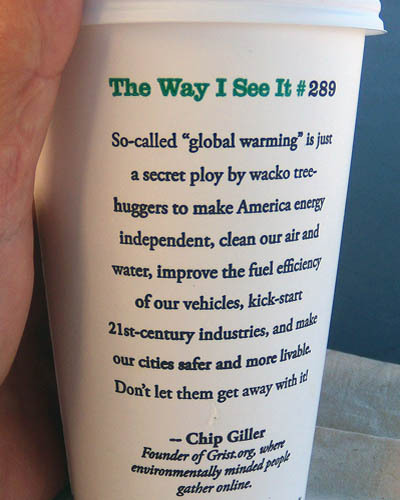
Starbucks controversy: The Way I See It #289 (global warming)

September 17, 2007

Found this on my coffee cup today:

The Way I See It #289

So-called “global warming” is just

a secret ploy by wacko tree-

huggers to make America energy

independent, clean our air and

water, improve the fuel efficiency

of our vehicles, kick-start

21st-century industries, and make

our cities safer and more livable.

Don’t let them get away with it!

Chip Giller
Founder of Grist.org, where
environmentally-minded people
gather online.

Starbucks Coffee Cup, The Way I See It #289

Add to FacebookAdd to NewsvineAdd to DiggAdd to Del.icio.usAdd to StumbleuponAdd to RedditAdd to BlinklistAdd to TwitterAdd to TechnoratiAdd to Furl

Save


Fun history: Great blunders, literature division

September 12, 2007

People in literature are different from you and me.

University of Texas history professor David Oshinsky pulled back the curtain on some of the biggest blunders in the history of literature, in an article for the New York Times a couple of days ago: “No Thanks, Mr. Nabokov.”

He documents rejection letters that, in retrospect, perhaps publisher Alfred A. Knopf would rather had not been written — despite the fact that Knopf was enormously successful otherwise. For example, about a book on teen-aged angst:

In the summer of 1950, Alfred A. Knopf Inc. turned down the English-language rights to a Dutch manuscript after receiving a particularly harsh reader’s report. The work was “very dull,” the reader insisted, “a dreary record of typical family bickering, petty annoyances and adolescent emotions.” Sales would be small because the main characters were neither familiar to Americans nor especially appealing. “Even if the work had come to light five years ago, when the subject was timely,” the reader wrote, “I don’t see that there would have been a chance for it.”

Knopf wasn’t alone. “The Diary of a Young Girl,” by Anne Frank, would be rejected by 15 others before Doubleday published it in 1952. More than 30 million copies are currently in print, making it one of the best-selling books in history.

The goof examples roll out of the files:

Nothing embarrasses a publisher more than the public knowledge that a literary classic or a mega best seller has somehow slipped away. One of them turned down Pearl Buck’s novel “The Good Earth” on the grounds that Americans were “not interested in anything on China.” Another passed on George Orwell’s “Animal Farm,” explaining it was “impossible to sell animal stories in the U.S.A.” (It’s not only publishers: Tony Hillerman was dumped by an agent who urged him to “get rid of all that Indian stuff.”)

Thousands of high school students would agree with the difficulty of selling animal stories.

Oshinsky is working from the files of Knopf, recently donated to the Harry Ransom Humanities Research Center (HRC) at the University of Texas, in Austin. University libraries push and shove each other to get troves of private correspondence, and the HRC has worked to get special grants to help things along. Sometimes these treasures lie buried in library archives. In this case, a grant from the National Endowment for the Humanities helped fund the cataloging operation.

And Oshinsky, who won the Pulitzer for his book Polio: An American Story, has done a bit of history mining. The few nuggets of history gold he reveals in the newspaper will be “classic examples” of why authors, and students and people in the pews of a church, should keep trying in the face of adversity. You’ll see these examples in Readers Digest and inspirational speeches for years to come, count on it.

Literature teachers should find these quotes useful in comforting students who don’t like the classics they are assigned to read. Preachers will find them useful for a variety of reasons. Others of us will like them for the goofiness, and sheer acidity of harsh criticism that, often, proved wrong. We’re Americans; we like it when the underdog wins, and when the pundits get so exactly wrong.

More examples from Oshinsky’s article, below the fold.

Read the rest of this entry »


Tom Peters? Izzat you?

March 8, 2007

I posted it earlier today, and this photo bugged me:

Wax head of Millard Fillmore

Why? What was it that made that thing appear so familiar?

I finally figured it out. The good news: Business change guru Tom Peters will be pleased to hear that this man above, rendered in wax, Millard Fillmore, was once called “the handsomest man I ever met,” by Queen Victoria.

Why would Peters be pleased?

Look:

Tom Peters

Tom Peters

Or maybe this one better makes the point:

Tom Peters

Tom Peters

Uncanny resemblance, no?

Maybe Peters’ company could buy the wax head . . .

_____________

Update, October 9, 2011 — Upon reflection, I think Tom Peters the much more handsome man.  Mind you, the story is that Queen Victoria called Fillmore the “most handsome man” she had ever seen.  That was before Sean Connery, before Brad Pitt, before Clark Gable, before Morgan Freeman . . .


Belgium breaking up? Who gets the beer?

January 22, 2007

Town Hall in Leuven, Belgium

Town Hall in Leuven, Belgium; image from Katholieke Universiteit Leuven

Did I really miss this last month?  A television  network in Belgium, RTBF, started out the morning reporting on the breakup of Belgium.  Rather contrary to the rules of hoaxes set up by Orson Welles and the Mercury Theatre, no mention of a dramatization was made for at least a half-hour.

And of course, it was all a hoax.  The network said they wanted to generate discussion about how Belgium works, etc., etc.   Not everyone was happy with the kickoff to discussion.

I have no particular dog in that fight, though I’m fond of Belgium.  My wife spent a year studying in Louvin (Louvain, Leuven) (before I knew her), and we have wonderful photos.  My own business trip to Brussells was less than 24 hours, though we conducted our business in lightning fashion and were able to spend the evening in a wonderfully lit historic square sampling several brands of beer — okay, many brands.  We all made it to the Oh-Dark-thirty airplane home the next morning (some in better shape than others).

It’s always an eye-opener to learn how little most people know about the country, though it plays a huge role in the European Union, in NATO, and in the history of the 20th century, especially World Wars I and II.

Now it appears even Belgians don’t know whether their nation would break up or not.  Jacques Brel is no longer alive and well.

More: