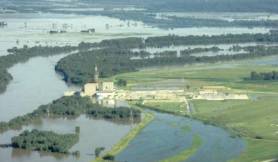
Troops who fought in two wars now protect public against Missouri River flood and nuclear accident

July 10, 2011

Hoax claims died down a bit across the blogosphere, but the Missouri River still floods, and the two Nebraska nuclear power plants on the Missouri still face threats from the flood.

Comes news via the Omaha World-Herald that members of Nebraska’s and Iowa’s Air National Guard — many of them veterans of Iraq or Afghanistan — patrol the levees, helping protect against floods.  Among points of special concern are the nuclear power plants at Fort Calhoun and Cooper.

The military helicopter’s black shadow dances on an engorged Missouri River as the aircraft slowly loops the flood-encircled Fort Calhoun Nuclear Station — the same left-leaning turns the pilot navigated two days prior.

Warrant Officer Boe Searight, 32, with the Nebraska Air National Guard wants the infrared camera mounted under the chopper to record similar flood scenes for levee experts on the ground to compare.

He and his colleague Chief Warrant Officer 2 Eric Schriner also are looking for new signs of trouble for the flooded plant.

“Keep daily eyes on it and see if anything changes,” says Schriner, 31.

Far below, on mosquito-infested riverbanks, two-person crews with the Nebraska National Guard and Iowa National Guard patrol the Omaha and Council Bluffs levees in mud-caked boots.

Members of the Guard are the front-line levee watchers in an operation that clearly has high stakes: Levees protect about 40,000 people from homelessness in the neighboring river cities — as well as the region’s key airport.

The levee watchers are out there right now — three shifts a day, all week, searching for gopher holes, chasing away sightseers who could fall from the levees, and checking for signs of water seepage.

More than 130 men and women with the Nebraska Army and Air National Guard work each day for flood duty, along with 120 from the Iowa Army and Air National Guard.

The idea is to spot trouble early. Levees don’t always give notice before they rupture, but more often than not they do.

If trouble is spotted, steps can be taken to shore up or boost a weakened levee.

Good to know.  Still no nuclear incident along the lines of the hoax report from the Pakistani outlet alleged to be based on a report from a Russian agency — which is also good news — but no cause for abatement of overall concern.

Sometimes safety preparations work.  Kudos to the Air National Guards, to the Nuclear Regulatory Agency, and to the companies who own  the power plants.  May their work continue to pay off in no nuclear incidents.

Idaho Samizdat noted earlier that the bizarre conspiracy theories haven’t borne out as accurate or true in the least:

The flooding situation in Nebraska has been the subject of bizarre conspiracy theories originating in Russia and Pakistan alleging that a meltdown has occurred at Ft. Calhoun and that the government is covering it up.

One U.S. web site, Business Insider, ran with the story as legitimate and set off a huge round of copy cat reports on the Internet.

Reports of a U.S. news blackout are also part of the conspiracy theory even though Nebraska papers such as the Omaha World-Herald and the New York Times have run major stories on measures by the two reactor sites to prevent the flood waters from reaching important infrastructure such as switch yards


Ben Stein in a nutshell (appropriately)

July 8, 2011

Ben Stein is too easy to kick around anymore.  His views on politics, science, and general public policy have inflated so much above the troposphere that he really cannot speak about life on the ground at all.  The movie mockumentary “Expelled!” provided the early signs of pundit dementia.

Graphic for Ben Stein's American Spectator column

Graphic for Ben Stein's American Spectator column: Even in the art, Stein's out of it; his column is titled, "Nation's Pulse," but the graphic shows Uncle Sam hooked up to a machine measuring everything but his pulse. Even Sam's genitals get wired, but the nurse isn't counting heartbeats, nor does it appear any other monitor is.

At the same time, he’s a friend of dogs.  One of his tributes to his old dog literally brought tears to my eyes, and reminded me much of the old saying that heaven has no room for those who don’t like dogs.  That also raised the horrible vision of spending eternity in a heaven with dog-lovers who also happen to be political idiots.

Stein won’t kick dogs, but he’ll kick scientists, and poor people, and anyone in the middle class.  Maybe heavens don’t take people solely on the basis of their affection for dogs.

I digress.

At the remains of the American Spectator — a once-great, nearly revolutionary and smart journal of conservatism slipped on the slime to twitchy, bumper-sticker politics — Stein’s every-issue column turned to his vacation in an exclusive and expensive home in Sandpoint, Idaho, his distaste for undeveloped land and and outright fear of wilderness, friends, and the birth of his granddaughter, nicknamed Coco:

I feel so worried about Coco, She is only a tiny infant with eyes barely open. What do I want Coco to know? To do her best. To love her parents. To forgive. To be a lot more prudent about money than I am. To be grateful for this, our America, the best place in the universe. To turn her will and her life over to God and turn to Him for help in every situation.

But I wish my parents and Alex’s parents were here to help. And I wish my sister lived closer so she could help. And that Mr Nixon were still alive to give the leaders of this nation some clue about how to lead a nation. I am excited about Coco, but I am scared.

Right emotions, wrong thoughts.  We need Lyndon Johnson, with a concern for eliminating poverty among the aged (something he did!), not Richard Nixon.  With the possible exception of his trip to China, nothing Nixon did couldn’t have been done better by Johnson with another four years, or Humphrey, had we had the sense.

But that’s Stein.  He’s human on the family front, full of emotion, loving dogs, getting a cold treat for his ill wife, worrying about the future his granddaughter faces, especially from his privileged palace in Sandpoint, a nice nearly-wild area unfortunately become home of right-wing militias, Aryan-loving neo-Nazis and Keystone Kops-style militias — then switching to his brain-driven mode from emotion-driven, and doing everything he can to make sure anyone who lacks a few million dollars in the bank courtesy of the Old Man will be unable to rise above the fears.  Stein luckily led a charmed life, dependent on the kindness of family, friends and strangers, and he cannot understand why others don’t do the same.  Stein’s solutions stand magnificently out of reason:  Out of work?  Take a tax cut.  Need money to go to college?  Your father needs a tax cut, if he’s rich.  Health care tough to find because you can’t pay for it?  Tax cuts for the owner of the company you wish to work for.  And stop your arguing for more practical or workable solutions whining.

Stein stands in such sharp contrast to the Nepali prince Siddhartha, whose views of real life led him to forsake his princely heritage and seek spiritual enlightenment.  One hopes for a Stein-like character with the conscience of Siddhartha, but the practicality of Ross Perot who once noted that what America really needs is a political leader who will fill some potholes, and then, instead of holding a press conference about it, fill some more potholes.

Ben Stein’s road of life has been stripped of most potholes.  It’s so smooth, he can’t understand why everyone doesn’t drive that way, going to fancy school’s on Dad’s big money, hobnobbing with Republicans at the country club and occasionally taking the opportunities they toss your way.  Wouldn’t such a life be divine?


Hoaxed Nebraska nuclear plant crisis update

June 24, 2011

Help me out, Dear Reader:  Here is the English language site of the Russian Federal Atomic Energy Agency (FAEE), the press site.  Can you find any statement at this site relating to the power plants in Nebraska along the flooding Missouri River?

Fires in Japan after tsunami -- not a nuclear power station

What some reports appear to paint as the Nebraska nuclear generating stations (However, please note: In this photo, no nuclear power plants appear)

Cooper nuclear generation station in 1993 floods

What you really see: Cooper Nuclear Generating Station in Nebraska -- still there (from a 1993 photo)

I have found no mention of any U.S. incident.   This suggests the Pakistani news report of a Russian agency report of disaster is hoax, too.

Claims of a crisis in Nebraska are hoaxes,  I think.  The Russian agency from which the report is claimed to have come, does not show such a report.

This is more evidence that the whole flap is a hoax.

True to form, several birther and other conspiracy paranoiac sites claim that these plants in Nebraska are gone, in flames, or leaking water that nearly glows.

Can’t Sarah Palin point her bus to Nebraska and let her press entourage get the real story?


Nuclear power plant incident in Nebraska?

June 19, 2011

A Pakistani newspaper, The Nation, should not be confused with the U.S. magazine of the same name, as I originally did.

Late Friday The Nation questioned an alleged news blackout around an incident at the Fort Calhoun nuclear power plant outside of Omaha, Nebraska:

A shocking report prepared by Russia’s Federal Atomic Energy Agency (FAAE) on information provided to them by the International Atomic Energy Agency (IAEA) states that the Obama regime has ordered a “total and complete” news blackout relating to any information regarding the near catastrophic meltdown of the Fort Calhoun Nuclear Power Plant located in Nebraska.

According to this report, the Fort Calhoun Nuclear Plant suffered a “catastrophic loss of cooling” to one of its idle spent fuel rod pools on 7 June after this plant was deluged with water caused by the historic flooding of the Missouri River which resulted in a fire causing the Federal Aviation Agency (FAA) to issue a “no-fly ban” over the area.

Located about 20 minutes outside downtown Omaha, the largest city in Nebraska, the Fort Calhoun Nuclear Plant is owned by Omaha Public Power District (OPPD) who on their website denies their plant is at a “Level 4” emergency by stating: “This terminology is not accurate, and is not how emergencies at nuclear power plants are classified.”

So, we have some questions to deal with:

  1. Is there a serious incident at the Fort Calhoun facility?
  2. Has anyone ordered a news blackout, and if so, why?
  3. Is it likely that a Pakistani newspaper relying on Russian sources can better report on a nuclear power plant in Nebraska than, say, the local Omaha newspaper?

As much as we might like to give The Nation a chance at being accurate, how likely is it that a U.S. president could order a complete revocation of emergency safety plans for a nuclear facility, when, by law and regulation, those plans are designed to protect the public?  The story smells bad from the start, just on government processes in the U.S.

The Nation, Fort Calhoun, Nebraska, nuclear power plant

This is the photograph used by The Nation to illustrate its online article claiming a meltdown at the Fort Calhoun nuclear power station in Nebraska. It shows a flooded nuclear power station, Fort Calhoun we might assume. Is it? Does the photograph show any problem besides the flooding?

The Russian report is too strong, probably.  First, there’s no news blackout, as evidenced by local reporting.  Second, our American “be-too-conservative-by-a-factor-of-ten” safety standards make piffles sound like major problems.  The story’s being filtered through a Pakistani newspaper should give us further pause in taking things at face value.

According to the local Nebraska newspaper, the Omaha World-Herald, the Fort Calhoun facility powered down on April 9 for refueling.  Because of the pending floods, it was not yet refired up.  A powered-down reactor is unlikely to melt down.

O W-H, Nebraska’s largest and most venerated newspaper, reports on a second problem at a second nuclear plant.  Reports on the second “incident” give a clear view into just how careful U.S. plants are usually operated:

Cooper Nuclear Station near Brownville, Neb., declared a “Notification of Unusual Event” about 4 a.m. Sunday when the Missouri River there reached a height of 42.5 feet.

The declaration, which has been anticipated by the power plant’s operators, was made as part of safety and emergency preparedness plan the station follows when flooding conditions are in effect.

The plan’s procedures dictate when the Missouri River’s water level reaches 42.5 feet, or greater than 899 feet above sea level, a notification of unusual event is declared. If the river’s level increases to 45.5 feet or 902 feet above sea level, plant operators are instructed take the station offline as a safety measure.

An earlier story at the O W-H dealt specifically with issues at Fort Calhoun, and the flooding — again suggesting there is little danger from that facility.

FORT CALHOUN, Neb. — Despite the stunning sight of the Fort Calhoun nuclear reactor surrounded by water and the weeks of flooding that lie ahead, the plant is in a safe cold shutdown and can remain so indefinitely, the reactor’s owners and federal regulators say.

“We think they’ve taken adequate steps to protect the plant and to assure continued safety,” Victor Dricks, spokesman for the Nuclear Regulatory Commission, said Thursday.

Tim Burke, vice president at Omaha Public Power District, said the plant’s flood barriers are being built to a level that will protect against rain and the release of record amounts of water from upstream dams on the Missouri River.

“We don’t see any concerns around the Fort Calhoun Nuclear Station,” Burke said at a briefing in Omaha Mayor Jim Suttle’s office.

The nuclear plant, 20 miles north of Omaha, was shut down April 9 for refueling. It has not been restarted because of the imminent flooding.

Who do we believe, a Russian report issued more than 6,000 miles from Nebraska, reported in a newspaper in Pakistan, or the local reporters on the beat?

Fort Calhoun nuclear generating plant, flooded by the Missouri River, on June 17, 2011 - Photo by Matt Miller, Omaha  World-Herald

Photo caption from the Omaha World-Herald: "The Fort Calhoun Nuclear Station from the air Thursday. OPPD was putting the finishing touches on federally ordered flood-defense improvements before flooding began. MATT MILLER/THE WORLD-HERALD"

More, other resources:

UPDATE, June 20, 2011:  Let’s call it a hoax

I don’t think I’m going too far out on a limb to call the claims of a serious accident, emergency and potential disaster at the Fort Calhoun site, a hoax.  The Russian report — if it exists — may not have been intended as a hoax, but coupled with filtering through the credulous and gullible foreign press (we’re looking at you, Pakistan’s The Nation), it has risen to hoax level, to be debunked.  Sure, you should be concerned about safety and security at Fort Calhoun and Cooper — but you should be concerned about safety and security at every nuclear power plant around the world, all the time.  This may be a good time for you to reread John McPhee’s brilliant Curve of Binding Energy.  It’s dated — Ted Taylor died October 28, 2004  (was his autobiography ever published?) — but still accurate and informative, plus, any excuse to read any work of McPhee is a great one.


Salt Lake Tribune obit for journalist Ernie Ford

June 4, 2011

The Salt Lake Tribune carried an obituary for my old journalism professor Ernie Ford today.

Small world:  Good words about Ernie came from an official at KSL-Television, Con Psarras, Vice President for Editorials and Special Projects.  Con is former news director at KSL, the job that many said Ernie was perfect for, but  could never have because he wasn’t in with the owners of the station.  Con is also a former colleague of mine from the University of Utah debate squad (he was a much better debater than I)*.

Con Psarras, KSL’s vice president of editorials and special projects, remembered Ford as “a one-of-a-kind character.”

“He was inspirational to a lot of people,” said Psarras, KSL’s former news director. “He was a real journalist who cared about all those fundamental things that make journalists good at what they do. He was a stickler for detail. If you got something wrong, it was not a pleasant experience. Someone said they earned their first layer of thick skin from Ernie Ford.”

Stickler for detail, sure.  Ford was a great copy editor, and as a managing editor he worried about getting things right, for the readers’ sake in addition to avoiding libel suits.  But I didn’t find it unpleasant to get those fact challenges from Ford.  He knew where the weak spots of a story were likely to be, and he asked the questions that exposed those weaknesses to the writer.  I enjoyed that banter and process — which prevented mistakes from getting into print. (There weren’t idiots as editors of the Chronicle — accuracy, shoe leather and decent writing lived in that paper, often.)

Where are schools of journalism these days?  I was shocked that Texas A&M dropped its journalism program a few years back.  The best intern I ever had came out of A&M’s program.  Liz Newlin wrote concisely and well, and she could smell the heart of a news story, and put it into the lead so you’d have to follow the arteries deeper into the thing to see what happened.  Newlin could have been another Ernie Ford — but she married a guy named Taylor (you figure out the married name), went to law school and became a water law expert in Tucson.

Who trains good journalists by the score in good journalism practices anymore?  Who would want to go into such a field, with newspapers coming down around those left in the newsrooms, and with every fourth yahoo with an internet connection blogging away? [Yeah, me too.]

_____________

*  We got a couple of good reporters out of that debate squad.  Good training for a reporter, I think.  Steve Christensen signed up with UPI back when it was still a noble outfit; I don’t know where he is these days.  Tim Weiler reported for several years in and around Salt Lake.   Carolyn Young, one of  our graduate assistants back in the Early Later Than You Think Holocene reported for KSL’s rival, KUTV, but she headed out to Oregon.  Of course, none of them were journalism majors.  Go figure.


Quiet giant of Utah journalism, Ernie Ford

June 2, 2011

Sometimes the news comes slow.

Jake Sorenson at the Daily Utah Chronicle sent out a notice that Ernie Ford died last night.  Cardiac issues.  He was 70, after all — young by today’s standards, and not yet used up.

Ford was adjunct faculty and adviser to the Chronicle when I wrote there, and took classes from him.  Ford and Roy Gibson were veterans of Utah journalism who could offer a couple of chapters of a textbook they never wrote on how to write well, and how to write good news stories — with just their markups, questions and corrections in the margins of the news story one had to meet deadline on.

Gibson died several years ago.

More than once I regretted that I had to send the copy, with Ford’s comments, off to “typesetting” in the backshop, knowing I’d never see it again.  We didn’t have a photocopier to just make another copy.

Details to come, Jake said.  We’re losing more than just old, established newspapers.  We’re losing the men and women who made the news, news, and made the news readable, and understandable.

Ford made his reputation at KSL Television News and the Salt Lake TribuneHere’s a 1989 story on his leaving KSL to move to a Dallas station.  Sometime after that he moved on to run the Society of Professional Journalists, in Indiana.  Details on Ford’s life and death to follow, but probably no film at 11:00.

When enough of the big trees fall, you can’t call it a forest any more, you know?

_______________

DePauw University put out a release on Ernie Ford:

Former Prof. Ernie Ford Passes Away at Age 70

98198

Veteran reporter, editor and journalism professor Ernie Ford died June 1 in Greencastle, Indiana

June 2, 2011, Greencastle, Ind. —  Ernest J. “Ernie” Ford Jr., a respected journalist and former member of the DePauw University faculty, passed away yesterday. He was 70 years old.

Ford was born on June 7, 1940, in Salt Lake City, and earned bachelor’s and master’s degrees in journalism from the University of Utah. After a lengthy career in print and broadcast journalism, Ford came to Greencastle in the spring of 1992 when he was named executive director of the Society for Professional Journalists (SPJ). The organization, which was founded by student journalists at DePauw University as Sigma Delta Chi (SDX) in 1909, is the nation’s most broad-based journalism organization. SPJ had its national headquarters in Greencastle in the 1990s. 98200

“Ernie Ford was selected because of his strong management experience in broadcast and print journalism,” said Georgiana Vines, assistant managing editor of the Knoxville News Sentinel and chair of the search committee, when Ford’s appointment was announced.

Ford had served as SPJ’s national president during 1991-92 before taking a paid post with the organization. He became a member of SPJ’s national board of directors in 1984, when he was elected Region 9 director, and served as chair of the Ethics Committee, Publication Committee, and the Legal Defense Fund.

98201

Photo, l-r: Ford and David Bohmer '69, director of the Pulliam Center for Contemporary Media Center and Media Fellows Program, with former The DePauw editors Eric Aasen '02 and Andrew Tangel '03 in October 2010

A regular lecturer to students in journalism classes and members of the DePauw Media Fellows program, Ford served as a part-time instructor in University Studies during the 2001-02 academic year. Ernie Ford and his wife, Linda, who survives, are also known to a generation of DePauw students as owners of the Fine Print Bookstore, which they operated on Greencastle’s square for 15 years.

He also served as an adjunct instructor at the University of Utah, Brigham Young University and Utah State University.

“Ernie was a great teacher who helped his students understand the media industry and journalism,” recalls Andrew Tangel, a 2003 DePauw graduate and former editor of The DePauw who now a reporter at New Jersey’s Bergen Record. “A former investigative reporter himself, he seemed to relish asking tough questions at public meetings on campus and in town. He passed along tips to student journalists and encouraged them to be aggressive, hard-nosed reporters.”

Before coming to Indiana, Ford’s journalism career which included stints as managing editor of KSL-TV in Salt Lake City, assistant news director of KDFW-TV in Dallas, assistant city editor of the Salt Lake Tribune, wire editor of the Idaho Post-Register in Idaho Falls, and general assignment reporter for the Deseret News in Salt Lake City. He collected numerous journalism awards, including a 1980 Sigma Delta Chi award for broadcast public service, regional Emmys, the Eudora Welty Award and the DuPont Award. A strong advocate for the First Amendment and the rights of journalists, Ford testified before Congress in support of the Freedom of Information Act and organized a a petition drive that led move the U.S. Supreme Court to permit still cameras in the 47517courtroom.

In 2006, Ford was inducted into the Hall of Fame of the Daily Utah Chronicle, the University of Utah’s student newspaper, where he cuts his reporting teeth as an undergraduate and later served as faculty adviser.

Ford served on the boards of the Putnam County Humane Society, Great Lakes Booksellers Association, served of president of Main Street Greencastle, and was a longtime supporter of the Putnam County Playhouse.

A celebration of Ernie Ford’s life will be held at 2 p.m. Sunday at the Putnam County Playhouse, 715 South County Road 100 East, Greencastle.

An obituary is accessible at the website of Greencastle’s Banner-Graphic.


Terrible plunge of BBC News

May 28, 2011

BBC Radio News logo

BBC Radio News logo

3:30 p.m. Central Daylight Time.  In Barcelona, Spain, London’s Wembley Stadium, Manchester United and Barcelona(Spain) tangle for the Champions’ League trophy.

BBC News?  This is the order of the stories:

  • In Afghanistan, the national police chief was murdered by a suicide bomber
  • In Egypt, Hosni Mubarak was fined $90 million for interfering with business by cutting phones and internet
  • Yemen’s got trouble
  • Palestinian independence got support from the Arab League, meeting in Doha, Qatr
  • U.S. President Obama ended his tour of Europe in Poland, with a pledge of friendship
  • In Moscow, Russian, gay rights demonstrators were attacked by a mob led by people who said they are members of the Russian Orthodox Church
  • Barcelona leads Manchester, 3 to 1, with minutes to play

I’m not usually one to complain, but doesn’t it appear BBC News has its priorities wrong in this order of stories?


Businessweek’s great covers – “Don’t play chicken with the debt ceiling”

May 21, 2011

BusinessWeek cover, April 18-24, 2011 - Don't play chicken with debt ceiling

BusinessWeek cover, April 18-24, 2011 - Don't play chicken with debt ceiling; chicken image by Jan Hamus/Alamy

Not every one of the Bloomberg Businessweek covers has been a hit, but a lot of them are — vastly more entertaining since Bloomberg took over the old workhorse magazine.

This one packs a political punch along with visual excitement.

And it’s right.  Do any Republicans pay attention to the finance and business worlds anymore?

Articles inside are informative, too — see Peter Coy’s article, and  did you see the article on the debt ceiling issue and the views of past Treasury secretaries?

Hey!  Republicans!  Stop playing chicken with the nation’s credit, will you?

Graphic - dangerous game on debt ceiling -- Businessweek

Businessweek graphic from April 18-24, 2011 issue - click for larger view at Businessweek site; chicken image by Jan Hamus/Alamy


Do you read about politics on line? Help with this research (it’s free!)

May 14, 2011

Texas Liberal asks help for a friend doing research:

I’ve been requested to ask my readers to consider taking part in a survey of uses and users of online sources of political information being conducted by researcher Tom Johnson.

Research, in dictionary - Oklahoma State U

Image from Oklahoma State University

Mr. Johnson is a senior scholar at the University of Texas School of Journalism.

Mr. Johnson says that most of the people responding have been conservatives. This is fine as far as that goes, but they’d like to balance it out so the survey is more representative of the full electorate.

The survey should take between about 15 – 20 minutes to complete.

You might also wish to consider passing along the link to the survey on Facebook or Twitter.

Thank you.

Don’t hope that your assisting with Dr. Johnson’s research will improve the writing or accuracy of anything you get on line, though.  It’s research, not miracle working.


Alan Alda speaks about the future of science communication, for NSF

March 28, 2011

After the long-running, ever popular television series M*A*S*H ended, star Alan Alda got roped into hosting a science program on public television for Scientific American. Alda discovered he really likes science.  He discovered he has a flair for talking about science, too.

With the constant discussion among scientists about how to overcome the War on Science, and especially how to combat the fruit loops, crank scientists, junk science purveyors and others who muddy the waters of understanding science, I thought this interview at a National Science Foundation function was interesting:

Vodpod videos no longer available.

Alan Alda speaks about the future of science co…, posted with vodpod

Caption from NSF:

Alan Alda, award winning actor and Visiting Professor with the Center for Communicating Science, talks about his experiences with communicating science to the general public. Looking to close the gap between the scientific community and the public, Mr. Alda discusses what needs to be improved, and how science can be better understood.

Credit: National Science Foundation

Can Alda really do anything about saving science communication, rescuing it from the propaganda machines?


Why conservative talk makes more money than liberal talk: No thinking (is it true?)

January 15, 2011

Some say the success of conservative radio can be traced to 1987 when the Reagan administration put an end to the Fairness Doctrine, making it easier for broadcasters to be one-sided. Others cite the Telecommunications Act of 1996, which led to mega-chains of stations and the widespread duplication of successful formats – including conservative talk radio – which gradually took over the stronger radio outlets in most markets.

Peter Funt, of Candid Camera

Peter Funt, of Candid Camera

But such arguments really overlook the simpler truths of the matter: conservative broadcasters serve an audience that is often angry and easily stirred, that wants to be reinforced more than challenged, and that doesn’t always feel compelled to slavishly adhere to the facts of a matter.

More importantly, conservative broadcasters across the dial are vastly more entertaining than their liberal counterparts. Limbaugh and Beck are polished performers, with enough shtick in the tank to keep truckers engrossed over the long haul, or to rouse tired shift workers on the drive to and from home. Indeed, the daring diatribe of the right is so compelling that it often seems as if the most dedicated listeners of conservative broadcasters are their progressive competitors.

Peter Funt of Candid Camera, at the Cagle Post (Cagle Cartoons)


Almost neglecting the “neglected anniversary” of Millard Fillmore’s Bathtub, H. L. Mencken’s hoax, and the lessons that lie therein

December 29, 2010

Could I get a longer title?  Here is our annual tribute to the hoax that gave its name and much inspiration to this blog.

Otherwise occupied — Kenny’s due to board an airplane in Beijing soon; tires for the cars; papers to correct, curriculum to correct; our wedding anniversary I cannot forget pending —  I nearly forgot: 93 years ago yesterday, on December 28, 1917, this column by H. L. Mencken was published in The New York Evening Mail:

A Neglected Anniversary

Mencken on April 7, 1933 - end of low-alcohol beer - Baltimore Sun Photo

H. L. Mencken at approximately 12:30 a.m., April 7, 1933, at the Rennert Hotel, corner of Saratoga and Liberty Streets, 17 years later, not neglecting a sudsy anniversary – Baltimore Sun photo

On December 20 there flitted past us, absolutely without public notice, one of the most important profane anniversaries in American history, to wit, the seventy-fifth anniversary of the introduction of the bathtub into These States. Not a plumber fired a salute or hung out a flag. Not a governor proclaimed a day of prayer. Not a newspaper called attention to the day.

True enough, it was not entirely forgotten. Eight or nine months ago one of the younger surgeons connected with the Public Health Service in Washington happened upon the facts while looking into the early history of public hygiene, and at his suggestion a committee was formed to celebrate the anniversary with a banquet. But before the plan was perfected Washington went dry (This was war-time Prohibition, preliminary to the main catastrophe. — HLM), and so the banquet had to be abandoned. As it was, the day passed wholly unmarked, even in the capital of the nation.

Bathtubs are so common today that it is almost impossible to imagine a world without them. They are familiar to nearly everyone in all incorporated towns; in most of the large cities it is unlawful to build a dwelling house without putting them in; even on the farm they have begun to come into use. And yet the first American bathtub was installed and dedicated so recently as December 20, 1842, and, for all I know to the contrary, it may still be in existence and in use.

Curiously enough, the scene of its setting up was Cincinnati, then a squalid frontier town, and even today surely no leader in culture. But Cincinnati, in those days as in these, contained many enterprising merchants, and one of them was a man named Adam Thompson, a dealer in cotton and grain. Thompson shipped his grain by steamboat down the Ohio and Mississippi to New Orleans, and from there sent it to England in sailing vessels. This trade frequently took him to England, and in that country, during the ’30s, he acquired the habit of bathing.

The bathtub was then still a novelty in England. It had been introduced in 1828 by Lord John Russell and its use was yet confined to a small class of enthusiasts. Moreover, the English bathtub, then as now, was a puny and inconvenient contrivance — little more, in fact, than a glorified dishpan — and filling and emptying it required the attendance of a servant. Taking a bath, indeed, was a rather heavy ceremony, and Lord John in 1835 was said to be the only man in England who had yet come to doing it every day.

Thompson, who was of inventive fancy — he later devised the machine that is still used for bagging hams and bacon — conceived the notion that the English bathtub would be much improved if it were made large enough to admit the whole body of an adult man, and if its supply of water, instead of being hauled to the scene by a maid, were admitted by pipes from a central reservoir and run off by the same means. Accordingly, early in 1842 he set about building the first modern bathroom in his Cincinnati home — a large house with Doric pillars, standing near what is now the corner of Monastery and Orleans streets.

There was then, of course, no city water supply, at least in that part of the city, but Thompson had a large well in his garden, and he installed a pump to lift its water to the house. This pump, which was operated by six Negroes, much like an old-time fire engine, was connected by a pipe with a cypress tank in the garret of the house, and here the water was stored until needed. From the tank two other pipes ran to the bathroom. One, carrying cold water, was a direct line. The other, designed to provide warm water, ran down the great chimney of the kitchen, and was coiled inside it like a giant spring.

The tub itself was of new design, and became the grandfather of all the bathtubs of today. Thompson had it made by James Cullness, the leading Cincinnati cabinetmaker of those days, and its material was Nicaragua mahogany. It was nearly seven feet long and fully four feet wide. To make it water-tight, the interior was lined with sheet lead, carefully soldered at the joints. The whole contraption weighed about 1,750 pounds, and the floor of the room in which it was placed had to be reinforced to support it. The exterior was elaborately polished.

In this luxurious tub Thompson took two baths on December 20, 1842 — a cold one at 8 a.m. and a warm one some time during the afternoon. The warm water, heated by the kitchen fire, reached a temperature of 105 degrees. On Christmas day, having a party of gentlemen to dinner, he exhibited the new marvel to them and gave an exhibition of its use, and four of them, including a French visitor, Col. Duchanel, risked plunges into it. The next day all Cincinnati — then a town of about 100,000 people — had heard of it, and the local newspapers described it at length and opened their columns to violent discussions of it.

The thing, in fact, became a public matter, and before long there was bitter and double- headed opposition to the new invention, which had been promptly imitated by several other wealthy Cincinnatians. On the one hand it was denounced as an epicurean and obnoxious toy from England, designed to corrupt the democratic simplicity of the Republic, and on the other hand it was attacked by the medical faculty as dangerous to health and a certain inviter of “phthisic, rheumatic fevers, inflammation of the lungs and the whole category of zymotic diseases.” (I quote from the Western Medical Repository of April 23, 1843.)

The noise of the controversy soon reached other cities, and in more than one place medical opposition reached such strength that it was reflected in legislation. Late in 1843, for example, the Philadelphia Common Council considered an ordinance prohibiting bathing between November 1 and March 15, and it failed of passage by but two votes. During the same year the legislature of Virginia laid a tax of $30 a year on all bathtubs that might be set up, and in Hartford, Providence, Charleston and Wilmington (Del.) special and very heavy water rates were levied upon those who had them. Boston, very early in 1845, made bathing unlawful except upon medical advice, but the ordinance was never enforced and in 1862 it was repealed.

This legislation, I suspect, had some class feeling in it, for the Thompson bathtub was plainly too expensive to be owned by any save the wealthy; indeed, the common price for installing one in New York in 1845 was $500. Thus the low caste politicians of the time made capital by fulminating against it, and there is even some suspicion of political bias in many of the early medical denunciations. But the invention of the common pine bathtub, lined with zinc, in 1847, cut off this line of attack, and thereafter the bathtub made steady progress.

The zinc tub was devised by John F. Simpson, a Brooklyn plumber, and his efforts to protect it by a patent occupied the courts until 1855. But the decisions were steadily against him, and after 1848 all the plumbers of New York were equipped for putting in bathtubs. According to a writer in the Christian Register for July 17, 1857, the first one in New York was opened for traffic on September 12, 1847, and by the beginning of 1850 there were already nearly 1,000 in use in the big town.

After this medical opposition began to collapse, and among other eminent physicians Dr. Oliver Wendell Holmes declared for the bathtub, and vigorously opposed the lingering movement against it in Boston. The American Medical Association held its annual meeting in Boston in 1849, and a poll of the members in attendance showed that nearly 55 per cent of them now regarded bathing as harmless, and that more than 20 per cent advocated it as beneficial. At its meeting in 1850 a resolution was formally passed giving the imprimatur of the faculty to the bathtub. The homeopaths followed with a like resolution in 1853.

But it was the example of President Millard Fillmore that, even more than the grudging medical approval, gave the bathtub recognition and respectability in the United States. While he was still Vice-President, in March, 1850, he visited Cincinnati on a stumping tour, and inspected the original Thompson tub. Thompson himself was now dead, but his bathroom was preserved by the gentlemen who had bought his house from the estate. Fillmore was entertained in this house and, according to Chamberlain, his biographer, took a bath in the tub. Experiencing no ill effects, he became an ardent advocate of the new invention, and on succeeding to the Presidency at Taylor’s death, July 9, 1850, he instructed his secretary of war, Gen. Charles M. Conrad, to invite tenders for the construction of a bathtub in the White House.

This action, for a moment, revived the old controversy, and its opponents made much of the fact that there was no bathtub at Mount Vernon, or at Monticello, and that all the Presidents and other magnificoes of the past had got along without any such monarchical luxuries. The elder Bennett, in the New York Herald, charged that Fillmore really aspired to buy and install in the White House a porphyry and alabaster bath that had been used by Louis Philippe at Versailles. But Conrad, disregarding all this clamor, duly called for bids, and the contract was presently awarded to Harper & Gillespie, a firm of Philadelphia engineers, who proposed to furnish a tub of thin cast iron, capable of floating the largest man.

This was installed early in 1851, and remained in service in the White House until the first Cleveland administration, when the present enameled tub was substituted. The example of the President soon broke down all that remained of the old opposition, and by 1860, according to the newspaper advertisements of the time, every hotel in New York had a bathtub, and some had two and even three. In 1862 bathing was introduced into the Army by Gen. McClellan, and in 1870 the first prison bathtub was set up at Moyamensing Prison, in Philadelphia.

So much for the history of the bathtub in America. One is astonished, on looking into it, to find that so little of it has been recorded. The literature, in fact, is almost nil. But perhaps this brief sketch will encourage other inquirers and so lay the foundation for an adequate celebration of the centennial in 1942.

(Text courtesy of Poor Mojo’s Almanac(k))

The entire history was a hoax composed by Mencken.

Even conservative wackoes appreciate the column.

Content with his private joke, Mencken remained silent about the hoax until a follow-up article, “Melancholy Reflections,” appeared in the Chicago Tribune on May 23, 1926, some eight years later. This was Mencken’s confession. It was also an appeal for reason to the American public.

His hoax was a joke gone bad. “A Neglected Anniversary” had been printed and reprinted hundreds of times in the intervening years. Mencken had been receiving letters of corroboration from some readers and requests for more details from others. His history of the bathtub had been cited repeatedly by other writers and was starting to find its way into reference works. As Mencken noted in “Melancholy Reflections,” his “facts” “began to be used by chiropractors and other such quacks as evidence of the stupidity of medical men. They began to be cited by medical men as proof of the progress of public hygiene.” And, because Fillmore’s presidency had been so uneventful, on the date of his birthday calendars often included the only interesting tidbit of information they could find: Fillmore had introduced the bathtub into the White House. (Even the later scholarly disclosure that Andrew Jackson had a bathtub installed there in 1834—years before Mencken claimed it was even invented—did not diminish America’s conviction that Fillmore was responsible.)

(No, dear reader, probably not correct; surely John Adams brought a bathtub with him when he moved into the White House, then called the President’s Mansion. Plumbing, hot water, and finally hot water to a bathtub in the president’s residence, were installed between 1830 and 1853, as best I can determine.)

Mencken wrote an introduction to the piece in a later book, A Mencken Chrestomathy (Alfred A. Knopf, 1949):

The success of this idle hoax, done in time of war, when more serious writing was impossible, vastly astonished me. It was taken gravely by a great many other newspapers, and presently made its way into medical literature and into standard reference books. It had, of course, no truth in it whatsoever, and I more than once confessed publicly that it was only a jocosity . . . Scarcely a month goes by that I do not find the substance of it reprinted, not as foolishness but as fact, and not only in newspapers but in official documents and other works of the highest pretensions.

There’s a moral to the story: Strive for accuracy!

So, Dear Reader, check for accuracy, and question authority.

Fact checks — what else might need to be corrected in this story?

Resources:


Power of good journalism: Cyberstalker jailed, no bail set

December 15, 2010

Good journalism is more priceless than gold.

Federal authorities arrested Vitaly Borker in New York for his threats against customers whom he had defrauded in on-line purchases of eyeglasses and frames.

The arrest came eight days after the New York Times published a lengthy story on Borker’s abusive behavior: Vitaly Borker advertised designer eyeglass frames on line; when a purchaser actually bought a frame, Borker would substitute a cheap knock-off worth much less than the purchaser paid. If and when purchasers complained, rather than cheerfully make a refund Borker would stalk them and make threats online, telling the purchasers he knew where they lived, and sending photos of the building in at least one case.

Authorities failed to act. It’s a shocking story that you should read; the Times reported:

Soon after, she discovered that DecorMyEyes had charged her $487 — or an extra $125. When she and Mr. Russo spoke again, she asked about the overcharge and said she would return the frames.

“What the hell am I supposed to do with these glasses?” she recalls Mr. Russo shouting. “I ordered them from France specifically for you!”

“I’m going to contact my credit card company,” she told him, “and dispute the charge.”

Until that moment, Mr. Russo was merely ornery. Now he erupted.

“Listen, bitch,” he fumed, according to Ms. Rodriguez. “I know your address. I’m one bridge over” — a reference, it turned out, to the company’s office in Brooklyn. Then, she said, he threatened to find her and commit an act of sexual violence too graphic to describe in a newspaper.

Ms. Rodriguez was shaken but undaunted. That day she called Citibank, which administers her MasterCard account, and after submitting some paperwork, she won a provisional victory. Her $487 would be refunded as the bank looked into the charge and discussed it with the owner of DecorMyEyes. A final determination, she was told, would take 60 days.

As that two-month deadline approached, Mr. Russo had dropped his claim for the contact lenses he’d never sent. But, she said, he began an increasingly nasty campaign to persuade her to contact Citibank and withdraw her dispute.

“Call me back or I’m going to drag you to small-claims court,” he wrote in an e-mail on Sept. 27. “You have one hour to call me back or I’m filing online.”

A few hours later, Mr. Russo sent details of what appeared to be a lawsuit filed in Brooklyn. It included a hearing date and time, the address of the court, a docket number and a demand for $1,500, which, the e-mail said, “includes my legal fees.”

On the strength of the Times’ reporting, federal authorities arrested Borker about a week later — the judge refused to allow bail.  Other agencies lined up to press charges once the man was in custody.

“Muckrakers” and investigative reporters long told that sunshine exposing wrongdoing is beneficial to the public, simply by the exposure.

Don’t we need more such reporting?


Whiskey and Cigar Day, 2010: Mark Twain and Winston Churchill

November 30, 2010

Mark Twain, afloat

November 30 is the birthday of Mark Twain (1835), and Winston Churchill (1874).

Twain had a comment on the Texas Education Agency and State Board of Education:

In the first place God made idiots. This was for practice. Then He made School Boards.

– Following the Equator; Pudd’nhead Wilson’s New Calendar

The Nobel literature committees were slow; Twain did not win a Nobel in Literature; he died in 1910. Churchill did win, in 1953.

Both men were aficionados of good whiskey and good cigars. Both men suffered from depression in old age.

Both men made a living writing, early in their careers as newspaper correspondents. One waged wars of a kind the other campaigned against. Both were sustained by their hope for the human race, against overwhelming evidence that such hope was sadly misplaced.

churchill-time-cover-man-of-the-year-1941.jpg

Both endured fantastic failures that would have killed other people, and both rebounded.

Each possessed a great facility with words, and wit, and frequently said or wrote things that people like to remember and repeat again.

Both of them rank near the top of the list of people to whom almost any quote will be attributed if the quote is witty and the speaker can’t remember, or doesn’t know, who actually said it.

Both men are worth study.  And wouldn’t you really love to have had them over to dinner?

Twain, on prisons versus education:

Every time you stop a school, you will have to build a jail. What you gain at one end you lose at the other. It’s like feeding a dog on his own tail. It won’t fatten the dog.” – Speech, November 23, 1900

Churchill on the evil men and nations do:

“No One Would Do Such Things”

“So now the Admiralty wireless whispers through the ether to the tall masts of ships, and captains pace their decks absorbed in thought. It is nothing. It is less than nothing. It is too foolish, too fantastic to be thought of in the twentieth century. Or is it fire and murder leaping out of the darkness at our throats, torpedoes ripping the bellies of half-awakened ships, a sunrise on a vanished naval supremacy, and an island well-guarded hitherto, at last defenceless? No, it is nothing. No one would do such things. Civilization has climbed above such perils. The interdependence of nations in trade and traffic, the sense of public law, the Hague Convention, Liberal principles, the Labour Party, high finance, Christian charity, common sense have rendered such nightmares impossible. Are you quite sure? It would be a pity to be wrong. Such a mistake could only be made once—once for all.”

—1923, recalling the possibility of war between France and Germany after the Agadir Crisis of 1911, in The World Crisis,vol. 1, 1911-1914, pp. 48-49.

Image of Twain aboard ship – origin unknown. Image of Winston S. Churchill, Time Magazine’s Man of the Year for 1941, copyright 1941 by Time Magazine.

More on Mark Twain

More on Winston Churchill

Orson Welles, with Dick Cavett, on Churchill, his wit, humor and grace (tip of the old scrub brush to the Churchill Centre):

Yeah, mostly this is an encore post from past years.


Called this one right: DDT advocates think poison is always the answer

October 25, 2010

This is a story about the persistence of bad information, and about the flow of news and other new information.

At about the same time I was writing about the Lancet study on potential undercounting of malaria deaths in India, Debora McKenzie at New Scientist pored over the same article (maybe the same Bloomberg News piece), and reported it in greater detail than I did here.  McKenzie’s piece is worthy of a read.

Glenn Reynolds, Instapundit

Glenn Reynolds, Instapundit

Glenn Reynolds at Instapundit picked up on McKenzie’s piece — but reflecting his pro-poison and anti-humanitarianism bias, he tacked on a gratuitous slap at health workers, scientists and governments who tried to eradicate malaria in the 20th century:

MALARIA KILLING MORE PEOPLE THAN WE THOUGHT?

Malaria has always been one of humanity’s biggest killers, but it may be far bigger than we realised. An unprecedented survey of the disease suggests that it kills between 125,000 and 277,000 people per year in India alone. In contrast, the World Health Organization puts India’s toll at just 16,000.

Other countries using similar accounting methods, such as Indonesia, may also be underestimating deaths from malaria. That means it could be killing many more than the WHO’s official estimate of nearly 1 million people a year worldwide, suggesting more money should be spent to fight it.

It’s too bad the malaria eradication efforts were allowed to fail.

“Allowed” to fail?  Reynolds assumes someone wanted the program to fail?  Reynolds assumes someone could have stopped the failure, other than the pro-DDT forces who overused the stuff and drove mosquitoes to evolve resistance, or other than the governments of Subsaharan Africa who could not mount massive health care campaigns due to the instability of their governments?  It’s too bad the program failed — it was mighty ambitious.  “Allowed to fail” is an undeserved slap at malaria fighters like Fred Soper.

This slip to finger-pointing is what I warned about in my post:  Though India is the world’s greatest manufacturer of DDT, and though more DDT is used in India today than the rest of the world combined, someone will look at the undercount story, blame the imaginary ban on DDT, blame Rachel Carson (who never advocated a ban on DDT), and make some smug political snark.

Reynolds was pulled away from the snark, fortunately.  Reader Kevin O’Brien wrote to Reynolds about  the difficulties of beating any disease, using smallpox as his launching point.  Beating smallpox was a massive effort, made easier by the fact that the pox resided only in humans, as opposed to the malaria parasite’s two-species life cycle.  O’Brien’s missive to Reynolds, a few errors included, is the best commentary Reynolds has had on DDT and disease in some time.

One frequently-obnoxious blogger pulled back from the brink is not enough, though.

Andrew Bolt

Andrew Bolt

Andrew Bolt jumped the shark at his blog for the Melbourne (Australia) Daily Sun.  The headline for his post is inflammatory and wrong, and warns us that most of what Bolt writes will be wrong:

How many children did Carson’s green lies kill?

Foolish hope that DDT could be a magic bullet against malaria, like Bolt’s,  helps frustrate workable plans to fight the disease.  Policy makers being convinced that some political conspiracy keeps DDT from working to beat malaria, in effect kills children.  Fighting malaria requires long, hard work, to bolster health care systems in entire nations, to accurately and quickly diagnose malaria, and to provide complete treatment to cure human victims.  That work is hampered by policy makers and popular opinion who hold that DDT would be cheaper and quicker, and effective.  Bolt takes any source, no matter how scurrilous, in his unholy condemnation of conservationists and scientists, especially Rachel Carson.  His sole source to condemn Carson is a publication from the far, far-fringe.

How many children will Bolt’s brown lies kill? one could ask.

I warned earlier:

Watch.  Advocates of poisoning Africa and Asia will claim scientists and environmental activists are somehow to blame for any underreporting, and they will call for more DDT use, claiming a ban has made India a refuge for malaria.  Those reports will fail to mention India’s heavy DDT use already, nor will they suggest an ineffectiveness of the nearly-sacred powder.

Andrew Bolt, you’ve made me a prophet — a saddened and disappointed prophet.  It’s good to see Glenn Reynolds step back from the brink of hysteria.  It’s too bad Bolt took the plunge.  Others will probably follow Bolt.

How far will the bad claims spread?