Heart of Atlanta Motel and civil rights

December 28, 2011

PG posted this photo in one of his collections at Chamblee54:
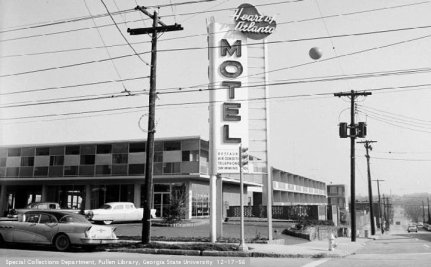
Heart of Atlanta Motel, 1956 - Special Collections and Archives,Georgia State University Library

Heart of Atlanta Motel, 1956 - Special Collections and Archives,Georgia State University Library

I wondered whether this is the motel in the case testing the 1964 Civil Rights Act — and sure enough, it is.  The case was decided, finally, by the U.S. Supreme Court in 1964, Heart of Atlanta Motel, Inc., v. United States, 379 U.S. 241 (1964) .

This important case represented an immediate challenge to the Civil Rights Act of 1964, the landmark piece of civil rights legislation which represented the first comprehensive act by Congress on civil rights and race relations since the Civil Rights Act of 1875. For much of the 100 years preceding 1964, race relations in the United States had been dominated by segregation, a system of racial separation which, while in name providing for “separate but equal” treatment of both white and black Americans, in truth perpetuated inferior accommodation, services, and treatment for black Americans.

During the mid-20th century, partly as a result of cases such as Powell v. Alabama, 287 U.S. 45 (1932); Smith v. Allwright, 321 U.S. 649 (1944); Shelley v. Kraemer, 334 U.S. 1 (1948); Sweatt v. Painter, 339 U.S. 629 (1950); McLaurin v. Oklahoma State Regents, 339 U.S. 637 (1950); NAACP v. Alabama, 357 U.S. 449 (1958); Boynton v. Virginia, 364 U.S. 454 (1960) and probably the most famous, Brown v. Board of Education of Topeka, 347 U.S. 483 (1954), the tide against segregation began to turn. However, segregation remained in full effect into the 1960s in parts of the southern United States, where the Heart of Atlanta Motel was located, despite these decisions.

The Atlanta Time Machine, a great collection of photos in the history of Atlanta and Georgia, has more photos, and this description of the site:

The Heart of Atlanta motel, located at 255 Courtland Street NE, was owned by Atlanta attorney Moreton Rolleston Jr.  Rolleston, a committed segregationist, refused to rent rooms at his hotel to black customers.  Upon passage of the Civil Rights Act of 1964, Rolleston immediately filed suit in federal court to assert that the law was the result of an overly broad interpretation of the U.S. Constitution’s commerce clause.  Rolleston represented himself in the case, HEART OF ATLANTA MOTEL, INC. v. UNITED STATES ET AL., which  went all the way to the United States Supreme Court.  Rolleston lost when the Supreme Court ruled that Congress was well within its powers to regulate interstate commerce in such a manner.  The Hilton Hotel now stands on the former site of the Heart of Atlanta Motel.

Texts in law school rarely have illustrations.  I know the motel mostly as a citation on pages of text, great grey oceans of somnambulent text.  This case is important in civil rights, though it is mentioned almost never in history texts.  What are these cases really about?  These photos offer us insight.

The Heart of Atlanta Motel aspired to greatness in the late 1950s and 1960s — evidenced by this publicity flyer photo from the Atlanta Time Machine; notice the flag flying for the motel’s Seahorse Lounge (Atlanta is landlocked):

Heart of Atlanta Motel publicity photo - Atlanta Time Machine

Heart of Atlanta Motel publicity photo - Atlanta Time Machine; not just a podunk "motor lodge," but a "resort motel." Click for larger image.

For the 1960s, this place offered great amenities, including two swimming pools and in-room breakfast service.

Flyer for the Heart of Atlanta Motel, circa 1960 - Atlanta Time Machine image

Flyer for the Heart of Atlanta Motel, circa 1960 - Atlanta Time Machine image

This photo is amusing — I can just imagine the difficulties of launching a motor boat of this size in one of the swimming pools, obviously for a publicity stunt.  The photo is dated February 27, 1960, in the Pullen Library Collection.

Boat in the pool at the Heart of Atlanta Motel, 1960 - Atlanta Time Machine image

Boat in the pool at the Heart of Atlanta Motel, 1960 - Atlanta Time Machine image

To compare how times have changed, you may want to look at this aerial photo of the area, including the Heart of Atlanta Hotel, and compare it with modern photos which show the Hilton Hotel that replaced the property.

Rolleston appears to have had a big ego.  As noted above, he represented himself in this case, and he argued it in the Supreme Court.  Here’s a picture from about that time, from the University of Missouri-Kansas City Law School “Famous Trials” site:

Moreton Rolleston, Jr., owner of the Heart of Atlanta Motel and the attorney who argued the case at the Supreme Court - UMKC Law School image

Moreton Rolleston, Jr., owner of the Heart of Atlanta Motel and the attorney who argued the case at the Supreme Court - UMKC Law School image; photo: Wayne Wilson/Leviton-Atlanta

You may decide for yourself whether this fits the old legal aphorism that a lawyer who represents himself in a case has a fool for a client.  The Oyez site at the University of Chicago provides access to the audio of the oral arguments.  Did Rolleston argue ably?  Rolleston argued against Archibald Cox, who went on to fame in the Watergate scandals.  This appears to have been Rolleston’s only appearance before the Supreme Court; it was Cox’s ninth appearance (he argued 20 cases before the Court in his career, several well known and notable ones).

Heart of Atlanta vs. United States was argued on October 5, 1964.  The opinion was issued on December 14, 1964, a 9-0 decision against Rolleston and segregation authored by Justice Tom C. Clark (one of Dallas’s earliest Eagle Scouts).

This was a fight Mr. Rolleston picked.  He was not cited nor indicted for violation of the Civil Rights Act, but instead asked for an injunction to prevent the law’s enforcement; according to the published decision,

Appellant, the owner of a large motel in Atlanta, Georgia, which restricts its clientele to white persons, three-fourths of whom are transient interstate travelers, sued for declaratory relief and to enjoin enforcement of the Civil Rights Act of 1964, contending that the prohibition of racial discrimination in places of public accommodation affecting commerce exceeded Congress’ powers under the Commerce Clause and violated other parts of the Constitution. A three-judge District Court upheld the constitutionality of Title II, §§ 201(a), (b)(1) and (c)(1), the provisions attacked, and, on appellees’ counterclaim, permanently enjoined appellant from refusing to accommodate Negro guests for racial reasons.

Oyez summarizes the case question:

Facts of the Case 

Title II of the Civil Rights Act of 1964 forbade racial discrimination by places of public accommodation if their operations affected commerce. The Heart of Atlanta Motel in Atlanta, Georgia, refused to accept Black Americans and was charged with violating Title II.

Question 

Did Congress, in passing Title II of the 1964 Civil Rights Act, exceed its Commerce Clause powers by depriving motels, such as the Heart of Atlanta, of the right to choose their own customers?

The decision turned on the commerce clause, and the reach of Congressional power to regulate interstate commerce.

Decision: 9 votes for U.S., 0 vote(s) against
Legal provision: Civil Rights Act of 1964, Title II

The Court held that the Commerce Clause allowed Congress to regulate local incidents of commerce, and that the Civil Right Act of 1964 passed constitutional muster. The Court noted that the applicability of Title II was “carefully limited to enterprises having a direct and substantial relation to the interstate flow of goods and people. . .” The Court thus concluded that places of public accommodation had no “right” to select guests as they saw fit, free from governmental regulation.

Good decision.

Heart of Atlanta Motel is gone.  The site is occupied by the Hilton Atlanta, today.


“It Takes Balls To Execute An Innocent Man”

August 4, 2011

Occasionally I stumble into a discussion of whether anywhere in the U.S. a government may have executed an innocent person.  Generally I note the horrible Texas case in which Texas fought for years for the point that a convicted murderer whose three allowed appeals had been exhausted should not be allowed to reopen his case simply because new evidence of his innocence had emerged.  In Herrera v. Collins (506 US 390, 1993), Texas won the right to not allow evidence of innocence to get a review of the case, and the man was executed.

Ladies and gentlemen I ask you:  Why would a state fight for the right to execute an innocent man, to the Supreme Court, if it did not intend to use that right?

The question rises more frequently these days as Texas Gov. Rick Perry steams toward announcing he will run for the presidency.

I point out that Herrera came down nearly eight years before Perry stumbled into the governor’s chair, his having been standing outside the door as Lieutenant Governor when George W. Bush persuaded the Supreme Court — most of the same justices — to stop both the popular vote and change the electoral vote to give him the presidency.  So we can’t blame that one on Perry.

But we can blame the execution of Todd Willingham on Rick Perry, even understanding that he was relying on what he assumed to be good evidence in his naturally uncurious waltz of destruction across Texas.   Perry could claim he got bad advice.  Though Texas’s governer really has little more than ceremonial power and some appointments, for someone like Perry it is a big job he can barely handle.  People would cut him slack on letting an innocent man die, convicted of a capital crime that as the evidence showed at the time probably did not occur, if he’d just confess it.

Instead, Perry engaged in a four-year campaign to cover up the affair — a cover up that is so far successful.

Jonathan Chait blogging at New Republic cites Politico and The New Yorker on the way to painting all Texans as morally bankrupt for allowing the coverup to go on — justifiably, I think.  While the newspapers cover the story, outrage does not rise from the drought-stricken populace.  New Republic’s blog explained the cover-up, and Texas’s blase attitude:

Alexander Burns and Maggie Haberman have a story for Politico about Rick Perry’s limitations as a general election candidate. It’s a really excellent piece on its own terms, but at the same time, it’s a bit of a parody of a Politico story in that it takes a vital moral question, drains it of all its moral significance, and presents it in purely electoral terms. The thesis of the piece is that Perry appeals to very conservative white southerners, but not to anybody else, making him a questionable choice to head the Republican ticket. The piece bears out that thesis pretty well. In the middle it includes a glancing reference to one episode of Perry’s gubernatorial tenure:

Perry would also have to answer for parts of his record that have either never been fully scrutinized in Texas, or that might be far more problematic before a national audience.

Veterans of Sen. Kay Bailey Hutchison’s unsuccessful 2010 primary challenge to Perry recalled being stunned at the way attacks bounced off the governor in a strongly conservative state gripped by tea party fever. Multiple former Hutchison advisers recalled asking a focus group about the charge that Perry may have presided over the execution of an innocent man – Cameron Todd Willingham – and got this response from a primary voter: “It takes balls to execute an innocent man.”

The Willingham case is just one episode in Perry’s gubernatorial tenure that could be revived against him in the very different context of a national race, potentially compromising him in a general election.

If you’re not familiar with this episode, David Grann wrote about in for the New Yorker in 2009 in what may be the single greatest piece of journalism I have ever read in my life. (I am biased, as David is a friend and former colleague.) The upshot is that Perry is essentially an accessory to murder. He executed an innocent man, displaying zero interest in the man’s innocence. When a commission subsequently investigated the episode, Perry fired its members.

I’m a Texan, and I’m appalled.  Dear Reader, what can a Texan do?  Please advise.

Surely the rest of America would be concerned and shocked, no?  We can excuse goofs in the histories of our presidential candidates.  Especially since Nixon, we should be doubly wary of those who work hard to cover up their errors, rather than learn from them.

By the way, in the latest action, the office of the Texas Attorney General issued a report on the duties of the commission established to investigate Texas justice to make it more fair — the commission whose members Perry fired when they got close to the Willingham case.  The report says that that Willingham case is water under the bridge, that the commission may not investigatet cases that predate the commission’s creation.

It’s a gross miscarriage of justice, and an attack on the democratic form of government which relies very much on continuous improvement of governmental processes, especially the due processes of criminal justice.


Conviction in Massachusetts church arson — hate crimes laws at work

November 4, 2010

Did you see this press release from the U.S. Department of Justice?  Prosecutors got a conviction in a 2008 arson of a church in Massachusetts.

Here’s the press release:

For Immediate Release
November 1, 2010

U.S. Department of Justice
Office of Public Affairs

Massachusetts Man Sentenced to Federal Prison for Burning African-American Church
WASHINGTON—Benjamin Haskell was sentenced by U.S. District Judge Michael A. Ponsor in Springfield, Massachusetts to nine years in prison and three years of supervised release for his role in the 2008 burning of the Macedonia Church of God in Christ, a predominately African-American Church, on the morning after President Barack Obama was elected as the first African-American president of the United States. In addition, Haskell will pay more than $1.7 million in restitution, including $123,570.25 to the Macedonia Church.

On June 16, 2010, Haskell, 24, of Springfield, pled guilty to conspiring to injure, oppress, threaten, and intimidate the mostly African-American parishioners of the Macedonia Church in the free exercise of the right to hold and use their new church building, which was under construction, and to damaging the parishioners’ new church building through arson and obstructing their free exercise of religion because of their race, color, and ethnic characteristics.

At the earlier plea hearing, a prosecutor told the court that had the case proceeded to trial, the government’s evidence would have proven that in the early morning hours of Nov. 5, 2008, within hours of President Barack Obama being elected, Haskell and his co-conspirators agreed to burn down, and did burn down, the Macedonia Church’s newly constructed building where religious services were to be held. The building was 75 percent completed at the time of the fire, which destroyed nearly the entire structure, leaving only the metal superstructure and a small portion of the front corner intact. Investigators determined that the fire was caused by arsonists who poured and ignited gasoline on the interior and exterior of the building.

Haskell confessed to the crime and admitted that prior to the presidential election, he and his co-conspirators used racial slurs against African-Americans and expressed anger at the possible election of Barack Obama as the first African-American president. Haskell admitted that after Obama was declared the winner of the election, he and his co-conspirators walked through the woods behind the Macedonia Church to scout out burning it down. Then, in the early morning hours of Nov. 5, 2008, Haskell and his co-conspirators went back to the church, poured gasoline inside and outside of the church, and ignited the gasoline.

“The freedom to practice the religion that we choose without discrimination or hateful acts is among our nation’s most cherished rights,” said Thomas E. Perez, Assistant Attorney General in charge of the Justice Department’s Civil Rights Division. “As seen here today, the Department will prosecute anyone who violates that right to the fullest extent of the law.”

“The burning of the Macedonia Church because of racial hatred and intolerance was a vicious attack on one of our most cherished freedoms—to worship in the religion of our choice safely and without fear of discrimination,” said U.S. Attorney for the District of Massachusetts Carmen Ortiz. “The successful investigation, prosecution, and punishment of those who committed this hateful act is a clear statement that law enforcement will do all in its power to protect our citizens’ civil rights.”

“While the Bureau of Alcohol, Tobacco and Firearms (ATF) is charged with investigating some of the most violent crimes, I consider the arson to be one of the most serious and dangerous offenses. Not only was this case about the burning of a house of worship, it cut to the very heart of our most valued rights, that of religious freedom. I want to acknowledge all of our partners who assisted in bringing the individuals responsible for this fire to justice,” said ATF Special Agent in Charge Guy Thomas.

“Today’s sentencing represents just one more step toward closure and healing, not only for the victims of this hate crime, but for the Springfield community as a whole. The FBI, along with its federal, state, and local law enforcement partners, remains committed to protecting each and every citizen’s civil rights, and will aggressively investigate any violation of those rights, bringing the perpetrators to justice,” said Richard DesLauriers, Special Agent in Charge of the FBI.

The case was prosecuted by Assistant U.S. Attorneys Paul H. Smyth and Kevin O’Regan of the U.S. Attorney’s Springfield Office, and Nicole Lee Ndumele, Trial Attorney in the Department of Justice’s Civil Rights Division.


Stupid math tricks: Judge’s innumeracy screws defendant

June 4, 2010

Had difficulty with fractions in third grade, did you?


Fractions, shown on a cake  - 1/4 and 1/2

Which is larger, 1/4, or 1/2?

Nothing like the judge in this story, I’m sure.  From the depths of Europe, Zeno details how a judge’s seeming infacility with numbers took an injustice against a petitioner in his court, and made it worse.

It’s the sort of error you’d expect of a third-grade kid who hasn’t watched enough “Sesame Street.”  Which of these fractions is larger?  1/5, or 1/6?

Is the judge really that dumb, or is this an elaborate, sarcastic hoax on the petitioner?

Math teachers, can you use this to show the importance of learning math well enough to do simple math functions mentally, without paper and calculator?

While you’re at Zeno’s place, Halfway There, look around. Zeno writes well, has good stories to tell, and you could learn a lot about a lot of things — you know, just by observing.


Brave 10-year-old Arkansas boy refuses to say the Pledge of Allegiance, on principle

November 17, 2009

Adults worry about peer pressure.  Kids can goad other kids into doing stupid things, dangerous things, illegal things, and immoral things.

Pressure from adults on kids might be just as strong.

What about a 10-year-old kid who stands up to peer pressure, and stands for principle against adults who use all sorts of inducements to get him to do something he believes is wrong?

I offer a salute to Will Phillips of  West Fork School District, in Washington County, Arkansas.

Will believes homosexuals in America are not beneficiaries of  liberty and justice for all.  Will now refuses to stand and say the Pledge of Allegiance for that reason.

It’s probably not what I’d advise the young man to do to protest, but he has every right.  He’s thought it through, which may not be said for the substitute teacher and the school administrator who tried to pressure him into giving up on his principles.

In the Arkansas Times, David Koon writes the story:

A boy and his flag

Why Will won’t pledge.

David Koon
Updated: 11/5/2009

WILL PHILLIPS: Freedom lover.

Will Phillips, freedom lover, in Arkansas (Arkansas Times photo)

Will Phillips isn’t like other boys his age.

For one thing, he’s smart. Scary smart. A student in the West Fork School District in Washington County, he skipped a grade this year, going directly from the third to the fifth. When his family goes for a drive, discussions are much more apt to be about Teddy Roosevelt and terraforming Mars than they are about Spongebob Squarepants and what’s playing on Radio Disney.

It was during one of those drives that the discussion turned to the pledge of allegiance and what it means. Laura Phillips is Will’s mother. “Yes, my son is 10,” she said. “But he’s probably more aware of the meaning of the pledge than a lot of adults. He’s not just doing it rote recitation. We raised him to be aware of what’s right, what’s wrong, and what’s fair.”

Will’s family has a number of gay friends. In recent years, Laura Phillips said, they’ve been trying to be a straight ally to the gay community, going to the pride parades and standing up for the rights of their gay and lesbian neighbors. They’ve been especially dismayed by the effort to take away the rights of homosexuals – the right to marry, and the right to adopt. Given that, Will immediately saw a problem with the pledge of allegiance.

“I’ve always tried to analyze things because I want to be lawyer,” Will said. “I really don’t feel that there’s currently liberty and justice for all.”

After asking his parents whether it was against the law not to stand for the pledge, Will decided to do something. On Monday, Oct. 5, when the other kids in his class stood up to recite the pledge of allegiance, he remained sitting down. The class had a substitute teacher that week, a retired educator from the district, who knew Will’s mother and grandmother. Though the substitute tried to make him stand up, he respectfully refused. He did it again the next day, and the next day. Each day, the substitute got a little more cross with him. On Thursday, it finally came to a head. The teacher, Will said, told him that she knew his mother and grandmother, and they would want him to stand and say the pledge.

“She got a lot more angry and raised her voice and brought my mom and my grandma up,” Will said. “I was fuming and was too furious to really pay attention to what she was saying. After a few minutes, I said, ‘With all due respect, ma’am, you can go jump off a bridge.’ ”

Will was sent to the office, where he was given an assignment to look up information about the flag and what it represents. Meanwhile, the principal called his mother.

“She said we have to talk about Will, because he told a sub to jump off a bridge,” Laura Phillips said. “My first response was: Why? He’s not just going to say this because he doesn’t want to do his math work.”

Eventually, Phillips said, the principal told her that the altercation was over Will’s refusal to stand for the pledge of allegiance, and admitted that it was Will’s right not to stand. Given that, Laura Phillips asked the principal when they could expect an apology from the teacher. “She said, ‘Well I don’t think that’s necessary at this point,’ ” Phillips said.

After Phillips put a post on the instant-blogging site twitter.com about the incident, several of her friends got angry and alerted the news media. Meanwhile, Will Phillips still refuses to stand during the pledge of allegiance. Though many of his friends at school have told him they support his decision, those who don’t have been unkind, and louder.

“They [the kids who don’t support him] are much more crazy, and out of control and vocal about it than supporters are.”

Given that his protest is over the rights of gays and lesbians, the taunts have taken a predictable bent. “In the lunchroom and in the hallway, they’ve been making comments and doing pranks, and calling me gay,” he said. “It’s always the same people, walking up and calling me a gaywad.”

Even so, Will said that he can’t foresee anything in the near future that will make him stand for the pledge. To help him deal with the peer pressure, his parents have printed off posts in his support on blogs and websites. “We’ve told him that people here might not support you, but we’ve shown him there are people all over that support you,” Phillips said. “It’s really frustrating to him that people are being so immature.”

At the end of our interview, I ask young Will a question that might be a civics test nightmare for your average 10-year-old. Will’s answer, though, is good enough — simple enough, true enough — to give me a little rush of goose pimples.  What does being an American mean?

“Freedom of speech,” Will says, without even stopping to think. “The freedom to disagree. That’s what I think pretty much being an American represents.”

Somewhere, Thomas Jefferson smiles.


Obama’s eligibility: California court tossed the challenge out

October 30, 2009

On the one hand it’s nice to see cool heads and wisdom prevail.

On the other hand, the Orly Taitz, Stumbling and Bumbling Bros., Barnyard Bailout Circus provided belly laughs for everyone who watched it.  How can such outstanding legal pratfall comedy possibly be replaced?  “Boston Legal” can’t hold a candle to Orly Taitz.

CNN and other sources report that Judge Carter booted the suit late Thursday, noting that the question is one for Congress, and Congress’s earlier decision sticks.

The lawsuit represented the claim by the so-called “birthers” movement that Obama was not born in Hawaii – despite a birth certificate to the contrary – or that if he was, his citizenship was invalidated by living overseas as a child.

In a 30-page ruling, U.S. District Judge David O. Carter of California said his court lacked the jurisdiction to rule on a case intended to unseat a sitting president.

Carter’s ruling said the plaintiffs were trying to persuade him to “disregard the constitutional procedures in place for the removal of a sitting president.”

“The process for removal of a sitting president – removal for any reason – is within the province of Congress, not the courts,” the ruling said.

Carter’s ruling also noted that the plaintiffs “have attacked the judiciary, including every prior court that has dismissed their claim, as unpatriotic and even treasonous for refusing to grant their requests and for adhering to the terms of the Constitution.”

“Respecting the constitutional role and jurisdiction of this court is not unpatriotic,” the ruling said. “Quite the contrary, this court considers commitment to that constitutional role to be the ultimate reflection of patriotism.”

Will Orly Taitz go quietly?  How can she replace the daily adrenaline rush of knowing she’s earned the official ire of judges from Chesapeake Bay to Long Beach Harbor?

It may be unrelated, but sketchy early reports say Orly Taitz has climbed aboard a mylar balloon shaped like a flying saucer . . .

More information:


Vintage film on Japanese internment during World War II

May 20, 2009

[Google Video version is not showing or playing for reasons I don’t know; fortunately the National Archives (NARA) has uploaded a version to YouTube]

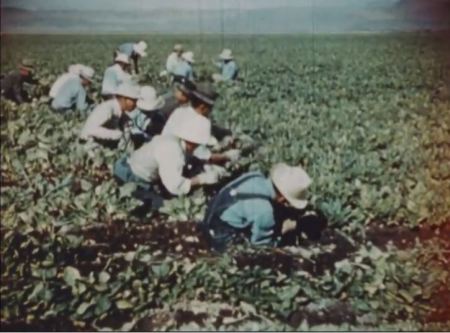
“A Challenge to Democracy,” by the War Relocation Board.  This film defends the relocation of 100,000 Japanese Americans during World War II.

Japanese-descended American citizens harvesting crops they grew during internment during World War II. Screen capture from "Challege to Democracy."

Japanese-descended American citizens harvesting crops they grew during internment during World War II. Screen capture from “Challege to Democracy.”

“These people are not under suspicion,” the narrator says.  “They are not prisoners, they are not internees.  They are merely dislocated people, the unwounded casualties of war.”

According to the Internet Archive, the film is a 1944 production.  That site has the film available for download in several formats.  The film is collected in the Prelinger Archives.  On my computer, some of the Internet Archive versions offer  better quality than the Google Video version above.

I originally found the film at a school site in Washington, Mr. Talmadge’s Wikispace site, apparently for his classes in the history of the State of Washington.  That site has a very useful series of links to good sites on the internet for information about the Japanese internment.  There are several other topics noted there, too, including the Chinese Exclusion Act, the Whitman Massacre in Oregon, and the Nez Perce Retreat.  I’d love to see Mr. Talmadge’s plan for the year.

What do your students do to display their work on the internet?


Tiger justice, with a hint of poetry

February 23, 2009

Wild Sumatran tiger.jpg  Face on with wild tiger in Sumatra. This animal didnt like camera traps and destroyed three over a weekend. Photo by Michael Lowe, 2006, Wikimedia Commons

Wild Sumatran tiger - "Face on with wild tiger in Sumatra. This animal didn't like camera traps and destroyed three over a weekend." Photo by Michael Lowe, 2006, Wikimedia Commons. See William Blake's poem, below.

Reuters reports from Jakarta, on six people killed by tigers in Indonesia recently:

On Sunday, a tiger attacked and killed a man carrying logs near an illegal logging camp, Wurjanto said. Two other loggers in the same area were mauled and killed on Saturday.

Preliminary findings suggested the attacks were taking place because people were disturbing the habitat of the tigers, Wurjanto said.

*   *   *   *   *

The Sumatran tiger is the most critically endangered of the world’s tiger subspecies.

Forest clearances, killings due to human-tiger conflict, and illegal hunting for the trade in their parts, have led to tiger numbers halving to an estimated 400-500 on the Indonesian island from an estimated 1,000 in the 1970s, conservationists said.

Under Texas law, a homeowner may use deadly force to  stop trespassers, especially someone who poses a threat to the homeowner and the property.  I wonder whether the tigers will even get a trial.

A tree poacher mauled to death by the endangered tigers whose habitat he destroys:  Perfect example of poetic justice.

The Tyger

Tyger! Tyger! burning bright,
In the forests of the night,
What immortal hand or eye
Could frame thy fearful symmetry?

In what distant deeps or skies
Burnt the fire in thine eyes?
On what wings dare he aspire?
What the hand dare seize the fire?

And what shoulder, and what art?
Could twist the sinews of thy heart?
And when thy heart began to beat,
What dread hand, and what dread feet?

What the hammer? What the chain?
In what furnace was thy brain?
What the anvil? What dread grasp
Dare its deadly terrors clasp?

When the stars threw down their spears,
And watered heaven with their tears,
Did he smile his work to see?
Did he who made the Lamb, make thee?

Tyger! Tyger! burning bright,
In the forests of the night,
What immortal hand or eye
Dare frame thy fearful symmetry?

— William Blake

Resources:


Supreme Court: No review of Obama eligibility

December 6, 2008

Generally the orders coming out of Friday conferences at the Supreme Court issue the following Monday. So, for Obama critics and dedicated Obama haters, there is still some hope that the Supreme Court might answer part of their wildest dreams. But it doesn’t look good for them.

[Saturday night update: Donofrio’s blog acknowledges the orders don’t include his case. He’s holding out for Monday. Technically, he’s right — the orders usually would issue Monday. But if Friday’s orders issued from Friday’s conference, it doesn’t speak well of the chances that an age discrimination case took precedence over a case challenging the election still in process. We won’t know for sure, until Monday.]

[Monday morning update, December 8: It’s official. Donofrio’s case was not accepted for a hearing. As the Washington Post noted, there are other pending cases, but nothing likely to be acted on soon. I’ve noted in other posts, I think it unlikely any of the cases has a signficant chance of success.]

No order issued from the Supreme Court to further discuss the appeal of the dismissal of a New Jersey lawsuit challenging Barack Obama’s eligibility to be president. Instead, the Court granted certiorari to an accused terrorist to challenge President George W. Bush’s authority (which will fall to President Barack Obama, really), and the Court granted cert and an okay for an amicus brief on a labor case (age discrimination).

(writ of certiorari: [Law Latin “to be more fully informed”] An extraordinary writ issued by an appellate court, at its discretion, directing a lower court to deliver the record in the case for review. ♦ The U.S. Supreme Court uses certiorari to review most of the cases it decides to hear.) Black’s Law Dictionary, 7th ed. (Bryan Garner, ed.)

Assuming this listing to be accurate, the shotgun arguments against Obama’s eligibility appear to be dead issues. The electoral college balloting occurs on December 15 in 50 state capitals and the District of Columbia.

Short of a mass exodus of Obama electors in states where law does not bind them to vote as they pledged to vote, Obama’s selection by the electoral college appears to be fait accompli.

The Wall Street Journal’s Law Blog noted the lack of order in the case, late yesterday.

For thousands of people addicted to the tubes of the internet, this will pose interesting problems as to what they can whine about for the next several weeks.

Previous comments on the Bathtub:

Over the front door of the U.S. Supreme Court:

Over the front door of the U.S. Supreme Court: “Equal Justice Under Law.” Wikipedia image by UpStateNYer


“Utah Supreme Court tosses conviction of ‘wedgie’ killer”

July 9, 2008

That’s the real headline from the Salt Lake Tribune.

Wedgie killer?

Reality once again demonstrates that hoaxes can’t keep up. Truth is either stranger than fiction, or just better.

You just can’t make this stuff up:

The Utah Supreme Court today threw out the manslaughter conviction of Erik Kurtis Low, who killed a Park City man after the victim gave him a “wedgie.”

Low, now 40, claimed in his 2005 trial he was defending himself when he shot 38-year-old Michael Jon Hirschey following a night of drinking, drug use and horseplay.

Ah, the old drinking, drug use and horseplay excuse.

The Utah Supreme Court said the trial court erred in instructing the jury on possible sentences, giving the jury too many ways to find the man guilty. The conviction was tossed out. Prosecutors cannot retry on the old charges, but new charges are possible.

Watch that space. Accurate history is always better than the hoax stuff.

Other resources:


Barbara Jordan

February 12, 2008

Rereading the Gettysburg Address and the Cooper Union speech of Lincoln, I wondered for a few moments whether there are others with similar gifts for words who might be on film or tape. It got me thinking about the vast gulf between religion on the one hand, and faith and justice on the other hand.

Then I got a notice of a link from this post about Barbara Jordan, at Firedoglake.

It’s a nice collection of links, a Barbara Jordan tribute all bundled up ready to unwrap. Sometimes truth does go marching on.

Who since Jordan?

(Thanks to Phoenix Woman at Firedoglake for the post, and for the link here.)

The Cooper Union speech of Lincoln was 148 years ago, on February 27.


Historian (and lawyer) traps thief of history on eBay

January 29, 2008

Another story of another amateur historian going out of his way to save history in the form of a letter stolen from the New York State Library.Is Joseph Romito a Boy Scout? Can we give him a medal?


“Grave breaches” of the Geneva Conventions

January 2, 2008

I tell students to go to the source; if they read the original documents, that puts them ahead of 99% of the people who claim to know what they are doing, especially in history.

Do you know what is a “grave breach” under the Geneva Conventions? Below the fold, material from the International Committee of the Red Cross (ICRC), with links to more original document material. DBQ, anyone?

Read the rest of this entry »


Bush continues push to make U.S. a banana republic

January 2, 2008

Some of us were still digesting the heart- and conscience-rending story of the Navy Judge Advocate General (JAG) who resigned rather than continue to work in an organization that unethically endorsed torture, when we also became aware of the Bush administration’s plan to politicize the justice operations of the U.S. military. (See Geneva Conventions, here.)

Jurist, a news organ from the University of Pittsburgh Law School, with the short version here (with a recounting of other political troubles in JAG); the Boston Globe has the longer version here.

It’s the sort of move one expects from Pakistan’s President Pervez Musharaf; it’s the sort of move one would expect President Hugo Chavez to try in Venezuela, before the college students and military shout him down. It’s a banana republic-style action. It’s a move beneath a U.S. politician. Or, it should be.

If Orrin Hatch and Arlen Specter were alive today, you can bet this proposal would be dead.

For high school history and government teachers, these are exciting times. Abuses of the Constitution and potential crises cross the headlines every day. Each of these stories tells students the importance of knowing government and where the levers of power are.

Jan Carlzon at SAS Airline used to say people armed with knowledge cannot help but act. We must be missing the boat — where is the action?

Tip of the old scrub brush to Ed Brayton at Dispatches from the Culture Wars.


Worst ever U.S. industrial accident, 1947: 576 dead

April 14, 2007

April 16 marks the 60th anniversary of the Texas City Disaster. A large cargo ship being loaded with tons of ammonium nitrate caught fire and exploded, setting fire to other nearby ships, one of which exploded, and devastating much of the town. In all, 576 people died in Texas City on April 16 and 17, 1947.

View of Texas City from across the bay, in Galveston, April 16, 1947

View of Texas City from Galveston, across the bay, after the explosion of the French ship SS Grandcamp, April 16, 1947. Photo from International Association of Fire Fighters Local 1259

The incident also produced one of the most famous tort cases in U.S. history, Dalehite vs. United States, 346 U.S. 15 (1953). (Here is the Findlaw version, subscription required.)

The entire Texas City fire department was wiped out, 28 firefighters in all. The International Association of Fire Fighters, Local 1259 has a website dedicated to the history of the disaster, with a collection of some powerful photographs.

More below the fold. Read the rest of this entry »