Declaration of War on working Americans

June 9, 2011

I get e-mail, even sometimes from the CATO Institute:

For your interest…

Cato has launched the Department of Labor portion of www.DownsizingGovernment.org

http://www.downsizinggovernment.org/labor

The site includes essays on unemployment insurance, job training programs, labor union laws, and trade adjustment assistance.

Please enjoy,

Chris Edwards
Editor, www.DownsizingGovernment.org
Cato Institute

Doesn’t that sound like a declaration of war on working people, to you?  If not, why not?


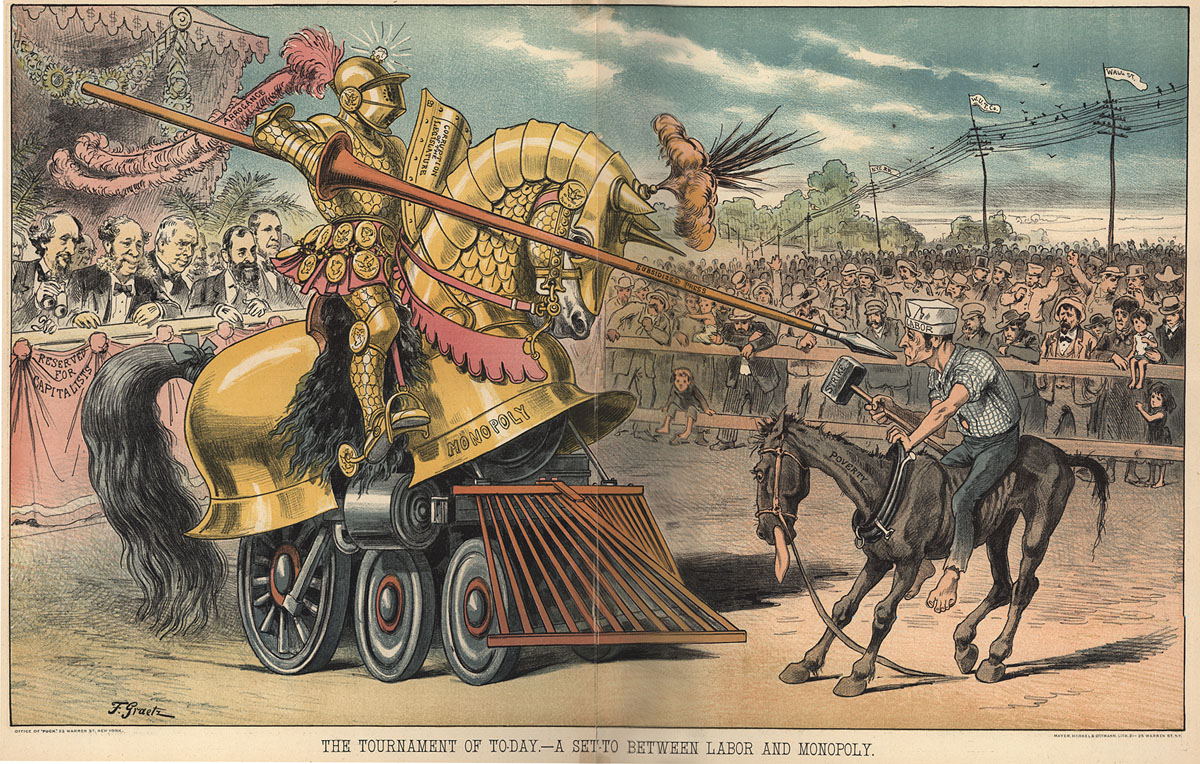
Then and now: Capitalism vs. Labor 1883, and today

April 2, 2011

Alas, it’s almost exactly the same now as then:

"Tournament of Today:  A set-to between Labor and Monopoly," Cartoon by Frederick Graetz, Puck Magazine, August 1, 1883 (from files of Georgia State University); click image for a larger view at Georgia State

“Tournament of Today: A set-to between Labor and Monopoly,” Cartoon by Frederick Graetz, Puck Magazine, August 1, 1883 (from files of Georgia State University); click image for a larger view at Georgia State

Information on the cartoon, from SuperITCH: Frederick Graetz, a chromolithograph that was the center spread for Puck Magazine‘s issue of August 1, 1883.  Monopolists portrayed are, from left to right, “businessman, financier and telecommunications pioneer Cyrus Field; railroad tycoon William Vanderbilt; shipbuilding magnate John Roach; financier, railroad mogul, and speculator Jay Gould; and an unknown monopolist.”  Some might say that the “unknown monopolist” bears a striking resemblance to one of the Koch brothers, but that’s fanciful thinking.

Cartoon - Labor vs Monopoly, Graetz, Puck 8-1-1883 (GSU image)

Labor vs Monopoly – click on this image for a larger version of this historic Puck Magazine cartoon

Tip of the old scrub brush to One Penny Sheet’s “condemned to repeat” feature.

More:


FOIA “request” in Wisconsin could be violation of whistleblower protection law

March 27, 2011

Wisconsinite Jean Detjen sent me a note correcting my misinformation:  Wisconsin does indeed have a whistleblower protection act.  The law protects Wisconsin state employees, against retaliation for disclosing information about wrongdoing.

William Cronon, Frederick Jackson Turner Professor of History, University of Wisconsin

William Cronon, Frederick Jackson Turner Professor of History, University of Wisconsin - University of Wisconsin photo

My reading suggests that, since professors are not specifically exempted, Prof. Cronon, at the University of Wisconsin, is specifically protected.

If the University of Wisconsin gives that answer to the Wisconsin Republican Party, however, the Party will argue that it is not a government official prevented from retaliating against a government employee.  That would be ample reason for the state to deny the FOIA request of the Party flatly and completely.

There is another, potentially more pernicious angle here:  The Republican Party in Wisconsin is, in this case, an agent of the Republicans in the state legislature, those whose tails are on the line for violating Wisconsin law, and as Prof. Cronon outlines it, Wisconsin tradition and historical norms.  It’s likely that the Party is acting at the direction of legislators.

In short, it’s kind of an organized crime action.  I think that the federal Racketeer Influenced and Corrupt Organization Act (RICO) would cover this sort of action — any retaliation for hire, or by an agent, which creates a pattern or practice of organized crime activities.  Worse for the Wisconsin Republicans, if there were an ambitious U.S. attorney out there somewhere, there is no scienter requirement on RICO actions — that is, there need not be a clear formation of criminal intent.  The mere actions of an organized crime group, even with no intent to break the law, can be a RICO violation.

Even worse for the Republicans, RICO is available for anyone to use.  Were I Prof. Cronon, and were the Republicans to press their FOIA request to court, I’d counterclaim in federal court with the RICO statute.

That’s a nasty escalation.  But in these days, in this case, where a state party organization has gone to the employer of a university professor to get his job after he merely reported history, I wouldn’t take chances that the Republicans would later play fair or nice.

Every step against Cronon, every press release, every statement from a legislator or party apparatchik, provides more evidence of the coordinated effort, and establishes further the “pattern and practice” of organized crime activity.

Maybe cool heads will soon prevail, maybe patriotism and love of the First Amendment will break out among Wisconsin Republicans, and they will retract their demand that Prof. Cronon deliver them all of his e-mails as a professor at  the University of Wisconsin.

Maybe badgers will fly.

“Badger” is supposed to be the mascot of Wisconsin’s top-flight university, not a tool of partisan politics.


EDUSolidarity Day After, Part 3: Why would a teacher like me hang with a union?

March 23, 2011

I mean, really.  I have two degrees after attending three colleges.  I’ve taught at three different universities.  My parents were (nominally) Republicans.  I worked the Republican side of the U.S. Senate, for Orrin Anti-Labor-Law-Reform Hatch, for heaven’s sake.  I sat  through the hearings on the graft in the Operating Engineers local, the graft in the welders union in Pennsylvania that provided workers to the nuclear reactors, and the graft in the Central States Teamsters Pension Fund.  Two of my staff colleagues went on to chair the National Labor Relations Board, one is a well-known anti-labor lobbyist, and I’ve sat through the “no union here, ever” courses at three different corporations as a member of management.

What gives?

Why do I and other teachers stick with the union?

Diagram of a Liberty Ship

Diagram of a Liberty Ship

My father did carry a union card, though he was a Republican.  He had lots of stories about the difficulty of working with unions from his days with the United Cigar Stores in Los Angeles, and he probably had plenty of reason  to dislike them — but he got a job as a pipefitter building Liberty Ships.  He had to join the pipefitters union, and so he did.

Deep at heart, my father wanted to be a successful businessman.  After the war, he went back to sales.  He wound up in Burley, Idaho, managing a Western Auto store, when he struck out on his own.  Well, he and a partner.  Sedam and Darrell Furniture.  They had a disagreement, and it ended up as Sedam’s on one side of town, and Paul Darrell Hotpoint on the other.

Liberty Ships under construction during World War II

Liberty Ships under construction during World War II

It was about that time that he got a lung x-ray for something, and they found the spot.  He’d given up smoking in the 1930s, but as a pipefitter, he put a lot of asbestos on pipes to shield merchant marines from heat, to insulate the pipes, to prevent shipboard fires.  That was before the dangers of asbestos were well understood.  On the x-ray, it looked like cancer.

But it didn’t grow.  The spot just stayed there, for years.

The store in Burley fell victim to a bad economy when the union at J. R. Simplot Potatoes struck one year, in November.  The strikers weren’t buying Christmas gifts.  There were about 16 furniture and appliance stores in a county with about 16,000 people total.  Several of them didn’t survive the strike and my father’s was one of them.  A lot of people in town cursed the union for causing the strike.  On one of our trips moving to Utah, I rode with Dad and asked him about it, and why the union went on strike.  As a victim of the strike, he could have unloaded.  But he didn’t.

He explained how workers organized to get power to negotiate with big businesses.  Jack Simplot was a man we knew, a good man and a customer from all we knew — but the workers were good people, too, my father explained.  Sometimes workers and employers can’t agree.  My father explained that a strike was one of the few tools workers could use to get an employer to change his position against his will.  I told him I thought it was unfair that workers could strike and force other businesses out.  My father explained that it was tougher on the workers who didn’t buy from us — they needed the stuff they didn’t buy.

Over the next few years I watched as my father got screwed over by good people running good companies, people who were anti-union, but more, anti-employee.  He lost guaranteed bonuses.  He lost promised promotions.  He didn’t get promised raises.  My father never again owned his own business.  Instead he was an employee, unprotected by unions in a string of positions where union protection would have been a good deal for him.  He could not strike, as the workers at J. R. Simplot had.

One of the investigators for the Senate Labor Committee was a character of great proportion — no central casting bureau could have thought up a character like Frank Silbey.  Silbey headed Orrin Hatch’s investigations into unions, and he was a marvel to watch.  Soon after Hatch took over as chair of Labor, Silbey and I had a long lunch to work out just how we would work together.  I expressed to him my concern that any investigation of a union might hurt unions, and hurt workers.

Silbey thought for a minute, and took in a deep breath.  He started to put his finger in my face, but he stopped, and used it to doodle on the table cloth at the old Monocle, near his office in an odd building the Senate owned.

“Listen,” he said.  “You need to know that I am not anti-union.  I can’t be.”  And he told me about his own father.

I don’t remember the business.  I remember that Frank talked about how his family was not rich by any stretch, and his father worked hard at a union job.  The old man had not a lot of time for friends off the job, not after spending the time he wanted to with his wife and kids.  And so it was that, when he died unexpectedly, too young, Frank’s mother knew that it would be a sad funeral, with very few people attending.

When they got to the synagogue for the funeral, though, there was a huge crowd.  The place was literally overflowing with people.  The union had closed the business in honor of Mr. Silbey, and the union turned out for the funeral.  Each of the workers spent time meeting the widow, and telling her what a great man and good friend her husband had been.

“And that’s why I can’t ever be anti-union,” Frank said.  “When all is said and done, the union will stick by you when nobody else does.”

Over the next five years we found a few unions where that was not exactly true, but in most of those cases, those people who made that not true, went to jail.

The health care side of the Senate Labor Committee had a hearing into lung diseases, including black lung, brown lung, and the mesothelioma, the disease pipefitters got from asbestos.  One of the witnesses came from a pipefitters union.  Among other things, he testified to the astonishing rates of illness and untimely deaths among the pipefitters on the World War II Liberty Ships.

On the way out of the hearing I mentioned to the guy that my father had worked on the Liberty Ships, as a pipefitter.  He looked stricken, and paled.  He pulled me off to the side of the hallway, and said, “I am so sorry for you.  Your father did heroic work and the nation owes him a deep debt.”  No one had ever spoken about my father like that to me before, and I teared up.

“How long has he been gone,” the guy asked.

“Well, he’s got a spot on his lung, but it hasn’t changed.  He’s still alive,” I said (my father would die within the decade).

The pipefitters representative smiled, then laughed.  “He’s one of a very small band of survivors.  He’s still a hero, though.”

Throughout his life, my father was a very good man.  Think of the character Jimmy Stewart played in “It’s a Wonderful Life.”  That was my father.  He organized across party lines for local elections.  He organized blood drives.  During the Korean War he headed the local program to take care of soldiers passing through town who ran out of money, or got sick, or got thrown in jail.  My father served on more Troop Committees for the various Boy Scout units my brothers and I joined than anyone had a right to expect.

For all his good work, he didn’t get anything but his own satisfaction out of it.

It was a staffer who never met him, for a union he hadn’t worked in for 40 years who called him the hero he was.

“When all is said and done, the union will stick by you when no one else does,” Frank Silbey said.

It’s still true.  In America, we still need that kind of loyalty to working people, especially to teachers.  We need it now more than ever.


EDUSolidarity Day

March 22, 2011


From the EDUSolidarity site:

Throughout the day of March 22, teachers will be sharing posts entitled “Why Teachers Like Us Support Unions”.  For those of you here to share, thank you for doing so.  To submit your posts, click here.

For those of you not sharing, we hope you will take the time to read from an extremely varied and wide variety of teachers across the country and world.  We ask that you read with open minds.  You will read many different reasons for support, some of them contradictory.  What all stories will share though is a desire to serve students.  We all feel that teachers unions give us the best shot to give our students the best possible education.

The full list of posts can be found here.

If you’re a blogger and you want to join us, please do.  Send the link to your post to the EDUSolidarity site — and let us know about it here, in comments.

Teachers in New York City are wearing red in support of union teachers (so are some in Dallas).

Of course, this is a part-time activity for those of us who teach.  I don’t have my post up yet, and may not until the school day is over.

We’re professional teachers, not professional lobbyists.  We don’t have billionaires paying for our political speech, only our hearts and minds.

Other bloggers’ contributions

  1. Rachel Levy at All Things Education
  2. Sarah Puglisi at A Day in the Life
  3. Leo Casey at EdWize
  4. Sherman Dorn
  5. f(t)
  6. Gregg Lundahl at Edwize
  7. Doug Noon – Borderland – Fairbanks, AK.
  8. Jamie JosephsonDontworryteach – Washington, DC.
  9. Kate Nowakf(t) – Syracuse, NY.
  10. Sabrina Stevens Shupe – Failing Schools – Denver, CO.
  11. Jonathan – jd2718 – Bronx, NY.
  12. Anthony Cody – Living in Dialogue – Oakland, CA.
  13. Stephen Lazar – Outside the Cave – Gotham Schools – Bronx, NY.
  14. Nancy Flanagan – Teacher in a Strange Land – Cedar, MI.
  15. Ken Bernstein aka “teacherken”teacherken at Daily Kos – Arlington, VA. teacherken
  16. Jose Vilson – The Jose Vilson – New York, NY. thejlv
  17. Sophie Germain – A Brand New Line – Santa Clara, CA. sophgermain
  18. Sarah PuglisiA Day In the Life – Oxnard, CA.
  19. Jeff Silva-BrownA Passion for Teaching and Opinions – Ukiah, CA. ukiahcoachbrown
  20. Dan Anderson – A Recursive Process – Saratoga Springs, NY. dandersod
  21. Mr. A. TalkAccountable Talk – New York, NY.
  22. Frank Noschese – Action-Reaction – Cross River, NY. fnoschese
  23. Lisa Butler – Adventures with Technology – Harrisburg, PA. SrtaLisa
  24. Rachel Levy – All Things Education – Ashland, VA. RachelAnneLevy
  25. Jason BuellAlways Formative – San Jose, CA. jybuell
  26. The Reflective EducatorAn Urban Teacher’s Education – New York, NY. urbanteachersed
  27. Apple A Day – Apple A Day Project – Boston, MA. appleadayproj
  28. Amy Valens – August to June: Bringing Life to School – New York, NY. augusttojune
  29. Chana – Blogging at the Edge of Democracy – Durham, NC. democracysedge
  30. Bud Hunt – Bud the Teacher – Fort Collins, CO. budtheteacher
  31. ChazChaz’s School Daze – Queens, NY.
  32. Marc Bousquet – Chronicle of Higher Education – Los Gatos, CA.
  33. David Coffey – Delta Scape – Spring Lake, MI. delta_dc
  34. Leo CaseyDissent Magazine – New York, NY.
  35. Brent NyczDon’t Settle – New York, NY. BNiche
  36. Peter – Ed in the Apple – New York, NY.
  37. Norm ScottEducation Notes – Rockaway Beach, NY.
  38. Deven Black – Education on the Plate – New York City, NY. devenkblack
  39. David Andrade – Educational Technology Guy – Bridgeport, CT. daveandcori
  40. educator4WI – educator4WI – Madison, WI.
  41. Francis S. Midy – EduSolidarity Essays – Bronx, NY.
  42. Suzanne Donahue – EduSolidarity Essays – Rockland County, NY.
  43. Eric BrunsellEdutopia – STEM Blog – Appleton, WI. Brunsell
  44. Esther BerksonEdwize – Bronx, NY.
  45. Jason LeibowitzEdwize – New York, NY.
  46. Jessica JacobsEdwize – Staten Island, NY.
  47. Lissette VelazquezEdwize – New York, NY.
  48. Marc KorashanEdwize – New York, NY.
  49. Roseanne McCoshEdwize – Bronx, NY.
  50. JennyElementary, My Dear, or Far From It – Springfield, VA. jenorr
  51. Marie Levey-Pabst – English Teachin’ Vegan – Boston, MA.
  52. Christal WattsFive Feet of Feisty – Fairfield, CA. christal_watts
  53. Jay Bullockfolkbum’s rambles and rants – Milwaukee, WI. folkbum
  54. Fred Klonsky – Fred Klonsky’s Blog – Chicago, IL. fklonsky
  55. Zeno – Halfway There – Northern CA.
  56. Mimi YangI Hope This Old Train Breaks Down… – El Salvador (formerly NYC). untilnextstop
  57. Cathy B – I.M.O. In My Opinion – Detroit, MI. Cathy_Brackett
  58. David B. Cohen – InterACT – Palo Alto, CA. CohenD
  59. Ruben BrosbeIs Our Children Learning? – New York, NY. blogsbe
  60. Lynne Winderbaumjd2718 (friend’s blog) – Rockland County, NY.
  61. Larry Ferlazzo – Larry Ferlazzo’s Websites of The Day – Sacramento, CA. larryferlazzo
  62. Julia TsyganLearning (by) Teaching – Stockholm, Sweden.
  63. Kathryn Coffey – Literacy Gurl – Spring Lake, MI. literacygurl
  64. Gregg LundahlLundahl – New York, NY.
  65. Brian CohenMaking the Grade – Philadelphia, PA. bncohen
  66. Mark Anderson – MAnderson’s Bubble – New York, NY. mandercorn
  67. Nick Yates – Maryland Math Madness – Baltimore, MD. nyates314
  68. CurmudgeonMath Curmudgeon – VT.
  69. Chris Hill – Math is a Shovel – Seattle, WA. hillby258
  70. Sue VanHattum – Math Mama Writes – Richmond, CA.
  71. Owen Thomas – MathEdZineBlog – Columbus, OH. vlorbik
  72. John Goldenmathhombre – Grand Haven, MI. mathhombre
  73. Miss Adventure – Miss Adventure’s Adventures – GA.
  74. Michael Dunn – Modern School – San Francisco, CA. ModSchool
  75. Bill IveyMy Blog at ISENET.ning.com – Shelburne Falls, MA.
  76. Tricia DiPasqualeMy Life – Somerville, MA. PDiPasquale
  77. Kristen FoussMy Web 2.0 journey – Cincinnati, OH. fouss
  78. Courtney FerrellNo Teacher Left Behind – New York, NY.
  79. Miss EyreNYC Educator – New York, NY.
  80. Christopher SearsOmega Unlimited – Maysville, KY.
  81. Stephen LazarOutside the Cave – Bronx, NY. SLazarOtC
  82. John Mcrann – Outside the Cave (guest post) – Bronx, NY.
  83. Penelope MillarOutside the Cave (Guest post) – VA. PetiteViking
  84. Alexa – Pas Pour Tout Les Yeux (personal blog, mostly private) – Chicago, IL.
  85. Chris Spiliotispassing notes – Enterprise, FL. _thelink
  86. Pat BallewPat’s Blog – USA.
  87. Peggy RobertsonPeg with Peg – Centennial, CO. PegwithPen
  88. Brendan Murphy – Philosophy Without A Home – Waukegan IL. dendari
  89. pissedoffteacherPissedoffteacher – Queens, NY.
  90. Chris LehmannPractical Theory – Philadelphia, PA. chrislehmann
  91. Gamal Sherif – ProgressEd – Philadelphia, PA.
  92. Alice Mercer – Reflections on Teaching – Sacramento, CA. alicemercer
  93. Chuck Olynyk – Remember Fremont – Pomona, CA.
  94. Nancy Cavillones – Se Hace Camino al Andar – Bronx, NY.
  95. Shakespeare’s SisterShakespeare’s Sister – CO. shakes_sister
  96. Sherman Dorn – Sherman Dorn – Tampa, FL. shermandorn
  97. Chris Janotta – SOS Million Teacher Blog Site – Tinley Park IL. SOSMTM
  98. Ira David Socol – SpeEdChange – Holland, MI. irasocol
  99. Maria AngalaTeacher Sol – Washington, DC. TeacherSol
  100. Mary Rice-BootheThe Education Traveler – New York, NY. Edu_Traveler
  101. Jose VilsonThe Jose Vilson – New York, NY. thejlv
  102. Timothy Boyle – The Notebook – Philadelphia, PA.
  103. Samuel ReedThe Philadelphia Public School Notebook – Philadelphia, PA. sriii2000
  104. Kelly Mueller – The Power of Accomplished Teaching – St. Louis, MO. lkelly46
  105. Rich Trash – The Trashman’s Disposable Reader – Queens, NY. RichTrash
  106. David ReberTopeka K-12 Examiner – Lawrence, KS. David_Reber
  107. Tuba BauhoferTuba Bauhofer – Kent. springrose12
  108. Mary Tedrow – Walking to School – Winchester, VA. mtedrow
  109. Katie Svoboda – What’s on Katie’s Mind? – Sturgis, MI.
  110. Paul Wagnerzenbassoon at Daily Kos – Hebron, IN. BssnistPaul

Quote of the moment: Goodbye unions, goodbye democracy

March 20, 2011

Nelson Lichtenstein, University of California - Santa Barbara

Nelson Lichtenstein, University of California - Santa Barbara, Santa Barbara Independent photo

Most jobs in America are not in manufacturing or subject to international competition. So the service sector, retail, construction — there are a huge number of jobs where international competition has nothing to do with it. The obstacles there are domestic. Labor law is totally dysfunctional. Workers really don’t have the right to form unions of their choosing. So you’re right to be pessimistic, just for different reasons.

I also have a mega-historical answer to that question, though. If you look at the last 150 years of history across all nations with a working class of some sort, the maintenance of democracy and the maintenance of a union movement are joined at the hip. We’ve seen this dramatically reconfirmed in Spain and South Korea and Poland over the years. If democracy has a future, then so too must trade unionism. Sadly, that doesn’t offer much hope for my lifetime. But there is such a thing as conflict between capital and labor.

Nelson Lichtenstein is arguably the most influential living historian of American labor; interviewed by Ezra Klein of the Washington Post blogs, March 10, 2011


Teachers standing up for teachers, unions, and education: EDUSolidarity

March 15, 2011

Teaching is a lonely profession, oddly enough.  All too often teachers get stuck on an island away from other adults, away from socializing with colleagues even just a few feet away in the next room.  Different from most other professions, teachers in most schools are required to function without basic support for much of what they do, or with minimal support.

Consequently, teachers organizing to support teachers is difficult and too rare.

Unions become vital organizations to fight against unhealthy social isolation, to fight for teachers, to fight for education.

On March 22 union teachers in New York will wear red as an expression of solidarity with and support for teachers under attack in Wisconsin, Tennessee, Texas, Ohio, Indiana, and dozens of other places that we don’t know much about because, after all, brutal legislative attacks on teachers and teaching are so commonplace these days — “dog bites man” stories.

I was asked to join a group of bloggers who will blog on the importance of teaching, the importance of education, and why we support teacher unions on March 22.

If you teach and blog, will you join us?  If you had a teacher who made a difference in your life, and blog, will you join us?

Here’s an invitation from our group, EDUSolidarity:

edusolidarityIMAGE

Please join us!


As we all know, teachers and our unions, along with those of other public sector employees, face unprecedented attacks in the national media and from local and state governments. It is easy for politicians and the media to demonize the “unions” and their public faces; it is far more difficult to demonize the millions of excellent teachers who are proud union members. Those of us who are excellent teachers and who stand in solidarity with our unions are probably no stranger to the question “Well, why are you involved with the union if you’re a good teacher?” It’s time for us to stand up and answer that question loudly and clearly.

On Tuesday, March 22, teachers in NYC will wear red in solidarity with our brothers and sisters who are under attack in Wisconsin, Ohio, Indiana, Tennessee and elsewhere. We also stand with teachers in places like Idaho, California, and Texas who are facing massive layoffs. We would like to take this stand on the web as well. We encourage you to publish a piece on March 22 entitled “Why Teachers Like Me Support Unions.” In this piece, please explain your own reasons for being a proud union member and/or supporter. Including personal stories can make this a very powerful piece. It would be great to also explain how being a union member supports and enables you to be the kind of teacher that you are. We want these posts to focus not only on our rights, but also on what it takes to be a great teacher for students, and how unions support that.

After you have published your post, please share it through the form that will go live on March 22 at http://www.edusolidarity.us. Posts should also be shared on Twitter using the tag #edusolidarity.

In Solidarity,
Ken Bernstein – Social Studies, MD – teacherken
Anthony Cody – Science Instructional Coach, CA – Living in Dialogue
Ed Darrell – Social Studies, TX – Millard Fillmore’s Bathtub
Nancy Flanagan – Educational Consultant, MI – Teacher in a Strange Land
Jonathan Halabi – Math, NY – JD2718
Jamie Josephson – Social Studies, DC – Dontworryteach
Stephen Lazar – Social Studies/English, NY – Outside the Cave
Deborah Meier – Professor of Education, NY – Deborah Meier’s Blog
Doug Noon – Elementary, AK – Borderland
Kate Nowak – Math, NY – f(t)
Jose Vilson – Math, NY – The Jose Vilson


No, race isn’t the cause of our economic and education woes

March 11, 2011

Just when you think the conservatives can’t possibly sound any more like fascists of the 1930s . . . I mean, can we just repeal Godwin’s law and call a racist fascist argument, a racist fascist argument?

Paul Krugman, whose Nobel Memorial Prize for economics galls conservatives more than left turns bothered J. Edgar Hoover, noted the other day that Texas is in a series of fixes.  This is important because Texas is what Wisconsin’s governor claims Wisconsin should be:  Shorn of union interference in almost all things, especially in public service sectors including education.  Krugman wrote in his column, “Leaving Children Behind”:

Texas likes to portray itself as a model of small government, and indeed it is. Taxes are low, at least if you’re in the upper part of the income distribution (taxes on the bottom 40 percent of the population are actually above the national average). Government spending is also low. And to be fair, low taxes may be one reason for the state’s rapid population growth, although low housing prices are surely much more important.

But here’s the thing: While low spending may sound good in the abstract, what it amounts to in practice is low spending on children, who account directly or indirectly for a large part of government outlays at the state and local level.

And in low-tax, low-spending Texas, the kids are not all right. The high school graduation rate, at just 61.3 percent, puts Texas 43rd out of 50 in state rankings. Nationally, the state ranks fifth in child poverty; it leads in the percentage of children without health insurance. And only 78 percent of Texas children are in excellent or very good health, significantly below the national average.

But wait — how can graduation rates be so low when Texas had that education miracle back when former President Bush was governor? Well, a couple of years into his presidency the truth about that miracle came out: Texas school administrators achieved low reported dropout rates the old-fashioned way — they, ahem, got the numbers wrong.

It’s not a pretty picture; compassion aside, you have to wonder — and many business people in Texas do — how the state can prosper in the long run with a future work force blighted by childhood poverty, poor health and lack of education.

But things are about to get much worse.

A few months ago another Texas miracle went the way of that education miracle of the 1990s. For months, Gov. Rick Perry had boasted that his “tough conservative decisions” had kept the budget in surplus while allowing the state to weather the recession unscathed. But after Mr. Perry’s re-election, reality intruded — funny how that happens — and the state is now scrambling to close a huge budget gap. (By the way, given the current efforts to blame public-sector unions for state fiscal problems, it’s worth noting that the mess in Texas was achieved with an overwhelmingly nonunion work force.)

Krugman was too easy on Perry.  In his campaign last year, Perry claimed that Texas had plenty of money, a surplus, even.  In debates with Democratic candidate Bill White, Perry pooh-poohed the notion that Texas had a sizable deficit, certainly not the $18 billion deficit White named.

No, the Texas deficit actually is north of $25 billion.  (Linda Chavez-Thompson, the defeated Democratic candidate for Lieutenant Governor, addressed Perry’s denial in a line that very few reporters bothered to report (or report accurately):  “Do you know how many zeroes there are in 18 billion?” Chavez-Thompson said. “11, when you count Perry and Dewhurst.”)

But blogger Iowahawk would hear none of that — no, the issue isn’t bad government and poor fiscal management.  Texas loses out in education because its got more racial minorities, he wrote at some length.

Other bloggers who should know better, or at least should be struck by the repugnance of the claim that race is the problem, spread the claim, including Paul E. Peterson at EducationNext and Mark at Pseudo-Polymath.

Krugman’s original point was untouched by any of these guys.  Texas is in deep trouble, on many, many fronts.  One of the more common comments on Texas education is, “Thank God for Mississippi!”  Mississippi’s having closed down its education system rather than integrate, and continued underfunding and mismanagement since the federal government forced the reopening, keeps Mississippi at the bottom of almost all state rankings regarding children.  That means Texas isn’t dead last.  Texas’s very real problems will affect racial disparities in achievement, but they are in no way caused by racial disparity, or race of the students.

Notice, too, how Iowahawk changed the comparison.  Krugman noted dropout rates.  Unable to muster a direct rebuttal to Krugman’s point, Iowahawk switched to comparing scores in NAEP.  It’s not the same thing by any stretch.

No Texas teacher would say Texas performs better than any other state in stopping dropouts.  While we might brag a bit on how we’ve increased scores on the ACT and SAT, it’s not across the board, and it’s not enough.  (It’s a miracle with the stingy funding, and it will likely stop with the proposed budget cuts — but we’re proud of our ability to make improvement despite obstacles carefully placed by state policy makers.)

Notice, too, that dropouts tend to perform more poorly on standardized tests.  If one wishes to screw around with the statistics for spin, one might note that by forcing students to drop out, Texas raises its scores on NAEP.  I seriously doubt any Texas educator conducts a campaign to get dropouts to boost NAEP scores, but let’s be realistic.  (Which is not to say that there is not a lot of action to mask the dropout problem; a Texas high school is responsible for the academic achievement of kids who drop out, or more accurately, the lack of academic achievement.  Dropouts count against a school’s performance rating, and count hard.  Every school on the cusp of “Exemplary,” or “Recognized,” or “Unacceptable,” has a campaign to track down dropouts to find that they have enrolled in another school to whom blame can be passed, or that they have left the state or the nation, and so don’t count in Texas at all.  One wishes one could school administrators and legislators in Deming’s Red Bead Experiment.)

It’s impossible to claim Wisconsin union teachers are to blame for any Wisconsin woe, when Texas, with it’s strong anti-union stands and ban on unionizing among teachers, performs worse, on average.

Will busting the unions put Wisconsin in the black?  It didn’t work for Texas.

Will busting the unions help Wisconsin schools?  You can’t make that case based on the information from Texas.  In fact, Angus Johnson conducted a more serious analysis of statistics that may provide a better view into the issue, and they tend to show that unionized teachers improve education performance.

Surely these guys understand where their argument ends up.  It is absolutely untrue that Texas’s minorities dragged the state into deficits.

We know where Texas deficits came from.  Several years ago Texas cut property taxes, a key source of education and other funding for the state, promising to make up the difference with corporate tax reforms.  But the corporations blocked significant reform.  Texas has been running on empty for six years, and now the deficits are simply too big to hide.

Unwise tax cuts, made for political gains, that put Texas in the dumper.

It wasn’t unions, and it sure wasn’t the large population of hard-working, tax-paying, union-needing Hispanics and blacks and Native Americans who got Texas in trouble.  They didn’t get the tax cut benefits, for the most part.

Race is not the cause of our education and budget woes, except in this way:  Racists, especially the latent, passive-aggressive sort, will not hesitate to cut programs that they see benefiting minorities.  Those education programs that have done the most to reduce the achievement gaps between the races, boosting minority achievement, are the first to go under the Republican budget meat cleavers.  The proposed cuts are not surgical in any way, to preserve education gains.


Interesting parent/teacher conference coming in Wisconsin

February 24, 2011

What do you want to bet Wisconsin Gov. David “Ahab” Walker will skip the conference with his son’s teacher next time?

(From the Wisconsin Democratic Party)

The woman, Leah Gustafson,  is very brave.  This is the sort of thing that invites local retaliation by administrators, without even consulting with the governor’s office.  Let’s hope her district’s administrators have a clear understanding of the law, and will back her right to state her views.

Heck, let’s hope they agree with her views.  If they don’t, they should get out of the business.

Tip of the old scrub brush to Michael A. Ryder.


Little Hoovers should ask: Are we in a Second Great Depression?

February 23, 2011

Stalking America and haunting the shadows of every capitol building in America today are people who would profess, if asked, that they fashion themselves in the mold of Herbert Hoover.  Little Hoovers, we might call them.  Unlike Hoover, and unlike the friendly “Little Hoover” phrase we might apply to them, the welfare of America is not their concern.  We might worry about that.

President Harry Truman in 1947 appointed former President Herbert Hoover to head a commission on how to reform the federal government.  I do not know of a high school history text that even mentions this effort today.

Herbert Hoover on the cover of Time Magazine, 1925

Herbert Hoover on the cover of Time Magazine, 1925

Hoover’s commission made 273 recommendations that were taken to heart, then taken to Congress.  Many were enacted into law.

Several states followed the example, as in Utah and famously in California. These groups were often called “Little Hoover” commissions.  In no case that I have found did any of these commissions ever recommend stripping union collective bargaining agreements out of any situation.

But again, this history is mostly lost.  Hoover is remembered today for his failure to stop the Great Depression, for his seeming unwillingness to do what was necessary in great enough effort to relieve the nation’s serious hurts.  That’s too bad, really.

Herbert Hoover was not opposed to government action to fix the depression on most counts.  In his correspondence with Franklin Roosevelt, especially after Roosevelt replaced him in the presidency, Hoover often complained that Roosevelt’s actions were in the right vein, but too much.

We should remember this.

Are we in a Great Depression?  Economically, technically, our nation is in “recovery.”

Realistically, our nation is teetering on the brink of great financial disaster.  Sadly, most people ignore the lessons of history, and consequently, actions of many governmental units today seem driven to push the nation over the brink.  Home prices have not recovered.  Millions are out of work — millions of highly-trained workers cannot find jobs with pay adequate to support a family.

We appear not to have learned these lessons that should not have been forgotten:

  • Stimulus from the government creates demand, which fuels manufacturing recovery, and more jobs.  Tax cuts, such as Hoover’s 1932 tax cut for the wealthy, drive us deeper into recession.
  • Labor unions form vital components of a healthy manufacturing segment; they stand up for worker health and safety, for fair pay and work conditions that spur productivity.  When we ignore or fight unions, we damage economic productivity.  When we work with unions, we make progress.
  • Cracking the whip may get a temporary reaction from workers that looks good.  In the long run, if not immediately, such actions damage productivity and creativity.
  • Unions do not make the big financial decisions that cripple industry.  Unions don’t decide the products to be produced.  Unions cannot gamble a company’s future on ill-advised acquisitions or switches in corporate focus, usually.  Union demands for restrooms improve the sanitation and health of our food supplies.  Union demands for limited work hours lead to productive workers, better safety, and better products.
  • In almost every case where foreign corporations compete successfully with U.S. companies on high-tech and high-skill jobs, and take away U.S. jobs, the government of that foreign nation provides health care for all citizens, so that health care costs are not a cost of business.  In the case of most industrial nations, foreign pension laws are much stiffer than U.S. laws, stiffer in protecting generous benefits for pensioners.
  • All workers benefit when unions gain, traditionally.  It wasn’t Andrew Carnegie who invented the two-week vacation.
  • Workers can do more for consumers when they are treated well and listened to by company management.

I’m depressed at the nasty actions in so many places, in so many ways, designed to thwart progress to good ends, and instead drive our nation into mediocrity.  I find it difficult to post when there is so much disaster looming in so many places.

When political movements from the right go after one group with hammer and tongs, we might do well to remember the old, wise words.  With a full-on awareness of Godwin’s Law, we might do well to remember the words attributed to Martin Niemöller,  and the moral of that story:

“Then they came for the trade unionists,
and I didn’t speak out because I wasn’t a trade unionist.”

What has Scott Walker done for anyone who makes less than $500,000 a year, anyway?  So you should ask:  What has Scott Walker ever done for you, or your family?  If the bargaining rights of any union are removed, anywhere in the U.S., who will speak up for your vacation, pension, health care benefits, and job safety?  OSHA?  Are you sure?

Update: It’s not paranoia when they are coming after you with more ill-will than you can imagine — see this Mother Jones update. It appears some people didn’t learn anything from the Tucson shootings.


More:

Cover of Gordon Lloyd's Two Faces of Liberalism:  How the Hoover-Roosevelt Debates Shape the 21st Century

A book you should buy: Gordon Lloyd's Two Faces of Liberalism: How the Hoover-Roosevelt Debates Shape the 21st Century


NJ Gov. Christie applauds video/cyber assault on special education teacher

November 28, 2010

You couldn’t make this stuff up.

Teachers, they hate you out there — some people do, at least.  Who?  Republicans.  The War on Education is getting pretty serious, now with Republican operatives using techniques of public shaming made famous in Moscow in the 1920s and in Mao’s China in the 1970s.  Consider this:

  1. Sleazeball political hack James O’Keefe, R-Sodom,  tried to get a New Jersey special education teacher drunk, to hit on her, to get her to dish on her colleagues.
  2. Not just any teacher — a special ed teacher commended by President Clinton for risking her life to save the lives of her students.
  3. New Jersey Gov. Chris Christie (R) then applauded the resulting video, saying it indicates a problem with teachers.  (Christie has his own anger management issues, it appears.)

Godwin’s law prevents us from making the obvious comparisons.

James O'Keefe, hired thug

James O'Keefe, undercover political hoaxster -- teachers, if you see this man and he asks you about education, call the police and your education association that provides your liability insurance, and do not talk to O'Keefe.

Details at The New Republic.

It’s Republicans Gone Wild, with all the depth of analysis and moral backbone such a title implies.

Tip of the old scrub brush to Ed Brayton at Dispatches on the Culture Wars.


Labor Day history

September 6, 2010

A bit more on Labor Day and history, from this site and others:

More from Millard Fillmore’s Bathtub:

More from other sites:

Song music cover, "Look for the union label," 1900s

Union Label poster from the AF of L, early 1900s. Robert F. Wagner Labor Archives, New York University. Copyright Labor Arts Inc. (here under Fair Use for education)


“Here’s to the troublemakers”: Labor Day letter from Linda Chavez-Thompson, candidate for Lt. Gov.

September 6, 2010

Worrying about education on Labor Day, with good reason — I get e-mail from the woman who would make a great lieutenant governor in Texas:

Queridos Amigos,

As you light up the grill and enjoy some well-deserved relaxation with family and friends, I hope you will take a moment to reflect on a question I like to ask myself every Labor Day. 


What kind of trouble am I willing to cause?

We forget how indebted we are to a brave group of forgotten heroes, all of who were labeled troublemakers in their day.  They bucked the status quo, stepping out of line to stand up for the dignity of every human being. Their bravery was often met with a baton, or the butt of a pistol, but they showed that the human spirit can not be silenced.

Their names seldom make the history books, but we owe these troublemakers for many of the blessings we take for granted today —including the 40-hour work week, a minimum wage, vacations, and child labor laws.

So what are we willing to step out of line for?

This past Saturday a group of over 30 volunteers joined my campaign team to go door-to-door in Brownsville, Texas.  I want to send a special thanks to County Commissioners John Wood and Sophia Benavides, as well as Jared Hockema, the Vice Chair of the Cameron County Democratic Party for helping inspire the crowd.

Stirring up their own brand of trouble, they got South Texas parents to sign the “Linda Chavez Thompson Today, Tomorrow and November 2nd Pledge” — pledging to do more to help kids succeed in school, to stand up for candidates who support education, and pledging to show up a the polls on November 2nd.

Today millions of jobs are being created in science, technology, engineering and math.  But instead of investing in education so our kids can compete for these jobs, Rick Perry and David Dewhurst and have led the Texas economy to the greatest share of minimum wage jobs.

We can do better. And in real conversations in Brownsville, Texas, parents and grandparents told us time and again they want more for their kids.

Labor Day is here folks.  Enjoy your time with family today.  Give thanks for all your blessings.  And then get ready to step out of line and challenge the status quo.

Here’s to the troublemakers,

Linda Chavez-Thompson

Teachers make great trouble, as everyone knows — which is why Socrates was condemned to death, why Booker T. Washington is so feared, and why the world’s greatest democrats always support education — like Thomas Jefferson, John Adams, James Madison, Abraham Lincoln, Teddy Roosevelt, and Lyndon Johnson, to mention a few education-supporting presidents.

Strike a blow against ignorance:  Give a few bucks to Chavez-Thompson’s campaign, or sign up to help out if you live in Texas.


News from the strike at Science Blogs, and Pharyngula

July 21, 2010

Management noticed the picket line, has agreed to discuss.   Let us hope it’s a short-lived* strike.

_____________

That’s pronounced with a long “i” if you care to say it correctly.


Left out of the textbooks: The Great Cowboy Strike of 1883

June 10, 2010

It wasn’t in the textbooks before, and after the Texas State Soviet of Education finished work on new social studies standards last month, the Great Cowboy Strike of 1883 remains a topic Texas students probably won’t learn.

Unless you and I do something about it.

From University of California at Davis's  Exploring the West Project: Cowboy at work, TX, c. 1905. Library of Congress, Washington, DC. Erwin Smith photo. http://historyproject.ucdavis.edu/khapp.php?SlideNum=2721

From University of California at Davis’s Exploring the West Project: Cowboy at work, TX, c. 1905. Library of Congress, Washington, DC. Erwin Smith photo. http://historyproject.ucdavis.edu/khapp.php?SlideNum=2721

In the history of labor in the U.S., the common story leaves out most of the great foment that actually drove progressive politics between, say, 1865 and 1920.  Union organization attempts, and other actions by workers to get better work hours and work conditions, just get left behind.

Then there is the sheer incongruity of the idea.  A cowboy union? Modern cowboys tend toward conservative politics.  Conservatives like to think of cowboys as solitary entrepreneurs, and not as workers in a larger organization that is, in fact, a corporation, where workers might have a few grievances about the fit of the stirrups, the padding of the saddle, the coarseness of the rope, the chafing of the chaps, the quality of the chuck, or the very real dangers and hardships of simply doing a cowboy’s job well.

Until today, I’d not heard of the Great Cowboy Strike of 1883.

Check it out at the Texas State Historical Association’s Handbook of Texas Online:

COWBOY STRIKE OF 1883. In the two decades after the Civil War the open-range cattle industry dominated the Great Plains, then died and was replaced by closed-range ranching and stock farming. In West Texas during the 1880s new owners, representing eastern and European investment companies, gained control of the ranching industry and brought with them innovations threatening to many ranchhands. Previously, cowboys could take part of their pay in calves, brand mavericks, and even run small herds on their employers’ land. New ranch owners, interested in expanding their holdings and increasing their profits, insisted that the hands work only for wages and claimed mavericks as company property. The work was seasonal. It required long hours and many skills, was dangerous, and paid only an average of forty dollars a month. The ranch owners’ innovations, along with the nature of the work, gave rise to discontent.

In 1883 a group of cowboys began a 2½-month strike against five ranches, the LIT, the LX, the LS, the LE, and the T Anchor,qqv which they believed were controlled by corporations or individuals interested in ranching only as a speculative venture for quick profit. In late February or early March of 1883 crews from the LIT, the LS, and the LX drew up an ultimatum demanding higher wages and submitted it to the ranch owners. Twenty-four men signed it and set March 31 as their strike date. The original organizers of the strike, led by Tom Harris of the LS, established a small strike fund and attempted, with limited success, to persuade all the cowboys in the area of the five ranches to honor the strike. Reports on the number of people involved in the strike ranged from thirty to 325. Actually the number changed as men joined and deserted the walkout.

It was the wrong time to strike.  With a full month remaining before the spring roundup, ranchers had plenty of time to hire scabs and strikebreakers, to replace the striking cowboys.  Some ranches increased wages, but most of them fired the strikers and made the strikers crawl back to beg for jobs.  Santayana’s Ghost is tapping at the chalk board about the potential lessons there.  (You should read the whole article at TSHA’s site.)

It didn’t help that the striking cowboys didn’t have a very large strike fund, nor that they drank a lot of the strike fund up prematurely.

The Great Cowboy Strike, unimpressive as it was, is part of a larger story about labor organizing and progressive politics especially outside the cities in that larger Progressive Era, from the Civil War to just after World War I.  It involves large corporations running the ranches — often foreign corporations with odd ideas of how to raise cattle, and often with absentee ownership who hired bad managers.  The strike talks about how working people were abused in that era, even the supremely independent and uniquely skilled cowboy.  It offers wonderful opportunities to improve our telling the story of this nation, don’t you think?

Resources:

Save