A no-bourbon Christmas

December 26, 2008

You can’t buy bourbon in Dallas on Christmas day.

We planned pork tenderloin with apricot/bourbon filling.  Wonderful recipe.

But we needed a cup of bourbon, and when we got to the liquor cabinet, we had only about a quarter cup left in a bottle.

We aren’t bourbon drinkers.  The last time we used bourbon was the last time we cooked pork tenderloin with apricot/bourbon filling . . .

So at about 10:00 a.m. I headed out of our nearly-dry end of the county to a precinct rife with liquor stores.  If any place was selling bourbon on Christmas day, it would likely be among this small city of liquor stores just off I-35, near the sinning areas of Harry Hines Blvd. and a couple of truck stops.

A mile down the road the new quickee mart was open, selling beer and wine.  No hard liquor in this precinct, though.

Liquor store by I-35 near Dallas - photo on Flickr by Futurowoman

Liquor store by I-35 near Dallas - photo on Flickr by Futurowoman (Polaroid photo?)

12 miles up the road, past the doomed Texas Stadium, I passed four liquor stores at one exit, all dark.  At the next exit, the gas station at a liquor store was open.  The main liquor store next door was dark, but I was hopeful.

Inside, one man with an obvious need for a hit of something bargained with one employee over the price of a can of malt liquor.  Another customer queried the other counter man about where he could get a ribbon for the can of beer he’d just bought for his girlfriend, sleeping outside in the car.  Merry Christmas, baby.

No ribbons.  It would be an unwrapped, un-beribboned can of beer.

“What are the chances of finding some bourbon?” I asked.   The guy looked at me like I came from Mars.  His store was selling cheap alcohol in tiny amounts to people down on their luck, but of me he wanted to know:  “What are you doing with bourbon so early in the day?”

Cooking, I told him.

“You won’t find any today.  State law.  All the stores are closed.”

The sauce would have been better with more bourbon, I think.  What else would I be doing with bourbon on Christmas morning?


Book collectors value Darwin more than school boards do

November 4, 2008

Abe Books’ e-newsletter features “Bookshelves of the Rich and Famous,” showing off a number of volumes one could purchase, if one had the inclination and a very large pocketbook.

This one caught my eye:

1st edition, Darwins On the Origin of Species

1st edition, Darwin's On the Origin of Species

On the Origin of Species

Charles Darwin
$179,090.31

If your collection includes books on genetics and evolution, this first edition, first issue from the Father of Evolution is a must have. It was published in 1859, and in a true testament to survival of the fittest, is in handsome condition 149 years later. It’s one of only 1250 copies issued. For only $179,000 and change, it would be a fantastic addition to any library. However, if you want to study the species a little more intently, you could put your cash toward 140 life-sized, hand-finished, fully flexible model human skeletons.

The book’s 1,250 copies sold out the first day of sales.  In 1859, that counted as a massive best seller.

Turns out the book is for sale in England, at Peter Harrington, Antiquarian Bookseller.  That listing has a few more details:

Description: [On the Origin of Species by Means of Natural Selection,] or the Preservation of Favoured Races in the Struggle for Life. First Edition, first issue of “the most influential scientific work of the 19th century” (Horblit) and “the most important biological book ever written” (Freeman), one of 1250 copies. “The publication of the Origin of species ushered in a new era in our thinking about the nature of man. The intellectual revolution it caused and the impact it had on man’s concept of himself and the world were greater than those caused by the works of Copernicus, Newton, and the great physicists of more recent times Every modern discussion of man’s future, the population explosion, the struggle for existence, the purpose of man and the universe, and man’s place in nature rests on Darwin” (Ernst Mayr). 8vo, with adverts dated June 1859. Original green cloth, titles to spine gilt, decoration to boards in blind, chocolate brown coated endpapers, all edges untrimmed, Edmonds & Remnants binder’s ticket. Folding diagram, slit at fold. Slightly cocked, small ink mark to edge of spine, else a very nice copy with cloth bright and fresh, hinges uncracked and with no repairs. Rare thus. Bookseller Inventory # 40762

Bibliographic Details

Publisher: London: John Murray, 1859
Publication Date: 1859
Edition: 1st Edition

Nine more gems, for the rich, at Abe Books.  One of them is Dashiell Hammett’s Maltese Falcon. C’mon, lottery ticket!


A day in the life of a teacher: One more life saved

September 17, 2008

Some do, some teach, some teach and do.

Kudos to Coach Russ Henrie in Delta, Utah (one of my mother’s home towns), for knowing CPR, and delivering it at a crucial time.


And now, the Nigerian scam investigation scam

August 22, 2008

A few months ago I posted about a guy who issued a spectacular reply to someone trying the old Nigerian scam on him.

Yesterday that post got this comment:

Levy Says:
August 22, 2008 at 1:56 am edit

I have found good service for check nigerian. It’s
http://www.nigerianscamcheck.com

Go check that site out. If it’s not a scam itself, it should be.  Just what you were looking for, a “good service for check nigerian.”

Especially note the certificate from the “Global School of Detectives,” the membership in “World Association of Detectives” (yes: W.A.D.), and the certificate from the California Board of Collections and Investigatives Services (P.I.s in California now are licensed by the much newer Bureau of Security and Investigative Services). (See the images of the certificates below.)

If you ever post again, Levy, I swear I’ll send your name and address to both the Latter-day Saints and Jehovah’s Witnesses.


Looking for a great college to launch your life?

August 19, 2008

High school seniors should be firming up their choices for colleges to apply to in the next couple of months — early decision applications will be due in November for some schools.

Students looking for a great college should consider looking at one or more of the 40 outstanding small colleges and universities that have banded together in a group known as Colleges that Change Lives. Each is an outstanding institution that has a reputation for taking good kids and helping them transform into great people.

There are more than a dozen events planned around the nation where a score or more of the colleges will show up in one location to talk to high school students and their parents. You really should consider attending one of these events if one is close by.

We attended an event in Houston last year. Our younger son, James, eventually chose Lawrence University, a school he knew almost nothing about before that afternoon.  (It appears Lawrence recovered its sanity after recruiting me to play football back in, uh, a few years ago.  I didn’t attend Lawrence, and I’m greatly amused that my son will.)

Here, stolen directly from CTCL’s website, is the list of cities where events are scheduled this fall, and an interactive map. Clicking on the hot links will take you to CTCL’s site with details about the meet ups.

Colleges That Change Lives, 2008 events

LOCATION INDEX:

Atlanta, GA
Austin, TX
Boston, MA
Chicago, IL [2]
Columbus, OH
Denver, CO
Houston, TX
Indianapolis, IN
Kansas City, KS
Latin America
Los Angeles, CA
Minneapolis, MN
Nashville, TN
New York, NY [2]
Philadelphia, PA
Portland, OR
Raleigh-Durham, NC
San Diego, CA
San Francisco, CA [2]
Seattle, WA
St. Louis, MO
Tulsa, OK
Washington, D.C. [2]


From the basest of things, art: Scott Wade

June 27, 2008

A generalization:  Many creationists complain that evolution “can’t be true” because it doesn’t exalt humans enough.  This is the old Bishop Wilberforce whine, about whether you are related to the monkeys on your mother’s side or father’s side.

Nothing good can come from humble beginnings” is the thrust of the creationist argument, apparently with the creationists who make the claim losing every neuron they ever had that held the story of Jesus in their memory.

Nature, art, and life, keep pounding home the fact that the creationist argument is seriously in error.  But as Robert Frost wondered, how many times did the apple have to fall before Newton took the hint?  Scott Wade has taken the rebuttal to the creationists’ argument to new heights, and made art out of it.  From dust, is art:

Einstein, by Scott Wade

Credit Barcroft Media via The Daily Telegraph.

Click the thumbnail picture for a larger view:  Scott Wade creates Albert Einstein out of dust

Britain’s Daily Telegraph has a slide show with seven of Wade’s works.

Mr. Wade’s own website features a slide show demonstrating the creation of artworks, step by step.  Wade lives on a dirt road, a  half-mile from pavement.  In the course of coming and going, he gets a lot of material to work with.

If life gives you lemons, make lemonade.  If life gives you dust, make art.  If life gives you limes, make margaritas.

Tip of the old scrub brush to Science Notes.


28 poems on living life to the fullest, today

June 25, 2008

So, you just graduated from [pick one: high school, college, business school, law school, medical school, flight school, cooking school, firefighters academy, police academy] and you’re looking for a job. But here you are cruising the web instead of knocking on the doors of employers.  Carpe diem poems for making the most of time

You have come to the right place. To keep you in the flow where you need to be to get that job, let me suggest this article from the Academy of American Poets, “Carpe Diem: Poems for making the most of time.” And most especially, let me suggest the 28 poems they list there on plucking the day. The chief list of 28 you will find below the fold.

The Latin phrase and a lot of the history of the idea in poetry gets a lithe explanation in the essay there:

The Latin phrase carpe diem originated in the “Odes,” a long series of poems composed by the Roman poet Horace in 65 B.C.E., in which he writes:

Scale back your long hopes

to a short period. While we
speak, time is envious and

is running away from us.
Seize the day, trusting
little in the future.

Various permutations of the phrase appear in other ancient works of verse, including the expression “Eat, drink, and be merry, for tomorrow we die,” which is derived from the Biblical book of Isaiah. At the close of “De rosis nascentibus,” a poem attributed to both Ausonius and Virgil, the phrase “collige, virgo, rosas” appears, meaning “gather, girl, the roses.” The expression urges the young woman to enjoy life and the freedom of youth before it passes.

Since Horace, poets have regularly adapted the sentiment of carpe diem as a means to several ends, most notably for procuring the affections of a beloved by pointing out the fleeting nature of life . . .

The careful reader will find another three poems on the topic hidden in the list at the end of the article.

Graduates, you’d be happy with just a little per diem at the moment. I can’t give you that. You might find that these poets give you much more. Seize the opportunity, and see for yourself.

Read the rest of this entry »


Taxis to the past, and the future

May 30, 2008

Bill Howdle lives, for a while longer anyway, in Manitoba. He’s got heart disease and a brain tumor, which explain the name of his blog, Dying man’s daily journal.

He used to drive a taxi. One woman was grateful he did.

That story is well worth the time to read it. Click on the link. After all, each of us is dying. We might learn something.


Memorial Day, 2008 – fly your flag in honor of our nation’s dead

May 26, 2008

(Much of this is reprise from Memorial Day 2007)

You may fly your flag the entire weekend.  Please fly your flag today.

Memorial Day, traditionally observed on May 30, now observed the last Monday in May, is a day to honor fallen veterans of wars. Traditionally, family members visit the cemetery where loved ones are interred and leave flowers on the grave.

On Memorial Day itself, flags on poles or masts should be flown at half-staff from sunrise to noon. At noon, flags should be raised to full-staff position.

When posting a flag at half-staff, the flag should be raised to the full-staff position first, with vigor, then slowly lowered to half-staff; when retiring a flag posted at half-staff, it should be raised to the full staff position first, with vigor, and then be slowly lowered. Some people attach black streamers to stationary flags, though this is not officially recognized by the U.S. Flag Code.

Got another week of school? Here’s a quiz about the history of Memorial Day that might make a warm-up, provided by Carolyn Abell writing in the Tifton (Georgia) Gazette:

1. Memorial Day was first officially proclaimed by a general officer. His name was: A. Robert E. Lee; B. John A. Logan; C. Douglas MacArthur D. George Washington.

2. The first state to officially recognize Memorial Day was A. Virginia; B. Rhode Island; C. New York; D. Georgia.

3. The use of poppies to commemorate Memorial Day started in A. 1870 B. 1915 C. 1948; D. 1967.

4. The original date of Memorial Day was A. May 30; B. July 4; C. May 28; D. Nov 11.

5. Which U.S. Senator has tried repeatedly to pass legislation that would restore the traditional day of Memorial Day observance? A. John McCain B. Ted Kennedy C. Saxby Chambliss D. Daniel Inouye.

The answers, again provided by the Tifton Gazette:

OK, now for the answers. General John Logan, national commander of the Grand Army of the Republic, proclaimed May 30, 1968 as Memorial Day in his General Order Number 11, issued on May 5, 1868. The purpose was to honor the dead from both sides in the War Between the States. Subsequently flowers were placed on the graves of both Union and Confederate soldiers in Arlington National Cemetery on May 30 of that year.

New York was the first state to officially recognize the Memorial Day, in 1873. Southern states, though paying tribute to their dead on separate dates, refused to use May 30 as the official date until after World War I, when the holiday was broadened to honor those who died in any war.

In 1915 a woman named Moina Michael, inspired by the poem, “In Flanders Fields,” (by Canadian Colonel John McRae) began wearing red poppies on Memorial Day to honor our nation’s war dead. The tradition grew and even spread to other countries. In 1922 the VFW became the first veterans’ organization to sell the poppies made by disabled veterans as a national effort to raise funds in support of programs for veterans and their dependents. In 1948 the US Post Office issued a red 3-cent stamp honoring Michael for her role in founding the national poppy movement.

As stated above, May 30 was the original Memorial Day. In 1971, with the passage of the national Holiday Act, Congress changed it so that Memorial Day would be celebrated on the last Monday of May. Some citizens feel that turning it into a “three-day weekend” has devalued the importance and significance of this special holiday. In fact, every time a new Congress has convened since 1989, Senator Daniel Inouye of Hawaii has introduced a bill to the Senate calling for the restoration of May 30th as the day to celebrate Memorial Day.

In his 1999 introductory remarks to the bill, Senator Inouye declared:

“Mr. President, in our effort to accommodate many Americans by making the last Monday in May, Memorial Day, we have lost sight of the significance of this day to our nation. Instead of using Memorial Day as a time to honor and reflect on the sacrifices made by Americans in combat, many Americans use the day as a celebration of the beginning of summer. My bill would restore Memorial Day to May 30 and authorize the flag to fly at half mast on that day.

In addition, this legislation would authorize the President to issue a proclamation designating Memorial Day and Veterans Day as days for prayer and ceremonies honoring American veterans. This legislation would help restore the recognition our veterans deserve for the sacrifices they have made on behalf of our nation.” (from the 1999 U.S. Congressional Record).

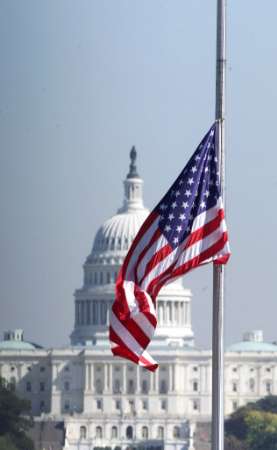
Flat at half-staff, U.S.Capitol in background - from Flag Bay

Other sources:

Image of flag and U.S. Capitol from Flags Bay.


Graduation 2008, part 1

May 24, 2008

Today is graduation day for some of my seniors, at the school where I teach. It’s a wonderful affair, and it will be good to see them off on the next step, ceremonial though it is.

The chaos caused by graduation in this district cannot be minimized, for an odd scheduling reason. Today the seniors graduate. Tuesday, we’re back in class with everyone else, with a couple of days of instruction and finals yet to go. It’s nice to have the seniors gone — the halls are much easier to navigate, the juniors are already stepping up, the sophomores and freshmen suddenly realize the work they do leads to something — but the schedule seems out of whack.

I’m trying to adapt.

This year our family has multiple graduations — well, two. Younger son James graduates in a bit over a week, assuming he gets in a mass of work in classes that appeared after the state tests (for which he was exempt because he passed them all the previous year), and after more AP tests than I thought humanly possible.

James’ school held a ceremony and reception for the top 11% of the graduates, 75 kids who may be in the top 10% (a magic number in Texas because it guarantees admission to Texas colleges). Texas colleges won a majority of the plans of the graduates, but there was an impressive number of students off to out-of-state schools of high repute. (James is off to Lawrence, in Wisconsin.)

I wake up in a cold sweat. Clearly we must have done something right, as parents of graduating kids, as teachers of graduating kids. What was it?