Have a great Bloomsday

June 16, 2011

James Joyce fans, and other literati fans:  Happy Bloomsday, June 16.

Is anyone reading Ulysses in your town?  Public performance?

(We’re at the Clinton Library today; no Joyce, I’ll bet.)

Bloomsday:


Quote of the moment, on shaping lives: Lord of the Rings or Atlas Shrugged

May 13, 2011

Good donkey quote of the day candidate:

Atlas Shrugged, by Ayn Rand

Atlas Shrugged, by Ayn Rand

There are two novels that can change a bookish fourteen-year old’s life: The Lord of the Rings and Atlas Shrugged. One is a childish fantasy that often engenders a lifelong obsession with its unbelievable heroes, leading to an emotionally stunted, socially crippled adulthood unable to deal with the real world. The other, of course, involves hobbits orcs.

Attributed to John Rogers, whoever that is. (Got a better source?  Let us know in comments.)

Tip of the old scrub brush to Kent commenting at PennLive.com.

Lord of the Rings trilogy

Lord of the Rings trilogy, by J. R. R. Tolkien


Quote of the moment: Charles Dickens, on Tea Party and Republican Party budget cuts

May 12, 2011

This is mostly an encore post, unfortunately made more urgent recently.

What is the driving motivation of Republican budget cuts in Texas, Wisconsin, and the rest of the nation?

Quote of the moment:

Darkness is cheap, and Scrooge liked it.

— Charles Dickens, A Christmas Carol, Stave 1

I thought of that line of Dickens’s when I read of this celebration of darkness, ignorance and calumny. Although, with the recent renewing of Limbaugh’s contract, it may no longer be true that his particular brand of darkness is cheap.

Still, it remains dark.

Scrooge meets Ignorance and Want, the products of his stinginess (drawing by John Leech, 1809-1870)

Scrooge meets Ignorance and Want, the products of his stinginess (drawing by John Leech, 1809-1870)

I was reminded of this post from three years ago by a discussion at What’s Wrong With the World (commented on earlier at the Bathtub, here), in which the principal protagonists appear to me to be wholly ignorant of the New Deal, the progressive movement and progressive ideals, and much more of U.S. history, law, and events.  In effect, I thought, that discussion was fueled by that ugly, mean little boy, Ignorance.  The angel warned Scrooge, “but most of all beware this boy [Ignorance], for on his brow I see that written which is Doom.”

(More about the drawing below the fold)

Read the rest of this entry »


“Is that a poem in your pocket?” she asked.

April 13, 2011

Not only is April National Poetry Month, but April 14th is National Poem in Your Pocket Day.

Poem in Your Pocket Day logo, 2011

National Poem in Your Pocket Day 2011 - click for details

The idea is simple: select a poem you love during National Poetry Month then carry it with you to share with co-workers, family, and friends.

Poems from pockets will be unfolded throughout the day with events in parks, libraries, schools, workplaces, and bookstores. Create your own Poem In Your Pocket Day event using ideas below or let us know how your plans, projects, and suggestions for Poem In Your Pocket Day by emailing npm@poets.org.

Put Poems In Pockets

In this age of mechanical and digital reproduction, it’s easy to carry a poem, share a poem, or start your own PIYP day event. Here are some ideas of how you might get involved:

  • Start a “poems for pockets” give-a-way in your school or workplace
  • Urge local businesses to offer discounts for those carrying poems
  • Post pocket-sized verses in public places
  • Handwrite some lines on the back of your business cards
  • Start a street team to pass out poems in your community
  • Distribute bookmarks with your favorite immortal lines
  • Add a poem to your email footer
  • Post a poem on your blog or social networking page
  • Project a poem on a wall, inside or out
  • Text a poem to friends

Help us expand the list: send your ideas to npm@poets.org.

Poem In Your Pocket History

Poem In Your Pocket Day has been celebrated each April in New York City since 2004. Each year, city parks, bookstores, workplaces, and other venues burst with open readings of poems from pockets. Even the Mayor gets in on the festivities, reading a poem on the radio. For more information on New York City’s celebration, visit nyc.gov/poem.

Highlights from past Poem In Your Pocket Day events.

Poems have been stowed in pockets in a variety of ways, from the commonplace books of the Renaissance to the pocket-sized publications for Army soldiers in World War II. Have a story about the marriage of the poem and the pocket? Send them to npm@poets.org.

I just stumbled into National Poetry Month and National Poem in Your Pocket Day a few years ago, gearing up to use The Ride of Paul Revere on the anniversary of his famous ride.  How are you using poetry in your job?


April is National Poetry Month, 2011

April 10, 2011

You did remember, right?  I got another reminder in e-mail:

National Poetry Month continues, and so does your support! We’re getting closer to our goal of $30,000 in 30 days, and we thank you for your donation. If you haven’t donated yet, please do. You’ll be helping us share your love of poetry with children and adults all across America.

Here’s another way to support National Poetry Month: celebrate Poem In Your Pocket Day on Thursday, April 14. It’s simple: tuck a poem you love in your pocket and share it with co-workers, family, and friends. Or go a step further and create your own Poem In Your Pocket Day event using the ideas at www.poets.org/pockets.

And please, please, show your support for poetry with a donation to the Academy of American Poets. As an added incentive, we’ll thank you for your generosity with these free gifts:
• Donate $25 and receive a free download of W.S. Merwin recordings.
• Donate $50 and receive a free download of W.S. Merwin recordings and a Walt Whitman ruled notebook for your own poems.
• Donate $100 and receive a free download of W.S. Merwin recordings, a Walt Whitman ruled notebook for your own poems, and a copy of the innovative anthology Poem in Your Pocket for Young Poets.

Please click here to support National Poetry Month. And if you haven’t downloaded the Poem Flow app for your iPhone, find it on iTunes and take poetry with you wherever you are.


Thanks for being a part of the Poets.org community. Please sign in to subscribe to other Poets.org newsletters, change your email address or unsubscribe from this list at any time.

Academy of American Poets
75 Maiden Lane, Suite 901
New York, NY 10038
212-274-0343
academy@poets.org


Quote of the moment: Edward Albee on democracies, and hope for the future

March 14, 2011

Playwright Edward Albee - Albee Foundation photo

Playwright Edward Albee - Albee Foundation photo

[On the slashing of arts education funding:] It’s especially discouraging when you live in a democracy where anything good is possible, if only we have the courage to deal with it.

— Edward Albee, playwright, Diane Rehm Show (WAMU-FM/NPR), March 14, 2011 (49:50 in)


Phillis Wheatley: Poem for Presidents Day

February 21, 2011

From the Poem-a-Day folks at the American Academy of Poets:

His Excellency General Washington
by Phillis Wheatley

George Washington

George Washington, as he appears on the one dollar bill.


Celestial choir! enthron’d in realms of light,
Columbia’s scenes of glorious toils I write.
While freedom’s cause her anxious breast alarms,
She flashes dreadful in refulgent arms.
See mother earth her offspring’s fate bemoan,
And nations gaze at scenes before unknown!
See the bright beams of heaven’s revolving light
Involved in sorrows and the veil of night!

The Goddess comes, she moves divinely fair,
Olive and laurel binds Her golden hair:
Wherever shines this native of the skies,
Unnumber’d charms and recent graces rise.

Muse! Bow propitious while my pen relates
How pour her armies through a thousand gates,
As when Eolus heaven’s fair face deforms,
Enwrapp’d in tempest and a night of storms;
Astonish’d ocean feels the wild uproar,
The refluent surges beat the sounding shore;
Or think as leaves in Autumn’s golden reign,
Such, and so many, moves the warrior’s train.
In bright array they seek the work of war,
Where high unfurl’d the ensign waves in air.
Shall I to Washington their praise recite?
Enough thou know’st them in the fields of fight.
Thee, first in peace and honors—we demand
The grace and glory of thy martial band.
Fam’d for thy valour, for thy virtues more,
Hear every tongue thy guardian aid implore!

One century scarce perform’d its destined round,
When Gallic powers Columbia’s fury found;
And so may you, whoever dares disgrace
The land of freedom’s heaven-defended race!
Fix’d are the eyes of nations on the scales,
For in their hopes Columbia’s arm prevails.
Anon Britannia droops the pensive head,
While round increase the rising hills of dead.
Ah! Cruel blindness to Columbia’s state!
Lament thy thirst of boundless power too late.

Proceed, great chief, with virtue on thy side,
Thy ev’ry action let the Goddess guide.
A crown, a mansion, and a throne that shine,
With gold unfading, WASHINGTON! Be thine.

American Poet Phyllis Wheatley, detail from the Boston Women's Memorial on Commonwealth Ave.

American Poet Phillis Wheatley, detail from the Boston Women’s Memorial on Commonwealth Ave.

Who was the inspiring woman, Phillis Wheatley? Read her biography at the Academy of American Poets site.

Phillis Wheatley was the first black poet in America to publish a book. She was born around 1753 in West Africa and brought to New England in 1761, where John Wheatley of Boston purchased her as a gift for his wife. Although they brought her into the household as a slave, the Wheatleys took a great interest in Phillis’s education. Many biographers have pointed to her precocity; Wheatley learned to read and write English by the age of nine, and she became familiar with Latin, Greek, the Bible, and selected classics at an early age. She began writing poetry at thirteen, modeling her work on the English poets of the time, particularly John Milton, Thomas Gray, and Alexander Pope. Her poem “On the Death of the Rev. Mr. George Whitefield” was published as a broadside in cities such as Boston, New York, and Philadelphia and garnered Wheatley national acclaim. This poem was also printed in London. Over the next few years, she would print a number of broadsides elegizing prominent English and colonial leaders.

More, at the AAP site.


Quote of the moment: Thoreau explains, this, too, is heaven

January 26, 2011

Walden Pond frozen over, Winter 2005 - Wikimedia image

Walden Pond frozen over, Winter 2005 - Wikimedia image by Bikeable

Every winter the liquid and trembling surface of the pond, which was so sensitive to every breath, and reflected every light and shadow, becomes solid to the depth of a foot or a foot and a half so that it will support the heaviest teams, and perchance the snow covers it to an equal depth, and it is not to be distinguished from any level field. Like the marmots in the surrounding hills, it closes its eyelids and becomes dormant for three months or more.  Standing on the snow-covered plain, as if in a pasture amid the hills, I cut my way first through a foot of snow, and then a foot of ice, and open a window under my feet, where, kneeling to drink, I look down into the quiet parlor of the fishes, pervaded by a softened light as through a window of ground glass, with its bright sanded floor the same as in summer; there a perennial waveless serenity reigns as in the amber twilight sky, corresponding to the cool and even temperament of the inhabitants. Heaven is under our feet as well as over our heads.

Henry David Thoreau, Walden, or Life in the Woods, “The Pond in Winter,” 1899, pp 296-297.

Thanks to Inward/Outward, a project of the Church of the Saviour community.

Special tip of the old scrub brush to Bill Longman, who sent me the e-mail today.


Poem-a-Day: William Cullen Bryant, “A Song for New Year’s Eve”

December 31, 2010

Poem-a-Day from the Academy of American Poets (you don’t subscribe?):

Poet William Cullen BryantCullen

Poet William Cullen BryantCullen

A Song for New Year’s Eve

by William Cullen Bryant

Stay yet, my friends, a moment stay—
Stay till the good old year,
So long companion of our way,
Shakes hands, and leaves us here.
Oh stay, oh stay,
One little hour, and then away.

The year, whose hopes were high and strong,
Has now no hopes to wake;
Yet one hour more of jest and song
For his familiar sake.
Oh stay, oh stay,
One mirthful hour, and then away.

The kindly year, his liberal hands
Have lavished all his store.
And shall we turn from where he stands,
Because he gives no more?
Oh stay, oh stay,
One grateful hour, and then away.

Days brightly came and calmly went,
While yet he was our guest;
How cheerfully the week was spent!
How sweet the seventh day’s rest!
Oh stay, oh stay,
One golden hour, and then away.

Dear friends were with us, some who sleep
Beneath the coffin-lid:
What pleasant memories we keep
Of all they said and did!
Oh stay, oh stay,
One tender hour, and then away.

Even while we sing, he smiles his last,
And leaves our sphere behind.
The good old year is with the past;
Oh be the new as kind!
Oh stay, oh stay,
One parting strain, and then away.

More:


Dan Valentine – “The Xmas Stiff,” a one-act play

December 26, 2010

THE XMAS STIFF

by Daniel Valentine

(c) 2010

A FARCE IN ONE ACT

Characters
(4 F, 2 M)
CAROL-LEIGH, owner/bartender
ORSON, regular customer
SHANNON, cocktail waitress
BULLET, exotic dancer
ROCKY, exotic dancer
Unnamed customer/corpse.

SCENE: A hole-in-the-wall “gentlemen’s club” on the second floor of a three-story building just a few blocks from Chinatown in Washington, D.C. A bar with stools is situated by a small elevated stage, with “Merry Xmas” scrawled in white shoe polish on a mirror behind it. A neon sign above the bar reads “lST LADEEZ Show Bar.” Stairs near the bar climb to a dressing room on the third floor. On one wall, there are several windows with floor-to-ceiling velvet curtains pulled closed. Outside the entrance door, which is kept open during business hours, there is an ill-lit landing. Unseen stairs lead to the street below. There are tables and chairs, a booth or two, and a decorated Christmas tree. A sign on a wall reads “Exotic Dancers – No Cover – No Minimum.”

It is a late afternoon on the day before Christmas during one of the worst blizzards of the year.

Before the curtain rises, various voices from a TV, separated by white noise, are heard as someone yet-to-be-seen channel-surfs:

“The clock is ticking for today’s guests. This may be their last Christmas. So, please, stay with us and help us get them into the holiday spirit. Today! Surprise holiday make-overs for death-row inmates” . . .  “Hundreds of years ago, did he predict this season’s Super Bowl winner? Next. The amazing Nostradamus!” . . . “It’s a little crazy out there on this Christmas Eve afternoon” . . . “Everybody’s kind of shivering” . . .  “More than a foot of snow is predicted” . . .  “Today! Some of your favorite movie stars get the surprise of their lives when convicted stalkers reveal their secret celebrity crushes. How will our stars react?” . . .  “Look, Daddy, Teacher says, every time a bell rings an angel gets his wings” . . .  “Omigod! This is so amazing. It’s so cute. Have you ever seen a prison uniform on a convicted mass-murderer that fits like this? So, Franco, what did you do? Tell us about the hair.”

(The curtain rises just as CAROL-LEIGH, remote in hand, clicks off the flat-screen TV behind the bar.)

CAROL-LEIGH: (Disgusted.) There’s nothing on.

(She places the remote beside the register. Standing at the cocktail station, cutting lemons, is SHANNON. ORSON, the lone patron, sits with a Corona before him, his coat hangs from the back of his stool. BULLET, fully-dressed, is dancing halfheartedly on the stage, one eye on the clock.)

CAROL-LEIGH: (To Orson.) So, Congressman. How come you’re not back home in your district caroling with constituents?

ORSON: I’d rather look at naked women.

(He swivels on his stool to watch the dancer.)

BULLET: Carol-Leigh, I’m not taking my clothes off for one customer. Congressman or no. I don’t think I should have to.

(The sudden sound of the howling snowstorm outside is heard momentarily as the door to the street opens and closes.)

ORSON: (Turning back to Carol-Leigh.) Who’s dancing besides Bullet?

(A lone man in an unzipped jacket, sporting a Redskins ball cap, holding his stomach appears in the doorway. He is missing one shoe. He looks around, then makes his way to a semi-secluded table by the Christmas tree. Picking up her cocktail tray, Shannon leaves to serve him.)

CAROL-LEIGH: Rocky is here. (Gesturing to the upstairs dressing room.) Cricket or Ursula or Shiloh or whatever Laura is calling herself these days is a no-show. She simply didn’t come in. Candy was supposed to dance but called in sobbing. Her dad died.

ORSON: Poor kid.

CAROL-LEIGH: It’s the fifth holiday he’s died on this year.

(Shannon sets both napkin and coaster down in front of the new customer.)

SHANNON: Can I help you? We have a holiday special on pitchers.

(The customer rocks back and forth on his seat, clutching his stomach.)

CUSTOMER: How much is a beer?

CAROL-LEIGH: So, anyway, Bullet and Rocky are tag-teaming it.

ORSON: That’s it?

CAROL-LEIGH: Hey, it’s Christmas Eve. It’s snowing. It’s cold. A person would have to be crazy … Like me.

(The customer struggles to rise.)

CUSTOMER: Seven bucks! SEVEN BUCKS? For a beer? (Looking around.) Where am I? The Four Seasons? (And he collapses onto the floor.)

CAROL-LEIGH: I called Wendy. She doesn’t feel well. I called Breezy. She has a cold. Stormy didn’t answer her phone. I called Fury. She has a twenty-four-hour virus. I called Moonflower. She has a bug. I called everybody. Bambi, Barbie, Bunny …

SHANNON: (To customer.) Sir? Excuse me. If you’re going to stay, you need to buy a drink. You can’t just flop out. We’re running a business here. Sir? Sir?

CAROL-LEIGH: (To Orson.) You want to fill in?

ORSON: Sure. If I can dance on the bar. (He loosens his tie and unbuttons a shirt button.)

(Carol-Leigh takes a dollar from the tip jar and slaps it down on the bar before him.)

CAROL-LEIGH: Please. Business is bad enough.

SHANNON: (Poking the body with her big toe.) Get up, you. Get up, honey. You okay? Are you alive? Damn!

CAROL-LEIGH: (To Orson.) Another Corona?

(He checks his watch.)

ORSON: You’re open till seven tonight?

CAROL-LEIGH: Somewhere thereabouts.

SHANNON: (Now at the service bar.) Carol-Leigh, there’s a dead man under the Christmas tree.

ORSON: (Re: beer.) Sure. Why not? One more.

(Carol-Leigh uncaps another Corona.)

SHANNON: I’m not lying. We’ve got a problem.

(Carol-Leigh sets the bottle on the counter.)

CAROL-LEIGH: Did you say there was a dead man?

SHANNON: Take a look for yourself.

(Orson swivels around on his barstool.)

ORSON: Somebody died? You’re kidding. What now, just now?

(Carol-Leigh comes from behind the bar and goes with Shannon across the room, passing the stage.)

BULLET: What’s up?

(Orson follows close behind.)

SHANNON: Look!

(The music on the jukebox stops and Bullet steps down from the stage and hurries to see what’s happening as Carol-Leigh kneels down and feels the man’s wrist for a pulse.)

CAROL-LEIGH: Oh, my God! (She flips the left side of his jacket open and puts an ear to his heart and holds it there.) My God, he is dead. (She gets to her feet.) I thought you were joking.

ORSON: Well, so much for Happy Hour.

BULLET: (Upon seeing the body.) Oh, man! Is he dead?

SHANNON: Oh, yeah.

ORSON: (re: Bullet.) Wish I’d had a camera. You should have seen your face. Your eyes went–

BULLET: Hey, man, some things still surprise me. A dead body is one of ‘em. What happened?

(Orson crouches and flips open the right side of the man’s jacket.)

ORSON: Looks like he’s been stabbed.

SHANNON: Stabbed?!

ORSON: Looks like. Check that out.

BULLET: Merry Christmas.

CAROL-LEIGH: (sighing) I don’t need this.

ORSON: (Still squatting, puzzled.) There’s not much blood.

BULLET: Depends on the weapon. An ice pick doesn’t draw blood.

ORSON: That true?

BULLET: An ice pick’s quite a weapon.

ORSON: Better than a knife?

BULLET: Oh, yeah.

ORSON: (Standing). Really? (To no one in particular.) Every day you learn something new.

CAROL-LEIGH: Whether you want to or not.

BULLET: You can stick a knife cleanly into someone and not kill him. But an ice pick causes internal bleeding.

ORSON: How do you know that? What are you, some sort of expert on ice pick-related homicides?

BULLET: Yeah, man, matter of fact. I know all about it. My ol’ man showed me. You gotta know where the organs are. An inch either way and you’ll hit a rib.

ORSON: Bullet, you’re so full of it.

SHANNON: I believe her. Ever seen her boyfriend? He looks like Ted Bundy should have.

CAROL-LEIGH: I’m just glad he didn’t get his brains blown out on the carpet.

SHANNON: Hey, it just hit me. He’s missing one shoe. Maybe somebody stabbed him for his shoe.

BULLET: That could be. Some mugger doing some last-minute Christmas shopping for a one-legged friend.

ORSON: Who is he? (To Shannon.) Do you recognize him?

SHANNON: It was his first time here.

BULLET: Welcome to 1st Ladeez Show Bar! We obviously made a good impression on him.

CAROL-LEIGH: Does he have any I.D.?

(Orson crouches on his heels again and rolls the body on its side a little to get at the man’s hip pockets. He gets to his feet.)

ORSON: Nothing on him.

CAROL-LEIGH: Beautiful.

BULLET: Another day at the office.

CAROL-LEIGH: If D.C. ever gains statehood, a good state flag would be a black banner with the chalk outline of a corpse in the upper left-hand corner.

ORSON: What are you going to do, Carol-Leigh?

SHANNON: Sshh! She’s thinking.

CAROL-LEIGH: (Beside herself, tapping a finger on her forehead.) No brains suddenly.

BULLET: Take your time, Carol-Leigh. The dude’s not goin’ nowhere.

CAROL-LEIGH: (At last.) We have to get him out of here.

ORSON: You’re not going to report it? Call 9-1-1. I’ll call. (He turns to go get his cell from his coat.)

CAROL-LEIGH: Wait a minute. We don’t want the cops here.

ORSON: (Sarcastically.) Oh, you’re worried about the cops. Well, when you put it that way. (Losing it.) Have you lost your marbles?!

CAROL-LEIGH: Orson, it’s Christmas Eve. By eight I want to be home. I don’t want to stay around here all night answering questions from the police. I have two dogs who depend on me.

BULLET: (Agreeing.) We call the cops, we could be here forever.

SHANNON: And I’m starving! Big-time. I haven’t eaten all day. I skipped breakfast. I had a birth-control pill for lunch.

BULLET: Carol-Leigh’s right. We’re talking about Channels 2, 4, 5, 7, 9, and 11 outside and all that stuff.

CAROL-LEIGH: Exactly.

ORSON: Did you say Channel 9? (Reconsidering.) My mother watches Channel 9. (After a pause.) Get rid of the sucker. Like roll him down the stairs and out the door. See ya bye!

BULLET: Now you’re talkin’!

CAROL-LEIGH: Shannon, take him outside. Immediately.

SHANNON: Who, me? You want me to pick up a dead body? I don’t think so. Sorry, no way.

CAROL-LEIGH: I’m very, very serious.

SHANNON: Oh, yeah, sure-sure. Gimme a break. Bill Gates could walk in here and he couldn’t give me a big enough tip.

CAROL-LEIGH: Stubborn one. Pleeeeeeeese?

SHANNON: No, period. I ain’t gonna do it.

ORSON: Guys!

SHANNON: Forget it. Not me!

ORSON: Guys!

SHANNON: It’s not in my job description. If you want him outta here, you do it.

ORSON: Guys! Guys! C’mon! I’ll do it. Let me get my coat. (To himself on his way to the bar.) Channel 9. My mom watches Channel 9.

(Rocky, the only other dancer, appears on the stairs from the dressing room above. She is sporting reindeer antlers and a Santa’s hat.)

ROCKY: (Upon seeing Orson at the bar.) Hi, guy. What’s happening?

ORSON: Oh, not a heck of a lot. A customer just got murdered.

ROCKY: (Laughing.) You’re teasin’. You like my holiday headgear? (She turns around modeling it for him.)

ORSON: (Eyeing her curiously.) I wouldn’t wear it.

ROCKY: On me, dummy! Isn’t it cute? I’m Dancer, one of Santa’s reindeer. (She striking a serious pose.) Because I, too, am a dancer. (Then she laughs at herself.)

ORSON: (The politician.) Yes, very lovely.

CAROL-LEIGH: (Shouting.) Hey, Orson! C’mon!

(Orson shrugs into his coat.)

ORSON: I’m coming. Excuse me, Rocky. I’ve got to take the body outside.

ROCKY: You’re just pulling my chain. (She gaily walks with him, her only concern in life at the moment: the antlers.) They’re not very practical for dancing. In the dressing room, they were off and on. But– (She stops in her tracks. Stocked.) Gosh, business is sure the pits. Where are all the customers? (Then she sees the body. She gives a little gasp and looks away, then looks, then looks away again.) Oooooo! Somebody close his eyes. Put a tablecloth over him! Put something on him!

BULLET: Where’s my body glitter?

ROCKY: Don’t be bad. Where’d he come from?

CAROL-LEIGH: (To Orson.) Ready?

(He nods and grasps the dead man’s ankles as Carol-Leigh clears a path of chairs.)

ROCKY: Oh, my gosh! What are you guys doing?

ORSON: (To Carol-Leigh.) Where to?

CAROL-LEIGH: Down the back fire escape.

(He drops the legs–kerplunk.)

ORSON: No way. Impossible. This is a big guy here. He’s not big-big, but he’s big. He’s tall.

(Bullet uses her fingers to tabulate on an imaginary hand-held calculator.)

BULLET: (Aloud to herself.) Just how many does it take to carry a dead body down a fire escape in a snowstorm?

SHANNON: Sssh.

(Carol-Leigh gives the problem some thought.) Out the front. But don’t let anybody see you.

ORSON: Yes, Ma’am.

CAROL-LEIGH: Just make sure.

ROCKY: You’re going to take him out into the street?

(Orson bends down, gripes the dead man’s ankles again, and begins to tug the limp body toward the entrance.)

BULLET: Welcome to Carol-Leigh’s Carryout. Yes, we deliver.

ORSON: (Panting.) Damn. (Puffing.) He’s heavy.

CAROL-LEIGH: Don’t strain your back.

ORSON: I can’t tell you … how much … I looooove doing this … Hell, I don’t even know this guy.

(He stops to catch his breath, letting go of the man’s legs again–plop.)

ROCKY: (Sighing.) Boy, I’ve just about had it with this place. I’d like to find a real job. This is not a fun place anymore.

CAROL-LEIGH: (To Shannon.) Go look out the window. Tell us when it’s clear.

(Shannon hurries to one of the windows, throws open the curtains, and rubs off the steam. Snow is falling, wind howling, and it’s hard to see anything clearly.)

ROCKY: How can you do this, Carol-Leigh? (She fiddles nervously with the crucifix at her throat.) This is bad. (Orson repositions the body and grabs it under the armpits.) This isn’t good. (He walks backwards in a half-crouch towards the door.) This is bad. (The dead man’s head dangles between his knees.) Don’t you feel this is wrong, Carol-Leigh?

CAROL-LEIGH: Not at all. It’s Christmas Eve. I don’t want to stay around answering questions from the police all night. (To Shannon.) Tell me when it’s clear.

ROCKY: (To herself.) I want to leave. I want to go home right now.

BULLET: Take the body with you.

ROCKY: (Glaring at her.) I love you, too. (Chants.) I want to get off work, I want to get off work, I want to go home.

CAROL-LEIGH: Exactly. That’s what I’m saying. If we call the police, we won’t get out of here till late. (She pats Rocky tenderly on the shoulder.) It’s going to be all right, Rocky. Just relax. Get it together. Don’t go off the deep end. (After a pause.) Sit down!

(Rocky sits. Orson, winded, pauses to catch his breath again.)

ORSON: How did I get myself into this?

CAROL-LEIGH: (Humoring him.) Hey, you said last night. “I sure wish this place would get some new bodies!” Quote unquote.

ROCKY: I heard that.

CAROL-LEIGH: You only get three wishes. That was a dumb one.

(Orson pulls the body out the door onto the landing.)

CAROL-LEIGH: Watch your step.

ORSON: Yes, Ma’am.

CAROL-LEIGH: Just be careful.

ORSON: Yes, Ma’am

(And poof!–he disappears backwards out of sight with the body. There is a quick succession of heavy thumps and Rocky leaps up and flinches to each one as if her own head were being bounced on wooden steps)

ROCKY: Oh, boy! (THUMP, THUMP, THUMP.) Oh, man! (THUMP, THUMP, THUMP.) We’re going to get in trouble! (THUMP, THUMP, THUMP.) Oh, my gosh! (And KABOOM!) FUCK!!!

(And they all turn and stare at her, mouths agape. Prim-and-proper Rocky has never uttered a bad word in her life! All are stunned, so much so that they don’t hear Orson screaming for help at the bottom of the steps.)

ORSON: (Off.) Get him off ‘a me!

ROCKY: Oops! Four-letter word. Did I just say one?

ORSON: (Off.) Get him the hell off ‘a me!!

ROCKY: Sorry.

CAROL-LEIGH: (Returning to Planet Earth.) ORSON!!! (She rushes to the landing, afraid to look but does.) You okay?

ORSON: (Off.) If I can get myself untangled here. (After a pause.) Someone get the door.

BULLET: (Volunteering.) I’ll get it. I got it.

(Carol-Leigh makes a last-minute look-see around the area.)

CAROL-LEIGH: Wait a sec! He’s gotta hat. (She scoops the dead man’s ball cap up from off the floor and hands it to Bullet who rushes off down the steps, twirling it on a finger.)

BULLET: (Half to herself.) What’s he gonna do without his hat?

ORSON: (Off.) Is it clear?

CAROL-LEIGH: (Relaying the question to Shannon.) Is it clear?

(Shannon takes a good look.)

SHANNON: Okay, now!

CAROL-LEIGH: (Relaying her reply.) GO, GO, GO!

(There is the sound of howling wind from outside as the street door opens and shuts.)

SHANNON: (Like a sportscaster.) He’s out the door. He’s slipping and sliding, but he’s still on his feet. So far so good. Bullet is standing look-out on the corner.

CAROL-LEIGH: Smart girl.

SHNNON: Half-nude.

CAROL-LEIGH: Oh, terrific.

SHANNON: She’s stepping from foot to foot. She’s either cold or she’s gotta pee.

CAROL-LEIGH: I love it.

(Rocky stands clutching her crucifix, eyes shut, praying silently but mightily, crossing herself from time to time.)

CAROL-LEIGH: What now? (She hurries to the window.) What now?

SHANNON: He’s dragging the body, leaving a corpse-trail in the snow.

CAROL-LEIGH: For crying out loud! (She stands on her toes attempting to look over Shannon’s shoulder.) What’s going on? What’s going on?

SHANNON: (Whirling around.) What’s going on! What’s going on! Stop asking me what’s going on! (She looks out the window again.) Oh, no! (She taps her nails frantically on the glass. She tries to open the window to no avail. She throws her arms up in despair.) I want a Christmas bonus.

CAROL-LEIGH: What’s going on?

SHANNON: A patrol car’s coming!

CAROL-LEIGH: (With outstretched arms heavenward.) Why me, Lord?

SHANNON: (Shouting, horror-struck.) LOOK OUT! COME BACK!

(There is the sudden wail of a police siren and all three freeze, panic stricken, as the red beam of the siren lights up the room. The patrol car zooms by, the siren growing gradually fainter, as Shannon takes a quick sneak-peek down below. Sighing with relief, liking what she sees, she pulls the drapes shut.)

SHANNON: Let the wake begin!

(Rocky opens one eye.)

ROCKY: Mission accomplished?

SHANNON: Party down!

(Orson and Bullet come up the stairs.)

ORSON: Well, that’s enough of that. Let’s have some fun. I’m through with dead bodies.

(The two join the others now at the bar.)
CAROL-LEIGH: Thank you very, very much.

SHANNON: You guys are great. (To Orson.) Gimme a cheek. (She gives him a peck.)

(Bullet hugs her breasts, shivering all over.)

BULLET: It’s cold out there. My God, it must be two degrees. When I got outside, I thought: This is really stupid. I’m not dressed!

ORSON: You have goosebumps all over you.

BULLET: I’m cold! (Teeth chattering uncontrollably.) Never been so cold.

(Orson takes his coat off.)

ORSON: You’ll catch pneumonia. (He drapes it over her shoulders.) Don’t you drop dead on us. Have a brandy to warm you up.

CAROL-LEIGH: On me. I’d like to buy everybody a round.

ROCKY: (A teetotaler.) Can I have a drink of water, please? (She fumbles in her purse and produces a tiny bottle of pills.) I have a bad headache. (She flips the top off with a thumb) I need Advil. I can’t work here without Advil. (She shakes the bottle. It’s empty! She’s crushed.)

(Orson pats her tenderly on the back.)

ORSON: Hey, it’s going to be all right. Smile. ‘Tis the season. (Then cheerfully to the others.) C’mon, lets get this party started. Let the good times roll.

(Carol-Leigh lines up a row of snifter glasses and fills them. They hold up their drinks and toast, ab libbing “Merry Christmas,” etc. Then throwing their heads back, they all down the contents in one gulp, except for Rocky who takes a hefty-sized organizer from her bag to make an entry.

CAROL-LEIGH: (To Orson, re: the body.) Where’d you put him?

ORSON: Where else? In the rear of the alley. Beside the Dumpster.

ROCKY: (To herself, half-aloud as she writes.) Advil.

ORSON: On an abandoned La-Z-Boy. Where he’ll be comfy.

ROCKY: (Rethinking her entry.) A crate full of Advil!

(Carol-Leigh collects the glasses and gives the bar a once-over with a bar towel.)

CAROL-LEIGH: (Half to herself.) I can’t believe there was a dead body in here.

BULLET: (Blowing on her hands.) With the crowd today, he fit right in. He didn’t tip me, either.

SHANNON: I’m disappointed there wasn’t more blood. He looked like my ex.

ROCKY: (Shocked.) Shannon!

SHANNON: Just joking.

BULLET: Wishful thinking, you mean.

SHANNON: You’re right. If I had an ice pick, I’d like to put fifty holes in him.

ORSON: (To change the subject.) Did he pay his tab?

SHANNON: Who? Oh, the dead dude?

BULLET: Yeah, did he pay his tab?

SHANNON: He stiffed me!

ROCKY: Ho, ho, ho. I want to take a shower. I feel dirty. Don’t you guys feel dirty? This was bad.

ORSON: I’ll take a shower with you.

ROCKY: Don’t be naughty!

ORSON: C’mon! It’ll be fun! I’ll get a room.

ROCKY: No! (A pause.) But you can tip me if you want to. (She lifts her gartered leg.)

ORSON: Don’t trip on the body going out. (Laughing.) That’s a good tip. That’s a good one, isn’t it? (No one laughs.) Hey, what do I look like, the Federal Reserve? I’m not.

ROCKY: (Pouting.) Aren’t you going to tip me for Christmas? (Orson reluctantly peels off a single from a wad in his pocket and slips it in her garter.) Only one? I have a ten, a five, and three ones. If you give me two dollars, I can get a twenty-dollar bill.

ORSON: (To the others.) Miss Sting here. (To Rocky, rolling his eyes.) Okay, okay, give me the ten and the five and the two ones and I’ll give you a twenty as a Christmas gift.

(The two carry out the transaction, much to the amusement of the others, and Rocky tucks the twenty in her garter.)

ROCKY: What time is it?

(Orson checks his watch.)

ORSON: Not even six.

ROCKY: That’s all it is? (She straightens her antlers.) I don’t feel like dancing another set? (To Orson.) You have five singles for the jukebox? It only takes dollars and I only have a twenty.

(It is then that another sudden gush of wind rushes up the stairwell from outside. There is the sound of footsteps and all eyes turn toward the entrance. A solitary figure, not unlike the dead man, in a Redskin ball cap, appears in the doorway, his shadow stretching across the floor, falling just short of their feet. The figure gives no greeting, just stands and looks about.)

STRANGER: (After a glance.) Dead, huh? (After a long pause.) Catch you later. (He descends the stairs.)

(For a moment, it is very quiet. All are noticeably startled. Bullet breaks the silence.)

BULLET: Man, was that weird, or what? (She turns to the others.) Am I the only person who thinks that was weird?

SHANNON: Weird. That was weird.

CAROL-LEIGH: Bizarre.

SHANNON: Certainly was that.

CAROL-LEIGH: Strange.

SHANNON: That, too.

ORSON: As much as I like here, I’m getting the hell outta here. One more drink and I’m outta here. I don’t want him catching me later.

BULLET: What’d he say? “Dead, huh?” I hope he meant business.

CAROL-LEIGH: Who was it, someone taking a sneak peek?

ROCKY: (Terrified.) I’m not so sure. (Clutching her crucifix once again.) For a moment, I thought it was him.

SHANNON: Me, too.

ROCKY: Maybe the Man upstairs is telling us something.

SHANNON: That’s what I was thinking.

ROCKY: It’s Christmas Eve. Santa knows who’s been naughty and nice.

CAROL-LEIGH: What if … I don’t know. This is exhausting me. What if …

BULLET: Spit it out, Carol-Leigh. What are you trying to say, we should bring him back in?

ROCKY: (All for it.) Yeah!

SHANNON: Maybe we should.

ORSON: I like the idea.

BULLET: He’s upstairs, he’s downstairs. Corpse in, corpse out. I wish y’all would make up your minds.

ROCKY: Hope he’s still out there. I had CDs stolen out of my car a week ago. It was the second time.

SHANNON: (Taking a cell phone from her purse.) Carol-Leigh, what do you want?

CAROL-LEIGH: I want to wake up and say I had the weirdest dream. I want to go home. I want my mom.

SHANNON: No, on your pizza. (And dialing Domino’s

The Curtain Falls)


Typewriter of the moment: William Saroyan

December 19, 2010

William Saroyan's typewriter, photo from the Bancroft Library, University of Caliornia - Berkeley

William Saroyan's typewriter, displayed at the Saroyan Museum at his home in San Francisco - photo from the Bancroft Library, University of California; Berkeley

William Saroyan’s niece, Jacqueline Kazarian, recently gifted the Bancroft Library with a significant part of the archives of Saroyan’s work.  The press release on the gift included a photo of Saroyan’s Fox typewriter, which is displayed at the Saroyan museum in San Francisco.

Saroyan came from an Armenian American family, born in Fresno, California in 1908.  His writings illuminated the experience of Californians and Armenian Americans, especially during the Great Depression.

In many ways Saroyan’s work symbolizes the uniqueness of the Armenian community in America, especially California.  [You still out there, Ben Davidian?]   Wikipedia strikes the right tone:

Saroyan’s stories celebrated optimism in the midst of the trials and tribulations of the Depression. Several of Saroyan’s works were drawn from his own experiences, although his approach to autobiographical fact contained a fair bit of poetic license.

His advice to a young writer was: “Try to learn to breathe deeply; really to taste food when you eat, and when you sleep really to sleep. Try as much as possible to be wholly alive with all your might, and when you laugh, laugh like hell.” Saroyan endeavored to create a prose style full of zest for life and seemingly impressionistic, that came to be called “Saroyanesque”.

The complete May 19, 2010,  press release from the University of California is below.

a sketch "from a Turkish admirer," a photo of the author in his youth, and a framed sketch of Saroyan

The Bancroft Library's new archival material on William Saroyan includes (left to right) a sketch "from a Turkish admirer," a photo of the author in his youth, and a framed drawing of Saroyan with a passage of his writing on Armenia. (Images courtesy of the Bancroft Library)

The Bancroft Library accepts gift of William Saroyan archives

By Kathleen Maclay, Media Relations | 19 May 2010

William Saroyan

William Saroyan (Photo courtesy of The Bancroft Library)

BERKELEY — The Bancroft Library at the University of California, Berkeley, has received a spectacular gift of hundreds of books, drawings, correspondence and other personal communications to and from one of America’s best-known writers, the Armenian-American author and playwright William Saroyan.

The rich collection includes approximately 48 cartons with 1,200 books and other archival materials assembled by his niece, Jacqueline Kazarian, of San Francisco, who also is the founder of the William Saroyan Literary Foundation International. A celebration of the gift is set for noon on Friday (May 21) at The Faculty Club on campus.

“UC Berkeley is such an incredible place of learning and growing and intellectual exploration,” said Kazarian, who earned degrees in communication and decorative arts at UC Berkeley in the early 1950s. “I know that my uncle wanted his library, manuscripts and galleys to go to Berkeley. Students will be inspired by the collection.”

Apart from this gift, The Bancroft Library already retains significant holdings of Saroyan’s work that it collected over the course of his life and career, and it continues to add to that collection. Most of the latest materials come from Saroyan’s home on San Francisco’s 15th Avenue that is now a Saroyan museum directed by Kazarian. Those materials were supplemented by Kazarian’s extensive personal collection, as well as by items of Saroyan’s that she acquired through a prominent Boston archivist and via a Saroyan friend.

“Jacqueline Kazarian’s new gift is the largest and most substantial augmentation to the Saroyan collections at Bancroft that we have ever received,” said Peter Hanff, Bancroft’s deputy director.

The author’s classic manual typewriter, as displayed at his San Francisco home

The author’s classic Fox manual typewriter, as displayed at his San Francisco home. (Photo courtesy of The Bancroft Library)

Saroyan, born in Fresno, Calif., in 1908, drew extensively on his Armenian-American heritage and childhood experiences for his books, plays and short stories. Much of his writing was considered impressionistic and reflected a hearty optimism often hard to find during the gritty Great Depression. He died in 1981 at the age of 72, with his niece at his side.When Story magazine editors Martha Foley and Whit Burnett printed Saroyan’s “The Daring Young Man on the Flying Trapeze” in 1934, it was an immediate success, triggering Saroyan’s fame and standing as one of his many literary achievements.

“Uncle Bill’s writing revolutionized the short story,” said Kazarian, adding that she has always found his work “almost spiritual and fable-like.”

His five-act play, “The Time of Your Life,” is the only American play to have won both the New York Drama Critics’ Circle Award and the Pulitzer Prize. Saroyan’s work as a screenwriter with Hollywood director Louis B. Mayer on the film “The Human Comedy” won an Academy Award in 1943, and Saroyan later wrote a widely acclaimed book with the same title.

Kazarian’s gift to The Bancroft Library includes multiple first editions of Saroyan’s works, such as “The Daring Young Man on the Flying Trapeze,” “My Name is Aram” (1940), “The Human Comedy” and “Obituaries” (1979), and many materials personally inscribed by the writer. Also among the new items according to Steven Black, the head of acquisitions for Bancroft, are letters, telegrams and notes written by Saroyan to relatives and others close to him, mostly during the 1930s and 1940s.

antiquarian book dealer Peter Howard of Berkeley, shown here poring through Saroyan materials

Antiquarian book dealer Peter Howard of Berkeley, poring through Saroyan materials. (Photo courtesy of The Bancroft Library)

“He personalized a lot of what passed through his hands,” Black said, noting that much of the material features marginalia reflecting Saroyan’s thoughts and interests.

There also is a copy of Henry Miller’s “Aller Retour New York,” an 80-page journal about a 1935 visit by Miller to New York City and his journey aboard a Dutch ship back to Europe. It is inscribed by Miller to Saroyan.

And a Saroyan scrapbook in the collection contains press announcements about the Pulitzer Prize for his book, “The Time of Your Life.” He scoffed at the award, contending that the arts should not be judged by commerce.

The new Bancroft collection also contains a pre-publication proof of “Burnt Norton,” the first poem of T.S. Eliot’s “Four Quartets,” which Black said the publisher may have given to Saroyan “when he crossed the pond” on a trip from his temporary home in France to England.

There also is a wide range of magazines, including issues of Horizon and the Partisan Review, a leading publication of the Anglo-American intelligentsia during the 1930s and ’40s, Black said.

The first major deposit at The Bancroft Library of Saroyan’s papers was recorded in October 1980, and the library agreed to organize the collection and give Saroyan a general description and an index. After Saroyan died in 1981, the Saroyan Foundation paid the library to continue assembling the papers for official archives, which the foundation ultimately decided to place at Stanford University. That happened in 1996.

William Saroyan's niece, Jacqueline Kazarian, surveys materials at his San Francisco home

William Saroyan's niece, Jacqueline Kazarian, surveys materials in his home. (Photo courtesy of The Bancroft Library)

Kazarian’s donation is in honor of Berkeley antiquarian book dealer Peter Howard, who has provided appraisal assistance to Bancroft on Saroyan materials and other collections for decades. While director of The Bancroft Library, the late James D. Hart also developed strong professional and personal ties to Saroyan over the years, according to Kazarian and Black.

“Now, the Saroyan family materials come to a place that Saroyan himself would have been happy to see accepting them,” Black said, noting that Bancroft is proud to have so much of Saroyan’s “intellectual remains” to be able to share with the public.

Scheduled to speak about the acquisition at Friday’s event are Jacqueline Kazarian; David Calonne, vice president of education for the Saroyan Literary Foundation International and a Saroyan scholar; San Francisco novelist Herbert Gold; theater director Val Hendrickson reading Saroyan’s short story, “Common Prayer,” and the credo to “The Time of Your Life”; and Charles Faulhaber, director of The Bancroft Library.

UC Berkeley already is home to an Armenian Studies Program, which is focused on contemporary Armenian history, politics, language and culture. And Bancroft, a rich, special collections library containing historical and literary documents and other materials relating to California, the West, Mexico and Latin America, is known for its strong collections on California writers, including Jack London, Robinson Jeffers, Bret Harte, Frank Norris and others.

More information about The Bancroft Library is online. Bancroft is celebrating its 150th anniversary this year.

More:

William Saroyan commemorative stamps from the U.S., and U.S.S.R.

On commemorative stamps issued in both the U.S. and the U.S.S.R., Saroyan wears the Armenian-style moustache he wore through most of his later life. For a stamp to honor a man in both the U.S. and the Soviet Union was extremely rare -- maybe unique.


Typewriter of the moment: Harlan Ellison and his Olympia SG3

December 12, 2010

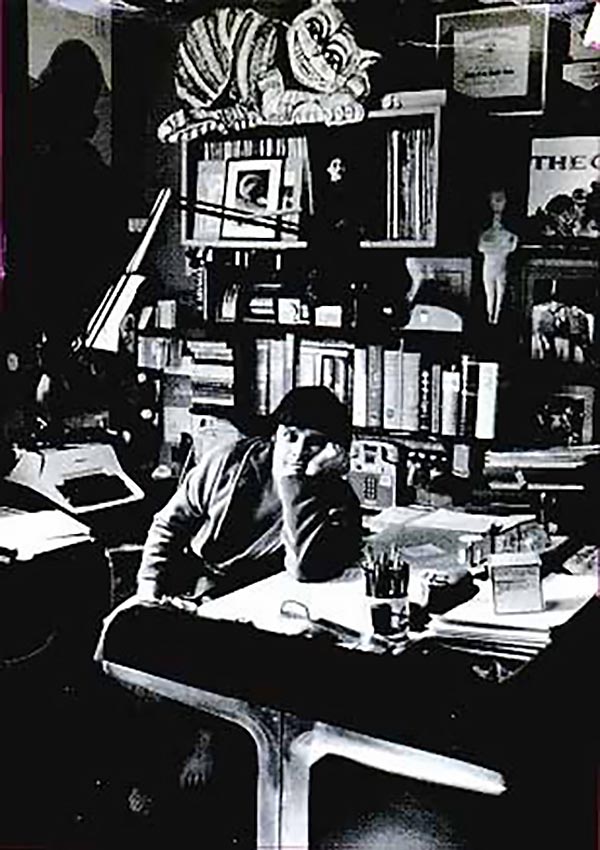
Harlan Ellison, his Olympia SG3, and other stuff - photo credit to MAX KATZ and KAREN FRIEDRICH
Harlan Ellison and his typewriter.  According to Richard Polt, the machine pictured is probably the Olympia SG3. Photo credit to Max Katz and Karen Friedrich.

Writers and their tools, in their workspaces.  We could probably date this photo by the stuff in Ellison’s office — the Cheshire Cat cutout?  Wasn’t that from an Edward Gorey-illustrated version of the Alice in Wonderland story?  What year was that?  The telephone on the wall, the desk scissors design . . . none of those fall into any expertise I have.  Someone else will have to date it.  My TinEye search didn’t shed any useful light.

I found the photo at Richard Polt’s fun site at Xavier University, The Classic Typewriter Page.  Polt is clearly working toward a MacArthur Foundation genius grant with this material.  Well, he would be, were I a judge.  (Who should get credit for the photo?  I don’t know — can you help identify who gets credit? See comment from Mr. Ellison:  ” . . .  image was captured for my 1974 STORY collection, APPROACHING OBLIVION, by MAX KATZ and KAREN FRIEDRICH.”  Credit for the photo gleefully acknowledged here.)

Oh, by the way, stay tuned:  Ellison is trying to sell his first typewriter.  That is a topic worthy of its own post.

Tip of the old scrub brush to the unfortunately moribund The Wit of the Staircase.


Whiskey and Cigar Day, 2010: Mark Twain and Winston Churchill

November 30, 2010

Mark Twain, afloat

November 30 is the birthday of Mark Twain (1835), and Winston Churchill (1874).

Twain had a comment on the Texas Education Agency and State Board of Education:

In the first place God made idiots. This was for practice. Then He made School Boards.

– Following the Equator; Pudd’nhead Wilson’s New Calendar

The Nobel literature committees were slow; Twain did not win a Nobel in Literature; he died in 1910. Churchill did win, in 1953.

Both men were aficionados of good whiskey and good cigars. Both men suffered from depression in old age.

Both men made a living writing, early in their careers as newspaper correspondents. One waged wars of a kind the other campaigned against. Both were sustained by their hope for the human race, against overwhelming evidence that such hope was sadly misplaced.

churchill-time-cover-man-of-the-year-1941.jpg

Both endured fantastic failures that would have killed other people, and both rebounded.

Each possessed a great facility with words, and wit, and frequently said or wrote things that people like to remember and repeat again.

Both of them rank near the top of the list of people to whom almost any quote will be attributed if the quote is witty and the speaker can’t remember, or doesn’t know, who actually said it.

Both men are worth study.  And wouldn’t you really love to have had them over to dinner?

Twain, on prisons versus education:

Every time you stop a school, you will have to build a jail. What you gain at one end you lose at the other. It’s like feeding a dog on his own tail. It won’t fatten the dog.” – Speech, November 23, 1900

Churchill on the evil men and nations do:

“No One Would Do Such Things”

“So now the Admiralty wireless whispers through the ether to the tall masts of ships, and captains pace their decks absorbed in thought. It is nothing. It is less than nothing. It is too foolish, too fantastic to be thought of in the twentieth century. Or is it fire and murder leaping out of the darkness at our throats, torpedoes ripping the bellies of half-awakened ships, a sunrise on a vanished naval supremacy, and an island well-guarded hitherto, at last defenceless? No, it is nothing. No one would do such things. Civilization has climbed above such perils. The interdependence of nations in trade and traffic, the sense of public law, the Hague Convention, Liberal principles, the Labour Party, high finance, Christian charity, common sense have rendered such nightmares impossible. Are you quite sure? It would be a pity to be wrong. Such a mistake could only be made once—once for all.”

—1923, recalling the possibility of war between France and Germany after the Agadir Crisis of 1911, in The World Crisis,vol. 1, 1911-1914, pp. 48-49.

Image of Twain aboard ship – origin unknown. Image of Winston S. Churchill, Time Magazine’s Man of the Year for 1941, copyright 1941 by Time Magazine.

More on Mark Twain

More on Winston Churchill

Orson Welles, with Dick Cavett, on Churchill, his wit, humor and grace (tip of the old scrub brush to the Churchill Centre):

Yeah, mostly this is an encore post from past years.


Quote of the moment: Lewis Carroll on Republican politics, climate skeptics, DDT advocates and creationism

October 26, 2010

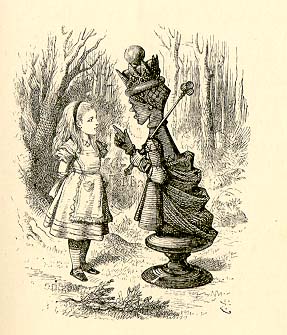
Alice and the Red Queen

Alice and the Red Queen – illustration by Sir John Tenniel

Alice laughed: “There’s no use trying,” she said; “one can’t believe impossible things.”

“I daresay you haven’t had much practice,” said the Queen. “When I was younger, I always did it for half an hour a day. Why, sometimes I’ve believed as many as six impossible things before breakfast.”

Charles Lutwidge Dodgson, writing under the name Lewis Carroll,
Alice in Wonderland, 1866

[Yes, the illustration is from Through the Looking Glass, 1871]


Typewriter of the moment: Ayn Rand

July 15, 2010

Ayn Rand at her typewriter

Ayn Rand at her typewriter

Ayn Rand at her typewriter, in an undated photo (do you know the date?).

Contrary to a popular myth, Rand did not take her name from the typewriter.  From the website of the Ayn Rand Institute:

What is the origin of “Rand”?

[From ARI’s monthly newsletter Impact, 06/2000]
“Ayn Rand, born Alisa Rosenbaum, based her professional first name on a Finnish one [see above]. The source of her last name, however, has been a mystery.

“Although its origin is still uncertain, recent biographical research by Drs. Allan Gotthelf and Michael Berliner has eliminated one possible source. An oft-repeated story claims that Ayn Rand took her last name from her Remington Rand typewriter while she was living in Chicago in 1926. This is false and we would like to put the error to rest.

“While still in Russia, c. 1925, and long before Remington-Rand typewriters were produced, Alisa Rosenbaum had adopted the name ‘Rand.’ Letters written in 1926 from Ayn Rand’s family in Russia already refer to the name ‘Rand.’ These were sent from Russia before Ayn Rand had communicated from America. The Remington and Rand companies did not merge until 1927; ‘Rand’ did not appear on their (or any) typewriters until the early 1930s.

“One lead to the actual source of the name comes from Ayn Rand herself. In 1936, she told the New York Evening Post that ‘Rand is an abbreviation of my Russian surname.’ Originally, we thought that this was a red herring in order to protect her family from the Soviet authorities.

“In 1997 Dr. Berliner noted an interesting coincidence when looking at a copy of Miss Rand’s 1924 university diploma. On the diploma was the name Rosenbaum in the Cyrillic alphabet:

The last three letters clearly look like the Roman letters ‘ayn.’ Richard Ralston then noticed that by covering those letters—and dropping out the second and fourth letters—what remains bears a strong resemblance to the Roman letters ‘Rand.’

“Although far from certain, it appears that the quote in the New York Evening Post may not have been a decoy.”

Her most often used typewriter was a Remington, I’ve read (but can’t find a reference now that I need it).  So far as I have found, however, typewriters were always manufactured under the “Remington” marque, and never as “Remington-Rand.”  Contrary to the implications from the ARI, Remington typewriters were produced from Reconstruction times (circa 1870), originally by the Remington Arms company.  Typewriter manufacturing was spun off from the arms producer in 1886; that company merged with Rand, forming Remington-Rand in 1927.