Biography of Millard Fillmore — not up to the bathtub test?

September 4, 2011

A new biography of Millard Fillmore popped out last spring, and the publisher didn’t send me a copy to review!

Not that my review could boost sales much — nor harm them — but don’t publishers use Google to figure out how they might get some publicity for their books?  Most internet searches for “Millard Fillmore” end up here.

No, I’m not really offended.  But I did find it interesting that none of my “Millard Fillmore” keyword  compilers picked up on the book.

Details:  Millard Fillmore, Paul Finkelman, Times Books, $23.

Cover of Millard Fillmore, by Paul Finkelman

Cover of Millard Fillmore, by Paul Finkelman

In a review for the Wall Street Journal, Fergus M. Bordewich wrote:

In this short, fierce book—part of the “American Presidents” series—Mr. Finkelman has delivered an unvarnished but compelling portrait of one of our least remembered but far from insignificant presidents. Against his grain, he gives Fillmore credit for promoting a number of “visionary” ideas that would come to fruition only after he left the presidency in 1853: the transcontinental railroad, the assertion of American power in Hawaii, the building of a Central American canal. “But on the central issues of the age,” Mr. Finkelman writes at the end of “Millard Fillmore,” “his vision was myopic and his legacy is worse.”

Has anyone read the book?  Is it any good?

More: 


May 23, 1926: Mencken confessed the Millard Fillmore bathtub hoax

May 23, 2011

May 23, 1926, H. L. Mencken’s newspaper column confessed his hoax of nine years earlier — he had made up whole cloth the story of Millard Fillmore’s only accomplishment being the installation of a plumbed bathtub in the White House (in the 1850s known as the Executive Mansion).

Alas, the hoax cat was out of the bag, and the hoax information still pollutes the pool of history today.

Text of the confession, from the Museum of Hoaxes:

Melancholy Reflections

On Dec. 28, 1917, I printed in the New York Evening Mail, a paper now extinct, an article purporting to give the history of the bathtub. This article, I may say at once, was a tissue of absurdities, all of them deliberate and most of them obvious…

This article, as I say, was planned as a piece of spoofing to relieve the strain of war days, and I confess that I regarded it, when it came out, with considerable satisfaction. It was reprinted by various great organs of the enlightenment, and after a while the usual letters began to reach me from readers. Then, suddenly, my satisfaction turned to consternation. For these readers, it appeared, all took my idle jocosities with complete seriousness. Some of them, of antiquarian tastes, asked for further light on this or that phase of the subject. Others actually offered me corroboration!

But the worst was to come. Pretty soon I began to encounter my preposterous “facts” in the writings of other men. They began to be used by chiropractors and other such quacks as evidence of the stupidity of medical men. They began to be cited by medical men as proof of the progress of public hygiene. They got into learned journals. They were alluded to on the floor of congress. They crossed the ocean, and were discussed solemnly in England and on the continent. Finally, I began to find them in standard works of reference. Today, I believe, they are accepted as gospel everywhere on earth. To question them becomes as hazardous as to question the Norman invasion.

* * *

And as rare. This is the first time, indeed, that they have ever been questioned, and I confess at once that even I myself, their author, feel a certain hesitancy about doing it. Once more, I suppose, I’ll be accused of taking the wrong side for the mere pleasure of standing in opposition. The Cincinnati boomers, who have made much of the boast that the bathtub industry, now running to $200,000,000 a year, was started in their town, will charge me with spreading lies against them. The chiropractors will damn me for blowing up their ammunition. The medical gents, having swallowed my quackery, will now denounce me as a quack for exposing them. And in the end, no doubt, the thing will simmer down to a general feeling that I have once more committed some vague and sinister crime against the United States, and there will be a renewal of the demand that I be deported to Russia.

I recite this history, not because it is singular, but because it is typical. It is out of just such frauds, I believe, that most of the so-called knowledge of humanity flows. What begins as a guess — or, perhaps, not infrequently, as a downright and deliberate lie — ends as a fact and is embalmed in the history books. One recalls the gaudy days of 1914-1918. How much that was then devoured by the newspaper readers of the world was actually true? Probably not 1 per cent. Ever since the war ended learned and laborious men have been at work examining and exposing its fictions. But every one of these fictions retains full faith and credit today. To question even the most palpably absurd of them, in most parts of the United States, is to invite denunciation as a bolshevik.

So with all other wars. For example, the revolution. For years past American historians have been investigating the orthodox legends. Almost all of them turn out to be blowsy nonsense. Yet they remain in the school history books and every effort to get them out causes a dreadful row, and those who make it are accused of all sorts of treasons and spoils. The truth, indeed, is something that mankind, for some mysterious reason, instinctively dislikes. Every man who tries to tell it is unpopular, and even when, by the sheer strength of his case, he prevails, he is put down as a scoundrel.

* * *

As a practicing journalist for many years, I have often had close contact with history in the making. I can recall no time or place when what actually occurred was afterward generally known and believed. Sometimes a part of the truth got out, but never all. And what actually got out was seldom clearly understood. Consider, for example, the legends that follow every national convention. A thousand newspaper correspondents are on the scene, all of them theoretically competent to see accurately and report honestly, but it is seldom that two of them agree perfectly, and after a month after the convention adjourns the accepted version of what occurred usually differs from the accounts of all of them.

I point to the Republican convention of 1920, which nominated the eminent and lamented Harding. A week after the delegates adjourned the whole country believed that Harding had been put through by Col. George Harvey: Harvey himself admitted it. Then other claimants to the honor arose, and after a year or two it was generally held that the trick had been turned by the distinguished Harry M. Daugherty, by that time a salient light of the Harding cabinet. The story began to acquire corroborative detail. Delegates and correspondents began to remember things that they had not noticed on the spot. What the orthodox tale is today with Daugherty in eclipse, I don’t know, but you may be sure that it is full of mysterious intrigue and bold adventure.

What are the facts? The facts are that Harvey had little more to do with the nomination of Harding than I did, and that Daugherty was immensely surprised when good Warren won. The nomination was really due to the intense heat, and to that alone. The delegates, torn by the savage three cornered fight between Lowden, Johnson, and Wood, came to Saturday morning in despair. The temperature in the convention hall was at least 120 degrees. They were eager to get home. When it became apparent that the leaders could not break the deadlock they ran amuck and nominated Harding, as the one aspirant who had no enemies. If any individual managed the business it was not Harvey or Daugherty, but Myron T. Herrick. But so far as I know Herrick’s hand in it has never been mentioned.

* * *

I turn to a more pleasant field — that of sport in the grand manner. On July 2, 1921, in the great bowl at Jersey City, the Hon. Jack Dempsey met M. Carpentier, the gallant frog. The sympathy of the crowd was overwhelmingly with M. Carpentier and every time he struck a blow he got a round of applause, even if it didn’t land. I had an excellent seat, very near the ring, and saw every move of the two men. From the first moment Dr. Dempsey had it all his own way. He could have knocked out M. Carpentier in the first half of the first round. After that first half he simply waited his chance to do it politely and humanely.

Yet certain great newspapers reported the next morning that M. Carpentier had delivered an appalling wallop in the second round and that Dr. Dempsey had narrowly escaped going out. Others told the truth, but what chance had the truth against that romantic lie? It is believed in to this day by at least 99.99 per cent of all the boxing fans in Christendom. Carpentier himself, when he recovered from his beating, admitted categorically that it was nonsense, but even Carpentier could make no headway against the almost universal human tendency to cherish what is not true. A thousand years hence schoolboys will be taught that the frog had Dempsey going. It may become in time a religious dogma, like the doctrine that Jonah swallowed the whale. Scoffers who doubt it will be damned to hell.

The moral, if any, I leave to psycho-pathologists, if competent ones can be found. All I care to do today is to reiterate, in the most solemn and awful terms, that my history of the bathtub, printed on Dec. 28, 1917, was pure buncombe. If there were any facts in it they got there accidentally and against my design. But today the tale is in the encyclopedias. History, said a great American soothsayer, is bunk.


Millard Fillmore in 1848

January 15, 2011

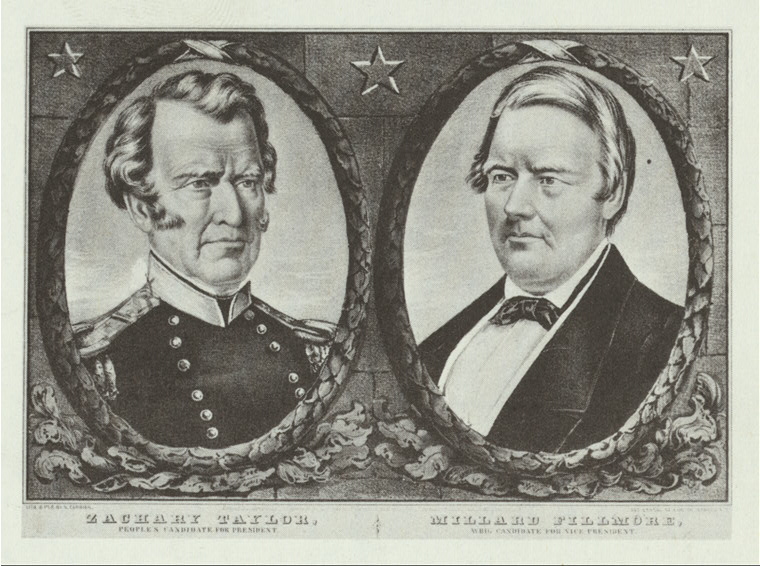
From a flyer or something published for the 1848 presidential campaign, images of the Whig Party ticket, Zachary Taylor for president and Millard Fillmore for vice president:

Campaign flyer for Taylor/Fillmore Whig ticket, 1848 - NY Public Library image

"Zachary Taylor, People's candidate for president; Millard Fillmore, Whig candidate for vice president"

We probably shouldn’t read anything into Taylor’s being identified as the “People’s Candidate” and Fillmore’s being identified as the “Whig Candidate.”  Probably just the copy writer’s way of not sounding redundant.

Found it at the massive digital image collection of the New York Public Library.  Image details from the NYPL:

Image Title:  Millard Fillmore.

Source: Print Collection portrait file. / F / Millard Fillmore. / Portraits.

Location: Stephen A. Schwarzman Building / Print Collection, Miriam and Ira D. Wallach Division of Art, Prints and Photographs

Digital ID: 1234729

Record ID: 583391

Digital Item Published: 12-8-2004; updated 6-25-2010

Image Title

:  Millard Fillmore.


Source

: Print Collection portrait file. / F / Millard Fillmore. / Portraits.


Location

: Stephen A. Schwarzman Building / Print Collection, Miriam and Ira D. Wallach Division of Art, Prints and Photographs


Digital ID

: 1234729


Record ID

: 583391


Digital Item Published

: 12-8-2004; updated 6-25-2010


Sitting Bear, and the Millard Fillmore medal

January 13, 2011

Sitting Bear, Chief of the Arikaras, wearing a medal commemorating Millard Fillmore - Photo by Edward S. Curtis, Library of Congress image

Sitting Bear, Chief of the Arikaras, wearing a medal commemorating Millard Fillmore - Photo by Edward S. Curtis, Library of Congress image

In the 19th century, the U.S. Mint struck medals with the likeness of the sitting president, for use as gifts to foreign dignitaries.  Often these medals would be given to Native Americans as tokens of friendship between the government and the tribe, or as a ceremonial gift on the striking of a treaty.

Description from the Library of Congress:

Photograph shows Sitting Bear, an Arikara chief, in full regalia, with a medallion around his neck. The medallion appears to bear the image of Millard Fillmore and the words: … President of the United States, 1851(?).

Famous photographer of American Indians Edward S. Curtis took this photo.  The photo was copyrighted on November 19, 1908.

  • Reproduction Number: LC-USZ62-136605 (b&w film copy neg.)
  • Rights Advisory: No known restrictions on publication.
  • Call Number: LOT 12321-D [item] [P&P]
  • Other Number: H118592
  • Repository: Library of Congress Prints and Photographs Division Washington, D.C. 20540 USA
  • Notes:
    • H118592 U.S. Copyright Office.
    • Title from item.
    • Curtis no. 2894-08.
    • Forms part of: Edward S. Curtis Collection (Library of Congress).
    • Published in: The North American Indian / Edward S. Curtis. [Seattle, Wash.] : Edward S. Curtis, 1907-30, Suppl. v. 5, pl. 166.

Is the medal the 1851 Indian Peace Medal, perhaps?

Without medals, any plan of operations among the Indians, be it what it may, is essentially enfeebled. This comes of the high value which the Indians set upon these tokens of Friendship. They are, besides this indication of the Government Friendship, badges of power to them, and trophies of renown. They will not consent to part from this ancient right, as they esteem it; and according to the value they set upon medals is the importance to the Government in having them to bestow.

Thomas L. McKenney, head of the Indian Office, to the secretary of the War Department, 1829

And, by the way — isn’t that a grand photo of Sitting Bear?  Even knowing that Curtis might, on occasion, take some liberties in clothing Indians he photographed, it’s a great photo in a great setting of a great man.


Would Albuquerque and Santa Fe be part of Texas, but for Millard Fillmore?

January 9, 2011

Different take on Millard Fillmore here, at Duke City Fix (“Duke City” is a nickname for Albuquerque).

Republic of Texas, from Wikipedia

Republic of Texas, showing boundaries that would have inlcuded much of New Mexico in Texas - Wikipedia


A day that will live in obscurity

January 8, 2011

Except of course for you, Dear Reader, who knew that January 7 is the anniversary of the birth of Millard Fillmore, our 13th president.

But, did Brian Crane know that when he penned this Pickles strip for January 7?

Pickles cartoon strip, for January 7, 2011

Pickles cartoon strip, for January 7, 2011 - Brian Crane, Washington Post Writers Group

Could it really be just coincidence that Crane picked Fillmore for the punchline, on Fillmore’s birthday?  Or is it really that great an inside joke?


Millard Fillmore’s 211th

January 7, 2011

Millard Fillmore was born January 7, 1800. Had he lived, Millard Fillmore would be 211 years old today, very cranky, and looking for a good book to read.

Millard Fillmore clipart from University of South Florida

Millard Fillmore clipart from University of South Florida - Free! Click image to go to USF site.

Would you blame him for being cranky? He opened Japan to trade. He got from Mexico the land necessary to make Los Angeles a great world city and the Southern Pacific a great railroad, without firing a shot. Fillmore promoted economic development of the Mississippi River. He managed to keep a fractious nation together despite itself for another three years. Fillmore let end the practice of presidents using slaves to staff the White House, then called “the President’s Mansion,” eight years before the election of Abraham Lincoln.

Then in 1852 his own party refused to nominate him for a full term, making him the last Whig to be president. And to add insult to ignominy, H. L. Mencken falsely accused him of being known only for adding a bathtub to the White House, something he didn’t do.

As Antony said of Caesar, the good was interred with his bones — but Millard Fillmore doesn’t even get credit for whatever evil he might have done: Fillmore is remembered most for being the butt of a hoax gone awry, committed years after his death. Or worse, he’s misremembered for what the hoax alleged he did.

Even beneficiaries of his help promoting the Mississippi River have taken his name off their annual celebration of the event. Fillmore has been eclipsed, even in mediocrity (is there still a Millard Fillmore Society in Washington?).

Happy birthday, Millard Fillmore.

Millard Fillmore, free clipart from University of South Florida

Millard Fillmore, free clipart from University of South Florida

Millard Fillmore was a man of great civic spirit, a man who answered the call to serve even when most others couldn’t hear it at all. He was a successful lawyer, despite having had only six months of formal education (a tribute to non-high school graduates and lifelong learning). Unable to save the Union, he established the University of Buffalo and the Buffalo and Erie County Historical Society.  During the Civil War, he led the local militia in support of the war effort, many rungs down from his role of Commander-in-Chief.  And, it is said of him that Queen Victoria said he was the most handsome man she had ever met.

A guy like that deserves a toast, don’t you think?

Resources:


University of Buffalo President Simpson to speak at Millard Fillmore’s 2010 birthday observance

January 5, 2011

Baird Point at University of Buffalo's North Campus

Baird Point at University of Buffalo's North Campus; tradition holds that the university was founded by Millard Fillmore, its first chancellor

John B. Simpson, President of the University of Buffalo

John B. Simpson, President of the University of Buffalo, will speak at a ceremony honoring President Millard Fillmore on the 211th anniversary of Fillmore's birth.

Press release from the University of Buffalo:

News Release

Simpson to Speak at Ceremony Commemorating 211th Birthday of Millard Fillmore

Release Date: January 4, 2011

BUFFALO, N.Y. — The 211th anniversary of the birth of Millard Fillmore, the University at Buffalo’s first chancellor and 13th president of the United States, will be celebrated at a ceremony to be held at 10 a.m. Jan. 7 at Fillmore’s gravesite in Buffalo’s Forest Lawn Cemetery.

UB President John B. Simpson will present the memorial address at the annual observance, which honors Fillmore, who played a major role in the founding of numerous cultural, civic and community organizations in Erie County.

Hosted by UB, the Forest Lawn Group and the Buffalo Club, the event will be free and open to the public, and each year draws a wide range of community supporters.

“The annual Millard Fillmore commemoration is a time-honored tradition that celebrates the life of a man who made considerable contributions to Buffalo and the United States,” said William J. Regan, director of special events at UB.”

Col. Jim S. McCready, vice wing commander of the 107th Airlift Wing of the New York Air National Guard based at Niagara Falls Air Reserve Station, will place a wreath from the White House at the gravesite.

Officials from the Buffalo Club, the Forest Lawn Group and UB will also be on hand to present wreaths.

The Rev. Joel Miller of the Unitarian Universalist Church of Buffalo will provide an invocation. The UB Police Color Guard will present the flags. To close the ceremony, West Richter, a UB undergraduate and a member of the UB Marching Band, will play taps.

A reception will follow immediately in the Forest Lawn Chapel.

Born on Jan. 7, 1800, Fillmore was instrumental in founding the Buffalo & Erie County Historical Society, the Buffalo Club and the Buffalo General Hospital. His activities also led to the creation of the Buffalo and Erie County Public Library, the Buffalo Fine Arts Academy and the Buffalo Society of Natural Sciences.

Some historians credit the former teacher, postmaster, lawyer and member of Congress with establishing the White House Library.

This year’s commemoration marks the 46th consecutive year UB has programmed the ceremony, a tradition that dates back to 1937.

From 1937 until 1965, the anniversary ceremonies were a cooperative staging by the City of Buffalo and the Buffalo Board of Education.

The events were administered by Irving R. Templeton, a 1909 graduate of UB, who scheduled two programs annually on or near Jan. 7, one in City Hall and one in Forest Lawn. Templeton was a partner in the law offices of Templeton, Turnabull & Templeton.

Following his death in 1965, responsibility for the event shifted to UB through an agreement between Chancellor Clifford C. Furnas and Alfred E. Kirchhofer, editor of The Buffalo Evening News. While UB participated in programming prior to Templeton’s death, the 1966 event marked the start of UB’s role as official steward of the annual community event.

The vice president for university relations and the Office of Public Affairs programmed the event from 1966-87, when the Office of Special Events began managing the program.

The University at Buffalo is a premier research-intensive public university, a flagship institution in the State University of New York system and its largest and most comprehensive campus. UB’s more than 28,000 students pursue their academic interests through more than 300 undergraduate, graduate and professional degree programs. Founded in 1846, the University at Buffalo is a member of the Association of American Universities.


Almost neglecting the “neglected anniversary” of Millard Fillmore’s Bathtub, H. L. Mencken’s hoax, and the lessons that lie therein

December 29, 2010

Could I get a longer title?  Here is our annual tribute to the hoax that gave its name and much inspiration to this blog.

Otherwise occupied — Kenny’s due to board an airplane in Beijing soon; tires for the cars; papers to correct, curriculum to correct; our wedding anniversary I cannot forget pending —  I nearly forgot: 93 years ago yesterday, on December 28, 1917, this column by H. L. Mencken was published in The New York Evening Mail:

A Neglected Anniversary

Mencken on April 7, 1933 - end of low-alcohol beer - Baltimore Sun Photo

H. L. Mencken at approximately 12:30 a.m., April 7, 1933, at the Rennert Hotel, corner of Saratoga and Liberty Streets, 17 years later, not neglecting a sudsy anniversary – Baltimore Sun photo

On December 20 there flitted past us, absolutely without public notice, one of the most important profane anniversaries in American history, to wit, the seventy-fifth anniversary of the introduction of the bathtub into These States. Not a plumber fired a salute or hung out a flag. Not a governor proclaimed a day of prayer. Not a newspaper called attention to the day.

True enough, it was not entirely forgotten. Eight or nine months ago one of the younger surgeons connected with the Public Health Service in Washington happened upon the facts while looking into the early history of public hygiene, and at his suggestion a committee was formed to celebrate the anniversary with a banquet. But before the plan was perfected Washington went dry (This was war-time Prohibition, preliminary to the main catastrophe. — HLM), and so the banquet had to be abandoned. As it was, the day passed wholly unmarked, even in the capital of the nation.

Bathtubs are so common today that it is almost impossible to imagine a world without them. They are familiar to nearly everyone in all incorporated towns; in most of the large cities it is unlawful to build a dwelling house without putting them in; even on the farm they have begun to come into use. And yet the first American bathtub was installed and dedicated so recently as December 20, 1842, and, for all I know to the contrary, it may still be in existence and in use.

Curiously enough, the scene of its setting up was Cincinnati, then a squalid frontier town, and even today surely no leader in culture. But Cincinnati, in those days as in these, contained many enterprising merchants, and one of them was a man named Adam Thompson, a dealer in cotton and grain. Thompson shipped his grain by steamboat down the Ohio and Mississippi to New Orleans, and from there sent it to England in sailing vessels. This trade frequently took him to England, and in that country, during the ’30s, he acquired the habit of bathing.

The bathtub was then still a novelty in England. It had been introduced in 1828 by Lord John Russell and its use was yet confined to a small class of enthusiasts. Moreover, the English bathtub, then as now, was a puny and inconvenient contrivance — little more, in fact, than a glorified dishpan — and filling and emptying it required the attendance of a servant. Taking a bath, indeed, was a rather heavy ceremony, and Lord John in 1835 was said to be the only man in England who had yet come to doing it every day.

Thompson, who was of inventive fancy — he later devised the machine that is still used for bagging hams and bacon — conceived the notion that the English bathtub would be much improved if it were made large enough to admit the whole body of an adult man, and if its supply of water, instead of being hauled to the scene by a maid, were admitted by pipes from a central reservoir and run off by the same means. Accordingly, early in 1842 he set about building the first modern bathroom in his Cincinnati home — a large house with Doric pillars, standing near what is now the corner of Monastery and Orleans streets.

There was then, of course, no city water supply, at least in that part of the city, but Thompson had a large well in his garden, and he installed a pump to lift its water to the house. This pump, which was operated by six Negroes, much like an old-time fire engine, was connected by a pipe with a cypress tank in the garret of the house, and here the water was stored until needed. From the tank two other pipes ran to the bathroom. One, carrying cold water, was a direct line. The other, designed to provide warm water, ran down the great chimney of the kitchen, and was coiled inside it like a giant spring.

The tub itself was of new design, and became the grandfather of all the bathtubs of today. Thompson had it made by James Cullness, the leading Cincinnati cabinetmaker of those days, and its material was Nicaragua mahogany. It was nearly seven feet long and fully four feet wide. To make it water-tight, the interior was lined with sheet lead, carefully soldered at the joints. The whole contraption weighed about 1,750 pounds, and the floor of the room in which it was placed had to be reinforced to support it. The exterior was elaborately polished.

In this luxurious tub Thompson took two baths on December 20, 1842 — a cold one at 8 a.m. and a warm one some time during the afternoon. The warm water, heated by the kitchen fire, reached a temperature of 105 degrees. On Christmas day, having a party of gentlemen to dinner, he exhibited the new marvel to them and gave an exhibition of its use, and four of them, including a French visitor, Col. Duchanel, risked plunges into it. The next day all Cincinnati — then a town of about 100,000 people — had heard of it, and the local newspapers described it at length and opened their columns to violent discussions of it.

The thing, in fact, became a public matter, and before long there was bitter and double- headed opposition to the new invention, which had been promptly imitated by several other wealthy Cincinnatians. On the one hand it was denounced as an epicurean and obnoxious toy from England, designed to corrupt the democratic simplicity of the Republic, and on the other hand it was attacked by the medical faculty as dangerous to health and a certain inviter of “phthisic, rheumatic fevers, inflammation of the lungs and the whole category of zymotic diseases.” (I quote from the Western Medical Repository of April 23, 1843.)

The noise of the controversy soon reached other cities, and in more than one place medical opposition reached such strength that it was reflected in legislation. Late in 1843, for example, the Philadelphia Common Council considered an ordinance prohibiting bathing between November 1 and March 15, and it failed of passage by but two votes. During the same year the legislature of Virginia laid a tax of $30 a year on all bathtubs that might be set up, and in Hartford, Providence, Charleston and Wilmington (Del.) special and very heavy water rates were levied upon those who had them. Boston, very early in 1845, made bathing unlawful except upon medical advice, but the ordinance was never enforced and in 1862 it was repealed.

This legislation, I suspect, had some class feeling in it, for the Thompson bathtub was plainly too expensive to be owned by any save the wealthy; indeed, the common price for installing one in New York in 1845 was $500. Thus the low caste politicians of the time made capital by fulminating against it, and there is even some suspicion of political bias in many of the early medical denunciations. But the invention of the common pine bathtub, lined with zinc, in 1847, cut off this line of attack, and thereafter the bathtub made steady progress.

The zinc tub was devised by John F. Simpson, a Brooklyn plumber, and his efforts to protect it by a patent occupied the courts until 1855. But the decisions were steadily against him, and after 1848 all the plumbers of New York were equipped for putting in bathtubs. According to a writer in the Christian Register for July 17, 1857, the first one in New York was opened for traffic on September 12, 1847, and by the beginning of 1850 there were already nearly 1,000 in use in the big town.

After this medical opposition began to collapse, and among other eminent physicians Dr. Oliver Wendell Holmes declared for the bathtub, and vigorously opposed the lingering movement against it in Boston. The American Medical Association held its annual meeting in Boston in 1849, and a poll of the members in attendance showed that nearly 55 per cent of them now regarded bathing as harmless, and that more than 20 per cent advocated it as beneficial. At its meeting in 1850 a resolution was formally passed giving the imprimatur of the faculty to the bathtub. The homeopaths followed with a like resolution in 1853.

But it was the example of President Millard Fillmore that, even more than the grudging medical approval, gave the bathtub recognition and respectability in the United States. While he was still Vice-President, in March, 1850, he visited Cincinnati on a stumping tour, and inspected the original Thompson tub. Thompson himself was now dead, but his bathroom was preserved by the gentlemen who had bought his house from the estate. Fillmore was entertained in this house and, according to Chamberlain, his biographer, took a bath in the tub. Experiencing no ill effects, he became an ardent advocate of the new invention, and on succeeding to the Presidency at Taylor’s death, July 9, 1850, he instructed his secretary of war, Gen. Charles M. Conrad, to invite tenders for the construction of a bathtub in the White House.

This action, for a moment, revived the old controversy, and its opponents made much of the fact that there was no bathtub at Mount Vernon, or at Monticello, and that all the Presidents and other magnificoes of the past had got along without any such monarchical luxuries. The elder Bennett, in the New York Herald, charged that Fillmore really aspired to buy and install in the White House a porphyry and alabaster bath that had been used by Louis Philippe at Versailles. But Conrad, disregarding all this clamor, duly called for bids, and the contract was presently awarded to Harper & Gillespie, a firm of Philadelphia engineers, who proposed to furnish a tub of thin cast iron, capable of floating the largest man.

This was installed early in 1851, and remained in service in the White House until the first Cleveland administration, when the present enameled tub was substituted. The example of the President soon broke down all that remained of the old opposition, and by 1860, according to the newspaper advertisements of the time, every hotel in New York had a bathtub, and some had two and even three. In 1862 bathing was introduced into the Army by Gen. McClellan, and in 1870 the first prison bathtub was set up at Moyamensing Prison, in Philadelphia.

So much for the history of the bathtub in America. One is astonished, on looking into it, to find that so little of it has been recorded. The literature, in fact, is almost nil. But perhaps this brief sketch will encourage other inquirers and so lay the foundation for an adequate celebration of the centennial in 1942.

(Text courtesy of Poor Mojo’s Almanac(k))

The entire history was a hoax composed by Mencken.

Even conservative wackoes appreciate the column.

Content with his private joke, Mencken remained silent about the hoax until a follow-up article, “Melancholy Reflections,” appeared in the Chicago Tribune on May 23, 1926, some eight years later. This was Mencken’s confession. It was also an appeal for reason to the American public.

His hoax was a joke gone bad. “A Neglected Anniversary” had been printed and reprinted hundreds of times in the intervening years. Mencken had been receiving letters of corroboration from some readers and requests for more details from others. His history of the bathtub had been cited repeatedly by other writers and was starting to find its way into reference works. As Mencken noted in “Melancholy Reflections,” his “facts” “began to be used by chiropractors and other such quacks as evidence of the stupidity of medical men. They began to be cited by medical men as proof of the progress of public hygiene.” And, because Fillmore’s presidency had been so uneventful, on the date of his birthday calendars often included the only interesting tidbit of information they could find: Fillmore had introduced the bathtub into the White House. (Even the later scholarly disclosure that Andrew Jackson had a bathtub installed there in 1834—years before Mencken claimed it was even invented—did not diminish America’s conviction that Fillmore was responsible.)

(No, dear reader, probably not correct; surely John Adams brought a bathtub with him when he moved into the White House, then called the President’s Mansion. Plumbing, hot water, and finally hot water to a bathtub in the president’s residence, were installed between 1830 and 1853, as best I can determine.)

Mencken wrote an introduction to the piece in a later book, A Mencken Chrestomathy (Alfred A. Knopf, 1949):

The success of this idle hoax, done in time of war, when more serious writing was impossible, vastly astonished me. It was taken gravely by a great many other newspapers, and presently made its way into medical literature and into standard reference books. It had, of course, no truth in it whatsoever, and I more than once confessed publicly that it was only a jocosity . . . Scarcely a month goes by that I do not find the substance of it reprinted, not as foolishness but as fact, and not only in newspapers but in official documents and other works of the highest pretensions.

There’s a moral to the story: Strive for accuracy!

So, Dear Reader, check for accuracy, and question authority.

Fact checks — what else might need to be corrected in this story?

Resources:


Hams squared: Presidents left holding the ham

November 13, 2010

You could call it art.

Millard Fillmore, holding a ham - by Bijijoo

Millard Fillmore, holding a ham - by the artist known as Bijijoo

Perhaps it is related to the rain and the clouds:  An Oregon artist painted portraits of the U.S. presidents, each holding a pink ham.  A big ham.

No kidding.  Salon explained:

As it turns out, “The Presidential Ham” is both real and utterly hilarious. Since 2006, Oregon artist bijijoo (real name: M.T. Horne) has painted pictures of each president holding a giant, pink piece of pork. Some, like Abraham Lincoln, are fiercely protective of their meat; others, like Richard Nixon, look proud and dismissive. But each image has a very clear and important message: I am a president, and I am holding this ham.

Some people may be suspected of having too much time on their hands.  Or too much ham.

No, Millard Fillmore was not the first president to put ham into the White House.

Tip of the old scrub brush to Dr. Bumsted.


July 8, 1853: Perry anchors U.S. ships in Edo Bay, the beginning of American Imperialism

July 8, 2010

History item:  On July 8,1853 four black ships led by USS Powhatan and commanded by Commodore Matthew Perry, anchored at Edo (Tokyo) Bay. Never before had the Japanese seen ships steaming with smoke. They thought the ships were “giant dragons puffing smoke.” They did not know that steamboats existed and were shocked by the number and size of the guns on board the ships.

President Millard Fillmore, defying H. L. Mencken’s later, crabby, hoax claim of do-little-government, sent Matthew C. Perry to Japan to open Japan as a refuge for shipwrecked sailors, and as a coaling stop for steamships.  For the previous 200 years, Japan had been closed to all but a few Dutch and Chinese traders.   On July 8, 1853, Perry’s small fleet sailed boldly into restricted waters of Japan and anchored.

Delivering the American presents to the Emperor of Japan, at Yokohama.  Nimitz Museum, Annapolis

Delivering the American presents to the Emperor of Japan, at Yokohama. A. O. P. Nicholson image, 1856 publication, “Narrative of the Expedition of an American Squadron to the China Seas and Japan” – artist not identified (Washington, A. O. P. Nicholson, 1856); Nimitz Museum, Annapolis. A list of the presents can be seen at a link near the end of this post; some of the gifts, such as the model of the steam engine, can be identified in this picture.

Perry told the Emperor he would return the following year for an answer.  Perry returned on March 8, 1854, and within a month concluded the Convention of Kanagawa, opening Japan to trade from the west.  Generally unheralded, this may have been one of the more important pieces of U.S. diplomacy in history, especially considering the dramatic rise of Japan as an economic and military power, on the basis of the trade Commodore Perry demanded Japan engage in.

More:

Japanese woodblock print showing one of Perry's ships - Nagasaki Prefecture, via MIT

Japanese woodblock print showing one of Perry’s ships – Nagasaki Prefecture, via MIT

Documents below the fold

Read the rest of this entry »


Millard Fillmore and the Indians of California

March 30, 2010

Some of the most interesting stuff of history can only be found accidentally.   You don’t know what you don’t know, and so the only way to find it is to stumble into it in the dark.

Pamela Bumsted sent me a link to this site, which describes the travails of the Winnemem Wintu, a band of people native to the area of California from Sacramento, going north.  It is an American Indian tribe, except under the view of the U.S. government.

Their troubles relate to their giving up claims to their traditional lands in a treaty with the U.S. government, during the administration of Millard Fillmore.  Alas for the Winnemem Wintu, the treaty was not ratified by the U.S. Senate, and their own claims to their own lands fell out of law and out of history.

In the 1851 Treaty at Cottonwood Creek, the Winnemem (represented by the signature of Numterareman), along with other Wintu bands, ceded a vast territory from Sacramento to near the Oregon border to the United States in exchange for a 25-square-mile reservation along the Sacramento River. The California legislature lobbied against the treaty to the U.S. Senate which, in turn, pressured President Millard Fillmore to refuse ratification of any of the 18 treaties signed “in peace and friendship.” As a consequence, the Winnemem never got their reservation and started losing their traditional lands to encroaching settlement and the designation of the Shasta National Forest in 1906.

Eighteen treaties were not ratified by the Senate?  Which 18?  What happened to those bands? Were they all California bands?

We know the Winnemem Wintu are fighting for recognition  now.  What happened to the other 17 nations, and the other 17 treaties?  Got resources?  List them in comments

More:


Could Abraham Lincoln ever live up to Millard Fillmore’s record?

March 4, 2010

Alexander Stephens, Portage Publications image

Alexander Stephens, Portage Publications image

Elektratig found the most delightful thing, and wrote about it on his blog — Georgia politician and future vice president of the Confederacy, Alexander Stephens wondering about this new guy on the hustings, Abraham Lincoln, and comparing him to Millard Fillmore, in a letter from July 1860.  You gotta read it there.

You couldn’t make this stuff up.  Real history is always better than fiction.  There’s a delightful surprise around every bend of the river.

Also:


Reaction to the Millard Fillmore dollar

February 20, 2010

Millard Fillmore’s dollar got a bit of coverage — well, more than the dollar for Zachary Taylor, so far as I can tell.  It was not a big story.

The Wall Street Journal carried a page 1 feature. Some of the most fun coverage came out of local newspapers in Buffalo and Moravia, New York.

From the Berkshire-Hathaway-owned Buffalo News:

MORAVIA — When the U.S. Mint wanted to unveil a new $1 Millard Fillmore coin, it went to the 13th president’s birthplace to do the honors.

That’s this town of 4,000 in the Finger Lakes, where about a quarter of the population turned out Thursday to pay tribute to their favorite son.

But what about Buffalo, where he served as the University of Buffalo’s first chancellor and helped found a historical society and a hospital?

No problem. The same U.S. Mint official came to Buffalo to hold a second unveiling in Fillmore’s adopted hometown, where about three dozen people showed up at City Hall.

And in the Auburn, New York, Citizen, a story of a crowd much larger than anticipated:

MORAVIA – With close to 1,000 witnesses watching, a young Millard Fillmore impersonator and his equally sprite make-believe wife Abigail poured from a wooden bucket a stream of coins bearing the face of the 13th president and Moravia native.

The United States Mint Thursday released its 13th presidential dollar coin, honoring Millard Fillmore, at a ceremony in the Moravia Junior Senior School cafeteria, which was not large enough to accommodate the crowd of community members who had come to celebrate a president whose national legacy is not legendary, but whose roots are their roots.

“This is a grand, grand event,” Moravia Mayor Gary Mulvaney said, as he waited in a line that started at the cafeteria doors and wound through the school.

James P. McCoy’s photos of the unveiling and the large mockup of the dollar itself are good (you could steal them for a PowerPoint in your classroom), but I especially enjoyed the pictures in the Auburn paper, by Sam Tenney.  Two middle school students played Abigail and Millard Fillmore at the ceremony in Moravia.

Eleanor Younger, 10, and Colton Langtry, 12, portraying Abigail Powers Fillmore and Millard Fillmore, help Andy Brunhart, deputy director of the United States Mint, pour a bucket of $1 coins - Sam Tenney photo, Auburn, NY Citizen

Caption from the Auburn, New York, Citizen: "Eleanor Younger, 10, and Colton Langtry, 12, portraying Abigail Powers Fillmore and Millard Fillmore, help Andy Brunhart, deputy director of the United States Mint, pour a bucket of $1 coins bearing Fillmore's likeness during a ceremony celebrating the release of the coin Thursday morning at Moravia High School. The Fillmore coin is the 13th in a series honoring past presidents." Photo by Sam Tenney, Auburn, NY, Citizen

Uncharacteristically, the U.S. Mint offered some of the $1.00 coins to students for free — perhaps the only recorded time that the Mint has handed out money for free.

Looks like they had a good time.


Millard Fillmore’s dollar picks up steam?

February 18, 2010

Buffalo Rising comments on the local events in Buffalo, New York, around the release of the Millard Fillmore dollar.

Oh, yeah, I forgot:  The U.S. Mint is giving away dollars to kids.  Free money.

Look at all the grousing about it in comments at Buffalo Rising.  Some people are never happy.  Not even with free money for the kids.