Great mysteries of science, history and spirit call to us: How do the monarch butterflies do it?
Monarch butterflies (Danaus plexippus) fly north from their enclave in Mexico every spring, stopping to lay eggs on milkweed plants. After a migration of several hundred miles, that first group that left Mexico dies off. Their offspring hatch in a few days, devour the milkweed, make a chrysalis, metamorphose into butterflies, then fly farther north, where they repeat their parents’ behavior: Lay some eggs, and die. Within three generations, they’ve spread north into Canada.

Inviting the monarchs in: You can see how Kathryn worked to attract butterflies. In this photo, you can see the butterfly weed (a milkweed), red Turk's cap, and blue ageratum especially for the monarchs.
Then the fourth generation does something so strange and wonderful people can’t stop talking about it: They fly back to Mexico, to the same trees their great-great-great grandparents left. There they sip some nectar, get some water, and spend a lot of time hanging in great globs, huddling over the winter, to start life for generations of monarch butterflies the next spring.
Sometimes in Texas in October, we can see clouds of monarch butterflies winging south. If we’re lucky, they stop to visit our backyards and gardens, and we might provide some water and nectar to urge them homeward. Kathryn, of course, plants the stuff the monarchs like, to help them, and to give us a chance to see them.
Monarch habitat in Mexico is under severe stress and threat. Late storms and early freezes decimated monarch populations over the last decade [yes, that’s the proper use of “decimated;” look it up]. Human plantings are more critical to the monarch butterflies than ever before.
Two years ago Kathryn and I spent a September morning outside the library at Lawrence University, in Appleton, Wisconsin, watching monarchs sip nectar from local flowers for their journey. Those same butterflies — we hope — passed through Texas a couple of weeks later.
Two weeks ago . . . well, see for yourself:

A monarch butterfly feeds on blue porterweed in Kathryn's garden, October 2010 - photo by Ed Darrell

. . . we're here with the camera, little guy, just open up those wings, please . . .
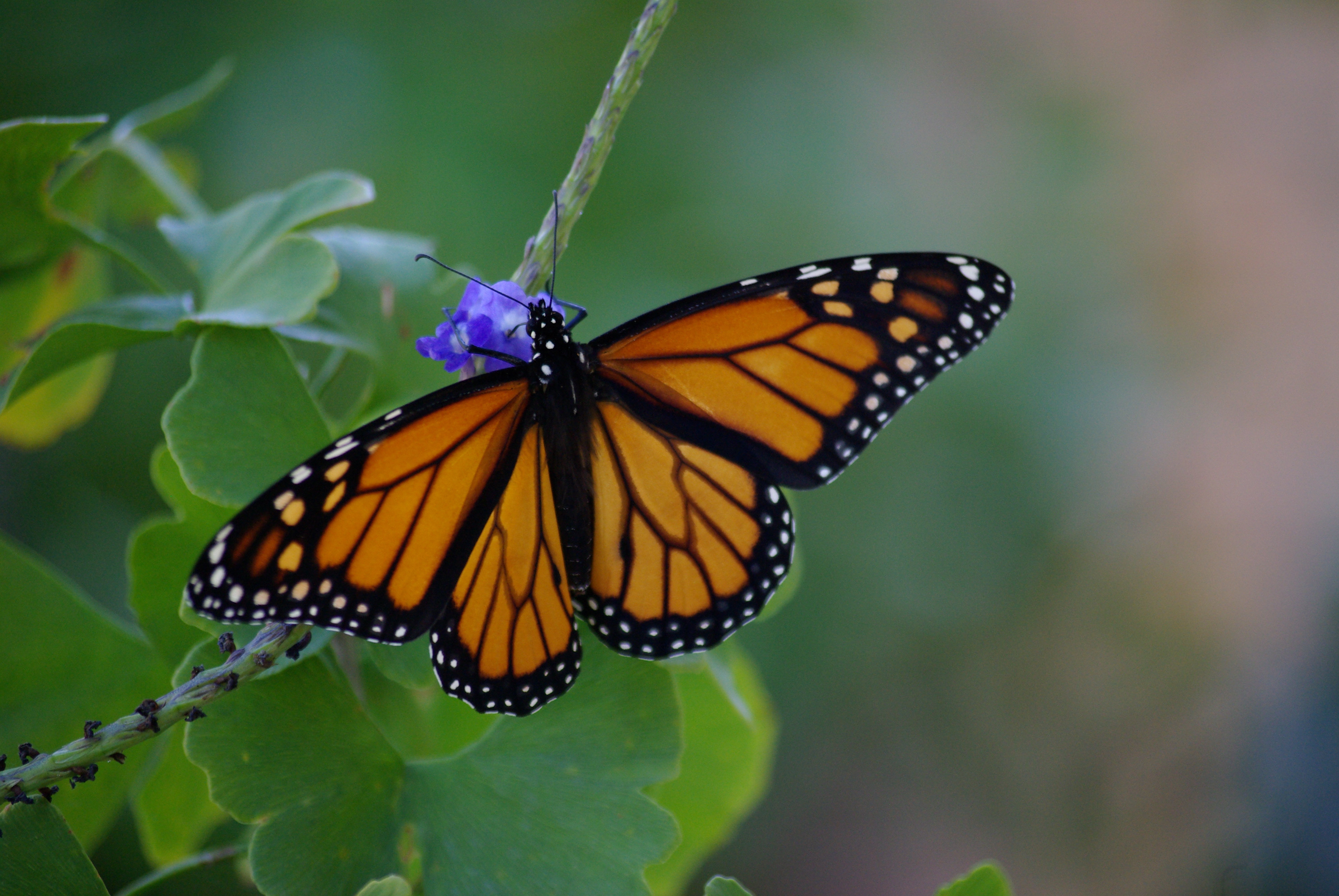
That's it! Beautiful! Have a safe trip, and come back next spring, will you?
Resources, more:
- Blue ageratum is also known as blue mistflower, Conoclinium coelestinum
- Turk’s Cap passes under a lot of aliases: Drummond Wax-mallow, Texas Mallow, Mexican Apple, Red Mallow, May Apple, Wild Turk’s Cap, Bleeding Heart;
Malvaviscus drummondii (M. arboreus var. drummondii) - Butterfly weed — there are several plants that take this name in various parts of the country, this one is Asclepias tuberosa, but Kathryn’s bloom redder and more intense yellow than any of the photos I’ve seen on line.
- Blue porterweed is another important butterfly plant, Stachytarpheta jamaicensis; it also goes under many names: Blue Snakeweed, Jamaica vervain, Brazilian Tea, Devil’s Coachwhip. Ours is in a container on the patio (not in the garden path picture).
- Yeah, the headline is a real groaner — an old movie title coupled with Southwest Airline’s slogan. You’re free to suggest a better headline, anytime.
- You can help track the migrations of the monarch butterflies — go to MonarchWatch.org for instructions and details.
- Here’s another migration tracking program, at Learner.org (an Annenberg Foundation project)
- MonarchButterflyUSA.com
- Enchanted Learning’s monarch page
- I think the monarch in my photos is a male, at least, that’s what it looks like from the photos at Great Plains Nature Center in Wichita, Kansas — can anyone tell for sure? How?
- Mexico’s tourism office advertising agency appears unable to tell the difference between a monarch and a viceroy — can you tell?


 Posted by Ed Darrell



 Millard Fillmore's Bathtub