Flash mobs for cultural literacy, history and heritage, and a little fun

March 12, 2012

What happens when you take a 20th century rock song (from U2), contemporary dancers, a church choir, an ancient but beautiful language, battery-powered amps for buskers, and use digital personal communications to mash them all up on Grafton Street in Dublin?

Great stuff:  “A Language That Will Never Die” from PBO

More:


“John Brown’s Body” becoming “The Battle Hymn of the Republic”: Managing expectations of a nation during a civil war

November 27, 2011

Our textbooks and curriculum guides too often fail to make clear the links between the bloody conflicts in the Kansas Territory and the Civil War, between the conflicts engaged in by men like John Brown in Kansas, and later at Harper’s Ferry, Virginia, and the conflicts of the Civil War.

We might make the history more vivid and clear with the use of Julia Ward Howe’s “Battle Hymn of the Republic,” an epic war song based closely on a folk tune favored by Union troops of the time, conscripted specifically because of that affinity by Howe to serve the greater action of repurposing the war from merely saving the Union to freeing people from bondage.  It’s a study in propaganda earlier than we usually think of it.

Prof. R. Blakeslee Gilpin’s essay explaining those links, and exposing the substantial and usually hidden role Julia Ward Howe’s husband played in Brown’s raid on Harper’s Ferry, appears in the New York Times’s coverage of the 150th anniversary of the Civil War.  As identified at the NYT website, Gilpin is a visiting assistant professor of history at the University of South Carolina, and the author of a book on the issue, John Brown Still Lives!: America’s Long Reckoning With Violence, Equality, and Change.

Early lyric sheet for "Battle Hymn of the Republic," by Julia Ward Howe, Library of Congress via New York Times

An early lyric sheet for "Battle Hymn of the Republic," by Julia Ward Howe, Library of Congress via New York Times

Most of my students claim not to know the song, “John Brown’s Body,” and an astonishing number of the students say they don’t know “The Battle Hymn of the Republic.”  It’s a chance to bore them — or instruct them, if the planets and stars align — using a bit of music (a teacher should be able to find a copy of the Mormon Tabernacle Choir’s version of the “The Battle Hymn” with little difficulty; it appears in the hymnals of most Protestant sects, so you can get a copy of the lyrics; you’ll have to do a search to find a good copy of  “John Brown’s Body,” though; I’ve not found one I like to use in class).

It might be a short lesson, an adjunct to a lesson, or a project for a student with some choir training.

Gilpin wrote:

Even if Howe’s song spoke to a different understanding of the war, her efforts to transform “John Brown’s Body” into a national patriotic text meant that, much like Brown’s afterlife, people would end up using and abusing “Battle Hymn” as they saw fit. What Howe observed in that Union camp outside of Washington in 1861 was just the beginning of a war of clashing agendas and endlessly obscured meanings. To be sure, those north and south of the Mason-Dixon Line knew that the developing war was being fought over slavery – its brutal realities, its political volatility and especially its uncertain future – but even in its opening months, commentary about the war was already cloaked in the bland language of preserving the Union or defending states’ rights. Assessing the war itself, Howe later wrote that “its cruel fangs fastened upon the very heart of Boston and took from us our best and bravest.”

For Howe and generations of Americans, the cruelty of war demanded a providential overseer. Despite her urge to celebrate noble-hearted men like Brown, “Battle Hymn” helped to take responsibility for the Civil War out of the brutal and clumsy hands of ordinary mortals. To be sure, Brown his death would help to make his nation holy and especially to make all men free, but his radical extremism was frightening to most Americans. Soon enough, the Civil War would be transformed by songs like Howe’s into a conflict of necessity and destiny – a providential trial by fire. That narrative, of a harrowing but essential national adolescence, would eventually be at the expense of those Brown had died for, and whose fate the war was being fought to settle.

More links and a couple of original documents can be found at the NYT site — I would encourage all U.S. history teachers to subscribe to the paper’s coverage of the sesquicentennial of the war.


Documentary film worth seeing: “The Other ‘F’ Word” at the Texas Theatre

November 20, 2011

Here’s the trailer:

Kathryn and I caught it last night at the renovated, historic Texas Theatre on Jefferson Avenue in Oak Cliff (formerly an independent town, now a sprawling neighborhood of Dallas).  The audience enthusiasm didn’t overpower the movie — the audience was much smaller than the film deserves.

It’s showing again this afternoon and Wednesday night at the Texas.

Advantages of seeing this at the Texas:

  1. Parking is easy and free after 4:00 p.m. on Jefferson Avenue.
  2. The bar has Mothership beer on tap (and a variety of other good libations).
  3. Popcorn is cheaper than at most megaplexes, plus it doesn’t taste as if made from petroleum by-product (which is not to say it is healthy, but that it may be less unhealthy).
  4. History point 1:  This is a near-Art Deco theatre built originally by Howard Hughes.
  5. History point 2:  This is the theatre in which Lee Harvey Oswald was captured in his flight from the scene of the assassination of President John F. Kennedy.
  6. It’s a great film.
  7. It’s a great theatre to view great films in.

Punk never made a great impression on me.  But at length, years later, I think I understand part of the angst and noise of the punkers, thanks to this film.  The description at the YouTube trailer:

THE OTHER F WORD
directed by Andrea Blaugrund Nevins
produced by Cristan Reilly and Andrea Blaugrund Nevins

IN THEATERS NOVEMBER 2ND, 2011
http://www.theotherfwordmovie.com/

This revealing and touching film asks what happens when a generation’s ultimate anti-authoritarians — punk rockers — become society’s ultimate authorities — dads. With a large chorus of punk rock’s leading men – Blink-182’s Mark Hoppus, Red Hot Chili Peppers’ Flea, Rise Against’s Tim McIlrath – THE OTHER F WORD follows Jim Lindberg, a 20-year veteran of the skate punk band Pennywise, on his hysterical and moving journey from belting his band’s anthem “F–k Authority,” to embracing his ultimately authoritarian role in mid-life: fatherhood.

Other dads featured in the film include skater Tony Hawk, Art Alexakis (Everclear), Mark Mothersbaugh (Devo), Tony Adolescent (The Adolescents), Fat Mike (NOFX), Lars Frederiksen (Rancid), and many others.

These are Tea Partiers with a cause and a brain, and a sense of social responsibility.  Lindberg said, near the end of the movie:

That’s what I want to hold on to, is that feeling that we can make a change out there.  Maybe the way we change the world is by raising better kids.

Readers of this blog may note the great irony in one of the chief profiles of the film being of Ron Reyes, a member of early West Coast punk band Black Flag, who quit the band in the middle of a set to protest the violence that afflicted the Los Angeles punk scene, and moved to Vancouver, British Columbia, to raise his kids well.

Heck, it’s probably a great film to see even if you can’t see it at the Texas.

(You know, I’ve got some shots of our tour of the Texas Theatre in August . . . hmm . . . where are those pictures?  Other computer?)


Pete Seeger: STILL standing taller than his critics

September 6, 2011

(This is almost completely an encore post — one that should get more circulation.  From four years ago, in 2007.  I have not updated years or ages — sharpen your math skills, and do it as you go.)

Some people can’t let go of the past, and like the greedy chimpanzee who grasps the rice in the jar, and then is trapped when he cannot pull out his fist nor will he give up his prize to save his freedom, they trap themselves out of a good life.

  • Cover to Pete Seeger album

    Cover of 1996 album of songs, "Pete." Seeger, born May 3, 1919, is 88 years old now.

Like this fellow, whose father’s dislike of an old political position of Pete Seeger kept them both from a good concert. He appears to agree with his father, though, thinking that somehow Seeger is responsible for the evils of Stalinism, and complaining that Seeger was tardy in making note of the fact that Stalin was evil. And Instapundit’s Glenn Reynolds agrees, profanely, and inaccurately, as I’ll explain below the fold. But heed this warning: I’m explaining at length.

Get a life, people! Pete Seeger did.

Read the rest of this entry »


OK Go! and Muppets!

August 28, 2011

Together!  OK Go and the Muppets:

Oh, if only this meant the Muppet Show was coming back.


Bathtub reading for a broiling July

July 18, 2011

Make that a cold bath.  It hit 107° F here Friday.  15th consecutive 100°-plus day?  17th?  200th?

Birds refuse to bathe in the bird bath — they’re saving it to drink.  The sprinkler system misfired yesterday — had to kill the power to fix a kitchen light and the clock on the sprinkler got a few hours off — and we were alerted by dozens of bluejays broadcasting the news.  “Water!” they screamed.  Dallas isn’t supposed to be home to robins, but there were three of them dancing on the wet sidewalk with the jays, plus assorted other birds — house finches, mourning doves, white-winged doves, cardinals, and that little scamp, the Bewick’s wren.  The woodpeckers declined to land on the ground.  No room for grackles.

While soaking, and cooling, what do we read?  In total chaos, or at least, in no particular order:

New Year's 1909, cartoon by John T. McCutcheon of Chicago

Cartoon by Chicago cartoonist John T. McCutcheon, 1909

You can only read until your fingers get all wrinkly.  There’s still stuff on the reading stack!

Another soak, for another time.


Rolling Stones, “Salt of the Earth”

May 24, 2011


Robert Johnson’s centennial, May 8: Memorial to the blues

May 8, 2011

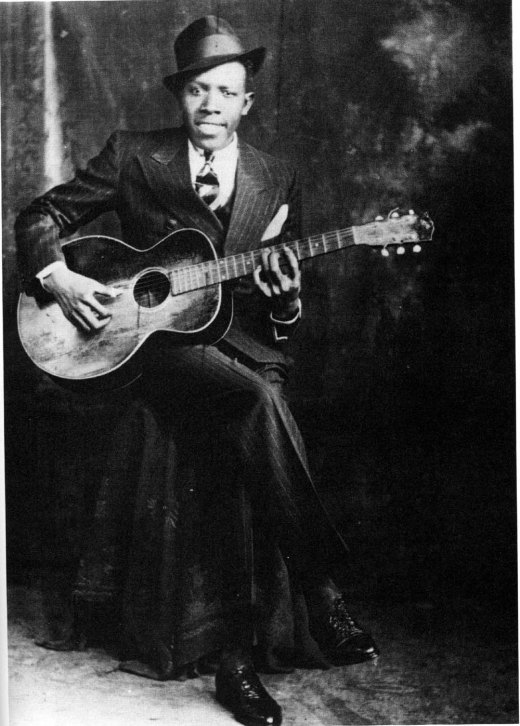
May 8, 2011, is the 100th anniversary of the birth of bluesman Robert Johnson.

Robert Johnson, hat and guitar
Robert Johnson — one of two known photographs of the Delta blues legend

In a fitting tribute to Johnson and an important coming-of-age coming-to-senses moment, First Presbyterian Church in downtown Dallas announced plans to save the old Brunswick Records Building at 508 Park Avenue, a site where Johnson recorded songs in 1937 that changed the blues, changed recording, and left us a legacy of Johnson to study from his short life.

(On at least one day of those 1937 recordings, Johnson could have brushed shoulders with the Light Crust Doughboys, the Texas Swing legends, who were recording in the same building.  The Doughboys set their own pace and gave birth to Bob Wills and the Texas Playboys.  Two of Texas’s greatest music legends, in the same building on the same day, both just stepping on the platform of the train to immortality.)

Saving 508 Park Avenue vexed Dallas for a couple of decades.  First, blues is not the music of Dallas cognescenti, though the world class musicians in town including Dallas Symphony Orchestra’s Jaap van Zweden tend to support the eclectic music scence and honoring musicians of all genres (and Texas is loaded with different music genres).  Second, while Park Avenue may have been a bustling business district adjunct once, Dallas’s city center suffered 50 years of decline after school desegregation.  Parts of downtown and Uptown begin to look prosperous again, but the southern peninsula of the city, away from the now-packed-with-performance venues Arts District, a freeway and ten blocks away from Uptown, with its back up against another freeway, part of Interstate 30 and the famous Dallas Mixmaster.

508 Park Avenue, Dallas, Robert Johnson's early recording site, photo by Justin Terveen for the Dallas Observer in 2011
508 Park Avenue, Dallas, Robert Johnson’s early recording site, photo by Justin Terveen for the Dallas Observer, 2011

Plus, the building is directly across the street from the Stewpot, a kitchen operated by First Presbyterian Church to serve Dallas large and unfortunately thriving homeless population.

Who wants to renovate an abandoned building that has homeless people as scenery for the better part of the day?

Big news this week:  508 Park Avenue was sold to First Presbyterian, who have plans to save the building (and recording studio!), add a performance amphitheatre at one end of the block, and a park at the other.  This is people-friendly development well ahead of its time — there is not a resident population in that part of the city to support such a venue — yet.

Last summer, it was the neighbors, First Presbyterian Church of Dallas, who made an offer to buy 508 Park Avenue and the adjacent building and empty lot. But the deal was contingent on the city allowing the church, which also operates the Stewpot, to tear down an unrelated building next door, at 1900 Young, and replace it with an outdoor amphitheater for church socials and concerts. The Landmark Commission went into last Monday’s meeting with angels on one shoulder and devils on the other: The commission’s task force suggested approval; city staff, denial. The latter would have sent 508 Park Avenue back into purgatory.

But Landmark OK’d the plan, and the church says it will restore 508 Park Avenue to its former glory, inside and out—including the construction of a real recording studio where Johnson once sat and played “Hell Hound on My Trail.”

The church promises: It has musicians lined up to participate, but it can’t yet reveal who. The church promises: 508 Park Avenue will be resurrected.

One hell of a birthday gift for a man who supposedly sold his soul to the Devil.

The second authenticated photo of blues legend Robert Johnson

So, on Robert Johnson’s 100th birthday (assuming he wasn’t really born in 1912 . . . another mystery for another time, perhaps), the news is that the legendary bluesman who burned out like a shooting star helped save one of the few examples of art deco building decoration in Dallas, when a group of Christians who help the homeless, decided to step in an update their downtown Dallas campus.

Every step of the way, it’s an unlikely story.  Truth is, in this case, much, much stranger than fiction.

Ovation Music released to YouTube the video of Eric Clapton playing and singing “Me and the Devil,” at 508 Park Avenue, in the same room where Robert Johnson sang for a record early on.  Johnson recorded the song at that same location on Sunday, June 20, 1937.

508 Park Avenue, Dallas, is already a memorial to Robert Johnson, to the blues, and to the city where these early blues hits were made.  The struggle remains to make the memorial accessible, and not threatened with destruction.

More, resources: 


Quote of the moment: Doug Sahm on Texas music

April 14, 2011

Doug Sahm, Magnet Magazine photo

Doug Sahm, 1941-1999, Magnet Magazine photo

“I’m a part of Willie Nelson’s world and I love it, but at the same time, I’m part of the Grateful Dead’s world. One night I might be playing twin fiddles at the Broken Spoke and the next night I’ll be down at Antone’s playing blues. In that way Texas is a paradise, because all that music is here.”

Doug Sahm, 1975

Tip of the old scrub brush to Un Perla, Por Favor.


Oldest written melody in history

January 17, 2011

There is the oldest known animated cartoon, 5,200 years old.  There is the oldest known musical instrument, between 7,000 and 9,000 years old.

Now, also, here is the oldest known written melody, too – from 1400 BCE.

Are we to assume that for at least 5,000 years, music was all improvised?  Would that make jazz the oldest musical form?

In the YouTube comments, there is what may be oldest known copyright dispute, too.

Michael Levy performs on the lyre in the video, and he’s the authority on ancient music who put the thing together.  His explanation and website offer a lot more that teachers of world history might use to bring these ancient arts to life.  He explained at YouTube:

This unique video, features my arrangement of the 3400 year old “Hurrian Hymn no.6”, which was discovered in Ugarit ,ancient northern Canaan (now modern Syria) in the early 1950s, and was preserved for 3400 years on a clay tablet, written in the Cuneiform text of the ancient Hurrian language – it is THE oldest written song yet known! Respect, to the amazing ancient culture of Syria…السلام عليكم

Although about 29 musical texts were discovered at Ugarit, only this text, (text H6), was in a sufficient state of preservation to allow for modern academic musical reconstruction.

In short, the Cuneiform text clearly indicated specific names for lyre strings, and their respective musical intervals — a sort of “Guitar tablature”, for lyre!

Although discovered in modern day Syria, the Hurrians were not Syrian — they came from modern day Anatolia. The Hurrian Hymn actually dates to the very end of the Hurrian civilisation (c.1400BCE) . The Hurrian civilization dates back to at least 3000 BCE. It is an incredible thought, that just maybe, the musical texts found at Ugarit, preserved precious sacred Hurrian music which may have already been thousands of years old, prior to their inscription for posterity, on the clay tablets found at Ugarit!

My arrangement here, is based on the original transcription of the melody, as interpreted by Prof. Richard Dumbrill. Here is a link to his book, “The Archeomusicology of the Ancient Near East”:
http://bit.ly/d3aovp

A photograph of the actual clay tablet on which the Hurrian Hymn was inscribed, can be seen here:

http://phoenicia.org/music.html

The melody is one of several academic interpretations, from the ambiguous Cuneiform text of the Hurrian language in which it was written. Although many of the meanings of the Hurrian language are now lost in the mists of time, it can be established that the fragmentary Hurrian Hymn which has been found on these precious clay tablets are dedicated to Nikkal; the wife of the moon god.

There are several such interpretations of this melody, but to me, the fabulous interpretation just somehow sounds the most “authentic”. Below is a link to the sheet music, as interpreted by Clint Goss:

http://www.flutekey.com/pdf/HurrianTa…

In my arrangement of the Hurrian Hymn, I have attempted to illustrate an interesting diversity of ancient lyre playing techniques, ranging from the use of “block and strum” improvisation at the end, glissando’s, trills & tremolos, and alternating between harp-like tones in the left hand produced by finger-plucked strings, and guitar-like tones in the right hand, produced by use of the plectrum.

I have arranged the melody in the style of a “Theme and Variations” – I first quote the unadorned melody in the first section, followed by the different lyre techniques described above in the repeat, & also featuring improvisatory passages at the end of the performance.

I am also playing the lyre horizontally – a much more authentic playing position, as depicted in ancient illustrations of Middle Eastern Lyre players:

http://www.hebrewhistory.info/factpap…

This also seems a much more stable playing position to me, and I find it much easier to improvise with string-blocking etc when the lyre is held in this manner.

My arrangement of the melody is much slower than the actual academic interpretation – I wanted the improvisations in the variations on the theme to stand out, and to better illustrate the use of lyre techniques by a more rubato approach to the melody.

All of my 9 albums of mystical, ancient lyre music are now available from iTunes . . .

1)”An Ancient Lyre”: http://bit.ly/dhCozi

2)”King David’s Lyre; Echoes of Ancient Israel”: http://bit.ly/9PCIua

3)”The Ancient Biblical Lyre”: http://bit.ly/9hTDje

4)”Lyre of the Levites”: http://bit.ly/9baWuM

5)”Apollo’s Lyre”: http://bit.ly/dhCozi

6)”Ancient Times — Music of The Ancient World”: http://bit.ly/aRF5PD

7)”The Ancient Greek Modes”: http://bit.ly/cZks0o

8)”The Ancient Greek Lyre”: http://bit.ly/bxO7Ra

9)”Ancient Visions — New Compositions for an Ancient Lyre”: http://bit.ly/dCPmRN

Physical CDs are also available anywhere in the world from CD Baby, for 3 of my best selling albums:

“An Ancient Lyre”: http://www.cdbaby.com/cd/mlevy4

“King David’s Lyre; Echoes of Ancient Israel”: http://www.cdbaby.com/cd/mlevy

“Lyre of the Levites”: http://www.cdbaby.com/cd/mlevy2

For full details about my albums of lyre music, and the fascinating ancient historical background, please visit my official website:

http://www.ancientlyre.com

Tip of the old scrub brush to Pharyngula, who used the video only in passing, oddly enough.


Atheists got no song, no hymnal but the blues?

December 28, 2010

Tip of the old scrub brush to Disciple/Methodist David Bates, with whom I used to enjoy singing bass on the back row of the choir.

From a 2010 production of Austin City Limits, Steve Martin joins the Steep Canyon Rangers in an a capella singing of the entire atheist hymnal.

Atheists have a very witty lyricist.

Update:  “Austin City Limits” asserted its copyright on that version (might be available at their website).  Here’s the song from a handheld camera at Merlefest, courtesy of Freedom Tuners:

Also via Boing-Boing; credit where credit is due.


Tuba Christmas in Dallas, today at noon

December 24, 2010

Tuba Christmas!  Today, in Dallas!

DALLAS – FRIDAY, DECEMBER 24 – TIME: 12:00 noon [2010]
LOCATION: Thanks-Giving Square, corner of Bryan, Ervay & Pacific Streets, Downtown
NOTE: Local sponsorship provided by Brook Mays Music, McKay Music, Mr.E’s Music and Houghton Music.
GUEST CONDUCTOR: Donald Little

It’s cold and looking like rain — dress warmly.

Tuba Christmas, by Stephen Ferris, stephenferris-art.com

Tuba Christmas, by Stephen Ferris. You can own this print: stephenferris-art.com; click on the picture to go to his gallery

Tip of the old scrub brush for the artwork to Donald Miller.  Yes, that Donald Miller.

[Donald Miller said, at his blog, way back in 2008:

*Stephen Ferris’ artwork, “Tuba Christmas” is significant because it is a painting of the Portland site. The tent, under which the tubas are organized, is a staple. And the man in the hat is Dr. John Richards, who played in the Oregon Symphony for many years. He actually wears that hat each year because he also drives a submarine.]


Christmas greetings, unapproved by Dallas First Baptist Grinchlist

December 23, 2010

This video does NOT have the seal of approval from Dallas First Baptist Church.  Also, the composer of the song was Jewish.  Reasoning Person discretion advised:

A 2007 post on YouTube, with these details:

Sung by The Drifters. Cartoon by Joshua Held.
Featuring Bill Pinkney on lead bass and Clyde McPhatter on tenor.
An animated Christmas Card, and a homage to a great song, a great band, and a great Holiday.

More me on: http://www.joshuaheld.com

Tip of the old scrub brush to Oh,  For Goodness Sake.

__________

Some guy, Melvin Rose,  posted this comment on a Dallas Morning News blog about First Baptist’s Grinchiness:

Pastor Jeffress, Dallas's Chief Grinch

Pastor Jeffress, in his deepest Grinch voice, orders the Whos in Whoville to toe the Christmas line. If you're not "religiously correct," you'd better watch out!

Imagine if a guy had a really primo parking space at the mall, right by the door, and you were circling round and round looking for a space, and he said to you, “Happy Holidays! I’m leaving. Would you like my space?”

Who amongst us, no matter what flavor of religion they choose, would turn the guy down?

Two people complained about it. I kid you not.

It’s not the War on Christmas we need to worry about — it’s the War for Fundamentalist Correctness that threatens us more.


Dan Valentine – I Miss Kissing You

December 10, 2010

I MISS KISSING YOU
Words by Daniel Valentine
© 2010

“Why did I have to go and fall for a soldier?
Soldiers march off and oh how I long to hold yer
Face and mouth to mine
While arms and legs and tongues entwine.

Other than in my dreams it’s, like, been forever,
So late at night it seems, since we kissed, and never
Have I missed your touch –
Your lips and fingertips — so much . . .”

Such are the thoughts inside my head,
Alone and lonely home in bed.
Thoughts better left for now unsaid.
So this I wrote my love instead:

“Missing you,
I miss kissing you
Under the mistletoe,
Three or four sweet sips
From a cup of hot cocoa on your lips . . .

Missing you,
I miss kissing you
Under the town hall clock –
Friends and fam’ly there –
Colored bits of confetti in our hair.

I miss kissing you,
Curled up in your arms,
In the glow of firelight.
I miss kissing you
And making up
Those few foolish times we fight.
I miss kissing you
Good morning.
I miss kissing you
Goodnight.

Missing you,
I miss kissing you.
When I think the last time
We kissed was goodbye,
The day you left for the war,
I’m sad for a while
But force a brave smile,
Counting the days and living for when
You walk through the jetway to kiss you again,
Baby, and then
Hold you and kiss you some more.”


Tuba Christmas near you?

November 28, 2010

Did I mention I really like a good tuba melody?  No, not the oompah back-up — I love it when tubas take the lead, when they sing as only a tuba can.

It’s that time of year I get a chance to hear organized tuba playing for Tuba Christmas.

Like here, in Dallas, at Thanksgiving Square  — the 31st annual Tuba Christmas (2008):

In Texas, the first performance I know of is in Brenham (home of Blue Bell Ice Cream!) on December 3; Amarillo is December 4.   Dallas is set for December 24, at Thanksgiving Square once again.

Is there a Tuba Christmas peformance near you?  Check the website of the Harvey Phillips Foundation, which promotes and organizes the events.

Do you play tuba, or euphonium (baritone), or Sousaphone?

Is America a great place, or what?