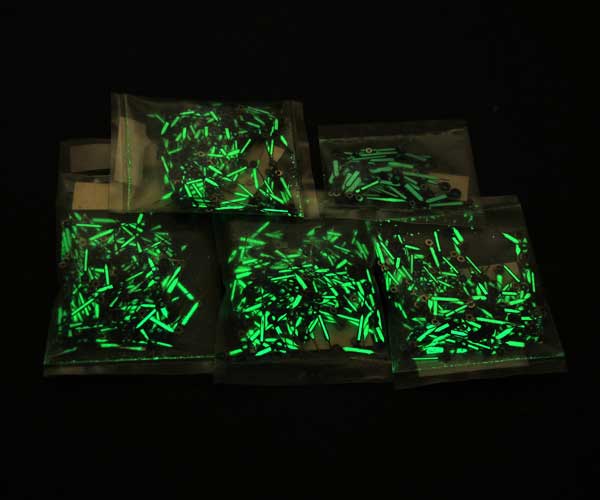
Caption from the Nobel.org site: “Radium hands from 1940-1950’s watches. (Photo licensed under Creative Commons, author: Mauswiesel, November 2011)” The glowing watches to which these hands were attached sometimes caused problems; people who painted the radium on to the hands and the dial suffered a high degree of radiation-related diseases. Modern watches that glow typically do not use radium.
On April 20, 1902, Marie and Pierre Curie succeeded in isolating a chunk of the element radium, one of the earliest radioactive elements studied.
Pierre died in 1906, run over by a horse-drawn carriage. Marie won a second Nobel, in Chemistry, in 1911. Marie died in 1934 of aplastic anemia, a disease probably caused by her having received so much radiation over the course of her career.
KERA Television has a marvelous short film profile of Jack Kilby, who won the Nobel in physics for his invention of what we now call “the computer chip.”
Late in his life, Jack Kilby holds his first integrated circuit, which is encased in plastic. Photo via Texas Instruments, via Earth & Sky
Teachers should check out the film and use it — it’s a great little chapter of Texas history, science history, and U.S. history. It’s an outstanding explanation of a technological development that revolutionized so much of our daily life, especially in the late 20th century. At 8 minutes and 37 seconds, the film is ideal for classroom use.
2009 marks the 50th anniversary of Kilby’s filing for a patent on an integrated circuit. He’s been honored by the Inventor’s Hall of Fame. Despite the stupendous value of his invention, Kilby’s name is far from a household name even in North Dallas, home of Texas Instruments. Robert Noyce, who came up with almost exactly the same idea at almost exactly the same moment, is similarly ignored.
Shouldn’t today’s high school students know about Kilby and Noyce? Not a class period goes by that I don’t use a device powered by Kilby’s invention; nor does one pass that I don’t have to admonish at least one student for misuse of such a device, such as an iPod, MP3 player, or cell phone. It’s difficult to think of someone whose invention has greater influence on the life of these kids, hour by hour — but Kilby and his invention don’t get their due in any text I’ve seen.
It’s a great film — original and clever animation, good interviews, and it features Kilby’s charming daughter, and the great journalist and historian of technology T. R. Reid. Don’t you agree that it’s much better than most of the history stuff we have to show?
Texas history standards require kids to pay brief homage to inventors in the 20th century. Kilby is not named in the standards, however, and so he and his invention are ignored as subjects of history study. You ought to fix that in your classroom, teachers.
Or, until that account is unsuspended by the forces supporting Donald Trump: Follow @FillmoreWhite, the account of the Millard Fillmore White House Library
We've been soaking in the Bathtub for several months, long enough that some of the links we've used have gone to the Great Internet in the Sky.
If you find a dead link, please leave a comment to that post, and tell us what link has expired.
Thanks!
Retired teacher of law, economics, history, AP government, psychology and science. Former speechwriter, press guy and legislative aide in U.S. Senate. Former Department of Education. Former airline real estate, telecom towers, Big 6 (that old!) consultant. Lab and field research in air pollution control.
My blog, Millard Fillmore's Bathtub, is a continuing experiment to test how to use blogs to improve and speed up learning processes for students, perhaps by making some of the courses actually interesting. It is a blog for teachers, to see if we can use blogs. It is for people interested in social studies and social studies education, to see if we can learn to get it right. It's a blog for science fans, to promote good science and good science policy. It's a blog for people interested in good government and how to achieve it.
BS in Mass Communication, University of Utah
Graduate study in Rhetoric and Speech Communication, University of Arizona
JD from the National Law Center, George Washington University


 Posted by Ed Darrell





 Millard Fillmore's Bathtub