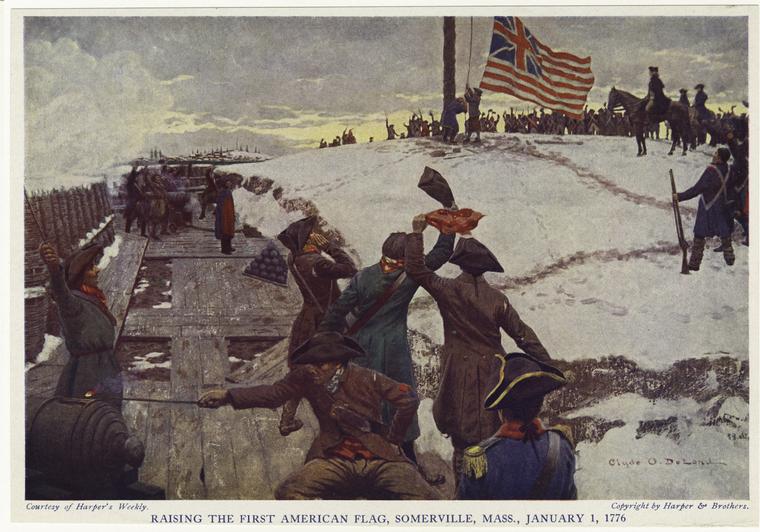
Will you fly your U.S. flags in January 2016?

January 2, 2016

“Raising the first American flag, Somerville, Mass., January 1, 1776.” Harper’s Weekly painting by Clyde Osmer DeLand, 1897. From the digital collections of the New York Public Library

January is loaded with flag flying dates, when we add in statehood days, dates those states are invited to fly their U.S. flags.

In January 2016, the U.S. Flag Code urges citizens to fly flags on these dates, listed chronologically:

  • New Year’s Day, January 1, a federal holiday
  • January 2, Georgia Statehood Day
  • January 3, Alaska Statehood Day
  • January 4, Utah Statehood Day
  • January 6, New Mexico Statehood Day
  • January 9, Connecticut Statehood Day
  • Martin Luther King’s Birthday, a federal holiday on the third Monday of January; that date is January 18, in 2016; King’s actual birthday is January 15, and you may fly your flag then, too
  • Inauguration Day, January 20, the year after election years (next one in 2017)
  • January 26, Michigan Statehood Day
  • January 29, Kansas Statehood Day

You may fly your flag any other day you wish, too; flags should not be flown after sundown unless they are specially lighted, or at one of the few places designated by Congress or Presidential Proclamation for 24-hour flag flying.  According to Wikipedia’s listing, those sites include:

  • Fort McHenry, Baltimore, Maryland (Presidential Proclamation No. 2795, July 2, 1948).
  • Flag House Square, Albemarle and Pratt Streets, Baltimore, Maryland (Public Law 83-319, approved March 26, 1954).
  • Marine Corps War Memorial (Iwo Jima Memorial), Arlington, Virginia (Presidential Proclamation No. 3418, June 12, 1961).
  • Lexington Battle Green, Lexington, Massachusetts (Public Law 89-335, approved November 8, 1965).
  • White House, Washington, D.C. (Presidential Proclamation No. 4000, September 4, 1970).
  • Washington Monument, Washington, D.C. (Presidential Proclamation No. 4064, July 6, 1971, effective July 4, 1971).
  • Any port of entry to the United States which is continuously open (Presidential Proclamation No. 413 1, May 5, 1972).
  • Grounds of the National Memorial Arch in Valley Forge State Park, Valley Forge, Pennsylvania (Public Law 94-53, approved July 4, 1975).
Flag House in 1936, 844 East Pratt & Albemarle Streets (Baltimore, Independent City, Maryland) (cropped). Image courtesy of the federal HABS—Historic American Buildings Survey of Maryland.

Flag House in 1936, where Mary Pickersgill sewed the garrison-sized, 15-star flag that flew over Fort McHenry at the Battle of Baltimore in 1814; one of the sites where the U.S. flag may be flown 24 hours. The house is at 844 East Pratt & Albemarle Streets (Baltimore, Independent City, Maryland). Cropped image courtesy of the federal HABS—Historic American Buildings Survey of Maryland.


December 2015, flag-flying days

November 28, 2015

Mural of Alexander Henson planting the American flag at North Pole, by Austin Mecklem, at the Recorder of Deeds building, built in 1943. 515 D St., NW, Washington, D.C. Library of Congress image

Mural of Alexander Henson planting the American flag at North Pole, by Austin Mecklem, at the Recorder of Deeds building, built in 1943. 515 D St., NW, Washington, D.C. Library of Congress image. Santa Claus may have been out of town when Henson was there.

November offers several flag flying days, especially in years when there is an election.

But December may be the month with the most flag-flying dates, when we include statehood days.

December 7 is Pearl Harbor Remembrance Day.  It’s not in the Flag Code, but public law (P.L. 103-308) urges that the president should issue a proclamation asking Americans to fly flags.

December 25 is Christmas Day, a federal holiday, and one of the score of dates designated in the Flag Code. If you watch your neighborhood closely, you’ll note even some of the most ardent flag wavers miss posting the colors on this day, as they do on Thanksgiving and New Years.

Other dates?

Nine states attained statehood in December, so people in those states should fly their flags (and you may join them).  Included in this group is Delaware, traditionally the “First State,” as it was the first colony to ratify the U.S. Constitution:

  • Illinois, December 3 (1818, 21st state)
  • Delaware, December 7 (1787, 1st state)
  • Mississippi, December 10 (1817, 20th state)
  • Indiana, December 11 (1816, 19th state)
  • Pennsylvania, December 12 (1787, 2nd state)
  • Alabama, December 14 (1819, 22nd state)
  • New Jersey, December 18 (1787, 3rd state)
  • Iowa, December 28 (1846, 29th state)
  • Texas, December 29 (1845, 28th state)

December 15 is Bill of Rights Day, marking the day in 1791 when the Bill of Rights was declared ratified; but though this event generally gets a presidential proclamation, there is no law or executive action that requires flags to fly on that date, for that occasion.

Eleven flag-flying dates in December.  Does any other month have as many flag flying opportunities?

Have I missed any December flag-flying dates?  11 events on 10 days (Delaware’s statehood falls on the anniversary of the Pearl Harbor attack).

Here’s a list of the days to fly the flag, under national law, in chronological order:

  1. Illinois, December 3 (1818, 21st state)
  2. Pearl Harbor Remembrance Day, December 7
  3. Delaware, December 7 (1787, 1st state) (shared with Pearl Harbor Remembrance Day)
  4. Mississippi, December 10 (1817, 20th state)
  5. Indiana, December 11 (1816, 19th state)
  6. Pennsylvania, December 12 (1787, 2nd state)
  7. Alabama, December 14 (1819, 22nd state)
  8. New Jersey, December 18 (1787, 3rd state)
  9. Christmas Day, December 25
  10. Iowa, December 28 (1846, 29th state)
  11. Texas, December 29 (1845, 28th state)

Fly your flag with respect to the flag, for the republic it represents, and for all those who sacrificed that it may wave on your residence.

Appropriate to a snowy December.

Appropriate to a snowy December. “The Barn on Grayson-New Hope Road. This barn with its old truck and ever-present American flag, is often the subject of photographs and paintings by the locals.” Photo and copyright by Melinda Anderson


Patriot Day, September 11, 2015: Fly your flag at half staff today

September 11, 2015

In Washington, D.C., three American flags fly at half-staff on Columbus Circle (outside of Union Station) on Patriot Day 2013.

Wikipedia image. In Washington, D.C., three American flags fly at half-staff on Columbus Circle (outside of Union Station) on Patriot Day 2013. The flags of several US states and territories can be seen also flying at half-staff in the background. “Union Station 2013-09-11 A” by T. H. Kelly. Licensed under CC BY-SA 3.0 via Commons – https://commons.wikimedia.org/wiki/File:Union_Station_2013-09-11_A.JPG#/media/File:Union_Station_2013-09-11_A.JPG

To honor those who died on September 11, 2001, flags in the U.S. fly at half-staff on September 11.  Known as Patriot Day, the date is not in the Flag Code, but is listed in a separate law.

In the United States, Patriot Day, observed as the National Day of Service and Remembrance, occurs on September 11 of each year in memory of the 2,977 killed in the 2001 September 11 attacks.

Fly your flag today, at half-staff. Remember when flying a flag at half-staff, it is first raised to full staff, then slowly lowered to the half-staff position. When the flag is retired at the end of the day, it should again be crisply raised to the full-staff position before being lowered.

A flag attached to a pole that does not allow a half-staff position should be posted as usual.

To further honor the dead, and survivors, many people participate in a day of service to others.

President Barack Obama issued a proclamation ordering all federal facilities to fly flags at half-staff:

Presidential Proclamation: Patriot Day and National Day of Service and Remembrance, 2015

PATRIOT DAY AND NATIONAL DAY OF SERVICE AND REMEMBRANCE, 2015

– – – – – – –

BY THE PRESIDENT OF THE UNITED STATES OF AMERICA

A PROCLAMATION

On September 11, 2001, America experienced the worst terrorist attack in her history when nearly 3,000 men, women, and children were taken from us, leaving their families and our Nation with a void that can never be filled.  But those who brought hate to our shores and smoke to our skies did not expect our country to emerge stronger, and our beacons of hope and freedom to shine brighter as a result.  In the years since, we have stood strong as one people ‑‑ determined to further embolden our country’s character with acts of endurance and strength; rebuilding and resilience; renewal and progress.  In remembrance of the innocent victims who lost their lives and in honor of the families they left behind, let us continue to answer these heinous acts by serving our communities, lifting the lives of our fellow citizens, and spreading the hope that others tried to dim that day.

The compassion that rose in the hearts and minds of the American people on September 11 still serves as the ultimate rebuke to the evil of those who attacked us.  First responders who risked and gave their lives to rescue others demonstrated the unwavering heroism that defines our great Nation.  Volunteers donated time, money, and blood to ensure wounds gave way to healing and recovery.  Young people, raised until then in a time of peace, stepped forward to serve and defend us, and meet the threats of our time.  And people from across our country and the world joined together in the days that followed to stand up and turn toward one another with open arms, making of a tragedy something the terrorists could never abide ‑‑ a tribute of hope over fear, and love over hate.

As we reflect on the lives we lost and pay tribute to the families who still live with extraordinary pain, let us resolve to continue embodying the American spirit that no act of terror can ever extinguish.  I call on all Americans to observe this National Day of Service and Remembrance with acts of selflessness and charity.  In doing so, we prove once again that the power of those who seek to harm and to destroy is never greater than our power to persevere and to build.  I encourage everyone to visit http://www.Serve.gov to learn of the many opportunities available to give back to others and to reaffirm the fundamental truth that we are our brothers’ and our sisters’ keepers, and that we can forge a brighter future together.

Today, we continue our unfaltering march forward, enduring in the perennial optimism that drives us and brightening the light that the darkness of evil can never overcome.  We remember and yearn for the presence of the beautiful lives lost, and we recommit to honoring their memories by shaping the days to come ‑‑ in as stark a contrast as possible to those who took them from us ‑‑ with courage, liberty, and love.

By a joint resolution approved December 18, 2001 (Public Law 107-89), the Congress has designated September 11 of each year as “Patriot Day,” and by Public Law 111-13, approved April 21, 2009, the Congress has requested the observance of September 11 as an annually recognized “National Day of Service and Remembrance.”

NOW, THEREFORE, I, BARACK OBAMA, President of the United States of America, do hereby proclaim September 11, 2015, as Patriot Day and National Day of Service and Remembrance.  I call upon all departments, agencies, and instrumentalities of the United States to display the flag of the United States at half-staff on Patriot Day and National Day of Service and Remembrance in honor of the individuals who lost their lives on September 11, 2001.  I invite the Governors of the United States and its Territories and interested organizations and individuals to join in this observance.  I call upon the people of the United States to participate in community service in honor of those our Nation lost, to observe this day with appropriate ceremonies and activities, including remembrance services, and to observe a moment of silence beginning at 8:46 a.m. Eastern Daylight Time to honor the innocent victims who perished as a result of the terrorist attacks of September 11, 2001.

IN WITNESS WHEREOF, I have hereunto set my hand this

tenth day of September, in the year of our Lord two thousand fifteen, and of the Independence of the United States of America the two hundred and fortieth.

BARACK OBAMA

Do you plan any special service today?

More:

  • Bryan on Scouting has an article on flying flags at half staff today; bookmark it

Remember to fly your flag for Labor Day 2015, September 7

September 7, 2015

Still important in 2015: Fly your flag for American labor, Monday.

Free Labor Will Win, poster from 1942, (Library of Congress)

Poster from the Office of War Information, 1942

(Okay, you may fly your flag all weekend — especially if you’re a union member.  We get the whole weekend, but Labor Day itself is Monday.)

Labor Day 2015 in the United States is a federal holiday, and one of those days Americans are urged to fly the U.S. flag.

“Free Labor Will Win,” the poster said, encouraging a theme important during World War II, when unions were encouraged to avoid strikes or any action that might interrupt work to build the “arsenal of democracy” believed necessary to win the war.  Labor complied, the war was won, and organized labor was the stronger for it. In 2015, some have difficulty remembering when all Americans knew that our future rides on the backs of organized labor.

In war, America turned to organized labor to get the jobs done. Not only do we owe a debt to labor that deserves remembering, we have many jobs that need to be done now, for which organized labor is the best group to turn to.

The poster was issued by the Office of War Information in 1942, in full color. A black-and-white version at the Library of Congress provides a few details for the time:

Labor Day poster. Labor Day poster distributed to war plants and labor organizations. The original is twenty-eight and one-half inches by forty inches and is printed in full color. It was designed by the Office of War Information (OWI) from a photograph especially arranged by Anton Bruehl, well-known photographer. Copies may be obtained by writing the Distribution Section, Office of War Information [alas, you can’t get a copy from the Office of War Information in 2012]

Even down here in deepest, darkest-right-to-work Texas, patriots fly their flags to honor Labor today. It’s heartening.

Flags fly all around in 1882 at the first Labor Day Parade in New York City’s Union Square; lithograph from USC’s Dornsife History Center, via Wikipedia, artist unidentified

This is partly an encore post, a Labor Day tradition.

More, Other Resources:

This is an encore post.

This is an encore post, a Labor Day tradition.


What dates do we fly the flag in May?

May 2, 2015

"Allies Day, May 1917" -- 1917 oil on canvas by Childe Hassam; National Gallery of Art, Washington, D.C.

“Allies Day, May 1917” — 1917 oil on canvas by Childe Hassam; National Gallery of Art, Washington, D.C. Allies Day is no longer celebrated.

May has three days designated for flying the U.S. flag out of the specific days mentioned in the U.S. Flag Code, and three statehood days, when residents of those states should fly their flags.

Interestingly, the three designated days all float, from year to year:

  • Mother’s Day, second Sunday in May (May 10, in 2015)
  • Armed Forces Day, third Saturday in May (May 16)
  • Memorial Day, the last Monday in May (May 25)

Residents of these states celebrate statehood; South Carolina and Wisconsin share May 23:

  • Minnesota, May 11 (1858, the 32nd state)
  • South Carolina, May 23 (1788, the 8th state)
  • Wisconsin, May 23 (1848, the 30th state)
  • Rhode Island, May 29 (1790, the last of the 13 original colonies to ratify the Constitution)

This year President Obama issued a proclamation calling on citizens to fly the flag on May 1, Law Day (I missed that one).

May 8 marks the 70th anniversary of Victory in Europe Day, the day the Axis Powers in Europe surrendered at the end of World War II.  Some years that day is marked by a proclamation calling for flag flying.  (You may fly your flag then even if Congress and the President do nothing.)

In recent years President Obama has proclaimed May 15 as Peace Officers Memorial Day, with flags to fly at half-staff. We might expect another such declaration in 2015.

May 22 is National Maritime Day, under a Joint Resolution from Congress from 1933. President Obama may be expected to proclaim that day as a day to fly the flag, too.

Gee, eleven events on ten days to fly the U.S. flag.  May could be quite busy for flag fliers.

  1. Law Day, May 1
  2. Victory in Europe Day, May 8
  3. Mothers Day, May 10
  4. Minnesota Statehood, May 11
  5. Peace Officers Memorial Day, May 15 (half-staff flags)
  6. Armed Forces Day, May 16
  7. National Maritime Day, May 22
  8. South Carolina Statehood, AND Wisconsin Statehood, May 23
  9. Memorial Day, May 25
  10. Rhode Island Statehood, May 29

Quote of the moment: Calvin Coolidge, on building America: “Look to service, not selfishness”

March 3, 2015

Calvin Coolidge, 30th president of the United States (elected vice president in 1920, and succeeding to the presidency upon the death of Warren G. Harding).  History.com image

Calvin Coolidge, 30th president of the United States (elected vice president in 1920, and succeeding to the presidency upon the death of Warren G. Harding). History.com image

Referring to progress in the U.S. after World War I, Coolidge said:

With peace has come prosperity. Burdens have been great, but the strength to bear them has been greater. The condition of those who toil is higher, better, more secure than in all the ages past. Out of the darkness of a great conflict has appeared the vision, nearer, clearer than ever before, of a life on earth less and less under the deadening restraint of force, more and more under the vitalizing influence of reason. Moral power has been triumphing over physical power. With peace has come prosperity. Burdens have been great, but the strength to bear them has been greater. The condition of those who toil is higher, better, more secure than in all the ages past. Out of the darkness of a great conflict has appeared the vision of a nearer, clearer than ever before, the  [of] life on earth less and less under the deadening restraint of force, more and more under the vitalizing influence of reason. Moral power has been triumphing over physical power. Education will tend to bring reason and experience of the past into the solution of the problems of the future. We must look to service and not selfishness, for service is the foundation of progress. The greatest lesson that we have to learn is to seek ever the public welfare, to build up, to maintain our American heritage.

Candidate for vice president Calvin Coolidge, “America and the War,” 1920

Digging a little deeper, I discover that the first part of this quote also appeared in Coolidge’s Thanksgiving Proclamation on November 27, 1919, when he was  Governor of Massachusetts.  Knowing a good turn of words when he wrote it (I’m assuming he didn’t have ghost writers then), he used the same words in making phonograph recordings of speeches to be distributed in the election campaign of 1920, before radio was available to carry speeches to voters.  I have made minor corrections in the transcript, from the earlier text and the audio delivery.

According to Talking History, the 78 rpm record and audio version were saved and made available by the Library of Congress.

You may want to listen to Coolidge say the words himself. Mp3  RealPlayer


Fly your U.S. flags on these dates in January

January 3, 2015

Flag House in 1936, 844 East Pratt & Albemarle Streets (Baltimore, Independent City, Maryland) (cropped). Image courtesy of the federal HABS—Historic American Buildings Survey of Maryland.

Flag House in 1936, where Mary Pickersgill sewed the garrison-sized, 15-star flag that flew over Fort McHenry at the Battle of Baltimore in 1814; one of the sites where the U.S. flag may be flown 24 hours. The house is at 844 East Pratt & Albemarle Streets (Baltimore, Independent City, Maryland). Cropped image courtesy of the federal HABS—Historic American Buildings Survey of Maryland.

January is loaded with flag flying dates, when we add in statehood days, dates those states are invited to fly their U.S. flags.

In January, the U.S. Flag Code urges citizens to fly flags on these dates:

  • New Year’s Day, January 1, a federal holiday
  • Martin Luther King’s Birthday, a federal holiday on the third Monday of January; that date is January 18, in 2014; King’s actual birthday is January 19, and you may fly your flag then, too
  • Inauguration Day, January 20, the year after election years (next one in 2017)
  • January 2, Georgia Statehood Day
  • January 3, Alaska Statehood Day
  • January 4, Utah Statehood Day
  • January 6, New Mexico Statehood Day
  • January 9, Connecticut Statehood Day
  • January 26, Michigan Statehood Day
  • January 29, Kansas Statehood Day

You may fly your flag any other day you wish, too; flags should not be flown after sundown unless they are specially lighted, or at one of the few places designated by Congress or Presidential Proclamation for 24-hour flag flying.  According to Wikipedia’s listing, those sites include:

  • Fort McHenry, Baltimore, Maryland (Presidential Proclamation No. 2795, July 2, 1948).
  • Flag House Square, Albemarle and Pratt Streets, Baltimore, Maryland (Public Law 83-319, approved March 26, 1954).
  • Marine Corps War Memorial (Iwo Jima Memorial), Arlington, Virginia (Presidential Proclamation No. 3418, June 12, 1961).
  • Lexington Battle Green, Lexington, Massachusetts (Public Law 89-335, approved November 8, 1965).
  • White House, Washington, D.C. (Presidential Proclamation No. 4000, September 4, 1970).
  • Washington Monument, Washington, D.C. (Presidential Proclamation No. 4064, July 6, 1971, effective July 4, 1971).
  • Any port of entry to the United States which is continuously open (Presidential Proclamation No. 413 1, May 5, 1972).
  • Grounds of the National Memorial Arch in Valley Forge State Park, Valley Forge, Pennsylvania (Public Law 94-53, approved July 4, 1975).

Changing a nation’s flag? New Zealand might

December 4, 2014

A few of us, a vanishing few, remember when Canada changed its flag in 1965.

Canada's flag in 1965. Wikipedia image.

Canada’s flag in 1965, featuring the British Union Jack. This design dates from 1957, following several earlier, similar designs. Wikipedia image.

Change the flag?  What a concept!

We probably forget that the U.S. flag, while recognizable since 1789, changed quite a bit between then and now, mostly in stars, but also in stripes.

Here’s what Canada settled on in 1965, after a surprisingly bitter debate that ran for months in 1964:

Wikipedia:  The National Flag of Canada,[1] also known as the Maple Leaf and l'Unifolié (French for

Wikipedia: The National Flag of Canada,[1] also known as the Maple Leaf and l’Unifolié (French for “the one-leafed”), is a flag consisting of a red field with a white square at its centre, in the middle of which is featured a stylized, 11-pointed, red maple leaf. Adopted in 1965 to replace the Union Flag, it is the first ever specified by statute law for use as the country’s national flag. The Canadian Red Ensign had been unofficially used since the 1890s and was approved by a 1945 Order in Council for use “wherever place or occasion may make it desirable to fly a distinctive Canadian flag”

New Zealand contemplates changing her flag, with a referendum on the action pending, probably in 2016.  What are they in for?  Will the debate in New Zealand be so bitter as Canada’s was?

At the BBC site, a few more details:

New Zealand is to hold a binding referendum in 2016 on whether to change the national flag.

The announcement by Prime Minister John Key of the referendum came after his government last month won a third term in a general election.

A panel of “respected New Zealanders” will lead the public discussion on potential designs for a new flag.

Mr Key has previously said he would like to see a new flag featuring a silver fern, on a black background.

That would be similar to the banner already used by many New Zealand teams such as the All Blacks national rugby union team.

“I believe that this is the right time for New Zealanders to consider changing the [flag’s] design to one that better reflects our status as a modern, independent nation,” Mr Key said.

Photo illustrating the BBC story, showing the silver fern flag of the New Zealand All Blacks football club -- Getty Images

Photo illustrating the BBC story, showing the silver fern flag of the New Zealand All Blacks football club — Getty Images

A fern leaf.  Hey, that’s rather like Canada’s switch from the mostly-red flag with a Union Jack to a maple leaf.  Canada’s been happy with that flag for more than 50 years, now.  Right?

Wait. Canadian Prime Minister Harper wants to change the maple leaf now?

OTTAWA — Prime Minister Stephen Harper surprised media this morning by unveiling a “new-look” Canadian flag in red, white, and blue that “just by fluke” matches the colours of the Conservative Party’s logo.

“I was doodling with my magic markers a while back and it just came to me out of the blue. Our flag needs some blue!” said Harper sporting a lapel pin with his proposed new flag design.

“Frankly, the boring old flag doesn’t reflect my new Canada…we needed something with more energy, something gutsier to better reflect my world leadership role.”

Harper’s doodle, cleaned up a bit:

A new flag for Canada, with blue added in?  And what a lovely shade of blue it is . . . why does it make us suspicious?

A new flag for Canada, with blue added in? Stephen Harper’s proposed new flag. And what a lovely shade of blue it is . . . why does it make us suspicious?

When a CBC reporter pointed out that Harper’s new flag colours are identical to the Conservative Party logo the PM said he was surprised by the question and hadn’t really noticed the similarity.

“Wow…I guess if you squint at our new flag you could maybe see some loose, loose likeness to my party’s logo colours.  But my new design really captures the new Canada…bold and not to be messed with.”

ConservativePartyLogoSmaller

“Proud Canadians will rally behind this new flag as a patriotic symbol of what Canada has become.”

Liberal Party leader Justin Trudeau reacted immediately telling the Ottawa Citizen, “I, like most Canadians, must now question the very sanity of Mr. Harper.  Has he gone nuts?  That’s a real and pressing question.  Has Mr. Harper’s ego finally won the sweaty arm-wrestling match that goes on in his brain.”

“The NDP has been calling loudly for increased spending on mental health care and Mr. Harper just proved the need,” said opposition leader Tom Mulcair.

[Well, no, not really.  Notice that the source of the Canadian flag proposal is The Lapine, Canada’s most successful on-line satirical news site — the Onion of the Frozen North.  Yes, I got suckered in, until I read the entire article; if it makes you shake your head, be suspicious, even if it doesn’t trigger your Hemingway™ Shit Detector. New Zealand is serious, though.]

Flag wars ahead!  Social studies teachers, you should tee this up so your students can enjoy the popcorn.

Good thing the U.S. had Betsy Ross around to tell the rebels what the flag would be, eh?*

More, and resources:


Don’t fall for the star-spangled voodoo history

September 14, 2014

Star-spangled Banner and the War of 1812 - The original Star-Spangled Banner, the flag that inspired Francis Scott Key to write the song that would become our national anthem, is among the most treasured artifacts in the collections of the Smithsonian’s National Museum of American History in Washington, D.C.

Star-spangled Banner and the War of 1812 – The original Star-Spangled Banner, the flag that inspired Francis Scott Key to write the song that would become our national anthem, is among the most treasured artifacts in the collections of the Smithsonian’s National Museum of American History in Washington, D.C.

Every school kid learns the story of the “Star-Spangled Banner,” or should.

During the War of 1812, Georgetown lawyer Francis Scott Key, stood aboard a British ship in Baltimore Harbor to negotiate the release of his friend, Dr. William Beanes, who had been taken prisoner while the British stormed through Bladensburg, Maryland, after burning Washington, D.C.  Key witnessed the British shelling of Fort McHenry, the guardian of Baltimore’s harbor.  Inspired when he saw the U.S. flag still waving at dawn after a night of constant shelling, Key wrote a poem.

Key published the poem, suggested it might be put to the tune of “Anachreon in Heaven” (a tavern tune popular at the time) — and the popularity of the song grew until Congress designated it the national anthem in 1931.  In telling the story of the latest restoration of that garrison flag now housed at the Smithsonian Museum of American History, Smithsonian Magazine repeated the story in the July 2000 issue:  “Our Flag Was Still There.”

It’s a wonderful history with lots of splendid, interesting details (Dolley Madison fleeing the Executive Mansion clutching the Gilbert Stuart portrait of George Washington, the guy who had introduced Dolley to James Madison and then snubbed them after they were married; the British troops eating the White House dinner the Madisons left in their haste; the gigantic, 42 by 30 foot flag sewn by Mary Pickersgill, a Baltimore widow trying to support her family; the rag-tag Baltimore militia stopping cold “Wellington’s Invicibles;” the British massing of 50 boats and gunships; and much more).

It’s a grand and glorious history that stirs the patriotic embers of the most cynical Americans.

And it’s all true.

So it doesn’t deserve the voodoo history version, the bogus history created by some person preaching in a church (I gather from the “amens”) that is making the rounds of the internet, stripped of attribution so we can hunt down the fool who is at fault.

We got this in an e-mail yesterday; patriots save us, there must be a hundred repetitions that turn up on Google, not one correcting this horrible distortion of American history.

Horrible distortion of American history

(The full version is a mind-numbing 11 minutes plus.  Some people have put it on other sites. )

Why do I complain?

  1. It was the War of 1812, not the Revolutionary War — there were 15 states, not 13 colonies.
  2. There was no ultimatum to to Baltimore, nor to the U.S., as this fellow describes it.
  3. Key negotiated for the release of one man, Dr. Beanes.  There was no brig full of U.S. prisoners.
  4. It’s Fort McHenry, not “Henry.”  The fort was named after James McHenry, a physician who was one of the foreign-born signers of the Constitution, who had assisted Generals Washington and Lafayette during the American Revolution, and who had served as Secretary of War to Presidents Washington and Adams.
  5. Fort McHenry was a military institution, a fort defending Baltimore Harbor.  It was not a refuge for women and children.
  6. The nation would not have reverted to British rule had Fort McHenry fallen.
  7. There were 50 ships, not hundreds.  Most of them were rafts with guns on them.  Baltimore Harbor is an arm of Chesapeake Bay, more than 150 miles from the ocean; Fort McHenry is not on the ocean, but across the harbor from the Orioles’ Camden Yards ballpark.
  8. The battle started in daylight. Bombardment continued for 25 hours.
  9. Bogus quote:  George Washington never said “What sets the American Christian apart from all other people in this world is he will die on his feet before he will live on his knees.”  Tough words.  Spanish Civil War. Not George Washington.  I particularly hate it when people make up stuff to put in the mouths of great men.  Washington left his diaries and considerably more — we don’t have to make up inspiring stuff, and when we do, we get it wrong.
  10. The battle was not over the flag; the British were trying to take Baltimore, one of America’s great ports.  At this point, they rather needed to since the Baltimore militia had stunned and stopped the ground troops east of the city.  There’s enough American bravery and pluck in this part of the story to merit no exaggerations.
  11. To the best of our knowledge, the British did not specifically target the flag.
  12. There were about 25 American casualties.  Bodies of the dead were not used to hold up the flag pole — a 42 by 30 foot flag has to be on a well-anchored pole, not held up by a few dead bodies stacked around it.

You can probably find even more inaccuracies (please note them in comments if you do).

The entire enterprise is voodoo history.  The name of Francis Scott Key is right; the flag is right; almost everything else is wrong.

Please help:  Can you find who wrote this piece of crap?  Can you learn who the narrator is, and where it was recorded?

I keep finding troubling notes with this on the internet: ‘My school kids are going to see this to get the real story.’  ‘Why are the libs suppressing the truth?’  ‘I didn’t know this true story before, and now I wonder why my teachers wouldn’t tell it.’

It’s voodoo history, folks.  It’s a hoax.  The real story is much better.

If Peter Marshall and David Barton gave a gosh darn about American history, they would muster their mighty “ministries” to correct the inaccuracies in this piece.  But they are silent.

Clearly, it’s not the glorious history of this nation they love.

More:

This is an encore post.

Yes, this is an encore post. Defeating ignorance takes patience and perseverance.

Save

Save

Save


Patriot Day, September 11, 2014: Fly your flag at half staff today

September 11, 2014

U.S. flag at half-staff, in Brighton, New York

U.S. flag at half-staff, in Brighton, New York

To honor those who died on September 11, 2001, flags in the U.S. fly at half-staff on September 11.  Known as Patriot Day, the date is not in the Flag Code, but is listed in a separate law.

In the United States, Patriot Day, observed as the National Day of Service and Remembrance, occurs on September 11 of each year in memory of the 2,977 killed in the 2001 September 11 attacks.

To further honor the dead, and survivors, many people participate in a day of service to others.

President Barack Obama issued a proclamation ordering all federal facilities to fly flags at half-staff:

PATRIOT DAY AND NATIONAL DAY OF SERVICE AND REMEMBRANCE, 2014

– – – – – – –

BY THE PRESIDENT OF THE UNITED STATES OF AMERICA

A PROCLAMATION

America will never forget the September tragedy that shook our Nation’s core 13 years ago.  On a day that began like so many others, a clear blue sky was pierced by billowing black smoke as a wave of grief crashed over us.  But in one of our darkest moments, we summoned strength and courage, and out of horrible devastation emerged the best of our humanity.  On this solemn anniversary, we pause in remembrance, in reflection, and once again in unity.

On September 11, 2001, nearly 3,000 men, women, and children — friends and neighbors, sisters and brothers, mothers and fathers, sons and daughters — were taken from us with a heartbreaking swiftness and cruelty.  As we come together once more to mourn their loss, we also recall how the worst terrorist attack in our history brought out the true character of the American people.  Courageous firefighters rushed into an inferno, brave rescue workers charged up stairs, and coworkers carried others to safety.  Americans in distant cities and local towns united in common purpose, demonstrating the spirit of our Nation; people drove across the country to volunteer, donors lined up to give blood, and organizations collected food and clothing.  And in our Nation’s hour of need, millions of young Americans raised in a time of peace volunteered to don the uniforms of our country’s military and defend our values around the world.

As we remember all those we lost on that day and the Americans who made the ultimate sacrifice in the wars that followed, we must strive to carry forward their legacy.  On this National Day of Service and Remembrance, we take up their unfinished work and pay tribute to their lives with service and charity.  Through these acts and quiet gestures, we can honor their memory and reclaim our sense of togetherness.  I encourage all Americans to visit www.Serve.gov or www.Servir.gov to learn more about service opportunities across our country.

In the face of great terror, some turned to God and many found comfort in family and friends — but all Americans came together as one people united not only in our grief, but also in our determination to stand with one another and support the country we love.  Today and all days, we remember the patriots who endure in the hearts of our Nation and their families who have known the awful depths of loss.  In their spirit, let us resolve to move forward together and rededicate ourselves to the ideals that define our Union as we work to strengthen our communities and better our world.

By a joint resolution approved December 18, 2001 (Public Law 107-89), the Congress has designated September 11 of each year as “Patriot Day,” and by Public Law 111-13, approved April 21, 2009, the Congress has requested the observance of September 11 as an annually recognized “National Day of Service and Remembrance.”

NOW, THEREFORE, I, BARACK OBAMA, President of the United States of America, do hereby proclaim September 11, 2014, as Patriot Day and National Day of Service and Remembrance.  I call upon all departments, agencies, and instrumentalities of the United States to display the flag of the United States at half-staff on Patriot Day and National Day of Service and Remembrance in honor of the individuals who lost their lives on September 11, 2001.  I invite the Governors of the United States and its Territories and interested organizations and individuals to join in this observance.  I call upon the people of the United States to participate in community service in honor of those our Nation lost, to observe this day with appropriate ceremonies and activities, including remembrance services, and to observe a moment of silence beginning at 8:46 a.m. Eastern Daylight Time to honor the innocent victims who perished as a result of the terrorist attacks of September 11, 2001.

IN WITNESS WHEREOF, I have hereunto set my hand this  tenth day of September, in the year of our Lord two thousand fourteen, and of the Independence of the United States of America the two hundred and thirty-ninth.

BARACK OBAMA

Do you plan any special service today?


September is a flag-waving month

September 7, 2014

U.S. flag displayed in the National Center for the Constitution, Philadelphia.  Photo by Jeffrey M. Vinocur, via Wikimedia. Constitution Day is September 17.

U.S. flag displayed in the National Center for the Constitution, Philadelphia. Photo by Jeffrey M. Vinocur, via Wikimedia. Constitution Day is September 17.

Flag flying dates in September?  Three more (you flew your flag for Labor Day, right?):

  • September 9, for California statehood
  • September 11, for Patriot Day (not listed in the U.S. Flag Code, but encouraged in other law. Public Law No. 107-89)
  • September 17,for Constitution Day

Ready?

More:

Trivia note:  The U.S. flag is not mentioned in the U.S. Constitution.


Remember to fly your flag for Labor Day 2014, September 1

August 30, 2014

Still important in 2014: Fly your flag for American labor, Monday.

Free Labor Will Win, poster from 1942, (Library of Congress)

Poster from the Office of War Information, 1942

(Okay, you may fly your flag all weekend — especially if you’re a union member.  We get the whole weekend, but Labor Day itself is Monday.)

Labor Day 2014 in the United States is a federal holiday, and one of those days Americans are urged to fly the U.S. flag.

“Free Labor Will Win,” the poster said, encouraging a theme important during World War II, when unions were encouraged to avoid strikes or any action that might interrupt work to build the “arsenal of democracy” believed necessary to win the war.  Labor complied, the war was won, and organized labor was the stronger for it. In 2012, some have difficulty remembering when all Americans knew that our future rides on the backs of organized labor.

The poster was issued by the Office of War Information in 1942, in full color. A black-and-white version at the Library of Congress provides a few details for the time:

Labor Day poster. Labor Day poster distributed to war plants and labor organizations. The original is twenty-eight and one-half inches by forty inches and is printed in full color. It was designed by the Office of War Information (OWI) from a photograph especially arranged by Anton Bruehl, well-known photographer. Copies may be obtained by writing the Distribution Section, Office of War Information [alas, you can’t get a copy from the Office of War Information in 2012]

Even down here in deepest, darkest-right-to-work Texas, patriots fly their flags to honor Labor today. It’s heartening.

Flags fly all around in 1882 at the first Labor Day Parade in New York City’s Union Square; lithograph from USC’s Dornsife History Center, via Wikipedia, artist unidentified

This is partly an encore post, a Labor Day tradition.

More, Other Resources:

This is an encore post.

This is an encore post, a Labor Day tradition.


July 4, 1826: Astonishing coincidences on the 50th anniversary of the Declaration

July 4, 2014

You know the story, don’t you? If you don’t, you should commit this one to memory.  It’s not fiction, and if you proposed it for fiction, the editors would reject it as too improbable, or too sappy, a tug on your heartstrings and tear ducts.  It’s true, better than the faux patriot fiction we often get on July 4.

July 4, 2014, is the 238th anniversary of the announcement of the Declaration of Independence.  I hope you’re thinking about how you’ll fly the flag this weekend in honor of the Declaration of Independence.

The resolution proposed by Richard Henry Lee calling for independence of the 13 colonies passed the Continental Congress on July 2, 1776.  The Declaration would be Thomas Jefferson’s crowning achievement, outshining even his presidency and the Louisiana Purchase.   John Adams wrote to his wife, Abigail, that July 2 would forever be marked by patriotic displays.

But the Declaration itself, which gave teeth to the resolution, was adopted two days later on July 4.  That has come to be the day we celebrate.

Detail, John Trumbull's Signing of the Declaration of Independence - Theodor Horydczak photo, Library of Congress

Detail, John Trumbull’s Signing of the Declaration of Independence – The committee of five presents the Declaration of Independence to John Hancock, the President of the Second Continental Congress; from left, the committee is John Adams, Robert Livingston, Roger Sherman, Thomas Jefferson, and Ben Franklin.  Theodor Horydczak photo, Library of Congress

Adams didn’t miss a beat.  Who quibbles about a couple of days when the celebrating is so good?

Adams and Jefferson were two of the five-member committee the Congress had tasked to write a declaration.  Adams and Ben Franklin quickly determined to leave it up to Jefferson, who had a grand flair with words, and who had just written a couple of stirring documents for Virginia.  Roger Sherman and Robert Livingston, the other two members, went along.  And so it was that the Declaration of  Independence is almost completely the work of Thomas Jefferson.

Adams and Jefferson became friends only later, when they both served the nation at war as ambassadors to France, and then for Adams, to England.  A widower, Jefferson was taken in by Abigail Adams who worried about him.  After the war, Jefferson was in England when Adams was to meet King George III in a grand ceremony in which the king would accept the credentials of all the ambassadors of foreign nations to England.  As the king strode down the line, each ambassador or delegation would bow, the king would acknowledge them, the papers would be passed, and the king would move on.  Adams and Jefferson bowed.  King George moved on, ignoring them completely.

In such a case of such a snub, the snubbed foreigners usually made a quick exit.  Adams and Jefferson did not.  They stood at attention as if the king had treated them like all the rest, reversing the snub.  From the beginning, Americans and the United States pushed for more practical, reasonable, and compassionate government and relations.  Standing together, against the snub of the British King one more time, Adams and Jefferson formed a silent bond that held them the rest of their lives.

Back in America in peacetime, and both members of the administration of George Washington, Adams and Jefferson fell out.  Secretary of State Jefferson favored a more limited federal government; Vice President Adams favored a more powerful one.  By the end of Washington’s second term, party politics had been well developed.  Adams defeated Jefferson in the election of 1796.  As was the law then, Jefferson was vice president as the runner-up vote getter in the electoral college; but Adams kept Jefferson out of all government affairs.  Perhaps because he didn’t have Jefferson to help, Adams’s presidency did not go well.  In the rematch election in 1800, one of  the bitterest election fights ever, Jefferson’s party defeated Adams.  The gleeful Democratic-Republican electors all voted one ballot for Jefferson, the presidential candidate, and one ballot for Aaron Burr, the party’s vice presidential candidate.

Alas, that produced a tie vote in the electoral college.  Adams’s party, the Federalists, still held the House of Representatives before the new Congress came in.  A tie vote goes to the House for decision.  They could not bring themselves to vote for Jefferson, and the deadlock continued for 37 ballots.  Finally Jefferson’s former friend but now arch-enemy Alexander Hamilton intervened, explaining that Burr was clearly the greater scoundrel, and the House elected Jefferson.  Adams slunk out of town, avoiding the inauguration.

It wasn’t until after 1809 when Benjamin Rush hoodwinked Jefferson into writing to Adams, and Adams to Jefferson, that the two became friendly again.  For the next 17 years Jefferson and Adams carried on perhaps the greatest series of correspondence in history between two great minds.  Letters went out almost daily, from Monticello, Virginia,  to Braintree, Massachusetts, and from Braintree to Monticello.  They discussed the weather, their families, old times, farming — but especially the republic they had been most instrumental in creating, and how it might be preserved, and made to prosper.  Eventually the letters became harder to read, both because their eyesight was failing, and because their penmanship deteriorated, too.

The ideas, however, flowed like a great river of freedom.  Perhaps this correspondence was the river flowing justice the prophet Amos foretold.

Letter from Thomas Jefferson to John Adams, August 15th, 1820 - Library of Congress image

Letter from Thomas Jefferson to John Adams, August 15th, 1820. From The Thomas Jefferson Papers at the Library of Congress, Thomas Jefferson Papers Series 1. General Correspondence. 1651-1827. Library of Congress image

Both men took ill early in 1826.  This was a landmark year, 50 years since the Declaration of Independence.  In Massachusetts, a grand display of fireworks was planned to cap off a day of feasting and celebration.  Adams hoped he might attend.  In Virginia, a week before, it became clear Jefferson was too ill to venture even as close as Charlottesville for the celebration.  Jefferson sent his regrets to invitations from several celebrations.  Jefferson slept through most of July 3, but awoke about 9:00 p.m., and asked, “This is the fourth?”  It was not.  These are the last significant, recorded words of Jefferson.  He awoke at about 4:00 a.m. on the Fourth of July, 1826, but could not make a rally.  He died at 12:50 in the afternoon.

Adams, too, was too ill to attend the celebrations.  In the late afternoon or early evening of the Fourth, he awoke, and heard the celebration in the town.  Almost as if he had worked just to live to see that particular day, he checked the date.  Realizing he was near the end, happy that he’d seen 50 years after the Declaration, and unaware of the events a few hours earlier that day in Virginia, Adams said, “Thomas Jefferson still survives.”  Adams, too, died on July 4, 1826.

Fly your flag July 4th. Remember John Adams and Thomas Jefferson.  Remember their great work in creating the nation that protects our freedoms today.  Remember their great friendship.  Write a letter to a good friend you’ve not written to lately.

It is Independence Day, a day created and celebrated by great men like John Adams and Thomas Jefferson.  Their spirit survives in us, as we celebrate, and if we remember why we celebrate as friends.

More:


Fly your flag today! July 4, 2014, 238th anniversary of the public reading of the Declaration of Independence

July 4, 2014

It’s a day of tradition — oddly enough, since we are in reality a very new nation, and Lee’s resolution to declare independence from Britain came on July 2.

A soak in Millard Fillmore’s Bathtub is nothing if not a steeping in tradition.  Fly your flag today, to celebrate the independence of the American colonies of Britain.

Fourth of July: NPR has already read the Declaration of Independence (or will soon, if you’re up early), PBS is ready to broadcast the Capitol Fourth concert  (maybe a rebroadcast is available, if you’re off at your own town’s fireworks — check your local listings), your town has a parade somewhere this weekend, or a neighboring community does, and fireworks are everywhere.

At the White House, traditionally, new citizens are sworn in — often people who joined our armed forces and fought for our nation, before even getting the privileges of citizenship.  Fireworks on the Capital Mall will be grand, with the White House hosting a few thousand military people and their families from some of the best views.  Traditionally, five photographers, chosen by lottery, get to shoot photos of the fireworks from the windows of the Washington Monument; will that occur, with the Monument shut down from public view for repair from the earthquake?

There will be great fireworks also in Baltimore Harbor over Fort McHenry, the fort whose siege inspired Francis Scott Key to write the “Star-spangled Banner” from his boat in the harbor, in 1814. Firworks will frighten the bluebirds nesting at Yorktown National Battlefield.  I suspect there will be a grand display at Gettysburg, on the 150th anniversary of the end of that battle. July 4, 1863, also marked the end of the Siege of Vicksburg; tradition holds that Vicksburg did not celebrate the 4th of July for 83 years after that. I’ll wager there will be fireworks there tonight.  In Provo, Utah, the city poobahs will have done all they can to try to live up to their self-proclaimed reputation as having the biggest Independence Day celebration in the nation.  The celebration in Prescott, Arizona, is muted by the tragic deaths of 19 Hot Shot firefighters last week; will drought halt the fireworks, too?  There will be fireworks around the Golden Gate Bridge, in Anchorage, Alaska, reflecting on the waters of Pearl Harbor, and probably in Guam, American Samoa, and the Northern Marianas Islands.

Fireworks on the Fourth is a long tradition — a tradition that kept John Adams and Thomas Jefferson alive, until they both died on the 50th anniversary of the Declaration of Independence, in 1826, the sounds of the fireworks letting Adams know the celebration had begun (Adams erroneously celebrated that Jefferson, the Declaration’s author, still lived, unable to know Jefferson had passed just hours earlier).

Remember to put your flag up today.

Astronaut Eugene Cernan and the U.S. Flag -- Apollo 17 on the Moon (NASA photo)

Last flag on the Moon: Astronaut Eugene Cernan and the U.S. Flag — Apollo 17 on the Moon (NASA photo)

If you’re not on the Moon, here are some tips on flag etiquette, how to appropriately fly our national standard.

Also:

Lunar Reconnaissance Orbiter photo of the Apollo 17 landing site.

Lunar Reconnaissance Orbiter photo of the Apollo 17 landing site. NASA caption: Apollo 17 Lunar Module Challenger descent stage comes into focus from the new lower 50 km mapping orbit, image width 102 meters. Credit: NASA/GSFC/Arizona State University

This is mostly an encore post, but I so love that photo of the flag with the Earth in the distance.

Happy birthday, Kathryn!

Fireworks in Duncanville, Texas, for July 4

Fireworks in Duncanville, Texas, for July 4 — Kathryn Knowles’s birthday. We’re always happy the town chimes in with the celebratory spirit.

Tip of the old scrub brush to Thomas Jefferson, Richard Henry Lee, John Adams, Benjamin Franklin, Roger Sherman, Robert Livingston, and the cast of thousands of patriots including George Washington.


Reminder: How to fly the flag on July 4 in 2014

July 4, 2014

Every kid should learn this stuff by third grade, but it’s clear from what we see that they don’t.

Flag flying in front of U.S. Capitol (East side) LOC photo

Flag flying at the eastern front of the U.S. Capitol. Library of Congress photo

So here’s a quick review of dos and don’ts for display and behavior toward the U.S. flag on this most flag-worthy of days, the 4th of July. With a few comments.

1. Fly your flag, from sunup to sundown. If you’re lucky enough to have a flagpole, run the flag up quickly. Retire it slowly at sunset. Then go see fireworks.

2. Display flags appropriately, if not flown from a staff. If suspended from a building or a wall, remember the blue field of stars should always be on the flag’s right — the “northwest corner” or left as you look at it. Do not display a flag flat, parallel to the ground.

3. Salute the flag as it opens the 4th of July parade. In a better world, there would be just one U.S. flag at the opening of the parade, and the entire crowd would rise as it passes them in a great patriotic, emotional wave — civilians with their hands over their hearts, hats off; people in uniform saluting appropriately with hats on. It’s likely that your local parade will not be so crisp. Other entries in the parade will have flags, and many will be displayed inappropriately. A true patriot might rise and salute each one — but that would look silly, perhaps even sillier than those sunshine patriots who display the flag inappropriately. Send them a nice letter this year, correcting their behavior. But don’t be obnoxious about it.

4. Do not display the flag from a car antenna, attached to a window of a car, or attached in the back of a truck. That’s against the Flag Code, which says a flag can only be displayed attached to the right front fender of a car, usually with a special attachment. This means that a lot of the National Guard entries in local parades will be wrongly done, according to the flag code. They defend the flag, and we should not make pests of ourselves about it. Write them a letter commending their patriotism. Enclose the Flag Code, and ask them to stick to it next time. Innocent children are watching.

5. Do not dishonor the flag by abusing it or throwing it on the ground. It’s become popular for a local merchant to buy a lot of little plastic flags and pass them out to parade goers. If there is an advertisement on the flag, that is another violation of the Flag Code. The flag should not be used for commercial purposes. I have, several times, found piles of these flags on the ground, dumped by tired people who were passing them out, or dumped by parade goers who didn’t want to carry the things home. It doesn’t matter if it’s printed on cheap plastic, and made in China — it is our nation’s flag anyway. Honor it. If it is worn, dispose of it soberly, solemnly, and properly.

That’s probably enough for today. When the Flag Desecration Amendment passes — if it ever does — those parade float makers, National Guard soldiers, and merchants, can all be jailed, perhaps. Or punished in other ways.  And wouldn’t that be silly and unproductive?

Until that time, our best hope is to review the rules, obey them, and set examples for others.

Have a wonderful 4th of July! Fly the flag. Read the Declaration of Independence out loud. Love your family, hug them, and feed them well. That’s part of the Pursuit of Happiness that this day honors. It is your right, your unalienable right. Use it wisely, often and well.

Happy birthday, Kathryn!

More, and Additional Resources: