Pat Bagley tells the truth (Pulitzer committee, are you paying attention?)

December 18, 2012

Bagley on gun control politics

Pat Bagley, in the Salt Lake Tribune, December 17, 2012, on gun safety issues, “Coming to Grips with Gun Control.”

This would explain why the National Rifle Association (NRA) feels like it need not offer condolences to victims of gun violence in a recent mass shooting, and has gone silent on Twitter and Facebook.

Your thoughts?


Education, unions, guns and Superman: A few random thoughts

December 18, 2012

Here, I’ve been quiet for a few days on these issues.  I like to have more facts before forming opinions.  Others don’t feel so constricted, though, and one of the key lessons of life we must learn over and over is that too often we must act without knowing all the facts we’d wish to know.

Ryan Houck, Broken Pencil for Bach

Borrowed art: A Broken Pencil for Bach, drawing by Ryan Houck

This is one of those times.  In Michigan, the governor has been presented bills which he has signed which take away rights of teachers to stand up for themselves, part of a long-standing GOP war on education and teachers.  He has other bills intended to legalize carrying guns in schools, which he has not yet signed.   In several states, legislatures gear up for sessions starting early next year, with pre-filed bills to put the screws to teachers, cut back education spending, take money from public schools and give it to private groups under a pretext of improving education (I say pretext because all research indicates the public schools perform better, but I digress).  In Congress, the GOP demands cuts to health care, mental health care, education, roads, aid to any workers, employed, under-employed or unemployed, and especially in payments to people in poverty or otherwise in economic distress (“no pain to others, no GOP gain”).

Highlighting the intentional sloth the GOP insists on in government, Hurricane/Tropical Storm Sandy hammered one of our nation’s largest cities and most important regions for technology, manufacturing, business, finance and news, and the GOP opposes federal aid to speed up recovery; and in Newtown, Connecticut, a man with learning difficulties and/or behavioral issues broke into an elementary school over-armed with human-killling automatic and semi-automatic weapons legally purchased and legally owned, with which he had legally trained, and murdered 26 people, including 20 children.

My few random thoughts:

  • The unions demonized in Michigan, Texas and Wisconsin, saved children’s lives in Newtown.  (Yes, teachers; cops and firefighters, too.)
  • The teachers who “don’t deserve the pay they get,” according to many speakers in the public fora, laid down their lives in Newtown.
  • Teachers who ask for parental support, chaperones for a trip to the art gallery, a working copier, a full set of books for the students, a working grading machine, enough pencils so every kid can write, a working projector and ten minutes to set it up — and too often don’t get any of that, let alone ten minutes for a body break — now are asked by the crazy gun lobby to arm themselves and take on other beneficiaries of crazy gun lobbyists in the halls of the schools.
  • Waiting for Superman” was a film about how teachers are animals, teachers unions are monsters.  Turns out Superman was already teaching first grade, in Newtown, but is demonized by the filmmakers as someone or something else.
  • Maybe we should rethink who are the monsters, who is Superman, and who deserves our support.  Superman’s already in our schools — what are we waiting for?  Somehow I doubt that Superman’s merely showing up will be enough to resolve the issues and “fix” our schools.

What are your thoughts?

More, and related material:


Quote of the moment: John Adams, on government debt

December 12, 2012

John Adams, by Asher B. Durand

President John Adams, painted by Asher B. Durand; U.S. Navy image, via Wikipedia

Our second President, the author of the Constitution and Bill of Rights of Massachusetts, John Adams was quite pragmatic about debt — use it when you have to, don’t use it too much. In his first Annual Message to Congress, on November 22, 1797, Adams said:

Since the decay of the feudal system, by which the public defense was provided for chiefly at the expense of individuals, the system of loans has been introduced, and as no nation can raise within the year by taxes sufficient sums for its defense and military operations in time of war the sums loaned and debts contracted have necessarily become the subjects of what have been called funding systems. The consequences arising from the continual accumulation of public debts in other countries ought to admonish us to be careful to prevent their growth in our own. The national defense must be provided for as well as the support of Government; but both should be accomplished as much as possible by immediate taxes, and as little as possible by loans.

Taxes over loans.  Who would have guessed that?

In contrast to some of the things circulating around the internet today attributed to John Adams, he actually wrote this in his message to Congress.


Rachel Carson’s Silent Spring at 50: Catalog of tributes

December 11, 2012

Over the year so many tributes, commentaries, and wild-hare critiques keep pushing Rachel Carson‘s Silent Spring back into our memories, and relevance.  Too many to list and comment on, but I’ll make a list of those I found most informative or useful, and of a couple I found most repugnant.

I’ll update this list from time to time.  I’m using this as a file for my writing as well, but some of this stuff needs to be shared more broadly — and of course, I appreciate corrections and pointers to other good sources.

English: An image of the main entrance of Rach...

Main entrance of Rachel Carson Middle School, Falls Church Public Schools, Herndon, Virginia. (Photo credit: Wikipedia)

A collection:

Good stuff on Carson and Silent Spring:

Informative:

People who don’t get it, are blinded by bias, or never had their mouths washed out with soap:

General news:

More, not categorized:


Teacher video: No, Texas can’t secede

December 11, 2012

Another video from super teacher CGPGrey, right up our Texas alley, on the issue of Texas secession:

Minor error:  No provision I can find in any Texas Constitution to allow Texas to split.  Language to allow a territory to split into as many as five states was pretty standard for new U.S. territories organized during the 19th century; but that didn’t carry over to the Texas Constitution approved by Congress, not in a unilateral way.  One needs to recall that when Texas entered the Union, it carried with it lands that eventually became parts of New Mexico, Colorado, Oklahoma and Wyoming — which was part of the scruff with Mexico, which led to the U.S.-Mexico war of 1846 to 1848.

Still a teacher from another state demonstrates a much clearer conception of Texas history and state and federal law than some of the nutcases in Texas.  That so many Texans hold so many false perceptions of law and Texas history is an indictment of Texas education, and Texas’s governor and legislature.

You also should check out:

And, while we’re thinking about it, did you ever comment on the Digital Aristotle concept, which first introduced this blog to Mr. Grey?

More:


Selecting a replacement for South Carolina’s Sen. Jim DeMint

December 9, 2012

Pecan tree shaker

Machine used by the San Antonio River Authority, similar to one to be used in South Carolina.


GOP Victory Center, for rent

December 9, 2012

What’s for rent?

Republican Victory Center for rent

Republican Victory Center, for rent. Location and photographer unidentified so far — can you help identify them? Photo taken after November 6, 2012

Not quite so good as Norman Rockwell’s famous painting, but real.  “Republican Victory Center” probably isn’t the name it will be remembered by.

Can you help identify the location, and the photographer?  Notice the photographer is portrayed in the reflection in the window.

More:


Why we need fewer GOP Members of Congress, climate change category

December 7, 2012

Pie chart, research on climate change vs. denials

Via UpWorthy: ORIGINAL: By Dr. James Lawrence Powell, author of The Inquisition of Climate Science.

I can’t make that URL in the chart work — the original article at DeSmogBlog is here.

Climate change denial or global warming denial is much like creationism — it lacks a scientific basis.  Dr. Powell wrote:

Global warming deniers often claim that bias prevents them from publishing in peer-reviewed journals. But 24 articles in 18 different journals, collectively making several different arguments against global warming, expose that claim as false. Articles rejecting global warming can be published, but those that have been have earned little support or notice, even from other deniers.

A few deniers have become well known from newspaper interviews, Congressional hearings, conferences of climate change critics, books, lectures, websites and the like. Their names are conspicuously rare among the authors of the rejecting articles. Like those authors, the prominent deniers must have no evidence that falsifies global warming.

Anyone can repeat this search and post their findings. Another reviewer would likely have slightly different standards than mine and get a different number of rejecting articles. But no one will be able to reach a different conclusion, for only one conclusion is possible: Within science, global warming denial has virtually no influence. Its influence is instead on a misguided media, politicians all-too-willing to deny science for their own gain, and a gullible public.

Scientists do not disagree about human-caused global warming. It is the ruling paradigm of climate science, in the same way that plate tectonics is the ruling paradigm of geology. We know that continents move. We know that the earth is warming and that human emissions of greenhouse gases are the primary cause. These are known facts about which virtually all publishing scientists agree.

Desmogblog (http://s.tt/1tBXZ)


Millard Fillmore: Victim of yet another hoax

December 6, 2012

The Washington Post’s usually great blog on politics, The Fix, features a list of the best presidential biographies.  This comes just in time for the holidays, of course.  It could be a guide to getting the book for that wonk you know, the one who says Franklin Pierce is underrated, or the woman you know who is fixated on what might have been had Warren G. Harding not died in San Francisco.

The list links to good versions of obscure and arcane history, as well as some major stuff — any good biography of Thomas Jefferson, George Washington, Abraham Lincoln, or Teddy Roosevelt, has to have some major chops going for it, in those crowded niches of good biographies of important people.

English: 1938 u.s. postage stamp of Millard Fi...

1938 U.S. postage stamp of Millard Fillmore, a 13-cent stamp for our 13th president – Wikipedia image

Then there is poor old, hapless Millard Fillmore.

We can excuse Natalie Jennings and Sean Sullivan, perhaps.  After all, there are not many books on Millard Fillmore.  Pickings are slim.

Ever since America’s favorite curmudgeon, H. L. Mencken, created a World War I hoax on the gullibility of the public, with a completely invented history that claimed the only thing of note ever done by Millard Fillmore was putting a bathtub in the White House, against the advice of the American Medical Association, poor Fillmore has been the butt of jokes, but more often the cruel butt of unintended slights when people cite the fictions of his life rather than his accomplishments.  We approach the anniversary of the Mencken “Fillmore’s Bathtub” Hoax, on December 28.

I said the pickings on Fillmore books were slim.  The list at The Fix  includes a parody history of some five years back by George Pendle, The Remarkable Millard Fillmore: The Unbelievable Life of a Forgotten President.

At Amazon, we learn of Pendle’s book:

Millard Fillmore has been mocked, maligned, or, most cruelly of all, ignored by generations of historians–but no more! This unbelievable new biography finally rescues the unlucky thirteenth U.S. president from the dustbin of history and shows why a man known as a blundering, arrogant, shallow, miserable failure was really our greatest leader.

In the first fully researched portrait of Fillmore ever written, the reader can finally come face-to-face with a misunderstood genius. By meticulously extrapolating outrageous conclusions from the most banal and inconclusive of facts, The Remarkable Millard Fillmore reveals the adventures of an unjustly forgotten president. He fought at the Battle of the Alamo! He shepherded slaves to freedom on the Underground Railroad! He discovered gold in California! He wrestled with the emperor of Japan! It is a list of achievements that puts those of Washington and Lincoln completely in the shade.

Refusing to be held back by established history or recorded fact, here George Pendle paints an extraordinary portrait of an ordinary man and restores the sparkle to an unfairly tarnished reputation.

Of course it’s parody!  There’s no indication Fillmore, never a member of the military, fought at the Alamo.  Fillmore never made it to California, nor was he the Mormon who discovered gold at Sutter’s Mill.  In one of his greatest acts, Fillmore dispatched Commodore Perry to Japan to coerce that nation to open its doors to American sailing ships, and trade with the rest of the world.  Fillmore himself did not journey to Japan, and never met the Japanese emperor, let alone wrestled the man. (After his presidency, Fillmore visited Europe; Queen Victoria is attributed with having said he was one of the handsomest men she’d ever met; he refused an honorary degree because, he said, he couldn’t read the Latin it was written in — you can’t make up the real stuff.)

Despite its clearly being a parody, however, there it is on the list of The Fix, as the best biography of Millard Fillmore.

Fillmore parody history listed as best Fillmore biography

Screen clip showing parody Fillmore biography on The Fix’s list of best presidential biographies

H. L. Mencken lifts a beer to toast end of Prohibition

H. L. Mencken at approximately 12:30 a.m., April 7, 1933, at the Rennert Hotel, corner of Saratoga and Liberty Streets, 17 years later, not neglecting a sudsy anniversary – Baltimore Sun photo

The Ghost of H. L. Mencken notes that this item appeared on December 5, 2012, the anniversary of the end of Prohibition — and knocks back a brew.  Every other president gets a serious biography mentioned; for Millard Fillmore, The Fix lists a hoax book as his “best presidential biography.”

More:

A note on fairness to Mr. Pendle:  Pendle has argued here before that his book does contain real history, and it’s there despite the embellishments which he says at least get the book sold.  Earlier, in comments he said:

Dear Sir,

I am the author of the recently published ‘The Remarkable Millard Fillmore’, which I have just discovered has been mentioned by your website on a couple of occasions. Judging by your website’s wonderful name, and your obvious interest in making people more aware of American history, I was slightly troubled to see that you thought I treated Millard Fillmore unfairly in my book.

I don’t know if you have had a chance to read ‘TRMF’ yet, but I can assure you that while it is a faux-biography, and does indeed poke fun at Millard Fillmore’s perceived image (or lack of it), its larger target is that of presidential biographies that are unthinkingly reverential of the office of the president. The cynical revision of history, in which one man is placed at the center of the world’s events is a historical fallacy, as you are probably well aware. Yet it is one which – unlike my book – many historians perpetrate with a straight face.

In ‘TRMF’ I attempted to mock this school of biography by extrapolating the most ridiculous situations from the most basic and inconclusive of historical facts. For instance, I have Millard Fillmore stowing away to Japan, and Sumo-wrestling with the Mikado’s champion, because in real life Fillmore opened up Japan to western trade (albeit from a safe distance in Washington D.C.).

Lest you think I am playing too fast and loose with the truth (some readers have complained that they did not realize my book was a spoof, despite the picture of Millard Fillmore riding a unicorn on its cover!) my book also includes a large appendix of strange but true historical notes to show that many of the ridiculous situations I place Fillmore in were actually based on fact. By reading them I hope one can discover that even the most staid of human lives can be touched by the fantastic.

In short I come not to bury Fillmore, but to praise him, and all those forgottens who have not been granted a role as a ‘Great Man of History’ by the Academy. I very much hope that although ‘The Remarkable Millard Fillmore’ is primarily a spoof and designed to make people giggle, readers will, possibly without being aware of it, come away from the book with a better knowledge of American History than when they started it.

Yours sincerely,
George Pendle

So we are left with a little mystery.  Did the WaPo reporters know that Pendle’s book is a parody, and are they saying it works wonderfully as a tool of history telling?  Or, did they not know?

_____________

Update:  Comes word this morning that The Fix changed its listing for Fillmore, to the Rayback book (Thanks, Lea).  The column says only that it’s been “updated,” but doesn’t explain where or why.   Mr. Pendle might argue his book should be there:  How many books are there on Fillmore after all?


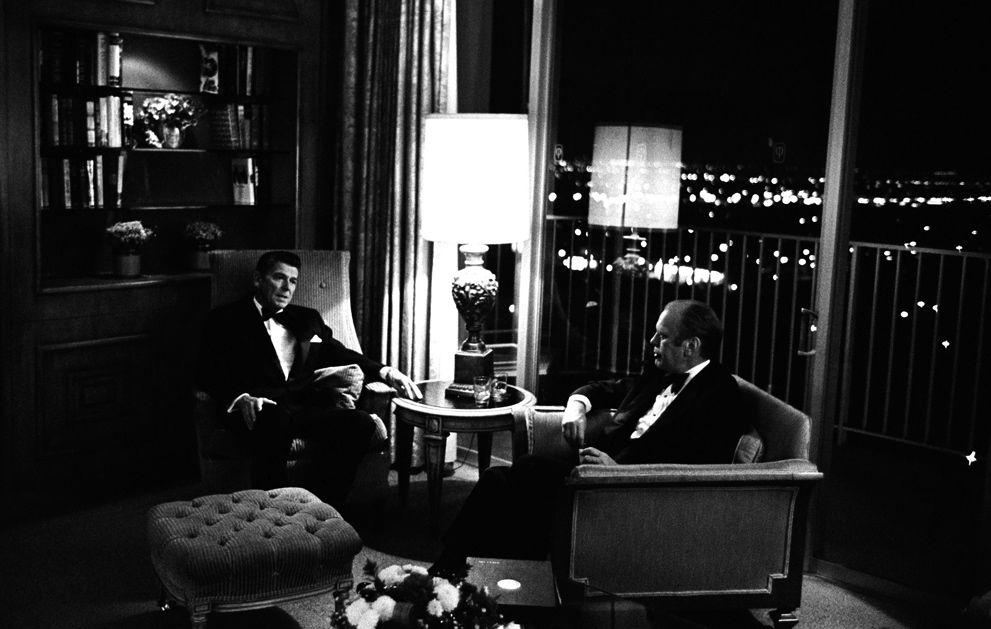
Before the fight: Ford and Reagan, October 31, 1974

December 5, 2012

Historian Michael Beschloss Tweeted out a wonderful photo:

President Gerald Ford, former-Gov. Ronald Reagan, October 31, 1974, Century Plaza

October 31, 1974: President Gerald Ford, right, met with former-California Gov. Ronald Reagan, at the Century Plaza Hotel, Los Angeles. Photo courtesy Micheal Beschloss.

Who took the photo?  What was the event?  Beschloss asks on Twitter, why two drinks on Ford’s side of the table, and none on Reagan’s?

Looks like it’s a photo by David Hume Kennerly, the White House photographer in the Ford administration.  The photograph was taken with film, probably in black and white to save money and because it was the best way to get images for print media at the time.  Few newspapers ran color photos as a regular feature.  Electronic still photography at the time occurred in laboratories as tests.  As a pragmatic matter, media to store such photographs electronically were impractical — a large mainframe computer might have 256 kilobytes of memory for such storage, or enough for photo of poor resolution.

Kennerly’s site said this meeting came around a black-tie Republican fund-raiser in Los Angeles, at the then-swanky Century Plaza Hotel.

Vanity Fair’s David Friend called it “L.A. Noir” in a 2007 article on a book of photos by Kennerly:

Today, the image conveys a touch of Rat Pack swagger, an architectural elegance, and a hint of the California glamour that Reagan would eventually import to Washington. At the time, however, Kennerly, who had won a Pulitzer for his work in Vietnam, considered the picture too dark and brooding; he almost overlooked the frame on his contact sheet. But that darkness captured something of the spirit of the time: less than three months before, Watergate had forced Richard Nixon from office; inflation, unemployment, and gas prices were on the rise; and the U.S. was facing defeat in Vietnam.

The picture also caught the sometimes frosty relationship between the two leaders. Both Reagan and Ford, after all, would nix the 1980 “dream ticket” idea, floated by some Republican mandarins, to draft Ford as Reagan’s vice president. And Ford, during his unsuccessful 1976 campaign against Jimmy Carter, resented Reagan’s political infighting. “Truthfully,” Ford confessed to Kennerly years later, “I was upset when he challenged me [for the ’76 Republican nomination]. I thought it was unwise for a Republican to challenge a sitting Republican president. We had a pretty bitter contest. It was a head-to-head, knock-down, drag-out affair.”

“I study this picture now,” says Kennerly, “and it looks like a scene from The Godfather”—which had won the best-picture Oscar the year before.

Were I to guess, with a bit of education, I’d say both glasses belonged to Ford, one a cocktail, one water.  Reagan tended to avoid alcohol.

A great photograph, a tribute to the artistry and craftsmanship of Kennerly, especially with film; it also poses as a time capsule, freezing convention in GOP big-money fundraising, dress for men of influence and means, architecture, and so much more.

David Kennerly

Pulitzer Prize-winning war photographer, and White House photographer, David Hume Kennerly; TEDxBend image


Not before the deluge, not after it, but during the storm.  Nixon was three-months gone from the White House.  Vietnam’s peace agreement was a year-old, but it was seven months to the final invasion of South Vietnam by the communist North that would force the U.S. retreat, and “reunify” Vietnam under communist rule.  The Cold War still raged.  Iran was considered a U.S. puppet.  Mao Zedong still ruled in China.  Elvis Presley still ruled in Memphis.  AIDS was unknown.  Computers were accounting machines taking floors of entire buildings.  Portable telephones were expensive devices that hogged power and generally required at least an automobile to be attached to power the thing.

Barack Obama was 13.

It was a different time.

More:


Rachel Carson biography, On a Farther Shore, one of best books of 2012

December 4, 2012

Kirkus Reviews listed as one of 2012’s top 25 books William Souder’s biography of Rachel Carson, On a Farther Shore.

William Souder, author of On a Farther Shore. MPR  image

William Souder, author of On a Farther Shore. Minnesota Public Radio image

Rachel Carson often gets credit for starting the modern environmental movement.  In highly cynical political times, Carson is under cruel smear attack from people who wish the environmental movement did not exist, and who appear to think that we could poison Africa to prosperity if only we’d use enough DDT, contrary to all scientific work and medical opinion.

Souder’s book, issued on the 50th anniversary of the publication of Carson’s best-known book, Silent Spring, lays out the facts.

Nice to see that book lovers like Souder’s work, too.  Carson’s work was painstakingly accurate as science, but also a wonderful read.  Silent Spring has a larger following among lovers of literature than science, a tribute to her writing ability.  Souder’s book plows both veins, science and writing.

Cover of On a Farther Shore, by William Souder

Cover of On a Farther Shore, by William Souder

In circles serious about science, the environment, human health, and literature, Souder’s book is the book of the 50th anniversary of Silent Spring.  There is irony there.  Pesticide manufacturers mounted a campaign against Silent Spring and Rachel Carson calculated to have cost $500,000 in 1962, when that book was published.  Souder’s book fights propaganda from Astro-turf™ organizations like Africa Fighting Malaria, a pro-DDT group that collects money from chemical manufacturers and anti-environmental political sources for a propaganda campaign that costs well over $500,000/year.  Despite all the paid-shill shouting against Rachel Carson and her work, it is the voice of On a Farther Shore that stands out.

More:


Texas secessionists ecstatic . . . over what, they don’t know

November 30, 2012

Not sure how I got on the mailing list, but I’ll take it.

Texas bugs out on the U.S., by Paul Windle

Graphic for the New York Times, by Paul Windle

To those who commented here that the Texas secessionists are joking, and the petition means nothing at all, please note the e-mail I got today from Roxanna M.  Roxanna is the thoughtful person behind the petition AGAINST the Texas secession petition.  Heed what she says:

Hey friends!

I want to thank each of you again!  I’ve received so many emails, and I am going to be getting back to everyone, but I work two jobs so it will take me a bit.  But thank you all for your interest and your support.  It’s amazing.  There are a couple people, though, that have sent emails calling me some not-so-nice names.  I will not be responding to you, aside from this.  Thanks for being engaged and interested enough to respond, though.

I have had quite a few requests about how many signatures we have so far.  As of today this petition has 13,011 signatures. [Emphasis added here] I think we’re off to a pretty good start!  This is my first petition, so I am open to any suggestions or ideas any of you have.

I checked the “We the People” petition the day I sent out the other email, and yes, at that time the number was 117,889.  I checked it twice.  The number at that time was accurate.  It may be more now.  Unfortunately, my roommate also sends me random text messages when they get more signatures on the petition.  He was very excited when they hit 100,000.

Here’s where you can find the petition to secede:
https://petitions.whitehouse.gov/petition/peacefully-grant-state-texas-withdraw-united-states-america-and-create-its-own-new-government/BmdWCP8B

It’s actually at 118,203 as of today.

I honestly have no idea how they plan on Texas to go it alone.  There’s a lot of boasting about the our economy and how it’s the best, but I haven’t seen or heard a concrete plan as of yet.  I have heard hints that if Texas isn’t granted a peaceful secession then this could end up another Civil War.  I certainly hope not, and tend to ignore those comments, but things like that are being said.

I do not have a Facebook page for the petition.  I have posted links on Facebook, like on Formidable Republican Opposition’s page.  If anyone wants to start one, feel free!  Just let me know and I’ll send out an email with the link.  I’ve gone to a couple forums for Texas Democrats/Independents and posted links as well.  But, like I said, I’m new at this, and I work two jobs, so if any of you have ideas I’m happy to hear them.

I know that I made some grammar mistakes in the petition, and I apologize.  Unfortunately, once someone signed it (besides me), it wouldn’t let me revise it.  So yeah.  We’ll make do, hopefully.

For those of you who would like to read a bit on the secession petition:

Star-Telegram article
http://www.star-telegram.com/2012/11/20/4429851/a-peaceful-texas-secession-would.html

Examiner article with links of sites supporting Texas secession:
http://www.examiner.com/article/texas-secession-petition-response-white-house-deadline-nears-1

Any other questions, comments, concerns, just let me know.  You all are absolutely fantastic!  Thanks so much! [Note this is the petition AGAINST secession.]
http://signon.org/sign/texans-against-secession?mailing_id=7220&source=s.icn.em.cr&r_by=6253019

Many of those who signed and advocate Texas secession appear to lack an idea of scale, as well as any idea about how government works in a constitutional federal republic.

118,000 signatures from Texas?  Wholly apart from the not-really-joking suggestion that at least 50,000 of those come from Oklahoma, that’s less than the population of rural-to-suburban, southern Dallas County.  Duncanville, Desoto, Cedar Hill, and Lancaster, and all the unincorporated nodules at sea in the area, can’t get Dallas County to pay much attention to them, let alone Texas, let alone the U.S. Congress to consider letting such a tiny group secede.  Compare the 118,000 with more than 3 million Texans who voted for Obama, consider the most of the more-than 3 million who voted for Romney and consider themselves proud citizens of the U.S. who would never consider secession, and at least ten million other Texans who think secession is a stupid idea, and you get a clue as to how inconsequential 118,000 people can be.

Please consider the facts; as John Mashey suggests, and as Roxanna warns, let the secessionists make their case, and tally the costs and benefits.  It’s not a pleasant tally:

  • Gov. Rick Perry opposes the idea, dismisses it as silly and says to move on — he’s otherwise a rather randyesque maverick who loves to slam the federal government if it’ll get him a few votes or a case of beer, or a favor from a businessman.  Truth be told, Perry still thinks he can be president of the U.S., which would be impossible were Texas to secede, and even unlikely were secessionists to get any traction from the state government.
  • On straight up accounting, federal income taxes versus direct aid from the federal government to Texas, Texas is modestly a payer rather than a taker of federal largesse.  However, that accounting does not include the several Air Force Bases, Navy installations, major Army and Marine facilities, Houston’s NASA Control Center, and other federal establishments in the state.  Texas pays almost nothing for border protection, for example, while it costs billions just along the Texas-Mexico border; Texas cannot protect its own borders without the U.S.  Texas is an economic shell waiting to collapse, without the U.S.  That does not account for the several dozens of Fortune 500 companies headquartered in Texas, who would have to move out, to stay domestic corporations.  This includes Exxon-Mobil, AT&T, Frito Lay, and dozens of others.
  • If anyone in the Texas Lege thinks it’s a good idea, they’ve got the good sense to keep quiet about it.  Texas needs federal money to balance its budget, and the Texas Constitution requires a balanced budget.  As a nation, Texas would have to borrow big time, probably spend into deficits (as responsible nations do from time to time) — that is not a popular idea among Texas conservatives, who would be the most likely supporters of secession.
  • With no one in the state government supporting the idea, 117,000 signatures on a petition is about the number of Texans Rick Perry snubs his nose at on a daily basis.  The Great State of Texas is not a signatory to any secession idea.  Congress won’t agree anyway, but especially Congress won’t act contrary to the State of Texas’s wishes.
  • While the First Amendment specifically protects American citizens’ right to petition for redress of grievances, there is no process set by which that is done on such issues, really.  Notice this petition is really just a letter of suggestion to the President, and not any requirement for any action.  Obama likes to listen to citizens (no comment on previous people holding his position, of course); this “We the People” process is a public outreach effort by the Obama administration.  Their promise is, if there is a serious issue, they’ll work to answer questions.  The informal process is, on any issue, serious or not, they’ll answer if there are more than 25,000 people who ask (“sign the petition”).  By gathering 117,000 signatures, those people have earned the right, under Obama’s magnanimity, for a letter.  That letter will probably say, “Sorry you’re disappointed, but we will continue to be the united states, in the United States of America.”
  • Were it a petition to Congress, there is still no requirement for any action. The Constitution forbade Congress from even discussing action against slavery for 20 years after the document became effective, Article II Section 9.  During that time, thousands of Americans petitioned Congress to end slavery.  Congress noted the receipt of those petitions somewhere, and did nothing.  After 1808, Congress received thousands of other petitions, and while taking note of them, rarely did anything about them.  We have a right to petition the government for redress of grievances, and that prevents us from being thrown into jail for pointing out the government is screwing up.  But that right ends with the petition.  There is no right of any response, nor are such petitions considered demands that government actually act.  Secessionists seem almost giddy that if they get a bunch of signatures, secession is a reality.  That’s some potent moonshine, but it’s no more than moonshine talking.

John Mashey suggested in another thread that secessionists should start running the numbers now.  They might learn from people who wanted the Iron Curtain to fall, for more than 40 years.  They seriously thought about how to fix things, and in much of Eastern Europe, once the oppressive communist regimes fell, serious people stepped up to make serious reforms in government, and some good stuff resulted — see the Czech Republic, Germany’s reunification, the economic boom and increased liberty in Poland, and the great increase in business in Estonia, for examples.  In sharp contrast, the Muslim Brotherhood complained about Egypt’s government for 50 years.  But when that government fell (not much thanks to the Muslim Brotherhood), it turned out they had not thought about how to actually run a nation; after more than a shaky year and a questionable election, the government is still wracked by demonstrations by nominal allies of the government, asking reforms of actions the former Muslim Brotherhood member President Morsi has already taken.

For good government to work, first, government must work.  Texas secessionists have not even thought through a secession process, let alone how to make things work afterward.

But Roxanna notes secessionists have given little thought to any serious next step, even of just getting a letter from President Obama.  Roxanna hasn’t seen any analysis, nor has anyone else.

Take Mashey’s suggestion, secessionists, and start running the numbers.  It will help you avoid disappointment soon, in the near-future, and perhaps for the rest of your life.

Yesterday Kathryn and I toured the National Memorial in Oklahoma City.  It is a grim, curt and hard reminder that political discontent can drive malcontents to horrific action.  Secessionists need to rein in their rabid nationalism before it destroys their patriotism.  Timothy McVeigh had a plan to try to cut things asunder, but nothing else other than ill-intent.

More: 


Cliffhanger avoidance, from Robert Reich

November 30, 2012

Economist/policy wonk/good guy Robert Reich sends along notes on the discussions in Washington (at his Facebook site, and at his personal site) (links added here for your benefit and ease of use):

Robert Reich

Rhodes Scholar, former Secretary of Labor and UC Berkeley Prof. Robert Reich

Apparently the bidding began this afternoon. According to the Wall Street Journal (which got the information from GOP leaders), Tim Geithner met with Republican leaders and made the following offer:

— $1.6 trillion in additional tax revenues over the next decade, from limiting tax deductions on the wealthy and raising tax rates on incomes over $250,000 (although those rates don’t have to rise as high as the top marginal rates under Bill Clinton)

— $50 billion in added economic stimulus next year

— A one-year postponement of pending spending cuts in defense and domestic programs

— $400 billion in savings over the decade from Medicare and other entitlement programs (the same number contained in the President’s 2013 budget proposal, submitted before the election).

— Authority to raise the debt limit without congressional approval.

The $50 billion in added stimulus is surely welcome. We need more spending in the short term in order to keep the recovery going, particularly in light of economic contractions in Europe and Japan, and slowdowns in China and India.

But by signaling its willingness not to raise top rates as high as they were under Clinton and to cut some $400 billion from projected increases in Medicare and other entitlement spending, the White House has ceded important ground.

Republicans obviously want much, much more.

The administration has taken a “step backward, moving away from consensus and significantly closer to the cliff, delaying again the real, balanced solution that this crisis requires,” said Senate Minority Leader Mitch McConnell (R., Ky.) in a written statement. “No substantive progress has been made” added House Speaker John Boehner (R., Ohio).

No surprise. The GOP doesn’t want to show any flexibility. Boehner and McConnell will hang tough until the end. Boehner will blame his right flank for not giving him any leeway — just as he’s done before.

It’s also clear Republicans will seek whatever bargaining leverage they can get from threatening to block an increase in the debt limit – which will have to rise early next year if the nation’s full faith and credit is to remain intact.

Meanwhile, the White House has started the bidding with substantial concessions on tax increases and spending cuts.

Haven’t we been here before? It’s as if the election never occurred – as if the Republicans hadn’t lost six or seven seats in the House and three in the Senate, as if Obama hadn’t won reelection by a greater number of votes than George W. Bush in 2004.

And as if the fiscal cliff that automatically terminates the Bush tax cuts weren’t just weeks away.

But if it’s really going to be a repeat of the last round, we might still be in luck. Remember, the last round resulted in no agreement. And no agreement now may be better than a bad agreement that doesn’t raise taxes on the wealthy nearly enough while cutting far too much from safety nets most Americans depend on.

If Republicans won’t budge and we head over the fiscal cliff, the Clinton tax rates become effective January 1 – thereby empowering the White House and Democrats in the next congress to get a far better deal.

Watch that space.

It’s especially interesting to me how House Minority Leader Nancy Pelosi (D-California) and Senate Majority Leader Harry Reid (D-Nevada) will work to get a solution, if the GOP continues its blockade to almost all action.

More:


Climate insanity

November 28, 2012

Watching New Yorkers get caught not-yet-prepared to stop the shutdown of the subways and electrical grid due to the Sandy storm surge at high tide, and noting that the ridicule heaped by denialists on those who tried to warn us about such storms, I asked at Climate Sanity about updates on their rosy “What? Us worry?” view of climate change.

Photo of water in 86th Street Station in Brooklyn, NY, after Sandy

Photo of water in 86th Street Station in Brooklyn, NY, after Sandy – photo found at Naked Capitalism. Denialists could note that subway crime was significantly reduced at the time of this photo.

Surprisingly, we got an answer.  ‘What?  Worry?  Us?  What surge?  You shoulda seen the Hurricane of 1938!  Why, back in the Jurassic there were even BIGGER surges . . .’

It’s a classic example of how rabid advocacy for a disproven position can predict that the rabid advocate will not change her/his mind, at least publicly.

More:

Cartoon by Joel Pett, USAToday, what if climate change is a big hoax

Cartoon by Joel Pett, USA Today


Reich’s right, again: Budget deficits are NOT the problem

November 16, 2012

Robert Reich‘s so good he can dispense wisdom in four 140-character Tweets:

His three following Tweets:

1. The real issue is ratio of deficit to total economy. If economy grows, deficit shrinks in proportion. That’s why austerity dangerous.

2. Public investments in education, infrastructure, and basic R&D should be made regardless, if public return is greater than their cost.

3. Biggest driver of future deficits rising healthcare costs (Medicare & Medcaid) but they’re slowing, so deficit projections exaggerated.

Three simple points.

Robert Reich speaks at the World Affairs Council

Robert Reich speaks at the World Affairs Council (Photo credit: tharpo)

To get more people to understand those points, Reich and his friends want to put out a film — but they need cash to finish it off, and they ask for your contribution

Alas, I can’t embed the proprietary video format here on WordPress. So you’ll have to go to the KickStarter site to see the trailer and money plea. Please do.

Print it out on a 3 x 5 card for your boss, if you’re the secretary to a Member of Congress, eh?

More: