Quote of the moment: Robert C. Lieberman, “Why the Rich Are Getting Richer: American Politics and the Second Gilded Age”

February 20, 2011

The U.S. economy appears to be coming apart at the seams.  Unemployment remains at nearly ten percent, the highest level in almost 30 years; foreclosures have forced millions of Americans out of their homes; and real incomes have fallen faster and further than at any time since the Great Depression.  Many of those laid off fear that the jobs they have lost — the secure, often unionized, industrial jobs that provided wealth, security and opportunity — will never return.  They are probably right.

Cover of Winner-Take-All Politics, by Jacob Hacker and Paul Pierson

Cover of Winner-Take-All Politics, by Jacob Hacker and Paul Pierson

And yet a curious thing has happened in the midst of all this misery.  The wealthiest Americans, among them presumably the very titans of global finance whose misadventures brought about the financial meltdown, got richer.  And not just a little bit richer; a lot richer.  In 2009, the average income of the top five percent of earners went up, while on average everyone else’s income went down.  This was not an anomaly but rather a continuation of a 40-year trend of ballooning incomes at the very top and stagnant incomes in the middle and at the bottom.  The share of total income going to the top one percent has increased from roughly eight percent in the 1960s to more than 20 percent today.

This what the political scientists Jacob Hacker and Paul Pierson call the “winner-take-all economy.”  It is not a picture of a healthy society.  Such a level of economic inequality, not seen in the United States since the eve of the Great Depression, bespeaks a political economy in which the financial rewards are increasingly concentrated among a tiny elite and whose risks are borne by an increasingly exposed and unprotected middle class.  Income inequality in the United States is higher than in any other advanced democracy and by conventional measures comparable to that in countries such as Ghana, Nicaragua, and Turkmenistan.

Robert C. Lieberman, reviewing the book Winner-Take-All Politics:  How Washington Made the Rich Richer — and Turned Its Back on the Middle Class, by Jacob S. Hacker and Paul Pierson, Simon and Schuster, 2010, 368 pages.  $27.00.; review appears in Foreign Affairs, January/February 2011, pp. 154-158.

More:


How to start a hoax about Donald Trump: “Do we really know who Donald Trump is, or where he came from?”

February 19, 2011

Donald Trump demonstrated his ability to spread hoax information at the CPAC Conference recently — a group who love to hear hoaxes and spread them, as much as fourth-grade boys love to hear and spread jokes about flatulence.

But can he take it?  [Note the hoax insinuations below are underlined.]  Could Donald Trump withstand the kind of attack* he made on President Obama?

I mean, he claims President Obama may not have attended Columbia because Trump hasn’t personally interviewed anyone who knew him there — despite years of stories in alumni magazines, major media interviews with the people who knew Obama there, etc., etc.

Donald Trump and unidentified woman

Gratuitous picture that makes trump look funny or evil, with gratuitously misleading caption: “Donald Trump wants people to stop asking why no one, in America, can remember his high school and college days.”  Alternative caption:  “Donald Trump, two of his closest friends and an unnamed woman discuss politics and government policy.”

Does Trump have room to talk?  His Wikipedia bio claims he attended Fordham University for a brief period (got kicked out, maybe?), but didn’t graduate.  It claims he got an undergraduate degree from the Wharton School in Pennsylvania.

A search found no one from Wharton who remembers Donald Trump as a student there.  Jon Huntsman, the founder of Huntsman Container and Huntsman Chemical, the guy who invented the “clamshell box” for McDonalds, is one of the most famous and wealthy Wharton grads (and also the father of Jon Huntsman, Jr., the recently resigned Obama Ambassador to China).  He never saw Trump on campus at Wharton.  James DePriest, the outstanding conductor now with the Oregon Symphony (and fun to watch, trust me) — he never ran into Trump on campus when he attended Wharton.  There’s no record of Trump having had a roommate there. Alan Rachins, the famous actor who graduated from Wharton — not only never took a class with Trump, but said he never heard of Trump attending classes at the time.

Who is Donald Trump?  Where did he come from?  How come no one remembers him?

But the fog gets inkier.

Trump was not only a football standout in high school, he was a social standout, winning awards for his community involvement (although, no one at the high school in his hometown remembers his attending classes there).

But during the time he claims to have attended Fordham, no one remembers him.  No social standout.  No football hero.  Was he ever really at Fordham?

And what about his odd religious beliefs?  There are jokes about his worship of money — but what sort of religion would lead a man to claim that the 2008 economic collapse was “an Act of God?”  Yes, he really believes that.  His “god” appears to have a grudge against the United States and its economy.  Even in his greatest economic ventures, he pays homage to Muslim Hindu religious landmarksWhat is his secret agenda on religion?

Where did Donald Trump come from?  Why does no one in his hometown high school remember him?  Why did he drop out of sight at the time he claims to have attended Fordham University?  Did he buy his way into a listing as an alumnus of Wharton, after so many Wharton grads don’t remember seeing him there?   Who can trust a guy who worships (if he does worship at all) a “god” who strikes down the U.S. economy?

Who is Donald Trump?  Why did no one at CPAC check his questionable credentials before giving Trump a national platform?  Why is CPAC mum about this entire affair?  Why did Fox News conspire to obscure the message and candidacy of Ron Paul, with their new darling, Donald Trump?

Worse for Trump, most of the things in this screed are factually accurate.  Those who live by the inaccurate spin can die by it, too.

Scarier:  Which conservative sites will have the guts to question** Trump’s secret credentials?

Read more here, at Oh, For Goodness Sake (and here at “Donald Trump Pants On Fire”), and here, at PolitiFact.

_____________________________

*   That is, “completely hoaxed up.”

**  Oh, yeah — that should have read, “gullibility to fall for.”  When will the blog owner correct that glaring error?***

*** Not until Trump apologizes to President Obama.

Save

Save

Save

Save


Pressure on Texas Board of Education to fix damage to social studies standards

February 18, 2011

Probably not enough pressure to get the board to act, but the Dallas Morning News turned a cannon on the Texas State Board of Education this morning, asking that they fix the damage done to social studies last year.

The paper’s editorial board keyed off of the Fordham Institute’s grading of state standards — Texas failed, with at D.

Here’s the editorial in its entirety — there’s more at the Dallas Morning News website and I encourage you to go read it there:

Editorial: Report offers new reason to rewrite standards

Just in case you think it’s only us warning about Texas’ new social studies standards, check out the awful grade that the respected Thomas B. Fordham Institute gave those benchmarks in a report released Wednesday.

A big, fat “D” is what Texas got for the history, economics, geography and cultural standards the State Board of Education approved last year for Texas’ elementary and secondary school students.

Some of that awful mark was for the way the standards are organized. Fordham researchers likened their confusing structure to a jigsaw puzzle. But much of the national organization’s critique was about how politicized the State Board of Education has made those standards.

We were particularly struck by Fordham’s conclusion that the hard-right faction on the board, which dominated the writing of the standards, made the same mistake left-wing academics have made in approaching such subjects as history and economics. The Fordham study puts it this way:

“While such social studies doctrine is usually associated with the relativist and diversity-obsessed educational left, the hard right-dominated Texas Board of Education made no effort to replace traditional social studies dogma with substantive historical content. Instead, it seems to have grafted on its own conservative talking points.”

Oh, it gets worse. Back to the report: “The strange fusion of conventional left-wing education theory and right-wing politics undermines content from the start.”

For the record, Fordham is not a left-wing outpost of American thought. Its leader is Chester Finn, a former Reagan administration official and one of education’s most recognized voices. At the least, his organization’s critique is not a predictable one.

The institute echoes the complaint this newspaper has had since the 15-member Texas board rewrote the state’s social studies standards. Its hard-right faction at the time insisted on inserting its slant on those important subjects, such as suggesting Joe McCarthy wasn’t so bad, that international treaties are a problem and that the separation of church and state is misguided.

The warped view is why the revised board must go back and rewrite the standards this spring. And that should be possible.

Voters were so frustrated with the board’s work last year that they elected more moderate Republican members. Moderates now have enough of the upper hand to fix these standards before schools start planning for next year and before publishers start drafting new history and social studies textbooks.

Some on the new board may believe that rewriting the social studies standards will be too difficult. But surely Texas students deserve better than a “D” when it comes to what the state wants them to learn in some of the most critical subjects.


Texas fails among its peers

How big states fared on the Fordham Foundation report on social studies standards nationwide:

California: A-

New York: A-

Florida: C

Texas: D

National average: D


USAID policy statement on DDT and malaria control

February 16, 2011

USAID-paid tools and pesticides used to prevent malaria in a campaign coordinated with the government in Tanzania. USAID photo.

USAID-paid tools and pesticides used to prevent malaria in a campaign coordinated with the government in Tanzania. USAID photo.


The U.S. Agency for International Development (USAID) issued a statement on their support for the use of DDT, where appropriate.  I don’t have a date — if you know the date, please let me know — but for the record, here’s the statement.

Those who claim the U.S. discourages the use of DDT to the detriment of African and Asians, are incorrect in their claims, once again.

USAID Support for Malaria Control in Countries Using DDT

USAID and Malaria

USAID activities for malaria control are based on a combination of internationally-accepted priority
interventions and country-level assessments for achieving the greatest public health impact, most importantly, the reduction of child mortality (deaths).

Contrary to popular belief, USAID does not “ban” the use of DDT in its malaria control programs. From a purely technical point of view in terms of effective methods of addressing malaria, USAID and others have not seen DDT as a high priority component of malaria programs for practical reasons. In many cases, indoor residual spraying of DDT, or any other insecticide, is not cost effective and is very difficult to maintain. In most countries in Africa where USAID provides support to malaria control programs, it has been judged more cost-effective and appropriate to put US government funds into preventing malaria through insecticide-treated nets, which are every bit as effective in preventing malaria and more feasible in countries that do not have existing, strong indoor spraying programs.

USAID country missions provide support to national malaria control programs in about 21 countries in sub-Saharan Africa, where the burden of malaria deaths is the highest. This support covers a broad range of activities, according to local priorities, resource availability and complementary activities by other donors and multinational institutions in each country.

International efforts to fight malaria are largely coordinated by Roll Back Malaria (RBM), a global partnership that includes leaders from across Africa, African health institutions, the World Health Organization (WHO), UNICEF, World Bank, UNDP, multi-lateral agencies, international, national and local NGOs, and the private sector. USAID is a key RBM partner. RBM has identified three priority interventions to reduce deaths and illness from malaria. These are consistent with USAID ’s priority areas for investment in malaria. These are:

1. Insecticide-Treated Nets (ITNs) for young children and pregnant women.
2. Prompt and Effective Treatment with an anti-malarial drug within 24 hours of onset of fever
3. Intermittent Preventive Therapy (IPT) for pregnant women as a part of the standard ante –
natal services.

Each of these interventions is backed by solid evidence of effectiveness under program conditions and effective in reducing the sickness and death from malaria, especially in Africa. For example, proper use of ITNs can reduce overall child deaths by up to 30% and significantly reduce sickness in children and pregnant women.

DDT in Malaria Programs

DDT is only used for malaria control through the spraying of interior house walls – Indoor Residual Spraying, or (IRS). A number of other insecticides can also be used for IRS, and are in many countries when those alternative insecticides are safer and equally effective. IRS, when efficiently conducted in appropriate settings, is considered to be as efficacious as ITNs in controlling malaria.

In most countries in Africa where USAID provides support to malaria control programs, it has been judged more cost-effective and appropriate to put US government funds into other malaria control activities than IRS. USAID has funded non-IRS support to malaria control programs in countries in which DDT is being used, for example, Eritrea, Zambia, Ethiopia and Madagascar.

USAID regulations (22 CFR 216) require an assessment of potential environmental impacts of supporting either the procurement or use of pesticides in any USAID assisted project, but if the evidence assembled in preparing such an environmental review indicates that DDT is the only effective alternative and it could be used safely such as interior wall spraying undertaken with WHO application protocols, then that option would be considered. The U.S. government is signatory to the Stockholm Convention on Persistent Organic Pollutants (the POPS treaty), which specifically allows an exemption for countries to use DDT for public health use in vector control programs, as long as WHO guidelines are followed and until a safer and equally effective alternative is found. The US voted in favor of this exemption.

There are a few situations in which IRS with DDT is generally found to be appropriate. For example, in South Africa when certain mosquitoes developed resistance to the major alternative class of insecticides, the synthetic pyrethroids, DDT was used. Such situations are relatively rare, however, and demonstrate the value of the provisions of the POPs Treaty, which restrict and document use of DDT, but provide for its use when appropriate.

USAID Interventions

USAID is emphasizing prevention via mosquito nets dipped in pyrethriods – a synthetic insecticide originally found in chrysanthemums. USAID is supporting an innovative Africa regional public-private venture for the commercial distribution of ITNs. In 2003 USAID’s NetMark Project launched insecticide-treated net products in Zambia, Senegal, Ghana, and Nigeria selling more than 600,000 nets and 500,000 insecticide re-treatments during its first five months of operation. In 2004, NetMark will launch in at least five more countries in Africa.

USAID also invests in development of new tools for malaria control, particularly vaccine development and the response to increasing drug resistance. USAID is funding projects to discover and dispense new drugs such as Arteminisin-based combination therapies (ACT), which have proven to be more effective against malaria than the traditional drugs chloroquine and mefloquine. USAID also supports the development of new policies and strategies for use of these new therapies, as well as the improvement of both public and private health systems. Since 1998, the agency has aggressively supported the development of the combination therapy as a safe and effective alternative treatment.  In addition, USAID and its global partners in RBM are working to ensure sustained financing of the drugs. USAID has played a critical role in drawing attention to the spread of drug resistance in Africa and in assisting countries in effectively treating malaria, including the use of combination therapy.

In summary, USAID directs its support for malaria control programs based on evidence for maximum impact on reducing child deaths. Based on this criterion, for most countries with USAID support for malaria control in sub-Saharan Africa, indoor residual spraying (regardless of the choice of insecticide) has not been judged to be the most effective use of US government funds. USAID continues to plan its support for national malaria control programs in sub -Saharan Africa on a country by country basis, and will continue to strive to use US taxpayer funds as efficiently and effectively as possible with the most appropriate tools at our disposal to reduce deaths from malaria.

I suspect that statement is dated.  Here is a site at USAID that details the policy on DDT, malaria and mosquitoes, and includes a different statement under the same title as the above:

USAID and Malaria

USAID activities for malaria control are based on a combination of internationally accepted priority interventions and country-level assessments for achieving the greatest public health impact, most importantly, the reduction of child mortality (deaths).

USAID backs a comprehensive approach to prevent and treat malaria. This includes:

  • Spraying with insecticides (“indoor residual spraying,” or IRS) in communities: IRS is the organized, timely spraying of an insecticide on the inside walls of houses or dwellings. It is designed to interrupt malaria transmission by killing adult female mosquitoes when they enter houses and rest on the walls after feeding, but before they can transmit the infection to another person. IRS has been used for decades and has helped eliminate malaria from many areas of the world, particularly where the mosquitoes are indoor-resting and where malaria is seasonally transmitted. USAID and the President’s Malaria Initiative (PMI) activities include conducting environmental assessments, training spray teams, procuring insecticide and equipment, and developing and evaluating spraying activities.
  • Insecticide-treated mosquito nets (ITNs): Bednets treated with insecticide have been proved highly effective in killing mosquitoes. In addition, the netting acts as a protective barrier.  Consistently sleeping under an ITN can decrease severe malaria by 45 percent, reduce premature births by 42 percent, and cut all-cause child mortality by 17 to 63 percent. PMI is expanding access to free and highly subsidized nets while also creating commercial markets in African countries.
  • Lifesaving drugs: Artemisinin-based combination therapies (ACTs) are the most effective and rapidly acting drugs currently available for treating malaria.  PMI activities include purchasing ACT drugs; setting up management and logistics systems for their distribution through the public and private sectors; and training health care workers and community caregivers in their use.
  • Intermittent preventive treatment for pregnant women (IPTp): Each year, more than 30 million African women living in malaria-endemic areas become pregnant and are at risk for malaria. IPTp involves the administration of at least two doses of sulfadoxine-pyrimethamine (SP) to a pregnant woman through antenatal care services.  The treatment helps to protect pregnant women against maternal anemia and low birthweight, which contributes to between 100,000 and 200,000 infant deaths annually in Africa.  PMI activities include purchasing SP, training health care workers in administering the drug, and providing information about IPTp to pregnant women.

USAID and DDT

USAID supports indoor residual spraying (IRS) with DDT as an effective malaria prevention strategy in tropical Africa in those specific situations where it is judged to be the best insecticide for IRS both epidemiologically and entomologically and based on host-country policy. Its use for IRS to prevent malaria is an allowable exception under the Stockholm Convention – also known as the Persistent Organic Pollutants Treaty or POPs Treaty – when used in accordance with WHO guidelines and when safe, effective, and affordable alternatives are not available. For a variety of reasons, some countries do not conduct IRS or have not registered DDT for use in their malaria control programs.  The reasons may include the epidemiological situation of the country, the organizational capacity of the program, or in some cases, concerns related to their agricultural export market.  The Stockholm Convention aims to eventually end the use of all POPs, including DDT.

The determination of which of the WHO-approved insecticides to use for USAID’s IRS programs is made in coordination with the host-country malaria control program, with the primary objective of preventing as many malaria infections and deaths as possible.  That determination is based on cost-effectiveness; on entomological factors; on local building materials; and on host-country policy.  USAID adheres to strict environmental guidelines, approval processes, and procedures for the use of DDT and all other WHO-approved insecticides in its malaria control programs. As part of our environmental assessments and safer use action plans, we help countries build capacity for safe and judicious use of all chemicals used in their malaria control programs, including DDT

The fact is that DDT is more effective and less expensive than many other insecticides in many situations; as a result, it is a very competitive choice for IRS programs.   DDT specifically has an advantage over other insecticides when long persistence is needed on porous surfaces, such as unpainted mud walls, which are found in many African communities, particularly in rural or semi-urban areas.

USAID has never had a “policy” as such either “for” or “against” DDT for IRS.  The real change in the past two years has been a new interest and emphasis on the use of IRS in general – with DDT or any other insecticide – as an effective malaria prevention strategy in tropical Africa.  (Recent successful applications of IRS, particularly in the southern Africa region, have also contributed to the keen interest among donors and among African malaria control programs.)  For example, in Fiscal Year 2005, USAID supported less than $1 million of IRS in Africa, with programs utilizing insecticides purchased by the host government or another donor.  For fiscal year 2007, in the PMI and in other bilateral programs, USAID will support over $20 million in IRS programs in Africa, including the direct purchase of insecticides.  This dramatic increase in the scale of our IRS programs overall is the greatest factor in DDT’s recent prominence in USAID programs.

USAID Issue Briefs

President’s Malaria Initiative (PMI)

Tanks of pesticide (DDT?) used for Indoor Residual Spraying (IRS) against malaria in Africa bear the labels to indicate USAID paid for the tools and the pesticide, contrary to hoaxsters' claims.

Tanks of pesticide (DDT?) used for Indoor Residual Spraying (IRS) against malaria in Africa bear the labels to indicate USAID paid for the tools and the pesticide, contrary to hoaxsters’ claims.

Update: If you’re here from a religious discussion group that veered off into malaria and DDT, you’d do well to use this site’s search feature, and search for DDT.  Most of the statements from those favoring DDT in your discussion are pure, buncombe, junk science, as this site and several others reveal.


The Egyptian Revolution will be Tweeted as well

February 12, 2011

Not only broadcast, but Tweeted, too.  From Dave Does The Blog:

RT @mhegi: Uninstalling dictator COMPLETE – installing now: egypt 2.0: █░░░░░░░░░░░░░░░░░░ #egypt #jan25 #tahrir#

Hey, I’m not that tech savvy — I had to think about that for a minute myself.  Quick:  Can you define “hashtag” to your grandmother?

Shouldn’t it be more like “Egypt 10.0?”

Update:  The actual Tweet:


Bathtub reading on a cold February day . . .

February 10, 2011

Stuff to make you think:

  • Do you care? At least 16 members of Congress passed up on the government-sponsored health care plans, trying to be true to their campaign promises to repeal similar care for all citizens, a plan they try to ridicule as Obamacare.  Some of them discovered other plans “available from the market” are expensive, don’t cover pre-existing conditions, and generally don’t meet their needs.  Crooks and Liars explains:

Nevertheless, Republicans are discovering the truth: The status quo is unsustainable, unaffordable, and discriminatory. Now what will they do about that? And how will they appease their angry hordes of Tea Party members being stoked daily via email and fear campaigns?

  • Arctic Ice disappears, and so does the evidence Tim Lambert notes that those wacky pranksters at the Heartland Institute managed to find one small part of a chart to make a case that Arctic ice is increasing, even as Russia and China prepare to beat the U.S. to trans-Arctic shipping when the ice disappears.  Whose side is the Heartland Institute on, again?  It’s a new propaganda tactic:  The Small Lie.

There are people who need to soak their crania.  Back to work, here.


Students frozen out of schools, education, maybe hope

February 9, 2011

Does the headline pertain to Dallas ISD’s being closed for cold weather for the fifth day in eight, or does it refer to the situations in Austin, where Gov. Rick Perry insists Texas is better off than the rest of the nation with a $25 billion deficit it can’t close, and all education institutions being given solitary confinement or death penalties?

Gov. Rick Perry, Texas State of the State Address, February 8, 2011

Photo by Ralph Barrera/Austin American-Statesman; Dallas Morning News caption: "Texas Gov. Rick Perry, with Lt. Gov. David Dewhurst after delivering the State of the State address Tuesday, said there are 'no sacred cows' in the strapped Texas budget." Reality caption: Texas Emperor Rick Perry gives thumbs up to the lions who will face education's representative, Hypatia, in the Lege Arena fight-to-the-death; Perry promised not to be present for the final moments of the fight.


Watt’s Up puts collective hand into the fan – er, um, windmill

February 6, 2011

In the march to brand all non-fossil fuel use as politically incorrect (at least for those who deny global warming should get our policy making attention), the poobahs and commenters at Watts Up have outdone themselves in seeing conspiracies under the ice, mountains where there are molehills, and molehills where there are mountains.

If you wonder whether global warming deniers are biased, Watts’s blog just confessed.

We’re quite frozen in here in Texas, you know.  The unseasonable warm air (high pressure) over the Arctic that warms the sea and melts the ice also pushed the Arctic air south over the U.S.  Where that frigid air met wet air coming from the Gulf of Mexico, weather ensued (yeah, warming may have increased the amount of moisture, too — but that just makes the anti-warmists go blind, so we won’t say it).

Texas got hit with rolling power blackouts last week, when the cold weather increased demand for electricity and crimped the ability of several utilities to bring on power plants build to generate to meet such extra demands.  Some coal-fired plants were off-line, a couple froze up, and natural gas supplies were not in the right place at the right time, so some natural gas plants couldn’t fire up.

But Anthony Watts, seeing spooks behind every clump of Texas Bluestem (Big or Little), promptly got a post up blaming wind power turbines. His post’s headline gives you the whole story as Watts spun it:  “We Spent Billions on Wind Power… and All I Got Was a Rolling Blackout.”

If you’re wondering just what in the world he was thinking, you’d be demonstrating more common sense than the average global warming denier.

Freezing rain had been predicted, but not so much as Texas got.  The follow-up snow also surpassed predictions and expectations — for example, the “skiff to 1″ accumulation” predicted for Dallas turned into 5″ to 7″ through much of the area — stopping any hope that the ice might clear so schools could reopen.  Texas got slammed by the same enormous storm that slammed much of the Midwest and Northeast, with similar results.  For Super Bowl host cities Fort Worth, Arlington and Dallas, that created big problems.  Texas is not equipped to deal with much winter weather, let alone so much in so little time.

In cold weather, power plants fail.  Sometimes power lines fail when the plants stay up.  Sometimes it’s just a question of wheeling power from one part of a local, regional or national grids.  Sometimes the wheeling fails because a switch fails or . . . a failure of capacity can have myriad causes.  In the past, we covered for these problems with additional generating capacity, in excess of what might be needed at any point — mandated by state and local utility commissions to insure power at all times.

Texas deregulated electrical power more than a decade ago, too — which means that market forces govern what gets built and whether there is any emergency generating capacity.

Free enterprise cannot take any blame in the kingdom of those who deny climate and economics.  So when the rolling blackouts plagued Texas, the search for a scapegoat became frenetic.   The question was, who could take the blame that could cast what was perceived to be the most aspersional light on Al Gore, the case for global warming, and anything approaching “green energy?”

Ah, there’s the target!   Wind power.

Watts Up quickly claimed that Texas windmill-generated electricity had failed, if not in fact, then in economic hypothesis.  If the windmills didn’t fail themselves, it must be that the money invested in them could have been better invested in coal-fired power plants, or oil-fired plants, and the blame can be squarely laid at the feet of Michael Mann, or the UN’s IPCC, or Al Gore, or Rachel Carson, or John Muir, or Aeolus — or anyone other than the real trouble, the freakish weather.  Avoiding blame on the weather is important to denialists, because such “perfect storm” combinations come astonishingly close to the predictions of some global warming hypotheses.

So blame must be established, far from the house of warming denialists if possible.  Watts’ blog attacked windpower all through 2010; ignoring any rebuttals, all Watts had to do was point to his earlier published articles.

Days later the facts come out, as revealed in a lengthy investigative story published this morning in the Dallas Morning News with this lead:

The operators of Texas’ electricity grid blamed myriad problems at power plants across Texas for last week’s rolling blackouts.  But interviews and a review of documents by The Dallas Morning News reveal that the breakdown of a cluster of coal-fired power plants in Central Texas was at the heart of the problem.

These facts were known days ago.  In fact the second comment at Watts’ blog corrected the record:

Walt Stone says:

I believe it was two power plants, one coal and one gas fired.

http://fuelfix.com/blog/2011/02/02/whats-behind-the-blackouts-power-plants-not-designed-for-cold-weather/

Could Watts ever concede a possible error?  Not yet, not on his blog, nor anywhere else.  Texas electric grid officials said early they had coal-fired power plants down; they’ve stuck to that story.  Reporting by the state’s major newspapers and other news organizations has borne out that story.

Continuing their leading reporting on energy and environment issues, the Texas Tribune, an on-line publication by a non-profit group, specifically asked about wind power shortages as alleged by Watts:

TT: Were there problems with wind-power plants needing to be shut down for high winds or icing blades, and also did nuclear plants have any problems?

[Trip] Doggett [CEO of the Electricity Reliability Council of Texas (ERCOT)]: I’m not aware of any nuclear plant problems, and I’m not aware of any specific issues with wind turbines having to shut down due to icing. I would highlight that we put out a special word of thanks to the wind community because they did contribute significantly through this time frame. Wind was blowing, and we had often 3,500 megawatts of wind generation during that morning peak, which certainly helped us in this situation.

Is there any room for the wind nay-sayers to squirm on this?

One publication which should be keyed into the facts poked fun at Watts’ hypothesis, although in a subtle, implicit fashion.  Energy Tribune’s story by Philip E. Lewis, comparing Texas to King Canute, noted that Texas has bragged about its energy reliability and separateness from the rest of the state.  What to do in the next energy crisis?

But no worries, I have the perfect solution: Next time power plants are “tripping,” ERCOT (irony alert: Electric Reliability Council of Texas) should issue an order for the wind to blow harder in West Texas. If the wind is reluctant to comply, ERCOT should brook no nonsense and immediately escalate. Surely an order from the governor’s office will do the trick.

Based on little more than antipathy towards wind power, bloggers beginning with Anthony Watts started a hoax rumor that wind power is to blame for Texas’s electricity shortage problems.  Very little  basis could be found for such a claim, and in the days since the events, that little basis is evaporating.  It’s time to put that claim to bed.

Sorta post script:  I am aware of the claims at Meteorological Musings that wind generation is, somehow, to blame — if for no other reason than that it could not play Superman and bring a few thousand megawatts online with no notice to save the rest of the grid.  As best I can cipher it, the claim is that because not every wind generator was on line, wind generators should have been able to take up the slack.  Of course, no other energy source could step in to take up the slack, either, including those who were scheduled to do it.  I don’t put a lot of stock in the claim that we need to be particularly stern with wind generating companies when other generating companies fall down on the job.  For that matter, there is a Reuters article listed at Watts Up that said a wind shortage added to the problems, but it didn’t suggest in any way that a wind shortage caused the problems — and it’s from 2008, not 2011.  I don’t believe problems in 2008 contributed to blackouts in 2011.   I’m also aware that Energy Tribune is hostile to wind generated power.  Testimony contrary to interest . . .

More:

Tip of the old scrub brush to a commenter named Bryan Brown.


War on science – what else would you call it?

February 4, 2011

From Michael Tobis at Only In It For the Gold, an essential blog for Texans:

At the other end of Pennsylvania Avenue, Rand Paul proposes half a trillion in cuts to the US government, including:

  • National Oceanic And Atmospheric Administration (NOAA) is cut by $857 million.
  • NIH is cut by $5.8 billion.
  • DOE is completely defunded, with some nuclear-related tasks shifted to DOD.
  • NASA is cut by $4,500,000,000 (25%)
  • NSF is cut by $4,723,000,000. (62%)

Science? What science?

Cutting the federal budget is difficult.  Yes, we have a crisis in spending.  We also have many crises in education and in research, and many crises in our economy that are, each of them, rooted in a need for new research.

Is Rand Paul a complete fool?  Is he in league with Chinese Exceptionalists?  Are his ears made of tin?  Or is he a warrior against American knowledge and the American future?

This is a debate which needs facts, and people who can evaluate facts and arguments, and people with a vision for a future America — a good vision for a future America.

One gets the feeling that Rand Paul would have gone after the funding for Ben Franklin’s experiments — not because it would help the federal deficits, since Franklin funded his own work — but because he just doesn’t like science. ‘Why should we let Dr. Franklin take lightning from the gods?’ Rand might ask.  ‘Dr. Franklin should stay out of theology.’

And so the modern-day, real Rand Paul, blunders on, waging a War on Science.


Bill Clinton on Bachmann/Tea Party “parallel universe” politics: “We need to put our country back in the future business”

February 3, 2011

At Davos, Switzerland, Bill Clinton answered a question from former White House advisor David Gergen, I gather.  American is exceptional, Clinton said — but those who insist on making “American Exceptionalism” a political mantra seriously risk making America unexceptional, and putting us into decline, he argues.

Texas Gov. Rick Perry’s ears are stinging on the issue of unbalanced state budgets.

President Bill Clinton interviewed at the 2011 World Economic Forum Annual Meeting held in Davos, Switzerland. – World Economic Forum

William Jefferson “Bill” Clinton was the 42nd President of the United States, serving from 1993 to 2001. At 46 he was the third-youngest president. He became president at the end of the Cold War, and was the first baby boomer president. His wife, Hillary Rodham Clinton, is currently the United States Secretary of State. Each received a Juris Doctor (J.D.) from Yale Law School.

The complete Clinton discussion can be viewed here.

Tip of the old scrub brush to Nicole Smith.


Septic tank leadership

February 2, 2011

Septic Tank - where the big clumps float

Septic Tank - where the big clumps float to the top - SeptiCare image

Former Sen. Jake Garn, R-Utah, used to tell a story he claimed he first heard from then-Sen. Alan Simpson, R-Wyoming.

“The seniority system in Congress is a lot like a septic tank. You know: All the big clumps rise to the top.”

Not sure why, but that story sprang to mind when I saw this headline:

Michele Bachmann Rises as Sarah Palin Falls

(Original story, and headline, at U.S. News politics blog.)


Palin can’t tell satellites from doughnuts

February 1, 2011

You can tell by the dates I’m not following this closely — it’s a Sarah Palin thing, after all, and we all hope it will go away.

Spudnut Shop, Richland Washington, Tri-City Herald photo by Kai-Huei Yau

Baking doughnuts before dawn at the Spudnut Shop, Richland Washington, Tri-City Herald photo by Kai-Huei Yau

Palin wasn’t content to just screw up the history of the phrase “Sputnik moment,” as noted earlier.  Oh, no, she had to go deeper in dumb, and talk about Spudnut shops.  If you’re not from Salt Lake City where the Spudnut HQ sign adorned Interstate 15 for many years, you may never have heard of Spudnuts, doughnuts made with potato dough.

If you’re wondering what in the world Spudnuts have to do with Sputnik, you’ve got more sense than Sarah Palin.

After screwing up the history, like a blind squirrel, Palin blundered on to talk about a vestige Spudnut shop in Richland, Washington.  She found something we all applaud, a good doughnut shop.   On one hand fans of the doughnut are happy to know of one of a tiny handful of such shops left.  Plus, it’s great to boost a small shop in a small Washington town.

On the other hand, doughnuts, even Spudnuts, don’t come close to the movement to improve American education inspired by the Soviet launch of Sputnik.  From just getting history horribly in error, Palin came close to ridiculing American business with her idea of meeting the challenges like space exploration, with doughnuts and coffee.  Doughnuts and coffee will not lift student test scores, nor are they the answer to lifting our economy today and keeping the U.S. competitive and on top, in the future.

Others covered the topic better than I.

Yes, that is what we need to get the economy back on track.

A bakery.

Not more expertise in math and science, engineering, technology, and developing enterprises that will allow us to compete with the rest of the world. A bakery, full of Real Americans.

Do you realize how this sounds? This is like if I were to say, “Hey, I think we need to take a course to familiarize ourselves with what actually caused the Soviet Union to collapse!” and you were to respond, “Anything can be solved with Hard Work, donuts, and the American Way!” It’s as if I were to say, “Let’s study geometry!” and you were to respond, “Let’s study Gia Spumanti, the red-blooded American protagonist of ‘A Shore Thing.'” “Those two sound similar, but are in no way comparable,” I would point out. And that’s what this is. It’s the kind of bizarre semi-sequitur that has always been a hallmark of your speaking style.

Stromberg got serious for a moment, and makes the case against Palin’s claims:

But in claiming that the Soviets incurred their consequential debts long before Reagan was president, Palin ends up arguing that the Gipper wasn’t nearly that responsible for the USSR spending itself to death. If a reverence for Reagan’s anti-Soviet spending inspired her narrative in the first place, then this is incoherent. If she’s just making this all up, then she’s really also claiming that the Reagan-brought-down-the-USSR narrative is overstated.

Palin appears to be lazily checking a lot of Fox News boxes. She wants to criticize Obama’s State of the Union address, so she grabs hold of the Sputnik line. She wants to make a point about debt, so she invents a history in which the USSR had a debt crisis decades before this inference could have made much sense. Even better — her argument sounds like an implicit vindication of Reagan, but that really just makes it either self-contradictory or hostile to Reagan’s legacy.

Even worse, it seems that Palin planned her rhetorical disaster, as she goes on to discuss the “Spudnut Shop,” a bakery in Washington State that’s succeeding without government support. Yet more evidence that her judgment in both what she says and who she has vetting it is pathetic. It’s not even cleverly manipulative. It’s just dreck.

Zeno provides the horrifying evidence that Palin’s stupid is leaking out, and may be contagious.  Zeno caught Brian Sussman at the formerly-august KSFO talking to a woman who would fail the Sputnik issue even by Texas standards.  In Texas, in 11th grade U.S. history, students need to know a half-dozen dates, turning points in U.S. history.  1957 is one of those dates, for the launch of Sputnik.  Oy, what does it say when a San Francisco radio station is dumber than Texas’s weak and skewed social studies standards?

More:

Tip of the old scrub brush to Oh, For Goodness Sake.


Tarryl Clark keeps an eye on Michele Bachmann’s mad rantings

January 31, 2011

I get interesting, if not exclusive, e-mail:

Dear Ed,

Even if you haven’t heard, it probably won’t surprise you: Following a weekend in which she tested the “Presidential waters” in Iowa (and rewrote American history to virtually omit slavery), Congresswoman Michele Bachmann delivered her own response to President Obama’s State of the Union address last night to a national Tea Party audience.

Even with Bachmann working harder than ever to increase her own fame, and push the agenda of her wealthiest supporters, last night’s speech was more than a little strange.

And as expected, she repeated many of her usual false claims, including:

• Falsely claiming that 16,500 IRS agents would be hired to be “in charge” of the new health care law. (This was debunked a year ago. FactCheck.org said it, “stems from a partisan analysis based on guesswork and false assumptions, and compounded by outright misrepresentation.”)

• Falsely claiming that President Obama and the White House “promised” the Recovery Act would keep unemployment below 8%. (PolitiFact.com calls this ‘barely true’, and has given Bachmann seven ‘false’ and six ‘pants on fire’ ratings for other statements she’s made.)

Michele Bachmann is wrong on the facts, and wrong on the issues.

Bachmann’s cuts to education would devastate Minnesota’s workforce, her cuts to transportation would wreck our infrastructure, and her tax loopholes reward all the wrong economic behavior.

By repealing health care reform, Congresswoman Bachmann would let health insurance companies deny coverage due to pre-existing conditions, add as much as $230 billion to the deficit, take health insurance away from tens of thousands of Minnesota families and raise costs for almost everyone else.

It’s clear that in 2011 and beyond, Republicans and Democrats are going to have to speak honestly about the challenges we face and work together to deliver the results Minnesotans deserve.

We need honest debate, and civil discourse. We need to speak up. We need to get active, and stay active. It will be our voices, our energy, and our commitment that leads America forward.

After all, as President Obama himself said last night, we’ll move forward together – or not at all.

Sincerely,

Tarryl Clark

PS Keep in touch on our Facebook page here, and let us know what you thought of Congresswoman Bachmann’s speech.

More:


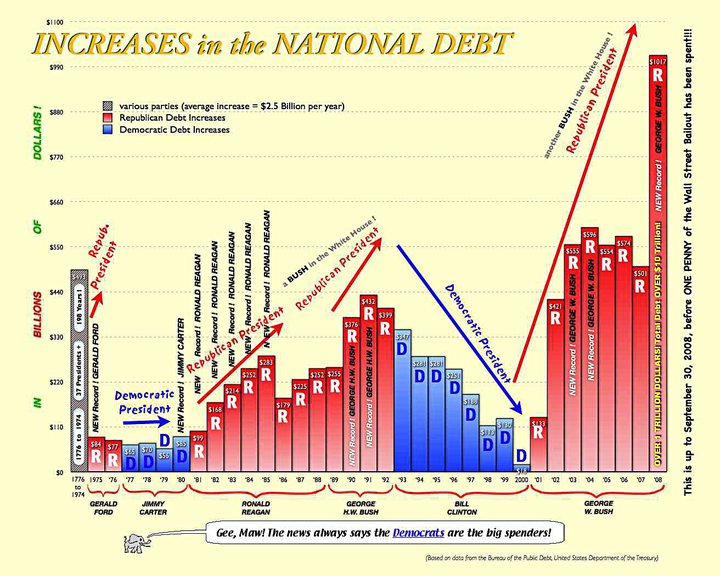
Charts conservatives hope you won’t see, that Tea Party members won’t read

January 30, 2011

Food for thought:

Increases in the national debt, by president since 1976

Increases in the national debt, by president since 1976 - I'm not sure the source; is it right?

Click the thumbnail for a larger version:

Increases in national debt to 2008

Increases in national debt to 2008

Gross national debt, by president:

Increases in gross national debt, by president

Increases in gross national debt, by president; z-facts via About.com

All this, and they want to lecture “liberals” on how government should be run?

Tip of the old scrub brush to Marion Young.


Annals of Hoaxes: American Enterprise Institute sends out hoax backgrounder on DDT and trade barriers

January 25, 2011

How do hoaxes get started?

The self-proclaimed august American Enterprise Institute issued a “backgrounder” today on foreign trade.  Backgrounder #2509, written by James Roberts.

The first paragraph is complete fiction:

Decades ago, the use of DDT (dichlorodiphenyltrichloroethane) was banned worldwide for what were generally seen as noble and unassailable environmental and public health reasons. Today, ample evidence shows that the ban on DDT spraying has been a tragic mistake. In developing countries, it is linked to millions of preventable deaths from malaria. Worse, some protectionist European business sectors and activist groups continue to exploit the fears of DDT in ways that increase the suffering of the poor around the world.

Here are the errors of fact:

  1. DDT has never been banned worldwide, so there could never be a decades-old worldwide ban. A nearly-world-wide ban was agreed upon by treaty  in late 2001, less than one decade ago.  However, any nation may ignore the ban, legally, by simply writing a letter to the World Health Organization (WHO) saying the nation will be using DDT.  DDT manufacturing continues in a few nations today, including North Korea and India.  India is far and away the largest user of DDT now, using more than all other nations combined.  No worldwide ban on DDT ever existed, and DDT use has been continuous since 1946.
  2. Earlier bans on DDT were assailed in court as unreasonable infringements on commerce. The U.S. banned DDT use on agricultural crops in 1972, but only after two federal district courts had ruled the substance essentially uncontrollable in the wild, and after a lengthy administrative law hearing at the Environmental Protection Agency (EPA) covering most of 1971 and more than 9,000 pages of testimony.  EPA’s rule left DDT available in the U.S. for emergency use, or for health use.  EPA’s rule left manufacturing alone so the U.S. could export DDT to any other nation who wanted to use it.  Still, DDT manufacturers fought hard in court to overturn the ruling.  Manufacturers argued that the science was thin to back the ban, and that the ban was too much regulation for small gain.  Appeals courts ruled that the science backing the ban was ample.
  3. 39 years after the U.S. ban on crop spraying with DDT, benefits are enormous — history and science show the recovery of dozens of beneficial species, ranging from mosquito-eating Mexican free-tail bats in Texas, through fish in Oklahoma, to osprey, peregrine falcons, brown pelicans and bald eagles in the rest of the U.S. Unknown at the time EPA acted, DDT has been shown to be an endocrine disruptor of the sort that scrambles the sex organs of fish and amphibians in the Potomac and Susquehanna Rivers in the U.S.  Also unknown in 1972, EPA now is listed by the American Cancer Society as a “probable human carcinogen,” though it is thought to be a weak carcinogen to adults directly exposed.
  4. Malaria deaths have been cut by 75% since DDT was indicted as a harmful substance. Perhaps more surprising, without DDT, health workers around the world have sharply reduced malaria incidence and especially malaria deaths.  Nearly four million people died from malaria, worldwide, at the height of DDT use in 1959 through 1961.  Today that death toll has been cut to under 900,000, through wise use of curative pharmaceuticals, careful use of prophylactic nets and home improvements, and the development of new, better-targeted pesticides.  Malaria fighters especially are redoubling efforts to make the disease at least rare, now encouraged by the dramatic strides made without relying on DDT.  Ironically, India has a growing malaria problem, despite its being the greatest user of DDT today.  (Even more ironic:  Roberts claims about half the death rate WHO does — a 90% reduction in malaria deaths.)
  5. No preventable death to malaria has been tied to a lack of DDT. No nation has ever had difficulty getting DDT if it wanted it.  The fight against malaria was hampered when the malaria parasites developed resistance to traditional pharmaceuticals used to treat the disease in humans, but the promulgation of artemisinin-based combination therapies made up the gap. Nations have difficulty developing a health care system that can quickly and accurately diagnose malaria, and which form of malaria, and then deliver the necessary therapeutic regimen of pharmaceuticals to cure humans.  DDT cannot make up for that difficulty, partly because DDT use itself now requires rather extensive testing to make sure it works.  As Jonathan Weiner noted in his Pulitzer Prize-winning The Beak of the Finch, nearly every mosquito on Earth today carries at least one of two alleles which make them resistant or wholly immune to DDT.  DDT cannot be used without first testing to be sure the mosquitoes are killed by it.
  6. No otherwise noble European or “western” business groups nor environmental groups work against the minor use of DDT for indoor residual spraying (IRS). For example, the Environmental Defense Fund was one of the groups that lobbied the Bush administration to allow USAID money to buy DDT for IRS in Africa, a use the Bush administration inexplicably had not allowed.  Opposition to this minor DDT use in Uganda was organized by Uganda businessmen who sued to stop it, not by European groups — generally.  BAT, British-American Tobacco, did organize opposition to use of DDT, on specious grounds — highly ironic since the people who run the pro-DDT publicity machine are, several of them, former tobacco propagandists whose organizations go seed money from tobacco companies.  Generally, DDT use for IRS in Africa is supported by everyone involved, including environmentalists and the U.S. government.

Four sentences and six grievous errors of fact from the American Enterprise Institute.  And this is just the first paragraph of their “background” paper.

James Roberts may have tried to pluck an example from a history he does not understand.  There may be a problems with trade and pharmaceuticals and pesticides — but none of the problems he cites for DDT is accurate and true.  He may have fallen for the hoaxes perpetrated by others.

Watch:  A hundred others will cite the hoax conclusions Roberts lists, claiming American Enterprise Institute as the source.  Likely they will assume AEI had its facts straight, and wasn’t the victim of a hoax.

And that’s how hoaxes get started, big time. This is how no-think tanks wage the War on Science.

Will AEI issue a correction?

Does anyone take such publications as authoritative?  May God forbid.

With such a sloppy start, can the rest of the paper be any better?

(Oy, now I scan down the document, and I see Roberts cited Rachel Carson’s Silent Spring as saying DDT use would lead to extinction of birds, “offering no proof.”  Since Carson made no such direct claim, and since the book was loaded with citations to the studies that proved her points, that is it was loaded with “proof,” we must conclude that Roberts did not bother to actually open the book, let alone read it.  That doesn’t speak well for the chances of getting a correction.)