Strange crossings: Booth asked the president for an umbrella

November 17, 2015

This is just so odd that it merits our attention, something I found a while ago researching about presidents and umbrellas.

On November 17, 1864, John Wilkes Booth wrote to President Abraham Lincoln asking for money to purchase an umbrella.

Yes, Booth, the man who would eventually assassinate that same Abraham Lincoln.

Page 1 of John Wilkes Booth's 1864 letter to President Abraham Lincoln

Page 1 of John Wilkes Booth’s 1864 letter to President Abraham Lincoln

Booth to Lincoln, page 2

Booth to Lincoln, page 2

Booth to Lincoln, page 3

Booth to Lincoln, page 3

Booth to Lincoln, page 4

Booth to Lincoln, page 4

Booth to Lincoln, page 5

Booth to Lincoln, page 5

Booth to Lincoln, page 6

Booth to Lincoln, page 6

The letter is in the collection of Lincoln papers at the Library of Congress, described as “John Wilkes to Abraham Lincoln, Thursday, November 17, 1864 (Congratulations; request that Lincoln send him money to buy an umbrella).”

I have found no official transcript of the letter.

Of all the richochets of umbrellas in the history of the American presidency, this must be the strangest.

Tinfoil hatters, conspiracy nuts, historical psychanalyzers, and the rest of us, might wonder if this played any role in the sad crossing of these two people almost exactly six months later, in Ford’s Theatre.

More:

Yes, this is mostly an encore post. Fighting ignorance requires patience.

Yes, this is mostly an encore post. Fighting ignorance requires patience.


Happy birthday, Jimmy Carter (he’s 91)

October 1, 2015

Photo and caption from the Atlanta Journal-Constitution: It’s been a busy few days for former President Jimmy Carter, who turns 91 today. This past Saturday, he was out and about at the annual Plains Festival, including watching the parade with his wife, Rosalynn , from the balcony of the Plains Inn. Ben Gray / bgray@ajc.com

Photo and caption from the Atlanta Journal-Constitution: It’s been a busy few days for former President Jimmy Carter, who turns 91 today. This past Saturday, he was out and about at the annual Plains Festival, including watching the parade with his wife, Rosalynn , from the balcony of the Plains Inn. Ben Gray / bgray@ajc.com


Jimmy Carter was born 91 years ago today in Plains, Georgia.

The Nobel Peace Prize winner still lives there, today. Maybe there are exceptions to Thomas Wolfe’s rule? Especially for those who stay at home.

A short note in the Atlanta Journal-Constitution website suggests celebration activities, if you’re in Atlanta:

Jimmy Carter turns a youthful 91 today. While the former Georgia governor and president of the United States celebrates with family and friends, the Jimmy Carter Presidential Library and Museum in Atlanta has a way for everyone to join the fun. Admission is reduced to 91 cents all day Thursday (those 16 and under are always admitted free of charge), and there’ll be a special drawing for a signed copy of Carter’s book, “Keeping Faith.” In addition, if you bring a birthday card along with you, the library says they’ll make sure President Carter sees it.

The Jimmy Carter Presidential Library and Museum is located at 441 Freedom Parkway, and is open from 9 a.m. to 4:45 p.m Mondays-Saturdays, and from noon to 4:45 p.m. on Sundays. For more information call (404) 865-7100 or go to www.jimmycarterlibrary.gov.


Millard Fillmore’s ascent, July 9, 1850: Death of President Zachary Taylor

July 10, 2015

President Zachary Taylor died on July 9, 1850.  The cause is still not fully clear, but poisoning by arsenic has been ruled out.

What would have happened had Taylor lived?

At the blog of the National Constitution Center, we get a few details of his death and life immediately preceding:

President Zachary Taylor’s death on July 9, 1850 shocked a nation that was in a heated debate about issues that eventually led to the Civil War. But his sudden passing also sidestepped two constitutional crises.

zachary-taylorThe details about how and why President Taylor died are still in dispute today. The president attended a ceremony at the site of the Washington Monument on July 4th on a reportedly hot summer day.

He fell ill soon after with a stomach ailment. His doctors gave him relief medication that included opium and later bled the president. Taylor died five days later at the age of 65.

Officially, he died from cholera morbus, and today, the prevalent theory is that Taylor suffered from gastroenteritis, an illness exacerbated by poor sanitary conditions in Washington.

There are other theories, including one where Taylor was poisoned by people who supported the South’s pro-slavery position. (In recent years, Taylor’s body was exhumed and a small, non-lethal amount of arsenic was found in samples taken from his corpse.)

It was Taylor’s unexpected opposition to slavery (he was from the South and was the last president to own slaves) that had caused an immediate crisis in 1850.

Taylor ran as a Whig candidate in 1848 and he wasn’t a professional politician. Taylor was a career military man and a hero in the war with Mexico.

Once he took office in March 1849, it became clear that Taylor, the military man, was more interested in preserving the Union than the art of politics.

Taylor decided to press for statehood for the newly acquired territories of California and New Mexico, and to let the regions hold their own constitutional conventions. This guaranteed that California and New Mexico would join the Union as anti-slavery states, tipping the balance in the Senate to the North.

[more at the blog site]

In any case, Taylor died on July 9.

And on July 10, 1850, his vice president, Millard Fillmore, was sworn in as president.

No, that doesn’t mean the bathtub tale is true.

More:

Yes, this is mostly an encore post. Fighting ignorance requires patience.

Yes, this is mostly an encore post. Fighting ignorance requires patience.


Happy birthday, President George H. W. Bush, 91

June 11, 2015

Former President George H. W. Bush was born on June 12, 1924, in Milton, Massachusetts.

Former President George H. W. Bush, at 86. Portrait by Platon, via PBS

Former President George H. W. Bush, at 86. Portrait by Platon, via PBS

Happy birthday!

Undated photo of former President George H. W. Bush by Allison Slomowitz, AP, via Houston Chronicle

Undated photo of former President George H. W. Bush by Allison Slomowitz, AP, via Houston Chronicle


Quote of the moment: Calvin Coolidge, on building America: “Look to service, not selfishness”

March 3, 2015

Calvin Coolidge, 30th president of the United States (elected vice president in 1920, and succeeding to the presidency upon the death of Warren G. Harding).  History.com image

Calvin Coolidge, 30th president of the United States (elected vice president in 1920, and succeeding to the presidency upon the death of Warren G. Harding). History.com image

Referring to progress in the U.S. after World War I, Coolidge said:

With peace has come prosperity. Burdens have been great, but the strength to bear them has been greater. The condition of those who toil is higher, better, more secure than in all the ages past. Out of the darkness of a great conflict has appeared the vision, nearer, clearer than ever before, of a life on earth less and less under the deadening restraint of force, more and more under the vitalizing influence of reason. Moral power has been triumphing over physical power. With peace has come prosperity. Burdens have been great, but the strength to bear them has been greater. The condition of those who toil is higher, better, more secure than in all the ages past. Out of the darkness of a great conflict has appeared the vision of a nearer, clearer than ever before, the  [of] life on earth less and less under the deadening restraint of force, more and more under the vitalizing influence of reason. Moral power has been triumphing over physical power. Education will tend to bring reason and experience of the past into the solution of the problems of the future. We must look to service and not selfishness, for service is the foundation of progress. The greatest lesson that we have to learn is to seek ever the public welfare, to build up, to maintain our American heritage.

Candidate for vice president Calvin Coolidge, “America and the War,” 1920

Digging a little deeper, I discover that the first part of this quote also appeared in Coolidge’s Thanksgiving Proclamation on November 27, 1919, when he was  Governor of Massachusetts.  Knowing a good turn of words when he wrote it (I’m assuming he didn’t have ghost writers then), he used the same words in making phonograph recordings of speeches to be distributed in the election campaign of 1920, before radio was available to carry speeches to voters.  I have made minor corrections in the transcript, from the earlier text and the audio delivery.

According to Talking History, the 78 rpm record and audio version were saved and made available by the Library of Congress.

You may want to listen to Coolidge say the words himself. Mp3  RealPlayer


New York Air National Guard honored Millard Fillmore, presented President Obama’s wreath at grave

January 7, 2015

I wasn’t there; this is the press release:

107th Airlift Wing Honors Millard Fillmore During Annual Ceremony at Presidents Grave Wednesday, Jan. 7

New York Air National Guard Col. Kevin Rogers places a wreath from President Barack Obama at the gravesite of President Millard Fillmore on Jan. 7, 2015. (Photo by Tech Sgt. Brandy Fowler, 107th AW)

New York Air National Guard Col. Kevin Rogers places a wreath from President Barack Obama at the gravesite of President Millard Fillmore on Jan. 7, 2015. (Photo by Tech Sgt. Brandy Fowler, 107th AW)

BUFFALO, NY (01/07/2015)(readMedia)– New York Air National Guard Col. Kevin Rogers marked the 215th birthday of President Millard Fillmore by laying a wreath from President Barack Obama at the grave of the 13th President on Wednesday, Jan. 7.

The tribute from the 107th Airlift Wing Inspector General, was part of the 50th graveside ceremony marking Fillmore’s birth conducted at Forest Lawn Cemetery by the University of Buffalo.

Fillmore, who was president from 1850 to 1853, was one of the founders of the University of Buffalo. He was also the school’s first Chancellor and instrumental in founding Buffalo’s General Hospital and local libraries and museums.

The University of Buffalo has hosted a graveside ceremony for Fillmore for the past 50 years. The ceremony also encompasses another tradition: the presentation of wreaths form the current president at the gravesites of past presidents on their Birthday.

The 107th Airlift Wing, based at Niagara Falls Air Reserve Station, traditionally places a wreath on Fillmore’s Grave. The New York National Guard also places wreaths on the graves of President Martin Van Buren in Kinderhook and President Chester Arthur in Albany.

Fillmore was born in 1800 in Moravia New York. He was a lawyer and served in the New York State Assembly. He served in the United States Congress from 1833 to 1835 and again from 1837 to 1845.

Fillmore ran unsuccessfully for governor of New York in 1844 but was defeated. He ran successfully for the position of State Comptroller in 1847 and was the first person to serve in that office as the state’s financial watchdog.

In 1848 Fillmore was nominated to run as vice president with the popular General Zachery Taylor, a hero of the Mexican War. Taylor died suddenly and Fillmore became president. He approved the bills that put in place the Compromise of 1850 designed to allow Texas to enter the Union as a Slave State in exchange for California entering it as a Free State. The measure also banned the sale of slaves in the District of Columbia.

Fillmore, the last member of the Whig Party to serve as president, returned home to Buffalo after losing the election of 1852. During the Civil War Fillmore, a former Major in the New York Militia, commanded a Buffalo home guard regiment called the Union Corps. He died in 1874.

The New York Air National Guard’s 107th Airlift Wing shares Niagara Falls Air Reserve Station with the Air Force Reserve’s 914th Airlift Wing. The unit is currently in the process of transitioning to a mission flying remotely piloted MQ-9 aircraft after previously flying the C-130 transport aircraft and the KC-135 refueling plane.

Members of the 107th Airlift Wing also respond to New York state emergencies and were heavily involved in responding to the lake effect snowstorm which hit Erie County in November.


December 2: Millard Fillmore’s Guano Day!

December 1, 2014

Why December 2?

(You couldn’t make this stuff up if you were Monty Python.)

English: Millard Fillmore White House portrait

Millard Fillmore’s White House portrait, via Wikipedia

President Millard Fillmore, in the State of the Union Address, December 2, 1850

Peruvian guano has become so desirable an article to the agricultural interest of the United States that it is the duty of the Government to employ all the means properly in its power for the purpose of causing that article to be imported into the country at a reasonable price. Nothing will be omitted on my part toward accomplishing this desirable end. I am persuaded that in removing any restraints on this traffic the Peruvian Government will promote its own best interests, while it will afford a proof of a friendly disposition toward this country, which will be duly appreciated.

Did any other U.S. President spend so much time thinking about guano?  Did any president ever mention it in a State of the Union Address?  The curious case of Millard Fillmore, Seer, just grows.

Guano, or bird poop (and its relative, bat poop), contains phosphorus, which is an essential element for life.  Consequently, it turns out to be a key ingredient in effective agricultural fertilizers.  In international competition for supremacy in farming and farm exports, guano became a key resource to fight over, in the 19th century.

It’s almost safe to say the fights were economic; but guano did play a key role in wars in South America (see Andrew Leonard’s article, noted below).

Fillmore figured out that the substance had great importance, coupled that with the rather esoteric knowledge that sea birds tended to deposit guano in great abundance on certain islands, often unoccupied, and ordered the U.S. Navy to claim islands found to contain guano deposits that were not claimed by other nations.

By the American Civil War, the importance of phosphorus to the production of gun powder became an issue for the armies of the North and South.  Millard Fillmore had set the stage for the North to win an important advantage in gun powder production, just one of many that led to the defeat of the South.

It’s one more thing we should thank Millard Fillmore for doing. Our study of history should inform us that it is, indeed, important for politicians to understand the importance of guano.

Fillmore knew his guano.

Take a moment on December 2 to toast Millard Fillmore’s prescience, on Guano Day!

More:  


Thanksgiving 2014 – Fly your flag today!

November 26, 2014

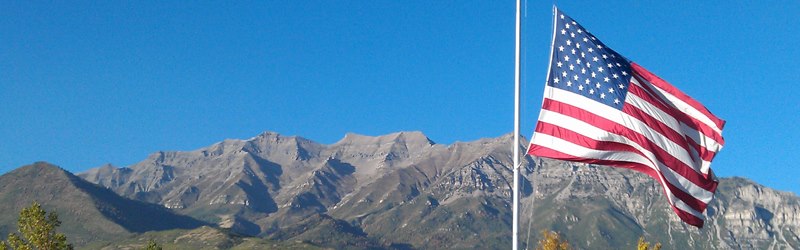
Mt. Timpanogos and the U.S. flag. Photo by Bob Walker of Orem, Utah; from Orem, circa September 2012. That's Mt. Baldy on the left. This site is about six miles from our old home in Pleasant Grove, Utah.

Mt. Timpanogos and the U.S. flag. Photo by Bob Walker of Orem, Utah; from Orem, circa September 2012. That’s Mt. Baldy on the left. This site is about six miles from our old home in Pleasant Grove, Utah, where we celebrated a few dozen Thanksgivings.

Fly  your flag on Thanksgiving — it’s one of about a score of dates Congress designated specially to fly the flag, in the U.S. flag code.

Americans load up this particular holiday with significance, often for no particular reason.  As a holiday, it is really rather uniquely American.  There were feasts of thanksgiving from time to time throughout recorded history, but most often they were one-shot affairs, after a particular event.

In America, Americans eagerly seized on the idea of one day set aside “to give thanks,” both with the religious overtones some wanted to see, and with the commercial overtones others wanted, especially during the Great Depression.  In our 238th year since the Declaration of Independence, the 225th year since the Constitution was enacted, we come to Thanksgiving as a major period of travel to old family homesteads, to Thanksgiving as a period of genuine thanks to American troops fighting in foreign lands half a world away, and as a commercial celebration that sucks the sobriety and spirituality out of all but the most dedicated of profiteers, or bargain hunters.

Vintage Thanksgiving greeting card, from HubPages

In the early 20th century, some people sent greeting cards for Thanksgiving; this is a tradition overtaken by Christmas, Hanukkah and New Years cards, today. (Image from HubPages, unknown year — credit for cards, “Images courtesy VintageHolidayCrafts.com

Thanksgiving often stumbled into controversy.  George Washington issued proclamations calling for a day of thanks, but struck out all references to Christianity.  Some president’s issued similar proclamations up to the Civil War, When Abraham Lincoln used the holiday as a time to remind  Americans that they had a lot to be thankful for, partly as a means to keep Americans focused on the war to be won, and keep supporting troops in the field.  During the Great Depression, Franklin D. Roosevelt juggled dates for Thanksgiving, moving it earlier in November to create a longer Christmas shopping season, hoping to stimulate sales, and thereby push America further out of the Depression.

In 2001 George W. Bush urged Americans to go shopping so terrorists would know America was not defeated by the attack on the World Trade Center, knowing that a stimulus to the economy would help garner support for other policies.

Vintage thanksgiving card, Boy riding turkey with American flag, from HubPages, original date unknown

Children riding large turkeys, waving American flags, made popular images in several years of the early 20th century.

2012 saw controversy over Big Box stores and other major, national retailers pushing their post- Thanksgiving, Christmas sales, into Thanksgiving day itself.  Is this fair to employees?  Is this too much emphasis on purchasing, and too little emphasis on family and giving thanks?

In 2014, we have the same arguments about Big Box stores pushing “Black Friday” into the holiday, and even more arguments about Christmas creep reducing the importance of Thanksgiving to Americans.

You can be sure of one thing:  It’s probably safe to fly your American flag on Thanksgiving, as Congress suggested.  It won’t make your turkey more moist  or your pumpkin pie taste any better.  It won’t boost your sales, if you’re a retailer, nor find you a bargain, if you’re a shopper.

If you have the flag, it costs nothing.  Flying the flag makes no particular religious statement, supports no particular political party, supports no one’s favorite football team.  Flying the flag earns you nothing, usually.

But as a free act of patriotism, support for our nation, and our troops, and a demonstration that even after a divisive election, we’re all one nation, it’s a pretty good deal.

Fly your flag today.

More:


Sunshine on Harry Truman’s place

August 20, 2014

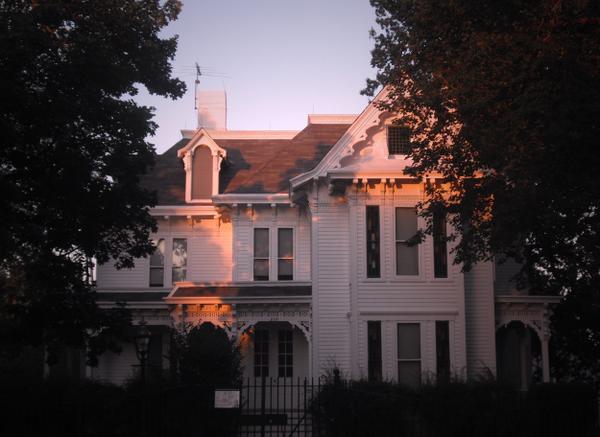
Sunset at the home of President Truman. @GoParks @Interior #POTUS

Sunset at the home of President Truman. @GoParks @Interior #POTUS

In the late afternoon light, one gets a better view of just why Harry Truman was so fond of this house.  Who wouldn’t be?

Something to visit when you’re next in Independence, Missouri.

More:


July 9, 1850: Death of President Zachary Taylor; cue Millard Fillmore

July 9, 2014

President Zachary Taylor died on July 9, 1850.  The cause is still not fully clear, but poisoning by arsenic has been ruled out.

What would have happened had Taylor lived?

At the blog of the National Constitution Center, we get a few details of his death and life immediately preceding:

President Zachary Taylor’s death on July 9, 1850 shocked a nation that was in a heated debate about issues that eventually led to the Civil War. But his sudden passing also sidestepped two constitutional crises.

zachary-taylorThe details about how and why President Taylor died are still in dispute today. The president attended a ceremony at the site of the Washington Monument on July 4th on a reportedly hot summer day.

He fell ill soon after with a stomach ailment. His doctors gave him relief medication that included opium and later bled the president. Taylor died five days later at the age of 65.

Officially, he died from cholera morbus, and today, the prevalent theory is that Taylor suffered from gastroenteritis, an illness exacerbated by poor sanitary conditions in Washington.

There are other theories, including one where Taylor was poisoned by people who supported the South’s pro-slavery position. (In recent years, Taylor’s body was exhumed and a small, non-lethal amount of arsenic was found in samples taken from his corpse.)

It was Taylor’s unexpected opposition to slavery (he was from the South and was the last president to own slaves) that had caused an immediate crisis in 1850.

Taylor ran as a Whig candidate in 1848 and he wasn’t a professional politician. Taylor was a career military man and a hero in the war with Mexico.

Once he took office in March 1849, it became clear that Taylor, the military man, was more interested in preserving the Union than the art of politics.

Taylor decided to press for statehood for the newly acquitted territories of California and New Mexico, and to let the regions hold their own constitutional conventions. This guaranteed that California and New Mexico would join the Union as anti-slavery states, tipping the balance in the Senate to the North.

[more at the blog site]

In any case, Taylor died on July 9.

And on July 10, 1850, his vice president, Millard Fillmore, was sworn in as president.

No, that doesn’t mean the bathtub tale is true.

More:


Mo Rocca’s profile of Millard Fillmore

April 7, 2014

You may view Mo Rocca’s “profile” of President Millard Fillmore for CBS Sunday Morning, on YouTube:

“CBS Sunday Morning” correspondent Mo Rocca, far left, poses with Kathy Frost, curator of the Millard Fillmore Presidential Site, and Robert Lowell Goller, town historian and director of the Aurora Historical Society, during his recent visit to East Aurora.  Photo by  Robert Lowell Goller

East Aurora Advertiser caption: CBS Visits East Aurora “CBS Sunday Morning” correspondent Mo Rocca, far left, poses with Kathy Frost, curator of the Millard Fillmore Presidential Site, and Robert Lowell Goller, town historian and director of the Aurora Historical Society, during his recent visit to East Aurora. Photo by Robert Lowell Goller

CBS broadcast this piece on February 16, 2014.

 974

More:


Honoring James Madison, the go-to guy, on his birthday

March 16, 2014

James Madison, the fourth President of the United States, and the Father of the Constitution, was born March 16, 1751, in the Tidewater area of Virginia.

Is it sinful that we do not celebrate his birthday with a federal holiday, fireworks, picnics and speeches and concerts?

Maybe you could fly your flag to day.  If the neighbors ask why, tell them you’re flying it for freedom on James Madison’s birthday.  They’ll say, “Oh,” and run off to Google Madison.  You will have struck a blow for the education that undergirds democracy.

A few years ago I was asked to talk about freedom to a group of freedom lovers in North Texas.  I chose to speak about James Madison’s remarkable, and too-often unremarked-upon life. Later, when I started this blog, I posted it here, with an introduction.  All of that is below, in honor of the birth of James Madison.

Did you know that Madison is the shortest man ever to have been president?  His stature is measured in freedom, not in feet and inches.

(Originally a post on July 31, 2006)

James Madison, 1783, by Charles Wilson Peale.  Library of Congress collection

James Madison, 1783, miniature by Charles Wilson Peale. Madison would have been 32. Library of Congress collection

I don’t blame students when they tell me they “hate history.”  Heaven knows, they probably have been boringly taught boring stuff.

For example, history classes study the founding of the United States. Especially under the topical restrictions imposed by standardized testing, many kids will get a short-form version of history that leaves out some of the most interesting stuff.

Who could like that?

Worse, that sort of stuff does damage to the history and the people who made it, too.

James Madison gets short shrift in the current canon, in my opinion. Madison was the fourth president, sure, and many textbooks note his role in the convention at Philadelphia that wrote the Constitution in 1787. But I think Madison’s larger career, especially his advocacy for freedom from 1776 to his death, is overlooked.

Madison was the “essential man” in the founding of the nation, in many ways. He was able to collaborate with people as few others could, in order to get things done, including his work with George Mason on the Virginia Bill of Rights, with George Washington on the Constitution and national government structure, Thomas Jefferson on the structure and preservation of freedom, Alexander Hamilton on the Constitution and national bank, and James Monroe on continuing the American Revolution.

We need to look harder at the methods and philosophy, and life, of James Madison. This is an opinion I’ve held for a long time. Below the fold I reproduce a “sermon” I delivered to the North Texas Church of Freethought in November 2001.

James Madison White House portrait, John Vanderlyn, 1816

James Madison’s official White House portrait, by John Vanderlyn in 1816; in the White House collection

I have left this exactly as it was delivered, though I would change a few things today, especially emphasizing more the key role George Washington played in pushing Madison to get the Constitution — a view I came to courtesy of the Bill of Rights Insitute and their outstanding, week-long seminar, Shaping the Constitution: A View from Mount Vernon 1783-1789. The Bill of Rights Institute provides outstanding training for teachers, and this particular session, at Washington’s home at Mount Vernon, Virginia, is well worth the time (check with the Institute to see whether it will be offered next year — and apply!). I am especially grateful to have had the opportunity to discuss these times and issues with outstanding scholars like Dr. Gordon Lloyd of Pepperdine University, Dr. Adam Tate of Morrow College, and Dr. Stuart Leibiger of LaSalle University, during my stay at Mount Vernon.

James Madison by Gilbert Stuart c. 1821

James Madison, portrait by Gilbert Stuart c. 1821; National Portrait Gallery

My presentation to the skeptics of North Texas centered around the theme of what a skeptic might give thanks for at Thanksgiving. (It is available on the web — a misspelling of my name in the program carried over to the web, which has provided me a source of amusement for several years.)

Here is the presentation:

Being Thankful For Religious Liberty

As Presented at the November, 2001 Sunday Service of The North Texas Church of Freethought

Historians rethink the past at least every generation, mining history for new insights or, at least, a new book. About the founders of this nation there has been a good deal of rethinking lately. David McCullough reminds us that John Adams really was a good guy, and that we shouldn’t think of him simply as the Federalist foil to Thomas Jefferson’s more democratic view of the world. Jefferson himself is greatly scrutinized, and perhaps out of favor — “American Sphinx,” Joseph Ellis calls him. The science of DNA testing shows that perhaps Jefferson had more to be quiet about than even he confessed in his journals. While Jefferson himself questioned his own weakness in his not freeing his slaves in his lifetime, historians and fans of Jefferson’s great writings wrestle with the likelihood of his relationship with one of his own slaves (the old Sally Hemings stories came back, and DNA indicates her children were fathered by a member of the Jefferson clan; some critics argue that Jefferson was a hypocrite, but that was Jefferson’s own criticism of himself; defenders point out that the affair most likely was consensual, but could not be openly acknowledged in Virginia at that time). Hamilton’s gift to America was a financial system capable of carrying a noble nation to great achievement, we are told – don’t think of him simply as the fellow Aaron Burr killed in a duel. Washington is recast as one of the earliest guerrilla fighters, and in one book as a typical gentleman who couldn’t control his expenses. Franklin becomes in recent books the “First American,” the model after which we are all made, somehow.

Of the major figures of these founding eras, James Madison is left out of the rethinking, at least for now. There has been no major biography of Madison for a decade or more, not since Ralph Ketcham’s book for the University of Virginia press. Madison has a role in Joseph Ellis’s Founding Brothers, but he shares his spotlight with Hamilton and Jefferson. I think this is an oversight. As we enter into the first Thanksgiving season of the 21st century, we would do well to take a look back at Madison’s life. Madison gives us a model of reason, and more important, a model of action coupled to reason. America’s founding is often depicted as a time of great thunder — if not the thunder of the lightning Ben Franklin experimented with, an experiment he parlayed into worldwide respect for Americans, it is the thunder of the pronouncements of Thomas Jefferson in the Declaration of Independence, or of George Washington, just generally thundering through history.

The use of a bolt of lightning as a symbol for this group is inspired, I think. I’m a great fan of Mark Twain, and when I see that bolt of electricity depicted I think of Twain’s observation:

“Thunder is good; thunder is impressive. But it is lightning that does the work.”

Thunder at the founding is impressive; where was the lightning?

I’d like to point out two themes that run through Madison’s life, or rather, two activities that we find him in time and again. Madison’s life was marked by periods of reflection, followed by action as a result of that reflection.

We don’t know a lot about Madison’s youth. He was the oldest son of a wealthy Virginia planter, growing up in the Orange County area of Tidewater Virginia. We know he was boarded out for schooling with good teachers – usually clergymen, but occasionally to someone with expertise in a particular subject – and we know that he won admission to Princeton to study under the Rev. John Witherspoon, a recent Presbyterian transplant from across the Atlantic. Madison broke with tradition a bit in attending an American rather than an English school. And after completing his course of study he remained at Princeton for another year to study theology directly under Witherspoon, with an eye toward becoming a preacher.

Witherspoon is often held up as an example of how religion influenced the founders, but he was much more of a rationalist than some would have us believe. He persuaded the young Madison that a career in law and politics would be a great service to the people of Virginia and America, and might be a higher calling. After a year of this reflection, Madison returned to Virginia and won election to local government.

In his role as a county official Madison traveled the area. He inspected the works of government, including the jails. He was surprised to find in jail in Virginia people accused of — gasp! — practicing adult baptism. In fact Baptists and Presbyterians were jailed on occasion, because the Anglican church was the state church of Virginia, and their practicing their faith was against the common law. This troubled Madison greatly, and it directed an important part of his work for the rest of his life. In January of 1774, Madison wrote about it to another prominent Virginian, William Bradford:

“Poverty and Luxury prevail among all sorts: Pride ignorance and Knavery among the Priesthood and Vice and Wickedness among the Laity. This is bad enough. But it is not the worst I have to tell you. That diabolical Hell conceived principle of persecution rages among some and to their eternal infamy the Clergy can furnish their Quota of Imps for such business. This vexes me the most of any thing whatever. There are at this time in the adjacent County not less than 5 or 6 well meaning men in close Gaol for publishing their religious Sentiments which in the main are very orthodox. I have neither patience to hear talk or think of any thing relative to this matter, for I have squabbled and scolded abused and ridiculed so long about it, to so little purpose that I am without common patience. So I leave you to pity me and pray for Liberty of Conscience to revive among us.”

By April, Madison’s views on the matter had been boiled down to the essences, and he wrote Bradford again more bluntly:

“Religious bondage shackles and debilitates the mind and unfits it for every noble enterprise.”

Madison must have done a fine job at his county duties, whatever they were, because in 1776 when Virginia was organizing its government to survive hostilities with England, Madison was elected to the legislative body.

Madison was 25, and still raw in Virginia politics. He was appointed to the committee headed by George Mason to review the laws and charter of the colony. Another who would serve on this committee when he was back from Philadelphia was Thomas Jefferson. George Mason was already a giant in Virginia politics, and by the time Madison got to Williamsburg, Mason had already completed much of the work on a bill of rights to undergird the new Virginia government. Madison noted that freedom of religion was not among the rights enumerated in Mason’s version — but it was too late, Mason said. The work was done.

Madison quietly went to work on Mason, in committee, over dinner, during social occasions — noting the great injustice of jailing people solely because of their beliefs, and urging to Mason that it did Virginia no good to keep these fathers from providing for their families.

Mason ultimately agreed to accept the amendment.

The pattern was set.

Perhaps a better example of this reflection and action cycle occurred nearly a decade later. By 1785 the war was over, independence was won, but the business of government continued. While serving as governor of Virginia, Thomas Jefferson had drafted about 150 proposals for laws, really a blueprint for a free government. About half of these proposals had been passed into law. By 1785, Jefferson was away from Virginia, representing the Confederation of colonies in Paris. Jefferson had provided several laws to disestablish religion in Virginia, and to separate out the functions of church and state. With Jefferson gone, however, his old nemesis Patrick Henry sought to roll back some of that work. Henry proposed to bring back state support for the clergy, for the stated purpose of promoting education. (Yes, this is the same battle we fight today for church and state separation.) After Jefferson’s troubled term as governor, Virginia turned again to Henry – Henry ultimately served six terms as governor. His proposal was set for a quick approval in the Virginia assembly. It was late in the term, and everyone wanted to get home.

Henry was, of course, a thundering orator of great note. Madison was a small man with a nervous speaking style, but a man who knew the issues better than anyone else in almost any room he could be in. Madison came up with an interesting proposal. Picking the religion for the state was serious stuff, he said. A state doesn’t want to pick the wrong religion, and get stuck with the wrong god, surely – and such weighty matters deserve widespread support and discussion, Madison said. His motion to delay Henry’s bill until the next session, in order to let the public know and approve, was agreed to handily.

You probably know the rest of this story. With a year for the state to reflect on the idea, Madison wrote up a petition on the issue, which he called a “Memorial and Remonstrance.” In the petition he laid out 15 reasons why separation of church and state was a superior form of government, concluding that in the previous 1,500 years, every marriage of church and state produced a lazy and corrupt church, and despotic government. Madison’s petition circulated everywhere, and away from Patrick Henry’s thundering orations, the people of Virginia chose Madison’s cool reason.

When the legislature reconvened in 1786, it rejected Henry’s proposal. But Madison’s petition had been so persuasive, the legislature also brought up a proposal Thomas Jefferson had made six years earlier, and passed into law the Virginia Statue for Religious Freedom.

This was a great victory for Madison, and for Virginia. He celebrated by convening a convention to settle disputes between Virginia and Maryland about navigation on the Chesapeake Bay. Having reflected on the nature of this issue — a dispute between colonies — Madison had sought advice from others having the same problems, such as New York and New Jersey. In that effort he got the support of a New Yorker working on the same problems, Alexander Hamilton. In the course of these discussions Madison thought it clear that the difficulty lay with the form of government that bound the colonies together under the Articles of Confederation. Hamilton agreed, and they got their respective states and conferences to agree to meet in Philadelphia in 1787 to try to fix those problems. [Since I first wrote this, I’ve learned that it was George Washington’s desire to get a federal government, to facilitate the settling of the Ohio River Valley where Washington had several thousands of acres to sell, that prompted him to push Madison into the Annapolis Convention, and who made the introduction between Madison and Washington’s old aide and friend, Alexander Hamilton; Madison’s work with Washington runs much deeper than I orignally saw.]

James Madison, 1792 portrait by Charles Wilson Peale, Gilcrease Museum, Tulsa

James Madison, 1792 portrait by Charles Wilson Peale, Gilcrease Museum, Tulsa

Amending the Articles of Confederation was a doomed effort, many thought. The colonies would go their separate ways, no longer bound by the need to hang together against the Parliament of England. Perhaps George Washington could have got a council together to propose a new system, but Washington had stayed out of these debates. Washington’s model for action was the Roman general Cincinnatus, who went from his plow to lead the Romans to victory, then returned to his farm, and finding his plow where he had left it, took it up again.

Madison invited Washington, and persuaded Washington to attend. Washington was elected president of the convention, and in retrospect that election guaranteed that whatever the convention produced, the colonies would pay attention to it.

You know that history, too. The convention quickly decided the Articles of Confederation were beyond repair. Instead, they wrote a new charter for a new form of government. The charter was based in part on Jefferson’s Virginia Plan, with lots of modifications. Because the Constitution resembles so much the blueprint that Jefferson had written, and because Jefferson was a great founder, many Americans believe Jefferson was a guiding light at that Philadelphia convention. It’s often good to reflect that Jefferson was in Paris the entire time. While America remembers the thunder of Washington’s presiding, Franklin’s timely contributions and Jefferson’s ideas, it was Madison who did the heavy lifting, who got Washington and Franklin to attend the meeting Madison had set up, and got Jefferson’s ideas presented and explained.

It was Madison who decided, in late August of 1787, that the convention could not hang together long enough to create a bill of rights, and instead got approval for the basic framework of the U.S. government. In Virginia a few months later, while Patrick Henry thundered against what he described as a power grab by a new government, it was Madison who assembled the coalitions that got the Constitution ratified by the Virginia ratifying convention. And when even Jefferson complained that a constitution was dangerous without a bill of rights, it was Madison who first calmed Jefferson, then promised that one of the first actions of the new government would be a bill of rights. He delivered on that promise as a Member of the House of Representatives in 1789.

It is difficult to appreciate just how deeply insinuated into the creation of America was James Madison. In big ways and small, he made America work. He took the lofty ideas of Jefferson, and made them into laws that are still on the books, unamended and unedited, more than 200 years later.

When the ratification battle was won, when Madison had won election to the House over Patrick Henry’s strong objection, partly by befriending the man Henry had picked to defeat Madison, James Monroe, Madison could have savored the moment and been assured a place in history.

James Madison in 1804, by Gilbert Stuart

James Madison in 1804, by Gilbert Stuart. Colonial Williamsburg Foundation, Williamsburg, Virginia. Gift of Mrs. George S. Robbins

That’s not what a lightning bolt does. Journeying to New York for the opening of the First Congress and the inauguration of Washington as president, Madison stopped off at Mount Vernon to visit with Washington, apparently at Washington’s request. In what was a few hours, really, Madison wrote Washington’s inaugural address. While there at Mount Vernon, Madison stumbled into a discussion by several others on their way to New York, wondering what high honorific to apply to the new president. “Excellency” was winning out over “Your highness,” until Washington turned to Madison for an opinion. Madison said the president should be called, simply, “Mr. President.” We still do.

Once in New York, Madison saw to the organizing of the Congress, then to the organizing of the inauguration. And upon hearing Washington’s inauguration address — which Madison had ghosted, remember — Congress appointed Madison to write the official Congressional response.

Years later, in Washington, Madison engineered the candidacy of Thomas Jefferson for president, and after Jefferson was elected, Madison had the dubious honor as Secretary of State of lending his name to the Supreme Court case that established the Supreme Court as the arbiter of what is Constitutional under our scheme of government, in Marbury v. Madison.

Wherever there was action needed to make this government work, it seemed, there was James Madison providing the spark.

James Madison was the lightning behind the thunder of the founding of America. We should be grateful that he lived when he did, where he did, for we all share the fruits of the freedoms he worked to obtain. And in this Thanksgiving season, let us look for appropriate ways to honor his work.

James Madison circa 1829-1839, portrait by Chester Harding.  National Portrait Gallery

James Madison, 1829, portrait by Chester Harding. National Portrait Gallery. “In 1829, Madison came out of retirement to attend a convention for revising Virginia’s constitution. While there, he posed for this portrait by the Massachusetts painter Chester Harding.”

The Madisonian model of thoughtful reflection leading to action is one that is solidly established in psychological research. It is the model for leadership taught in business schools and military academies.

I would compare religious liberty to a mighty oak tree, under which we might seek shade on a hot summer day, from which we might draw wood for our fires to warm us in winter, or lumber to build great and strong buildings. That big oak we enjoy began its life long before ours. We enjoy its shade because someone earlier planted the seed. We enjoy our freedoms today because of men like James Madison.

How do we give thanks? As we pass around the turkey to our family, our friends, we would do well to reflect on the freedoms we enjoy, and how we got them.

Finally, remembering that someone had to plant those seeds, we need to ask: What seeds must we plant now for those who will come after us? We can demonstrate our being grateful for the actions of those who came before us by giving to those who come after us, something more to be grateful for. A life like Madison’s is a rarity. Improving on the freedoms he gave us might be difficult. Preserving those freedoms seems to me a solemn duty, however. Speaking out to defend those freedoms is an almost-tangible way to thank James Madison, and as fate would have it, there is plenty of material to speak out about. A postcard to your senators and representative giving your reasoned views on the re- introduction of the Istook Amendment might be timely now – with America’s attention turned overseas for a moment, people have adopted Patrick Henry’s tactic of trying to undo religious freedom during the distraction. I have had a lot of fun, and done some good I hope, in our local school system by asking our sons’ science and biology teachers what they plan to teach about evolution. Whatever they nervously answer — and they always nervously answer that question — I tell them that I want them to cover the topic fully and completely, and if they have any opposition to that I would be pleased to lend my name to a suit demanding it be done. We might take a moment of reflection to ponder our views about a proposed Texas “moment of silence” bill to be introduced, and then let our state representatives have our thoughts on the issue.

Do you need inspiration? Turn to James Madison’s writings. In laying out his 15-point defense of religious freedom in 1785, Madison wrote that separation of church and state is essential to our form of government:

“The preservation of a free Government requires not merely, that the metes and bounds which separate each department of power be invariably maintained; but more especially that neither of them be suffered to overleap the great Barrier which defends the rights of the people.”

How can we express our gratitude for such a foundation for religious liberty? Let loose a few lightning bolts, in remembrance of Madison.

Copyright © 2001 and 2006 by Ed Darrell. You may reproduce with attribution. Links added in May 2013.

More:


If you’re not remembered as much as Millard Fillmore . . .

January 10, 2014

The University of Buffalo honored Millard Fillmore today in a graveside ceremony on Thursdaypostponed from Fillmore’s birthday on January 7 due to cold and icy weather.

Is Fillmore forgotten as much as many claim?

Compare to notes on the births of other presidents.

Richard Nixon was born on January 9, 1913 (same year as my mother!)  He’d be 101 today, and still not a crook in his view.

US Senate History tweeted:

Not quite so good as a graveside ceremony.  Funnier picture, perhaps.

But consider Andrew Johnson.  His birthday was a couple of weeks ago, on December 29.

Andrew Johnson, the seventeenth president of the United States, was born in Raleigh, North Carolina, on December 29, 1808. His father’s death when the boy was three left the family in poverty. From age fourteen to age seventeen, young Johnson was apprenticed to a tailor. He then moved with his mother and stepfather to Greeneville, Tennessee, where he established himself as a tailor. Johnson never attended school but taught himself to read and write—he all but memorized the U.S. Constitution—and after his 1827 marriage to Eliza McCardle, a shoemaker’s daughter, acquired a good common education under her tutelage.

A gifted orator, Johnson quickly ascended the political ladder. In 1829, he won his first office, as an alderman. In steady succession he became mayor of Greeneville, a member of the Tennessee state legislature (1835-37, 1839-43), U.S. congressman (1843-53), governor of Tennessee (1853-57), and U.S. senator (1857-62). In Congress, Johnson supported the annexation of Texas and the Mexican-American War, and sponsored a homestead bill that anticipated the 1862 Homestead Act. He also was the only Southern senator who firmly supported the Union and remained in the Senate throughout both the secession crisis and the Civil War. In the spring of 1862, after federal forces captured portions of Tennessee, President Lincoln appointed him military governor of the state, an office he held despite constant danger to his life.

Two years later, influential moderates such as William Seward worked to secure Andrew Johnson, a Democrat, as Lincoln’s running mate on the Republican Party ticket. According to a May 20, 1865, editorial in Harper’s Weekly, Seward had seen in Johnson “that his fellow-Senator, a land-reformer, a stern Union man, a trusted representative of the people of the South as distinguished from the planting aristocracy, was the very kind of leader by whom the political power of the aristocracy was ultimately to be overthrown in its own section.”

After Lincoln’s assassination in April 1865, little more than a month after their inauguration, Johnson assumed the presidency. His administration ran more smoothly in the foreign than the domestic arena: in 1867, Secretary of State Seward purchased Alaska and helped negotiate France’s withdrawal of troops from Mexico.

If nothing else, Johnson is notorious for having been the first president to be impeached (he was acquitted at trial by the Senate; best account probably in John Kennedy’s Profiles in Courage).

Was there much of a peep in popular media on his birthday?

Any note?  I didn’t find it except in a very few of the “Today in History” columns.

Johnson may be forgettable, though — not considered a good president (who could be following Lincoln!).

What about Woodrow Wilson?  His birthday also cropped up a couple of weeks ago, on December 28, the day before Johnson’s.

It is not needful or possible at this time, whilst yet he lives, to say that Wilson is a Washington or another Lincoln, but he is a great American. He is one of the great presidents of American history.

Rabbi Stephen A. Wise in a tribute to Woodrow Wilson.
American Leaders Speak: Recordings from World War I and the 1920 Election, 1918-1920

Anyone notice?  I mean, anyone outside of Staunton, Virginia, his birthplace?  (Well, yeah — see below.)

What is a fair measure of ignominy? If the world forgets the great man’s birthday, is that a sign?

Photo by Michael Bupp, The Carlisle Sentinel:

Photo by Michael Bupp, The Carlisle Sentinel: “For 88 years, there has been a Woodrow Wilson Birthday Association of Cumberland County that organized an annual observance around Dec. 28 to remember Wilson. Pat Stumbaugh is the current treasurer and has been involved in the association since she was a little girl.”

More:


Stretching celebration of Millard Fillmore’s birthday through the week

January 7, 2014

Summerhill, New York, got a jump on celebrating Millard Fillmore’s birthday with a Sunday ceremony; today’s scheduled graveside commemoration is postponed due to weather, to Thursday — nearly a full week of Millard Fillmore!

Summerhill’s annual birthday party continued a tradition of uncertain age.  Fillmore was born in a log cabin in Summerhill.

Details come from the Auburn, New York, Citizen:

Three members of Flock of Free Range Children John Davis, from left, Ron Van Nostrand and Don Watkins perform at the birthday party for former President Millard Fillmore Sunday in the Summerhill Town Hall.   (Photo by Jessica Soule)

Music for the Summerhill, New York, celebration of Millard Fillmore’s 214th birthday was provided, again, by Flock of Free Range Children. Caption from the Auburn Citizen: Three members of Flock of Free Range Children John Davis, from left, Ron Van Nostrand and Don Watkins perform at the birthday party for former President Millard Fillmore Sunday in the Summerhill Town Hall. (Photo by Jessica Soule)

SUMMERHILL | Summerhill’s town hall was taken over Sunday with the delights of a birthday party – cake, live music and community members coming together in celebration. Millard Fillmore was born 214 years ago, on Jan. 7, 1800, in a log cabin there.

In honor of his birthday, the Cayuga Owasco Lakes Historical Society partnered with the town of Summerhill to put on a party for the 13th president of the United States of America. This annual celebration has happened for years, society President Joyce Hackett Smith-Moore said.

Three members of the Flock of Free Range Children performed in the hall, as people munched on food and chatted. A banner with Fillmore’s birth year hung from the wall above a birthday cake.

“This is our opportunity for the town and our members to keep the memory of Fillmore alive,” Smith-Moore said. “After all, there’s not a lot of counties that have a president from there. There is a lot of history, but there’s so much more.”

The historical society also hosts an annual fundraiser in August. This year, the money gathered will benefit the pavilion that commemorates Fillmore’s birthplace. Specifically, the society wants to install bathrooms. The path that connects his birthplace and Fillmore Glen State Park was recently cleared, giving walkers another trail to learn more about the president who was responsible for adding indoor plumbing to the White House.

Commemorating the president with origins in Cayuga County is especially important, as he hasn’t gotten his due from national historians.

“All presidents have a library or museum, except Fillmore. We’re the only executive of his effects,” Smith-Moore said.

Fillmore only recently became the subject of his first biography, completed by a former Moravia teacher. The birthday celebration is an effort to raise awareness of his accomplishments and the many positive effects of his work on the nation, Smith-Moore said.

The historical society presented the town a frame that contained coins, one bearing Fillmore’s image and another of his wife, a photo of the deputy director of the United States Mint dedicating the Fillmore coin in 2010 and a flier of the coin dedication.

In an effort to remind the community of their local treasure, fifth-graders will be treated to a sit down between Fillmore and Abraham Lincoln in their curriculum.

“People just don’t know anything about Millard Fillmore,” Smith-Moore said.

She said one of his biggest accomplishments was to order the military to start surveying in preparation for what would become the Transcontinental Railroad. Meanwhile, town historian Florence Lansdowne said Fillmore opening up trade with Japan led to major benefits.

“We want to instill in people how important he was,” Lansdowne said.

Lansdowne is retiring, and will work with her replacement Patricia McCloy this year. McCloy lauded Lansdowne for her work in gaining recognition for the 13th president.

McCloy said she is excited to take over as local historian. She’s going to try to encourage more use of the pavilion that commemorates Fillmore’s birthplace.

“Is it amazing,” she said. “There aren’t many towns in American that can say they had a president.”

From the Auburn Citizen:  New Summerhill town historian Patricia McCloy, right, smiles during a presentation by the Cayuga Owasco Lakes Historical Society as retiring town historian Florence Lansdowne, left, and society President Joyce Hackett Smith-Moore look on. (Photo by Jessica Soule)

From the Auburn Citizen: New Summerhill town historian Patricia McCloy, right, smiles during a presentation by the Cayuga Owasco Lakes Historical Society as retiring town historian Florence Lansdowne, left, and society President Joyce Hackett Smith-Moore look on. (Photo by Jessica Soule)

What other celebrations might there be out there?  Does anyone race bathtubs anymore?

More, perhaps related:


Two presidents, a study in blue

September 27, 2013

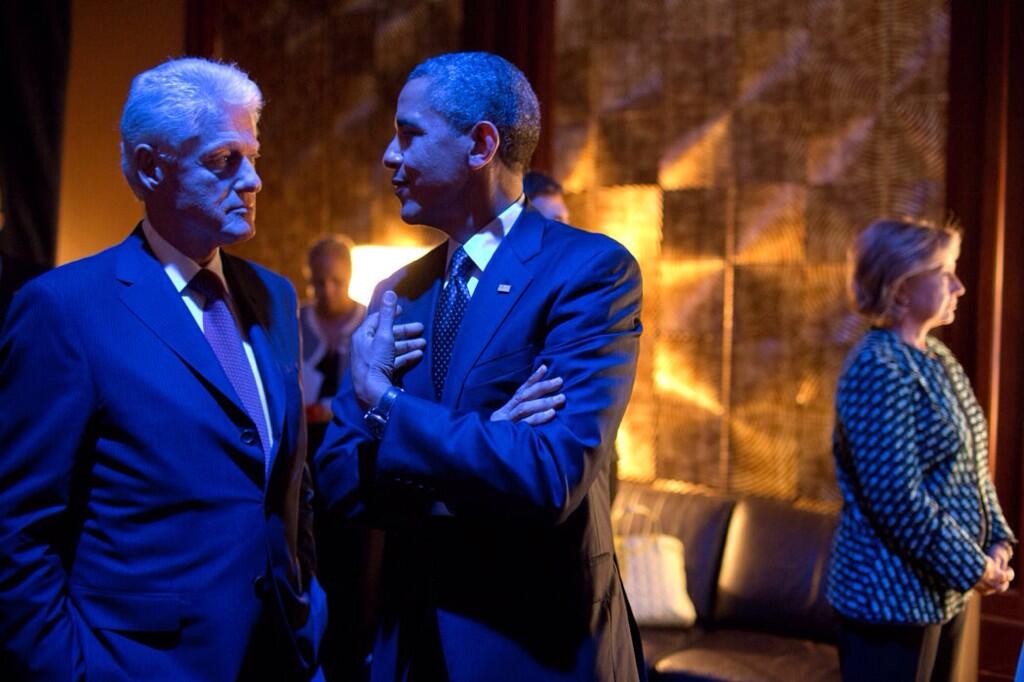
Pete Souza photo - Pres Obama talks backstage with Pres Clinton as Hillary Clinton waits to be introduced at CGI event 9-24-2013

White House photographer Pete Souza: ‏@petesouza 24 Sep Pres Obama talks backstage with Pres Clinton as Hillary Clinton waits to be introduced at CGI [Clinton Global Initiative] event today [September 24, 2013] pic.twitter.com/TCYqyxMZa8

Pete Souza’s work as White House photographer continues to fascinate me.  He’s got more opportunity than most of us have to get great shots — but he’s also got a keen eye for a good story-telling photo, and a good eye for great photo composition on the fly.

In this photo, Souza captures two presidents lost in conversation, bathed in blue stage lights, awaiting their time on the stage; but next up is Hillary Clinton, who will introduce them.  Mrs. Clinton awaits her cue.  The presidents met at the annual meetings for the Clinton Global Initiative.

Hold on to this photo; depending on events of 2016, it may yet have many more stories to tell.