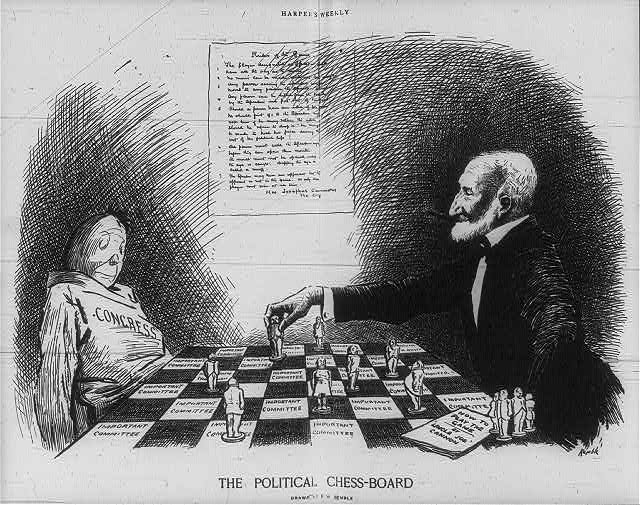
Chess games of the rich and famous: House Speaker Joe Cannon vs. Congress

July 7, 2010

Cartoon - Cannon, Joe, The Poltiical Chessboard, Harpers 2-05-1910 - 3b23316r

The Poltiical Chessboard, Harper's Magazine, February 5, 1910, by E. W. Kemble - Library of Congress image

Description from the Library of Congress:

Joseph Cannon playing chess with straw man labelled “Congress,” using toy men on chessboard with squares labelled “important committee” and “freak committee.”

Legendary House Speaker Joe Cannon — after whom the Cannon House Office Building is named — is remembered for the almost absolute power he held over the House of Representatives.  Here’s the generic description at Wikipedia:

House Speaker Joseph G. Cannon - Wikimedia image, photo from October 1915

House Speaker Joseph G. Cannon - Wikimedia image, photo from October 1915

Cannon wielded the office of Speaker with unprecedented power. At the time of Cannon’s election the Speaker of the House concurrently held the chair of the Rules Committee, which determined under what rules and restrictions bills could be debated, amended, and voted on, and in some cases whether they would be allowed on the floor at all. As such, Cannon effectively controlled every aspect of the House’s agenda: Bills reached the floor of the house only if Cannon approved of it, and then in whatever form he determined—with he himself deciding whether and to what extent the measures could be debated and amended.

Cannon also reserved to himself the right to appoint not only the chairs of the various House committees, but also all of committees’ members, and (despite the seniority system that had begun to develop) used that power to appoint his allies and proteges to leadership positions while punishing those who opposed his legislation. Crucially, Cannon exercised these powers to maintain discipline within the ranks of his own party: the Republicans were divided into the conservative “Old Guard,” led by Cannon, and the progressives, led by President Theodore Roosevelt. His committee assignment privileges ensured that the party’s Progressive element was essentially powerless in the House, and his control over the legislative process obstructed progressive legislation.

Progressives wished to break Cannon’s ability to control so completely the flow of legislation.  By early 1910, progressives in the Republican Party especially chafed under Cannon’s rule.  Anxious for revolt, they struck on March 17, just a few weeks after this cartoon appeared.

On March 17, 1910, after two failed attempts to curb Cannon’s absolute power in the House, Nebraska Representative George Norris [of Nebraska] led a coalition of 42 progressive Republicans and the entire delegation of 149 Democrats in a revolt. With many of Cannon’s most powerful allies absent from the Chamber, but enough Members on hand for a quorum, Norris introduced a resolution that would remove the Speaker from the Rules Committee and strip him of his power to assign committees.

While his lieutenants and the House sergeant-at-arms left the chamber to collect absent members in attempt to rally enough votes for Cannon, the Speaker’s allies initiated a filibuster in the form of a point of order debate. When Cannon supporters proved difficult to find (many of the staunchest were Irish and spent the day at various St. Patrick’s Day celebrations), the filibuster continued for 26 hours, with Cannon’s present friends making repeated motions for recess and adjournment. When Cannon finally ruled the resolution out of order at noon on March 19, Norris appealed the resolution to the full House, which voted to overrule Cannon, and then to adopt the Norris resolution.

Cannon managed to save some face by promptly requesting a vote to remove him as Speaker, which he won handily since the Republican majority would not risk a Democratic speaker replacing him. However, his iron rule of the House was broken, and Cannon lost the Speakership when the Democrats won a majority later that same year.

Instead of the Speaker’s wishes, committee assignments and chairs were selected by a seniority system.

Cannon lost his seat representing Illinois in the progressive tide of 1912, but regained it in 1914, and served another four terms in the House, to 1922.

I have found no information on whether Cannon actually played chess.

Norris’s star was on the rise at the same time.  Though he supported Theodore Roosevelt in the election of 1912, when Roosevelt bolted the Republican Party and ran as a Progressive or “Bullmoose Party” nominee for president, Norris stayed with the Republican Party and won election to the U.S. Senate in 1912.

Norris became an isolationist, and was one of six senators to vote against the declaration of war in 1917 that pushed the U.S. into World War I.  Norris also opposed the Versailles Treaty, and played an important role in keeping the treaty from U.S. ratification.  He supported Franklin Roosevelt’s New Deal Reforms a decade-and-a-half later, and one of the early dams of the Tennessee Valley Authority is named for him.  Norris’s role in the New Deal, and in pushing progressive reforms well into the 20th century, is not fully appreciated, for example:

In 1932, along with Rep. Fiorello H. La Guardia, Norris secured passage of the Norris-La Guardia Act, which outlawed the practice of requiring prospective employees not to join a labor union as a condition of employment (the so-called yellow-dog contract) and greatly limited the use of court injunctions against strikes.

A staunch supporter of President Roosevelt’s New Deal programs, Norris sponsored the Tennessee Valley Authority Act of 1933. In appreciation, the TVA Norris Dam and a new planned city in Tennessee were named after him.[3][4] Norris was also the prime Senate mover behind the Rural Electrification Act that brought electrical service to under-served and unserved rural areas across the United States.

Switching to the Democratic Party in 1936 when the Republicans fell into the minority, Norris generally supported New Deal efforts but did not fear to oppose ideas he found unworthy, regardless their source or party connection.  His opposition to President Franklin Roosevelt’s “court packing” plan helped smother the idea.  Norris finally lost election in 1942.  Norris is one of eight U.S. senators profiled in John F. Kennedy’s book, Profiles in Courage.


Left out of the textbooks: The Great Cowboy Strike of 1883

June 10, 2010

It wasn’t in the textbooks before, and after the Texas State Soviet of Education finished work on new social studies standards last month, the Great Cowboy Strike of 1883 remains a topic Texas students probably won’t learn.

Unless you and I do something about it.

From University of California at Davis's  Exploring the West Project: Cowboy at work, TX, c. 1905. Library of Congress, Washington, DC. Erwin Smith photo. http://historyproject.ucdavis.edu/khapp.php?SlideNum=2721

From University of California at Davis’s Exploring the West Project: Cowboy at work, TX, c. 1905. Library of Congress, Washington, DC. Erwin Smith photo. http://historyproject.ucdavis.edu/khapp.php?SlideNum=2721

In the history of labor in the U.S., the common story leaves out most of the great foment that actually drove progressive politics between, say, 1865 and 1920.  Union organization attempts, and other actions by workers to get better work hours and work conditions, just get left behind.

Then there is the sheer incongruity of the idea.  A cowboy union? Modern cowboys tend toward conservative politics.  Conservatives like to think of cowboys as solitary entrepreneurs, and not as workers in a larger organization that is, in fact, a corporation, where workers might have a few grievances about the fit of the stirrups, the padding of the saddle, the coarseness of the rope, the chafing of the chaps, the quality of the chuck, or the very real dangers and hardships of simply doing a cowboy’s job well.

Until today, I’d not heard of the Great Cowboy Strike of 1883.

Check it out at the Texas State Historical Association’s Handbook of Texas Online:

COWBOY STRIKE OF 1883. In the two decades after the Civil War the open-range cattle industry dominated the Great Plains, then died and was replaced by closed-range ranching and stock farming. In West Texas during the 1880s new owners, representing eastern and European investment companies, gained control of the ranching industry and brought with them innovations threatening to many ranchhands. Previously, cowboys could take part of their pay in calves, brand mavericks, and even run small herds on their employers’ land. New ranch owners, interested in expanding their holdings and increasing their profits, insisted that the hands work only for wages and claimed mavericks as company property. The work was seasonal. It required long hours and many skills, was dangerous, and paid only an average of forty dollars a month. The ranch owners’ innovations, along with the nature of the work, gave rise to discontent.

In 1883 a group of cowboys began a 2½-month strike against five ranches, the LIT, the LX, the LS, the LE, and the T Anchor,qqv which they believed were controlled by corporations or individuals interested in ranching only as a speculative venture for quick profit. In late February or early March of 1883 crews from the LIT, the LS, and the LX drew up an ultimatum demanding higher wages and submitted it to the ranch owners. Twenty-four men signed it and set March 31 as their strike date. The original organizers of the strike, led by Tom Harris of the LS, established a small strike fund and attempted, with limited success, to persuade all the cowboys in the area of the five ranches to honor the strike. Reports on the number of people involved in the strike ranged from thirty to 325. Actually the number changed as men joined and deserted the walkout.

It was the wrong time to strike.  With a full month remaining before the spring roundup, ranchers had plenty of time to hire scabs and strikebreakers, to replace the striking cowboys.  Some ranches increased wages, but most of them fired the strikers and made the strikers crawl back to beg for jobs.  Santayana’s Ghost is tapping at the chalk board about the potential lessons there.  (You should read the whole article at TSHA’s site.)

It didn’t help that the striking cowboys didn’t have a very large strike fund, nor that they drank a lot of the strike fund up prematurely.

The Great Cowboy Strike, unimpressive as it was, is part of a larger story about labor organizing and progressive politics especially outside the cities in that larger Progressive Era, from the Civil War to just after World War I.  It involves large corporations running the ranches — often foreign corporations with odd ideas of how to raise cattle, and often with absentee ownership who hired bad managers.  The strike talks about how working people were abused in that era, even the supremely independent and uniquely skilled cowboy.  It offers wonderful opportunities to improve our telling the story of this nation, don’t you think?

Resources:

Save


Sources: Triangle Shirtwaist Fire, and Trial

November 28, 2009

More than just as tribute to the victims, more than just a disaster story, the Triangle Shirtwaist Co. fire, and the following events including the trial of the company owners, lay out issues students can see clearly.  I think the event is extremely well documented and adapted for student projects.  In general classroom use, however, the event lays a foundation for student understanding.

A couple of good websites crossed my browser recently, and I hope you know of them.

Cartoon about 1911 Triangle Shirtwaist Fire, New York Evening Journal, March 31

Cartoon about 1911 Triangle Shirtwaist Fire, New York Evening Journal, March 31, 1911

Events around the fire illuminate so much of American history, and of government (which Texas students take in their senior year):

  • Labor issues are obvious to us; the incident provides a dramatic backdrop for the explanation of what unions sought, why workers joined unions, and a sterling example of a company’s clumsy and destructive resistance to resolving the workers’ issues.
  • How many Progressive Era principles were advanced as a result of the aftermath of the fire, and the trial?
  • Effective municipal government, responsive to voters and public opinion, can be discerned in the actions of the City of New York in new fire codes, and action of other governments is clear in the changes to labor laws that resulted.
  • The case provides a dramatic introduction to the workings and, sometimes, misfirings of the justice system.
  • With the writings from the Cornell site, students can climb into the events and put themselves on the site, in the courtroom, and in the minds of the people involved.
  • Newspaper clippings from the period demonstrate the lurid nature of stories, used to sell newspapers — a working example of yellow journalism.
  • Newspapers also provide a glimpse into the workings of the Muckrakers, in the editorial calls for reform.
  • Overall, the stories, the photos, the cartoons, demonstrate the workings of the mass culture mechanisms of the time.

Use the sites in good education, and good health.
