Quote of the moment: Mr. Mike’s everlasting humility

May 30, 2009

Senate Majority Leader Mike Mansfield, oil on canvas painting by Aaron Shikler, 1978 - Wikimedia image

Senate Majority Leader Mike Mansfield, oil on canvas painting by Aaron Shikler, 1978 - Wikimedia image

Beginning in March 1974 I had the great pleasure and high honor of interning with the Secretary of the Senate, Francis R. Valeo.  Valeo served because of his close relationship with the Majority Leader, Mike Mansfield, and working in Valeo’s office put one on the Mansfield team.  In an era before serious security with magnetometers in Washington’s public buildings — we didn’t even have photo identification cards then — Mike Mansfield’s signature on my staff card got me anywhere I wanted to go in Washington, including the White House.

People who knew Mansfield held him in very high regard.  I often tell people he was the best politician to work for, but in reality, he’s probably the best leader I ever worked with in any enterprise.  He respected every senator as a representative of the people of one of the 50 states, and that respect was returned.

In his office one afternoon he met with the a couple of members of the Joint Chiefs of Staff, the big bigwigs from the Pentagon.  Mansfield was a former sailor, marine and soldier — he had served in the Navy, Army and Marines.   He lied about his age the first time.  He had served in China and the Philippines, producing a life-long interest and deep expertise in U.S. affairs in the Pacific and Far East.

But this was 1974.  Mansfield had turned against supporting corrupt Vietnamese politicians early in the U.S. involvement in Vietnam.  Originally a supporter of Nixon’s policies, by 1974 his opposition to the war was the chief part of their relationship.  Still the military guys loved him.  An Army Colonel accompanying the group was anxious to explain to the young intern part of the mystique.

“You should see Mansfield in the formal meetings.  Everybody is always introduced, and their full rank is laid on the table.  ‘General Muckamuck.  West Point ’33, Columbia Law.  Admiral Bigship.  General Soandso, who recently got his third star.'”

“And then they get to Mansfield.  He’s the Senate Majority Leader.  And he introduces himself as ‘Mike Mansfield, Private First Class.'”

I asked Mansfield about it later.  He smiled, and said he might have done that a time or two.  He said that the big brass in the military need to remember as every senator does that they work for the American people.  Rank doesn’t make you right, he said.

Looking up a minor fact on Mansfield this morning I ran into this statement, which I’d never heard [quoting now from Wikipedia]:

This gentleman went from snuffy to national and international prominence. And when he died in 2001, he was rightly buried in Arlington. If you want to visit his grave, don’t look for him near the “Kennedy Eternal Flame”, where so many politicians are laid to rest. Look for a small, common marker shared by the majority of our heroes. Look for the marker that says “Michael J. Mansfield, Pfc. U.S. Marine Corps.”

Remarks by Col. James Michael Lowe, USMC, October 20, 2004.

The burial plot of Senator and Mrs. Mansfield can be found in section 2, marker 49-69F of Arlington National Cemetery.

For the sake of accuracy, I would like to know the occasion of Col. Lowe’s remarks, and who Col. Lowe is.  The link at Wikipedia is dead.  Does anyone know?

Resources:

Know a marine?  Honor a Marine hero and share this story:

Add to FacebookAdd to NewsvineAdd to DiggAdd to Del.icio.usAdd to StumbleuponAdd to RedditAdd to BlinklistAdd to TwitterAdd to TechnoratiAdd to Furl


True, but did Einstein say it?

May 6, 2009

Poster by Ricardo Levins Morales. Updated March 2015 - click image to purchase a copy of the poster from Mr. Morales.

Poster by Ricardo Levins Morales. Updated March 2015 – click image to purchase a copy of the poster from Mr. Morales.

Nice poster, great thought — you can’t measure everything about a student with a test, nor with a battery of tests.  Texas testing in core areas finished up last week, Advanced Placement and International Baccalaureate testing runs this week.

Not everything that can be counted, counts, and not everything that counts can be counted.
– Albert Einstein

I especially thought of this quote one day last week while reading the questions to a kid with Downs syndrome who, as best I could measure from just watching reactions working problems, has a great flair for mathematics, and again when I discovered a geographic genius in the special education group.  (My classes say universally the tests were easy — and for some reason I find that terrifying.)

Did Einstein say it? I found the poster at Learning is More Than a Score; it can be purchased from the Northland Poster Collective.  Neither suggests where we might verify that Albert actually said it, though Bob Murphy at More Than a Score said he understands it may have been on the wall in Einstein’s office.  The artist is Ricardo Levins Morales (see more at Ricardo Levins Morales Galleries).

Readers, can you help?  Did Einstein say that?  When and where?

Update March 2015:  Quote Investigator urges that we attribute the quote to William Bruce Cameron, in a 1963 book.


Quote of the moment: Einstein on nature’s secrecy

April 1, 2009

Einstein

Einstein

Nature conceals her secrets because she is sublime, not because she is a trickster.


Quote of the moment: Millard Fillmore on Peruvian guano

February 16, 2009

You couldn’t make this stuff up if you were Monty Python.

English: Millard Fillmore White House portrait

Millard Fillmore’s White House portrait, via Wikipedia

President Millard Fillmore, in the State of the Union Address, December 2, 1850

Peruvian guano has become so desirable an article to the agricultural interest of the United States that it is the duty of the Government to employ all the means properly in its power for the purpose of causing that article to be imported into the country at a reasonable price. Nothing will be omitted on my part toward accomplishing this desirable end. I am persuaded that in removing any restraints on this traffic the Peruvian Government will promote its own best interests, while it will afford a proof of a friendly disposition toward this country, which will be duly appreciated.

Update, May 22, 2013:  Phosphorus becomes even more critical, according to Mother Jones (phosphorus is a key component of bat and bird guano).


Misquoting Jefferson?

February 1, 2009

Statue of Thomas Jefferson in the Jefferson Memorial - Mr. Lant's HIstory page

Statue of Thomas Jefferson in the Jefferson Memorial, Rudulph Evans, sculptor – Library of Congress photo by Carol Highsmith, who graciously puts her photos in the public domain

A commentary from Cal Thomas caught my eye — little more than a few quotes from Thomas Jefferson strung together.  Jefferson seems oddly prescient in these quotes, and, also oddly, rather endorsing the views of the right wing.

From the way the text is laid out, and the brevity of the piece, I’m guessing it’s a radio commentary.

I read Jefferson often.  I’ve read Jefferson a lot.  I don’t recognize any of the quotes.

So I plugged them into the Jefferson collection at Liberty Fund’s Online Library of Liberty, which has a lot of Jefferson ready for full-text searching.

Oops.  None of the quotes scored a hit.

Couldn’t find them in the Library of Congress’s on-line list of quotes, either.

It looks as though Jefferson didn’t say these things that are being attributed to him.

Cal, is that you?

Cal, can you give us citations on these quotes?

How about you, Dear Reader?  Can you save Cal Thomas’s bacon by providing a citation for any of the quotes below, alleged to be from Thomas Jefferson?

AS WE LISTEN TO TALK OF BAILOUTS AND ENDLESS DEBT, THINK ON THESE THOUGHTS FROM THOMAS JEFFERSON:

“THE DEMOCRACY WILL CEASE TO EXIST WHEN YOU TAKE AWAY FROM THOSE WHO ARE WILLING TO WORK AND GIVE TO THOSE WHO WOULD NOT.”

HERE’S ANOTHER: “IT IS INCUMBENT ON EVERY GENERATION TO PAY ITS OWN DEBTS AS IT GOES. A PRINCIPLE WHICH IF ACTED ON WOULD SAVE ONE-HALF THE WARS OF THE WORLD.”

AND ANOTHER: “I PREDICT FUTURE HAPPINESS FOR AMERICANS IF THEY CAN PREVENT THE GOVERNMENT FROM WASTING THE LABORS OF THE PEOPLE UNDER THE PRETENSE OF TAKING CARE OF THEM.”

AND ONE MORE:  “MY READING OF HISTORY CONVINCES ME THAT MOST BAD GOVERNMENT RESULTS FROM TOO MUCH GOVERNMENT.”

There you have ’em, Dear Readers.  Did somebody hoodwink Cal Thomas into thinking these are Jefferson’s bon mots, when they are not?

Shake of the wet scrub brush to Truthseeker.

Below the fold, the complete Cal Thomas commentary.
Read the rest of this entry »

Quote of the moment: Stephen Jay Gould, evolution a question that thinking people ponder

January 4, 2009

Stephen Jay Gould, Massachusetts Academy of Sciences portrait

Stephen Jay Gould, photo from New York Times obituary

Q. Why is your work so popular?

A. It’s the subject more than anything else. I often say there are about half a dozen scientific subjects that are immensely intriguing to people because they deal with fundamental issues that disturb us and cause us to wonder. Evolution is one of those subjects. It attempts, insofar as science can, to answer the questions of what our life means, and why we are here, and where we come from, and who we are related to, and what has happened through time, and what has been the history of this planet. These are questions that all thinking people have to ponder.

Stephen Jay Gould, interviewed by Daniel S. Levy, for Time Magazine, published Monday, May 14, 1990


Quote of the moment: Santayana on science, “timid reappearance in modern times”

November 22, 2008

At its second birth science took a very different form. It left cosmic theories to pantheistic enthusiasts like Giordano Bruno, while in sober laborious circles it confined itself to specific discoveries — the earth’s roundness and motion about the sun, the laws of mechanics, the development and application of algebra, the invention of the calculus, and a hundred other steps forward in various disciplines. It was a patient siege laid to the truth, which was approached blindly and without a general, as by an army of ants; it was not stormed imaginatively as by the ancient Ionians, who had reached at once the notion of nature’s dynamic unity, but had neglected to take possession in detail of the intervening tracts, whence resources might be drawn in order to maintain the main position.

Nevertheless, as discoveries accumulated, they fell insensibly into a system, and philosophers like Descartes and Newton arrived at a general physics. This physics, however, was not yet meant to cover the whole existent world, or to be the genetic account of all things in their system. Descartes excluded from his physics the whole mental and moral world, which became, so far as his science went, an inexplicable addendum. Similarly Newton’s mechanical principles, broad as they were, were conceived by him merely as a parenthesis in theology. Not until the nineteenth century were the observations that had been accumulated given their full value or in fact understood; for Spinoza’s system, though naturalistic in spirit, was still dialectical in form, and had no influence on science and for a long time little even on speculation.

Indeed the conception of a natural order, like the Greek cosmos, which shall include all existences–gods no less than men, if gods actually exist–is one not yet current, although it is implied in every scientific explanation and is favoured by two powerful contemporary movements which, coming from different quarters, are leading men’s minds back to the same ancient and obvious naturalism. One of these movements is the philosophy of evolution, to which Darwin gave such an irresistible impetus. The other is theology itself, where it has been emancipated from authority and has set to work to square men’s conscience with history and experience. This theology has generally passed into speculative idealism, which under another name recognises the universal empire of law and conceives man’s life as an incident in a prodigious natural process, by which his mind and his interests are produced and devoured. This “idealism” is in truth a system of immaterial physics, like that of Pythagoras or Heraclitus. While it works with fantastic and shifting categories, which no plain naturalist would care to use, it has nothing to apply those categories to except what the naturalist or historian may already have discovered and expressed in the categories of common prose. German idealism is a translation of physical evolution into mythical language, which presents the facts now in the guise of a dialectical progression, now in that of a romantic drama. In either case the facts are the same, and just those which positive knowledge has come upon. Thus many who are not brought to naturalism by science are brought to it, quite unwillingly and unawares, by their religious speculations.

George Santayana, Life of Reason; or, The Phases of Human Progress, Vol. 1, Reason in Common Sense; Chapter 1, “Types and Aims of Science.” Dover Publications, New York, 1980; from Charles Scribner & Sons 1905 edition.  This section carries a sidebar with the notation, “Its timid reappearance in modern times.”

(Text provided by the Gutenberg Project, here.)

Santayana on the cover of Time Magazine, 1936.  Copyright by Time, Inc.

Santayana on the cover of Time Magazine, 1936. Copyright by Time, Inc.

Which philosophers have made the cover of Time since Santayana?


Quote of the moment: Book of Proverbs, on winking

October 12, 2008

12 A scoundrel and villain,
who goes about with a corrupt mouth,

13 who winks with his eye,
signals with his feet
and motions with his fingers,

14 who plots evil with deceit in his heart—
he always stirs up dissension.

15 Therefore disaster will overtake him in an instant;
he will suddenly be destroyed—without remedy.

Proverbs 6 (New King James Version)

9 The man of integrity walks securely,
but he who takes crooked paths will be found out.

10 He who winks maliciously causes grief,
and a chattering fool comes to ruin.

11 The mouth of the righteous is a fountain of life,
but violence overwhelms the mouth of the wicked

Proverbs 10

29 A violent man entices his neighbor
and leads him down a path that is not good.

30 He who winks with his eye is plotting perversity;
he who purses his lips is bent on evil.

Proverbs 16


Quote of the moment: Oliver Wendell Holmes, Jr., on taxes

October 9, 2008

The frequently quotable Oliver Wendell Holmes, Jr., circa 1930. Edited photograph from the Library of Congress Prints and Photographs Division. Original photo by Harris & Ewing. LC-USZ62-47817.  Copyright expired.

The frequently quotable Oliver Wendell Holmes, Jr., circa 1930. Edited photograph from the Library of Congress Prints and Photographs Division. Original photo by Harris & Ewing. LC-USZ62-47817. Copyright expired.

I like paying taxes. With them I buy civilization.

Justice Oliver Wendell Holmes, Jr., attributed.  (see Felix Frankfurter, Mr. Justice Holmes and the Supreme Court, Harvard University Press, 1961, page 71.)

Did Holmes say that?

The quote is all over the internet Wednesday, after New York Times op-ed writer Tom Friedman noted it in his column criticizing Alaska Gov. Sarah Palin for her assertion that paying taxes is not patriotic.

I found reference to the quote in a book about eminent economists, through Google Scholar:

Eminent Economists: Their Life Philosophies
By Michael Szenberg
Published by Cambridge University Press, 1993
320 pages

On page 201, Szenberg refers Holmes’s view of “taxation as the price of liberty.”  In a footnote, he points to Justice Frankfurter’s book.  The quote is dolled up a little.  According to Szenberg’s footnote:

More precisely, he rebuked a secretary’s query of “Don’t you hate to pay taxes?” with “No, young fellow, I like paying taxes, with them I buy civilization.”

Frankfurter is a reliable source.  It’s likely Holmes said something very close to the words Friedman used.

Urge others to buy a chunk of civilization:

Add to FacebookAdd to NewsvineAdd to DiggAdd to Del.icio.usAdd to StumbleuponAdd to RedditAdd to BlinklistAdd to TwitterAdd to TechnoratiAdd to Furl


Quote of the moment: Mark Twain, on speculating in stocks

October 6, 2008

Mark Twain in 1907 - A.F. Bradley, New York, copyright, Mark Twain, three-quarter length portrait, seated, facing slightly right, with cigar in hand 1907. Prints and Photographs Division, Library of Congress

Mark Twain in 1907 - A.F. Bradley, New York, copyright, Mark Twain, three-quarter length portrait, seated, facing slightly right, with cigar in hand 1907. Prints and Photographs Division, Library of Congress

October.  This is one of the peculiarly dangerous months to speculate in stocks in.  The others are July, January, September, April, November, May, March, June, December, August, and February.


But, did Lee really say it?

September 9, 2008

Kevin Levin at A Civil War Memory checks out an almost-Sherman-like quote attributed to Gen. Robert E. Lee. “It is good that war is so terrible,” Lee is reputed to have started out . . .

Levin shows again why so many regard him as a very good historian.


Wrong in the small things

September 5, 2008

21“His master replied, ‘Well done, good and faithful servant! You have been faithful with a few things; I will put you in charge of many things. Come and share your master’s happiness!’ Matthew 25:21 NIV

As I’ve listened to the Republican speeches this week, I’ve noticed a nasty trend:  They get small things wrong, usually just for a good line.  Good Hollywood writing, but snarky, and missing historical context.  Good speeches, but a preface to bad policy, I fear.

Two examples.

First, I listened to the smarm from former Arkansas Gov. Mike Huckabee Wednesday night. It’s always a struggle to listen to Huckabee because of the way he mangles facts.  He had a great laugh line:

In fact, I don’t know if you realize this, but Sarah Palin got more votes running for mayor in Wasilla, Alaska, than Joe Biden did in two quests for the presidency — that oughta tell you something.

Well, yeah, it tells me Mike Huckabee can’t count.

I remember looking at vote totals, and Biden’s were not great, compared to others like Hillary Clinton and Barack Obama.  But I would have sworn Biden got a couple thousand votes in Texas, or some other race after he’d dropped out.  That should be approximately equal to a winning candidate in a town like Wasilla, which has 9,000 residents if you count the sled dogs and every moose that’s ever wandered through (slight exaggeration — the population is officially listed at under 6,000).

Sure enough, it turns out that Biden got almost 80,000 votes in the Democratic primaries this campaign.  Palin would have had to have gotten every man, woman, child and dog in Wassilla to vote for her, nine times each, to equal that vote. Huckabee was off by a factor of 9.   Huckabee can’t count.

What else in Huckabee’s speech was off by a factor of 9?

Then, Thursday night, former Pennsylvania Gov. Tom Ridge said that 230 years ago this nation was founded by men who were called mavericks themselves:

More than 230-plus years ago, a group of leaders – some people called them mavericks – dared to think differently, dared to act boldly and dared to believe its future leaders would preserve, honor and protect the great land of the free.

Oh, really?  Who called them mavericks?  That would have been very prescient of them — the phrase didn’t come into use until cattle became big business in Texas, more than 100 years after the founding.  The word comes from a Texas cattleman, Samuel Augustus Maverick (1803-1870), who used to leave his stock unbranded, and then claim all unbranded cattle on a range as his.  It was a semi-legal way to steal cattle from his neighbors.

Critically, Maverick’s having been born in the year of the Louisiana Purchase, it’s highly unlikely that anyone in Philadelphia in 1776, the event Ridge was obviously referring to, would have called themselves after his actions 75 or 100 years or more in the future.

David Barton, the King of the Misquote and Mangled Quote, was a Texas delegate — surely he could have corrected these minor historical errors — had Barton any idea about what really happened in history.

Should we dismiss this errors as one-liner jokes, or do Republicans really deserve criticism for failing to know history?  It’s astounding that they’d get wrong the well-known history of our founding, don’t you think?

Coupled with Sarah Palin’s defense of the Pledge of Allegiance — “if it was good enough for the founding fathers, it’s good enough for me” (the pledge was written by a socialist minister in 1892, more than a century after the Constitution) — one could make a case that ignorance is a value the Republicans value, in their audiences.


Quote of the moment: Mark Twain, and a majority in favor

August 9, 2008

Hain’t we got all the fools in town on our side? and ain’t that a big enough majority in any town?

— Mark Twain (Samuel Langhorn Clemens),
Adventures of Huckleberry Finn

Mark Twain, Library of Congress image

Mark Twain, Library of Congress image


Celebrating darkness, ignorance, and calumny

August 1, 2008

Quote of the moment:

Darkness is cheap, and Scrooge liked it.

— Charles Dickens, A Christmas Carol, Stave 1

I thought of that line of Dickens’s when I read of this celebration of darkness, ignorance and calumny. Although, with the recent renewing of Limbaugh’s contract, it may no longer be true that his particular brand of darkness is cheap.

Still, it remains dark.

Scrooge meets Ignorance and Want, the products of his stinginess (drawing by John Leech, 1809-1870)

Scrooge meets Ignorance and Want, the products of his stinginess (drawing by John Leech, 1809-1870)

(More about the drawing below the fold)

Read the rest of this entry »


Encore post: Jefferson on religious freedom, “infidels of every denomination”

July 31, 2008

Jefferson on religious freedom

Thomas Jefferson

August 1, 2006

 *

In his Autobiography Jefferson recounted the 1786 passage of the law he proposed in 1779 to secure religious freedom in Virginia, the Statute for Religious Freedom:

The bill for establishing religious freedom, the principles of which had, to a certain degree, been enacted before, I had drawn in all the latitude of reason and right. It still met with opposition; but, with some mutilations in the preamble, it was finally passed; and a singular proposition proved that its protection of opinion was meant to be universal. Where the preamble declares, that coercion is a departure from the plan of the holy author of our religion, an amendment was proposed, by inserting the word “Jesus Christ,” so that it should read, “a departure from the plan of Jesus Christ, the holy author of our religion;” the insertion was rejected by a great majority, in proof that they meant to comprehend, within the mantle of its protection, the Jew and the Gentile, the Christian and the Mahometan, the Hindoo, and the Infidel of every denomination.

Life and Selected Writings of Thomas Jefferson, Modern Library 1993 edition, pp. 45 and 46.

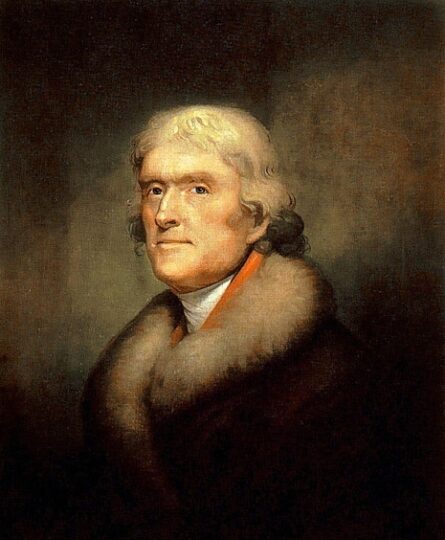
* Image is a photo of detail from a painting of Jefferson by Rembrandt Peale, courtesy of the New York Historical Society by way of the Library of Congress.

[Encore post from August 1, 2006]

An encore post; fighting ignorance takes repetition.

Save

Save