Scrooge’s 2015 Christmas gift to GOP: Their platform reduced to three words

December 20, 2015

Roberto Innocenti, Scrooge on a dark staircase

Ebenezer Scrooge, up a dark staircase; “Darkness was cheap, and Scrooge liked it.” Illustration by Roberto Innocenti, via Pinterest.

It’s a Quote of the Moment (an encore post for the season, with a bit of context thrown in later), the GOP platform edited down to three words, in green:

Darkness is cheap,
and Scrooge liked it.

– Charles Dickens, A Christmas Carol, Stave 1

Isn’t that the entire GOP platform in three words? “Darkness is cheap.”

I think of that line of Dickens’s often when  I read of the celebrations of calumny that pass as discourse in Republican politics these days. Although, with the 2008 renewing of Limbaugh’s contract, it may no longer be true that his particular brand of darkness is cheap. With the advent of Donald Trump’s insult politics, offending America’s allies and all American ethnic groups possible, with un-ironic calls to drop nuclear weapons, GOP politics is even darker than ever.

Cheap or not, darkness remains dark.

John Leach, Scrooge meets Ignorance and Want

Scrooge meets Ignorance and Want, the products of his stinginess (drawing by John Leech, 1809-1870)


Here is the sentence Dickens put before the quote, to add a little context; Scrooge was climbing a very large, very dark staircase.

Half-a-dozen gas-lamps out of the street wouldn’t have lighted the entry too well, so you may suppose that it was pretty dark with Scrooge’s dip.

Up Scrooge went, not caring a button for that. Darkness is cheap, and Scrooge liked it.

Speaking of darkness, a longer excerpt from a bit later in Dickens’s story:

‘Forgive me if I am not justified in what I ask,’ said Scrooge, looking intently at the Spirit’s robe, ‘but I see something strange, and not belonging to yourself, protruding from your skirts. Is it a foot or a claw?’

‘It might be a claw, for the flesh there is upon it,’ was the Spirit’s sorrowful reply. ‘Look here.’

From the foldings of its robe, it brought two children; wretched, abject, frightful, hideous, miserable. They knelt down at its feet, and clung upon the outside of its garment.

‘Oh, Man! look here. Look, look, down here!’ exclaimed the Ghost.

They were a boy and girl. Yellow, meagre, ragged, scowling, wolfish; but prostrate, too, in their humility. Where graceful youth should have filled their features out, and touched them with its freshest tints, a stale and shrivelled hand, like that of age, had pinched, and twisted them, and pulled them into shreds. Where angels might have sat enthroned, devils lurked, and glared out menacing. No change, no degradation, no perversion of humanity, in any grade, through all the mysteries of wonderful creation, has monsters half so horrible and dread.

Scrooge started back, appalled. Having them shown to him in this way, he tried to say they were fine children, but the words choked themselves, rather than be parties to a lie of such enormous magnitude.

‘Spirit! are they yours?’ Scrooge could say no more.

‘They are Man’s,’ said the Spirit, looking down upon them. ‘And they cling to me, appealing from their fathers. This boy is Ignorance. This girl is Want. Beware them both, and all of their degree, but most of all beware this boy, for on his brow I see that written which is Doom, unless the writing be erased. Deny it!’ cried the Spirit, stretching out its hand towards the city. ‘Slander those who tell it ye! Admit it for your factious purposes, and make it worse. And bide the end!’

‘Have they no refuge or resource?’ cried Scrooge.

‘Are there no prisons?’ said the Spirit, turning on him for the last time with his own words. ‘Are there no workhouses?’ The bell struck twelve.

Scrooge looked about him for the Ghost, and saw it not. As the last stroke ceased to vibrate, he remembered the prediction of old Jacob Marley, and lifting up his eyes, beheld a solemn Phantom, draped and hooded, coming, like a mist along the ground, towards him.

A Christmas Carol, Stave 3

Think of 2014 and 2015, children abused in Central America and in the Middle East, fleeing as best they can, only to die off the shores of Greece, on the southern deserts of the U.S., or be cast into incarceration after having achieved a nation whose very name promised them refuge, the United States. “Two children; wretched, abject, frightful, hideous, miserable,” Dickens described. Whose children? “Man’s.” Yours, and mine.

Christmas is a festival to celebrate light, what many Christians call “the light of the world?” If so, let us work to stamp out the darkness which the unrepentant Scrooge so dearly loved.

Darkness may be cheap, but it is not good.  Light a candle, and run into the darkness, spreading light. We need more light.

Merry Christmas 2015. Let us remember, as Tom and the late Ray Magliozzi always reminded us, the cheapskate pays more in the end, and usually along the way. Is Darkness cheap? Let us then eschew it as too costly for a moral nation, too costly for a moral people.

More:


He really said it, October 29, 1941: Churchill, ‘never give in’ (Quote of the Moment)

October 29, 2015

The statue of Churchill (1973) by Ivor Roberts-Jones in Parliament Square, London. Wikipedia image. Photo by Eluveitie.

The statue of Churchill (1973) by Ivor Roberts-Jones in Parliament Square, London. Wikipedia image. Photo by Eluveitie.

In late 1941, at the height of Britain’s troubles as the sole surviving, able-to-fight exponent of democratic government in Europe, Winston Churchill paid a visit to his old school, to hear the students sing and join them in song. He was asked to speak.

It was a short speech, wholly extemporaneous, but one phrase went on to become one of the most-quoted parts of any speech ever given, anywhere.

Never give in, never give in, never, never, never, never — in nothing, great or small, large or petty — never give in except to convictions of honour and good sense!

Winston S. Churchill, address to the boys of Harrow School, October 29, 1941.

More:

Yes, this is mostly an encore post. Fighting ignorance requires patience.

Yes, this is mostly an encore post. Fighting ignorance requires patience.


Who said it? ‘Better to die on your feet, than live on your knees’

October 22, 2015

A Tweet from Tim Fargo reminded me of a collection of leadership quotes I put together years ago, and of the digging I did on one particular quote urging action rather than capitulation:

https://twitter.com/alphabetsuccess/status/657054791672176640

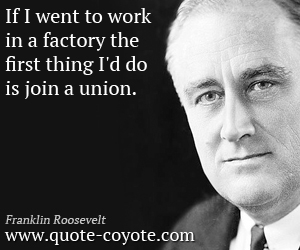
That was the quote I got to, but it’s only attributed to to Zapata so far as I know. I started with the quote cited to Franklin Roosevelt’s speech when he got an honorary Doctor of Laws from Oxford in 1941, when Britain badly needed such inspiration to fight on, in a war for freedom in which the U.S. was not yet actively engaged:

We, too, born to freedom, and believing in freedom, are willing to fight to maintain freedom. We, and all others who believe as deeply as we do, would rather die on our feet than live on our knees.

Franklin Delano Roosevelt (1882-1945), upon receiving the degree of Doctor of Civil Law from Oxford University, June 19, 1941; special convocation ceremony held at Harvard University, with FDR’s remarks delivered by secretary to the President, Major General Edwin M. Watson

One of a set of ten postcards printed by the Spanish Red Cross, the subjects shown, favor the republican cause. | Spanish. | Wolfsonian Exhibit: Library Vestibule Complement to: Revolutionary Tides, the Art of the Political Poster, 1914-1989; February 25 - August 24, 2006.

One of a set of ten postcards printed by the Spanish Red Cross, the subjects shown, favor the republican cause. | Spanish. | Wolfsonian Exhibit: Library Vestibule Complement to: Revolutionary Tides, the Art of the Political Poster, 1914-1989; February 25 – August 24, 2006. [Untranslated from Spanish:] Dolores Ibarruri (Pasionaria): Representante de Asturias en el Parlamento de España y figura destacadísima entre las mujeres de la Revolución; Spain Cruz Roja. | Garcia, A. (illustrator.) | Edit. R. Molero (publisher)

When I checked it in the then-current Bartlett’s Quotations I learned it was a common expression during the Spanish Civil War, and attributed to a radio propagandist on the Republican side. It’s likely FDR and his research aides knew that.

It is better to die on your feet than to live on your knees.

Dolores Ibårruri, “La Pasionaria” (1895-1989), Speech in Paris, September 3, 1936

Checking that one out, I found a reference to Mexico’s revolutionary Zapata, whose work was likely familiar to the Spanish Republicans.

Mejor morir a pie que vivir en rodillas.
Men of the South! It is better to die on your feet than to live on your knees!

Emiliano Zapata (c. 1877-1919), attributed

That’s as far as I took it 20 years ago. Can we get a better attribution, or find Zapata’s likely inspiration, if there is one?

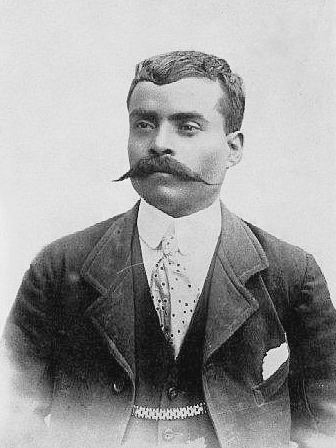
Mexico revolutionary Emiliano Zapata, studio portrait perhaps in 1914. Wikipedia image

Mexico revolutionary Emiliano Zapata, studio portrait perhaps in 1914. Wikipedia image

N.B.: Looked for a photo of FDR at Oxford, but quickly discovered he was nowhere near England on June 19, 1941 — hadn’t thought he would be with the Battle of Britain not really over. Found references to Watson’s delivering of the speech at Harvard, but little else. Good people at the FDR Library’s Pare Lorentz Center confirm that FDR was at the White House the entire day. There’s a story there, about the awarding of the degree.

Update 2017: It was not George Washington.

Especially in 2017, would you do us the favor of saying in comments how you got to this article? Thank you.

Save


Mike Mansfield’s been gone 14 years

October 5, 2015

Senate Majority Leader Mike Mansfield, D-Montana

Senate Majority Leader Mike Mansfield, D-Montana; oil on canvas by Aaron Shikler, 1978 – Wikimedia image

Mike Mansfield was born on March 16, 1903.  Best boss I ever had.

Mansfield died 14 years ago on this day, October 5. Rarely a day goes by I don’t read the newspaper and think we could sure use a few more people like him today.  He’s been gone 14 years, and I miss him. I hope I’m not alone in that.

Robert A. Nowlan’s Born This Day attributed this quote to Mansfield:

After all, even a politician is human.

Laconic as he was, Mansfield didn’t say anything more meaty than that?

Read about Mansfield at the Bathtub, here.  Mansfield died on October 5, 2001.  He is interred at  Arlington National Cemetery in a soldier’s grave, reflecting his unique view of the world from an ordinary grunt soldier. Mansfield served as a Seaman in the U.S. Navy, enlisting at the age of 14; he served then as a Private in the U.S. Army; then he served as a private in the U.S. Marine Corps. His history proved a delightful prelude when, as Majority Leader of the U.S. Senate,  he met with the Joint Chiefs of Staff at the Pentagon on issues of soldiers’ welfare.

At our current sad time, when the political agenda of activist republic destroyers includes bitterly working hard to wipe out the history of great men like Mansfield, it’s important we remember him.

English: Senate desk X, used by Democratic lea...

This is a photo of one of the rarest views of history one can see, visible only to those few people who get onto the floor of the U.S. Senate, and only if someone opens a desk for them.  One of the more interesting, odd, and sentimental traditions developed in the U.S. Senate is the signing of the desks.  Sometime in the 19th century senators began signing the inside of the desks they were assigned to on the Senate floor.  Sometimes a desk gets associated with a particular state and a senator from that class; sometimes a desk get associated with family (Sens. John, Ted and Robert Kennedy, for example).  Here is Senate desk X, used by Democratic leaders (Joseph T. Robinson, Alben W. Barkley, Scott W. Lucas, Ernest McFarland, Lyndon B. Johnson, Mike Mansfield, Robert Byrd, George J. Mitchell, Tom Daschle and Harry Reid) (Photo credit: Wikipedia)

More:

Mike Mansfield on the cover of Time Magazine, March 20, 1964. This cover story reminds us that the Democrats were a fractious majority in the 1960s, which lends an even greater patina to Mansfield's reputation as a wrangler of Senators and the Senate Majority, at one of the most productive times in Congress's history, a sharp comparison to 2015.

Mike Mansfield on the cover of Time Magazine, March 20, 1964. This cover story reminds us that the Democrats were a fractious majority in the 1960s, which lends an even greater patina to Mansfield’s reputation as a wrangler of Senators and the Senate Majority, at one of the most productive times in Congress’s history, a sharp comparison to 2015.


Yes, this is mostly an encore post. Fighting ignorance requires patience.

Yes, this is mostly an encore post. Fighting ignorance requires patience.


Quote of the moment: John Adams, nation must have public schools, paid by the people

September 10, 2015

What would John Adams have said about charter schools?

Adams was quite clear, during his lifetime, that a nation should be known by the good people its good schools produce. No, not private schools: Adams insisted the schools must be open to the public, and funded by the people. Public schools, not private contractors brought in at public expense.

Do you think Adams changed his mind after his death?

Here’s the letter Adams sent to a regular correspondent, John Jebb, on September 10, 1785, 230 years ago today. Capitalization, spelling punctuation, insertions and grammar, as in the original; highlighting added:

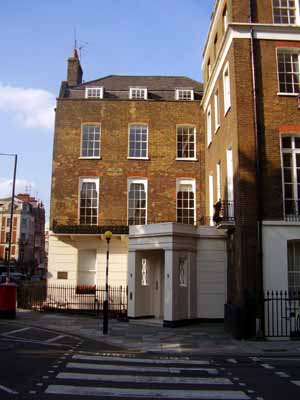
John Adams' residence at Grosvenor Square, in London

John Adams’ residence at Grosvenor Square, in London; presumably, his letter to John Jebb took form in this house. Long in use by U.S. Ambassadors to England, it is in 2015 the office complex of former British Prime Minister Tony Blair, envoy for The Quartet.  Image from London Cyberpunk Tourist Guide

the social science will never be much improved untill the People unanimously know and Consider themselvs as the fountain of Power and untill they shall  know how to manage it Wisely and honestly. reformation must begin with the \Body of the/ People which can be done only, to affect, in their Educations. the Whole People must take \upon/ themselvs the Education of the Whole People and must be willing to bear the expences of it. there should not be a district of one Mile square without a school in it, not founded by a Charitable individual but maintained at the expence of the People themselv[s] they must be taught to reverence themselvs instead of adoreing their servants their Generals Admirals Bishops and Statesmen — Instead of Admiring so extravegantly a Prince of Orange, we Should admire the Botavian Nation which produced him. Instead of Adoring a Washington, Mankind should applaud the Nation which Educated him. If Thebes owes its Liberty and Glory to Epaminandas, She will loose both when he dies, and it would have been as well if she had never enjoyed a taste for either: but if the Knowledge the Principles the Virtues and Capacities of the Theban Nation produced an Epaminandas, her Liberties and Glory will remain when he is no more: and if an analogous system of Education is Established and Enjoyed by the Whole Nation, it will produce a succession of Epaminandas’s, the Human Mind naturally exerts itself to form its Character according to the Ideas of those about it.

♦  Letter from John Adams to John Jebb, September 10, 1785, from Grosvenor Square, London

It’s a warning from the past: Do we like freedom? Then we must educate our children well, in public schools, to understand the public interest and their role in preserving and bettering the state. Can any presidential candidate expound on the issue, let alone the man, with any sing of erudition?

Tip of the old scrub brush to Diane Ravitch’s Blog.

More:

John Adams High School, a public school in South Bend, Indiana.

John Adams High School, a public school in South Bend, Indiana. According to the Michiana Schools site, ” John Adams High School is a public school located in South Bend, Indiana right across the street from Indiana University South Bend. Adam’s mascot is the eagle and their school colors are scarlet, blue and white. Adams has a very successful mock trail team. The school was established in 1940. They have around 2,000 students every year, making it the second largest school in the Michiana area.”

Yes, this is mostly an encore post. Fighting ignorance requires patience.

Yes, this is mostly an encore post. Fighting ignorance requires patience.


How could John Adams be so wrong about the Fourth of July?

July 2, 2015

“The Second Day of July 1776 will be the most memorable Epocha, in the History of America. . . . It ought to be solemnized with Pomp and Parade, with Shews, Games, Sports, Guns, Bells, Bonfires, and Illuminations from one End of this Continent to the other from this Time forward forever more.”
John Adams to Abigail Adams, July 3, 1776

Surely John Adams knew that July 4 would be Independence Day, didn’t he?

In writing to his wife Abigail on July 3, John Adams committed one of those grand errors even he would laugh at afterward. We’ll forgive him when the fireworks start firing.

1776 filled the calendar with dates deserving of remembrance and even celebration. John Adams, delegate from Massachusetts to the Second Continental Congress, wrote home to his wife Abigail that future generations would celebrate July 2, the date the Congress voted to approve Richard Henry Lee’s resolution declaring independence from Britain for 13 of the British colonies in America.

Continental congress DSC_0607

Scene of the crime — Independence Hall in Philadelphia, where the Second Continental congress approved the resolution to declare the colonies independent from Britain – (Photo credit: diablodale)

Two days later, that same Congress approved the wording of the document Thomas Jefferson had drafted to announce Lee’s resolution to the world.

Today, we celebrate the date of the document Jefferson wrote, and Richard Henry Lee is often a reduced to a footnote, if not erased from history altogether.

Who can predict the future?

(You know, of course, that Adams and Jefferson both died 50 years to the day after the Declaration of Independence, on July 4, 1826. In the 50 intervening years, Adams and Jefferson were comrades in arms and diplomacy in Europe, officers of the new government in America, opposing candidates for the presidency, President and Vice President, ex-President and President, bitter enemies, then long-distance friends writing almost daily about how to make a great new nation. Read David McCullough‘s version of the story, if you can find it.)

(Yes, this is mostly an encore post.)

More, and Related articles:

The Lee Resolution.

The Lee Resolution, passed by the Second Continental Congress on July 2, 1776 – Wikipedia image (Wait a minute: Are those numbers added correctly? What are they?)

Yes, this is mostly an encore post. Fighting ignorance requires patience.

Yes, this is mostly an encore post. Fighting ignorance requires patience.


Misquoting the founders, still: Jefferson didn’t say banking is the end of America

May 20, 2015

He may have believed something similar, but Jefferson did not say this:

Quote, maybe edited, falsely attributed to Thomas Jefferson; gathered from Twitter, 2015

Quote, maybe edited, falsely attributed to Thomas Jefferson; gathered from Twitter, 2015

I’m not sure who originated the poster.  They probably had good intentions.

But turn to the Monticello website, the scholars who track Jefferson’s words most closely, in February 2012.

Quotation: “The end of democracy and the defeat of the American Revolution will occur when government falls into the hands of lending institutions and moneyed incorporations.”

Sources consulted:

  1. Papers of Thomas Jefferson: Digital Edition
  2. Thomas Jefferson: Papers collection in Hathi Trust Digital Library
  3. Retirement Papers

Earliest known appearance in print: 19941

Earliest known appearance in print, attributed to Thomas Jefferson: see above

Status:  This exact quotation has not been found in the writings of Thomas Jefferson.  It may be a mistaken amalgamation of the author’s comments in the above 1994 reference with a real Jefferson quotation.  Jefferson wrote in 1825 to William Branch Giles of “vast accession of strength from their younger recruits, who having nothing in them of the feelings or principles of ’76 now look to a single and splendid government of an Aristocracy, founded on banking institutions and monied in corporations under the guise and cloak of their favored branches of manufactures commerce and navigation, riding and ruling over the plundered ploughman and beggared yeomanry.”2  Chomsky’s 1994 book quotes Jefferson’s 1825 letter to Giles and then comments that “[Jefferson] warned that that would be the end of democracy and the defeat of the American revolution.”

Jefferson didn’t like the idea of the marriage of banks, rich people and control of government policy.  Jefferson scholar Anna Berkes commented at the Monticello site:

Yes, I’ve quoted this letter myself above – I’m seeing that quote a lot lately. The full sentence as it appeared in Jefferson’s letter is, “I hope we shall take warning from the example and crush in it’s birth the aristocracy of our monied corporations which dare already to challenge our government to a trial of strength, and to bid defiance to the laws of their country.” The letter was first published in Ford’s Writings of Thomas Jefferson in 1892 (see http://hdl.handle.net/2027/uc2.ark:/13960/t3pv6bn68?urlappend=%3Bseq=93 – the edition you link to is a 1904 commemorative edition of Ford), and the polygraph copy is also online: http://hdl.loc.gov/loc.mss/mtj.mtjbib022651.

Anna Berkes
February 29, 2012 – 4:24pm

In any case, it’s not the end of our democratic republic yet! Get out there and organize, and vote.

Jefferson always offered good advice.

Jefferson's advice on quotes found on the internet

Jefferson’s advice on quotes found on the internet


Quote of the moment: H. L. Mencken, on Christians and Christianity, and trouble

May 18, 2015

Stolen wholesale from WIST:

The trouble with Communism is the Communists, just as the trouble with Christianity is the Christians.

HL Mencken2H.L. Mencken (1880-1956) American writer and journalist [Henry Lewis Mencken]
“Mr. Mencken Sounds Off,” interview, LIFE Magazine (5 Aug 1946)

You recall, Mencken was the guy who wrote the Millard Fillmore Bathtub hoax in the first place, right?

Mencken held forth in Baltimore, a city that could probably use a newspaper columnist with Mencken’s ability to find corruption and fault in most good things — just to make people think.

You may disagree with Mr. Mencken, of course.  But if you do, tell us in comments:  What do YOU think the trouble with Christianity is?

Found on eBay: H. L. Mencken in bronze, as a bookend -- with a stein of beer and the Statute of Liberty.  Asking $595 for it.

Found on eBay: H. L. Mencken in bronze, as a bookend — with a stein of beer and the Statute of Liberty. Asking $595 for it. Beer and liberty. Mencken probably would have approved. How many of these were made? By whom?


Quote of the moment: Calvin Coolidge, on building America: “Look to service, not selfishness”

March 3, 2015

Calvin Coolidge, 30th president of the United States (elected vice president in 1920, and succeeding to the presidency upon the death of Warren G. Harding).  History.com image

Calvin Coolidge, 30th president of the United States (elected vice president in 1920, and succeeding to the presidency upon the death of Warren G. Harding). History.com image

Referring to progress in the U.S. after World War I, Coolidge said:

With peace has come prosperity. Burdens have been great, but the strength to bear them has been greater. The condition of those who toil is higher, better, more secure than in all the ages past. Out of the darkness of a great conflict has appeared the vision, nearer, clearer than ever before, of a life on earth less and less under the deadening restraint of force, more and more under the vitalizing influence of reason. Moral power has been triumphing over physical power. With peace has come prosperity. Burdens have been great, but the strength to bear them has been greater. The condition of those who toil is higher, better, more secure than in all the ages past. Out of the darkness of a great conflict has appeared the vision of a nearer, clearer than ever before, the  [of] life on earth less and less under the deadening restraint of force, more and more under the vitalizing influence of reason. Moral power has been triumphing over physical power. Education will tend to bring reason and experience of the past into the solution of the problems of the future. We must look to service and not selfishness, for service is the foundation of progress. The greatest lesson that we have to learn is to seek ever the public welfare, to build up, to maintain our American heritage.

Candidate for vice president Calvin Coolidge, “America and the War,” 1920

Digging a little deeper, I discover that the first part of this quote also appeared in Coolidge’s Thanksgiving Proclamation on November 27, 1919, when he was  Governor of Massachusetts.  Knowing a good turn of words when he wrote it (I’m assuming he didn’t have ghost writers then), he used the same words in making phonograph recordings of speeches to be distributed in the election campaign of 1920, before radio was available to carry speeches to voters.  I have made minor corrections in the transcript, from the earlier text and the audio delivery.

According to Talking History, the 78 rpm record and audio version were saved and made available by the Library of Congress.

You may want to listen to Coolidge say the words himself. Mp3  RealPlayer


Quote of the moment: FDR on government shutdowns

February 24, 2015

One wag, who didn’t want to discuss things after all, referred me to President Franklin Roosevelt’s message to the National Federal of Federal Employees (NFFE), of August 16, 1937 (from the American Presidency Project at the University of California – Santa Barbara (UCSB)).  The wag asked me to confess that FDR was anti-union, and that Wisconsin Gov. Scott “Ahab” Walker had acted in Roosevelt’s path in Walker’s assaults on the unions of policemen, firefighters and teachers in Wisconsin.

I demurred, and pointed out instead that Walker went after the unions despite their having NOT struck, that Walker refused to bargain in good faith, or bargain at all.  I pointed out that Walker had failed in his duty, in the view of FDR.

President Franklin Delano Roosevelt

President Franklin Delano Roosevelt, in 1936 (Checking to see whether, when and where FDR said that; Robert Reich says he did.)

It’s a good way to send wags packing on Twitter, I’ve learned.  They don’t like to read or think, and they certainly don’t want anyone pointing out that they may have misinterpreted something. Anything.

NFFE had invited Roosevelt to speak at their Twentieth Jubilee Convention; Roosevelt sent a letter declining the invitation. In declining, Roosevelt noted he opposed strikes by government employees.  No doubt there is more history there that deserves our attention.  We can get to it later.

Here’s the meat of FDR’s letter:

Particularly, I want to emphasize my conviction that militant tactics have no place in the functions of any organization of Government employees. Upon employees in the Federal service rests the obligation to serve the whole people, whose interests and welfare require orderliness and continuity in the conduct of Government activities. This obligation is paramount. Since their own services have to do with the functioning of the Government, a strike of public employees manifests nothing less than an intent on their part to prevent or obstruct the operations of Government until their demands are satisfied. Such action, looking toward the paralysis of Government by those who have sworn to support it, is unthinkable and intolerable. It is, therefore, with a feeling of gratification that I have noted in the constitution of the National Federation of Federal Employees the provision that “under no circumstances shall this Federation engage in or support strikes against the United States Government.”

What do you think Roosevelt would have made of the current and last “do nothing” GOP blocs in Congress?  (Or should we say “blocks?”)

Doesn’t this describe Republicans in Congress today?

” . . . intent on their part to prevent or obstruct the operations of government until their demands are satisfied. Such action, looking toward the paralysis of Government by those who have sworn to support it, is unthinkable and intolerable.”

Is it too much to ask Republicans in Congress to be at least as loyal to the U.S. as the unionized government employees who pledged not to shut down the government?

More:


Quote of the moment: Gen. Patton’s oddly non-profane explanation of profanity

February 18, 2015

Lt. Gen. George Patton with the signal corps, July 11th 1943, Sicily. (General George Patton Museum) - See more at: http://ww2today.com/10th-august-1943-general-george-s-patton-slaps-another-soldier#sthash.dVuHaPeg.dpuf

Lt. Gen. George Patton with the signal corps, July 11th 1943, Sicily. (General George Patton Museum) – See more at: http://ww2today.com/10th-august-1943-general-george-s-patton-slaps-another-soldier#sthash.dVuHaPeg.dpuf

  • When I want my men to remember something important, to really make it stick, I give it to them double dirty. It may not sound nice to some bunch of little old ladies at an afternoon tea party, but it helps my soldiers to remember. You can’t run an army without profanity; and it has to be eloquent profanity. An army without profanity couldn’t fight its way out of a piss-soaked paper bag. … As for the types of comments I make, sometimes I just, By God, get carried away with my own eloquence.
    • Remark to his nephew about his copious profanity, quoted in “The Unknown Patton” (1983) by Charles M. Province, p. 184 (here, via Wikiquote)

One:

One glorious summer, after a couple of months of Scouting, I signed on to do air pollution research for several weeks in the field, in and around Farmington, New Mexico.  Hours were long, and the driving between sampling sites was more than 120 miles a day, between Farmington and Teec Nos Pos, Arizona.  Driving through the desert, passing the Shiprock every day, is rough duty, but somebody had to do it.

My mother’s brother, Harry Stewart, lived in Farmington.  Weekends I was royally dined and liquored, and got the opportunity to meet Uncle Harry’s friends, who included C. M. Woodbury, then city manager of Farmington.  Woodbury’s exploits on the golf course provided constant entertainment.  His opinions about having to measure air pollution from the Four Corners Power Plant and the then-under-construction San Juan Generating Station gave me great insight into local views on regional and national issues, as the Clean Air Act wended its way through Congress.

Woodbury had been an aide of some sort to General George Patton in Europe, as I understood it.  Sadly, I never did get back to Farmington to debrief him in detail about World War II, a loss of information that still stings from time to time.  I think he was with the 752nd Tank BattalionWoodbury retired in 1976.

The movie, Patton, still played in theaters, and one Sunday, over dinner, conversation turned to great leadership and whether I thought Patton was such a leader.  I hadn’t seen the movie.  I didn’t know much about Patton.  I asked what a definition of a good leader might be.  Uncle Harry and Woodbury settled on this criterion:  A good leader is someone whose followers will go to hell and back for her, or him.  Why did Patton inspire that sort of followership, I asked.

Woodbury rambled on about Patton getting gasoline for his tanks and trucks on a run through German lines that became legendary, and was portrayed in the movie.  He talked about how Patton’s troops always could count on a good, warm meal when they got a break from battle.  He talked about how proud every soldier was to be a part of that unit under Patton’s command.  He stopped, his eyes welled up and a tear, or maybe more, rolled down his cheek.

“We would have gone to hell for Patton because we knew he would have gone to hell for us. And he did.”

William Manchester once noted that, in battle, soldiers don’t die for great causes.  They fight to defend and save the friend to the right and the friend to the left.

It would have been interesting to know Patton.

Two:

We moved to Texas in 1987. Texas is a culture shock, I think, regardless where one comes from, even sometimes if one comes from Texas.  We moved directly from Cheverly, Maryland, outside of Washington, D.C.

Describing the conservative, goody-two-shoes aspects of Texas culture of that time can’t be done in shorthand.  A couple of examples:  Duncanville at the time had about 35,000 residents, and 44 churches.  Bordering Duncanville were three or five megachurches, among the largest in the nation, which drew heavily from Duncanville residents.  It was rare to meet someone who wouldn’t ask early in any conversation, “And where do you go to church?” A great, personal and close relationship to Jesus is expected to be a feature of any “normal” person’s life in Texas.  The day I drove out of Utah, I remember thinking as I rose above the fog heading up Parley’s Canyon that I would probably never again live in a place where it was so difficult to get a drink with dinner.  Then we moved to Texas.  On the surface, and often below the surface, Texans worked hard (and still do) to demonstrate that they are straighter than Mormons, and blessed because of their lack of sinning.  We don’t need to get into the ironies and incongruities of country music, Dallas culture and other now-well-identified sins of the Bible Belt.

Let’s just say, profanity was not something one publicly assented to.

I came down here to work with American Airlines, which was headed at the time by Robert Crandall.  Crandall’s use of profanity was legendary among AA executives and workers — executives, especially.  Crandall ran a tight operation with high expectations of worker achievement, especially in competition with other airlines.  “Competitive anger,” Crandall called it — and he expected all employees to demonstrate that, in appropriate, customer-serving, money-making ways.  Failures were noted, and often enough one might expect to be in a meeting with Crandall where an explanation of how and why things went wrong would be cut off with an expletive-filled dressing down that both made the victim subject understand the nature and severity of the error and pledge never to make that nor any other error ever again.

Talking about these events later, witnesses almost never said anything about the profanity.  Living in Texas where profanity was thought to make even strong men faint and swoon, Crandall’s expletives were considered instead indications of the importance of his thought, and speech, and markers that he was to be listened to.  I remember one young MBA rattled by the profanity; he left the company within a few weeks, and he wasn’t even the subject of the discussion.  But among others, especially successful managers and executives, discussion of content of meetings focused on the subject of the meetings, what was said about that subject, with unconscious excising of the profanity.

One famous meeting involved cutting costs, and the subject was security for a warehouse in San Juan, Puerto Rico.  Complaints about the cost for security the previous year led the local manager to beef up fences, get rid of the security company, and get dogs to roam the area at night.  Crandall pushed harder, and discussion turned to whether it would be even cheaper than dog food to get a sound system that would randomly play the sounds of big, vicious dogs’ barking instead.  I wasn’t in that meeting, but I heard several different accounts, all of them noting the boss’s exploration of options others might not think of, and how hard it was to please him — but not one story that included any comment about profanity, which I learned had laced the entire episode and probably made it memorable to everyone within earshot. And so they’d retell it. A remarkable piece of effective corporate communication.

How does one gauge when and whether profanity is necessary, or effective, in communication?

In one project, we videotaped Crandall talking on company issues and what he expected in the leaders the company hired as managers.  In several hours of video, I don’t recall a single time we had to retape, or edit, any profanity out.  Crandall turned off the profanity when it might pose a problem.  People who know him outside the company often express surprise that he’d ever use such language.

I sometimes wondered if Crandall was a reincarnation of Patton in at least some small way.  But Crandall was born in 1935, and Patton died in 1945.  Reincarnation is not the answer.

More:


Quote of the moment, for politics at the end of 2014: Ebenezer Scrooge, “darkness is cheap”

December 23, 2014

Roberto Innocenti, Scrooge on a dark staircase

Ebenezer Scrooge, up a dark staircase; “Darkness was cheap, and Scrooge liked it.” Illustration by Roberto Innocenti, via Pinterest.

Quote of the moment (an encore post for the season, with a bit of context thrown in later):

Darkness is cheap, and Scrooge liked it.

– Charles Dickens, A Christmas Carol, Stave 1

I think of that line of Dickens’s often when  I read of the celebrations of calumny that pass as discourse in Republican politics these days. Although, with the 2008 renewing of Limbaugh’s contract, it may no longer be true that his particular brand of darkness is cheap.

Cheap or not, darkness remains dark.

John Leach, Scrooge meets Ignorance and Want

Scrooge meets Ignorance and Want, the products of his stinginess (drawing by John Leech, 1809-1870)


Drawing by John Leech (1809-1870), to illustrate Charles Dickens’ A Christmas Carol. Work in the public domain (available at WikiSource).

Here is the sentence Dickens put before the quote, to add a little context; Scrooge was climbing a very large, very dark staircase.

Half-a-dozen gas-lamps out of the street wouldn’t have lighted the entry too well, so you may suppose that it was pretty dark with Scrooge’s dip.

Up Scrooge went, not caring a button for that. Darkness is cheap, and Scrooge liked it.

Speaking of darkness, a longer excerpt from Dickens’s story:

‘Forgive me if I am not justified in what I ask,’ said Scrooge, looking intently at the Spirit’s robe, ‘but I see something strange, and not belonging to yourself, protruding from your skirts. Is it a foot or a claw?’

‘It might be a claw, for the flesh there is upon it,’ was the Spirit’s sorrowful reply. ‘Look here.’

From the foldings of its robe, it brought two children; wretched, abject, frightful, hideous, miserable. They knelt down at its feet, and clung upon the outside of its garment.

‘Oh, Man! look here. Look, look, down here!’ exclaimed the Ghost.

They were a boy and girl. Yellow, meagre, ragged, scowling, wolfish; but prostrate, too, in their humility. Where graceful youth should have filled their features out, and touched them with its freshest tints, a stale and shrivelled hand, like that of age, had pinched, and twisted them, and pulled them into shreds. Where angels might have sat enthroned, devils lurked, and glared out menacing. No change, no degradation, no perversion of humanity, in any grade, through all the mysteries of wonderful creation, has monsters half so horrible and dread.

Scrooge started back, appalled. Having them shown to him in this way, he tried to say they were fine children, but the words choked themselves, rather than be parties to a lie of such enormous magnitude.

‘Spirit! are they yours?’ Scrooge could say no more.

‘They are Man’s,’ said the Spirit, looking down upon them. ‘And they cling to me, appealing from their fathers. This boy is Ignorance. This girl is Want. Beware them both, and all of their degree, but most of all beware this boy, for on his brow I see that written which is Doom, unless the writing be erased. Deny it!’ cried the Spirit, stretching out its hand towards the city. ‘Slander those who tell it ye! Admit it for your factious purposes, and make it worse. And bide the end!’

‘Have they no refuge or resource?’ cried Scrooge.

‘Are there no prisons?’ said the Spirit, turning on him for the last time with his own words. ‘Are there no workhouses?’ The bell struck twelve.

Scrooge looked about him for the Ghost, and saw it not. As the last stroke ceased to vibrate, he remembered the prediction of old Jacob Marley, and lifting up his eyes, beheld a solemn Phantom, draped and hooded, coming, like a mist along the ground, towards him.

A Christmas Carol, Stave 3

Christmas is a festival to celebrate light, what many Christians call “the light of the world?” If so, let us work to stamp out the darkness which the unrepentant Scrooge so dearly loved.

Darkness may be cheap, but it is not good.  Light a candle, and run into the darkness, spreading light. We need more light.

More:


December 2: Millard Fillmore’s Guano Day!

December 1, 2014

Why December 2?

(You couldn’t make this stuff up if you were Monty Python.)

English: Millard Fillmore White House portrait

Millard Fillmore’s White House portrait, via Wikipedia

President Millard Fillmore, in the State of the Union Address, December 2, 1850

Peruvian guano has become so desirable an article to the agricultural interest of the United States that it is the duty of the Government to employ all the means properly in its power for the purpose of causing that article to be imported into the country at a reasonable price. Nothing will be omitted on my part toward accomplishing this desirable end. I am persuaded that in removing any restraints on this traffic the Peruvian Government will promote its own best interests, while it will afford a proof of a friendly disposition toward this country, which will be duly appreciated.

Did any other U.S. President spend so much time thinking about guano?  Did any president ever mention it in a State of the Union Address?  The curious case of Millard Fillmore, Seer, just grows.

Guano, or bird poop (and its relative, bat poop), contains phosphorus, which is an essential element for life.  Consequently, it turns out to be a key ingredient in effective agricultural fertilizers.  In international competition for supremacy in farming and farm exports, guano became a key resource to fight over, in the 19th century.

It’s almost safe to say the fights were economic; but guano did play a key role in wars in South America (see Andrew Leonard’s article, noted below).

Fillmore figured out that the substance had great importance, coupled that with the rather esoteric knowledge that sea birds tended to deposit guano in great abundance on certain islands, often unoccupied, and ordered the U.S. Navy to claim islands found to contain guano deposits that were not claimed by other nations.

By the American Civil War, the importance of phosphorus to the production of gun powder became an issue for the armies of the North and South.  Millard Fillmore had set the stage for the North to win an important advantage in gun powder production, just one of many that led to the defeat of the South.

It’s one more thing we should thank Millard Fillmore for doing. Our study of history should inform us that it is, indeed, important for politicians to understand the importance of guano.

Fillmore knew his guano.

Take a moment on December 2 to toast Millard Fillmore’s prescience, on Guano Day!

More:  


December 1, 1955: “Why do you push us around?” Rosa Parks asked the cop. (Anyone know the answer?)

December 1, 2014

Mrs. Rosa Parks asked a question of the policeman who arrested her for refusing to move to the back of the bus. In 2014, it’s a chilling question, to which we have no good answer.

Rosa Parks being fingerprinted, Library of Congress

Mrs. Parks being fingerprinted in Montgomery, Alabama; photo from New York World-Telegram & Sun Collection, Library of Congress

Rosa Parks: “Why do you push us around?”

Officer: “I don’t know but the law is the law and you’re under arrest.”

From Rosa Parks with Gregory J. Reed, Quiet Strength
(Grand Rapids, MI: Zondervan Pub. House, 1994), page 23.

Photo: Mrs. Parks being fingerprinted in Montgomery, Alabama; photo from New York World-Telegram & Sun Collection, Library of Congress

Today in History at the Library of Congress provides the simple facts:

On the evening of December 1, 1955, Rosa Parks, an African American, was arrested for disobeying an Alabama law requiring black passengers to relinquish seats to white passengers when the bus was full. Blacks were also required to sit at the back of the bus. Her arrest sparked a 381-day boycott of the Montgomery bus system and led to a 1956 Supreme Court decision banning segregation on public transportation.

Rosa Parks made a nearly perfect subject for a protest on racism. College-educated, trained in peaceful protest at the famous Highlander Folk School, Parks was known as a peaceful and respected person. The sight of such a proper woman being arrested and jailed would provide a schocking image to most Americans. Americans jolted awake.

Often lost in the retelling of the story are the threads that tie together the events of the civil rights movement through the 1940s, 1950s and 1960s. As noted, Parks was a trained civil rights activist. Such training in peaceful and nonviolent protest provided a moral power to the movement probably unattainable any other way. Parks’ arrest was not planned, however. Parks wrote that as she sat on the bus, she was thinking of the tragedy of Emmet Till, the young African American man from Chicago, brutally murdered in Mississippi early in 1955. She was thinking that someone had to take a stand for civil rights, at about the time the bus driver told her to move to allow a white man to take her seat. To take a stand, she kept her seat.

African Americans in Montgomery organized a boycott of the Montgomery bus system. This was also not unique, but earlier bus boycotts are unremembered. A bus boycott in Baton Rouge, Louisiana, earlier in 1955 did not produce nearly the same results.

The boycott organizers needed a place to meet, a large hall. The biggest building in town with such a room was the Dexter Street Baptist Church. At the first meeting on December 5, it made sense to make the pastor of that church the focal point of the boycott organizing, and so the fresh, young pastor, Rev. Dr. Martin Luther King, Jr., was thrust into civil rights organizing as president, with Ralph Abernathy as program director. They called their group the Montgomery Improvement Association (MIA). When their organizing stretched beyond the city limits of Montgomery, the group became the Southern Christian Leadership Conference.

Litigation on the boycott went all the way to the Supreme Court (Browder v. Gale). The boycotters won. The 381-day boycott was ended on December 21, 1956, with the desegregation of the Montgomery bus system.

Sources for lesson plans and projects:

Yes, this is mostly an encore post.  Fighting ignorance requires patience.

Yes, this is mostly an encore post. Fighting ignorance requires patience.


Tip of the old scrub brush to Slacktivist, who gave this post a nice plug.


Quote of the moment: Judge Richard Posner, on tradition and marriage

August 27, 2014

Judge Richard Posner, 7th Circuit, U.S. Court of Appeals

Judge Richard Posner, 7th Circuit, U.S. Court of Appeals

“It was tradition to not allow blacks and whites to marry — a tradition that got swept away.”

Federal appeals court Judge Richard Posner, balking when Wisconsin Assistant Attorney General Timothy Samuelson repeatedly pointed to “tradition” as the underlying justification for barring gay marriage.

Two states attorneys general argued before a panel of judges on the 7th U.S. Circuit Court of Appeals in Chicago yesterday that marriage between members of the same gender should be stopped because of tradition.  AP’s story explains what happened.

While judges often play devil’s advocate during oral arguments, the panel’s often-blistering questions for the defenders of the same-sex marriage bans could be a signal the laws may be in trouble — at least at this step in the legal process.

Richard Posner, who was appointed by President Ronald Reagan in 1981, hit the backers of the ban the hardest. He balked when Wisconsin Assistant Attorney General Timothy Samuelson repeatedly pointed to “tradition” as the underlying justification for barring gay marriage.

“It was tradition to not allow blacks and whites to marry — a tradition that got swept away,” the 75-year-old judge said. Prohibition of same-sex marriage, Posner said, derives from “a tradition of hate … and savage discrimination” of homosexuals.

Posner is one of those guys who gives us hope for the human race, and hope especially for that branch of the human race known as Homo americanus ssp. ordinarius.

Appointed to the bench by Ronald Reagan, Posner is widely recognized as one of the brightest and most engaging judges in the U.S. today.  That’s a sop to all the rest, to call him “one of ” the brightest — to avoid making everybody else give up hope.

But he’s outspoken enough that most legal scholars agree he’d never survive a hearing to take a place on the U.S. Supreme Court.  The late Sen. Roman Hruska’s revenge, that we can’t get the best and the brightest on our highest court.

Posner is not content to sit on the bench and make high pronouncements.  He pushes America, courts and lawyers, to be better.  He teaches at the University of Chicago Law School (in a position not unlike that the young Barack Obama had).  Posner’s high-flying comment-on-anything-important style got cut back in the past few months when his blogging partner died — Nobel-winning economist Gary S. Becker.

It must be agony to be a lawyer defending a pointless, silly and destructive law, to a panel that includes Richard Posner.

Arun With a View captured the reasons Posner strikes fear in conservatives, despite his being a Ronald Reagan conservative.

Sketch of Judge Richard Posner by the late David Levine

Sketch of Judge Richard Posner by the late David Levine

NPR has a delicious interview with Richard Posner. Money quote

“I’ve become less conservative since the Republican Party started becoming goofy,” [Posner] said.

And this

“Because if you put [yourself] in [John Roberts’] position … what’s he supposed to think? That he finds his allies to be a bunch of crackpots? Does that help the conservative movement? I mean, what would you do if you were Roberts? All the sudden you find out that the people you thought were your friends have turned against you, they despise you, they mistreat you, they leak to the press. What do you do? Do you become more conservative? Or do you say, ‘What am I doing with this crowd of lunatics?’ Right? Maybe you have to re-examine your position.”

Listen to it here and enjoy.

Tip of the old scrub brush to Texas Freedom Network’s emails — probably on the blog sometime soon.

Yes, I read Posner despite his errors, getting hoaxed by the DDT/Rachel Carson hoaxsters. That just indicates the danger of the hoax and the need to correct it and stamp it out.

More: