McLeroy declares war on science in Texas classrooms?

June 15, 2008

Considering recent history and the Texas State Board of Education, how can any reasonable voter or parent read this, except as a declaration of war on science? According to the blogs at the Dallas Morning News:

State Board of Education chairman David Bradley of Beaumont told GOP delegates [at the Texas State Republican Convention] that the board was about to take up the science curriculum for public schools. He forecasted a fight over evolution vs. creationism.
Bradley said there are some on the board (he’s among them) that believe God created Man.
“There are others who think their ancestors were apes. That’s okay. But I’m going to vote the right way,” Bradley said.

Is there anything there that suggests Bradley wants good science in Texas textbooks and Texas classrooms?

Remember the Excellence in Education Commission Report in 1983? The Commission warned that the nation was facing “a rising tide of mediocrity” in schools, in such things as lax science standards.

“Our nation is at risk. The educational foundations of our society are presently being eroded by a rising tide of mediocrity. If an unfriendly foreign power had attempted to impose on America the mediocre educational performance that exists today, we might well have viewed it as an act of war. We have, in effect, been committing an act of unthinking, unilateral educational disarmament. History is not kind to idlers.”

25 years later, Commissar Don McLeroy is leading the tide of mediocrity, doing crippling things to our education system that the likes of Nikita Khruschev and Mao Ze Dong could only dream about.


Friends of Rachel Carson win a quiet victory

June 13, 2008

How quiet?

None of my news readers pulled it up, either last August and September, when U.S. Rep. Jason Altmire, D-Penn., got the bill through Congress and signed into law by President Bush, nor a couple of weeks ago when the action occurred.

The Post Office in Rachel Carson’s home town, Springdale, Pennsylvania, has been named in her honor. The ceremony at the Post Office was held on May 27, 2008.

Rep. Rob Bishop’s, R-Utah, incendiary and inaccurate statement on the bill was what caught my eye originally about the continuing campaign of calumny against the author and scientist.

Rep. Altmire conducted a petition campaign in Pennsylvania, and used the lever of popular, bipartisan support to pry the bill loose from U.S. Sen. Tom Coburn’s hold in the Senate. Coburn is a Republican from Oklahoma, a physician, and an ardent advocate of spraying DDT. He had placed a hold on the bill in committee, stopping all action under the Senate’s rules of profound deference to members.

The swell of popular support made clear by Altmire’s campaign appears to have persuaded Sen. Coburn to allow the bill to move. The bill passed the Senate by unanimous consent on August 3, 2007, and got President Bush’s signature on August 9. These sorts of honorary bills generally are not targeted for political points. That Coburn allowed the bill through suggests a good deal of maturation as a senator on Coburn’s part.

Below the fold, Rep. Altmire’s press releases on the bill’s passing the Senate, and on President Bush’s signing the bill.

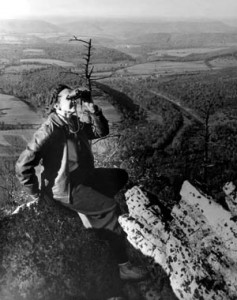
Photo below: Rachel Carson, birding, on a ridge (in Pennsylvania); photo originally found at site of Professor Catherine Lavender, The College of Staten Island of CUNY.

Rachel Carson, birding at Hawk Mountain Sanctuary

Rachel Carson, birding at Hawk Mountain Sanctuary

Read the rest of this entry »


Alma Conference statement pending: Don’t ease DDT restrictions

June 11, 2008

Here is the press release, from Alma College in Alma, Michigan:

Continued Use of DDT Is a Global Health Concern

Scholars who attended the Eugene Kenaga International DDT Conference on Health and the Environment at Alma College are drafting a consensus statement urging global policymakers to reconsider the future use of the synthetic pesticide DDT.

The scholars acknowledge that the use of DDT has prevented millions of infections and deaths from insect-borne diseases, especially malaria. Yet, substantial exposure to DDT poses serious health risks for human populations and the environment, says Edward Lorenz, director of the Public Affairs Institute at Alma College.

“The consensus of the scholars was a recognition of the serious impediments to further restricting DDT use, given that several million people die each year from malaria, most of whom are under the age of five,” says Lorenz. “However, these scholars have documented in numerous human health studies what can be called a ‘deepening understanding of the effects of DDT use on humans.’ The collective wisdom of the experts at the Kenaga Conference was that world policymakers need to use extreme caution when considering easing restrictions on DDT use.”

The March 14 conference attracted international experts in the areas of public health and the environment, including South African scholars Riana Bornman, Henk Bouwman and Christiaan de Jager; Aimin Chen of Creighton University; Barbara Cohn and Brenda Eskenazi of the University of California at Berkeley; Henry Anderson of the Wisconsin Division of Public Health; Suzanne Snedeker of Cornell University; Diane Henshel of Indiana University; Darwin Stapleton of the Rockefeller Archives; Lorenz and John Leipzig of Alma College; and Felicia Leipzig of the Pine River Superfund Citizen Task Force.

The anticipated DDT conference “consensus statement” is expected to list the following summary statements and recommendations, says Lorenz:

  • Repeated use of DDT results in serious health risks for humans.
  • Many sites of chemical-manufacturing facilities continue to be a source of DDT contamination to area residents. While clean-up efforts continue, some DDT proponents, such as John Tierney (New York Times, June 5, 2007), have claimed that, “the billions spent cleaning up Superfund sites would be better spent on more serious dangers.”

“The experts at the DDT Conference unanimously disagree with Tierney’s assessment,” says Lorenz. “Because of the known DDT impacts on human health, the experts not only support continued Superfund clean up, but also endorse assessment of health impacts on residents of communities with DDT sites, such as St. Louis, Mich.”

  • Children and pregnant women in malaria endemic areas where DDT is used are most at risk.
  • Studies have shown that DDT impedes breast milk production, the best source of infant nutrition in many parts of the world.

“Because of the negative impacts on breastfeeding, resulting in more low birth weight babies, communities potentially exposed to DDT to control malaria must be told that the short-term benefits of DDT may spawn longer-term problems,” says Felicia Leipzig.

  • New methods of malaria control should be encouraged and tested.

“Those who are lobbying for DDT use should focus on support for research into alternative chemicals and public health strategies that ultimately will allow for the full phase-out of DDT,” says John Leipzig, director of Alma’s Center for Responsible Leadership.

  • The socio-economic development of malaria-affected communities is the best solution to malaria eradication.
  • Conference experts call for “full support for the Stockholm Convention that will phase out the use of the 12 most dangerous persistent organic pollutants, including DDT,” says Lorenz.

“The Stockholm Convention mandates that each country using DDT have an implementation and management plan on controlling the use of DDT,” he says. “Ultimately it envisions eventual reliance on sustainable methods of disease vector control.”

The scholars argue that sufficient evidence exists that DDT exposure is occurring and posing significant health risks.

“Because of both DDT related Superfund sites and continued use of DDT, exposure to the pesticide is occurring around the world with significant health risks to current and future generations,” says Lorenz.

“The conference experts are challenging policy makers to provide support to further determine health risks associated with DDT exposure in both the developing world and in U.S. communities near contaminated Superfund sites,” he says. “The experts were especially critical of special interests groups and their lobbyists who negate the clear evidence of human health dangers of DDT exposure.”

-mjs-

Other coverage of the Alma DDT Conference at the Bathtub:


Smithsonian on origins of evolution theory

June 9, 2008

Smithsonian’s June issue features a story on the origins of evolution theory in the public eye, focusing not just on Darwin and Wallace, but also on the history of the idea as they found it, before they discovered the mechanism that makes the theory hold together and bind biology into a real science:  “On the Origin of a Theory.”

World history, western civilization and U.S. history teachers may want to keep a copy of the article — in U.S. history, for the Scopes trial section (or paragraph, depending on how science and philosophy friendly your text is).

Also, the article features a photo of Darwin not usually seen, from the Library of Congress Archives.

Darwin, Library of Congress (Smithsonian magazine June 2008)


Meanwhile, back at the DDT manufacturing plant . . .

June 9, 2008

Don’t breathe the air, don’t eat the eggs.  Life next door to a DDT plant in India.

In case you were wondering where nations that want to use DDT might find some, now that it’s not being made in the U.S.

Read the rest of this entry »


Don’t drink the water: Pesticides in India

June 8, 2008

Some nations do not wish to use DDT to poison mosquitoes because they have other poison problems, and they’d almost rather have malaria than more poison.

For example, see this description of clean water problems in India.  From A Wide Angle View of India. Be sure to follow the links to stories in the New York Times and on BBC’s website.


Freeman Dyson on protecting the environment as religion

June 6, 2008

In a review of a couple of books on climate change, at the New York Review of Books, physicist Freeman Dyson concludes with these observations:

Unfortunately, some members of the environmental movement have also adopted as an article of faith the belief that global warming is the greatest threat to the ecology of our planet. That is one reason why the arguments about global warming have become bitter and passionate. Much of the public has come to believe that anyone who is skeptical about the dangers of global warming is an enemy of the environment. The skeptics now have the difficult task of convincing the public that the opposite is true. Many of the skeptics are passionate environmentalists. They are horrified to see the obsession with global warming distracting public attention from what they see as more serious and more immediate dangers to the planet, including problems of nuclear weaponry, environmental degradation, and social injustice. Whether they turn out to be right or wrong, their arguments on these issues deserve to be heard.

Too bad Dyson wasn’t in charge of organizing the skeptics.  Dyson sounds so reasonable.  Surely he would not have opened a discussion about global warming with attacks on the scientists, censoring of the science findings, and a crass political campaign maligning science and environmental protection, and especially the people who stand for conservation, as the campaign against action for global warming action actually unfolded.

My experience may be odd, but generally I find those who claim to be skeptics of global warming, and those opposed to action to clean our air, also are not much concerned with “problems of nuclear weaponry, environmental degradation, and social injustice.”  If they were not running a Swift Boat Veterans-style campaign of calumny against Al Gore and anyone who calls for action, they’d be running similar campaigns against people who advocate control and non-proliferation of nuclear weaponry, or they’d be campaigning against people calling for clean water, or they’d be arguing that the poor, sick, aged, imprisoned or unemployed deserve the trouble they get.

Perhaps we should be grateful to the issue of global climate change for having attracted and occupied so many nuts who would be messing up affairs on other issues, if they weren’t already engaged in creating a massive, planetary cluster screw up to stop action against global warming.

Cynical Fridays.

An energetic shaking of a the wet scrub brush to RWDB.


Texas creationist eruptions

June 4, 2008

Not only is ICR appealing their case on granting creationism degrees for science teachers (see preceding post), the State Board of Education is gearing up for another battle in Commissar Don McLeroy’s War on Education and War on Science (two wars for the price of one!  He’ll campaign as a budget cutter next time . . .).

See the New York Times today, “Opponents of Evolution Adopting a New Strategy.

Oy.


Creationist group appeals decision on granting degrees

June 4, 2008

Texas’s Institute for Creation Research (ICR) is appealing the decision of the Texas Higher Education Coordinating Board that denied ICR the power to grant graduate science degrees.   According to the story in the Houston Chronicle, ICR plans to take the issue to court if THECB does not reverse itself.

Institute spokesman Lawrence Ford said the voluminous appeal — it is 755 pages long, including supporting documents — is based upon a claim of “viewpoint discrimination.”

The appeal described the board’s decision as “academic (and religious) bigotry masquerading as Texas Education Code ‘enforcement.’ ”

Board members and staff are accused of denying the request in April because the institute and its leaders believe the biblical version of the Earth’s creation is literally true.

Institute CEO Henry Morris III said last spring his school’s program includes information about evolution, although he and others affiliated with the school don’t accept the proof of evolution offered by mainstream scientists.

Board members and Higher Education Commissioner Raymund Paredes said they were concerned the degree would not equip graduates to teach science in Texas’ public schools.

The real issue, Stafford said Monday, is whether the institute’s course work — offered online and still available, although not accredited — fits the label of the proposed degree.

The disputed degree is a Master of Science in science education. “Either the curriculum or the label has to change,” Stafford said.

“That label has a particular meaning of preparing somebody as a science teacher.”

Paredes reiterated that in a May 21 letter to Morris. “It was determined that the designation of the degree and the content of the degree were not adequately aligned,” he wrote. “Approval would require either a change in the designation of the degree or a change in the content covered.”

The institute is not inclined to do either, Ford said.

More information at these websites:


DDT opposition in Uganda: Business, not environmentalists

June 3, 2008

DDT advocates continue to smear Rachel Carson and “environmental groups” with a campaign of made up calumny. To the frustration of scientists, health officials and the gods of fairness, these people continue to get credence from people who should know better, like the contributors at the Volokh Conspiracy (Quiggin and Lambert are the good guys, if you’re not following closely).

Reality is a different story. Business interests appear to have started a false rumor that someone stole a massive quantity of DDT from Uganda’s mosquito control program in an attempt to make the mosquito control guys look incompetent and dangerous. From The Monitor in Kampala, via allAfrica.com:

Safina Nambafu
Kampala

The Ministry of Health has denied reports that some people were last week arrested in possession of stolen DDT drugs in Oyam District.

The head of the Malaria Control Programme, Dr Rwakimari, said it was the detractors of the campaign that are inciting the public to spread falsified information.

He was addressing the press at the ministry headquarters on Monday.

Dr Rwakimari said some local leaders are trying to fail the DDT campaign yet over 94% of the district had successfully been sprayed as of last Monday. Last week, civil society organisations led by the National Association of Professional Environmentalists [Nape] held a half day sensitization meeting with stakeholders in Kampala where they collectively condemned the government for carrying out the exercise.

They claimed that many of the crew members had reported strange illnesses, which they fear could have been caused by exposure to DDT. Dr Rwakimari said the government would not just look on as individuals de-campaign the exercise, adding that DDT was being sprayed in eight district in an effort to fight malaria.

Erute North MP Charles Angiro Gutomoi told Daily Monitor that he was bitter that government had had sprayed DDT, saying the exercise threatens the food market.

“National Association of Professional Environmentalists” — in Uganda.  Don’t you love it?  The group’s website, lacking much information, looks like the site of an astroturf organization to me.  The organization exists, though, but DDT doesn’t appear to be a major concern of the group (it earns no mention in their April 2008 report).

There is real opposition to the use of DDT in Uganda, and there is a lawsuit to stop use of DDT.  The suit was filed on behalf of nine different agricultural businesses.  Farmers claim the spraying is not following the strict guidelines of the World Health Organization (WHO), and they fear their crops will be contaminated and unsaleable.

Effective malaria fighting uses only small quantities of DDT, in a few places, on a few occasions.  The fight also requires use of screens and nets to protect people at night, when the mosquitoes are active in feeding.  The New York Times featured a story on the successful Nothing But Nets program today — not a government-run program, not a program favored by the Rachel Carson critics, but a useful and necessary program.


Jill Bolte Taylor in the NY Times

June 2, 2008

Jill Bolte Taylor’s inspiring story of stroke and recovery in a brain function specialist got a nice treatment in the New York Times a week ago:  “A superhighway to bliss.


Moral corruption of Joe Carter and ID advocates

June 1, 2008

I’m often struck at how creationists, including advocates of intelligent design, cannot maintain an argument in favor of their perverse beliefs against science for more than about five minutes without descending into erroneous descriptions of science, or outright lies.

Joe Carter pens the very well-read Evangelical Outpost. He attends church regularly, I gather, considers himself a good Christian, and for all I know studies the Bible regularly and tithes. But he’s also an advocate of intelligent design. In 2007 he provoked a bit of a storm claiming that scientists were making the case for ID by advocating evolution (no, it doesn’t make much more sense in the longer argument). (See “The moral imperative against intelligent design,” and “. . . in which I defend the judiciary against barbaric assault.“)

I missed it earlier, but he followed up in April of this year with a repeat performance upon the release of Ben Stein’s mockumentary movie “Expelled!” — another three part epic. Carter cast away his virtue in the third paragraph of the first post:

Had the critics remained silent over the past decade, ID might possibly have moldered in obscurity. If they had given the theory the respect accorded to supernatural explanations like the “multiverse theory” it might even have faded from lack of support.

But instead the theory’s critics launched a irrational counter-offensive, forcing people into choosing sides. The problem with this approach is that the more the public learn about modern evolutionary theory, the more skeptical they become about it being an adequately robust explanation for the diversity of life on earth. For instance in Expelled, Michael Ruse and Richard Dawkins provide two explanations for how life probably began. Ruse says that we moved from the inorganic world to the world of the cell on the backs of crystals while Dawkins says that life on earth was most likely seeded by aliens from outer space.

When even Dawkins admits that intelligent agency is involved in creation of life on earth it isn’t difficult to see why other people think it is plausible.

Is there a claim in there that is not completely false? Is there one claim that is not demonstrably in error — or an outright lie?

What virus causes this rabid departure from truth-telling among creationists? For if it’s not a virus, it’s a moral failing of the faith, isn’t it? And knowing that, wouldn’t advocates of Christianity’s growth, like Joe Carter, take steps to hide their prevarications?

If you have an idea what the cause is, comments are open.


Encore post: A religious bias against good education?

June 1, 2008

From August 8, 2007, the post that exposed the educationally-destructive, religiously-drenched mathematics curriculum from Castle Hills First Baptist School in San Antonio, Texas.

One might be too stunned to shake one’s head; this is a description for a high school calculus course:

CALCULUS

Millard Fillmore\'s Bathtub Encore Post
Students will examine the nature of God as they progress in their understanding of mathematics. Students will understand the absolute consistency of mathematical principles and know that God was the inventor of that consistency. Mathematical study will result in a greater appreciation of God and His works in creation. The students will understand the basic ideas of both differential and integral calculus and its importance and historical applications. The students will recognize that God created our minds to be able to see that the universe can be calculated by mental methods.

No, I’m not kidding. It’s from Castle Hills First Baptist School in San Antonio, Texas.

The scientist who sent me the link called it “God’s math.” Architect Mies van der Rohe once said, “God is in the details.” But he didn’t mean that math should be taught as anything other than mathematics. He didn’t mean that any religion should be inserted into math classes — and frankly, that’s a little worrying to me. I speak regularly with theologians who read the same text and come up with radically different descriptions of what it means, sometimes diametrically opposite descriptions.

The social studies curricula are more troubling. What is described is at best second-rate course work. One hopes that the teachers teach the material instead of these descriptions:

SOCIAL STUDIES/HISTORY

WORLD HISTORY I
NINTH GRADE
The students will examine the nature of God as revealed through the study of social studies. Students will develop convictions about God’s word as it relates to world history and will define their responses to it. Through the study of world history, students will develop an understanding of the economic, social, political and cultural developments of our world, as they compare countries and civilizations, Students will learn and acquire an appreciation for God’s relations throughout the timeline of world events. The integration of literature into studies of ancient civilizations will enhance and inspire their learning process. Students will develop attitudes, values, and skills as they discover their place in the world. Students will analyze, synthesize and evaluate social studies skills, including social relationships such as family and church.

WORLD HISTORY II
TENTH GRADE
The students will examine the nature of God as revealed through the study of social studies. Students will develop convictions about God’s word as it relates to world history and will define their responses to it. Through the study of world history, students will develop an understanding of the economic, social, political and cultural developments of our world, as they compare countries and civilizations since the Reformation. Students will learn and acquire an appreciation for God’s relations throughout the timeline of world events. The integration of literature into the studies of modern civilizations will enhance and inspire their learning process. Students will develop attitudes, values, and skills as they discover their place in the world. Students will analyze, synthesize and evaluate social studies skills, including social relationships such as family and church.


AMERICAN HISTORY
ELEVENTH GRADE
Students will evaluate the past and learn from its lessons (I Corinthians 10:11), and become effectual Christians who understand “the times” (I Chronicles 12:32). Students will study the history of our country beginning with the Civil War with a biblically integrated filter as they examine the political, social, and economic perspectives. An emphasis will be placed on the major wars, the industrial revolution, and the settlement of the frontier, requiring students to critically analyze the cause and effect relationships of events in history.

GOVERNMENT/CIVICS
TWELFTH GRADE
Students will evaluate the past and learn from its lessons (I Corinthians 10:11), and become effectual Christians who understand “the times” (I Chronicles 12:32). Students will study the foundational documents of our founding Fathers built upon as they formulated the ideals upon which our country was established. Such documents include: The Magna Carta, The English Bill of Rights of 1689, and the Mayflower Compact. Students are equipped with an understanding of the basic principles contained in these documents, and are able to identify their dependence upon biblical and Reformation principles, leading them to an understanding why the American system is meant for a religious people.

ECONOMICS/FREE ENTERPRISE
TWELFTH GRADE

Students will evaluate the past and learn from its lessons (I Corinthians 10:11), and become effectual Christians who understand “the times” (I Chronicles 12:32). Students will gain an understanding of the workings of economic systems, being able to identify the strengths and weaknesses inherent in capitalism (Deuteronomy 8, 15, 28, Leviticus 25), and the reasons for its superiority to the models of communism and socialism (Ezekiel 46:18).

The last description there, for economics, might lead one to understand this school ignores most of the lessons of Jesus, and especially the stories of the disciples in the immediate aftermath of the crucifixion as described in Acts 2. Not only are the courses described inadequate (we hope the teachers teach the state standards instead, at least), where scripture is specifically mentioned, they appear to be tortured to fit the agenda.

Then comes the choker:

SCIENCE

BIOLOGY

Students will study the physical life of God’s creation. They will continue to develop skills in the use of the scientific method. The students will learn methods and techniques of scientific study, general attributes of the cell and its processes, characteristics of the wide spectrum of living organisms, the classification, similarities and differences of the five kingdoms, evolutionary models and the creation model, the mechanics of inheritance, disease and disorders, and the workings of the human body. Students will gain experience in manipulating the conditions of a laboratory investigation and in evaluating the applications of biological principles in everyday life.

There is no “creation model” that is scientific, nor is there one that conflicts with evolution and is also Biblical. What, in God’s name, are they teaching?

CHFB School was established over 25 years ago, and claims to have more than 300 students enrolled, K-12. Surely there is a track record to look at.

Anybody know what the actual curricula look like at this school? Are there any measures to suggest the school teaches real subjects instead of what is described?

What was the Texas legislature thinking when they authorized Bible classes? Isn’t this bad enough as it is?

____________________

Update: See parent and student comments and ratings of the school, here.


Quote of the moment: Sir Francis Bacon, creation as testament

May 30, 2008

Sir Francis Bacon (source unidentified)

Sir Francis Bacon (January 22, 1561 – April 9, 1626)

For certain it is that God worketh nothing in nature but by second causes: and if they would have it otherwise believed, it is mere imposture, as it were in favour towards God; and nothing else but to offer the Author of Truth the unclean sacrifice of a lie. But farther, it is an assured truth, and a conclusion of experience, that a little or superficial knowledge of Philosophy may incline the mind of man towards Atheism, but a farther proceeding therein doth bring the mind back again to Religion: for in the entrance of philosophy, when the second causes, which are next the senses, do offer themselves unto the mind of man, if it swell and stay there it may induce some oblivion of the highest cause; but when a man passeth on further, and seeth the dependence of causes, and the works of Providence, then, according to the allegory of the poets, he will easily believe that the highest link of Nature’s chain must needs be tied at the foot of Jupiter’s chair. To conclude therefore, let no man upon a weak conceit of sobriety or an ill-applied moderation think or maintain, that a man can search too far, or be too well studied in the Book of God’s Word, or in the Book of God’s Works—Divinity or Philosophy. But rather, let men endeavour an endless progress or proficience in both; only let men beware that they apply both to charity, and not to swelling [pride]; to use and not to ostentation; and again that they do not unwisely mingle or confound those learnings together.

Francis Bacon, Advancement of Learning (1605), Bk I. [for example, here]

Tip of the old scrub brush to John Stockwell commenting at Constructive Curmudgeon


Barnum’s Law and toxic feet

May 26, 2008

Much as we’d like to deny it, the evidence to verify Barnum’s Law just keeps piling up.

Here’s a blogger astounded by the black stuff on the pad on her feet, convinced that it’s toxic stuff magically drained out of her body, through her feet.

Who is going to tell her the facts?

Uh, you haven’t been suckered by that scam, have you?

Update: The blogger in question seems to have gotten the message:  The post has been yanked.  Smart people change things when their errors are pointed out.