On January 24, 1950, the U.S. Patent Office awarded Percy L. Stevens patent # 2,495,429, for his “Method of Treating Foodstuffs” with waves from a magnetron oscillator. Sixty years ago today Percy Stevens changed culinary life forever.
You guessed it: The microwave oven.
Patent for "Method for Treating Foodstuffs," granted January 24, 1950, to Percy L. Stevens of the Raytheon Corp. - the microwave oven. Image via FreePatentsOnline.com
On CBS “Sunday Morning” Charles Osgood said that in 1975 microwave oven sales surpassed conventional oven sales for the first time. This is more remarkable because the first commercial microwave in 1955 was too big for home kitchens, and at $1,300, too pricey. Japanese modifications of the magnetron to shrink it made microwave ovens much like those we have today ready for the market for the first time in 1967. Eight years from market entry to majority of the market.
It only makes sense: Today offices on every floor of every office building have microwave ovens in their break rooms, but almost none ever had conventional ovens. College students have microwaves in their dormitory rooms. Even gasoline stations offer foods for microwaving by customers.
Spencer’s invention makes it possible to heat foods quickly with a relatively small device, in thousands of places where no conventional oven would work well, or be welcomed.
According to legend — accurate? — Spencer got the idea after working with magnetron tubes while carrying a chocolate bar in his pocket. He noticed the chocolate bar melted. Within a short time he had demonstrated the ability to pop popcorn and burst an egg with the microwaves from the tube.
Sign of the changing times: Many children today do not know how to pop popcorn without a microwave. Legend has it that children in elementary school ask where the Massachusetts natives kept the microwaves with which they popped the corn that delighted the settlers of the Plymouth Colony.
Microwave oven inventor Percy Spencer with early microwave equipment at Raytheon - photo from Spencer family archive
You gotta admire the bravery of this guy, who came to fatherhood a little late (he claims), and struggles with the fatherliness expectations of a precocious child:
When my wife returned [from a vacation], we settled back into our routine, consisting of 1-2 days per week when we eat dinner out as a family. These events can also be challenging, as our daughter is one of those kids who just cannot sit still for anything. She seems well connected to her surroundings and engages with us and others, but she is perpetual motion personified. So imagine my surprise when the littlest tornado actually sat in her chair for an entire meal!
My wife’s new secret weapon was a series of iPhone apps created especially for toddlers that one of her California girlfriends had recommended. The most popular with our daughter is Letter Tracer, which works as the name suggests. So my daughter was occupied by learning to write her letters. The device and screen provided the engagement that pen and paper hadn’t, and she delighted at being able to successfully trace all the letters of the alphabet, smiling and exclaiming “Look Daddy, I did it!” each time she completed a new tracing. My daughter was having a blast learning how to write her letters, and her parents were enjoying not just her growth but a nice restaurant experience as well.
So, he got his daughter a de-activated iPhone. Seriously.
I’d love to see what Checker Finn would have done in that situation, or Diane Ravitch, or even dear old B. F. Skinner.
The discussion is good, too. Why can’t this guy be our tech director, in a district where getting technology is like asking for a French dictionary at Republican Party HQ?
It’s just such a brilliant question about technology, human communication and history, that I had to make it into it’s own post.
In response to this post about Edith Wharton’s extensive writings and what she’d have done today with e-mail, Mark posted the comment:
Who remembers Paul’s tweet to the Romans?
Helluva question. What does your Sunday school class say? What does your literature professor say? What does your history teacher say? Send ’em a tweet and see.
And that got me thinking: What if Edith Wharton had Facebooked? Had she lived in our time and communicated digitally, I wonder what her literature would be like. Looking at five days of cursive writing and personal letters made me realize that her compulsion to jot down her thoughts was no different than ours today when we tweet about what we had for lunch or share some fab link we just discovered. The difference between a letter written longhand and a Facebook post is that one takes a little bit longer (and leaves a more lasting trace), but the purpose is the same. Whether we live on a grand, Whartonian scale or a quieter, more ordinary one, we feel more significant when we share intimacies about ourselves with others.
There’s a good warm-up and/or journaling exercise in there for literature teachers.
Spread the word; friends don't allow friends to repeat history.
Here it is, the invention that stole sleep from our grasp, made clubbing possible, and launched 50,000 cartoons about ideas:
The light bulb Thomas Edison demonstrated on December 31, 1879, at Menlo Park, New Jersey - Wikimedia image (GFDL)
The light bulb. It’s an incandescent bulb.
It wasn’t the first bulb. Edison a few months earlier devised a bulb that worked with a platinum filament. Platinum was too expensive for mass production, though — and Edison wanted mass production. So, with the cadre of great assistants at his Menlo Park laboratories, he struggled to find a good, inexpensive filament that would provide adequate life for the bulb. By late December 1879 they had settled on carbon filament.
Edison invited investors and the public to see the bulb demonstrated, on December 31, 1879.
Thomas Edison in 1878, the year before he demonstrated a workable electric light bulb. CREDIT: Thomas Edison, head-and-shoulders portrait, facing left, 1880. Prints and Photographs Division, Library of Congress. Reproduction number LC-USZ62-98067
Edison’s successful bulb indicated changes in science, technology, invention, intellectual property and finance well beyond its use of electricity. For example:
Edison’s Menlo Park, New Jersey, offices and laboratory were financed with earlier successful inventions. It was a hive of inventive activity aimed to make practical inventions from advances in science. Edison was all about selling inventions and rights to manufacture devices. He always had an eye on the profit potential. His improvements on the telegraph would found his laboratory he thought, and he expected to sell the device to Western Union for $5,000 to $7,000. Instead of offering it to them at a price, however, he asked Western Union to bid on it. They bid $10,000, which Edison gratefully accepted, along with the lesson that he might do better letting the marketplace establish the price for his inventions. Other inventive labs followed Edison’s example, such as the famous Bell Labs, but few equalled his success, or had as much fun doing it.
Edison didn’t invent the light bulb — but his improvements on it made it commercial. “In addressing the question ‘Who invented the incandescent lamp?’ historians Robert Friedel and Paul Israel list 22 inventors of incandescent lamps prior to Joseph Wilson Swan and Thomas Edison. They conclude that Edison’s version was able to outstrip the others because of a combination of three factors: an effective incandescent material, a higher vacuum than others were able to achieve (by use of the Sprengel pump) and a high resistance lamp that made power distribution from a centralized source economically viable.”
Look around yourself this evening, and you can find a score of ways that Edison’s invention and its descendants affect your life. One of the more musing effects is in cartooning, however. Today a glowing lightbulb is universally accepted as a nonverbal symbol for ideas and inventions. (See Mark Parisi’s series of lightbulb cartoons, “Off the Mark.”)
Even with modern, electricity-saving bulbs, the cartoon shorthand hangs on, as in this Mitra Farmand cartoon.
Brilliant cartoon from Mitra Farmand, Fuffernutter
Or see this wonderful animation, a video advertisement for United Airlines, by Joanna Quinn for Fallon — almost every frame has the symbolic lightbulb in it.
Thomas Edison's electric lamp patent drawing and claim for the incandescent light bulb CREDIT: “New Jersey--The Wizard of Electricity--Thomas A. Edison's System of Electric Illumination,” 1880. Prints and Photographs Division, Library of Congress. Reproduction Number LC-USZ62-97960.
Spread the word; friends don't allow friends to repeat history.
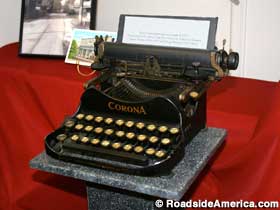
maybe a little late for Christmas: Here’s the typewriter used to answer letters to Santa Claus, at the U.S. Post Office of Santa Claus, Indiana:
Typewriter used to answer letters to Santa Claus, from the U.S. Post Office in Santa Claus, Indiana - Roadside America photo
For 30 years, kids letters to Santa Claus were answered, with the responses typed on this Corona at the Post Office. The machine rests on display at the Santa Claus Museum in Kris Kringle Plaza in Santa Claus, Indiana, about 40 miles east northeast from Evansville (south of Interstate 64).
Answers to letters to Santa Claus are answered from the museum today.
GE labs suggest some improvements to the Santa Claus Sleigh. A good way to introduce research, I think.
Click here for GE's interactive feature
Among improvements:
“Iceophobic Coatings” to make the metal parts super water resistant — a boon to airborne sleighs and commercial aircraft, and to windpower mills, all of which may be subject to icing in winter operations.
Sodium batteries for hybrid locomotion (this would be the first reindeer/electric hybrid).
Trip optimization mechanics and software — similar to that used by Canadian Pacific Railroad engineers — helps conserve fuel (I’m not sure how the reindeer get wired into this thing, but hey, this is all a bit of fantasy, isn’t it?).
Santa’s “naughty and nice” and gift request lists get reduced to a CD-sized, 500 gigabyte disk attached to his belt. He probably got this holographic data storage idea from Star Wars and R2D2.
Sensors in Santa’s gift bag allow real-time tracking of the gifts, something the wonks at GE call Asset Intelligence Tracking Tech (why not “accurate gift delivery?” “Package targeting?”). Again, Santa’s borrowing from the trucking and rail industries for this.
Here at Bathtub Manor we switched to LEDs on the Christmas tree this year. The blue lights are a bit intense (more yellow and red in the mix, please, string assemblers). Travel home, shopping, recipe-finding, and most other parts of our family’s Christmas preparations are laced with cell phones, computers, internet and digital photography, and microprocessors performing music — not to mention the yearly infusions of new technology under the tree.
QWERTY Exhibit at the Museum of Printing History, Houston
QWERTY: A Typewriter Retrospective
October 8, 2009– March 20, 2010 Typewriters inhabit a special place in the American psyche. No longer in widespread use, typewriters have been outsourced by the desktop computer, although they maintain a special air of nostalgia. Americans remember their junior high typing class, while many of today’s youngsters have never set eyes on such a machine. Tucked away in closets and in office corners, many typewriters are still occasionally put to good use. In addition to being beautiful specimens of design, who can forget the characteristic music of taps and bells created by a manual typewriter? From the collection of the Museum of Printing History.
More details on the Museum:
The Museum of Printing History
1324 W. Clay Street
Houston, Texas 77019
Hours:
10 a.m. – 5 p.m.
Tuesday – Saturday
713-522-4652
Free admission for self-guided tours
Spread the word; friends don't allow friends to repeat history.
KERA Television has a marvelous short film profile of Jack Kilby, who won the Nobel in physics for his invention of what we now call “the computer chip.”
Late in his life, Jack Kilby holds his first integrated circuit, which is encased in plastic. Photo via Texas Instruments, via Earth & Sky
Teachers should check out the film and use it — it’s a great little chapter of Texas history, science history, and U.S. history. It’s an outstanding explanation of a technological development that revolutionized so much of our daily life, especially in the late 20th century. At 8 minutes and 37 seconds, the film is ideal for classroom use.
2009 marks the 50th anniversary of Kilby’s filing for a patent on an integrated circuit. He’s been honored by the Inventor’s Hall of Fame. Despite the stupendous value of his invention, Kilby’s name is far from a household name even in North Dallas, home of Texas Instruments. Robert Noyce, who came up with almost exactly the same idea at almost exactly the same moment, is similarly ignored.
Shouldn’t today’s high school students know about Kilby and Noyce? Not a class period goes by that I don’t use a device powered by Kilby’s invention; nor does one pass that I don’t have to admonish at least one student for misuse of such a device, such as an iPod, MP3 player, or cell phone. It’s difficult to think of someone whose invention has greater influence on the life of these kids, hour by hour — but Kilby and his invention don’t get their due in any text I’ve seen.
It’s a great film — original and clever animation, good interviews, and it features Kilby’s charming daughter, and the great journalist and historian of technology T. R. Reid. Don’t you agree that it’s much better than most of the history stuff we have to show?
Texas history standards require kids to pay brief homage to inventors in the 20th century. Kilby is not named in the standards, however, and so he and his invention are ignored as subjects of history study. You ought to fix that in your classroom, teachers.
Sputnik model, at the Smithsonian Air & Space Museum (Wikimedia image)
The Union of Soviet Socialist Republics (USSR) launched the world’s first artificial satellite into orbit. After successfully putting the shiny ball into orbit, the Soviets trumpeted the news that Sputnik traced the skies over the entire planet, to the shock of most people in the U.S. (Photo of the model in the Smithsonian’s Air & Space Museum in Washington, D.C.)
New Scientist magazine’s website provides significant details about how awake America became, including very good coverage of the Moon landings that were nearly a direct result of Sputnik’s launch — without Sputnik, the U.S. probably wouldn’t have jump started its own space program so, with the creation of NASA and the drive for manned space flight, and without the space race President John F. Kennedy probably wouldn’t have made his dramatic 1961 proposal to put humans on the Moon inside a decade.
Texas Essential Knowledge and Skills (TEKS) lists 1957 as among the dozen dates students need to know in U.S. history, for Sputnik. It is the only date Texas officials list for U.S. history that is really an accomplishment by another nation. (The first time I encountered this requirement was in a meeting of social studies teachers gearing up for classes starting the following week. The standards mention the years, but not the events; I asked what the event was in 1957 that we were supposed to teach, noting that if it was the Little Rock school integration attempt, there were probably other more memorable events in civil rights. No one mentioned Sputnik. It was more than two weeks before I got confirmation through our district that Sputnik was the historic event intended. Ouch, ouch, ouch!)
Sputnik was big enough news to drive Elvis Presley off the radio, at least briefly, in southern Idaho. My older brothers headed out after dinner to catch a glimpse of the satellite crossing the sky. In those darker times — literally — rural skies offered a couple of meteoroids before anyone spotted Sputnik. But there it was, slowly painting a path across our skies, over the potato fields, over the Snake River, over America.
Sputnik’s launch changed our lives, mostly for the better.
John Lennon's manual Imperial typewriter, used when he was a teenager - now owned by Steve Soboroff - Image from Playa Vista Today
Steve Soboroff, CEO of Playa Vista Capital in Playa Vista, California, collects celebrity typewriters on the side. Earlier this year he acquired the typewriter John Lennon used as a teenager, according to Playa Vista Today.
Lennon’s Imperial (The Good Companion Model T) was among the late Beatle’s possessions originally auctioned by his Aunt Mimi to a Liverpool charity involving musical therapy. Soboroff came across Lennon’s writing instrument during an estate sale overseen by Bonhams auction house in England. The portable was originally auctioned through Sotheby’s in 1999. However, the owner succumbed to the economic downturn and put it up for sale earlier this year.
‘I was going to get on an airplane to go get it,’ Soboroff says regarding his summer purchase, which was probably used in the late Beatle’s first attempts at songwriting as a teenager. ‘He was living with his aunt when he owned it,’ he says.
And here’s a photo of John Lennon working at a typewriter other than the Imperial:
Autographed photo of John Lennon working at a typewriter - Image from Playa Vista Today
Soboroff also owns typewriters used by sportswriter Jim Murray, Ernest Hemingway, George Bernard Shaw, Tennessee Williams, and Jack London.
Spread the word; friends don't allow friends to repeat history.
Worse, it’s almost impossible to telephone AT&T or contact them by e-mail — they ask a lot of information entered that most people won’t have handy before they respond at all (I don’t know the three mystery numbers in some odd corner of our phone bill, for example, and I don’t want to go rummaging through the files just to tell the company that their service doesn’t work, especially since I’ve already told them that three times — if I’m calling from a different phone, the bill isn’t even in the building, okay?).
If the customer can’t complain, AT&T doesn’t have any complaints to worry about, right?
“AT&T phone service held hostage, 21 days.”
How many more? I wonder if they’ll make ransom demands.
Spread the word; friends don't allow friends to repeat history.
Or, until that account is unsuspended by the forces supporting Donald Trump: Follow @FillmoreWhite, the account of the Millard Fillmore White House Library
We've been soaking in the Bathtub for several months, long enough that some of the links we've used have gone to the Great Internet in the Sky.
If you find a dead link, please leave a comment to that post, and tell us what link has expired.
Thanks!
Retired teacher of law, economics, history, AP government, psychology and science. Former speechwriter, press guy and legislative aide in U.S. Senate. Former Department of Education. Former airline real estate, telecom towers, Big 6 (that old!) consultant. Lab and field research in air pollution control.
My blog, Millard Fillmore's Bathtub, is a continuing experiment to test how to use blogs to improve and speed up learning processes for students, perhaps by making some of the courses actually interesting. It is a blog for teachers, to see if we can use blogs. It is for people interested in social studies and social studies education, to see if we can learn to get it right. It's a blog for science fans, to promote good science and good science policy. It's a blog for people interested in good government and how to achieve it.
BS in Mass Communication, University of Utah
Graduate study in Rhetoric and Speech Communication, University of Arizona
JD from the National Law Center, George Washington University


 Posted by Ed Darrell







 Millard Fillmore's Bathtub