Quiet giant of Utah journalism, Ernie Ford

June 2, 2011

Sometimes the news comes slow.

Jake Sorenson at the Daily Utah Chronicle sent out a notice that Ernie Ford died last night.  Cardiac issues.  He was 70, after all — young by today’s standards, and not yet used up.

Ford was adjunct faculty and adviser to the Chronicle when I wrote there, and took classes from him.  Ford and Roy Gibson were veterans of Utah journalism who could offer a couple of chapters of a textbook they never wrote on how to write well, and how to write good news stories — with just their markups, questions and corrections in the margins of the news story one had to meet deadline on.

Gibson died several years ago.

More than once I regretted that I had to send the copy, with Ford’s comments, off to “typesetting” in the backshop, knowing I’d never see it again.  We didn’t have a photocopier to just make another copy.

Details to come, Jake said.  We’re losing more than just old, established newspapers.  We’re losing the men and women who made the news, news, and made the news readable, and understandable.

Ford made his reputation at KSL Television News and the Salt Lake TribuneHere’s a 1989 story on his leaving KSL to move to a Dallas station.  Sometime after that he moved on to run the Society of Professional Journalists, in Indiana.  Details on Ford’s life and death to follow, but probably no film at 11:00.

When enough of the big trees fall, you can’t call it a forest any more, you know?

_______________

DePauw University put out a release on Ernie Ford:

Former Prof. Ernie Ford Passes Away at Age 70

98198

Veteran reporter, editor and journalism professor Ernie Ford died June 1 in Greencastle, Indiana

June 2, 2011, Greencastle, Ind. —  Ernest J. “Ernie” Ford Jr., a respected journalist and former member of the DePauw University faculty, passed away yesterday. He was 70 years old.

Ford was born on June 7, 1940, in Salt Lake City, and earned bachelor’s and master’s degrees in journalism from the University of Utah. After a lengthy career in print and broadcast journalism, Ford came to Greencastle in the spring of 1992 when he was named executive director of the Society for Professional Journalists (SPJ). The organization, which was founded by student journalists at DePauw University as Sigma Delta Chi (SDX) in 1909, is the nation’s most broad-based journalism organization. SPJ had its national headquarters in Greencastle in the 1990s. 98200

“Ernie Ford was selected because of his strong management experience in broadcast and print journalism,” said Georgiana Vines, assistant managing editor of the Knoxville News Sentinel and chair of the search committee, when Ford’s appointment was announced.

Ford had served as SPJ’s national president during 1991-92 before taking a paid post with the organization. He became a member of SPJ’s national board of directors in 1984, when he was elected Region 9 director, and served as chair of the Ethics Committee, Publication Committee, and the Legal Defense Fund.

98201

Photo, l-r: Ford and David Bohmer '69, director of the Pulliam Center for Contemporary Media Center and Media Fellows Program, with former The DePauw editors Eric Aasen '02 and Andrew Tangel '03 in October 2010

A regular lecturer to students in journalism classes and members of the DePauw Media Fellows program, Ford served as a part-time instructor in University Studies during the 2001-02 academic year. Ernie Ford and his wife, Linda, who survives, are also known to a generation of DePauw students as owners of the Fine Print Bookstore, which they operated on Greencastle’s square for 15 years.

He also served as an adjunct instructor at the University of Utah, Brigham Young University and Utah State University.

“Ernie was a great teacher who helped his students understand the media industry and journalism,” recalls Andrew Tangel, a 2003 DePauw graduate and former editor of The DePauw who now a reporter at New Jersey’s Bergen Record. “A former investigative reporter himself, he seemed to relish asking tough questions at public meetings on campus and in town. He passed along tips to student journalists and encouraged them to be aggressive, hard-nosed reporters.”

Before coming to Indiana, Ford’s journalism career which included stints as managing editor of KSL-TV in Salt Lake City, assistant news director of KDFW-TV in Dallas, assistant city editor of the Salt Lake Tribune, wire editor of the Idaho Post-Register in Idaho Falls, and general assignment reporter for the Deseret News in Salt Lake City. He collected numerous journalism awards, including a 1980 Sigma Delta Chi award for broadcast public service, regional Emmys, the Eudora Welty Award and the DuPont Award. A strong advocate for the First Amendment and the rights of journalists, Ford testified before Congress in support of the Freedom of Information Act and organized a a petition drive that led move the U.S. Supreme Court to permit still cameras in the 47517courtroom.

In 2006, Ford was inducted into the Hall of Fame of the Daily Utah Chronicle, the University of Utah’s student newspaper, where he cuts his reporting teeth as an undergraduate and later served as faculty adviser.

Ford served on the boards of the Putnam County Humane Society, Great Lakes Booksellers Association, served of president of Main Street Greencastle, and was a longtime supporter of the Putnam County Playhouse.

A celebration of Ernie Ford’s life will be held at 2 p.m. Sunday at the Putnam County Playhouse, 715 South County Road 100 East, Greencastle.

An obituary is accessible at the website of Greencastle’s Banner-Graphic.


Chronic drought complicated by chronic denialism

May 26, 2011

Which is worse:  To be in the depths of a drought, or to deny drought where it exists?

I ask the question because, as one cannot tear one’s eyes away from a train wreck about to occur, I watch Steve Goddard’s blog.  Occasionally Steve or one of his fellow travelers says something so contrary to reality or fact that I can’t resist pointing it out.

In some discussion over there, Goddard suggested that because there is above-average snowpack around Salt Lake City and in Northern Utah, Lake Powell’s decade-long struggle with extreme drought is over.  Therefore, to Goddard, global warming does not exist.

(No, I’m not really exaggerating.  Seriously.  Go look.  No one there seems to have ever had a course in logic, nor in English composition and essay writing.  If Al Gore got svelte, one suspects half the commenters there would never be able to speak again.)

It is true that this year, contrary to the past decade, snowpack is high along the Wasatch Front and in the Uinta Mountains of Utah, and in Wyoming and Colorado areas that drain into the Green and Colorado Rivers.  Consequently, forecasters say that Lake Powell may gain a few feet of depth this year.  Powell is down about 50 feet, however, and even a record snowpack won’t erase the effects of drought on the lake.  (Yeah, I know:  The Wasatch doesn’t drain into the Colorado system — it drains to the Great Salt Lake, as indeed do many of the streams that have great snowpack in Utah — so a lot of the record snowpack won’t get within 400 miles of Lake Powell.  That’s geography, and it would be one more area that commenters would embarrass themselves in.  Don’t ask the pig to sing if you aren’t going to spend the time to teach it; if you need the aphorism on teaching pigs to sing, look it up yourself.)

Since Lake Powell won’t lose a lot of elevation this year, the Goddardites (Goddardians?  Goddards?  Goddardoons?) pronounce the U.S. free of drought.

Right.

Check it out for yourself, Dear Reader.  Here’s an animation from the National Drought Center, showing drought measurements in the contiguous 48 states plus Alaska and Hawaii, over the past 12 weeks:

Drought in the U.S., 12 weeks ending May 17, 2011, National Drought Mitigation Center, U of Nebraska-Lincoln

Drought in the U.S., 12 weeks ending May 17, 2011, National Drought Mitigation Center, U of Nebraska-Lincoln - click on map for a larger version at the Drought Monitor site.

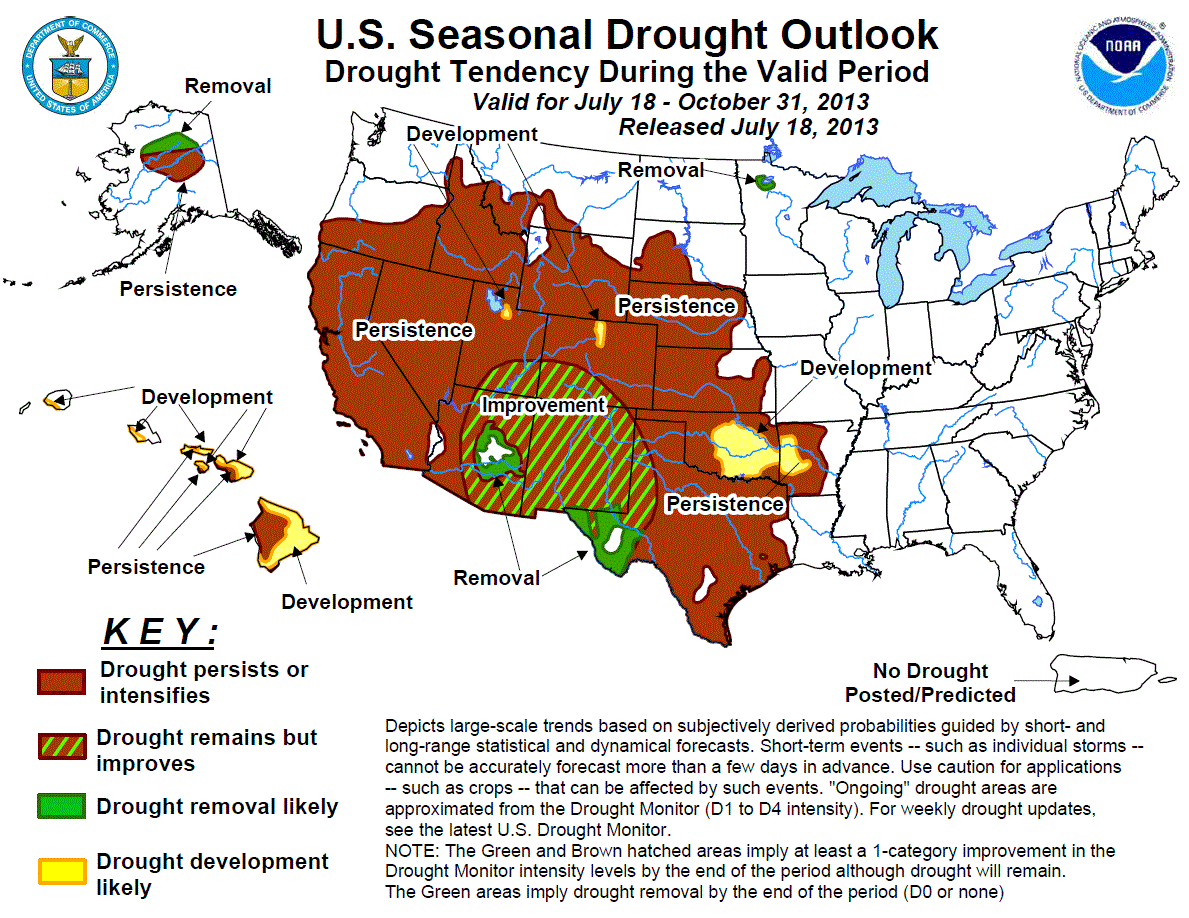
Here’s the drought outlook map from the Climate Prediction Center at NOAA:

U.S. Seasonal Drought Outlook Map, released May 19, 2011, NOAA and the Climate Prediction Center

U.S. Seasonal Drought Outlook Map, released May 19, 2011, NOAA and the Climate Prediction Center - click image for a larger version at NOAA's site.

It would be wonderful were these droughts to break soon.  But that is very unlikely.

So, why would anyone deny it?

Then, just to indicate the bait-and-switch logic these guys use, Goddard came back with a claim that the 1956 drought in Texas was worse, as if that means the current drought doesn’t exist.  Fore reasons apparent only to those whose heads get pinched by tinfoil hats, he also notes the CO2 levels for 1956.  I think I know what point he’s trying to make, but someone should tell him that apples are not oranges, and comparing apples and oranges to pomegranates doesn’t increase the supply of tennis balls.

Let’s just stick to the facts.  The experts who must operate the dams and lakes and get water to Mexico on schedule say the drought along the Colorado persists.  Who are we to gainsay them?

Resources:  

GEOSat photos of Lake Powell and drought, 2000 to 2004 - Dr. Paul R. Baumann, SUNY - Oneonta College

GEOSat photos of Lake Powell and drought, 2000 to 2004 - Dr. Paul R. Baumann, SUNY - Oneonta College


Then and now: Big Cottonwood Canyon, Utah – 1869 and 2006

March 18, 2011

Photographer Timothy H. O’Sullivan toured the western territories — not yet states — for either the U.S. Army Corps of Engineers or the U.S. Geological Survey, around 1868 and 1869.  Color photography hadn’t been perfected.  His plates were black and white only.

He had been one of the photographers who captured parts of the Civil War on film, with particularly poignant photos of the battlefield at Gettysburg, Pennsylvania, within hours after the battle ended on July 4, 1863.

O’Sullivan’s photos appear in the collection at the Library of Congress, and at the George Eastman House (Eastman was the founder of Kodak, as you know).

O’Sullivan’s photos show the mineral and mining operations of Nevada, Utah and Idaho, and Arizona and New Mexico, so far that I’ve found.  Particularly in the mountains, the places he photographed can be tracked down today.

In this post we compare O’Sullivan’s photo up what he called “Great Cottonwood Canon of the Wahsatch,” what is today one of the beautiful canyons leading out of Salt Lake City, Big Cottonwood, in the Wasatch Front.  O’Sullivan took a shot up the canyon, then very much unroaded, at an enormous block of granite that came to be known as Storm Mountain.

In 1869:

"Great Cottonwood Canyon, Wahsatch Mountains," 1869 photo by Timothy H. O'Sullivan - USGS photo from Eastman collection

"Great Cottonwood Canyon, Wahsatch Mountains," 1869 photo by Timothy H. O'Sullivan - USGS photo from Eastman collection

Rich Legg of Salt Lake City captured the same mountain in 2006, and graciously consented to let us use it here for comparison.  This is Storm Mountain, now:

From LeggNet:

Big Cottonwood Canyon, Utah, 2006 - photo by Rich Legg, copyright and rights reserved

Big Cottonwood Canyon, Utah, 2006 - photo by Rich Legg, copyright and rights reserved; image here by express permission

Note from LeggNet blog: This recent capture was made in Big Cottonwood Canyon just outside of Salt Lake City. The striking shadows along with the jagged ridges create a dramatic lighting effect.

Legg’s camera and film allowed a quicker shot, I’ll wager (if he used film at all — it may be an electronic image).

The granite didn’t change much.  Storm Mountain is literally a fraction of a mile outside the city limits of Salt Lake City.  A photo the other way would show dramatic change.  A photo of Storm Mountain, which consists chiefly of naked granite, appears almost unchanged in over a century.  It’s difficult even to find places where the vegetation has changed.

In the past 20 years we have seen comparisons of America’s and the world’s glaciers, from photos through the late 19th and 20th centuries, compared to photos of today.  The archives of landscape photos held by groups like the George Eastman House offer opportunities for historians and land managers and policy makers to compare American lands from more than a century ago, to those same lands today.  Much of those older photo archives are available on line, at least for searching.  Will scholars make methodical use of these resources?


Bull baiting bill not appearing ready, Utah legislator proposes for killing horses instead

January 20, 2011

You couldn’t make this stuff up, and if you did, you should see a therapist.

As the Utah 2011 legislative session gets underway, state Rep. Curt Oda wasted no time in introducing a bill that reflects his legislative priority. He is not using his position as a legislator, however, to try to create jobs, improve schools, or protect children, for example. Instead, his bill, H.B. 210,  encourages the torture and killing of animals.

Oda wants to amend the state’s animal cruelty law, Section 76-9-301, to exempt “pests” and “feral” animals from the definition of animal. This means that to the extent they were protected, these animals would no longer be protected by the state’s animal cruelty law. Oda is reported to have told a local newspaper that “feral” animals and “pests” could be shot with a bow and arrow, for example, decapitated or clubbed to death.

Why kill horses with such brutality?  Dog fighting and cock fighting clearly wouldn’t fly?  Bear baiting won’t work — not enough bears?  Surely there are more humane ways to deal with “pest” animals.


Boy Scout died in fall from Utah’s Gemini Bridges

July 19, 2010

Tragic accident at a spectacular site in Utah’s desert.

A Scout from Wisconsin attempted a leap from one part of a natural bridge to another, lost his balance and fell to his death.  According to the Salt Lake Tribune in Salt Lake City:

A Wisconsin Boy Scout died Saturday after falling 100 feet from Grand County’s Gemini Bridges.

Anthony Alvin, 18, of Green Lake, Wis., was with a Scout group at the Gemini Bridges rock formation, which is on federal land northwest of Moab, deputies wrote in a press statement. At about 9:30 a.m., Alvin tried to jump from one span of the double bridge to the other span, six feet away, when he fell backwards, dropping 100 feet to the bottom of the bridges.

Rescuers rappelled off the bridges and found Alvin had died. His body was lowered down two separate cliffs to the bottom of Bull Canyon, deputies wrote.

Erin Alberty

Anthony Alvin was a member of Troop 630 from Green Lake, Wisconsin, in the Bay Lakes Council, BSA.  The Troop has years of experience in high adventure trips.  This was a transition trip for Alvin, moving from Scout to leader.

High adventure Scouting takes teens to outstanding places with some risks.  Strict safety rules protect Scouts and leaders from most accidents.  Jumping the gap between the two natural bridge sections is a leap that experienced rock climbers and Scouters should advise against — and probably did — precisely because of the dangers of minor mishaps, 100 feet or more in the air.  A six-foot gap would look eminently leapable to a capable young man.

This is a picture of Gemini Bridges from below:

Gemini Bridges, near Moab, Utah - NaturalArches.org image

Gemini Bridges, near Moab, Utah, from below. Image from NaturalArches.org image, photo by Galen Berry.

NaturalArches.org includes details about many of these natural spans in the desert Southwest, in Utah and Arizona.  For Gemini Bridges we get this warning note:

These magnificent twin bridges are a popular 4-wheel drive destination on BLM land northwest of Moab, Utah. A few foolhardy individuals have lost their lives here. One person fell to his death while attempting to jump the 10 feet between the two spans, and in October 1999 a jeep and driver fell 160 feet off the outer span.

From atop the bridges, the gap between the two can appear deceptively small — see one view here.

Gemini Bridges from the trail, on top - PaulandKate.com

For safety’s sake, no one should attempt to leap the gap without proper rock-climbing safety equipment in place and in use — and frankly, I’m not sure how it could be secured even then, in the sandstone.

Redrock country brings out the worst in otherwise adventurous-but-mostly-sane people.  Even rock climbers will act irresponsibly.

Four-wheelers and off-road vehicles frequently climb these trails — despite the dangers, the area offers a huge playground for people out of the jurisdiction of the National Park Service or National Forest Service, each of which discourage excessive vehicular risk taking.   Several sites extoll the glories of conquering these deserts with gasoline-power.

Irresponsible jump at Gemini Bridges, from rockclimbing.com

Irresponsible jump at Gemini Bridges captured on film, from rockclimbing.com

The photo at the bottom shows a memorial plaque to the four-wheeler who lost his life off of Gemini Bridges in 1999.  So long as people make monuments to people who pull daredevil stunts, others who have less experience, or even more sense, will be tempted to try the same daredevil stuff.

Go to these wild and beautiful places.  Please remember they are treacherous, however, and stay safe.

Tribute to Beau James Daley, who died when his jeep plunged off of Gemini Bridges, Utah

Tribute to Beau James Daley, who died when his jeep plunged off of Gemini Bridges, Utah

Also at Millard Fillmore’s Bathtub:

More:


Lessons of history: How to boost newspaper sales with Sarah Bernhardt

June 20, 2010

Sarah Bernhardt selling newspapers in Salt Lake City, March 28, 1913 - Utah Historical Society image

Sarah Bernhardt, in fur, selling newspapers in Salt Lake City, March 28, 1913 - Utah Historical Society image

Just get the most famous actress in the world to hawk the newspaper on the street.

In this photo Sarah Bernhardt sells newspapers to a group of men in the street in Salt Lake City (probably State Street, but perhaps Main Street; I have not identified the building behind her in the photograph).  The photograph is from the Shipler Company Collection at the Utah Historical Society.

In 1913, Bernhardt was in the early autumn of her career, with several movies but not many plays in front of her.  She had lost a leg to gangrene from a badly-treated broken knee in 1905 (in Rio), but still acted in plays that she produced herself, and in movies.

The photo is dated 1913.  Bernhardt conducted a tour of the U.S. in 1915.  One may wonder if the date was misread from a handwritten note.

I wonder: Who are other people in the photo?


Wikipedia loses Sen. Arthur V. Watkins – can you help with the rescue?

May 30, 2010

Utah Sen. Arthur V. Watkins on the cover of Time Magazine, 1954; copyright Time, Inc.

Utah Sen. Arthur V. Watkins on the cover of Time Magazine, 1954 (copyright Time, Inc.) Can Wikipedia find enough information here to add to Watkins’s biography?  Are we really to believe a Time cover subject has disappeared from history?

Utah’s Sen. Arthur V. Watkins, a Republican, made the history books in 1954 when he chaired a special committee of the U.S. Senate that investigated actions by Wisconsin’s Sen. Joseph McCarthy with regard to hearings McCarthy conducted investigating communists in the U.S. Army.

This is all the biography at Wikipedia is, now, in May 2010:

Arthur Vivian Watkins (December 18, 1886 – September 1, 1973) was a Republican U.S. Senator from 1947 to 1959. He was influential as a proponent of terminating federal recognition of American Indian tribes.

[edit] References

  • Klingaman., William The Encyclopedia of the McCarthy Era, New York : Facts on File, 1996 ISBN 0816030979. Menominee Termination and Restoration [1]

[edit] External links

What is there is of little use.  It doesn’t even mention the work Watkins is most famous for, the brave action that brought him fame and electoral defeat, the censure of Sen. Joseph McCarthy during the Red Scare.  As a biography, it’s insultingly small, trivial, and misleading.

Here in Texas we have a school board that wishes to promote Joe McCarthy to hero status, to sweep under the rug the actual history of what he did, the inaccurate and vicious claims he made against dozens of people including his own colleagues in the U.S. Senate.  Good, readily available biographies of the people who stopped McCarthy, and good, readily available histories of the time can combat that drive for historical revisionism.

Wikipedia, in its extreme drive to prevent error, is preventing history in this case.  Wikipedia is no help.  For example, compare the article on Watkins with the article on Vermont Sen. Ralph Flanders, the man who introduced the resolution of censure against McCarthy. Flanders’s article is enormous by comparison, and no better documented. Why the snub to Watkins?

It’s odd.  Here I am providing a solid example of the evils of Wikipedia to warm the cockles of the heart of Douglas Groothuis, if he has a heart and cockles.   Facts and truth sometimes take us on strange journeys with strange traveling companions, even offensive companions.  Ultimately, I hope Wikipedia will wake up and choose to reinstate a useful and revealing biography of Watkins, to make Groothuis frostier than usual.

What to do?

Here is what follows, eventually below the fold:  I’ve copied one of the old biographies of Watkins from Wikipedia. Much of the stuff I recognize from various sources.  If there are inaccuracies, they are not intentional, nor are they done to impugn the reputation of any person (unlike the purging of Watkins’ biography, which unfortunately aides the dysfunctional history revisionism of Don McLeroy and the Texas State Soviet of Education).  I have provided some links to on-line sources that verify the claims.

Can you, Dear Reader, provide more and better links, and better accuracy?  Please do, in comments.  Help rescue the history around Sen. Watkins from the dustbin.

Will it spur Wikipedia to get its biographer act together and fix Watkins’s entry?  Who knows.

Here is the Wikipedia bio, complete with editing marks, and interspersed with some of my comments and other sources:

”’Arthur Vivian Watkins”’ (December 18, 1886 – September 1, 1973) was a Republican [[United States Senate|U.S. Senator]] from 1947 to 1959. He was influential as a proponent of terminating [[Federally recognized tribes|federal recognition]] of [[Native Americans in the United States|American Indian]] [[Indian tribe|tribes]] in order to allow them to have the rights of citizens of the United States.

Watkins’s life is available in basic outline form at a number of places on-line.  A good place to start is with the biographical directory of past members available from the U.S. Congress.  These sketches are embarrassingly short, but Watkins’s entry is four times the size of the Wikipedia entry, with about 20 times the information.  There is the Utah History Encyclopedia, with an article by Patricia L. Scott.  Her biography is copied by the Watkins Family History Society.

Watkins was born in [[Midway, Utah]]. He attended [[Brigham Young University]] (BYU) from 1903 to 1906, and [[New York University]] (NYU) from 1909 to 1910. He graduated from [[Columbia University Law School]] in 1912, and returned to Utah. There he was admitted to the bar the same year and commenced practice in [[Vernal, Utah]].

He engaged in newspaper work in 1914 (”The Voice of Sharon”, which eventually became the ”Orem-Geneva Times”, a weekly newspaper in [[Utah County, Utah|Utah County]].) [Sharon is an area in what is now Orem, Utah; the local division of the Church of Jesus Christ of Latter-day Saints is called the Sharon Stake, where Watkins was a member. ]In 1914 Watkins was appointed assistant county attorney of [[Salt Lake County, Utah|Salt Lake County]]. He engaged in agricultural pursuits 1919-1925 with a <span style=”white-space:nowrap”>600&nbsp;acre&nbsp;(2.4&nbsp;km²)</span> [[ranch]] near [[Lehi, Utah | Lehi]].

Watkins served as district judge of the Fourth Judicial District of Utah 1928-1933, losing his position in the [[Franklin Delano Roosevelt|Roosevelt]] Democratic landslide in 1932. An unsuccessful candidate for the [[Republican Party (United States)|Republican]] nomination to the Seventy-fifth Congress in 1936, Watkins was elected as a Republican to the [[United States Senate]] in 1946, and reelected in 1952. He served from January 3, 1947, to January 3, 1959. An [[Elder (LDS Church)|elder]] in [[The Church of Jesus Christ of Latter-day Saints]], Watkins was widely respected in Utah. {{Fact|date=August 2007}}

In 1954, Watkins chaired the committee that investigated the actions of Wisconsin Senator [[Joseph McCarthy]] to determine whether his conduct as Senator merited censure. As Chairman, Watkins barred [[television]] cameras from the hearings, and insisted that McCarthy conform to Senate protocol. When McCarthy appeared before the Watkins committee in September 1954 and started to attack Watkins, the latter had McCarthy expelled from the room.

This material comes from an oft-repeated, probably cut-and-pasted story, such as this biography of Watkins at the alumni association of his old high school, the experimental Brigham Young High.  It is confirmed in a thousand places, and one wonders why Wikipedia thought it undocumented, or inaccurate.  See Time’s contemporary report, for example (with a co-starring turn from a young Sen. Sam Ervin, D-North Carolina — the man who would later chair the Senate’s Watergate hearings).

The committee recommended censure of Senator McCarthy. Initially, the committee proposed to censure McCarthy over his attack on General [[Ralph Zwicker]] and various Senators, but Watkins had the charge of censure for the attack on General Zwicker dropped. The censure charges related only to McCarthy’s attacks on other Senators, and excluded from criticism McCarthy’s attacks on those outside of the Senate.

Watkins’s appearance on the cover of Time was the October 4, 1954, edition, reporting McCarthy’s censure.  The story accompanying that cover is here.  The Senate Resolution censuring McCarthy is designated as one of the 100 most important documents in American history by the National Archives and Records Administration — see the document and more history, here.  See more at the Treasures of Congress exhibit’s on-line version.

McCarthy’s anti-communist rhetoric was popular with Utah’s electorate, however. Former [[Governor of Utah|Utah Governor]] [[J. Bracken Lee]] took the opportunity in 1958 to oppose Watkins for the nomination in the senatorial election. Though Watkins won the Republican [[primary election|primary]], Lee ran as an [[independent (politics)|independent]] in the [[general election]]. This caused a split in the Republican vote and allowed Democrat [[Frank E. Moss]] to win the seat. Lee went on to a long career as [[mayor]] of [[Salt Lake City, Utah|Salt Lake City]]. Moss served three terms in the Senate, losing to Republican [[Orrin Hatch]] in 1976.

I’m not sure why Wikipedia’s editors rejected that historical paragraph.  Most of the points can be confirmed on Wikipedia, just following who sat where in the Senate.  Time Magazine covered the election shenanigans of 1958, with an article, “Feud in the desert,” detailing the fight between Watkins and Lee — July 14, 1958.

Watkins served as chair of the [[United States Senate Committee on Indian Affairs|Senate Interior Committee Subcommittee on Indian Affairs]]. He advocated [[Indian termination policy|termination]] of [[List of Native American Tribal Entities|Indian Tribal Entities]] in the belief that it was better for tribal members to be integrated into the rest of American life. He believed that they were ill-served by depending on the federal government for too many services.

Watkins called his policy the “freeing of the Indian from wardship status” and equated it with the Emancipation Proclamation, which freed slaves during the Civil War. Watkins was the driving force behind termination. His position as chairman of the Senate Subcommittee on Indian Affairs gave him tremendous leverage to determine the direction of federal Indian policy. His most important achievement came in 1953 with passage of House Concurrent Resolution No. 108, which stated that termination would be the federal government’s ongoing policy. Passage of the resolution did not in itself terminate any tribes.

That had to be accomplished one tribe at a time by specific legislation. The [[Bureau of Indian Affairs]] (BIA) began to assemble a list of tribes believed to have developed sufficient economic prosperity to sustain themselves after termination. The list was headed by the Menominee Tribe of Wisconsin. One reason the BIA chose the Menominee was that the tribe had successful forestry and lumbering operations which the BIA believed could support the tribe economically. Congress passed an act in 1954 that officially called for the termination of the Menominee as a federally recognized Indian tribe.

Termination for the Menominee did not happen immediately. Instead, the 1954 act set in motion a process that would lead to termination. The Menominee were not comfortable with the idea, but they had recently won a case against the government for mismanagement of their forestry enterprises, and the $8.5 million award was tied to their proposed termination. Watkins personally visited the Menominee and said they would be terminated whether they liked it or not, and if they wanted to see their $8.5 million, they had to cooperate with the federal government{{Fact|date=February 2009}}. Given this high-handed and coercive threat{{POV assertion|date=June 2009}}, the tribal council reluctantly agreed.

To set an example, Watkins pushed for termination of Utah Indian groups, including the Shivwits, Kanosh, Koorsharem, and Indian Peaks Paiutes. Once a people able to travel over the land with freedom and impunity, they were forced to deal with a new set of unfamiliar laws and beliefs. He terminated them without their knowledge or consent.

After Watkins left the Senate, he served as a member of the U.S. Indian Claims Commission from 1959 to 1967. He retired to Salt Lake City, and in 1973, to Orem.

In 1969 Watkins published a book about his investigation of McCarthy, ”Enough Rope: The Inside Story of the Censure of Senator Joe McCarthy by his Colleagues: The Controversial Hearings that Signaled the End of a Turbulent Career and a Fearsome Era in American Public Life”, (Englewood Cliffs, New Jersey: Prentice-Hall, 1969).

It’s astounding to me that mentions of Watkins’s book would be struck by Wikipedia, as if it were questionable that Watkins and the book ever existed.  Did the editor who cut that reference doubt sincerely?

Caption from the Utah Historical Society: Arthur Watkins (seated, center), a United States Senator from Utah, is shown here at a book signing for his book, "Enough Rope" at Sam Weller's Bookstore."Enough Rope" was a book about Joe McCarthy and the red scare. Rights management Digital Image (c) 2004 Utah State Historical Society. All Rights Reserved. (use here allowed by UHS, for education)

Caption from the Utah Historical Society: Arthur Watkins (seated, center), a United States Senator from Utah, is shown here at a book signing for his book, “Enough Rope” at Sam Weller’s Bookstore.”Enough Rope” was a book about Joe McCarthy and the red scare. Rights management Digital Image (c) 2004 Utah State Historical Society. All Rights Reserved. (use here allowed by UHS, for education)

State and local historical groups curate remarkable collections of images, now digitized and available free, online.  The Utah Historical Society offers a wealth of images in their collection.  Among them, we find a 1969 photograph of former-Sen. Watkins at a book signing at Sam Weller’s Zion Bookstore, the Salt Lake City monument to bookophilia and still one of the best bookstores in the world.  (Mormons read a lot, but Weller’s is not an official outlet of Mormon ideas; the store is a bastion of learning in a learned culture that pushes the envelope by challenging that culture at many turns; Weller’s bookstore is a nightmare to people who wish to cover up history).  Watkins is the guy seated at the table signing books — the other two men are not identified.  What more proof would one need of the existence of the book?

The book is referenced at the U.S. Congress biographical guideYou can find it at Amazon.com, though you’d have to buy it used or remaindered (hey! Call Sam Weller’s Zion Bookstore!)

A project of the [[United States Bureau of Reclamation|U.S. Bureau of Reclamation]], the Arthur V. Watkins Dam north of [[Ogden, Utah]], created Willard Bay off of the [[Great Salt Lake]]

U.S. Bureau of Reclamation, Christopher J. McCune, “The Weber Basin Project,” Historic Reclamation Projects Book; accessed May 29, 2010.  Scientific Commons lists Watkins’s papers, at Brigham Young University.  That listing can lead you to the Western Waters digital library, which contains an astonishing amount of information, including photos and newspaper clippings.   Watkins’s lifelong work in water and irrigation was the spur to name the BuRec dam after him.  (The Western Waters Digital Project is a good exemplar of the exquisite detail possible in a publicly-available, online archive.)

Watkins died in [[Orem, Utah]].

His son, Arthur R. Watkins, was a professor of German at [[Brigham Young University]] for more than 25 years.

I offered material to Wikipedia’s article on Watkins more than two years ago, when I discovered the article was little more than a repeat of the Congressional biography guide.  At the time I had a couple of inquiries from reporters and others watching elections in Utah, especially the reelection of Orrin Hatch, to the seat Watkins held (from 1946 to today, that seat has been held by just three people, Watkins, Ted Moss, and Hatch).  It was historical curiosity.

Recently in Texas we’ve seen that absence of good history can lead to distortions of history, especially distortions in the history to be taught in public schools.  It would serve the evil ends of the Texas Taliban were Arthur V. Watkins to be “disappeared” from history.  (See this astoundingly biased account from a guy named Wes Vernon; according to Vernon, McCarthy was improperly lynched.)

Let’s not let that happen, at least, not at Wikipedia.

_____________

Update: A reader more savvy than I in the ways of Wikipedia has restored most of the old biography.  Now it’s an effort to beef up references.

Wow.  Ask, and it’s done.  Good friends make things much better.

Add to FacebookAdd to NewsvineAdd to DiggAdd to Del.icio.usAdd to StumbleuponAdd to RedditAdd to BlinklistAdd to TwitterAdd to TechnoratiAdd to Furl

Save

Save


Dan Valentine – He makes me laugh

May 26, 2010

By Dan Valentine

My dad was a big man. Six-two, some two-hundred-and-thirty pounds. He was two-eighty or so at one time.

Once, he went on a public diet, along with other hefty local celebs–a radio deejay or two; a politician or three; John Mooney, the Trib’s sports’ columnist. I think Herman Franks, manager of the old Salt Lake Bees and former New York Giant catcher was one. All wanted to thin down. They called themselves the “Blubber Brigade”. Once a week my dad would report to the reading public their weekly success or failure.

When my mom first fell in love with my dad, friends would say, “But he’s fat.” My mom would answer, “But he makes me laugh.”

HE MAKES ME LAUGH
(c) 2010 by Daniel Valentine

There are men of worldly means,
Earthly goods, and riches,
Who’d have set me up in suites,
Each with household staff.

But my love I chose because
He keeps me in stitches.
He is not a man of wealth,
But HE MAKES ME LAUGH.

There are men of world renown,
Household names with money,
Who’d have handed me blank checks
With their autograph.

But my love I chose because
He’s bust-a-gut funny.
He is not a man of fame,
But HE MAKES ME LAUGH.

Friends wonder why
I’m no taken with the guy.
He’s not much to look at.
Not by half.
Some would even say he’s fat
And ask themselves, “What’s with that?”
Well, HE MAKES ME LAUGH.

There are notables I know
Who are sitting pretty.
Each of whom I said no to.
All must think me daff’.

But my love I chose because
He’s side-splitting witty.
He is far from well-to-do,
But HE MAKES ME LAUGH–
My, how that man can make me laugh!–
And he thinks I’m funny too.

YOU’RE HALFWAY HOME
(c) 2010 by Daniel Valentine

If you can make a woman laugh
In this world of ours gone daff’,
My friend,
YOU’RE HALFWAY HOME.

If you can roll her in the aisle,
Turn concern into a smile,
My friend,
YOU’RE HALFWAY HOME.

Sure, you’d love to wine-and-dine ‘er,
Buy her clothes by some designer,
Send her flowers, bring her candy.
All of which is fine and dandy.
But you’re broke! Not to choke.
Make her laugh. Tell a joke.

If you can make her slap her knee,
Grab her sides, go tee-hee-hee,
My friend,
YOU’RE HALFWAY HOME.

If you can bring tears to her eyes,
Make her laugh until she cries,
My friend,
YOU’RE HALFWAY HOME.

So you’ve none of earthly riches–
Pal, just keep your gal in stitches.
You don’t need a lotta money.
All you gotta be is funny.
Never mind that you’re broke.
Make her laugh. Tell a joke.

If you can make her spill her beer
While she’s grinning ear-to-ear,
My friend,
YOU’RE HALFWAY HOME.

If you can make her roll about,
On the verge of passing out,
My friend,
YOU’RE HALFWAY HOME.

Fill her heart and home with laughter,
Head to toe, floorboard to rafter.
Let the others buy her toddies,
Spend their dough as though their Saudis.
So you’re broke! Not to choke.
Perfect time for a joke.

If you can make her stamp her feet,
‘Fraid ‘a falling off her seat,
My friend,
YOU’RE HALFWAY HOME.

No need to buy a long-stemmed rose.
No box of chocks, no card with poem.
Just make her snort milk from her nose.
Make her laugh
And YOU’RE HALFWAY HOME
To happily-ever-af’.


Warning claxons from Utah: Bob Bennett voted out

May 8, 2010

Utah’s political year can be odd.  Among other things, there is an unusual feature to get the nomination of a party.  A candidate can win the nomination outright, and avoid the party primary, by taking 72% of the delegates at the state convention.  Delegates vote in rounds, eliminated those with the least support, until some magic number of total delegates is divided among the leaders.  If the leading candidate gets anything less than 72% in the final round, there is a run-off at the primary election.  This way, only two candidates show up on the primary election ballot in September.

The winner of the primary then appears on the ballot in November.

Saturday in Salt Lake City Utah Republicans scanned a list of eight people contesting incumbent U.S. Sen. Bob Bennett for his seat.  Bob Bennett represented Utah in the U.S. Senate for three terms.

Bennett’s father, Wallace F. Bennett, represented Utah for four terms.  Bob Bennett is married to a granddaughter of LDS Church President David O. McKay (LDS call the president of their church “prophet, seer and revelator”).  He was president of the University of Utah studentbody in college, and he headed several corporations, including his father’s Bennett Paints, and the probably better known nationally, FranklinQuest manufacturer of organizers and appointment books. Bennett got the 2010 endorsements of the National Rifle Association and popular Mormon politician Mitt Romney.

Mr. Republican, in other words.

Utah Republicans put Bennett third in the final round, Saturday (Salt Lake Tribune story).  Mike Lee and Tim Bridgewater face off in the primary election.   Bennett is out.  Bennett was “too liberal.”  Bennett was “too Washington.”  Bennett was viewed as not tough enough on government spending.

U.S. Sen. Robert F. Bennett and Utah constituent - campaign photo

U.S. Sen. Robert F. Bennett and Utah constituent - campaign photo

What can one say about such an event?

Utah Republicans have a long history of nominating cranks and crackpots, and sometimes they get elected.  Rarely does the story turn out happily for the state, or the party, though.

Douglas Stringfellow turned out to have made up the stories about his World War II bravery behind enemy lines, and lost his bid for re-election.  Enid Greene’s husband was the one with the imaginary biography, but the damage from the revelations ended her career in Congress.  Utah Republicans narrowly renominated Sen. Arthur V. Watkins, many Republicans refused to support him and bolted the party for that race, because they disapproved of Watkins’  having chaired the committee that recommended the censure of Sen. Joseph McCarthy.  [It appears McCarthy’s history rewriting team got to Sen. Watkins’ biography at Wikipedia.  Troubling.]  Because of the split, Democrat Frank E. Moss won the seat and held it for three terms.

Lee clerked for Supreme Court Justice Samuel Alito, but based his Utah campaign on a claim the U.S. government is acting unconstitutionally.  Bridgewater lifted himself out of his trailer park beginnings to be a consultant on “emerging markets,” and a sometimes education-advisor to Utah Gov. John Huntsman (now U.S. ambassador to China).

What’s that ticking I hear?  Do you smell something burning, like a fuse?

Is there a warning siren going off somewhere?  2010 is already a bizarre election year.

_____________

Update, May 9:  A source informs me that Mike Lee is Rex Lee’s son — Rex Lee was the founding Dean of the Law School at Brigham Young University, past Solicitor General, and Assistant Attorney General, in charge of the Civil Division.  He served nine years as president of Brigham Young University.  Rex Lee graduated first in his class at Chicago, and clerked for Justice Byron White.  Justice Alito was an assistant to Rex Lee in the Solicitor General’s office, 1981-85.

Setting up the law school at Brigham Young, Rex Lee personally recruited many of the top Mormon graduates from universities around the country, intending to make the first graduating class (1976) at BYU’s law school notable, to build the school’s reputation from the start.  Political organizing may run in the family.


Utah legislator proposes insult to Martin Luther King, Jr.: Share the holiday with gun inventor and manufacturer

February 18, 2010

First:  No, Dr. Martin Luther King, Jr., was not assassinated with a shot from a Browning rifle.  The gun alleged to have been used by the man convicted of the shooting, James Earl Ray, was a Remington Gamemaster 760.

It was found in a Browning box, however.

One of my Utah sources alerted me to this story, and I’ll let the conservative Deseret News give the facts:

Utah Legislature: Utah to get gun holiday on MLK day?

Holding both holidays on the same day was proposed as a money-saving measure, Niederhauser said. Madsen was not immediately available for comment.

By Lisa Riley Roche

Deseret News

Published: Wednesday, Feb. 17, 2010 8:46 p.m. MST
SALT LAKE CITY — The birthday of famed Ogden gunmaker John Browning would be celebrated as a state holiday on Martin Luther King Jr. Day under a new bill.

SB247, sponsored by Sen. Mark Madsen, R-Eagle Mountain, has yet to be drafted but is titled “John M. Browning State Holiday.”

According to Senate Majority Leader Scott Jenkins, R-Plain City, the holiday would be observed on Martin Luther King Jr. Day, the third Monday of every January.

King was born on Jan. 15, 1929, and assassinated in 1968. Browning’s birthday is believed to be around Jan. 21, and he died at age 71 in 1926. Jenkins acknowledged there is concern about celebrating both men on the same day.

Utah lawmakers had been criticized for beginning their annual legislative session on the same day as the King holiday until the state constitution was changed in 2008 to move the start date to the fourth Monday in January.

Then there is the question of whether a man who held 128 gun patents should share a holiday with a reverend who, before he was shot and killed, used non-violence to promote civil rights.

But Jenkins said, “Guns keep peace.”

Jeanetta Williams, president of the NAACP’s Salt Lake branch, said she was “furious” about the possibility.

“It is not acceptable for the name John M. Browning to jointly share the Dr. Martin Luther King Jr. holiday,” she said. “Dr. King was assassinated by a man using a gun. John M. Browning was a gun manufacturer. … To me, it’s a very mean-spirited act. I’m not sure what is behind doing all of this.”

The NAACP has been involved with a number of legislative battles, particularly over the holiday’s name and a recent fight to have the Legislature delay its start so as not to overlap with the holiday.

“I am extremely adamant about not making any changes to this holiday,” Williams said. “We have fought too hard for this.”

Senate Minority Leader Pat Jones, D-Holladay, also questioned the idea.

“There’s probably many famous Utahns who might deserve their own day,” she said. “Let’s keep the day for someone who spent his life working in a peaceful manner for the goodwill of all Americans and not dilute the memory of his efforts.”

Senate Majority Whip Wayne Niederhauser said Madsen is open to moving the Browning holiday to a different day. “His main purpose is to honor John Browning,” Niederhauser said. “He’s a pioneer here in Utah.”  (Contributing: Aaron Falk)

Utah’s legislature can be pretty insulting in its intended actions.  I interned there in two different sessions.  Many of us recall that this legislature once proposed to rename the College of Southern Utah to avoid confusion about its acronym with a couple of other schools (Colorado State and Colorado Southern, among others).  The original bill would have renamed it “Southern Utah College.”

Alert interns picked up on the acronym problem right away, and the school was instead renamed Southern Utah State College (then University, now Southern Utah University).

Maybe we can find those interns, and alert the current legislature that they should not even consider this patently, blatantly offensive idea.

Resources:


7th time the charm: Exhibit on Utah’s becoming the 45th state

January 19, 2010

Interior of main floor (second floor) of Utah Capitol, looking west from the Rotunda to the House of Representatives' chamber - Wikimedia photo by BigBen

Interior of main floor (second floor) of Utah Capitol, looking west from the Rotunda to the House of Representatives' chamber - Wikimedia photo by BigBen

Got a couple of hours in Salt Lake City?

Utah’s copper-domed capitol building is among my favorites in the U.S. for style and grace.  The high-hillside location gives one a hawk’s eye view of Salt Lake City and especially State Street (which runs, by tradition, south about 400 miles to the Utah-Nevada border).  So it’s a good piece of architecture to tour.

Starting March 3, it will also have a display on Utah’s many attempts to become a state.  Between 1847 and 1896 when finally admitted to the union, Utah submitted seven different constitutions trying to get approval of Congress.  Utah relocated its capital to the center of the state, named the town Fillmore and the county Millard to flatter the sitting president.  That didn’t work, either.  Later the capital was moved back to Salt Lake City, nearer to where most of the people resided.

To assuage fears that Utah would upset the balance of power in Washington, at one point Latter-day Saint church authorities designated every-other household Democrat or Republican, giving Utah a 50/50 split electorate that survived in that fashion until the 1970s.

It’s all there at the exhibit, in the capitol building.

It took 7 Constitutions and 47 years to get Utah admitted as the Nation’s 45th state. The Utah State Capitol celebrates that effort in a free exhibit opening on March 3,2010. Open March 2010 through Jan. 2011! Free to the Public! Docent guided tours available! For more information visit www.utahstatecapitol.utah.gov Hours: Mon-Fri: 8 a.m. – 8 p.m. Sat & Sun: 8 a.m. – 6 p.m. This exhibit is a building-wide exhibit. Main displays are located on the 1st and 4th floors. Ask any Capitol Docent for additional help.

Tip of the old scrub brush to UtahPolicy.com.

Utah Capitol, dlmark photo

Utah Capitol, photographed from the headquarters of the LDS Church - dlmark photo


Can your 9-year old kid help her rescuers?

June 23, 2009

This kid is from Heber, Utah — odds are he’s a Mormon, and he’s a Cub Scout.  Wolf elective #23 includes “Tell what to do if you get lost.”  But it’s an elective for a 7-year old, and in panic, a 9-year old may not remember.  We hope that this training will be part of the Outdoorsman requirement for a second-year Webeloes Scout, at age 10 or 11, but this kid wasn’t there yet.

Utah, showing Daggett County - from Pioneer, Utahs online library

Utah, showing Daggett County - from Pioneer, Utah's online library

So, this story from the Salt Lake Tribune is a morality tale.  One of the morals is that we need to drill our kids on what to do if they get lost, in the city, or in the wild:


Search crews found lost hiker, 9, after he left behind clues

Updated: 06/22/2009 10:51:25 AM MDT

Daggett County search crews found a missing 9-year-old hiker Sunday night thanks to a footprint, a granola bar wrapper, pieces of his raincoat and a backpack that he left behind as he wandered through the Ashley National Forest.Grayson Wynne’s first words to his father, Kynan: “Happy Father’s Day.”

Grayson, from Heber City, was hiking Saturday evening toward Daggett Lake to camp for a couple of days with his family when he was separated from the group.

Search and rescue teams, family members and volunteers — totaling more than 100 people — looked for Wynne on Saturday night and Sunday morning. Some rode horses or mules, others walked.

Grayson said he thought about his parents, prayed and cried while he was lost. He told searchers he spent the night under a log and didn’t get much sleep. He could hear searchers yelling his name but could not tell from which direction they were coming.

Searchers found a granola bar wrapper about 300 yards off of the main trail, and family members recognized the snack matched those Grayson had in his backpack. Rescuers also found a small footprint by a creek bed early Sunday, about 400 yards from the granola wrapper, the sheriff’s office said in a news release.

They later found Grayson’s black backpack, which he later told crews he left behind the night before because it was getting too heavy.

Based on Grayson’s belongings, Daggett County searchers said it appeared the boy was

following the creek, so they focused the rescue effort in specific areas along the water.A helicopter flew a bloodhound and her handler to the spot where the backpack was found. Before they could begin searching for Grayson, he heard the helicopter and headed for a meadow where he hoped the pilot would see him.

Grayson waved his last piece of yellow rain slicker to get the helicopter crew’s attention. He had been tearing the jacket apart and leaving behind chunks to trace his footsteps.

As he waved his slicker, two searchers rode up on horseback and found him in the meadow.

Grayson was taken to the command center, where he was checked by medical teams and reunited with his family. The boy’s feet were wet and cold, but he was in “good health and spirits,” the Sheriff’s Office said.

“This search was successful due to the many searchers and volunteers, and to Grayson for being such a strong little boy with a lot of common sense,” the Sheriff’s Office said in a news release.

I’m not entirely sure where the family was — in addition to the Ashley National Forest, there is the Flaming Gorge National Recreation Area in tiny Daggett County, in Utah’s northeast corner, for families to hike and camp in.

Daggett County was the last of the 29 counties in Utah to be organized, cut out of the much larger Uintah County.  I know the story well.  My maternal grandfather was one of the organizers of the county and the loser of the first election for sheriff (a great story of the power of women voting, for another time).  My mother was born in a the chicken coop her family lived in, in Manila, as her father was building what was to be the biggest house in the county (and the first with rooms set aside for indoor plumbing).


Moab’s uranium tailings, still “going to be moved”

June 8, 2009

Has this news story changed at all in the last 30 years?

You may remember last March when last the Bathtub visited the issue of uranium tailings near Moab, Utah — “soon” to be moved in a multi-million dollar project.

Still pending — but with more money! At this rate, by 2050, this project will have enough money to buy Utah and force all the residents out.  Then the tailings may not need so urgently to be moved.

(Actually, if you read the article at Planetsave, it says the tailings are being moved.  Good news.)

Cool picture, though:

Caption from Planetsave:  Desert spreads endlessly beyond the horizon, where crystalline azure meets rusted bronze. This is red rock country. Moab, Utah is known for its breathtaking scenery. Red rock arches, labyrinth-like canyons, the clever Colorado River. This paradise permeates the soul and the soil.  But something else sleeps in the soil: uranium tailings.

Caption from Planetsave: Desert spreads endlessly beyond the horizon, where crystalline azure meets rusted bronze. This is red rock country. Moab, Utah is known for its breathtaking scenery. Red rock arches, labyrinth-like canyons, the clever Colorado River. This paradise permeates the soul and the soil. But something else sleeps in the soil: uranium tailings.


π day forever

March 23, 2009

π day comes around every year on March 14, right?  3.14.

With all the other commemorative resolutions that zip through Congress, how could anyone vote against an official, federal designation of π day?

Utah Rep. Jason Chaffetz voted against the resolution.  Does he have a point?  He’s either a fool or a genius, Burr and Canham report in the Salt Lake Tribune:

Quote of the Week

“How can you vote in favor of Pi Day, if it’s just one day. Pi Day should be forever,” said Rep. Jason Chaffetz, R-Utah.

Chaffetz was one of just 10 members of Congress to oppose designating March 14th as Pi Day, meant to encourage math education. It honors the famous number pi (the ratio of the circumference of a circle to its diameter), which starts as 3.14 and goes on forever.

When asked if this is really why he voted against the resolution, Chaffetz said, “Absolutely.”

391 other members voted for the resolution.  H. Res 224, Supporting the designation of Pi Day and for other purposes, sponsored by Rep. Gordon Bart of Tennessee and 15 cosponsors, passed.  Full text below the fold, from the Library of Congress tracking application, Thomas.

Read the rest of this entry »


Happy birthday, Orrin Hatch

March 22, 2009

Dear Orrin,

We know how old you are really, but we won’t divulge.

U.S. Sen. Orrin G. Hatch, R-Utah

U.S. Sen. Orrin G. Hatch, R-Utah

When we were campaigning in 1976, I don’t think anyone thought you’d be there in 2009, still.  Sen. Reed Smoot served Utah for one day shy of 30 years.  No one else from Utah has come close to your 32 years of service, and it will be a long time before any other challenges your longevity.

Not bad for the first office you ever got elected to.

Kathryn and I wish you all the best on your birthday.

And we’ll be pleased to set  you straight any time you want.

Sincerely,

Ed

Read the rest of this entry »