Red eared sliders

May 31, 2010

Red-eared sliders, turtles at Texas Discovery Gardens - photo by Ed Darrell

Red-eared sliders cluster together to catch the sun on a spring day at Texas Discovery Gardens at Fair Park in Dallas. Photo by Ed Darrell, 2010

Red-eared sliders (Trachemys scripta elegans), a common aquatic turtle in the southern U.S., caught sunning themselves at the Texas Discovery Gardens at Fair Park in Dallas.


Strange signs of wildlife

May 10, 2010

A good sign of wildlife recovery.  Photo by Amanda Holland, all rights reserved.

A good sign of wildlife recovery. Photo by Amanda Holland, all rights reserved.

A cousin-in-law spends a few months working on condor recovery in California.  We get photos from time to time.

This one isn’t particularly spectacular, but I love the irony, and the levels of meaning.


Friday Fox, and Go vote! Defenders of Wildlife photo contest

April 2, 2010

Friday Fox will not be a regular feature — but, Wow! isn’t that a great photo?

Unless you’re the mouse.

Ron Charest photo of a red fox in the Bombay Hook National Wildlife Refuge (Delaware) - Defenders of Wildlife

Ron Charest photo of a red fox in the Bombay Hook National Wildlife Refuge (Delaware) - Defenders of Wildlife

Defenders of Wildlife called for entries for the 2010 wildlife and wilderness photography contest.  They got more than 10,000 entries, and they’ve got the top 10.  They want you to vote for the best one.  The photo above is just one of the spectacular nominees.

I predict one of the photos featuring animals will win, but the wild lands photos are great, too.

You may vote for three.  Voting ends Sunday, April 4, 2010.

Go see.  Go vote


Sage grouse non-listing: USDA offers $16 million to protect the birds

March 17, 2010

Remember the sage grouse? People groused because the U.S. Department of Interior Fish and Wildlife Service determined most populations of western sage grouse are threatened enough to earn listing as an endangered species under the Endangered Species Act — but then refused to list the bird, because other plants and animals are even more threatened, and need attention sooner.  (I was one of those people complaining.)

It’s a new administration.  U.S. Department of Agriculture offered $16 million for projects to protect the bird’s habitat.  This ruling put increased pressure on state wildlife agencies, in an interesting if not unique twist of the issue of federalism, state vs. federal responsibility for wildlife and wild lands.  Wyoming wants $3 million right away, for projects mostly on private land.

In other words, the administration will sometimes find ways to do the right thing without doing the most difficult or controversial thing.  Ranchers and energy developers cheered by original decision are also happy about Ag’s proposed spending.  Environmentalists unhappy with the first ruling shouled be cheered by Ag’s action, too.  State agencies that worked hard to make the case for listing the bird may be cheered, also.

Sage grouse habitat threatened by deveolopment, in Nevada - Las Vega Sun graphic

Sage grouse habitat threatened by deveolopment, in Nevada - Las Vega Sun graphic

Readers of the Las Vegas Sun learned about the program last week — the Sun has covered the sage grouse as part of its coverage of alternative energy programs.  Much sage grouse habitat in Nevada overlaps wind energy and geothermal energy development zones.

Ranchers across the west are being offered millions of dollars in aid from the federal government to make their operations more environmentally sustainable and reduce their impact on the sage grouse the U.S. Department of Agriculture announced today.

“USDA will take bold steps to ensure the enhancement and preservation of sage grouse habitat and the sustainability of working ranches and farms in the western United States,” Agriculture Secretary Tom Vilsack said. “Our targeted approach will seek out projects that offer the highest potential for boosting sage-grouse populations and enhancing habitat quality.”

The Department of Agriculture’s Natural Resources Conservation Service will soon begin accepting applications for two federal programs aimed at reducing threats to the birds such as disease and invasive species and improving sage-grouse habitat. The agency will have up to $16 million at its disposal for the programs.

The Wilderness Habitat Incentive Program provides up to 75 percent cost-share assistance to create and improve fish and wildlife habitat on private and tribal land.

Sage grouse face a difficult future.  State wildlife management agencies face a tough future, too, in trying to save the birds.  The nation needs energy resources found, often, where the sage grouse need lands to meet, mate and raise their young.  It’s a difficult balancing act.

More information:


Voice of America on Rachel Carson

March 14, 2010

Broadcast from March 13, 2010; transcript and link to MP3 version of the broadcast, here.

A few minor errors, but overall a good history of Rachel Carson and DDT.


For sage grouse, not a nickel’s difference between Bush and Obama

March 9, 2010

Sage grouse don’t vote. If they did vote, they’d have a difficult time picking between Democrats and Republicans on their own life and death issues.

Of course, there aren’t enough sage grouse to make much of a difference on election day. That’s the problem.

Courting sage grouse - Gail Patricelli, UC-Davis

Courting sage grouse - Photo from Gail Patricelli, University of California - Davis

Last week the U.S. Department of the Interior released a decision on the fate of the sage grouse:  Near enough to extinction to merit protection under the Endangered Species Act, but too far down the list of endangered plants and animals to merit action on anything at the moment.

That means that the vanishing habitats of the little, magnificent bird, can be crushed by trucks making tracks across westerns prairies, deserts and mountains searching for oil.

Exxon-Mobil 1, Sage Grouse 0.  One might must hope that’s an early game score, and not the population counts.

Jim Tankersly explained the situation, more dispassionately, in The Los Angeles Times:

Reporting from Washington — The Interior Department declared Friday that an iconic Western bird deserves federal protection under the Endangered Species Act, but declined to offer that protection immediately — a split decision that will allow oil and gas drilling to continue across large swaths of the mountainous West.

The department issued a so-called “warranted but precluded” designation for the greater sage grouse, meaning that the bird merits protection but won’t receive it for now because other species are a higher priority.

My childhood was marked by rapidly plummeting bird populations all around us.  Stopping the use of DDT benefited some of them, the Endangered Species Act benefited others.  Conservation efforts of groups like Ducks Unlimited and the Audubon Society saved others, and helped all of them.  While I lived near a great river, a view of a heron, egret or crane is not what I recall from my childhood.  Our children know the birds well.

Land birds, like turkeys, are even more rare.  Turkeys, mostly in eastern forested areas, at least well out of the Mountain West, made dramatic recoveries with massive aid from state game commissions.  I recall one column from the Washington Post’s recently retired hunting and outdoors columnist, Angus Phillips, in which he confessed that with the aid of professional guides paid from the paper’s expense accounts, in more than 15 years of hunting he had heard, but never seen, a wild turkey. This was two weeks after we had come upon a flock just off the side of the Baltimore-Washington Parkway, the first I’d ever seen.

I remembered Phillips’ confession a few months later as I sat in the cold, at dawn, in a field at the Land Between the Lakes preserve of the Tennessee Valley Authority with other staff and members of the President’s Commission on Americans Outdoors, when a guide summoned seven magnificent, lustful wild turkey toms to race across a field toward the lustful hen sounds the guide made with a part of a birth control diaphragm as a calling device.

In my years tramping the west for fun, in the months camping with the Scouts, in the professional tramping with the Air Pollution Lab and the Senate and the Utah Wilderness Commission, and just for fun, I’ve never seen a sage grouse.

Whether my children get such an opportunity, and their children, is a decision for the moment left to private interests, especially private groups with a financial stake in trampling out the nestings where the youth of grouse are grown.

Exxon-Mobil, will you and your colleagues go easy on the grouse, please?

More:


Tracks on the beach, footprints in the sand

January 30, 2010

Maybe not the tracks you expected — pulse quickening, all the same:

Grizzly bear tracks, Sithylemenkat Lake, Kanuti National Wildlife Refuge, Alaska - photo by Steve Hillebrand USFWS, public domain

Grizzly bear tracks, Sithylemenkat Lake, Kanuti National Wildlife Refuge, Alaska - August 2006 photo by Steve Hillebrand USFWS, public domain


Stealth malaria promotion in favoring DDT over brown pelicans

November 14, 2009

Another blogger decided to take some potshots at the environmental protection success that banning DDT was is.

edwinleap.com laments that the brown pelican flew off the Endangered Species List this week.  “Brown pelicans 1, brown human beings 0,” the headline reads.  The piece claims that banning DDT use in America has somehow increased malaria, or prolonged it, in Africa and Asia.

Clearly the writer can’t didn’t read a map, or figure distances, and knows nothing knew little about the migratory habits of mosquitoes.  Stopping the spraying of DDT in Arkansas didn’t stop the use or manufacture of DDT in Africa nor Asia, anywhere.  Nor did mosquitoes not killed in America fly to Africa to infect kids.  Someone who has decided to rail against wise science probably isn’t interested much in the facts, though.

I responded there:

DDT has never been banned in Africa, nor Asia.  Today, China and India together manufacture thousands of tons of DDT for use around the world.

Odd — in the nations where DDT was banned (for use on agriculture, never to fight malaria), malaria is eradicated or all but eradicated.  In those nations where DDT is still legal, still manufactured, and still used in great quantities, malaria runs rampant.

Perhaps a lack of DDT doesn’t have anything to do with the spread of malaria.

There are very few, if any, serious malaria fighters asking for DDT.  Improved medical care is the basis for beating malaria in humans.  Malaria is a parasite that must live for part of its life cycle in mosquitoes, and for part of its life cycle in humans.  If your goal is to wipe out malaria, you could do it more effectively by wiping out the humans that harbor the parasite.  That would be stupid and cruel, and very expensive.

Fortunately, DDT is not a powerful acute poison to use against the mammals where malaria breeds.  Perhaps unfortunately, it’s no panacea against malaria, either.

Why did African malaria fighters stop using DDT in the middle 1960s?  Mosquitoes had become resistant and immune to DDT.

Ronald Reagan once said for every serious problem there is a solution that is simple, easy, and wrong.  DDT is that simple, easy and wrong solution for malaria.

Why is this man so bigoted Let’s hope it’s ignorance of the issue and not bigotry against brown beings that he thinks leads anyone to think the brown pelican should have been sacrificed, and that  he thinks brown Africans are too stupid to figure out how to fight malaria with DDT, if DDT would in fact save them?  [See Mr. Leap’s comment below. Not stupid at all, he just didn’t have the facts.  Great to find someone willing to admit error.  Clearly, I was wrong assuming he knew better — see edits throughout the post.  It’s actually pleasant to discover one was wrong in a case like this.]

Rachel Carson was right: We should have restricted the use of DDT to save wild populations of animals, and to have preserved its efficacy for fighting malaria in carefully planned and delivered programs to fight malaria and other insect-borne diseases around the world.  Carson proposed we use integrated pest management (IPM) to fight disease, and this is the program and process Africans and Asians have turned to over the past decade as other slap-dash methods of fighting disease faltered.

In diverting attention from improving medical care to fight malaria, to a hopeless campaign to reintroduce DDT where it would not work the miracle claimed, edwinleap.com favors too many people favor  malaria over the kids in reality.  Odd position for a health professional to take, and we can be relatively certain that he’s responding to political hackery, and not basing his views on any sound science or history.

The brown pelicansmigration from the Endangered Species List pays high tribute to Rachel Carson’s views on saving life in the wild, and verification once again that she was right.  Perhaps its time more people paid attention to her accurate and effective ideas about how to fight human disease, without trying to poison all of Africa.

Add to FacebookAdd to NewsvineAdd to DiggAdd to Del.icio.usAdd to StumbleuponAdd to RedditAdd to BlinklistAdd to TwitterAdd to TechnoratiAdd to Furl


Poachers kill massive grizzly in Montana

August 24, 2009

Ralph Maughan’s Wildlife News reports that Maximus, an 800-pound grizzly bear thought to be Montana’s second largest, was illegally killed recently.

The poacher shot the bear about four weeks ago.  A reward has been offered for information leading to the capture of the poacher.

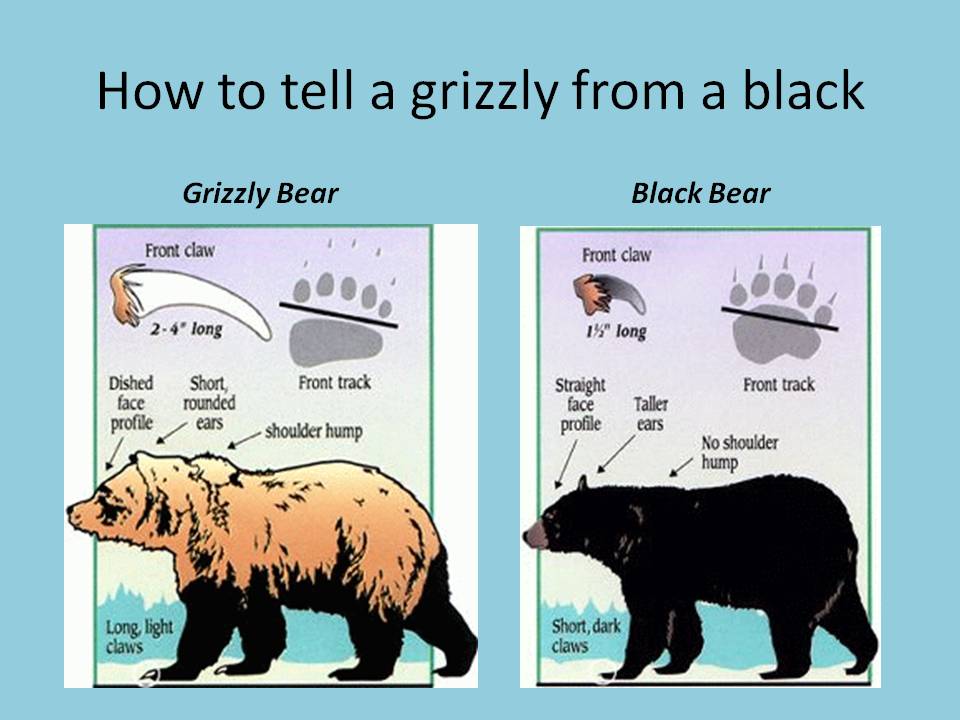
Can you tell a grizzly from a brown bear?  Chart from U.S. Fish and Wildlife Service

Can you tell a grizzly from a brown bear? Chart from U.S. Fish and Wildlife Service

Update, 1-30-2010: The chart linked to above has disappeared in a website redesign.  Below is a crude representation of the chart I made from a U.S. Fish and Wildlife information sheet on grizzlies, here.

How to tell a grizzly from a black (.pdf download)

Grizzly bear/black bear identification chart, adapted from USFWS by Ed Darrell, Millard Fillmore's Bathtub

Grizzly bear/black bear identification chart, adapted from USFWS by Ed Darrell, Millard Fillmore's Bathtub


Denialism doesn’t work: Polar bears still in trouble

February 9, 2009

Is there a climate change denialist blog that hasn’t tried to claim that the rest of the world is crazy, and that polar bears are in no danger at all?

As a tactic to save polar bears, denial doesn’t work.  Arctic Economics reports on research showing polar bears often go without food, a bad tactic for long-term survival.

Polar bear in the open ocean, Los Angeles Times photo

Polar bear in the open ocean, Los Angeles Times photo

You want that in English?  Sure:  Polar bears are starving to death because of climate change.  Shifts in the ice have ruined their hunting.

And, as often these days, I mention that here because it is one more case where “falsified data” or “badly placed measuring stations” can’t affect the outcome.  Polar bears don’t read The Economist. Last I checked ticket sales, no polar bear had ever seen Al Gore’s movie, let alone been misled by it.  It cannot be the case that polar bears starve because they believe hyped and false claims about global warming.  Polar bears starve because it’s really warmer.

___________

Update, 3-5-2009 — One of the signs of insanity among warming disbelievers is their practice of censoring comments on their blogs, when the blog owner edits the comments of opponents to make them look silly and, importantly, to keep contrary views backed by reason from infecting the blog.


Quote of the moment: Rachel Carson on DDT fish kills

July 9, 2007

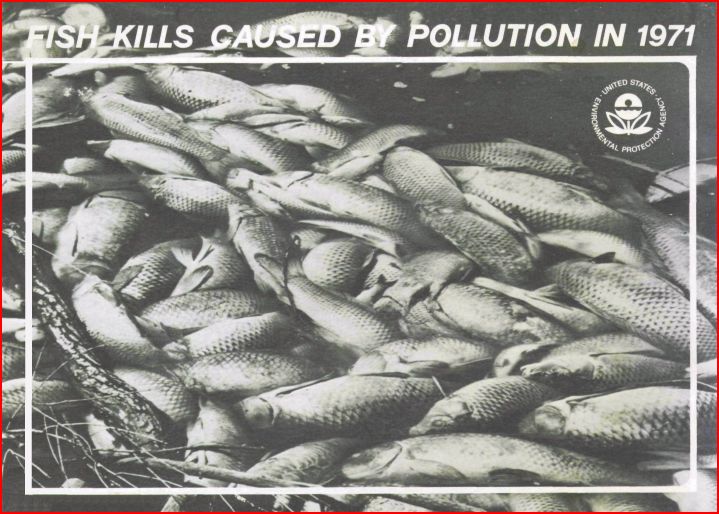
Cover of 1971 EPA publication, Fish Kills Caused By Pollution in 1971.

Cover of 1971 EPA publication, Fish Kills Caused By Pollution in 1971. According to the publication, in Texas, in 1971, 16 million fish died in just 6 pollution-caused incidents. (page 9 of the report).

One of the most spectacular fish kills of recent years occurred in the Colorado River below Austin, Texas, in 1961. Shortly after daylight on Sunday morning, January 15, dead fish appeared in the new Town Lake in Austin and in the river for a distance of about 5 miles below the lake. None had been seen the day before. On Monday there were reports of dead fish 50 miles downstream. . . . By January 21, fish were being killed 100 miles downstream. . . . During the last week of January the locks on the Intracoastal Waterway were closed to exclude the toxic waters from Matagorda Bay and divert them into the Gulf of Mexico.

. . . investigators in Austin noticed an odor associated with the insecticides. . . The manager of the (chemical) plant admitted that quantities of powdered insecticide had been washed into the storm sewer recently and, more significantly, he acknowledged that such disposal of insecticide spillage and residues had been common practice for the past 10 years.

. . . For 140 miles downstream from the lake the kill of fish must have been almost complete, for when seines were used later in an effort to discover whether any fish had escaped they came up empty. Dead fish of 27 species were observed, totaling about 1000 pounds to a mile of riverbank.

Rachel Carson, 1962, Silent Spring

Cribbed from the US Geological Survey site.