Typewriter of the moment: W. H. Auden at Swarthmore

June 25, 2008

Poet W. H. Auden taught students at Swarthmore for three years, 1942-1945. Swarthmore’s library started rather early to collect Auden’s manuscripts and other materials, including the typewriter he used there — an Underwood, as you can see, below.

Auden's typewriter during his Swarthmore years (1942-1945).

Auden’s typewriter during his Swarthmore years (1942-1945).

The library has a detailed, on-line exhibit of Auden’s work and associations with the college, material useful for student research and in-class presentations related to his work.

Auden’s poetry was contemporary, and it reflected the fears and passions of lovers, and lovers of liberty, in the face of the fascist threat of World War II.  Auden died, aged by tobacco, alcohol and barbituates, in 1973, aged 67.

Resources:

Add to FacebookAdd to NewsvineAdd to DiggAdd to Del.icio.usAdd to StumbleuponAdd to RedditAdd to BlinklistAdd to TwitterAdd to TechnoratiAdd to Furl

Save

Save

Save

Save


Query to historians: Material on German-American Internment in WWII?

June 14, 2008

Historians, help me out: What do you know about the internment of German Americans and Italian Americans during World War II?

The website of the German-American Internee Coalition lists several sources, and it has a lengthy set of lesson plans (too much for use in Texas, I fear). Is this information accurate? Has anyone used it in a classroom, and can you tell us your experience? Is there a mention of this in your world history or U.S. history text?

Please respond in comments.

Gate and guard tower at Fort Lincoln, ND, intern site for German-Americans and othersPhoto: At sunset, the gate and guard tower at Fort Lincoln, North Dakota, where German-Americans and Japanese-Americans were interned during World War II. From the John Christgau Collection of photos; courtesy the site at the German-American Internee Coalition (GAIC).

Typewriter of the moment: Heart Mountain Japanese internment camp

April 14, 2008

A remarkable device, in sad, remarkable circumstances.

The photos below show a typewriter that produces Japanese characters, an invention of no small achievement.

The photos also show American citizens, arrested for being Japanese, in the Heart Mountain internment camp in Wyoming, during World War II. They’re getting the machine in operation to produce a camp newspaper.

Newspaper volunteers reassemble a Japanese typewriter, for the Heart Mountain Sentinel

The official caption:

Members of the staff and volunteer helpers reassemble a privately owned Japanese typewriter to be used for the Japanese language edition of the Heart Mountain Sentinel, Center newspaper. The paper is wrapped around the rubber cylinder, the typist pushes the roller riding platen over the bed of type. After picking the next character, a lever is operated which picks up the type, presses it against the paper and replaces it in its niche. Complicated in appearance and operation, due to the shorthand characteristics of Japanese writing, the advance of thought is nearly equal in speed to a standard English typewriter. — Photographer: Parker, Tom — Heart Mountain, Wyoming. 1/13/43

Heart Mountain Relocation Center, workers assemble Japanese character typewriter for the newspaper, 1943

Official caption:

This complicated looking gadget is a standard Japanese typewriter, the private property of a resident of Japanese ancestry at the Heart Mountain Relocation Center. The machine, loaned to the center newspaper for its Japanese section which is printed for for the purpose of informing those residents unable to read English, is here being assembled by Sentinel staff members. The paper is wound on the round drum, which operates on rollers over the type bed, spotted over the required character, an arm picks the metal slug from the bed, presses it against the paper and returns it to its niche. Due to the shorthand character of Japanese printing, the typewriter is nearly equal in speed in conveying thoughts as a standard English typewriter. — Photographer: Parker, Tom — Heart Mountain, Wyoming. 1/13/43

These photos are available from several sites. The best quality is probably from UC Berkeley’s Bancroft Library’s contribution to the California Digital Library. Office Museum.com also carries the photos, with attribution to the Department of Interior, War Relocation Authority, National Archives, Still Picture Branch, NWDNS-210-G-E691 and E728.

From the Office Museum:

The first typewriter with Chinese characters was produced about 1911-14. Nippon Typewriter Co. began producing typewriters with Chinese and Japanese characters in 1917. “The Nippon has a flat bed of 3,000 Japanese characters. This is considered a shorthand version since the Japanese language contains in excess of 30,000 characters.” (Thomas A. Russo, Office Collectibles: 100 Years of Business Technology, Schiffer, 2000, p. 161.) A successor company, Nippon Remington Rand Kaisha, was producing similar machines in the 1970s.

To use the typewriter, paper is wrapped around the cylindrical rubber platen, which moves on rollers over the bed of type. The operator uses a level to control an arm that picks up a piece of metal type from the bed, presses it against the paper, and returns it to its niche. While the machine is complicated, because of the shorthand character of Japanese writing, the Japanese language typewriter is nearly equal to an English language typewriter in speed for recording thoughts.

Other posts on typewriters, here. Other posts on Japanese internment, here.


Anniversary of the Ardeatine Massacre

March 24, 2008

Do your texts even mention the Ardeatine Massacre?  On March 24, 1944, just outside of Rome, German troops murdered 335 Italians in a cave, in revenge for an attack on a column of German troops by an Italian resistance group that killed 31 German soldiers.

A Quantum Diaries Survivor wrote last year about the settling of a journalism controversy over the events.  I wrote moreThis year a blog tightly focused on executions — ExecutedToday.com —  marks the actual anniversary.


Last flag-raising vet from Iwo Jima, Raymond Jacobs

February 7, 2008

Raymond Jacobs died February 5 — he is thought to be the last surviving U.S. soldier pictured in the photos of the flag-raisings on Iwo Jima in 1945.

Raymond Jacobs looks up at flag, Iwo Jima 1945 - AP photo In the photo at right, Ray Jacobs is the radioman looking up; Associated Press photo

BBC news carried the story.

Raymond Jacobs died of natural causes at the age of 82 last week, his daughter told the Associated Press

Jacobs said he was present at the first flag raising, captured by a photographer for Leatherneck magazine. A later flag-raising, to put up a larger flag, was photographed by Joe Rosenthal, who won a Pulitzer Prize for the photo.

He is said to have returned to his unit by the time a more famous Associated Press photograph of a second flag-raising was taken later the same day.

Jacobs later fought in the Korean conflict in 1951 before retiring as a sergeant. He went on to work as a reporter, anchor and news director in local television in Oakland.

Eyewitnesses to the two World Wars dwindle in numbers. Historians and friends should be certain to capture their stories before they are gone.

Japan renamed the island Iwo To, its name prior to the war.


Found: Last photo of Ernie Pyle

February 4, 2008

A reporter named Richard Pyle — no relation, he notes — writing for the Associated Press reports that a photograph of Ernie Pyle has surfaced, showing him dead, after he was hit by a Japanese machine gun bullet while reporting on U.S. troops, on the island of Ie Shima, on April 18, 1945.

Photos here, at the Dallas Morning News site. Story here.

Especially in black and white, the photo is not so macabre as to shock. Pyle looks peaceful, asleep, as Richard Pyle wrote. The value is historical. It’s a reminder that reporters, too, put themselves in harm’s way, to inform Americans about the world, providing the information our democratic republic needs to function well.

Remember to vote in your state’s primary elections this year. Deserve their heroism.

Earlier notes on Ernie Pyle:

Read the rest of this entry »


Texas teachers: 9th Legacies Dallas History Conference, January 26

January 20, 2008

You’re not registered yet?

Students learn history best when it affects them directly, or when they can see the stuff close up. The Legacies Dallas History Conferences focus on history in and around Dallas, Texas. This is prime material for Texas and Dallas history, economics and government classes.

The 9th Annual Legacies Dallas History Conference is set for next Saturday, January 26, in the half-day from 8:30 a.m. to 1:10 p.m: “Dallas Goes to War: Life on the Homefront.” $40 for nine presentations — or $100 brings an invitation to schmooze with the presenters on Friday night, before the conference. The conference will be at the Hall of State at Fair Park. The conference was assembled by Dr. Michael V. Hazel.

If you’re teaching at a high school or middle school in the Dallas area, print this off for every social studies and English teacher at your school, and pass it out to them Tuesday (or Monday if you’re open then).

Nancy Harkness Love and Betty Huyler Gillies, first women to fly B-17, during WWII

Many of the conference presentations roll down that alley of a topic most Texas students need more of, the events around World War II. One session dives into Vietnam, one goes back to the Civil War, and World War I is remembered.

Bob Reitz, the public historian who curates the amazing Jack Harbin Museum of Scout History at Dallas’s Camp Wisdom, alerted me to the conference with a plug to his colleague’s presentation. Anita Mills-Barry will present her paper, “Homefront Scouting During World War II: Participation by Boy Scouts and Girl Scouts in the Civilian Effort in Dallas County.”

A copy of the web invitation to the conference below the fold.

Read the rest of this entry »


Quote of the moment: Peter Drucker, on leadership and very high objectives

December 27, 2007

I will never forget when [Franklin D.] Roosevelt announced that we would build thirty thousand fighter planes. I was on the task force that worked on our economic strength, and we had just reached the conclusion that we could build, at most, four thousand. We thought, “For goodness sake — he’s senile!” Two years later we built fifty thousand. I don’t know whether he knew, or if he just realized that unless you set objectives very high, you don’t achieve anything at all.


BusinessWeek cover, Why Peter Drucker's Ideas Still Matter; November 27, 2005

BusinessWeek cover, Why Peter Drucker’s Ideas Still Matter; November 27, 2005

–Peter R. Drucker (November 19, 1909–November 11, 2005), in interview with Bill Moyers, 1988

More: 


Silvestre S. Herrera, first Arizonan to win Medal of Honor

December 1, 2007

From the East Valley Tribune, November 9, 2007:

World War II veteran Silvestre S. Herrera, left, is applauded Thursday by Dr. Connie Mariano, veteran and former White House physician. Mariano gave a speech honoring veterans at a ceremony in Scottsdale.

“HEROES SALUTE: World War II veteran Silvestre S. Herrera, left, is applauded Thursday by Dr. Connie Mariano, veteran and former White House physician. Mariano gave a speech honoring veterans at a ceremony in Scottsdale.”
Photo by Bettina Hansen, For the Tribune

For Veterans Day this year, they gathered in Scottsdale, Arizona — mostly local veterans. Among them was World War II vet Silvestre Herrera, who fought in France.

One by one, veterans took their turn shaking hands and exchanging nods of respect with war hero Silvestre S. Herrera, 91, as he stood proudly wearing his Medal of Honor around his neck.

About 40 people gathered in 90-degree heat in north Scottsdale admiring a presentation of colors and listening in reverence to a high school band play in honor of the upcoming Veterans Day.

“It was very touching,” said Jackie Wolf, executive sales director for Classic Residence at Silverstone, where the event took place Thursday on a breezy patio.

It was fitting, somber and joyful all at once. A lot of veterans, paying honor to all veterans. [More below the fold]

Read the rest of this entry »


Jefferson DeBlanc, teacher, Medal of Honor winner

November 28, 2007

Jefferson DeBlanc, Sr, at the WWII Memorial - Medal of Honor Winner

You can just see the kid trying to get the goat of the physics teacher:“Hey, Teach! What do you think 5Gs feel like when one of those fighter pilots pulls a real tight turn?”

And you can see the teacher at the chalkboard scribbling a formula the kid doesn’t want to know, and a smile creeping over his face.

“It’s nothing like hitting the shark-infested Pacific — salt water, and you’re wounded — and then being traded for a ten-pound sack of rice! That’ll get your gut more.”

And don’t you wonder, did the kids ever think to ask him his view of the campaign against the Japanese in the Solomon Islands, for help on their U.S. history exams? Did they ever think he might have some knowledge to share?

Jefferson DeBlanc would have shared wisdom certainly, though it’s uncertain he would have shared his war experiences as a fighter pilot. He died last Thursday in St. Martinville, Louisiana. He was 86. DeBlanc was the last surviving Medal of Honor winner from World War II in Louisiana. Col. Jefferson DeBlanc, Sr.

What a story!

The incident that earned Jefferson the nation’s highest military honor took place Jan. 31, 1943, during operations against Japanese forces off Kolombangara Island in the Solomon Islands.

A Japanese fleet was spotted headed toward Guadalcanal. U.S. dive bombers were sent to attack the fleet, with fighter aircraft deployed to protect the bombers. In a one-man Grumman Wildcat fighter, DeBlanc led a section of six planes in Marine Fighting Squadron 112, according to the citation that accompanied his Medal of Honor.

At the rendezvous point, DeBlanc discovered that his plane, which was dubbed “The Impatient Virgin,” was running out of fuel. If DeBlanc battled the Japanese Zero fighter planes, he would not have enough fuel to return to base. Two of his comrades, whose planes malfunctioned, turned back, according to a 1999 article in the New Orleans Times-Picayune.

“We needed all the guns we could get up there to escort those bombers,” DeBlanc said in the Times-Picayune article. “I figured if I run out of gas, I run out of gas. I figured I could survive a bailout. I had confidence in my will to survive. You’ve got to live with your conscience. And my conscience told me to go ahead.”

DeBlanc and the other pilots waged fierce combat until, “picking up a call for assistance from the dive bombers, under attack by enemy float planes at 1,000 feet, he broke off his engagement with the Zeros, plunged into the formation of float planes and disrupted the savage attack, enabling our dive bombers and torpedo planes to complete their runs on the Japanese surface disposition and withdraw without further incident,” the citation says.

Ultimately, DeBlanc shot down two float planes and three of the fighters. But a bullet ripped through DeBlanc’s plane and hit his instrument panel, causing it to erupt into flames. DeBlanc “was forced to bail out at a perilously low altitude,” according to the citation.

“The guy who shot me down, he saw me bail out,” DeBlanc said in a 2001 article in the State-Times/Morning Advocate of Baton Rouge, La.. “He knew I was alive. I knew they (the Japanese) were looking for me. But I’m not a pessimist. I knew I could survive. I was raised in the swamps.”

A Louisiana kid raised in the swamps, a Tuba City, Arizona, kid raised in a hogan on a reservation, a kid from Fredericksburg, Texas, a kid from Abilene, Kansas, another kid from Columbus, Ohio, a West Point graduate with a corn-cob pipe — the reality of the people who fought the war looks like a hammy line-up for one of the post-war movies about them. Maybe, in this case, there was good reason for the stereotypes.

After his plane was shot down in 1943, DeBlanc swam to an island and slept in a hut until he was discovered by islanders and placed in a bamboo cage. The man who gave a sack of rice for him was Ati, an islander whom DeBlanc later called a guardian angel, responsible for orchestrating his rescue by a U.S. Navy boat.

DeBlanc served a second tour of overseas service in Marine Fighting Squadron 22 in the Marshall Islands. By the end of his service, he had shot down nine enemy planes.

On Dec. 6, 1946, President Truman awarded DeBlanc the Medal of Honor. His other honors include the Distinguished Flying Cross, several awards of the Bronze Star and the Purple Heart. In 1972, after serving six years as commander at Belle Chasse Naval Air Station, DeBlanc retired from the Marine Corps Reserve.

Then, as if to make the model for Tom Brokaw’s later book, DeBlanc went back home to mostly-rural Louisiana, and made the world a much better place.

At home, DeBlanc earned two masters’ degrees in education from Louisiana State University in 1951 and 1963, and a doctorate in education from McNeese State University in 1973. For years, he taught in St. Martin parish and supervised teachers.

Just a normal guy to his kids, neighbors and students:

Despite the illustrious awards, [daughter] Romero [DeBlanc] remembers a loving father first and dedicated educator second.

“I was very close to my father,” she said. “I could always talk to him. He taught me to drive. He taught school. He was very friendly with his students. He would come into the classroom and say, ‘I lost the test.’ Then he would look around and find it in the trash can. Of course he placed it in the trash can. He had a great sense of humor.”

Surely DeBlanc’s passing should have been worthy of note on national television news programs, and in the larger national print media. There was a note on the obituary page of the Dallas Morning News, and the Los Angeles Times obituary cited above. But DeBlanc has not yet gotten the recognition he probably deserved. A young cornerback for the Washington Redskins also died over the weekend.

No room for heroes in the news?

Resources for Teachers:

Read the rest of this entry »


History text accuracy: Okinawa mass suicides

October 25, 2007

Controversy surrounds history textbooks all over the world. Texans may be a bit more sensitive to the issues while the Texas Education Agency is revising curricula, but others are even more sensitive – such as Turkey, where controversy over the Armenian Genocide threatens to derail Turkey’s 40-year project to join the European Union; Japan, where citizens and other nations protest failures to mention harms done to people by the Japanese Imperial Army during World War II; and even Europe in general, where controversy surrounds efforts to find a unifying, Europe-wide culture.

History is important in our relations with other nations. With increasing globalization, it becomes ever more important that all citizens have basic understanding of their local history, their national history, and world history, if only to avoid the social faux pas in socializing with people from other nations.

The issue is hot in Japan right now. Okinawa, a formerly independent kingdom annexed by Japan in the 19th century (did you know that?), hosted the biggest protest demonstration the island prefecture has ever seen, earlier this month – a protest over the changing of a few words in Japanese school history texts, removing the responsibility for mass suicides on Okinawa from the Japanese Imperial Army.

A story in the New York Times describes the anguish felt by Okinawans:

Brainwashed by Japanese Imperial Army soldiers into believing that victorious American troops would rape all the local women and run over the men with their tanks, Mr. Kinjo and others in his village here in Okinawa thought that suicide was their only choice. A week before American troops landed and initiated the Battle of Okinawa in March 1945, Japanese soldiers stationed in his village gave the men two hand grenades each, with instructions to hurl one at the Americans and then to kill themselves with the other.

Most of the grenades failed to explode. After watching a former district chief break off a tree branch and use it to kill his wife and children, Mr. Kinjo and his older brother followed suit.

”My older brother and I struck to death the mother who had given birth to us,” Mr. Kinjo said in an interview at the Naha Central Church, where he is the senior minister. ”I was wailing of course. We also struck to death our younger brother and sister.”

Mr. Kinjo agreed to tell his story again because the Japanese government is now denying, in new high school textbooks, that Okinawans had been coerced by Imperial troops into committing mass suicide.

The proposed changes to the school textbooks — the deletion of a subject, the change to the passive voice — amounted to just a couple of words among hundreds of pages. But the seemingly minor grammatical alterations have led to swelling anger in the Okinawa islands in Japan, cresting recently in the biggest protest here in at least 35 years and stunning the Japanese government.

How should texts deal with such issues?

China and Korea also protested the rewrite. Hot button issues involve the Japanese invasion and taking of Nanking in 1937, generally known to western historians as “the rape of Nanking;” Japanese treatment of Prisoners of War (POWs), including the Bataan Death March in the Philippines, what amounted to slave labor using POWs in Japan, and Korean women impressed into service as prostitutes to the Japanese Army, at what are euphemistically called “comfort stations.”

Texas history standards writers may benefit from taking a look at some of these other controversies, in other places. These lessons can apply to Texas and U.S. history, where Anglo and European colonist treatment of aboriginal natives is certainly an issue, but also to subjects such as biology and the treatment of evolution, health and the treatment of preventing sexually-transmitted diseases, and environmental science, and the treatment of pollution and climate change issues.


Pete Seeger: Standing taller than his critics

September 10, 2007

Some people can’t let go of the past, and like the greedy chimpanzee who grasps the rice in the jar, and then is trapped when he cannot pull out his fist nor will he give up his prize to save his freedom, they trap themselves out of a good life.

Like this fellow, whose father’s dislike of an old political position of Pete Seeger kept them both from a good concert. He appears to agree with his father, though, thinking that somehow Seeger is responsible for the evils of Stalinism, and complaining that Seeger was tardy in making note of the fact that Stalin was evil. And Instapundit’s Glenn Reynolds agrees, profanely, and inaccurately, as I’ll explain below the fold. But heed this warning: I’m explaining at length.

Get a life, people! Pete Seeger did.

Read the rest of this entry »


Ardeatine Massacre: Bombers were soldiers, not terrorists

August 13, 2007

Our Italian physicist friend, Dorigo, at A Quantum Diaries Survivor reports that an Italian court ruled against a newspaper that started a campaign to deny the history of the Ardeatine Massacre.

Good news today. The supreme court of Cassazione in Italy has ruled that the press campaign labeling “terrorists” the GAP partisans who organized the bombing of Via Rasella in nazi-occupied Rome in 1944, launched by the national newspaper “Il Giornale”, was a striking example of manipulation of historic truth for political means. The newspaper is owned by Paolo Berlusconi (brother of Silvio, formerly premier of Italy in 1994 and 2001-2006), and was directed by Vittorio Feltri . . . a journalist who never hid his sympathy for the extreme right.

What was the Ardeatine Massacre?

Statue memorial to the victims of the Ardeatine Massacre, Italy Wikipedia:

The massacre of Fosse Ardeatine (Italian: Eccidio delle Fosse Ardeatine) took place in Rome, Italy during World War II. On 23 March 1944, 2 German soldiers, 31 Italian soldiers of Battaglione Bozen and a few Italian civilians passing along the road, were killed when members of the Italian Resistance set off a bomb close to a column of German soldiers who were marching on via Rasella[1]. This terrorist attack was led by the Gruppi di Azione Patriottica, of Rosario Bentivegna, Carla Capponi, Antonello Trombadori (Head of GAP in Roma) and the approval of Sandro Pertini (later President of Italian Republic), in order to provocate the reaction of SS troops.

Adolf Hitler is reported but never confirmed to have ordered that within 24 hours, one-hundred Italians were to be shot for each dead German. Commander Herbert Kappler in Rome concluded that ten Italians for each dead German would be sufficient and quickly compiled a list of 320 civilians who were to be killed. Kappler voluntarily added ten more names to the list when the 33rd German/Italian died after the Partisan attack. The total number of people murdered at the Fosse Ardeatine was 335, most Italians. The largest cohesive group among the murdered were the members of Bandiera Rossa, a Communist military Resistance group.

Why is there controversy 60 years later? Read the rest of this entry »


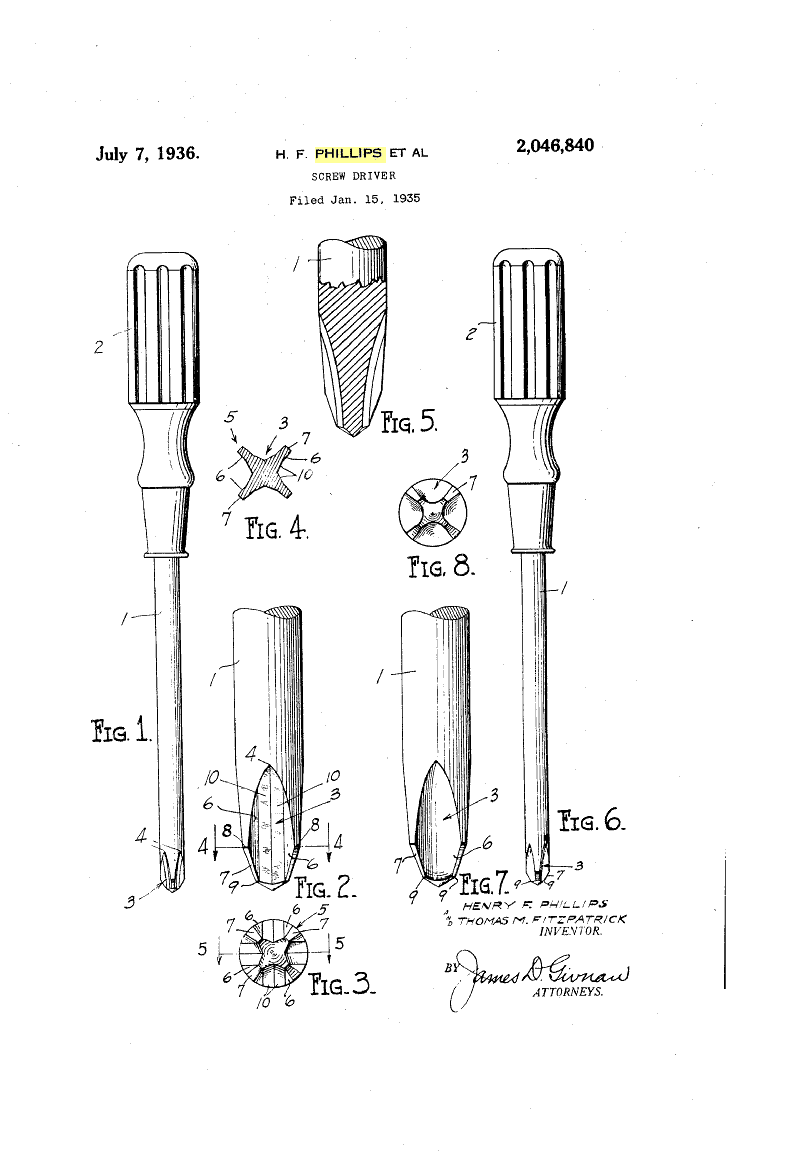
Henry F. Phillips — when do we celebrate?

August 10, 2007

Herny Phillips' patent for the Phillips screw and screwdriver (Google Patents)

Patent drawings for the Phillips screw and screwdriver, 1936

Only Crook in Town was alerted to the work of Henry F. Phillips by an alert and helpful librarian (well — aren’t they all?). She worries –January 15 is Martin Luther King, Jr., Day, and July 7 is the middle of the summer — what day would be appropriate to celebrate the invention and patenting of the Phillips Screwdriver? (If image above does not display, click the thumbnail picture at the end of the post.)

Ah, history teachers, you noticed that the drawing comes from Google’s files of patent applications. And now you wonder: What other wonderful illustrations can we legally rip off to use in class? Wonderful question — what do you find?

The Phillips screwdriver came along in time for World War II and the mass assembly of aircraft, and aircraft instrument panels. The Phillips screw head helped aircraft assemblers keep from scratching the black metal of the rest of the panel while securing instruments into the forms.

Read the rest of this entry »


88-year-old man finally gets Eagle Scout rank

July 29, 2007

Joining the elite, top 5% of all Boy Scouts, Walter Hart was awarded his Eagle rank in a ceremony Saturday in Fort Myers, Florida. Walter is 88.

There was a 70+ year delay in Walter’s ceremony — he passed the requirements for the rank, but then went off to fight in World War II before the award was made.

The Associated Press story ran in the New York Times:

”I’ve been looking forward to this for a long time,” said Hart, who lives in a retirement center in nearby Lehigh Acres.

Scout officials say he may be the oldest person to ever earn the honor.

Hart joined the Cub Scouts in 1928 in Malden, Mass., and earned 23 merit badges during his years as a Boy Scout, scouting officials said. Of the 120 merit badges available, 21 must be earned to qualify for Eagle Scout rank.

It all got set aside when he joined the Navy during World War II and served two years aboard the USS Alfred A. Cunningham.

Last year, he rediscovered some of his old Boy Scout memorabilia, including documents that showed he completed the requirements for his Eagle Scout rank. He contacted the Scouts about receiving his award.

”I think this was something that was always on his mind, but every time he went to go do it, something else came up,” daughter Elizabeth Gatturna said. ”I know how hard he’s tried to get to this point.”

Congratulations, Walter.

Walter Hart, 88, rec'd Eagle Badge 7-28-2007

  • Walter Hart, 88, is shown wearing a 2007 Boy Scout uniform with the merit badge sash he used as a youth, prior to World War II. Apart from the not-quite fit, we can tell the sash is his old one because many of the merit badges are in their pre-World War II designs, and the sash shows rank badges for Star Scout and Life Scout; current uniform rules do not allow rank badges on the sash. Under Scout rules, Walter may wear this sash for his Scouting career. Associated Press photo.

Spread the news, please:

Add to FacebookAdd to NewsvineAdd to DiggAdd to Del.icio.usAdd to StumbleuponAdd to RedditAdd to BlinklistAdd to TwitterAdd to TechnoratiAdd to Furl