The view from the seat of the pilot of the Enola Gay / Smithsonian National Air and Space Museum

December 19, 2010

Old friend and thorn in the side Gil Brassard in Baton Rouge alerted us to this wonderful marriage of modern technology and history from David Palermo Photography — an interactive, panoramic view of the cockpit of the Enola Gay, the B-29 from which the first atomic bomb used in war was dropped.

How can you use this in class, teachers?  Got a lesson plan that puts a student in the seat of the pilot?

Vodpod videos no longer available.

Enola Gay / Smithsonian National Air and Space …, posted with vodpod

For technical reasons beyond my ken, one may not make this a full screen image. No problem. Go to David Palermo’s site, and see this as big as your computer monitor. I recommend viewing it there — it’s better, really.

Palermo has a portfolio of cockpits he’s shot at the Smithsonian, including the French Concorde, Gemini VII, a Bell Huey helicopter, Mercury Friendship VII, and a Lockheed Martin X-35 — with spherical panoramas available of those and more (look for the link that says “HD360°” and look at the drop-down menu).  He sells massive prints of the cockpits — something special for aviation and space buffs.


2010 Anniversary of Pearl Harbor – Remembering

December 7, 2010

Encore post, mostly, from December 7, 2006.

1941 AP file photo, small boat rescues victims from U.S.S. West Virginia

Caption from Naval History and Heritage Command: Photo #: 80-G-19930
Pearl Harbor Attack, 7 December 1941
Sailors in a motor launch rescue a survivor from the water alongside the sunken USS West Virginia (BB-48) during or shortly after the Japanese air raid on Pearl Harbor.
USS Tennessee (BB-43) is inboard of the sunken battleship.
Note extensive distortion of West Virginia’s lower midships superstructure, caused by torpedoes that exploded below that location.
Also note 5″/25 gun, still partially covered with canvas, boat crane swung outboard and empty boat cradles near the smokestacks, and base of radar antenna atop West Virginia’s foremast.
Official U.S. Navy Photograph, National Archives Collection.

Today is the 69th anniversary of Japan’s attack on the U.S.’s Pacific Fleet at Pearl Harbor, Hawaii.

Many Americans fly their U.S. flags today.  The date is not one specified in law for flag-flying.

Our local newspaper, The Dallas Morning News, ran a front-page story on survivors of the attack in 2006, who have met every five years in reunion at Pearl Harbor. [December 7, 2006] was their last official reunion. The 18-year-olds who suffered the attack, many on their first trips away from home, are in their 80s now. Age makes future reunions impractical.

In 2010, it is estimated that fewer than 4,000 veterans of Pearl Harbor still live to remember, though, of course those surviving do.

From the article:

“We’re like the dodo bird. We’re almost extinct,” said Middlesworth, now an 83-year-old retiree from Upland, Calif., but then – on Dec. 7, 1941 – an 18-year-old Marine on the USS San Francisco.

Nearly 500 survivors from across the nation were expected to make the trip to Hawaii, bringing with them 1,300 family members, numerous wheelchairs and too many haunting memories.

Memories of a shocking, two-hour aerial raid that destroyed or heavily damaged 21 ships and 320 aircraft, that killed 2,390 people and wounded 1,178 others, that plunged the United States into World War II and set in motion the events that led to atomic bombings of Hiroshima and Nagasaki.

“I suspect not many people have thought about this, but we’re witnessing history,” said Daniel Martinez, chief historian at the USS Arizona Memorial. “We are seeing the passing of a generation.”

Another article notes the work of retired history professor Ron Marcello from the University of North Texas, in Denton, in creating oral histories from more than 350 of the survivors. This is the sort of project that high school history students could do well, and from which they would learn, and from which the nation would benefit. If you have World War II veterans in your town, encourage the high school history classes to go interview the people. This opportunity will not be available forever.

There is much to be learned, Dr. Marcello said:

Dr. Marcello said that in doing the World War II history project, he learned several common themes among soldiers.

“When they get into battle, they don’t do it because of patriotism, love of country or any of that. It’s about survival, doing your job and not letting down your comrades,” he said. “I heard that over and over.”

Another theme among soldiers is the progression of their fear.

“When they first got into combat, their first thought is ‘It’s not going to happen to me.’ The next thought is ‘It might happen to me,’ and the last thought is ‘I’m living on borrowed time. I hope this is over soon,’ ” Dr. Marcello said.

Dr. Marcello said the collection started in the early 1960s. He took charge of it in 1968. Since Dr. Marcello has retired, Todd Moye has taken over as the director.

Other sources:

While this is not one of the usual dates listed by Congress, you may fly your U.S. flag today.

End of 2006 post —

Other resources (2007):

USS Missouri Memorial – Main Battery - from the Panoramas of World War II site

USS Missouri Memorial – Main Battery – from the Panoramas of World War II site


WWII veterans tell their stories – Central Florida WWII Museum

November 1, 2010

Part of the Veterans History Project, a museum in Florida interviews World War II veterans, and much of the material shows up on YouTube.

These interviews offer great resources for student projects, and are simply a grand way to capture history.

See this story about “Flying the Hump,” transporting war materiel over the Himalayas into China; it’s an interview with E. W. “Bill” Cutler, one of the fliers who survived:

This interview caught my attention for a personal reason.  My uncle, Bruce Davis, died flying the route.  His aircraft and remains were recovered more than 30 years later — someone stumbled on the wreckage accidentally.  When an aircraft went down for any reason (usually weather), the crews passed into a limbo that comprised a special hell for their families.  It was almost impossible that anyone would survive, as Cutler details.  But, with no wreckage and no remains, there were always questions.

Update: Brother Dwight informed me his father-in-law served at the last base before the airplanes went over the mountains.  We have more family Himalayan connections than I knew.

This interview has a mere 152 views as of this posting — pass it around, let’s bump the viewing total up, and get the story out.  At YouTube, the Central Florida WWII Museum has its own channel, listing several similar interviews.

I could see each student assigned to one interview, to tell the story of the interview to the class, to research the background of the theatre of war discussed, the battle, the incident, the armaments, the nations and people involved — to make a history narrative out of the interview, in other words.    What other uses do you see?

Here’s the rest of the story:  The museum has not yet been built.  This project, the video interviews, is a place-holder, a way to communicate while raising the money to build an edifice to honor the veterans more appropriately.  It’s a virtual museum — one your students may browse from the classroom.  How cool is that?


October 31 anniversaries: Remember the Reuben James

October 31, 2010

Tell me, what were their names?  Tell me what were their names? Did you have a friend on the good Reuben James?

An encore post from 2008, mostly:

October 31 hosts several famous anniversaries. It is the anniversary of Nevada’s statehood (an October surprise by Lincoln for the 1864 campaign?). It is the anniversary of the cleaving of western, catholic Christianity, as the anniversary of Martin Luther’s tacking his 95 theses to the door of the church in Wittenburg, Germany in 1517, the formal start of the Reformation. Maybe the original Christian trick or treat.

U.S.S. Reuben James sinking, October 31, 1941 - National Archives photo

U.S.S. Reuben James sinking, October 31, 1941 - National Archives photo

October 31 is also the anniversary of the sinking of the World War I era Clemson-class, four-stack destroyer, U.S.S. Reuben James (DD-245), by a German U-boat. Woody Guthrie memorialized the sad event in the song, Reuben James, recorded by the Almanac Singers with Pete Seeger (see also here, and here), and later a hit for the Kingston Trio. The Reuben James was sunk on October 31, 1941 — over a month before the Japanese attack on Pearl Harbor. Details via Wikipedia (just to make you school librarians nervous):

USS Reuben James (DD-245), a post-World War I four-stack Clemson-class destroyer, was the first United States Navy ship sunk by hostile action in World War II and the first named for Boatswain’s Mate Reuben James (c.1776–1838), who distinguished himself fighting in the Barbary Wars.

This history figures into the current presidential campaign in a small way: One of the internet hoax letters complaining about Barack Obama claims that the U.S. entered World War II against Germany although the Germans had not fired a single round against the U.S. The 115 dead from the crew of 160 aboard the James testify to the inaccuracy of that claim, wholly apart from the treaty of mutual defense Germany and Japan were parties to, which required encouraged Germany to declare war upon any nation that went to war with Japan (see comments from Rocky, below). After the U.S. declaration of war on Japan, Germany declared war on the U.S., creating a state of war with Germany.

This history also reminds us that many Americans were loathe to enter World War II at all. By October 1941, Japan had been occupying parts of China for ten years, and the Rape of Nanking was four years old. The Battle of the Atlantic was in full swing, and the Battle of Britain was a year in the past, after a year of almost-nightly bombardment of England by Germany. Despite these assaults on friends and allies of the U.S., and the losses of U.S. ships and merchant marines, the U.S. had remained officially neutral.

Many Americans on the left thought the sinking of the Reuben James to be the sort of wake-up call that would push Germany-favoring Americans to reconsider, and people undecided to side with Britain. The political use of the incident didn’t have much time to work. Five weeks later Japan attacked Pearl Harbor, and by the end of 1941, the U.S. was at war with the Axis Powers.

Letter to the U.S. Navy asking the fate of friends aboard the U.S.S. Reuben James, November, 1941

Letter to the U.S. Navy asking the fate of friends aboard the U.S.S. Reuben James, November, 1941

Telegram informing his family of the death of Gene Guy Evans, of Norfolk, Virginia, lost in the torpedoing of the U.S.S. Reuben James

Telegram informing his family of the death of Gene Guy Evans, of Norfolk, Virginia, lost in the torpedoing of the U.S.S. Reuben James

The Kingston Trio sings, as the names of the dead scroll:

More, and Resources:


Relic bomb crater found in Darwin, Australia

October 20, 2010

A bit of World War II history:  Darwin, Australia, took more bombs than Pearl Harbor, during World War II.

We learn this from the Australian Broadcasting Corp. story on the recent rediscovery of a large bomb crater there:

Map of Australia

Map of Australia, from Australia.com

Bomb crater found in Darwin CBD

It has been confirmed that a large hole uncovered by earthworks in Darwin’s CBD is a bomb crater probably created during the first Japanese raid on Darwin in 1942.

The crater was spotted by a passing motorist who reported it to the Department of Heritage.

Archaeologist Silvano Jung has now investigated the site and says it is almost certainly a bomb crater.

“Judging by the diameter of the crater, it was probably a 1,000 pound bomb, or a 500 kilo bomb, dropped by a medium bomber either from Java or Ambon [in Indonesia],” he said.

“Most likely on February 19 [1942] as well.”

Mr Jung says the bomb crater will become a special part of Darwin’s history.

“Often it’s the small things in history that are really important and given that this is the only one, it makes it unique. It’s a unique hole in Darwin,” he said.

Darwin was subjected to 63 bombing raids during the war, with more bombs dropped on the city than Pearl Harbour.

Now we study bomb craters in archaeology.

According to some reports, it is the sole surviving bomb crater from the war, in Darwin:

Northern Territory heritage Minister Karl Hampton said the exciting discovery on McMinn Street provided a clear link with the past.

“World War II is an important part of the Territory’s history and identity,” Mr Hampton said in a statement released on Wednesday.

“Territorians are proud of our unique history, and we now have another attraction no other capital city can match – an authentic World War II bomb crater.”


Music stopped the deadly sniper

October 2, 2010

Fascinating story well told by the man who lived it:  After D-Day, an Allied unit was pinned down by a sniper.  Unable to move, and on an inspired whim, one of the American soldiers, Jack Leroy Tueller,  took out his trumpet, and played “Lili Marlene.”

Jack Tuler holding his trumpet, at 90 (maniacworld)

Jack Tueller holding his trumpet, at 90 (image from maniacworld/ Wearethemusic.com)

In the morning he was introduced to a German soldier, a sniper who had surrendered, unable to keep fighting after some mysterious trumpeter played the song that made him think of his home, his mother, his girlfriend, and love.

Two minutes of amazing history, vividly told and played, suitable for classroom use.

Go view “Taming a Nazi sniper with a trumpet,” at ManiacWorld.


[Is this the lost video from above? I think so.]

Videos say that Jack Tueller is 90 years old.  I’m guessing the video is about a year old — does anyone know any more about Col. Jack Tuler, his story, or where he livesCould this be the late Jack Tuler of Chicago? Hey, anyone:  Where is Jack Tueller today?  Who has his life details?  (Tueller lives today in Bountiful, Utah, with his wife, Marjorie.  He still plays the trumpet.)

Tip of the old scrub brush to Kenny, in China, and to Common American Journal, who had a YouTube copy.  Special tip of the old scrub brush to J. A. Higginbotham, who tracked down the Deseret News stories.

(Our YouTube host misspelled the name of the song, I think.)

_____________

Update, October 3, 2010: Reader J. A. Higginbotham tracked down two stories in the Deseret News, in Salt Lake City, about Col. Tueller.  I’ve corrected the spellings above, and edited otherwise to point to the details.  A new post is probably warranted.  Go to the Deseret News site and read their fine work, especially the long story by Doug Robinson.

Update March 2019: Both video links above seem to have died; here’s a video from StudiesWeekly.com, put up on YouTube in 2015.

Sad to hear, Jack Tueller died in 2016, at age 95.


Original Navajo Code Talkers: Two remain

October 1, 2010

Alan Dale June died in September in Window Rock, Arizona.  He was 91.

Alan Dale June, Navajo Code Talker, accepts Congressional Gold Medal from President George W. Bush

Alan Dale June, Navajo Code Talker, accepted the Congressional Gold Medal from President George W. Bush, in a ceremony in the U.S. Capitol on July 26, 2001. June died in September 2010, at 91. Photo Credit: John Klemmer, U.S. Senate Photo Studio.

June was one of three surviving Navajo Code Talkers out of 29 who developed the code and system by which they communicated by radio across the South Pacific Ocean, in Navajo.  Using a simple code for troops, ships, airplanes and other armaments, the Navajo Code Talkers passed crucial information between far-flung American forces, on regular radio waves.  Japanese forces could easily intercept the broadcasts, but they did not speak Navajo, nor did they break the Navajo code.

After the original 29, many more Navajos got training and performed the critical communications functions.

I met several of these men through the good graces of my brother, Jerry Jones, who helped promote their recognition when he worked in Page, Arizona, in public relations for the Salt River Project’s Navajo Power Station.  Jerry drew deep inspiration from the quiet dignity and great humility of these patriots.  He would have been gratified to see them get the Congressional Gold Medal, a belated and too-small recognition for the great service they rendered our nation.

RIP, Alan Dale June.

More:


Labor Day 2010 – Fly your flag!

September 6, 2010

Free Labor Will Win, poster from 1942, (Library of Congress)

Poster from the Office of War Information, 1942

It’s Labor Day 2010 in the United States, a federal holiday, and one of those days Americans are urged to fly the U.S. flag.

The poster was issued by the Office of War Information in 1942, in full color.  A black-and-white version at the Library of Congress provides a few details:

Labor Day poster. Labor Day poster distributed to war plants and labor organizations. The original is twenty-eight and one-half inches by forty inches and is printed in full color. It was designed by the Office of War Information (OWI) from a photograph especially arranged by Anton Bruehl, well-known photographer. Copies may be obtained by writing the Distribution Section, Office of War Information


History in photos – great art, good student project?

August 12, 2010

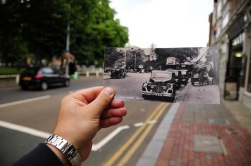
Earlier I found an idea I’ve not been able to incorporate into my classes, but which I still like:  Take historic photos of your town, go to the same place today and see what it looks like.

Comparing historic images with places today

Students could do this: Comparing historic images with places today

A Russian photographer takes the exercise further, and creates sometimes-stunning art.

Sergey Larenkov has photos from Europe in World War II.  He blends parts of those images with photos of the same places today, in cities across Europe. He has images from Berlin, Leningrad, and other cities (crawl over his LiveJournal site — there’s good stuff).

Sergey Larenkov, World War II historic photo overlay on modern shot - Leningrad?

Sergey Larenkov, World War II historic photo overlay on modern shot - is this Leningrad? Whose soldiers, what year?

Sergey Larenkov work, the Siege of Leningrad, and Leningrad today (reverting to the name St. Petersburg)

Sergey Larenkov work, the Siege of Leningrad, and Leningrad today (reverting to the name St. Petersburg)

Ghostly, no?

The photos show the destruction of war, and how far Europe has come since then.  It’s an astounding view of history.  If a picture is worth a thousand words, these photo mashups are worth ten thousand words or more.

Tip of the old scrub brush to Alices’ blog at My Modern Met.

Add to FacebookAdd to NewsvineAdd to DiggAdd to Del.icio.usAdd to StumbleuponAdd to RedditAdd to BlinklistAdd to TwitterAdd to TechnoratiAdd to Furl


Remembering D-Day, in 2010

June 6, 2010

Encore posts:

D-Day:  66 years ago today

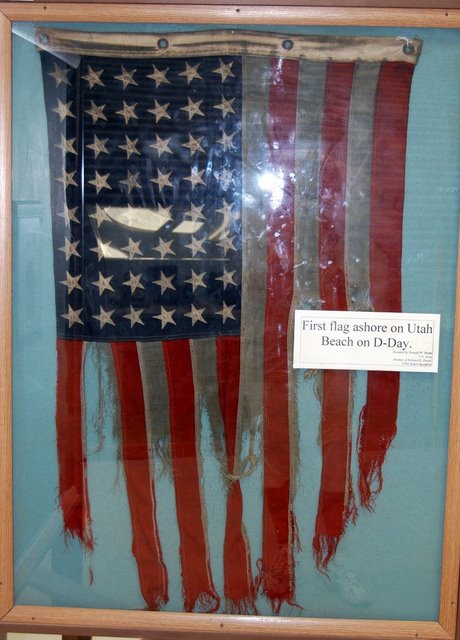
First Flag on Utah Beach, June 6, 1944

First U.S. flag on Utah Beach, Normandy, D-Day, June 6, 1944; Pima Air Museum, Tucson, Arizona

This mostly an encore post. A reader sent an e-mail with a question: Does U.S. law suggest the flying of the U.S. flag on the anniversary of D-Day?

Today is the 66th anniversary of the Invasion of Normandy in World War II, a date generally called D-Day. No, you don’t have to fly your flag. This is not one of the days designated by Congress for flag-flying.

But you may, and probably, you should fly your flag. If you have any D-Day veterans in your town, they will be grateful, as will their spouses, children, widows and survivors. A 22-year-old soldier on the beach in 1944 would be 87 today, if alive. These men and their memories of history fade increasingly fast. Put your flag up. You may be surprised at the reaction.

If you do run into a D-Day veteran, ask him about it. Keep a record of what he says.

First Wave at Omaha:  The Ordeal of the Blue and the Gray by Ken Riley:  Behind them was a great invasion armada and the powerful sinews of war. But in the first wave of assault troops of the 29th (Blue and Gray) Infantry Division, it was four rifle companies landing on a hostile shore at H-hour, D-Day -- 6:30 a.m., on June 6, 1944. The long-awaited liberation of France was underway. After long months in England, National Guardsmen from Virginia, Maryland and the District of Columbia found themselves in the vanguard of the Allied attack. In those early hours on the fire-swept beach the 116th Infantry Combat Team, the old Stonewall Brigade of Virginia, clawed its way through Les Moulins draw toward its objective, Vierville-sur-Mer. It was during the movement from Les Moulins that the battered but gallant 2d Battalion broke loose from the beach, clambered over the embankment, and a small party, led by the battalion commander, fought its way to a farmhouse which became its first Command post in France. The 116th suffered more than 800 casualties this day -- a day which will long be remembered as the beginning of the Allies Great Crusade to rekindle the lamp of liberty and freedom on the continent of Europe.  Image from National Guard Heritage series, from which the caption was borrowed.

"First Wave at Omaha: The Ordeal of the Blue and the Gray" by Ken Riley: Behind them was a great invasion armada and the powerful sinews of war. But in the first wave of assault troops of the 29th (Blue and Gray) Infantry Division, it was four rifle companies landing on a hostile shore at H-hour, D-Day -- 6:30 a.m., on June 6, 1944. The long-awaited liberation of France was underway. After long months in England, National Guardsmen from Virginia, Maryland and the District of Columbia found themselves in the vanguard of the Allied attack. In those early hours on the fire-swept beach the 116th Infantry Combat Team, the old Stonewall Brigade of Virginia, clawed its way through Les Moulins draw toward its objective, Vierville-sur-Mer. It was during the movement from Les Moulins that the battered but gallant 2d Battalion broke loose from the beach, clambered over the embankment, and a small party, led by the battalion commander, fought its way to a farmhouse which became its first Command post in France. The 116th suffered more than 800 casualties this day -- a day which will long be remembered as the beginning of the Allies' "Great Crusade" to rekindle the lamp of liberty and freedom on the continent of Europe. Image from National Guard Heritage series, from which the caption was borrowed.

Quote of the moment: Eisenhower on D-Day

Eisenhower talks to troops of invasion force, June 5 -- before D-Day[Encore post from 2007.]

Soldiers, Sailors, and Airmen of the Allied Expeditionary Force: You are about to embark upon the Great Crusade, toward which we have striven these many months. The eyes of the world are upon you.

Order of the Day, 6 June, 1944 (some sources list this as issued 2 June)

mmm


World War II, fought out on Facebook

April 11, 2010

It’s not exactly family safe, so I’ll link.  For a college class, I’d ask students to determine if the piece is accurate, and if not, what really happened.

What would it have looked like had World War II been fought with Facebook postings?


Quote of the moment: Martin Niemöller, “. . . I did not speak out . . .”

February 26, 2010

First they came for the communists, and I did not speak out—because I was not a communist;
Then they came for the trade unionists, and I did not speak out—because I was not a trade unionist;
Then they came for the Jews, and I did not speak out—because I was not a Jew;
Then they came for me—and there was no one left to speak out for me.

— Pastor Martin Niemöller

Martin Niemoller on a postage stamp, painted by Gerd Aretz in 1992 - Wikipedia

German theologian and Lutheran Pastor Martin Niemöller on a postage stamp, painted by Gerd Aretz in 1992 – Wikipedia

It’s spring, and school curricula turn to the Holocaust, in English, in world history, and in U.S. history.

Martin Niemöller’s poem registers powerfully for most people — often people do not remember exactly who said it.  I have seen it attributed to Deitrich Bonhoeffer (who worked with Niemöller in opposing some Nazi programs), Albert Einstein, Reinhold Niebuhr, Albert Schweitzer, Elie Wiesel, and an “anonymous inmate in a concentration camp.”

Niemöller and his actions generate controversy — did he ever act forcefully enough?  Did his actions atone for his earlier inactions?  Could anything ever atone for not having seen through Hitler and opposing Naziism from the start?  For those discussion reasons, I think it’s important to keep the poem attributed to Niemöller.  The facts of his life, his times, and his creation of this poem, go beyond anything anyone could make up.  The real story sheds light.

Resources:

Save

Save


Who are those Boy Scouts in 1943?

November 13, 2009

A posed photograph:  Three Boy Scouts, from at least two different units, holding a poster Scouts were distributing about international cooperation in World War II.  They are saluting, and behind them rises the dome of the U.S. Capitol on a brilliantly sunny day.

Boy Scouts at the Capitol, 1943? - Library of Congress image

Caption from the U.S. Senate Historical Office: "Boy Scouts aid the war effort by delivering posters that encourage a united fight for freedom, ca.1943. credit: Library of Congress"

1943?  Who were the Scouts?

The photo is online in the collection of the U.S. Senate Historical Office (a good source of images, by the way).

I just wondered, who are those Scouts, and where are they today?

Boy Scouts assisted war efforts in a lot of ways in a lot of American cities, towns and villages.  Affiliates at the Tom Harbin Scout Museum at Camp Wisdom in Dallas (Circle 10 Council) have papers documenting and detailing massive scrap and paper drives, and a lot of other activities we probably wouldn’t let Scouts get into today.

The three Scouts in the photo wear what appears to be two different neckerchiefs, suggesting they come from at least two different troops or other units.  All three wear the uniform of the Boy Scouts of America, but two of the three look as though they may be immigrants or children of immigrants.

The date given is a “circa 1943.”  But the poster plugs a “United Nations” — could it have been as late as 1945 or 1946 and the official organizing of the United Nations?

What do you think?  What do you know?

Update: Wikimedia puts the date of the poster as 1941Shorpy says the photo is 1943:

“Washington, 1943. “United Nations Fight for Freedom: Colored, white and Chinese Boy Scouts in front of Capitol. They help out by delivering posters to help the war effort.” View full size. 4×5 Kodachrome transparency by John Rous for the Office of War Information. What photo expert out there can tell us about the numbers on these Kodachromes — how and at what point in the manufacturing/ exposure/ developing process they were made, and what they signify.

All those details and not the names of the Scouts?  In comments at Shorpy we also see that the temporary patch for the Scout on the left is for a 1942 campout.  So we know the photo was later than 1941.  The community patch for the Scout on the right says Washington where the city patch should be, with no state patch (if they had separate patches then).  So it’s probably a Washington, D.C. unit — and it’s Troop 11.  Anybody from National Capital Council ever read this site?  Were all three of these Scouts from Troop 11?

I have found, but cannot yet examine, another photo from the same roll of film, showing just the Scout in the middle.

Update 2: This may identify one of the Scouts, with an astounding story:

1941, Boy Scout, poster urging water saving, Anderson Grimes

Caption from CityDesk.net: "July 1941. Local Boy Scout Anderson Grimes in front of the U.S. Capitol building in Washington, D.C., holding a copy of a WPA poster designed for the city’s landmark water conservation program."

That solo Scout is clearly the same one in the first photo, so we have one name:  Anderson Grimes.

But the entire story from CityDesk.net is more amazing, if true:

July 1941. Local Boy Scout Anderson Grimes in front of the U.S. Capitol building in Washington, D.C., holding a copy of a WPA poster designed for the city’s landmark water conservation program. Shortly after this photo was taken, he was to present the poster to local congressman Harford Collins in a brief ceremony. Tragically, Grimes, along with several local reporters and congressional aides, instead found Senator Collins slumped over his desk, dead from a heart attack.

Thirty years later, Grimes ended up serving the same seat in Congress for four terms. He did not die in office.
– RJ White

If true?  I can’t find a listing for a Sen. Harford Collins in the Congressional biography pages, nor for any Member in either house named Anderson Grimes.

More mystery.  Is the Scout even named Anderson Grimes?

Okay, after j. a. higginbotham wrote in, I finally got it:  CityDesk.net is a satire site.  They wrote a phony story to accompany the photograph.

That’s right:  I got hoaxed.

Still looking for information on the Scouts and their troop(s).

Update, November 15: Is the water conservation poster in the version above a PhotoShop addition?  Here’s a photo held by the Library of Congress:

Boy Scout after 1942 showing posters Scouts distributed; photo by John Rous, Library of Congress collection

From Library of Congress: "United Nations Fight for Freedom: Boy Scout in front of Capitol. They help out by delivering posters to help the war effort"

Add to FacebookAdd to NewsvineAdd to DiggAdd to Del.icio.usAdd to StumbleuponAdd to RedditAdd to BlinklistAdd to TwitterAdd to TechnoratiAdd to Furl


Last use of atomic weapons in war – Nagasaki, Japan, August 9, 1945

August 9, 2009

Nuclear anniversaries have been ignored this year, it seems to me.

Ceremony in Nagasaki marked the remembrance of the victims of the second atomic weapon used in war, which was detonated over Nagasaki on August 9, 1945Agence France Press reports:

Nagasaki’s mayor, marking the 64th anniversary of his city’s atomic bombing by the United States, called on Sunday on the leaders of nuclear-armed powers to visit the site and build a nuclear-free world.

Hiroshima and Nagasaki, map by CNN

Hiroshima and Nagasaki, map by CNN

Tomihisa Tanoue urged world leaders from both declared nuclear powers and others such as Iran, Israel and North Korea to visit the city in southwestern Japan.

“I am sure anyone who visits here would feel the sorrow of the victims and be shaken by it,” the mayor said in an address at an annual ceremony commemorating the 1945 bombing.

A minute of silence was observed at 11:02 am (0202 GMT), when the US bomb exploded above the city, killing roughly 74,000 people. The bombing followed one a week before in Hiroshima and hastened Japan’s surrender in World War II.

Tanoue said an April speech by US President Barack Obama in Prague, where Obama pledged to build a world with no nuclear weapons, “impressed” the residents of Nagasaki.

“The Japanese government must support the Prague speech. As a nation that has come under nuclear attack, Japan must lead the international community” in abolishing the weapons, he said.

Similar appeals were made Thursday when Hiroshima marked the anniversary of its bombing, which killed 140,000 people.

At the Nagasaki ceremony, Prime Minister Taro Aso reiterated the Japanese government’s anti-nuclear stance, three weeks ahead of national elections that he is tipped to lose.

Aso raised eyebrows at the Hiroshima ceremony, when he pledged to work toward abolishing nuclear weapons but later told reporters that he thought it was “unimaginable” to attain a nuclear-free world.

Similar ceremonies, and similar pleas for nuclear non-proliferation marked the August 6 anniversary of the atomic bomb drop on Hiroshima.  The Chinese news agency Xinhua reported:

Some 50,000 people gathered Thursday at the peace park in Hiroshima to mourn the 64th anniversary of the atomic bombing of the city by U.S. forces during the World War II.

Hiroshima Mayor Tadatoshi Akiba delivered a peace declaration, calling for the abolition of nuclear weapons by 2020.

“The hibakusha still suffer a hell that continues,” said Akiba.

“The Japanese government should support hibakusha, including those who were victims of black rain and those who live overseas,” he said.

Japanese Prime Minister Taro Aso delivers a speech in front of the Memorial Cenotaph during the Hiroshima Peace Memorial Ceremony in Hiroshima, western Japan on Aug. 6, 2009. Hiroshima on Thursday mourned the 64th anniversary of the atomic bombing of the city by U.S. forces during the World War II. (Xinhua/Ren Zhenglai)

"Japanese Prime Minister Taro Aso delivers a speech in front of the Memorial Cenotaph during the Hiroshima Peace Memorial Ceremony in Hiroshima, western Japan on Aug. 6, 2009. Hiroshima on Thursday mourned the 64th anniversary of the atomic bombing of the city by U.S. forces during the World War II. (Xinhua/Ren Zhenglai)"

It was reported Wednesday that the Japanese government aims to come to an agreement with all atomic bomb survivors who have sued the government for financial support to help them pay medical bills for illnesses related to the bombings of Hiroshima and Nagasaki.

Akiba also said “The year 2020 is important as we want to enter a world without nuclear weapons with as many hibakusha as possible. We call on the world to join forces with us to eliminate all nuclear weapons by 2020.”

Referring to the movements such as the environmentalists, Akibasaid, “Global democracy that respects the will of the world and respects the power of the people has begun to grow.”

“We have the power. We have the responsibility. We are the Obamajority. And we can abolish nuclear weapons. Yes we can,” said the mayor.

On Wednesday, Akiba urged the people around the world to join the city’s efforts to abolish nuclear weapons in response to U.S. President Barack Obama’ s appeal for a world free of nuclear weapons.

During the 50-minute memorial ceremony, a moment of silence was observed at 8:15 a.m., the time the atomic bomb detonated over Hiroshima 64 years ago, killing nearly 100,000 people in a blink.

This in a week when two burgeoning new nuclear powers, Iran and North Korea, continue to claim they will flout non-proliferation agreements for their own self defense.

The question obtains on nuclear issues as well as genocides:  When does “never again” start?

Other related posts at Millard Fillmore’s Bathtub:


Alas, that’s the way it is: Walter Cronkite dead at 92

July 18, 2009

You can’t explain the influence of Walter Cronkite to a high school kid today.  They don’t have any experience that begins to corroborate what you’d say.

Walter Cronkite in the last decade - Texas Parks and Wildlife photo by Richard Roberts

Walter Cronkite in the last decade - Texas Parks and Wildlife photo by Richard Roberts

Along with Chet Huntley and David Brinkley on NBC, Mr. Cronkite was among the first celebrity anchormen. In 1995, 14 years after he retired from the “CBS Evening News,” a TV Guide poll ranked him No. 1 in seven of eight categories for measuring television journalists. (He professed incomprehension that Maria Shriver beat him out in the eighth category, attractiveness.) He was so widely known that in Sweden anchormen were once called Cronkiters. (from the New York Times)

I’m saddened at the death of Cronkite.  One of the things that saddens me is that he probably could have anchored for at least a decade past when he last signed off.  Nothing against Dan Rather, at least not from me — just that Cronkite was one of a kind.  He won’t be missed by too many people alive today who never had a chance to see him work.

So, go see him work. Media Decoder has a series of YouTube pieces showing what Cronkite could do, what Cronkite did.  It’s history go see.

Other posts on Cronkite at Millard Fillmore’s Bathtub:

More, probably better stuff