How to fight malaria – Kenya’s example

August 17, 2007

Kenya has cut malaria by nearly half. Without further comment from me, here’s the news story from Gulf Times, Doha, Qatar, and below that, from a few other sources:

Kenya nearly halves child deaths from malaria

Published: Friday, 17 August, 2007, 01:27 AM Doha Time

NAIROBI: Kenya announced yesterday that it almost halved malaria deaths among small children by using insecticidal nets (INTs), spurring the World Health Organisation (WHO) to advocate free nets for all as it tackles Africa’s deadliest disease.

Health Minister Charity Ngilu said distribution of 13.4mn INTs over the past five years among children and pregnant women had helped curtail infections, a key success against a disease threatening 40% of the world’s population.

“Childhood deaths have been reduced by 44% in high-risk districts, in-patient malaria cases and deaths are falling (and) there are reduced cases at the community level,” she said in a statement.

“For every 1,000 treated nets used, seven children who might have died of malaria are saved.”

Malaria kills 34,000 children under the age of five each year in Kenya, and threatens the lives of more than 25mn of its population of 34mn people, the ministry said.

Children sleeping under INTs in malaria risk areas are 44% less likely to die than those who are not, according to a survey carried out in four districts representing the country’s epidemiological pattern.

The government has distributed 12mn doses of artemisinin-based therapy (ACT), the latest surefire anti-malaria drug cocktail to replace the mono-therapies that had developed resistance.

In addition, some 824,600 houses in 16 epidemic-prone districts underwent indoor spraying this year.
The government and donors spent 4.7bn shillings ($70.2mn) for the campaign, yet the funds were not enough.

Ngilu said the government would freely provide 2mn treated nets annually to ward off mosquitoes at night when they are active, calling on donors to boost the blanket distribution.

“The impact we have seen and the lessons we have learnt through massively distributing INTs, rather than selectively marketing and selling them, will not only benefit Kenya’s children but all Africa’s children,” she said.

In a statement, the WHO said it had abandoned its earlier guideline of targeting only vulnerable groups – under fives and pregnant women – in favour of “making their protection immediate while achieving full coverage”.

“Recent studies have shown that by expanding the use of these nets to all people in targeted areas, increased coverage and enhanced protection can be achieved while protecting all community members.”

WHO chief Margaret Chan said that Kenya’s success “serves as a model that should be replicated throughout ‘malarious’ countries in Africa.”

“This data from Kenya ends the debate about how to deliver the long-lasting nets. No longer should the safety or well-being of your family be based upon whether you are rich or poor,” said WHO’s Global Malaria Programme director Arata Kochi.

Chan and Kochi were deriding the “social marketing” model widely backed by donors of distributing INTs by selling them at subsidised rates, even to vulnerable groups, and raising awareness of their importance.

Although supporting anti-malaria campaigns, public health watchers have chided British and US foreign development agencies for pushing for social marketing in the world’s poorest continent.

The WHO launched a global programme in 1955 to eradicate the disease that has frustrated attempts to create a vaccine owing to its constant mutations.

Using dichloro-diphenyl-trichloroethane (DDT), a powerful insecticide, and the drug chroloquine, the organisation managed to eradicated the disease in the West by the 1960s.

But the programme never got off the ground in the humid and low-lying tropics in sub-Saharan Africa where the disease persisted.

By 1969, the programme collapsed as financing withered in the face of rising poverty, political upheavals and surging opposition to DDT for misuse, not by anti-malaria campaigners, but farmers.

But Kochi said the Stockholm Convention on Persistent Organic Pollutants allowed the use of DDT in endemic countries for “public health only” and Uganda and Malawi were the only African nations keen on the chemical.

Malaria affects more than 1bn people worldwide and kills 1mn – mainly under age five – every year, the vast majority in sub-Saharan Africa. – AFP (Agence France Press) Read the rest of this entry »


Typewriter of the moment: Scottish poet Edwin Morgan

August 17, 2007

A poet's typewriter; Scottish poet Edwin Morgan

From the Learning and Teaching Scotland site:

“Edwin Morgan has written hundreds of poems and translations on countless subjects and in a dizzying variety of forms and styles from Glasgow Sonnets to Science Fiction, opera libretto to Concrete poetry, live performance with jazz saxophonist Tommy Smith to the Instamatic poems.

“Edwin is widely acclaimed as Scotland’s greatest living poet. In 2004 the title of ‘Scots Makar’ was formally bestowed on Edwin effectively creating the first ‘Poet Laureate’ of Scotland.

“Literacy and Numeracy Scotland is developing a new Edwin Morgan resource for schools. The resource will feature video clips of Liz Lochhead and Edwin in conversation about his life, inspirations and poetry, as well as audio performances of 27 of Edwin’s poems with accompanying teaching ideas and interactives.”

See and hear Edwin Morgan’s poems here.

Photo from Learning and Teaching Scotland


DDT poisoning at the Wall Street Journal

August 17, 2007

The Wall Street Journals editorial page continues to exhibit signs of hysteria that can only be described as DDT poisoning. DDT has poisoned their view of what to do about malaria. (The article is now available by paid subscription.)

Malaria is a nasty disease that kills more than a million people every year. It is particularly brutal in attacking infants and pregnant women.

Malaria continues to rage because western nations with the resources to fight the disease spent their money on other things in the past 40 years, because the nations most affected lack the governmental adequacy or financial resources and willpower to mount effective campaigns against the disease, but mostly because malaria is a tough disease to fight.

Malaria is spread by several different species of mosquito, some of which have habits or constitutions which make mosquito eradication programs much less effective. Human malaria is really four different parasites, some of which have acquired resistance to the drugs used to fight it. The HIV/AIDS epidemics in tropical nations have not helped matters: What used to be minor cases of malaria now kill thousands who have compromised immune systems because of HIV/AIDS.

Hospitals in far too many nations are overwhelmed with malaria patients, and unable to provide care for many who could be saved. Most of those who die every year could live, with better distribution of health care, and with better prevention.

A few people have been afflicted with what can only be described as a different problem: DDT poisoning. Their views of malaria and what we need to do to fight the disease are poisoned by their anti-science political views. For at least five years there has been a nasty, persistent campaign to impugn “environmentalists” and Rachel Carson, claiming that DDT is the answer to all the world’s malaria woes. Though DDT has been available to fight malaria since 1946, these people complain that bans on spraying crops have discouraged the use of DDT against malaria, fatally.

Below the fold I’ll fisk the short piece from yesterday’s WSJ. It’s difficult to keep ahead of hoaxers, though — today they’ve got another call for DDT use, this time to fight West Nile Virus. Ironically, West Nile is most deadly against several species of bird, some of which are acutely subject to death by DDT.

Read the rest of this entry »


Phrases I wish I’d written

August 17, 2007

Some people have a flair for writing. P. Z. Myers is one of those, though his flair may be wasted a bit because he’s a practicing, teaching biologist (there probably is something to the oft-observed fact that so many great writers are scientists in their first professions, including people like Arthur Conan Doyle, Oliver Sacks, and Hans Zinsser).

Myers wrote this today, and I just wanted to memorialize it, so you, too, can admire the craft and skill that went into it:

If you want to take a look at one of the sources of creationist thought, the workshop where the red-hot anvil of pseudoscience and the inflexible hammer of theology are used to forge the balloon animals of creationism, The Journal of Creation (formerly the Creation ex nihilo Technical Journal) is now online . . .

“The workshop where the red-hot anvil of pseudoscience and the inflexible hammer of theology are used to forge the balloon animals of creationism.”

In just a few words, he captures the essence of the thing so perfectly!

File it under “Quotes that Should Be Famous.”


Texas couple gets $80,000 for Bush’s anti-protestor errors

August 17, 2007

Remember the two people kicked out of President Bush’s Independence Day speech in West Virginia for wearing protest t-shirts in 2004? Nicole and Jeffery Rank, now of Corpus Christi, Texas, were charged with trespassing.

But they were invited to attend the speech.

According to an Associated Press story via MSNBC, a judge dismissed the trespassing charge. The couple sued Bush for violating their First Amendment rights. Bush’s lawyers settled the case, agreeing to pay the couple $80,000.

“This settlement is a real victory not only for our clients but for the First Amendment,” said Andrew Schneider, executive director of the ACLU of West Virginia. “As a result of the Ranks’ courageous stand, public officials will think twice before they eject peaceful protesters from public events for exercising their right to dissent.”

In the course of the suit it was discovered that the official advance manual for the Bush White House urged removing dissenters from speech audiences, so the original claims that the action was just overzealous local officials was refuted. One wonders if the advance manual has been changed.

When asked if are glad they decided stand up for their beliefs, both answered “absolutely” without hesitation.

“We have thoroughly not enjoyed our 15 minutes [of fame]. It’s cost us personally and professionally,” Jeff Rank said. “The thing that we’re fighting for, the Constitution, the Bill of Rights, is just too important to this country to lay down on something like this.”

The First Amendment may have been wounded, but it’s still alive.

Other resources:

Tip of the old scrub brush to blueollie.


Respect for our soldiers, respect for our flag

August 17, 2007

Michigan Gov. Jennifer Granholm issued an executive order that flags across Michigan would be flown at half-staff to honor Michigan soldiers who die in service to the nation in Afghanistan and Iraq. In order to make the order work, her office issues a press release designating the day, and the governor’s website makes note, too. I get an e-mail notification; you may sign up for e-mails at the governor’s website.

Are other states making it as easy to know when to fly flags at half-staff?

Here is Gov. Granholm’s latest press release, on Friday, August 17, 2007:

Flags to be Flown Half-Staff Friday for Army Private First Class Jordan E. Goode

LANSING – Governor Jennifer M. Granholm today ordered United States flags throughout the state of Michigan and on Michigan waters lowered for one day on Tuesday, August 21, 2007, in honor of Army Private First Class Jordan E. Goode, of Kalamazoo, who died August 11 while on active duty in Afghanistan. Flags should return to full-staff on Wednesday, August 22.

Pfc. Goode, age 21, died in Zormont, Afghanistan, from wounds suffered from an improvised explosive device. He was assigned to the 4th Squadron, 73rd Cavalry Regiment, 4th Brigade Combat Team, 82nd Airborne Division, Fort Bragg, North Carolina.

Under Section 7 of Chapter 1 of Title 4 of the United States Code, 4 USC 7, Governor Granholm, in December 2003, issued a proclamation requiring United States flags lowered to half-staff throughout the state of Michigan and on Michigan waters to honor Michigan servicemen and servicewomen killed in the line of duty. Procedures for flag lowering were detailed by Governor Granholm in Executive Order 2006-10.

When flown at half-staff or half-mast, the United States flag should be hoisted first to the peak for an instant and then lowered to the half-staff or half-mast position. The flag should again be raised to the peak before it is lowered for the day.

When a member of the armed services from Michigan is killed in action, the governor will issue a press release with information about the individual(s) and the day that has been designated for flags to be lowered in his or her honor. The information will also be posted on Governor Granholm’s website at www.michigan.gov/gov in the section titled “Spotlight.”

# # #

Our condolences go out to the family of Pvt. Jordan Goode.

And our compliments for helping people with flag etiquette go to Gov. Granholm.


Nightmare at 1600 Pennsylvania Ave: Socialized medicine! (it works well)

August 16, 2007

Rep. Ron Paul, who wants to be president, made a speech recently on the floor of the House of Representatives where he suggested that Americans are mad at their government because the government tries to do stuff for them that they’d rather do themselves. Having recently spent two nights in the medical brig, I immediately thought that Paul is completely out of his mind — who in their right mind would want to do their own health care?

(Old joke: You know what they told the guy who wanted to do his own appendectomy? His doctor said, “Whatever! Suture self!”)

It seems to me people are upset because they can’t get health care at reasonable cost, and the government is doing absolutely nothing to fix most of those problems.

Then I read somewhere that Karl Rove urged his clients to bring up the bogey word “socialized” to describe programs their opponents advocate, since everybody hates anything that is socialized? Oh, yeah? You mean like people hate socialized roads, socialized water delivery systems, socialized sewer systems, and socialized airports?

So I was ready when Jim Wallis’s e-mail hit my in box this morning. His story about his experience with “socialized medicine” in London — a horror story that George Bush will use in his next State of the Union?

It’s a nightmare for sure — for the critics of “socialized medicine.” Read it for yourself, below the fold.

Here’s the usual, Republican view of “socialized medicine” (click on thumbnail for a larger view:

Government Optical

Pretty funny, eh? It’s totally groundless. Think about the government’s program of eye care for soldiers. Pilots and sharpshooters need great eye care. They get the best. They also get stylish glasses. And, though budgeted, you can get some style on Medicare and Medicaid, too — lots of styles, not just one. Our government operated eye care is socialized almost not at all in the classic, socialism definition of its being a planned output and planned outcomes system. Neither output nor outcomes are planned.

Socialized medicine really works. It’s a nightmare for the crowd that thinks bad health care or no health care is cheap, and the socialized medicine can’t work. Read Jim Wallis’s story, below the fold:

Read the rest of this entry »


What Churchill did NOT say

August 16, 2007

Winston Churchill often gets credit, or blame, for “famous quotations” that he did not say.

Cartoon of Churchill speaking (frustrated?)

Misattribution is a common problem in speeches, press releases, DeathbyPowerPoint, and in all other human interaction. I believe the third or fourth most powerful human instinct is to misattribute aphorisms to admired, famous people. So in business presentations across the world today, someone will quote Lincoln, Jefferson, Madison, Washington, Franklin, Einstein and Churchill, as saying things they never uttered.

Below the fold, from the Churchill Centre in London, here is a collection of famous things often attributed to Winston Churchill that he did not actually say: Read the rest of this entry »


Toad mapping – another cool tool

August 16, 2007

What amphibians can be found in your local biome? Great Plains toad, Bufo cognatusWhat is the range of a particular amphibian, say the Great Plains toad? What does that toad look like? How does it sing?

hear call (10337.1K WAV file)

Great source to supplement geography lessons: Amphibiaweb, a special project at the University of California – Berkeley.

Quite student friendly — get to the world map, click on your continent (ooh! kids gotta know what continent they’re on! see social studies TEKS, World geography 4.C, U.S. history 8, World history 11), click on your country, if you’re in the U.S., click on your state. Photos, maps of the range, scientific names, sound recordings of their calls, description, conservation status.

Read the rest of this entry »


Cheney too racy for children

August 16, 2007

 PG-13 rating for this blog

One of those silly internet things:  Mingle2 rates blogs as if they were movies, and issues a rating like the MPAA ratings.  Millard Fillmore’s Bathtub?  We’re PG-13 here.  Why?

This rating was determined based on the presence of the following words:

  • dead (3x)
  • dick (2x)
  • shoot (1x)

In discussions of casualties in war, a history blog might use the word “dead” a few times.  Considering how often I’ve posted about World War I, World War II, the Civil War, atomic bombs, etc., it’s amazing that the word “dead” only shows up three times.

And “shoot?”  Well, shoot, it might appear as a mild oath.

I try to police even the comments to keep profanity down, to keep the blog from being banned by bot programs in junior high schools.  So, how did the word “dick” sneak in there twice?

Dick Cheney.  It’s all his fault.  You can search just like I did, in the right column of the main page.  The search also turns up a post mentioning Charles Dickens, but that would have been a third mention.

It almost makes one yearn for the last year of the Nixon administration after the firing of special prosecutor Archibald Cox, when bumper stickers quickly appeared urging Congress to “Impeach the Cox Sacker.”

Saying Vice President Cheney’s first name is profanity?  Who knew?


Typewriter of the moment: Faulkner, again

August 15, 2007

The previous photo showed Faulkner himself using the machine.

It was a desktop machine. This color shot shows Faulkner’s portable typewriter, a different machine from the one in the publicity still from 1954.

William Faulkner's typewriter, displayed at his home in Oxford, Mississippi; photo by Gary Bridgman

Photographer Gary Bridgman provided a thorough history and explanation, at the Wikipedia Media site, which I quote completely and directly — bless him for the story:

The “Faulkner portable”: American novelist William Faulkner’s (1897-1962) Underwood Universal Portable typewriter, resting on a tiny desk his stepson helped him build. This space at Rowan Oak, the author’s home, was part of the back porch until Faulkner spent part of a Random House advance to enclose it in 1952, long after he had written his seminal Compson and Sartoris family novels. He insisted that this room not be called his “study.” According to biographer Joseph Blotner, “he did not study in it, so there was no sense in calling it that. It was the ‘office,’ the traditional name for the room in the plantation houses where the business was transacted.” As to the typewriter itself, Underwood introduced its Universal Portable in the mid-1930s among a full line of portables such as Champion, Noiseless Portable and Junior. Faulkner had a habit of buying used portables locally, wearing them out, then trading them in on more used portables. This Underwood was one of at least three typewriters in Faulkner’s possession at the time of his death (the University of Virginia has one, too). So, this is no more “the” typewriter any more than those square carpenter’s pencils next to it are “the” pencils. Had Faulkner lived a few more years, this machine would have met the same fate as the rest. Still, the room has a resonance. BOOK magazine was publishing an article of mine on “Yoknapatourism,” and thinking (mistakenly) that the editors hadn’t already selected a photographer, I returned to Oxford on a rainy October afternoon to make my own pictures for submission. The travel piece was eventually illustrated with sunny-day brochure shots, but I was happy to keep this one for myself. There was no direct lighting within the office, so I let the film take its time, soaking up faint incandescent glow from the library and main hallway, which neatly balanced the cloudy daylight. I used the camera’s timer so my hand wouldn’t jostle the tripod, and I even backed out of the room–in part to let the scarce light do its work and, I think, because I wanted Faulkner’s office truly vacant.

Trivia: the book next to the typewriter is the 1939 edition of Writer’s Market. Thanks to Bill Griffith, curator of Rowan Oak, for letting me past the Lucite wall and to Milly Moorhead West for lending me the tripod. – Gary Bridgman

Photo by Gary Bridgman, southsideartgallery.com.


Cincinnati Enquirer coverage of Creation Museum

August 15, 2007

For a while, at least, the Cincinnati Enquirer’s coverage of Ken Ham’s Creation Museum in Northern Kentucky is all neatly assembled online: http://news.nky.com/apps/pbcs.dll/section?Category=creationmuseum


Jefferson, economics and history

August 15, 2007

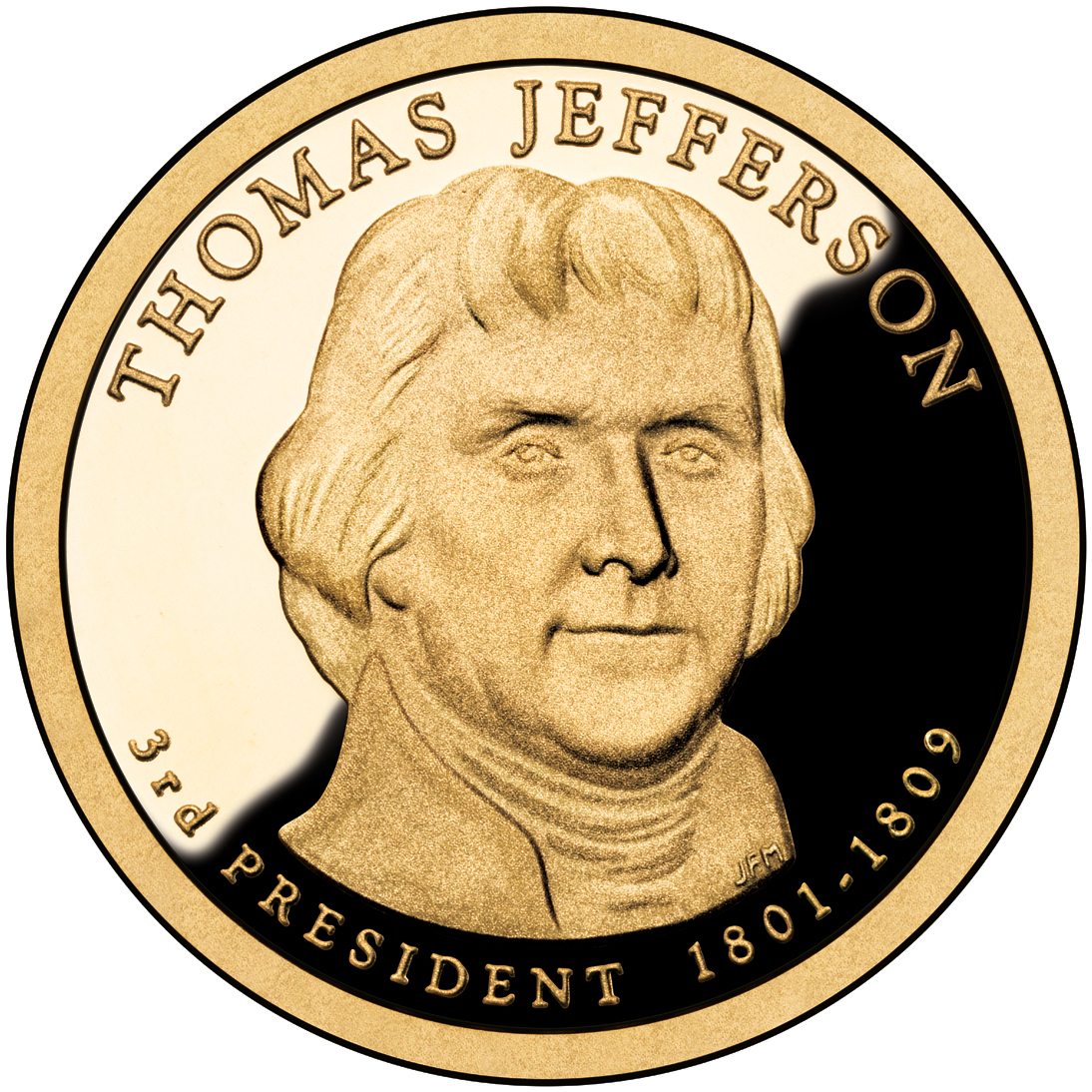
Jefferson dollars will be unveiled today in a ceremony at the Jefferson Memorial in Washington, D.C. They officially go into circulation tomorrow, August 16, 2007.

Jefferson dollar; U.S. Mint image via Associated Press

Jefferson dollars are the third in a series commemorating U.S. presidents. The series started with Washington and will proceed, three new coins a year, through all the presidents. (Quick: What’s the cheapest amount you can invest to get dollars representing all 43 administrations? Don’t forget Grover Cleveland’s anomaly . . .)

The Associated Press story notes three things of interest:

History: Fewer than a third of Americans know Jefferson was the third president. They did better with Washington as the first president. I had a few scary moments last year covering a Texas history course when kids kept answering either “George Washington” or “Abraham Lincoln” to the questions, “Who was the the Father of Texas?” (Stephen F. Austin) and “Who was the first president of the Republic of Texas?” (Sam Houston).

Economics: The vending machine industry loses about $1 billion each year when dollar bills jam in the machine’s vending mechanism. The U.S. Mint and vending machine operators hope the dollar coins catch on and help reduce those losses.

Dollar coins are unpopular: This is another in a series of efforts to “wean” people from paper dollars to coins — remember the Sacagawea dollar? The Eisenhower dollar? The Susan B. Anthony dollar? Just last week I got an Eisenhower dollar in change from our local Starbucks — they had mistakenly put it in the coin drawer for quarters. You can get dollar coins in change at the U.S. Post Office, but not at many other places. Our local post office occasionally sneaks a Euro into the dollar change mechanism. Bonus!

The Washington Post story carried more details of the poll, conducted by the Gallup organization for the U.S. Mint: Read the rest of this entry »


Key images for VJ Day, August 15

August 15, 2007

August 15, 1945, was VJ Day — the day that World War II ended in the Pacific Theatre. VJ is an acronym for Victory Japan. Victory in Europe, VE Day, was declared the previous April.

VJ Day is affiliated with a series of images that students of U.S. history should recognize; these images tell much of the story of the day and the events of the weeks leading up to it.

The most famous image is Alfred Eisenstadt’s photograph of an exuberant sailor kissing a swept-off-her-feet- for-the-moment nurse in Times Square, New York City. This is one of the most famous photographs from the most famous photographer from Life Magazine:

The Smack Seen 'Round the World, photo by Alfred Eisenstadt, Life Magazine, 8-15-1945 Eisenstadt coolly titled his photo “VJ Day, Times Square.” It came to be known as The Smack Seen ‘Round the World. It was fitting that the photo would be taken by Eisenstadt, since his work came to be a symbol of Henry Luce’s Life Magazine in a pre-television era when photography magazines like Life and Look were key news organs for the nation.

In a fun and continuing mystery, several people have claimed to be the sailor, or the nurse, through the years.

Before the victory celebration, there had to be a victory. Japan asked for conditional surrender discussions, but the Allied forces insisted on unconditional surrender. Japanese military officials were rather certain that, if the Soviet Union entered the Pacific War, Allied victory would be assured. Japan hoped to either get a conditional surrender agreement, according to some sources, or inflict heavy losses on Allied forces to get better surrender conditions, but before Russia entered the war. Russia and Japan had long-standing grudges against one another dating from before their earlier war in the first decade of the 20th century.

Read the rest of this entry »


Good Vibrations

August 15, 2007

August 15 is Leon Theremin’s birthday (b. 1896).

Leon Theramin and his instrument, the Theramin Without Leon Theremin, musical scores to horror movies would be nearly impossible, at least for everyone except Henry Mancini and John Williams.

His life would make a great movie. He invented the Theremin in the midst of World War I in Russia; after the war he toured Europe, and then the U.S. He played Carnegie Hall, he collaborated with Albert Einstein, and he married a young African-American ballerina, Lavinia Williams. In 1938 he was kidnapped by the Soviet KGB and forced to return to Russia, in the Union of Soviet Socialist Republics (USSR).

Sent to a work camp, he worked alongside Andrei Tupelov and a host of other famous Soviet scientists. Theremin was “rehabilitated” in 1956. He returned to invention, and invented bugging devices, including the famous microphone that was placed in the Great Seal of the United States in the U.S. Embassy in Moscow. The bug had no moving or active parts, and no power supply, but could transmit when hit with a microwave transmission. The bug spied on U.S. diplomats from 1945 until its accidental discovery in 1952.

Later Theremin turned to inventions of devices to open doors, and to burglar alarms. He trained his niece, Lydia Kavina, on the Theremin — she is considered a virtuoso at the instrument today. In 1991 he returned to the U.S., reunited with some of the artists he’d worked with 50 years earlier for several concerts. He died in Russia in 1993, at the age of 97.

And if you’ve ever heard the Beach Boys’ recording of “Good Vibrations,” you know what a Theremin sounds like.