Complete outline of U.S. history, high school version from Civil War to the present, for on-line use. Be sure to note the disclaimer!
From Oxnard High School, Oxnard, California.
Complete outline of U.S. history, high school version from Civil War to the present, for on-line use. Be sure to note the disclaimer!
From Oxnard High School, Oxnard, California.
 Leave a Comment » |
  History, History blogs, On-line education, On-line learning, Technology, Textbooks |
  Permalink
 Posted by Ed Darrell
Astronomy Picture of the Day for September 18, 2007:

[Text from APOD website, edited]
Tungurahua Erupts
Credit & Copyright: Patrick Taschler
Explanation: Volcano Tungurahua erupted spectacularly last year. Pictured above, molten rock so hot it glows visibly pours down the sides of the 5,000-meter high Tungurahua, while a cloud of dark ash is seen being ejected toward the left. Wispy white clouds flow around the lava-lit peak, while a star-lit sky shines in the distance. The above image was captured last year as ash fell around the adventurous photographer. Located in Ecuador, Tungurahua has become active roughly every 90 years since for the last 1,300 years. Volcano Tungurahua has started erupting again this year and continues erupting at a lower level even today.

Click thumbnail for larger image
More information:
Tungurahua, Ecuador
Location: 1.467 S, 78.44 W
Elevation: 16,475 ft. (5023 m)
Tungurahua is an active stratovolcano also known as the “The Black Giant.” It has a 600 ft. (183 m) wide crater. Most of the volcano is covered by snow. It causes many tremors in the nearby city of Banos. Tungurahua’s lava is mostly composed of basalts. Tungurahua has had at least seventeen eruptions in historical times, its most recent occurring in 1944 when it erupted explosively from its central crater. Located about 25 miles (~40 km) west of Tungurahua is the largest volcano in Equador, Chimborazo and to the north about 50 miles(~80 km ) is Cotopaxi volcano.

Leave a Comment » | Geography - Physical, History, Images, Natural history, Science | Permalink
Posted by Ed Darrell
Found this on my coffee cup today:
So-called “global warming” is just
a secret ploy by wacko tree-
huggers to make America energy
independent, clean our air and
water, improve the fuel efficiency
of our vehicles, kick-start
21st-century industries, and make
our cities safer and more livable.
Don’t let them get away with it!
— Chip Giller
Founder of Grist.org, where
environmentally-minded people
gather online.



20 Comments | Climate change, Cost of Green, Environmental protection, Global warming, Green Politics, History, Humor | Tagged: Climate change, Cost of Green, Environmental protection, Global warming, Global Warming Conspiracy, Green Politics, History, Humor | Permalink
Posted by Ed Darrell
Since my post noting DDT being sold as snake oil, good for any and all ailments, readers have called to my attention to already-existing calls to use DDT to fight West Nile virus, a use that no public health official has asked for, and a use that would be particularly ironic since broadcast spraying of DDT also kills the chief victims of West Nile: Song birds.
So, here’s our list for August 2007:
Milloy’s winning contribution is particularly brilliant. He notes that there are other pesticides that are effective, but, because they do not continue killing for years uncontrollably, he calls for DDT. It’s a column Dave Barry could not dream up for parody:
West Nile virus has killed seven people in Louisiana this year, two in Mississippi and at least 145 people in six states have been infected. A 12-year-old Wisconsin boy died last week of mosquito-borne encephalitis.
The Centers for Disease Control and Prevention says West Nile virus is in the U.S. to stay. The virus may now be found in 37 states, including every state from Texas to the Atlantic.
CDC Director Julie Gerberding called West Nile virus an “emerging, infectious disease epidemic” that could be spread all the way to the Pacific Coast by birds and mosquitoes.
Louisiana has been monitoring the virus since 2000 and has one of the most active mosquito-control programs in the country — and yet it is the state with the highest death toll.
It’s time to bring back the insecticide DDT.
Currently used pesticides, such as malathion, resmethrin and sumithrin, can be effective in killing mosquitoes but are significantly limited since they don’t persist in the environment after spraying.
This award has to be retroactive — Milloy wrote this in August 2002. Since then, it is still true that no public health official has asked for DDT, and it is also true that the West Nile outbreaks continue to plague birds more than humans. (I regret I did not find this article earlier, to use as an example of the craziness of the advocates.) Tiger mosquitoes don’t change their stripes, Milloy’s piece should remind us.
Miller’s winning entry is notable for the way it completely ignores contrary data, and rather overlooks 35 years of tough work to ameliorate damage from DDT.
In the absence of a vaccine, eliminating the carrier — the mosquito — should be the key to preventing an epidemic. But in 1972, on the basis of data on toxicity to fish and migrating birds (but not to humans), the Environmental Protection Agency banned virtually all uses of DDT, an inexpensive and effective pesticide once widely deployed in the U.S. to kill disease-carrying insects. The effectiveness and relative safety of DDT was underplayed, as was the distinction between the large-scale use of the chemical in agriculture and more limited application for controlling carriers of human disease. There is a world of difference between applying large amounts of it in the environment — as American farmers did before it was banned — and using it carefully and sparingly to fight mosquitoes and other disease-carrying insects. A basic principle of toxicology is that the dose makes the poison.
Miller fails to note that there is not a world of difference between applying large amounts of DDT on crops and applying large amounts of DDT on swamps, which is what he appears to be advocating.
To control mosquitoes that carry West Nile virus, the pesticide would need to be used extensively — and it should be. DDT should be made available, immediately, for both indoor and outdoor mosquito control in the U.S.; and the government should oppose international strictures on the pesticide.
Miller doesn’t mention that the deadliest, most uncontrollable actions of DDT were in waterways, especially when applied to kill mosquitoes in the past. The poison bio-accumulates as it rises through the food-chain, so that the dose a raptor like a bald eagle, osprey, or brown pelican gets from spraying for mosquitoes is a dose 10 million times more potent than was originally received by the mosquito.
Miller’s piece is highly ironic in its timing, coming about six weeks after the bald eagle was removed from the endangered species list. America has worked for 35 years to get rid of the effects of DDT, whose spraying ended prior to 1972, and we are just now seeing good results that merit celebration — Miller urges that we poison the birds all over again.
I predict West Nile virus will be the chief selling point for the DDT snake oil salesmen during the month of September. With the West Nile season winding down, however, one wonders what disease will crop up next for which the DDT snake oil will be touted as a cure: Rocky Mountain spotted fever? Lyme disease? Diabetes? Heart disease?
Stay tuned.
5 Comments | DDT, Environmental protection, Junk science, Rachel Carson, Voodoo science | Permalink
Posted by Ed Darrell
Editor’s note: Dr. Vincent Resh of the University of California at Berkeley addressed the distinguished, long-lived Commonwealth Club of San Francisco on August 22, 2007. Below is a column by Resh which appeared in the San Francisco Chronicle a few days before the speech, covering much of the same material.
Resh tells the story of a public health victory in Africa against a disease called river blindness. People victimized are made blind by a parasitic worm which lives in the victim’s eyes. I relate it here because Resh tells how the victory is achieved without resorting to the use of destructive DDT, which had been proposed. Note carefully what Resh says about DDT. This is one more chunk of evidence against the broadcast use of DDT, a story in support of the ban on DDT imposed in the U.S. since 1972. Rachel Carson was right.
_____________________
Sunday, August 19, 2007
Insect-transmitted diseases typically come to our attention through local news reports of the threat of West Nile virus or of dengue fever in our neighborhoods. The works of the Gates Foundation have made us more aware of malaria, the mosquito-transmitted disease that kills well more than a million people each year. But there are scores of insect-transmitted diseases that affect humans, and the insects responsible for many of them live in water.
 Click on thumbnail image for a chart showing the life cycle of river blindness — from the Carter Center, by Alberto Cuadra
DDT and its descendents were initially effective in controlling the water-dwelling vectors of human diseases. However, the effects of these insecticides on environmental health also had significant, indirect effects on human health. The fish in rivers, which are the main protein source for humans in most developing countries, were drastically reduced by these poisons.
Leave a Comment » | DDT, Geography - Physical, Government, Public health, Rachel Carson | Tagged: Blackfly, DDT, geography, Government, ivermectin, Onchocerciasis, Rachel Carson, River Blindness, Vincent H. Resh | Permalink
Posted by Ed Darrell
Utah’s voucher referendum vote is just over six weeks away. From here in Dallas, it appears the anti-voucher forces are leading.
Why do I say that without looking at a single poll? The pro-voucher forces have gone dirty, by Utah political standards: They’re pushing an opinion piece that says God and the Mormon pioneers favor vouchers, according to an AP report via KSL.com (radio and television).
It the occasionally peculiar language of Utah politics, it’s a desperate move, intentionally below the belt, in hopes of crippling the opposition so a win by default must be declared, even over the foul.
A conservative think tank is distributing a lengthy essay on the history of education in Utah that implies that if Mormons don’t vote in favor of the state’s school voucher law that they could face cultural extinction.
The “conservative think tank” is the Sutherland Institute (SI), which would be a far-right wing group in most other places. SI published a 40-page brief in favor of the Utah voucher plan, and its director, Paul Mero, is on the road in Utah speaking before every Rotary Club, Chamber of Commerce and gathering of checkers players he can find. An excerpt appears at their website, and this appears to be the subject of the current controversy.
Education is one of the key values of the Latter-day Saints Church (LDS or Mormon). “Knowledge is the glory of God,” reads one inscription on a gate leading to the church’s flagship school in Provo, Brigham Young University (BYU). Schools were always among the first things built in new Mormon settlements. The University of Utah — originally the University of Deseret — is the oldest public university west of the Missouri, founded in 1850. Mormons take pride in their getting of education, and in the education establishments they’ve created.
Mero’s argument is that the Mormons were forced to give up their private schools for public schools in the anti-polygamy controversies leading up to Utah statehood in 1896. This is a weak hook upon which to hang the voucher campaign. He’s trying to appeal to Mormons who worry about government interference in religion.
The foundations of his argument do not hold up well. “[LDS] Church spokesman Mark N. Tuttle issued a two-sentence response to the essay, saying the church hasn’t taken a position on school vouchers,” the AP article notes.
Utah’s voucher program is the standard vampire voucher structure, taking money away from public schools in favor of private and sectarian schools, and not putting any new money into public schooling. When the Utah legislature passed the program, public opposition was so strong that a petition to put in on the ballot as a referendum captured a record number of signatures in a record period of time.
More to come, certainly.
6 Comments | Education, Education reform, Education spending, History, Politics, School vouchers | Permalink
Posted by Ed Darrell
For U.S. students there is an uncomfortable nexus between mythology of the Arthurian style legend, Biblical mythology and history, and British history that fascinates me. The Stone of Destiny has a provenance stretching back 5,000 years to the Jewish patriarch Jacob, and which features a blog by one of the last men to steal the stone — with several stops along the way to open the story to trickery, hoaxes and uncertainty. It’s a fabulous story that too few people know.

And, as I noted, one of the last men to steal the thing is blogging away on politics today — on the topic of Iraq and how we treat our veterans, for example. Is history great, or what?
This is a long way of getting to recommending Ian Hamilton’s blog for an interesting read, which we’ll do below the fold, after a bit of history.
16 Comments | History, Hoaxes, Icons of history, Politics, Santayana's ghost, War | Tagged: History, Hoaxes, Ian Hamilton, Icons of History, Politics, Santayan's Ghost, Stone of Destiny, War | Permalink
Posted by Ed Darrell
Text publishers for Texas generally provide websites to accompany their texts. In several cases the on-line version’s chief virtue is offering the full text on-line, in case students leave their books in their locker. Most of the texts offer a few brilliant on-line sources.
In most cases, features of an on-line text are limited so those school districts that purchase the publisher’s books. Access is restricted by sign-in codes and passwords. In many cases the on-line books are a bit clunky.
Textbook Revolution is a site that claims to be “taking the bite out of textbooks.” I hope they don’t mean the intellectual bite.
The site points to textbooks available on-line with no serious restrictions. There are five history texts, four for U.S. history and one with a focus on world history. Economics is a hotter field, with 14 listings, including one from the Ludwig von Mises Institute which promises links to “dozens” of texts. Geography doesn’t have its own category, but a search of the site for “geography” turns up seven texts. The search for “government” is much less successful, turning up a hodge podge that includes chemistry and a rant, “Nudity and Smartfilter.”
See the hopeful little stub on open course-ware, too. (It features the MIT catalog mentioned here earlier.)
Great idea, good execution for an infant or tyro website. What on-line texts have you used and found useful?
2 Comments | Economics, History, On-line education, On-line learning, Technology in the classroom, Textbook Selection, Textbooks | Permalink
Posted by Ed Darrell
If you can figure some way to interpret this story in the LA Times as other than the Orange County Republicans don’t want a good, powerful dean of the UC-Irvine law school, let me know in comments. (This is a follow-up of my earlier post.)
This is one more case of Republicans working hard to keep education from being first rate, out of misplaced fear of what well-educated people can do. Uneducated peasants don’t contradict the priests, Jefferson and Madison observed. The OC Republicans know that.
Constitutional law is a good thing, they seem to be saying, so long as it never works to protect the poor, people accused or convicted of criminals, or citizens injured by corporations.
It’s an interesting barrel Chemerinsky has them over; much of the commentary, even among conservatives opposed to Chemerinsky’s views, has it that UC-Irvine will be unable to attract a first-rate dean, and a first-rate faculty, now that this ugly politics cat is out of the bag. If they cannot strike a deal with Chemerinsky to be rehired, they are in real trouble.
Let me say that I don’t put a lot of credence in the claims that pressure from outsiders is a strong motivating force in this crash. Having worked for both Democrats and Republicans, I’ve seen this too often, and it has all the symptoms of big donor demands to take back a perfectly rational decision for unholy political purposes. My experience, mostly from the Republican side, is that this is almost exclusively a Republican phenomenon, that big donors expect public institutions to which they donate to dance to their fiddlers. (There are exceptions, of course. But let me say: Ray Donovan.)
Maybe he can negotiate to require the Republican politicians who oppose his hiring to attend a 1st year Constitutional law class that Chemerinsky would teach, and they would have to do it for a grade that will be published. That would be a huge win all the way around, I think: Chemerinsky gets the job, UC-Irvine gets a the fast-track to high quality legal education, Republicans get a chance to know and understand Chemerinsky in the classroom, and some much needed education about the Constitution sinks into the Republicans.
Dream big, I always say.
Other sources:
Leave a Comment » | Academic freedom, Bill of Rights, College, Education, Education quality, Graduate study, Teacher Pay, U.S. Constitution | Permalink
Posted by Ed Darrell
Oooh, I missed this one; Instapundit said:
August 20, 2007
SOME KIND WORDS FOR DDT — in the New York Times, no less. “Today, indoor DDT spraying to control malaria in Africa is supported by the World Health Organization; the Global Fund to Fight AIDS, Tuberculosis and Malaria; and the United States Agency for International Development. . . . Even those mosquitoes already resistant to poisoning by DDT are repelled by it.”
The debate over DDT is over. There’s scientific consensus. Anyone who disagrees is a DDT denialist and a mouthpiece for Big Mosquito.
The debate should be over. There is scientific consensus that DDT is dangerous and the ban on broadcast use was wise, fair, and still necessary. Reynolds is one of the denialist brigade who keeps trying to paint environmentalists wrong for working for the ban.
Reynolds claim is deceptive in at least three ways:
Other than that, Reynolds is right: The debate is over. Reynolds’ “spray DDT on everything — it works better than snake-oil” argument lost. It’s time Reynolds stops denying the facts.
1 Comment | Accuracy, DDT, Environmental protection, Health care, Junk science, Malaria, Public health, Rachel Carson, Science, War on Science | Permalink
Posted by Ed Darrell
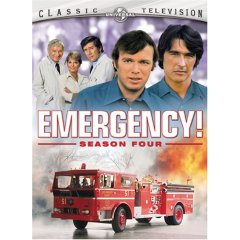
My first year in college, we spent Saturday nights watching “Emergency!” I don’t recall now whether it was on NBC or ABC, but after we saw it once, we were all hooked, Al, Ben and me.
No, it wasn’t great drama. An hour-long drama about paramedics in Los Angeles probably has a lot of potential — this wasn’t that drama. Jack Webb, of “Dragnet” fame, directed. It had a cast amazing for its “how-did-HE- get-there” quality: Bobby Troup, the jazz pianist and composer of “Route 66″ (” . . . get your kicks on . . .”) played a doctor; his wife, jazz vocalist Julie London, played a nurse. Loved Julie London. Beautiful, but she had all the acting chops of David Janssen (“the man of a thousand faces” of “The Fugitive” fame). Martin Milner was there, too — he actually starred earlier in NBC’s “Route 66” which featured Corvettes, but not Bobby Troupe’s hit song (go figure) — and so was Kevin Tighe and Randolph Mantooth. And Robert Fuller, and Kent McCord. Whew!
For undergraduate college students, the show was a riot. We noticed early on that the script writers were defibrillator happy. Every time the paramedic truck showed up, the first thing off was the defibrillator. Heart attacks seemed to be a big problem in LA at the time — maybe Jack Webb’s own mortality subconsciously sneaking into the scripts — so the defib unit got a lot of use.
But it also came out at all the wrong times. Drowning victim? Defibrillator first, THEN artificial respiration. Poison victim? Defib. Auto accident? Defibrillate the victim, THEN worry about the spurting, arterial bleeding (if it’s spurting, is the defib necessary?). Classic kitten in the tree? Defib the tree, THAT will get that kitten down. Read the rest of this entry »
10 Comments | Accuracy, DDT, Environmental protection, History, Public health, Rachel Carson, Reason, Science | Tagged: Bobby Troup, classic television, DDT, difibrillator, Emergency!, History, Julie London, Rachel Carson | Permalink
Posted by Ed Darrell
Maybe Fillmore fans should be offended.
Franklin Pierce ordered the first bathtub for the White House. Many people were upset. They thought taking baths was not healthy and would make you sick!
Good heavens! They’ve got all the points of the Millard Fillmore/bathtub in the White House hoax — but they’ve attributed it to the wrong president!
It’s a hoax hoax!
1 Comment | Bogus history, Hoaxes, Millard Fillmore, Presidents | Permalink
Posted by Ed Darrell
Are you ready for it, teachers?

Leave a Comment » | 1789, Curricula, Historic documents, History, Lesson plans, TEKS, U.S. Constitution | Permalink
Posted by Ed Darrell
Imagine the United States government had an agency that was staffed with experts who were respected by scientists and policy makers of all political stripes.
Imagine this agency did studies on serious issues that would affect the nation in the future, and recommend policies that would allow our nation to take advantage of technology to promote human welfare and our economy, and that would allow our nation to resolve issues that threaten our health, domestic welfare and national security.
Imagine that, because the agency had such strong support and credibility, policy makers would enact recommendations the agency made.
Imagine!?! No, all you need to do is remember the Office of Technology Assessment (OTA), an arm of Congress that provided powerful information, insight and recommendations on technology policies for about two decades, from about 1974 to 1995.
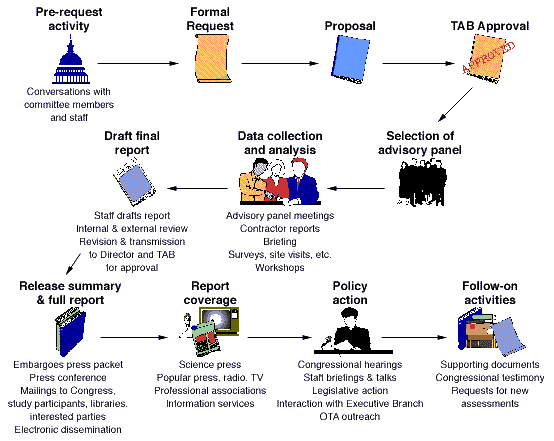 Click on thumbnail for chart of the assessment process used by the Office of Technology Assessment to advise Congress on important technology issues.
Now, think about how useful it would be to have such an agency back, to advise our nation on climate change, emergency preparedness, weapons of mass destruction in the post-Soviet era, malaria eradication policies, internet safety and security, and other key issues.
It’s time to bring back the OTA.
Mark Hoofnagle at the Denialism Blog started sounding the conch:
The fact of the matter is that our government is currently operating without any real scientific analysis of policy. Any member can introduce whatever set of facts they want, by employing some crank think tank to cherry-pick the scientific literature to suit any ideological agenda. This is truly should be a non-partisan issue. Everybody should want the government to be operating from one set of facts, ideally facts investigated by an independent body within the congress that is fiercely non-partisan, to set the bounds of legitimate debate. Everybody should want policy and policy debates to be based upon sound scientific ground. Everybody should want evidence-based government.
Go read what he said. Check in with P. Z. Myers’ view. See what John Wilkins says. Hoofnagle lists actions you can take, today, to get the ball rolling.
In the meantime, wander over to the Princeton University site where the OTA’s reports are now archived (I understand the government was going to take it offline, sort of a latter-day burning of the library at Alexandria). Noodle around and look at the report titles. Notice that, though the agency was killed dead by 1995, the agency had reports on climate change. Notice that the agency was a decade or two ahead in urging policies to encourage the internet. Look at the other issues the agency dealt with, look at the legislation that resulted — and you’ll lament with me that we don’t have the agency around today, when the issues are tougher, the technology more difficult to understand, and politics more driven by rumor than fact.
Killing the OTA was the Pearl Harbor of the present war on science. It’s time we started to fight back, to take back the scientific Pacific — our nation’s future is no less in peril now from the war on science, than it was then from hostile nations.
Resources:
6 Comments | Accuracy, Government, History, Politics, Reason, Science, Technology, U.S. House of Representatives, U.S. Senate | Permalink
Posted by Ed Darrell
Oh! The scandal and shame!
No, not really. The Disciples of Christ, generally, have a pretty good sense of humor about stuff, which may be one reason why their rather small national sect has produced three presidents: James Garfield, the only preacher and first college president to be elected, Lyndon B. Johnson, whose family ranch hosts a chapel, and Ronald Reagan, who also attended one of the sect’s colleges (Eureka College) but fell a way a bit near the end.*
The fact that Reagan and Johnson could both be Disciples is a tribute to the wide door the church has for membership.
A hardy band of Disciples still participate in a list-serv discussion of church matters, DOCDISC (a list-serv is an ancient e-mail group discussion software set, used to avoid the public nature of alt.net discussions, substituting mass e-mails for bulletin board posts; read about it in your paleontology texts, kids).
A recent post pointed to a comic book biography of Ronald Reagan at Slate.com (okay, “graphic biography”) and lamented the inaccurate way the sect was portrayed (see section 1, page 12):

Did you spot the problems?
The original post at DOCDISC complained first about the baptism. Horrors! It shows baptism by sprinkling! Well, not even sprinkling — more like a smearing on the forehead of young Ronald. Everybody knows Disiples dip! It should show baptism by immersion.
Once the tongue-in-cheek nature of the complaint became clear, other complaints surfaced. See the table of prayer votive candles over the left shoulder of the preacher? Some Disciples congregations have a rather high service, but no one knew of any so close to Catholicism as to host such a thing. One preacher whose father had been the pastor in the church in question suggested the sanctuary was a little fancy for the way the original was. And several suggested that the stole the pastor wears in the drawing is fancier by far than those used by most Disciples preachers (many Disciples preachers avoid such clerical garb altogether).
These are serious theological issues for Christians. The Disciples and what are now known as the Churches of Christ split in the early 20th century over the issue of musical instruments in worship, the Disciples being cool with all sorts of music, the Churches of Christ opting for a capella only, as they interpret one verse in scripture. In American colonial times, Anabaptists were reviled for their advocacy of immersion baptism and adult baptism — in Europe such advocates were disembowelled, but in American colonies only a few were hanged, and a few others sentenced to death by wolves (though some with this penalty, like Roger Williams, couldn’t find the wolves once put out into the wilderness, and had to found Rhode Island instead).
Even serious issues deserve a humorous look from time to time. Laughter eases the brain, makes it open to learning and creating. There are only about a million people in the U.S. who claim to be Disciples of Christ; we could probably use a lot more Christians with a good sense of humor.
We could use a lot more presidents with a good sense of humor, too. (The “graphic biography” from Slate.com is a pretty good shtick, for Reagan’s life — anybody know how it works in the classroom?)
____________
* I don’t think Reagan ever attended a service at National City Christian Church in Washington, D.C., the closest Disciples church to the White House. If anyone knows differently, please let me know.
3 Comments | Accuracy, Humor, Presidents, Religion | Permalink
Posted by Ed Darrell
You are currently browsing the Millard Fillmore's Bathtub blog archives for the year 2007.


Ed Darrell on Texas's Colorado River


Come on in, the water's fine. Come often: Cleanliness is next to godliness.


 Millard Fillmore's Bathtub
