Flag etiquette for the 4th of July

July 4, 2007

Every kid should learn this stuff by third grade, but it’s clear from what we see that they don’t.

Flag flying in front of U.S. Capitol (East side) LOC photo

So here’s a quick review of dos and don’ts for display and behavior toward the U.S. flag on this most flag-worthy of days, the 4th of July. With a few comments.

1. Fly your flag, from sunup to sundown. If you’re lucky enough to have a flagpole, run the flag up quickly. Retire it slowly at sunset. Then go see fireworks.

2. Display flags appropriately, if not flown from a staff. If suspended from a building or a wall, remember the blue field of stars should always be on the right — the “northwest corner” as you look at it. Do not display a flag flat.

3. Salute the flag as it opens the 4th of July parade. In a better world, there would be just one U.S. flag at the opening of the parade, and the entire crowd would rise as it passes them in a great patriotic, emotional wave — civilians with their hands over their hearts, hats off; people in uniform saluting appropriately with hats on. It’s likely that your local parade will not be so crisp. Other entries in the parade will have flags, and many will be displayed inappropriately. A true patriot might rise and salute each one — but that would look silly, perhaps even sillier than those sunshine patriots who display the flag inappropriately. Send them a nice letter this year, correcting their behavior. But don’t be obnoxious about it.

4. Do not display the flag from a car antenna, attached to a window of a car, or attached in the back of a truck. That’s against the Flag Code, which says a flag can only be displayed attached to the right front fender of a car, usually with a special attachment. This means that a lot of the National Guard entries in local parades will be wrongly done, according to the flag code. They defend the flag, and we should not make pests of ourselves about it. Write them a letter commending their patriotism. Enclose the Flag Code, and ask them to stick to it next time. Innocent children are watching.

5. Do not dishonor the flag by abusing it or throwing it on the ground. It’s become popular for a local merchant to buy a lot of little plastic flags and pass them out to parade goers. If there is an advertisement on the flag, that is another violation of the Flag Code. The flag should not be used for such commercial purposes. I have, several times, found piles of these flags on the ground, dumped by tired people who were passing them out, or dumped by parade goers who didn’t want to carry the things home. It doesn’t matter if it’s printed on cheap plastic, and made in China — it is our nation’s flag anyway. Honor it. If it is worn, dispose of it soberly, solemnly, and properly.

That’s probably enough for today. When the Flag Desecration Amendment passes — if it ever does — those parade float makers, National Guard soldiers, and merchants, can all be jailed, perhaps. Or punished in other ways.

Until that time, our best hope is to review the rules, obey them, and set examples for others.

Have a wonderful 4th of July! Fly the flag. Read the Declaration of Independence out loud. Love your family, hug them, and feed them well. That’s part of the Pursuit of Happiness that this day honors. It is your right, your unalienable right. Use it wisely, often and well.


Happy birthday, Kathryn!

July 4, 2007

The rain in New Mexico is more spectacular than the rain you’re getting in Dallas, especially with the lightning.

So on your birthday we both get rained on, but a few hundred miles apart. I’d prefer we get rained on together. Dinner when we get back. Out.

[Dear Reader, you can’t know what this dear woman has put up with. It was love at first date. Even despite our seeing “Quadrophenia.” We’ve enjoyed so much together — Washington, D.C., life in the Senate, birding the east, camping in Utah and Texas, two wonderful kids. And you know, with the celebration the nation does on her birthday, it’s still not really adequate.]

kathryn-and-cameras-at-church-sendoff.jpg

Kathryn photographing her son and husband off to New Mexico for a week. Click photo for larger version.


Texas Education Agency: Trouble at the top

July 4, 2007

Steve Schafersman dutifully follows events at the Texas Education Agency, particularly with regard to textbook selection, and particularly with regard to biology textbooks. As head and chief instigator and chief bottle washer for the Texas Citizens for Science, he still gets little notoriety for the good work he does — all volunteer.

Shafersman says important stuff to know. So, when he sends along an editorial from the Fort-Worth Star-Telegram pointing out ethical and legal lapses at the agency which appear to be the work of the chief lawyer of the agency, one should read it. That lawyer, by the way, is probably in line to be the next head of the agency.

TEA has suffered from politicized leadership the last few years. Since Mike Moses left the agency, Texas education has drifted, and lack of leadership from TEA has not helped. Controversies over silly things are almost invited; serious issues, like cheating on the state’s graduation test, go unstudied and unremedied. I take the liberty of publishing the full editorial, below the fold — please read it, especially if you’re in Texas. Since Texas influences education so heavily, especially in textbook selection, everybody who has a kid in U.S. schools, who did have a kid in U.S. schools, who was educated in U.S. schools, or lives in a state that has schools, has a dog in this fight. Read the rest of this entry »


Taos is beautiful this time of year

July 3, 2007

Posting is light — I’m on the road and relatively incommunicado. We’re in New Mexico, building houses with Habitat for Humanity. It’s great stuff.

Taos adobe wall

Adobe construction is amazing. It’s hitting 90 degrees Fahrenheit here by noon — adobe houses, without air conditioning or forced air of any kind stay cool well into the afternoon. Amazing.

My apologies for light posting; comment away on the stuff that is here. I’m running a few posts from the past that deserve wider audience (and more comment). And I’ll try to post from the road. So much to see and say.

  • Photo of adobe wall in house under construction in Taos, New Mexico.  Copyright 2007 by Ed Darrell.  Feel free to use it, with attribution.

Inexplicable insanity about DDT and Rachel Carson

July 3, 2007

Sheesh! I thought Rep. Rob Bishop, R-Utah, and Sen. Tom Coburn, R-Okla., pretty much took the cake in fanatical ideas close to insanity in the calumny campaign against Rachel Carson. I may have erred.

Please understand, it is important that good people speak up for science, for political sanity, for reason and reality. There are forces of ignorance and evil who willingly fill the information vacuum with excrement, and who thereby pollute political discourse — if you don’t speak up.

Here: Send Sen. Tom Coburn a note, tell him you think he should come to his senses and stop blocking a bill giving a minor honor to Rachel Carson. He needs to do the Christian thing and stand up for truth, for health care, for honesty, you should tell him. Here’s his official message-leaving site.

No, he’s not answered me, either. Swamp him with mail. Or telephone his office: 202-224-5754 (Washington, D.C. office).


Encore post: Recognizing bogus history, 2

July 3, 2007

Editor’s Note:  I’m traveling this week, celebrating our independence 231 years on.  While mostly out of pocket, I’ll feature some encore posts, material that deserves another look to keep it from fading from memory.  This post, below, is the second of a two-part series from August 2006.

Recognizing bogus history, 2

Bogus history infects political discussions more than others, though there are some areas where bogus history strays into the realm of science (false claims that Darwin and Pasteur recanted, for example).

1. The author pitches the claim directly to the media or to organizations of non-historians, for pay.

Historians are detectives, and they like to share what they find. One historian working in the papers of one figure from history will find a letter from another figure, and pass that information on to the historian working on the second figure. Historians teach history, write it up for scholarly work, and often spin it in more fascinating tales for popular work. Most years there are several good works competing for the Pulitzer Prize in history. Academic historians, those tied to universities and other teaching institutions, join societies, attend meetings, and write their material in journals — all pitched to sharing what they have learned.

Bogus historians tend to show up at conferences of non-historians. Douglas Stringfellow’s tales of World War II derring do were pitched to civic clubs, places where other historians or anyone else likely to know better, generally would not appear (Stringfellow’s stories of action behind enemy lines in World War II won him several speaking awards, and based on his war record, he was nominated to a seat in Congress for Utah, in 1952, which he won; a soldier who knew Stringfellow during the war happened through Salt Lake City during the 1954 re-election campaign, and revealed that Stringfellow’s exploits were contrived; he was forced to resign the nomination). Case in point: David Barton speaks more often to gun collectors than to history groups.

2. The author says that a powerful establishment is trying to suppress his or her work.

Sen. Joseph McCarthy insisted that anyone who opposed his claims that communists dominated certain government agencies, or that any given person was a communist, was because those who challenged him were, themselves, part of the greater conspiracy, trying to silence him. Utah Sen. Arthur V. Watkins, who chaired the committee that recommended censure for Sen. McCarthy, lost his own re-election campaign in 1958 in part to the belief by Utah voters that such a conspiracy existed and had succeeded in suppressing McCarthy.

But there was no organized campaign against McCarthy.  Individual Americans, spurred by patriotism, the Boy Scout Law, or just a sense that truth is valuable, spoke up against him, time and again in many different forums.  Sen. Watkins powerfully opposed communism.  Later historians found any truth in McCarthy’s claims against the State Department and other government agencies, and his critics, got there accidentally, below the usual levels of coincidence.

3. The sources that verify the new interpretation of history are obscure; if they involve a famous person, the sources are not those usually relied on by historians.

Most internet hoaxes simply don’t list sources. Bogus quotes circulating that have been attributed to Madison, Jefferson, Washington, Lincoln, and others, often list a year, and nothing else. When I staffed the Senate, several times a year I’d get letters to work on with claims that the Supreme Court had ruled in 1892 that the U.S. is, officially, a “Christian nation.” Usually there there was no case name attached, but I came to understand that the case referred to was the Church of the Holy Trinity vs. U.S. 1892 was far enough back that it was a difficult case for people outside of a decent law library to get — and then, it is couched in 1892 legalese, which makes it difficult to understand. It is an obscure enough case that most of the time it won’t be checked out. If the case can be produced, rarely will it be among lawyers who can interpret what happened from the fog of the language of the decision. The case is not listed at the Cornell University Law School’s on-line Legal Information Institute, nor at Findlaw.com — the databases they rely on go back to 1893. There is a full text copy at the Justicia website. [This was written in 2007.]

The case involved a law that prohibited the importing of laborers, and the Court ruled that the law probably was not intended to apply to a white, white collar worker, a preacher from England (the law was probably aimed at Chinese workers, coming as it did in that time when immigration from China was prohibited). It appears from the case that the church had argued some First Amendment justification to be exempt, and the U.S. Solicitor General had argued in response that the First Amendment requires the courts to assume that the government is hostile to religion; Justice David Brewer wrote at length about how the nation had accommodated religion over the years, especially Christianity, in dismissing the Solicitor General’s argument (he did not accept the church’s argument, either). This sort of writing is called obiter dicta in legal studies — words of an opinion wholly unnecessary to the decision. The case is cited rarely, and never for its religious “ruling,” because that was not what was ruled, and the language was not applied as law then, nor has it been since.  The Supreme Court ruled that importing preachers from England was not covered by the law. The ruling makes no mention of religion.

A bit of reflection on what really happened in history should make this clear: Consider the effect of such a ruling by the Supreme Court on later cases involving textbooks, busing of parochial students, student prayer, Bible readings, etc. Had such a precedent existed, lawyers would have sniffed it out regardless its obscurity.

4. Evidence for the history is anecdotal.

America’s founders carefully wrote laws that assure religious freedom, largely by creating a separation of state and church. To those unhappy with such a separation, every utterance of a founder in which God is praised, or invoked in any way, becomes “proof” that the founders did not mean what they wrote in the laws. Anecdote trumps any other evidence, to these people.
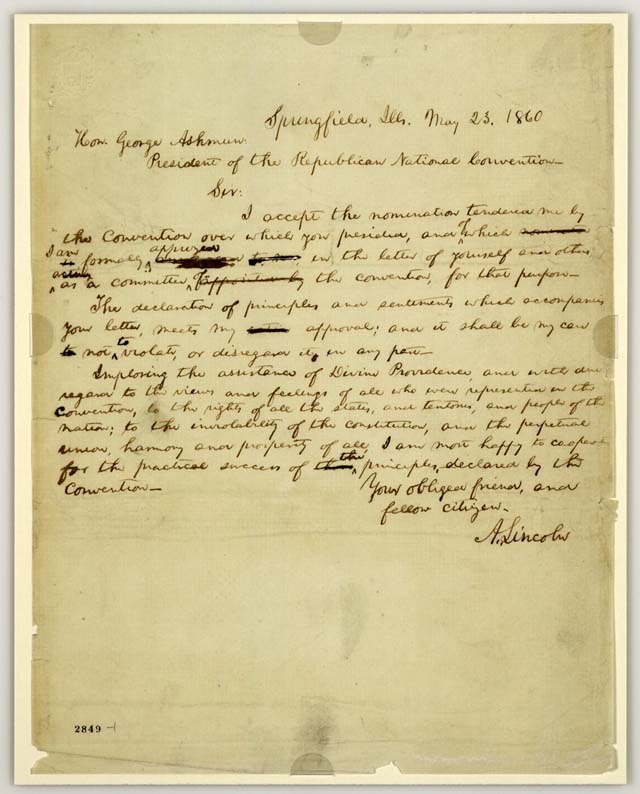
Abraham Lincoln's letter to the president of the Republican National Convention of 1860, accepting the convention's nomination for the presidency.

Abraham Lincoln’s letter to the president of the Republican National Convention of 1860, accepting the convention’s nomination for the presidency. It was written, you will note, from Springfield, Illinois, 200 miles away from Chicago where the convention was held.

To prove to me the piety of Abraham Lincoln, a fellow showed me photograph of a plaque on a church in Chicago, said to be the church where Abraham Lincoln said his prayers every morning during the Republican Convention of 1860, at which Lincoln got the nomination for president. Other records — newspapers, Lincoln’s letters and other documents, show that, as was the fashion in 1860, Lincoln did not attend the convention in Chicago, but as a candidate for president, stayed at home in Springfield, nearly 200 miles away.

Most real history can be read in documents, and does not need to rely on folk retellings exclusively.

5. The author says a belief is credible because it has endured for some time, or because many people believe it to be true.

Faced with the evidence that a dozen quotes he had attributed to figures such as James Madison, George Washington and Patrick Henry were whole cloth inventions, Texas quote-purveyor David Barton issued a statement urging people not to rely on them because they were “questionable.

A great example of belief triumphing over fact presents itself as the Cardiff Giant, now on display at the Farmers’ Museum in Cooperstown, New York (go visit when you visit the Baseball Hall of Fame). After an argument with a cleric over whether the Bible’s claim that giants once existed, a tobacconist named George Hull hired stonecarvers to carve a giant; then he hired a farmer to bury the carving on his farm, and claim to have struck it when planting. Once discovered the “petrified man” was put on display, for a fee. Hull got lucky: Syracuse businessmen offered to buy it from him for an enormous sum.

Paleontologist Othniel Marsh inspected it on display, and pronounced it a hoax. For some odd reason, that increased the popularity of the attraction. Carnival and side show entrepreneur P. T. Barnum offered $60,000 for the carving, but was refused. Barnum then had a plaster replica made and put on display. The owners of the original hoaxed carving sued, but the suit was thrown out because they could not demonstrate the “genuineness” of their own hoax.  Barnum made more money than the original.  A hoaxed hoax is even more popular than the truth.

A photo (staged?) of the 1869 unearthing of the Cardiff Giant (Cardiff, New York). Photograph courtesy Farmers Museum via Associated Press, and via National Geographic.

A photo (staged?) of the 1869 unearthing of the Cardiff Giant (Cardiff, New York). Photograph courtesy Farmers Museum (where the carving now rests, on display to museum visitors)  via Associated Press, and via National Geographic.

6. The author has worked in isolation.

Historians often help each other. Good historians put out queries to many sources, the better to assure accuracy. So, conversely, if there are only a few people who know anything about an account, that fact alone may cause suspicion. Clifford Irving’s hoax biography of Howard Hughes, while remarkably accurate in some regards, was unraveled when enough people familiar with Hughes called the bluff — including, of course, Hughes himself. The book got as far as it did with extreme secrecy on Irving’s part. Working alone makes error easier, and is essential for intentional frauds.

7. The author must propose a new interpretation of history to explain an observation.

Various conspiracy claims require that key people act counter to their known character. If Franklin Roosevelt had “allowed” Pearl Harbor to occur in order to get the U.S. into war, his actions over the previous six years to support Britain start to make little sense. Had Lyndon Johnson been part of a conspiracy to assassinate John Kennedy, his later carrying out the legislative plan of Kennedy runs contrary to all such motivations. If the founders of the U.S. actually intended to make Christianity the state religion, their efforts to disestablish the churches in all 13 colonies, efforts to write bills of rights for each state including freedom of religion, and efforts to create the First Amendment in the Bill of Rights seem like incredible, repeated errors.

Bogus history is much like the conjectured problems that result from time travel: Change one jot of history, and there is a cascading effect on later events. In many cases,were the bogus histories accurate, what follows could not be so, and we wouldn’t be here to discuss it.

Those are the seven warning signs of bogus history. Bogus, or voodoo history should be suspected if two or more of the signs are present — though it is quite possible for actual history to show more than two signs (perhaps actual history could show all seven signs — but I’d have to see an example before stating it’s so).

More:


Encore post: Recognizing bogus history, 1

July 3, 2007

While traveling this week, I’ll feature a few blasts from the past — posts that may merit new attention. This post comes from a two-part series in August 2006:

Recognizing bogus history, 1

Robert Park provides a short e-mail newsletter every Friday, covering news in the world of physics. It’s called “What’s New.” Park makes an art of smoking out bogus science and frauds people try to perpetrate in the name of science, or for money. He wrote an opinion column for the Chronicle of Higher Education published January 31, 2003, in which he listed the “7 warning signs of bogus science.”

Please go read Park’s entire essay, it’s good.

And it got me thinking about whether there are similar warning signs for bogus history? Are there clues that a biography of Howard Hughes is false that should pop out at any disinterested observer? Are there clues that the claimed quote from James Madison saying the U.S. government is founded on the Ten Commandments is pure buncombe? Should Oliver Stone have been able to to more readily separate fact from fantasy about the Kennedy assassination (assuming he wasn’t just going for the dramatic elements)? Can we generalize for such hoaxes, to inoculate ourselves and our history texts against error?

Perhaps some of the detection methods Park suggests would work for history. He wrote his opinion piece after the Supreme Court’s decision in Daubert v. Merrell Dow Pharmaceuticals, Inc., in which the Court laid out some rules lower courts should use to smoke out and eliminate false science. As Park described it, “The case involved Bendectin, the only morning-sickness medication ever approved by the Food and Drug Administration. It had been used by millions of women, and more than 30 published studies had found no evidence that it caused birth defects. Yet eight so-called experts were willing to testify, in exchange for a fee from the Daubert family, that Bendectin might indeed cause birth defects.” The Court said lower courts must act as gatekeepers against science buncombe — a difficult task for some judges who, in their training as attorneys, often spent little time studying science.

Some of the Daubert reasoning surfaced in another case recently, the opinion in Pennsylvania district federal court in which Federal District Judge John Jones struck down a school board’s order that intelligent design be introduced to high school biology students, Kitzmiller v. Dover Area School District.

Can we generalize to history, too? I’m going to try, below the fold.

Here are Park’s seven warning signs, boiled down:

Park wrote:

Justice Stephen G. Breyer encouraged trial judges to appoint independent experts to help them. He noted that courts can turn to scientific organizations, like the National Academy of Sciences and the American Association for the Advancement of Science, to identify neutral experts who could preview questionable scientific testimony and advise a judge on whether a jury should be exposed to it. Judges are still concerned about meeting their responsibilities under the Daubert decision, and a group of them asked me how to recognize questionable scientific claims. What are the warning signs?

I have identified seven indicators that a scientific claim lies well outside the bounds of rational scientific discourse. Of course, they are only warning signs — even a claim with several of the signs could be legitimate. [I have cut out the explanations. — E.D.]

  1. The discoverer pitches the claim directly to the media.
  2. The discoverer says that a powerful establishment is trying to suppress his or her work.
  3. The scientific effect involved is always at the very limit of detection.
  4. Evidence for a discovery is anecdotal.
  5. The discoverer says a belief is credible because it has endured for centuries.
  6. The discoverer has worked in isolation.
  7. The discoverer must propose new laws of nature to explain an observation.

Voodoo history

Here, with thanks to Robert Park, is what I propose for the warning signs for bogus history, for voodoo history:

  1. The author pitches the claim directly to the media or to organizations of non-historians, for pay.
  2. The author says that a powerful establishment is trying to suppress his or her work.
  3. The sources that verify the new interpretation of history are obscure; if they involve a famous person, the sources are not those usually relied on by historians.
  4. Evidence for the history is anecdotal.
  5. The author says a belief is credible because it has endured for some time, or because many people believe it to be true.
  6. The author has worked in isolation.
  7. The author must propose a new interpretation of history to explain an observation.

Any history account that shows one or more of those warning signs should be viewed skeptically.

In another post, I’ll flesh out the reasoning behind why they are warning signs.


Happy birthday, Ben Davidian

July 3, 2007

Wherever you are, Ben, happy birthday.  Even though you’re a Republican.

Born on the day before we celebrate the signing of the Declaration of Independence, Ben is not really older than the Declaration itself.


Photos of a hoax: The Cardiff Giant

July 2, 2007

David Carlson's pinhole camera photo of a sign promoting the Cardiff Giant

The Cardiff Giant was a great hoax of the 19th century. George Hull, a cigar maker in upstate New York, hired a Chicago sculptor to make a large statute of a man. He then buried the statue on a friend’s farm, and year later hired workmen to dig a well where the statue was buried, and of course the well-diggers “discovered” the statue. Hull’s intent was to hoax Bible literalists who talked about giants in the ground, based on Genesis 6:4.When the statue was discovered, it was claimed to be a petrified giant, evidence of giants living in America. The stone piece was put on traveling display.

The hoax was discovered. That only increased the desire to see the statue, and the price to see it was raised. P. T. Barnum tried to buy the thing, and when his offer was refused, initially he created a hoax of the hoax for his own display.

The Cardiff Giant is on display today at the Farmers Museum in Cooperstown, New York (also home of the Baseball Hall of Fame). Barnum’s fake fake is on display at Marvin’s Marvelous Mechanical Museum, Farmington Hills, Michigan.

Cardiff Giant on display at Cooperstown, New York

The photo at top was created with a grant from the Vermont Council on the Arts by David Carlson, whose website is here (his work is for sale — some of the photos would be good conversation starters in history classrooms) It’s a photo made with a pinhole camera, a camera without a lens. The second photo is from Roadside America, showing the Cardiff Giant as displayed today.


Blue Bell’s 100th; ice cream at the Farmers Museum

July 1, 2007

It looks like even the Farmers Museum in Cooperstown, New York, wants to get in on Blue Bell Ice Cream’s 100th anniversary, with a display on ice cream in America.

Good Humor Ice Cream Truck, NYC c 1926; Unilever 1999, via Farmers Museum, Cooperstown


But it’s only coincidence: Cooperstown is outside the Blue Bell distribution area.

Nice idea, though.

See my original post on Blue Bell’s 100th here.


Dembski’s blog caught hoaxing again

June 30, 2007

An acquaintance sends word he’s happy to be back in the mountains with his hammer again, breaking rocks as a geologist in support of a mining venture. The price of gold is high, a few advances in technology have helped the process, and our friend was tapped by suits with money to help keep the actual gold mining operation in the proper vein, so to speak.

Mining is best done with a good scientist on hand to make sure the hole dug out is done right, and to be sure that the digging keeps going for the genuine nuggets.

William Dembski’s blog, Uncommon Descent, has no scientists with any geology training, it appears. But again they’ve been mining, for quotes instead of useful ore, and they’ve come up with fool’s information. Unable to tell the difference between fool’s information and the real stuff, they’ve published the fool’s information for the world to see.

A wise person does not allow fool’s information into one’s information banks. Read the rest of this entry »


Economics: History of money

June 30, 2007

Texas standards for economics require students to learn the history of money.

Jennifer Dorman, writing at Cliotech, points to an on-line article by economist Robert Samuelson, “The Cashless Society Has Arrived,” and then she adds a series of links to other valuable articles covering the history of money, and she strings it together in a coherent story that will give you a couple of moments of worry about where our economy is headed.

Go beef up your links, and get the ideas for the lesson plan that will knock the kids’ socks off.


Fisking “Junk Science’s” campaign FOR the poison DDT, against Rachel Carson: Point #8, mosquito resistance to DDT

June 29, 2007

This is the second in a series of Fisks of “100 things you should know about DDT,” a grotesquely misleading list of factoids about DDT put up a site called JunkScience.com. While one would assume that such a site would be opposed, this particular site promotes junk science. I’m not taking the points in order.The “100 things” list is attributed to Steven Milloy, a guy who used to argue that tobacco use isn’t harmful, and who has engaged in other hoaxes such as the bizarre and false claim that Compact Fluorescent Lightbulbs (CFLs) can pose serious toxic hazards in your home (and therefore, you should continue to waste energy with less efficient bulbs); and to J. Gordon Edwards, a San Jose State University entomologist who, despite being a great entomologist, was a bit of a nut on some political things; Edwards assisted Lyndon Larouche’s group in their campaign against Rachel Carson before his death in 2004. (Did Edwards actually have a role in the development of this list?)

100 things you should know about DDT

Claim #8. Some mosquitoes became “resistant” to DDT. “There is persuasive evidence that antimalarial operations did not produce mosquito resistance to DDT. That crime, and in a very real sense it was a crime, can be laid to the intemperate and inappropriate use of DDT by farmers, especially cotton growers. They used the insecticide at levels that would accelerate, if not actually induce, the selection of a resistant population of mosquitoes.”

[Desowitz, RS. 1992. Malaria Capers, W.W. Norton & Company]

Cover of The Malaria Capers, by Robert S. Desowitz

Cover of The Malaria Capers, by Robert S. Desowitz

This was what Rachel Carson warned about. Indiscriminate use of DDT, such as broadcast application on crops to kill all insect, arthropod or other pests, would lead to mosquitoes and other dangerous insects developing resistance to the chemical. Of course, resistance developed as a result of overspraying of crops has exactly the same result, in the fight against malaria, as overuse in the fight against malaria.  Cover of The Malaria Capers, by Robert S. Desowitz

Worse, such overuse also killed predators of mosquitoes, especially birds. In an integrated pest management program, or in a well-balanced ecosystem, birds and other insect predators would eliminate a large number of mosquitoes, holding the population in check and preventing the spread of malaria. Unfortunately, when the predators are killed off, the mosquitoes have a population explosion, spreading their range, and spreading the diseases they carry.

Assuming Milloy quoted the book accurately, and assuming the book actually exists, this point says nothing in particular in favor of DDT; but it reaffirms the case Rachel Carson made in her 1962 book, Silent Spring. Contrary to suggestions from the campaign against Rachel Carson, she urged that we limit use of DDT to tasks like preventing malaria, around humans, to preserve the effectiveness of DDT and prevent overspraying.

And then, there is this: Milloy doesn’t bother to quote the first part of the paragraph he quotes, on page 214 of Malaria Capers. Here is what the paragraph actually says:

There were a number of reasons for the failure, not least that the anophaline vector mosquitoes were becoming resistant to the action of DDT both physiologically — they developed the enzymes to detoxify the insecticide — and behaviorally — instead of feeding and wall-resting, they changed in character to feed and then quickly bugger off to the great outdoors. [from this point, Milloy quotes correctly]

In other words, the DDT-based campaign against malaria failed because DDT failed; mosquitoes became resistant to it.  DDT’s declining ability to kill mosquitoes is one of the major reasons DDT use plunged after 1963, and continues to decline to no use at all.

To combat the dastardly campaign of calumny against Rachel Carson and science, you should also read: Deltoid, here, here and here, and the rest of his posts on the topic; Bug Girl, here, at least, and here, and the rest of her posts; denialism, here; and Rabett Run, here.

Save

Save


Pre-July 4 special: “English only” video insults U.S. flag

June 29, 2007

Okay. I’ve had five or six people send me links to a YouTube video of Ron and Kay Rivoli singing “Press One for English.” Ha. Ha.

It’s a rant about language accommodations. Some Americans, free marketeers for the most part, get all buggy when confronted with a free market in language choices. America is becoming more global, marketing more goods in more places, and getting visited by more people. This growth in commerce brings things like American Airlines’ Spanish language reservations center (Who would have thought? When they can make reservations in Spanish, Spanish speakers buy a lot more airplane tickets.)

And Ron and Kay Rivoli put these fears into a song. Funny.

Can we talk? Can I pick a bone? Ron and Kay Rivoli insult the U.S. flag. They may not mean to do it, they may have done it unthinkingly — but that’s the problem with the whole rant: It’s all unthinking.

Here are the flag insults:

  1. 44 seconds into the video three servicemen are shown saluting the U.S. flag, displayed with the flag of California and the POW-MIA flag. Contrary to the Flag Code and good flag etiquette, the U.S. flag is in the center, rather than to its own right. A center display would be acceptable if the center flag pole were higher than the others — but in this case the U.S. flag’s pole is lower than the other two. Two flag insults at once.
  2. At 2:59 into the video, the flag is shown as cut into an agricultural field of some kind. The Flag Code specifies that the flag is never to be displayed flat. The flag should fly free. Since this flag is cut into a crop on the ground, it cannot be displayed properly. Further, it is generally considered poor etiquette to make representations of the flag out of things other than cloth.

This is all highly ironic. At 1:37 into the video, a scroll of the famous Theodore Roosevelt quote on English as the only language scrolls by. “We have room for but one flag, the American flag,” Roosevelt said (oops — there goes the POW-MIA flag). “We have room but for one language, and that is the English language,” Roosevelt continues.

They use the flag they insult as a model for going for one language? This makes no sense.

Do I pick nits? No, I think that every educated American should know the flag code, and should avoid insult to the U.S. flag at least, if not honor it correctly. I am not pedantic about a lot of things, but this is one.

Ron and Kay Rivoli, you owe America and its flag apologies. Get straight with the flag, before you ask me to insult the traditional languages and free enterprise heritage of our nation. If you want my support, don’t tread on the American flag when you ask it.

The Rivolis owe apologies to the U.S. flag. Will we see it?


Japanese-American internment: Statesman-Journal web special

June 29, 2007

Looking for good sources on Japanese internment?

Editor & Publisher highlights the web version of a special series on Japanese internment during World War II, put together by the Statesman-Journal in Salem, Oregon. The series is featured in “Pauline’s Picks,” a feature by Pauline Millard showing off the best use of the web by old-line print publications.

Beyond Barbed Wire, photo by Salem Statesman-Journal

The Statesman-Journal’s web piece is “Beyond Barbed Wire,” featuring timelines, maps of the Tule Lake internment facility (closest to Oregon), stories about Japanese Americans in Oregon, especially in Salem, photos, video interviews, and a significant collection of original documents perfectly suited for document-based studies.

Texas kids test particularly badly in this part of U.S. history. Several districts ask U.S. history teachers and other social studies groups to shore up student knowledge in the area to overcome gaps pointed out in testing in the past three years, on the Texas Assessment of Knowledge and Skills (TAKS). In teacher training, I’ve noted a lot of Texas social studies teachers are a bit shaky on the history.

The Korematsu decision was drummed into my conscious working on civil rights issues at the Senate Labor and Human Resources Committee, and complemented by Constitutional Law (thank you, Mary Cheh) and other courses I was taking at the same time at George Washington University. It helped that Utah has a significant Japanese population and had “hosted” one of the internment camps; one of my tasks was to be sure committee Chairman Orrin Hatch was up on issues and concerns when he met with Japanese descendants in his constituencies in Utah. Hatch was a cosponsor of the bills to study the internment, and then to apologize to Japanese Americans affected, and pay reparations.
The internment was also a sore spot with my father, G. Paul Darrell, who witnessed the rounding up of American citizens in California. Many of those arrested were his friends, business associates and acquaintances. Those events formed a standard against which he measured almost all other claims of civil rights violations.

Because children were imprisoned with their parents, because a lot of teenagers were imprisoned, this chunk of American history strikes particular sympathetic chords with students of any conscience.  Dorothea Lange’s having photographed some of the events and places, as well as Ansel Adams and others, also leaves a rich pictorial history.

(I found this thanks to the RSS feed of headlines from Editor & Publisher at the Scholars & Rogues site.)