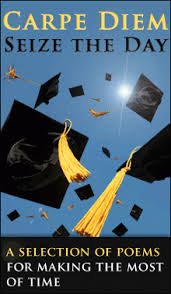
28 poems on living life to the fullest, today

June 25, 2008

So, you just graduated from [pick one: high school, college, business school, law school, medical school, flight school, cooking school, firefighters academy, police academy] and you’re looking for a job. But here you are cruising the web instead of knocking on the doors of employers.  Carpe diem poems for making the most of time

You have come to the right place. To keep you in the flow where you need to be to get that job, let me suggest this article from the Academy of American Poets, “Carpe Diem: Poems for making the most of time.” And most especially, let me suggest the 28 poems they list there on plucking the day. The chief list of 28 you will find below the fold.

The Latin phrase and a lot of the history of the idea in poetry gets a lithe explanation in the essay there:

The Latin phrase carpe diem originated in the “Odes,” a long series of poems composed by the Roman poet Horace in 65 B.C.E., in which he writes:

Scale back your long hopes

to a short period. While we
speak, time is envious and

is running away from us.
Seize the day, trusting
little in the future.

Various permutations of the phrase appear in other ancient works of verse, including the expression “Eat, drink, and be merry, for tomorrow we die,” which is derived from the Biblical book of Isaiah. At the close of “De rosis nascentibus,” a poem attributed to both Ausonius and Virgil, the phrase “collige, virgo, rosas” appears, meaning “gather, girl, the roses.” The expression urges the young woman to enjoy life and the freedom of youth before it passes.

Since Horace, poets have regularly adapted the sentiment of carpe diem as a means to several ends, most notably for procuring the affections of a beloved by pointing out the fleeting nature of life . . .

The careful reader will find another three poems on the topic hidden in the list at the end of the article.

Graduates, you’d be happy with just a little per diem at the moment. I can’t give you that. You might find that these poets give you much more. Seize the opportunity, and see for yourself.

Read the rest of this entry »


Typewriter of the moment: W. H. Auden at Swarthmore

June 25, 2008

Poet W. H. Auden taught students at Swarthmore for three years, 1942-1945. Swarthmore’s library started rather early to collect Auden’s manuscripts and other materials, including the typewriter he used there — an Underwood, as you can see, below.

Auden's typewriter during his Swarthmore years (1942-1945).

Auden’s typewriter during his Swarthmore years (1942-1945).

The library has a detailed, on-line exhibit of Auden’s work and associations with the college, material useful for student research and in-class presentations related to his work.

Auden’s poetry was contemporary, and it reflected the fears and passions of lovers, and lovers of liberty, in the face of the fascist threat of World War II.  Auden died, aged by tobacco, alcohol and barbituates, in 1973, aged 67.

Resources:

Add to FacebookAdd to NewsvineAdd to DiggAdd to Del.icio.usAdd to StumbleuponAdd to RedditAdd to BlinklistAdd to TwitterAdd to TechnoratiAdd to Furl

Save

Save

Save

Save


Symposium in a book: Rachel Carson’s legacy

June 25, 2008

Oklahoma Sen. Tom Coburn released his hold, Rep. Jason Altmire’s bill moved, and three weeks ago the post office in Springdale, Pennyslvania, was named in Rachel Carson’s honor. On the internet, yahoos still try to blame her deaths from malaria, claiming that her message of stewardship was misplaced, and led to a “ban” on DDT that allows malaria to run wild.

Off the internet, serious scholars still work. SUNY Press published a compilation of lectures at Oregon State Univesrity commemorating the 40th anniversary of Carson’s most famous book, Silent Spring. The new book, Rachel Carson: Legacy and Challenge is edited by Lisa Sideris and Kathleen Dean Moore.

The press release from the University of Indiana is below the fold.

Read the rest of this entry »


NY story: More money = better schools, better tests

June 24, 2008

Headlines across New York this morning shout about improved test scores, especially in reading and math, almost across the board. Scores are up in the “troubled” schools of New York City (and in the less-mentioned untroubled schools), scores are up in Buffalo. The news is so universally good that some are worried about statistical goofs, or cheating.

And while most economists with the possible exception of Milton Friedman would think it’s not news, some people point out that scores are up in poorer districts that got more money for educational programs.

At a news conference in Albany, the state education commissioner, Richard P. Mills, called the results “encouraging and exciting,” saying they were evidence that the state’s emphasis on giving more money to poorer school districts and focusing on high standards was successful. “The schools have delivered,” he said. (New York Times)

The War on Education continues unabated, however. The headline in the New York Daily News: “State math and reading exam scores released; critics question improvements.”

A beleaguered parent commented at the Daily News site:

our children are forced to do homework over weekends, Christmas vacation, winter break, spring break, etc. to prepare for these tests – their scores are up because they’ve worked hard all year!

If we’re wise, we’ll applaud the students and teachers, and we’ll wait for a lot more analysis. NYC Educator? JD2718? Is this good news for teachers in New York? Good news from teachers?

Update, June 26: NYC Educator takes note, “Test Scores Explode Statewide.”  JD2718, “Integrated Algebra Conversion Chart, Later Today.” Also:

Other notes and resources:


Torturing children, the Constitution, and a teacher’s duty to protect children

June 23, 2008

This is the device Ohio teacher John Freshwater was using to shock students and brand them with crosses: A BD-10A high-frequency generator tester for leak detection, from Electro-Technic Products, Inc.:

   BD10ASV  OUTPUT: 10,000-50,000 volts at frequency of approx. 1/2 megahertz. Power 230 V, with a momentary ON/OFF switch

BD-10A high frequency generator tester leak detector, from Electro-Technic Products.  “BD10ASV OUTPUT: 10,000-50,000 volts at frequency of approx. 1/2 megahertz. Power 230 V, with a momentary ON/OFF switch”

As described at the company’s website:

  • Model BD-10A is the standard tester
  • Model BD-10AS features a momentary ON/OFF switch
  • OUTPUT: 10,000-50,000 volts at frequency of approx. 1/2 megahertz

The company also offers a line of instruments for teaching science — notably absent from that part of the catalog is this shocking device (literally).

Generally, this tester should not produce serious injury, even when misapplied. Standard middle school lab safety rules would suggest that it should never be used to “test” a human for leaks. Such voltages are designed to produce sparks. Sparks do not always behave as one expects, or hopes. High voltages may make cool looking sparks, but the effects of high voltage jolts differ from person to person. It may be harmful.

“We have instructions to warn people that it’s not a toy,” said Cuzelis, who owns Electro-Technic Products in Chicago. “If this device is directed for seconds (on the skin), that’s a clear misuse of the product.”

Cuzelis said he is not aware of anyone seriously hurt with the device and said that his company has never been sued for injuries.

What sort of lab safety rules did Freshwater have for other experiments?

If you discovered your child’s science teacher had this device, designed to produce high-voltage sparks to highlight holes in rubber and plastic liners of tanks, would you be concerned? If you know what should go on in a science class, you’d know there is probably little use for such a device in a classroom. It’s been described as a Tesla coil.

Tesla coils of extremely small voltages can be safe. They should be safe. But one occasionally finds a safety warning, such as this generalized note at Wikipedia:

Even lower power vacuum tube or solid state Tesla Coils can deliver RF currents that are capable of causing temporary internal tissue, nerve, or joint damage through Joule heating. In addition, an RF arc can carbonize flesh, causing a painful and dangerous bone-deep RF burn that may take months to heal. Because of these risks, knowledgeable experimenters avoid contact with streamers from all but the smallest systems. Professionals usually use other means of protection such as a Faraday cage or a chain mail suit to prevent dangerous currents from entering their body.

Freshwater was using a solid state Tesla coil, if I understand the news articles correctly. Knowing that these sparks can cause deep tissue and bone damage in extreme cases, I suspect that I would not allow students to experience shocks as a normal course of a science classroom, especially from an industrial device not designed with multiple safety escapes built in.

Freshwater had been zapping students for years.

Here is a classic photo of what a Tesla coil does, a much larger coil than that used by John Freshwater, and a photo not from any classroom; from Mega Volt:

Tesla coil in action, from Mike Tedesco

Tesla coil in action, from Mike Tedesco

There is nothing in the Ohio science standards to suggest regular use of a Tesla coil in contact with students performs any educational function.

I offer this background to suggest that the normal classroom procedures designed to ensure the safety of students were not well enforced in Freshwater’s classrooms, nor was there adequate attention paid to the material that should have been taught in the class.

The teacher, John Freshwater, has been dismissed by his local school board. Freshwater supporters argue that this is a case of religious discrimination, because Freshwater kept a Bible on his desk.

Among the complaints are that he burned crosses onto the arms of students with the high-voltage leak detector shown above. This gives an entirely new and ironic meaning to the phrase “cross to bear.”

Cafe Philos wrote the most succinct summary of the case I have found, “The Firing of John Freshwater.” Discussion at that site has been robust. Paul Sunstone included photos of one of the students’ arms showing injuries from the schocks. He also included links to news stories that will bring you up to date.

Amazingly, this misuse of an electrical device may not be the most controversial point. While you and I may think this physical abuse goes beyond the pale, Freshwater has defenders who claim he was just trying to instill Biblical morality in the kids, as if that would excuse any of these actions. Over at Cafe Philos, I’ve been trying to explain just why it is that Freshwater does not have a First Amendment right to teach religion in his science class. There is another commenter with the handle “Atheist” who acts for all the world like a sock puppet for anti-First Amendment forces, i.e., not exactly defending a rational atheist position.

Below the fold I reproduce one of my answers to questions Atheist posed. More resources at the end.

Read the rest of this entry »


What Lucy will see, leaving Houston . . .

June 22, 2008

What Lucy saw will see, leaving Houston . . .

[The exhibit on Lucy, our Australopithecus afarensis ancestor, has been extended at the Houston Museum of Natural Science, through September 1, 2008. Go. Go see the exhibit. Don’t put it off.]

Coming out of the display on Lucy at the Houston Museum of Natural Science, coming back down the staircase, this is the painting on the wall. In my imagination, this is what Lucy saw will see as they carried carry her, crated up, out of the building. In reality they probably took will carry her down a freight elevator.

This one’s for you, P.Z. — drop into the Houston museum next time you’re down there:

Whale and Squid mural at Houston MNH


Scout Centennial video

June 22, 2008

Here’s a video on the 100th anniversary of the Boy Scouts of America, coming in 2010.

Vodpod videos no longer available.

more about “Scout Centennial video“, posted with vodpod

Scouts, Scouters, friends and media should probably bookmark this site, and use it to coordinate events planned for the centennial year.

Among other fun things, there was a contest to pick a logo for the year-long festivities. The logo is below, left.

The winning design came from an Eagle in California


Name: Philip Goolkasian
Hometown: Fresno, Calif.
Scout Rank: Eagle Scout
Council: Troop 223, Sequoia Counci


Is Ken Ham a Wackaloon?

June 21, 2008

Ken Ham appears to be unhappy that P. Z. Myers called him a wackaloon, but clueless as to why.

Ken, partly it’s because you don’t allow comments at your blog. Open your blog up for discussion, you might learn something.

It ain’t that the majority is silent, it’s that the wackaloons are deaf. Ham seems confused. He thinks Myers is worried that God exists. Myers is worried that Ham is a wackaloon. Those two statements are quite different, and mutually exclusive independent. God’s existence doesn’t change the fact that Ham is a wackaloon, and God’s existence is not conditional on Ham’s being a wackaloon.

Ham is a creationist who spends millions of dollars annually lying to children. Ham, it would appear to a rational person, does not believe God exists, and so thinks there is no penalty to be paid for doing this. “Wackaloon” might be a gentle term.

But, should creationists be allowed into the Pentagon without a full body search? People who don’t think radiation works in predictable ways should be kept far, far away from nuclear weapons and those who play a role in triggering them, I think. What if they required a sanity test before allowing people into the Pentagon?


Louisiana creationists gear up campaign to deceive students

June 20, 2008

My earlier post urging readers to contact Louisiana Gov. Bobby Jindal to urge him to veto the latest creationist eruption the Louisiana Lege gave him, produced an interesting comment. A fellow named Wayne provided links to a presentation by some guy named Perry Marshall, in which Marshall flails vainly against evolution theory.  The video is billed as one the Louisiana Coalition for Science “fears.”  Wayne wants to know, should we keep children from seeing it?

Marshall apparently isn’t even an engineer, but instead designs ads for internet placement — at least one step removed from the usual joke about engineers as creationists. Of course, that doesn’t help any of his arguments.

Wayne linked to three YouTube presentations, about half of the presentation Marshall made at an unidentified church (there are five segments total, I gather). What you see is bad PowerPoint slides, with audio. Marshall suggests that evolution couldn’t get from the American pronghorn antelope to the African giraffe, but in classic creationist form, he doesn’t address the unique signs of evolution we find in giraffes (neck, vagus nerve, for example) nor in pronghorns (bred for speed to beat the American cheetah, which is now extinct, and thereby hangs a great tale of sleuthing by evolution).

Marshall’s presentation is insulting. To me as a historian, it’s astounding how he can’t accurately list sequences of events well known to history. The science errors he makes are errors any 7th-grade student might make — but he’s passing them off as valid criticism of evolution theory.

Here’s the first YouTube presentation, and below the fold, my response to Wayne.

These presentations are an omen. They are sent to us as a warning for what the Discovery Institute will try to sneak into classrooms if Jindal signs that bill into law — heck, they’ll try anyway, but we don’t have to drill holes in our kids’ heads to make it easier for con men and snake oil salesmen to get their fingers in there.

My response below the fold.

Read the rest of this entry »


Handbook of Texas on-line

June 20, 2008

Question: Where do you find good Texas history in a hurry?

Answer: The Handbook of Texas.

Question: What about Texas history on-line?

Answer: Same thing, different format:

Tip of the old scrub brush to Will’s Texas Parlor. Crossposted at the Wayback Machine.


Driving with a banjo

June 20, 2008

There can be only three or four legitimate banjo jokes possible, right? There’s the one about the banjo player’s Porsche, there’s the one about perfect pitch . . .

Somebody was really ticketed for driving while strumming a banjo and singing into a cell phone? Read the story at The Bluegrass Blog, and be sure to catch the definition of “reckless.”

Tip of the old scrub brush to a perplexed NYC Educator.


Campaign underwater? (and classroom DVD offer)

June 19, 2008

Who are these guys?

Who are these guys in the pool? Can you identify them?

Can they swim?

(Answers below the fold.)

Read the rest of this entry »


Open thread, open comments

June 19, 2008

Several readers have dropped notes saying they couldn’t find a place to comment on something here, and they didn’t want to mess up a thread.  So, here’s a thread to put those comments in.  (Now watch:  Cat will get the typing fingers of everybody . . .)

And for those of you from the Christian blogs where comments are censored, other than editing out profanity and links to pornography, we generally don’t censor here.

Comments are open – discuss away!


Juneteenth

June 19, 2008

The Texas State Archives offers a succinct history:

Juneteenth, celebrated on June 19, is the name given to emancipation day by African-Americans in Texas. On that day in 1865 Union Major General Gordon Granger read General Order #3 to the people of Galveston. General Order #3 stated “The people of Texas are informed that, in accordance with a proclamation from the Executive of the United States, all slaves are free. This involves an absolute equality of personal rights and rights of property between former masters and slaves, and the connection heretofore existing between them becomes that between employer and hired labor. The freedmen are advised to remain quietly at their present homes and work for wages. They are informed that they will not be allowed to collect at military posts and that they will not be supported in idleness either there or elsewhere.”

Large celebrations on June 19 began in 1866 and continued regularly into the early 20th century. The African-Americans treated this day like the Fourth of July and the celebrations contained similar events. In the early days, the celebration included a prayer service, speakers with inspirational messages, reading of the emancipation proclamation, stories from former slaves, food, red soda water, games, rodeos and dances.

The celebration of June 19 as emancipation day spread from Texas to the neighboring states of Louisiana, Arkansas and Oklahoma. It has also appeared in Alabama, Florida, and California as African-American Texans migrated.

In many parts of Texas, ex-slaves purchased land, or “emancipation grounds,” for the Juneteenth gathering. Examples include: Emancipation Park in Houston, purchased in 1872; what is now Booker T. Washington Park in Mexia; and Emancipation park in East Austin.

Celebration of Juneteenth declined during World War II but revived in 1950 at the Texas State Fair Grounds in Dallas. Interest and participation fell away during the late 1950’s and 1960’s as attention focused on expansion of freedom for African-Americans. In the 1970’s Juneteenth revived in some communities. For example, in Austin the Juneteenth celebration returned in 1976 after a 25 year hiatus. House Bill no.1016 passed in the 66th legislature, regular session, declared June 19, “Emancipation Day in Texas,” a legal state holiday effective January 1, 1980. Since that time, the celebration of Juneteenth continues across the state of Texas with parades, picnics and dancing.

Texas State Library Reference Services 3/95

Celebrations across Texas started last Saturday, and will continue for another three or four days, I gather. Thought it’s an official State of Texas holiday, few people take it off. So celebrations are scheduled when they can be.

The great mystery to me is why the holiday seems to have spread so far outside Texas. Juneteenth is based on a uniquely Texas event — it involved notifying only the slaves in Texas that they had been freed. Celebrations go much farther today, even to places the Civil War didn’t touch.

Resources:


Louisiana lashes out at science

June 19, 2008

“Stop the World! I Want to Get Off!” won a Tony Award on Broadway in 1963. It was a musical play about a fellow who overreached. With book and lyrics by Leslie Bricuse and Anthony Newly, it spawned a string of hit popular songs: “What Kind of Fool Am I?” “Gonna Climb a Mountain,” “Once in a Lifetime,” and “Mumbo Jumbo” among them.

Oh, why not: Update, here’s Sammy Davis, Jr., singing “What Kind of Fool Am I?”:

How can one know that history and not think of it, when looking at the current Louisiana legislature? What kind of fools are they, indeed? Louisiana would like the world to stop, so they can get off.

Progress and science so much offend the Louisiana legislature that they have carved out what they hope is an exception so teachers can avoid hard science on issues like reproduction (cloning), evolution, and that pesky weather stuff that ransacked New Orleans, global warming. Sitting on Gov. Bobby Jindal’s desk right now is the enrolled version of S. B. 733, the misnamed “Science Education Act,” which gives teachers and local school districts the right to deviate from state curriculum and science texts in those three areas.

Why not the Big Bang and other cosmology? Why not gravity? Why not algebra? It may be that Louisiana’s preachers don’t know about those areas of science. Shhhhh! Don’t tell them!

A few observations.

First, having been slapped down by federal courts repeatedly when they’ve tried to introduce religion into science classes before, the legislature seems to have learned not to say much, in hopes that federal courts will have difficulty determining the religious intentions behind the bill. In 1987, in the case of Edwards v. Aguillard, federal courts didn’t even get to trial. They simply took the statements of the legislators as to their religious intentions.

This time around, the bill is being passed without debate at all. Legislators obviously hope that if they say nothing, they can’t be held responsible for anything. Better to keep your mouth closed and be thought a fool than to open it and remove all doubts — and obviously, there is hope among Louisiana creationists that federal courts won’t be able to use their closed-mouthedness as to evidence their foolishness. Well, they may want to consider that intelligent design has been ruled religious dogma by a federal court, already.

Second, the legislature’s learnings seem limited to bellicose speeches. The courts have repeatedly struck down Louisiana’s yearnings to teach creationism, both statewide, and repeatedly in the Tangipahoa Parish schools, which tried warning labels on textbooks and a variety of other methods, losing in court each time. It’s not just the ravings of the legislators that get up the dander of the courts. When the laws that come out of the ravings offend the Constitution, especially the First Amendment, the courts have struck them down. It’s not enough to just play at being non-offensive: The actions of the legislature must also not violate the Constitution. They appear not to have figured that one out. (More remedial con law courses coming up? Perhaps.)

The state should just let science be taught. Sneaking religion in does no good for the students, and it’s no secret that’s what they’re doing.

Third, the bill wasn’t drafted by people with much experience drafting legislation, running schools, or defending the Constitution. The bill could be used in some districts to teach nothing but evolution. It opens the door for anything a local school board decides might be science in three specific areas, cloning, evolution and global warming. Fruitcake groups like Ken Ham’s “Answers in Genesis” will rush to produce materials noting the accuracy of Hanna-Barbera’s “Flintstones.” Kids could be allowed to watch cartoons and call it science. In contrast, teachers who don’t understand the science in the first place will probably have few sources to turn to for good science information. Maybe one way to kill the law would be to point out that this thing opens the door wide for the theology of the Flying Spaghetti Monster (may his noodly appendage . . . well, you know).

What you should do: The Louisiana Coalition for Science urges Gov. Jindal to veto the bill; you should call Jindal’s office and urge a veto, too.

You can send e-mail here.

You can mail, or telephone, here:

Mailing Address:

Governor Bobby Jindal
PO Box 94004
Baton Rouge, LA 70804-9004

Phone: 225-342-7015 or 866-366-1121 (Toll Free)
Fax: 225-342-7099

Other sources:

Text of the bill below the fold.

Read the rest of this entry »