Hopewell Rocks and 45-foot tides at the Bay of Fundy

August 4, 2011

Great time-lapse video of the tides at Hopewell Rocks, Bay of Fundy, New Brunswick.

Teachers, can you get a decent geography warm-up with this video?  Every high school kid should know about the Bay of Fundy, one of nature’s greater phenomena.

More: 

Another time-lapse video of the tides at Fundy, taken at Halls Harbour, a different perspective:

5,869
3,340

DDT fanatic a former Monsanto lobbyist?

August 4, 2011

Sometimes in unexpected places you stumble across a factoid that makes sense out of a lot of other factoids, turning them into enlightening, and perhaps useful, information.

Steven Milloy used to be a Monsanto lobbyist?  Is that accurate?

Among the allegations, that Monsanto aggressively protects its patents on seeds and other products sold to farmers, and that the company may not be above a bit of skullduggery to push farmers and, in this case, milk processors, to use Monsanto products.  Watch for Steven Milloy’s name to pop up in the last paragraph.  The site quotes a Vanity Fair  article on Monsanto from 2008.

Even if Monsanto’s efforts to secure across-the-board labeling changes should fall short, there’s nothing to stop state agriculture departments from restricting labeling on a dairy-by-dairy basis. Beyond that, Monsanto also has allies whose foot soldiers will almost certainly keep up the pressure on dairies that don’t use Monsanto’s artificial hormone. Jeff Kleinpeter knows about them, too.

He got a call one day from the man who prints the labels for his milk cartons, asking if he had seen the attack on Kleinpeter Dairy that had been posted on the Internet. Kleinpeter went online to a site called StopLabelingLies, which claims to “help consumers by publicizing examples of false and misleading food and other product labels.” There, sure enough, Kleinpeter and other dairies that didn’t use Monsanto’s product were being accused of making misleading claims to sell their milk.

There was no address or phone number on the Web site, only a list of groups that apparently contribute to the site and whose issues range from disparaging organic farming to downplaying the impact of global warming. “They were criticizing people like me for doing what we had a right to do, had gone through a government agency to do,” says Kleinpeter. “We never could get to the bottom of that Web site to get that corrected.”

As it turns out, the Web site counts among its contributors Steven Milloy, the “junk science” commentator for FoxNews.com and operator of junkscience.com, which claims to debunk “faulty scientific data and analysis.” It may come as no surprise that earlier in his career, Milloy, who calls himself the “junkman,” was a registered lobbyist for Monsanto.

If accurate, it’s a sort of “origins” story — I don’t think it explains Milloy’s current advocacy of DDT and almost all other things anti-environmentally-wise.  Nor does it explain Milloy’s penchant for making things up whole cloth.  Does Fox News disclose this anywhere?

It does suggest his dirty tricks chops against environmentalists and scientists get exercised more than I had imagined.

The story is an interesting and odd footnote in the debunking of the unholy War on Science that claims Rachel Carson was wrong, and DDT is harmless and right.

More: 


Quote of the moment: August 3, 1914, “Lamps are going out all over Europe”

August 3, 2011

According to Time Magazine’s edition of August 30, 1943:

Portrait of Sir Edward Grey at Balliol College; 1928 portrait by Sir James Guthrie

Portrait of Sir Edward Grey, 1st Viscount Grey of Fallodon, KG FRS (1862-1933), at Balliol College; 1928 portrait by Sir James Guthrie

On Aug. 3, 1914, Sir Edward Grey of the British Foreign Office, watched London’s street lamps being lit. Mused Sir Edward: “The lamps are going out all over Europe; we shall not see them lit again in our lifetime.”

On the same day, Germany declared war on France, Britain’s ally, as “entangling alliances” increasingly drew European powers into the conflict started by Austria’s declaration of war on Serbia a few days earlier.

Time explained further in that 1943 issue:

Sir Edward lived to see the lights come up; died when they flickered in 1933. Others saw the lights blow out again. Europe’s darkness this time spread to Africa, Asia, Australia, America; in the universal war, even neutrals had to accept the night. Among the world’s blacked-out cities: London, Berlin, Rome, Paris, Bern, Budapest, Helsinki, Honolulu. Dimmed-out cities: Moscow, New York, Rio de Janeiro, Cape Town, Bombay.

Portent. From Egypt last week came a hopeful ray for another dawn: Cairo turned on its lights, first of the war-benighted cities to do so. From Shepherds Hotel, caravansary for restless polyglots, lights blazed out again on the Mid-East mosaic: tanned cosmopolites sipping gin & limes on Shepheard’s terrace; rattletrap taxis twisting up dust from the swarming streets; soft-voiced dragomans swishing at flies and barefooted fellahin ignoring them. Dawn’s early ray found Cairo unchanged, unchallenging; but the city was free from fear.

More:


Plan to save the spotted owls

August 2, 2011

A lawyer complains in the Wall Street Journal that the plan from the U.S. Fish and Wildlife Service (USFWS) intended to help the endangered spotted owl should be dismissed because, well, the spotted owl is still endangered, and after all, didn’t the spotted owl personally shut down the entire lumber industry in the Northwest?

Well, no, the owl didn’t shut down the mills.

But before we discuss, can we at least read the shorthand version of what USFWS has to say?  Here’s the press release on the plan:

Plan Marks New Route for Recovering Northern Spotted Owl and Promoting Healthy Northwest Forests

Contact:
Janet Lebson
503-231-6179
janet_lebson@fws.gov


The U.S. Fish and Wildlife Service today released a final revised recovery plan for the threatened northern spotted owl, stepping up actions that so far have helped stem but not reverse the old-growth forest raptor’s decline. The revised plan identifies three main priorities for achieving spotted owl recovery:  protecting the best of its remaining habitat, actively managing forests to improve forest health, and reducing competition from barred owls, a native of eastern North America that has progressively moved into the spotted owl’s range in Washington, Oregon, and northern California.

“For more than 20 years, northern spotted owl recovery has been a focal point of broader forest conservation efforts in the Pacific Northwest,” said Robyn Thorson, the U.S. Fish and Wildlife Service’s Pacific Northwest Regional Director. “This revised recovery plan is based on sound science and affirms that the best things we can do to help the spotted owl turn the corner are conserving its habitat, managing the barred owl, and restoring vitality to our forests.”

The U.S. Fish and Wildlife Service will use the recovery plan to work with land managers in the Pacific Northwest such as the U.S. Forest Service and Bureau of Land Management, as well as other federal and non-federal landowners, to advise them on habitat management activities that can benefit the spotted owl and contribute to improved forest health.

Because about 20 million acres of U.S. Forest Service lands and about 2 million acres of Bureau of Land Management lands are potentially affected by recovery plan recommendations, the three agencies worked together on key recommendations related to forest management. Both agencies provided formal letters of support for the plan’s recovery goals.

“This recovery plan is a welcome update to the state of the science surrounding the northern spotted owl,” said Cal Joyner, Deputy Regional Forester for the Pacific Northwest Region of the U.S. Forest Service. “The plan will help us implement a mix of actively managing and protecting habitat to best contribute to conservation and recovery.”

“The recovery plan provides space to develop ecological forestry principles and to actively manage our public forests to achieve the twin goals of improving ecological conditions and supplying timber,” said Ed Shepard, Oregon/Washington State Director for the Bureau of Land Management. “We look forward to continuing our close cooperation with the Fish and Wildlife Service as we put the science from the recovery plan to work in our planning, in evaluating proposed timber projects, and in improving forest health.”

Overarching recommendations in the revised plan include:

  • Conservation of spotted owl sites and high-value spotted owl habitat across the landscape. This means the habitat protections provided under land use plans on federal land will continue to be a focus of recovery, but protection of other areas is likely needed to achieve full success (including some of the lands previously slated for potential timber harvest on federal lands, and possibly non-federal lands in certain parts of the owl’s range where federal lands are limited).
  • Active management of forests to make forest ecosystems healthier and more resilient to the effects of climate change and catastrophic wildfire, disease, and insect outbreaks. This involves an “ecological forestry” approach in certain areas that will restore ecosystem functioning and resiliency. This may include carefully applied prescriptions such as fuels treatment to reduce the threat of severe fires, thinning, and restoration to enhance habitat and return the natural dynamics of a healthy forest landscape. The U.S. Fish and Wildlife Service recommends this approach in areas where it promotes ecosystem function and is in the best long-term interest of spotted owl recovery. The agency also strongly affirms adaptive management principles to continually evaluate and refine active forest management techniques.
  • Management of the encroaching barred owl to reduce harm to spotted owls. Most of the recovery actions the U.S. Fish and Wildlife Service has carried out since finalizing the spotted owl’s 2008 recovery plan deal with the barred owl threat. A major part of this is developing a proposal for experimental removal of barred owls in certain areas to see what effect that would have on spotted owls, and then to evaluate whether or not broad scale removal should be considered. This portion of the 2008 plan was not significantly revised.

“While the new recovery plan has been refined and improved from the 2008 version, the U.S. Fish and Wildlife Service continues to implement the most important recommendations,” said Acting U.S. Fish and Wildlife Service Director Rowan Gould. “We have begun to address the barred owl threat, improved survey protocols, and developed incentives for private landowners to voluntarily participate in recovery actions. We look forward to expanding conservation partnerships to contribute to the spotted owl’s recovery.”

Since the northern spotted owl was listed as threatened under the Endangered Species Act (ESA) 21 years ago, the U.S. Fish and Wildlife Service and recovery partners are benefitting from far more information on what factors most affect its survival and productivity. This includes a broader body of scientific knowledge on the species itself and forest ecosystem dynamics — including variables such as climate change and the role of natural disturbances such as wildfire. Recovery partners also are taking advantage of new science and technology to develop more precise tools for analyzing how different strategies can contribute to recovery.

In addition, land managers have made significant strides in advancing active forest management techniques to promote the health and resilience of forest ecosystems. The recovery plan emphasizes the concept of adaptive management to apply new knowledge and science to those techniques on an ongoing basis. This is a more mainstream approach today than in 1994 when the Northwest Forest Plan was created to address the needs of several forest-dependent species, including the spotted owl, and the region’s timber industry.

The U.S. Fish and Wildlife Service developed a final recovery plan specific to the spotted owl for the first time in 2008. As the agency and recovery partners moved forward in implementing many recommendations in the 2008 plan, the U.S. Fish and Wildlife Service initiated a targeted scientific revision to some portions of that plan after facing legal challenges and critical reviews from leading scientific organizations in the conservation community.

The U.S. Fish and Wildlife Service tapped the knowledge and perspectives of public and private sector experts over the last two years in developing this revised plan, the draft of which was released in September 2010. The agency held more than 30 workshops and meetings with public and private partners throughout the spotted owl’s range to share information, evaluate options, and incorporate valuable input during the revised plan’s development. The U.S. Fish and Wildlife Service accepted public comments on the draft revised plan for a 90-day period and received more than 11,700 comments. In April 2011, the agency released an updated Appendix C, relating to a new habitat modeling tool, for an additional 30-day public comment period and received about 20 public comments.

The revised recovery plan does not include recommendations from the 2008 plan for a new habitat conservation network of “Managed Owl Conservation Areas.” Rather than creating a potentially confusing new land classification, the plan identifies the scientific rationale and parameters for habitat protection and will revise the spotted owl’s designated critical habitat to reflect the latest scientific information about areas essential for the owl’s recovery. Identifying this habitat through the critical habitat process — as the ESA intended — will be more efficient and provide land managers and the public with additional opportunities for review and comment.

For a recovery timeline, Frequently Asked Questions, related information, and the recovery plan itself, visit www.fws.gov/oregonfwo.

America’s fish, wildlife and plant resources belong to all of us, and ensuring the health of imperiled species is a shared responsibility. The Service is working to actively engage conservation partners and the public in the search for improved and innovative ways to conserve and recover imperiled species. To learn more about the Service’s Endangered Species program, go to http://www.fws.gov/endangered/.

The mission of the U.S. Fish and Wildlife Service is working with others to conserve, protect and enhance fish, wildlife, plants and their habitats for the continuing benefit of the American people. We are both a leader and trusted partner in fish and wildlife conservation, known for our scientific excellence, stewardship of lands and natural resources, dedicated professionals and commitment to public service. For more information on our work and the people who make it happen, visit www.fws.gov. Connect with our Facebook page at www.facebook.com/usfws, follow our tweets at www.twitter.com/usfwshq, watch our YouTube Channel at http://www.youtube.com/usfws and download photos from our Flickr page at http://www.flickr.com/photos/usfwshq.

-FWS-

Stay tuned for the response, and my response to the response.

_____________

Oooooh, bonus!  Story in the Daily Astorian says saving the spotted owl habitat also ties up carbon, helping out with the fight against global warming.


Olbermann on debt ceiling bill: “Four great hypocrisies”

August 2, 2011

Keith Olbermann doesn’t like the debt ceiling compromise, and tells why:

One suspects he has not read all the specifics of the bill.

One may also fear he’s right anyway.

A requirement for passing a Constitutional amendment is clearly unenforceable — perhaps illegal (such pledges are considered corruption, generally prosecutable).  Not that it matters.

Ronald Reagan said we shouldn’t negotiate with terrorists, but then did.  Now we see why we shouldn’t.

The Tea Party took the U.S. economy hostage.  They sliced up the hostage, and got quite a bit in ransom.  This is not a good way to run politics.  Shame on them.


Ron Clark: Don’t dumb down the lessons

August 1, 2011

Cover of Ron Clark's new book, "End of Molasses Classes"

Cover of Clark's new book; he is also the author of "The Essential 55"

What we have found at the Ron Clark Academy is that if you teach to the brightest in the classroom and hold every student accountable to that level, all of the test scores will go up.

— Ron Clark, appearing on KERA FM 90.1’s “Think,” August 1, 2011

President Obama on the deficit ceiling deal

August 1, 2011

The White House published this video within the last hour or so:

302 views at posting

Here are the White House bullet points on the deal:

What the Debt Deal Does

  • Removes economic uncertainty surrounding the debt limit at a critical time and prevents either party from using a failure to meet our obligations for political gain.
  • Makes a significant down payment to reduce the deficit — finding savings in defense and domestic spending while protecting critical investments in education and job creation.
  • Creates a bipartisan commission to find a balanced approach to continue this progress on deficit reduction.
  • Establishes an incentive for both sides to compromise on historic deficit reduction while protecting Social Security, Medicare beneficiaries, and programs that help low-income families.
  • Follows through on President Obama’s commitment to shared sacrifice by making sure that the middle class, seniors, and those who are most vulnerable do not shoulder the burden of reducing the deficit. As the process moves forward, the President will continue to insist that the wealthiest Americans share the burden.
  • For a closer look at the mechanics of the debt agreement, take a look at this infographic.

More from Obama here.


Smokey’s gone

August 1, 2011

Smokey in May 2009 - glare; photo by Ed Darrell, please attribute IMGP0814

Smokey in better days in 2009, expressing her displeasure at being photographed asleep

Her first night out of the pound I don’t think she slept.  Yowled all night long.  Smokey made one aware of her presence.  It was one of the endearing qualities of one of the smartest, most personable, and grayest cats I’ve ever known.

For 21 years she let us know where she was.  Uncharacteristically, perhaps, she left us quietly Saturday at 5:32 p.m.  Kidney failure.

She fought for life so long as she could.  Last Monday she ate a great breakfast.  Then she stopped eating, cold.  She stopped drinking Tuesday.  We had her into the veterinarian, and blood tests confirmed that her long-time kidney disease had taken hold.  No function showed up.  Other than that, the only outward sign was a little more crankiness (as a cranky cat, she was legendary).  So we made the hard decision, and made an appointment to put her down Thursday.

Thursday afternoon, on her clock, she came to life big time.  She fought going into the carrier and wailed as loudly as ever all the way to the vet’s office.  Another family was struggling with a terminally-ill pet, so there was delay.  Smokey’s wails were disturbing others, so we let her out of the carrier, and she headed right for the door.

Going gently?  “Get out of my way,” she seemed to be saying.  “I’ll go at home, or take somebody else with me.”  At the vet’s office, she’s famous for fighting “procedures,” one of those cats who had to be muzzled on occasion.

We let her have her way, and brought her home.

Two years earlier, she fought a nearly-fatal infection.  Kathryn and I (mostly Kathryn) had to inject her with saline solution twice a day to get her hydrated enough just to hang on.  Her kidney function showed late-term renal disease, then.  The prognosis:  Perhaps two months.  But as soon as she got hydrated, she beat the infection and sprang back to life.

A more self-confident cat I’ve never met.  Cats’ tails go up when they feel good and secure.  For the first 18 years of her life that tail never fell below full sail.  She never met another cat she liked, which created some conflict with the older, gentler rescue cat she joined and the younger, meeker rescue cat who came along later.  Smokey got along with the dogs.  They were bigger, more appropriate for her ego.

She was a cat of many names.

Smokey came from the local animal pound, a hoped-to-be companion for a cat rescued from the side of the road.  She was smoke gray from nose to tail — even her lips and foot pads.  “Smokey” was a natural name, and Kenny suggested it.  James, just one at the time, had some difficulty with the name.  “Bokey” stuck as a nickname, turned to “Pokey” for her habit of yowling to have a door opened, and then pausing, half through the doorway, to ponder several things. Then “Pokes,” and “Poquito,” and “Pokesalot.”

Compared to the longer-haired cats especially, she was sleek.  Finely muscled, she could have been the model for what a good, lean cat should look like.  Each muscle was well exercised.  There was no high place she would not attempt to get to, and no impossible balancing act she would not attempt earning the awe and jealousy of the Wallendas.  “Sleek and gray” was a name she’d answer to — “Fink and gray” when she took to knocking stuff off our dressers to get us up at her preferred rising, at 4:30 or 5:00 every morning.  On weekends, or any day we wanted to sleep late, she’d get on the bed and gently tap a nose until she got a reaction.  Sometimes she’d lick a nose (“kitty kisses”).  Once she bit me.  Once was enough for her — she went back to gentle taps.  Very smart cat.

We resolved to keep the cats indoors, both for their protection and for the protection of the birds who visit the yard.  Within a year Smokey began making runs at the open door.  Astonishingly we avoided a broken or clamped-off tail, or broken ribs.  Finally she made a dash with several yards to build up speed, and by the time she could stop she stood in the middle of the street.  Calmly, she strode back to the curb, tail up, and proceeded to groom herself.  We couldn’t catch her.  After an hour, she yowled to come in.  So she made herself an indoor-outdoor cat.

Of course she had to wear a bell, as lithe and fast as she was she posed a great threat to smaller birds.  But she learned how to shed her collar, and got it down to a record 30 minutes.  Once she figured out we’d put the collar back on when we found it, she took to ditching the collars where they couldn’t be found.

Bird deaths tapered off, fortunately.  We were grateful for her hunting prowess when she made it a personal mission to rid the neighborhood of rats who had tried to move in.  It took her almost a month to get the family of rats under the shed — one by one — but within a summer the neighborhood was safe for squirrels and other more friendly rodents.  Soon after that, she stopped hunting.  The rats never returned.

For the past two summers, blue jays brought their offspring to see Smokey lying in the sun on the patio, teaching them that this was one cat they didn’t need to fear.  After a few months of that, Smokey stopped even glaring at them.  It was almost as if they were visits from old friends, sort of a Blue and Gray reunion after the conflict.

The last year was tough.  Arthritis in her hips slowed her.  We rescued another cat from the pound, and true to form Smokey took an immediate disliking to Luna.  To avoid Luna, Smokey retreated to the back parlor, generally off limits to pets but blocked only by a child gate — which Smokey quickly learned to climb.  As the arthritis affected her more, we put a step stool on one side, a concession she took to immediately.

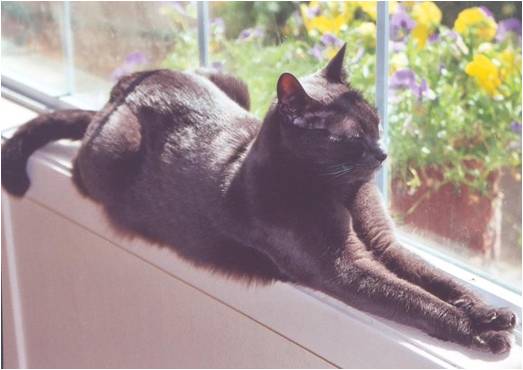
Smokey on the window sill, with sun and pansies

Smokey enjoying the sun from indoors, with pansies. It’s not an easy sill for a cat to balance on — Smokey would balance, and fall asleep.

The affair at the vet’s office Thursday was her last great show of will.  One thinks cats know they are dying.  Smokey would meet death on her terms, thank you very much.  By Friday she was clearly unable to walk or stand well.  Saturday Kathryn sat with her on the dining room floor.  When she wasn’t sleeping, Smokey would meow.  A stroke or two from Kathryn and she’d go back to sleep.  She had refused water until Friday night, but then started taking a little sips from a syringe.

Kathryn ran errands about 4:00 p.m., and I checked that Smokey was sleeping.  About 5:00 she woke up, wanted water, and looked around for Kathryn.  Kathryn returned a few minutes later, and Smokey relaxed, and breathed a last time.

A companion for more than two decades insinuates herself in ways one doesn’t even recognize.  Saturday night I turned off the kitchen lights to head to bed, and instinctively looked into the parlor to say goodnight to Smokey.  Sunday morning I got up to make coffee, and looked to see if Smokey wanted out.  I would have sworn she batted my nose this morning to wake me up, but no cat even close.

Sometime in the next few months I’ll take out a pair of pants or a coat, and notice it’s covered with Smokey’s gray fur.  At some point she used it for a pad, perhaps.  I’ll have to decide whether to clean the thing, or keep it as a reminder of our longtime friend.