Texas to U.S.: Sorry about Bush. Perry is worse.

August 16, 2011

See MeetRickPerry.com.


Howard Zinn: Bank bailout was trickle down economics run amok

August 14, 2011

You can disagree with him about every other sentence, but he speaks a lot of sense and a lot of stuff we need to think about.  Before his death in 2010, historian Howard Zinn talked about the bank bailouts that got us out of 2008:


White House notes advances in light bulbs and energy conservation

August 14, 2011

L-Prize-winning bulb from Philips North American Lighting -- a 10-watt LED bulb to replace 60-watt incandescent bulbs

L-Prize-winning bulb from Philips North American Lighting -- a 10-watt LED bulb to replace 60-watt incandescent bulbs

From the White House blog, something you probably didn’t see in your local newspaper and/or Tea Party organ:

Bright Ideas: Thomas Edison would be amazed. The conventional light bulb now has some serious competition. Philips Lighting North America has invented a revolutionary 10-watt light emitting diode (LED) bulb. Phillips is the first winner of the Energy Department’s Bright Tomorrow Lighting Prize(L Prize). The L Prize challenged the lighting industry to develop high performance, energy-saving replacements for conventional light bulbs that will save American consumers and businesses money.

Some business gets an award for lights that conserve energy?  Rats, there goes Rand Paul’s raison d’etre — all but for the lack of a toilet Paul could flush on his own.

More: 


August 13, 1961: The Berlin Wall’s 50th anniversary

August 13, 2011

August keeps handing us these dates:  How should the 50th anniversary of the construction of the Berlin Wall be remembered?

AP reports in the Seattle Post-Intelligencer that the current mayor of Berlin said we must use the Wall to remember that we must stand up for democracy.  Ceremonies in Berlin marked the anniversary and the creation of a new museum there.  I wrote before:

August 13 . . . [marks the 50th] “anniversary” of the erection of the Berlin Wall, the totem of the Cold War that came down in 1989, pushing the end of the Cold War. Residents of Berlin awoke on this day in 1961 to find the communist government of East Germany erecting what would become a 96-mile wall around the “western quarters” of the city — not so much to lay siege to the westerners (that had been tried in 1948, frustrated by the Berlin Airlift) as to keep easterners from “defecting” to the West. The Brandenburg Gate was closed on August 14, and all crossing points were closed on August 26.

From 1961 through 1991 1989, teachers could use the Berlin wall as a simple and clear symbol for the differences between the communist Eastern Bloc, the Soviet Union and her satellite states, and the free West, which included most of the land mass of Germany, England, France, Italy, the United States and other free-market nations — the North Atlantic Treaty Organization (NATO) countries. I suspect most high school kids today know very little about the Wall, why it was there, and what its destruction meant, politically.

This era of history is generally neglected in high school. Many courses fail to go past World War II; in many courses the Cold War is in the curriculum sequenced after the ACT, SAT and state graduation examinations, so students and teachers have tuned out.

But the Wall certain had a sense of drama to it that should make for good lessons. When I visited the wall, in early 1988, late at night, there were eight fresh wreaths honoring eight people who had died trying to cross the Wall in the previous few weeks (in some places it was really a series of walls with space in between to make it easier for the East German guards to shoot people trying to escape) — it’s an image I never forget. Within a year after that, East Germans could travel through Hungary to visit the West, and many “forgot” to return. Within 18 months the wall itself was breached.

The Wall was a great backdrop for speeches, too — President John F. Kennedy visited Berlin in June 1963, and expressed his solidarity with the walled-in people of both West and East Berlin, with the memorable phrase, “Ich bin ein Berliner, which produced astounding cheers from the tens of thousands who came to hear him. There are a few German-to-English translators who argue that some of the reaction was due to the fact that “Berliner” is also an idiomatic phrase in Berlin for a bakery confection like a jelly doughnut — so Kennedy’s words were a double entendre that could mean either “I am a citizen of Berlin,” or “I am a jelly doughnut.”  [Be sure to see the comments . . .  from Vince Treacy (9/28/2010).]  Ronald Reagan went to the same place Kennedy spoke to the Berlin Wall, too, to the Brandenburg Gate, in his famous June 1987 speech which included a plea to the Soviet Union’s Premier Mikhail Gorbachev: “Mr. Gorbachev, tear down this wall!”

What do we do appropriately with such memory?

What does the Berlin Wall, and its demise, mean to us today?  What should it mean?


Ethics in climate science: How do we know what we know?

August 12, 2011

It’s almost an arcane fight, but it’s an important one — if you’re going to discuss climate science and the policies required to clean up pollution that causes destruction of our planet, can we at least agree to stick to the facts, the real facts?

John Mashey is a computer smart guy who jumped into the fray to point out that most opponents to doing anything to stop the destruction have a social or economic interest in stopping the action and continuing the destruction, something Mashey determined from looking at the networks linking the people involved.  There’s a lot of howling about Mashey’s pointing out that the emperor is a crook.  So far he’s been proved correct.

An academic group you probably never heard of, the National Association of Scholars, has an elected leader who decided to take after Mashey, rather than clean up the house.  Peter Wood writes a column for the  Chronicle of Higher Education, and sadly, their editorial mavens appear not to have fact checked it.  To their credit, they allowed Mashey’s response.

Comments are brutal.

Here’s how Tim Lambert described it at Deltoid:

John Mashey and Rob Coleman have a guest post at The Chronicle of Higher Education‘s blog replying to Peter Wood’s hit piece.

Wood’s article misused the platform of CHE. Its relevance to the concerns of CHE was minimal. It had little purpose but to damage the reputation of one of us, John Mashey, and the climate scientist Michael Mann, whom Wood has often denigrated elsewhere. The political false-association tactics were obvious. Climate scientists are under incessant attack, a fact strongly decried the day before Wood’s article by the AAAS Board. The muddy battlefield of blogs and media has now arrived on the CHE premises, easily seen in the comments.

If one tells the truth in climate science, one needs thick skin.  Go read Mashey’s piece before you read the comments.  More background from Lambert, here.

And the context you need:  Only one study on climate change has actually been retracted over the past couple of years — no, not any of those noting that warming occurs, not any of those that use the graph famously described as “a hockey stick,” but the piece that pulled together all the criticism of the science, at the behest of Republicans on the environment committees in the U.S. Congress, called the Wegman Report.  And it was John Mashey who assembled the extensive and sometimes elegant case that the Wegman Report was plagiarized and wrong.

This is, indeed, a case of trying to kill the messenger’s reputation.

Am I the only one suspicious that the National Association of Scholars may have been named to foster confusion about the authority of reports, say from the National Academy of Sciences, the long-time science advisory group to presidents whose reports urge action to stop climate change?  Notice their acronyms are the same.


Will any Republican stand up for America?

August 12, 2011

Ezra Klein’s on-line column this morning worries me more — will any Republican stand up for America?

No, I don’t mean  lip service, I don’t mean flag lapel pins.  I mean, will any Republican stand up for the policies we need to steer through the shoals of economic woe we face in the next 60 months?

At Wonkbook Klein said:

The most telling moment of Thursday’s GOP debate wasn’t when Michele Bachmann cooly stuck a knife between Tim Pawlenty’s ribs, or when Rick Santorum plaintively begged for more airtime, or when Mitt Romney easily slipped past questions about his record on health-care reform. It was when every single GOP candidate on the stage agreed that they would reject a budget deal that was $10 in spending cuts for every $1 in tax increases. Even Fox News’s Bret Baier couldn’t quite believe what he was seeing. He asked again just to make sure the assembled candidates had understood the question.

Primary debates are usually watched for what they say about the candidates, but they’re generally important for what they say about the party. This one was no different. With the notable exceptions of Ron Paul and Jon Huntsman, the candidates didn’t disagree over policy. They disagreed over fealty to policy.

Bachmann didn’t attack Pawlenty’s policy proposals. She attacked him for past statements suggesting he might believe in other policy proposals, like the individual mandate and cap-and-trade. Pawlenty’s assault on Romney took the same form. This debate wasn’t about what policies the candidates believed in. That was largely a given. This debate was about which of the candidates believed in those policies the most.

The best policy in this debate wasn’t the policy most likely to work, or the policy most likely to pass. It was the most orthodox policy. The policy least sullied by compromise. A world in which the GOP will not agree to deficit reduction with a 10:1 split between spending cuts and tax increases is a world where entitlement reform can’t happen. It’s a world where the “supercommittee” fails and the trigger is pulled, and thus a world in which $1 out of every $2 in cuts comes from the Pentagon. It’s not a world that fits what many in the GOP consider ideal policy. But it is a world in which none in the GOP need to traverse the treacherous politics of compromise.

Policies discussed weren’t mainline, capitalist economic policies, either.  They’re so far out in left field they can’t even see the pitcher’s mound from where they are.  Plus, they’re looking the wrong way.

Over and over again, [Michelle] Bachmann misstated basic facts. She said that Tim Pawlenty “implemented” cap-and-trade in Minnesota. He did no such thing. She said “we just heard from Standard Poor’s,” and “when they dropped our credit rating what they said was we don’t have an ability to repay our debt.” Simply not true.

S&P has never questioned our ability to repay our debt. That’s why we remain AA+. They have questioned whether political brinksmanship will stop us from paying our debt. The downgrade “was pretty much motivated by all of the debate about the raising of the debt ceiling,” said John Chambers, head of S&P’s sovereign ratings committee. That is to say, it was motivated by political brinksmanship from the likes of, well, Michele Bachmann.

It’s fitting that the candidate best able to resist compromise is the candidate who seems least able to correctly explain the policies at issue and the choices we face. It’s a lot easier to take a hard line if you don’t understand the consequences of your actions, and a lot simpler to belt out applause lines if you’re not slowed down by the messy complexities of the issues. But where Bachmann is leading, the other candidates are following. Mitt Romney knows perfectly well that a deal with $10 in spending cuts for every $1 in tax increases is a great deal for conservatives. What he probably doesn’t know is how he’s going to explain why he pretended otherwise when he was vying for the nomination.

Winners in the debate?  Unclear.  Losers?  You, me, and every American.

Can any Republican explain where in the world they got these nightmare economic policies?  Are they being made up on the spot?


Genesis 51 — Ben Franklin’s favorite part of the Bible

August 11, 2011

There’s a longer explanation, but this needs to be put out where it can be caught by search engines.

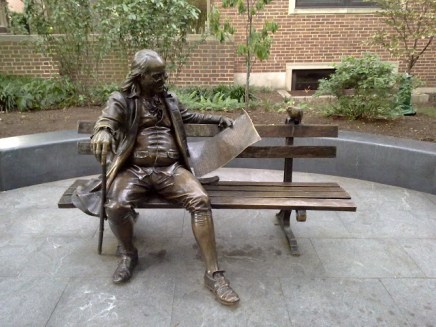
Ben Franklin reads to a bird, statue at the University of Pennsylvania - photo via Priyank

Benjamin Franklin reading the Pennsylvania Gazette, or “Ben on the Bench” (with a bird), statue at the University of Pennsylvania – photo via Priyank

This is the 51st chapter of the Book of Genesis, as related by Benjamin Franklin.  This copy of the text comes from a newspaper, The Otago Witness, December 2, 1887, page 35, courtesy of a website called Papers Past, maintained by the National Library of New Zealand.

Paste It in Your Bible.

A Chapter Verily Like the Original— How Benjamin Franklin Surprised Ms Friends.

Over 100 years ago the following so-called “Genesis 51” was used to puzzle Biblical scholars, and today, were it read aloud in any mixed company, it is questionable if its fraudulent nature would be discovered, so beautifully is the spirit and language of the Old Testament imitated : —

1. And it came to pass after these things, that Abraham sat in the door of his tent, about the going down of the sun.

2. And behold a man, bowed with age, came from the way of the wilderness leaning on a staff.

3. And Abraham arose and met him, and said unto him, Turn in, I pray thee, and wash thy feet, and tarry all night, and thou shalt arise early on the morrow, and go thy way.

4. But the man said, Nay, for I will abide under this tree.

5. And Abraham pressed him greatly; so he turned, and they went into the tent, and Abraham baked unleavened bread, and they did eat.

6. And when Abraham saw that the man blessed not God, he said unto him, Wherefore does thou not worship the most high God, Creator of heaven and earth?

7. And the man answered and said, I do not worship the God thou speakest of, neither do I call upon his name; for I have made to myself a God which abideth always in my house and provideth me with all things.

8. And Abraham’s zeal was kindled against the man, and he arose and drove him forth with  blows into the wilderness.

9. And at midnight God called unto Abraham, saying, Abraham, where is the stranger?

10. And Abraham answered and said, Lord, he would not worship Thee, neither would he call upon Thy name, therefore have I driven him out from before my face into the wilderness.

11. And God said, Have I not borne with him these hundred and ninety and eight years, and nourished him, and clothed him notwithstanding his rebellion against me, and couldst not thou, that art thyself a sinner, bear with him one night ?

12. And Abraham said. Let not the anger of my Lord wax against His servant; lo! I have sinned, forgive me, I pray thee.

13. And Abraham arose and went forth into the wilderness, and sought diligently for the man, and found him and returned with him to the tent, and when he had entreated him kindly, he sent him away on the morrow with gifts.

14, And God spake again unto Abraham, saying, For this thy sin shall thy seed be afflicted four hundred years in a strange land.

15. But for thy repentance will I deliver them, and they shall come forth with power, and with gladness of heart, and with much substance.

In 1759, when in England as agent for the colony of Pennsylvania, Benjamin Franklin privately printed this “Chapter,” as he always termed it.  Taking only a sheet of paper, he kept it laid in his Bible at the end of Genesis, and used to amuse himself by reading it aloud to his friends, and hearing them express their surprise that they had never recollected reading it, and their openly expressed admiration of the moral it carried with it. Its origin is unknown.  It has been traced back 700 years to a Persian poet, who simply says “it was so related.” It must be very old.

Ben Franklin’s version of Chapter 51 of the Book of Genesis is a hoax.  There is no such chapter.


Apathy wins again

August 11, 2011

Apathy is a cruel political philosophy.  It supports despots, fools, crooks and partisan hacks — more often than it supports good government, in my humble opinion.

In Wisconsin, had all those who signed the petitions to recall Tea Party Republicans, voted, the results would have been more favorable to Democrats.  Tea Partiers won big in 2010 on the basis of poor voter turnout nationally (could it really have been as low as 18% of all voters?).

In Wisconsin on Tuesday, apathy turned the tide for them again.  Post-Crescent editorial writers in Appleton wrote:

Look at it this way — 26,000 people in the 2nd Senate District signed the petition to recall Sen. Rob Cowles of Allouez in the spring. But only 18,000 people ended up voting for Cowles’ opponent, Nancy Nusbaum on Tuesday.If the 26,000 petition-signers would have voted for Nusbaum, she only would have needed 1,500 more votes to beat Cowles, who had 27,500 votes.

From Appleton, in one contested district, only 35 voters showed up to vote.

It is clear why Republicans work so hard, nationally, to restrict voter turnout by making it difficult, onerous, or just bothersome to vote.  And no doubt, they think that they will make better decisions than those who didn’t vote and thereby handed them the reins of power.  Despots, fools, crooks and partisan hacks rarely confess they are not the purveyors of good, democratic government.


Republicans lose only two in Wisconsin

August 10, 2011

Opening paragraph in this morning’s Post-Crescent in Appleton, Wisconsin:

By Steve Contorno, Gannett Wisconsin Media

Sen. Rob Cowles blocked one of six attempts by Democrats on Tuesday to oust a sitting Republican lawmaker from office, putting his party in a position to maintain control of Madison and continue its unchecked, aggressive agenda.

That’s about as polite as it is possible to be.

Democrats faced an uphill battle, but took two out of three seats from Republicans.  It is not enough to flip the majority in the Senate.

Will it be enough of a scare to make Republicans talk sense?  You’d think that, after watching the damage done to the stock market, almost as bad as the attack on the World Trade Center, Wisconsin voters would have been more circumspect.

But these six Republicans were well-entrenched.  33% is better than nothing.  It means 33% of Wisconsinites appear to have awakened to the wolves at their doors.

How to wake up the rest?

Two Democrats face recall elections next week, revenge for the recall elections this week.

Will the assault on U.S. values, education and public institutions, continue?

_____________

This morning, according to AP, Wisconsin Democrats said they will push forward to recall Gov. Scott “Ahab” Walker, just as soon as he is eligible for recall.


Barbara Ehrenreich wonders: What’s the real poverty rate in America?

August 10, 2011

Barbara Ehrenreich, “How America turned poverty into a crime,” Salon.com, August 9, 2011:

At the time I wrote “Nickel and Dimed,” I wasn’t sure how many people it directly applied to — only that the official definition of poverty was way off the mark, since it defined an individual earning $7 an hour, as I did on average, as well out of poverty. But three months after the book was published, the Economic Policy Institute in Washington, D.C., issued a report entitled “Hardships in America: The Real Story of Working Families,” which found an astounding 29 percent of American families living in what could be more reasonably defined as poverty, meaning that they earned less than a barebones budget covering housing, child care, health care, food, transportation, and taxes — though not, it should be noted, any entertainment, meals out, cable TV, Internet service, vacations, or holiday gifts. 29 percent is a minority, but not a reassuringly small one, and other studies in the early 2000s came up with similar figures.

The big question, 10 years later, is whether things have improved or worsened for those in the bottom third of the income distribution, the people who clean hotel rooms, work in warehouses, wash dishes in restaurants, care for the very young and very old, and keep the shelves stocked in our stores. The short answer is that things have gotten much worse, especially since the economic downturn that began in 2008.

Liberty does not flow to those who lack the money to eat, or keep warm.  We have strides to make to get to “liberty and justice for all.”

Libertarians, why do you oppose liberty for poor-but-working people?


Red dragonfly in Colorado Bend State Park, Texas

August 9, 2011

Dragon flies are not my area of expertise:  Can anyone identify this beauty?

Red Dragonfly in Colorado Bend State Park, Texas (photo by Ed Darrell)

Red dragonfly in Colorado Bend State Park, Texas - photo by Ed Darrell

_____________

Kate wrote in to say it’s probably Libella saturata.  From other photos I’ve found, that seems a good, accurate identification.  Citizens of Arizona have been urged to help identify dragon flies, odonates,  in their state, and this site explains how to do it with a camera and a notepad — with a fine picture of a Libella saturata for illustration.  And, as a reward to Kate and yourself, you may want to hop over to her blog, The Radula, and see what she’s got to look at.


Monckton in New Zealand: His reputation for fabrication preceded him

August 9, 2011

John Abraham’s work ended up giving Christopher Monckton a bumpy ride into New Zealand, according to Country 99 News:

Monckton was lucky the news channel labeled him “Climate Skeptic” and not “Barking Mad.”

More: 


Voting today in Wisconsin: Recall the Tea Party?

August 9, 2011

If Wisconsin voters have 401Ks or pension plans, you’d think it would be a complete rout in the six recall elections today in Wisconsin, no?

Here’s where we learn the perils of Americans who get their news from Fox News, and don’t read newspapers.

So, I get e-mail from the AFL-CIO Working Families Network — are you paying attention, Wisconsin?

Aug. 9, 2011

Wall Street greed
The Republican extremists who lit the fire that burned the nation’s credit rating work for a handful of billionaires and corporations. We didn’t say that. The corporate bible Forbes
said it
.

Wisconsin voters are going to the polls today to make history and recall the Walker 6. Those six are Gov. Scott Walker’s (R) closest state Senate allies who spearheaded his move to take away the collective bargaining rights of public employees and ram through a budget devastating to working families.

Read More

Got comments? Post them at blog.aflcio.org.

 Wall Street Gets Nervous About Who It Put in Office

Take Action: Tell Verizon to Stop Attacking the Middle Class

 New Taxes Won’t Turn Millionaires into Fleeing Tax Refugees

Would the AFL-CIO attract more voters if they noted the six Republicans are part of the Tea Party team that drove America’s financial future off the cliff? Wisconsin voters could send a message to Congress today, were they so inclined.


August 9, 1945, at Nagasaki: The last use of atomic weapons in war

August 9, 2011

How much has changed since I wrote the post, below, in 2009?  The number of years, perhaps (and I’ve changed them in the text).

Stars and Stripes posted this short video of the cermonies held in 2011 in Peace Park in Nagasaki

21

Stars and Stripes said:

A memorial service was held at the Nagasaki Peace Park on Aug. 9, 2011, the 66th anniversary of the atomic bomb being dropped on the city at the tail end of World War II. The ceremony was attended by dignitaries from 44 countries – including an envoy from the United States – to honor the more than 155,000 people who were claimed by the bomb, including the 80,000 killed instantly.

The service came three days after one similar in Hiroshima, and marked the first time in history that an envoy from the United States attended both services.

In the wake of the March 11 disaster, Japanese officials called for the abolition of nuclear weapons and also for renewable sources of energy to replace nuclear power.

Below is mostly an encore post:

Nuclear anniversaries have been ignored this year, it seems to me.

Ceremony in Nagasaki marked the remembrance of the victims of the second atomic weapon used in war, which was detonated over Nagasaki on August 9, 1945. Agence France Press reported (in 2009):

Nagasaki’s mayor, marking the 64th anniversary [66th in 2011] of his city’s atomic bombing by the United States, called on Sunday on the leaders of nuclear-armed powers to visit the site and build a nuclear-free world.

Hiroshima and Nagasaki, map by CNN

Hiroshima and Nagasaki, map by CNN

Tomihisa Tanoue urged world leaders from both declared nuclear powers and others such as Iran, Israel and North Korea to visit the city in southwestern Japan.

“I am sure anyone who visits here would feel the sorrow of the victims and be shaken by it,” the mayor said in an address at an annual ceremony commemorating the 1945 bombing.

A minute of silence was observed at 11:02 am (0202 GMT), when the US bomb exploded above the city, killing roughly 74,000 people. The bombing followed one a week before in Hiroshima and hastened Japan’s surrender in World War II.

Tanoue said an April speech by US President Barack Obama in Prague, where Obama pledged to build a world with no nuclear weapons, “impressed” the residents of Nagasaki.

“The Japanese government must support the Prague speech. As a nation that has come under nuclear attack, Japan must lead the international community” in abolishing the weapons, he said.

Similar appeals were made Thursday when Hiroshima marked the anniversary of its bombing, which killed 140,000 people.

At the Nagasaki ceremony, Prime Minister Taro Aso reiterated the Japanese government’s anti-nuclear stance, three weeks ahead of national elections that he is tipped to lose.

Aso raised eyebrows at the Hiroshima ceremony, when he pledged to work toward abolishing nuclear weapons but later told reporters that he thought it was “unimaginable” to attain a nuclear-free world.

Similar ceremonies, and similar pleas for nuclear non-proliferation marked the August 6 anniversary of the atomic bomb drop on Hiroshima. The Chinese news agency Xinhua reported:

Some 50,000 people gathered Thursday at the peace park in Hiroshima to mourn the 64th anniversary of the atomic bombing of the city by U.S. forces during the World War II.

Hiroshima Mayor Tadatoshi Akiba delivered a peace declaration, calling for the abolition of nuclear weapons by 2020.

“The hibakusha still suffer a hell that continues,” said Akiba.

“The Japanese government should support hibakusha, including those who were victims of black rain and those who live overseas,” he said.

Japanese Prime Minister Taro Aso delivers a speech in front of the Memorial Cenotaph during the Hiroshima Peace Memorial Ceremony in Hiroshima, western Japan on Aug. 6, 2009. Hiroshima on Thursday mourned the 64th anniversary of the atomic bombing of the city by U.S. forces during the World War II. (Xinhua/Ren Zhenglai)

"Japanese Prime Minister Taro Aso delivers a speech in front of the Memorial Cenotaph during the Hiroshima Peace Memorial Ceremony in Hiroshima, western Japan on Aug. 6, 2009. Hiroshima on Thursday mourned the 64th anniversary of the atomic bombing of the city by U.S. forces during the World War II. (Xinhua/Ren Zhenglai)"

It was reported Wednesday that the Japanese government aims to come to an agreement with all atomic bomb survivors who have sued the government for financial support to help them pay medical bills for illnesses related to the bombings of Hiroshima and Nagasaki.

Akiba also said “The year 2020 is important as we want to enter a world without nuclear weapons with as many hibakusha as possible. We call on the world to join forces with us to eliminate all nuclear weapons by 2020.”

Referring to the movements such as the environmentalists, Akibasaid, “Global democracy that respects the will of the world and respects the power of the people has begun to grow.”

“We have the power. We have the responsibility. We are the Obamajority. And we can abolish nuclear weapons. Yes we can,” said the mayor.

On Wednesday, Akiba urged the people around the world to join the city’s efforts to abolish nuclear weapons in response to U.S. President Barack Obama’ s appeal for a world free of nuclear weapons.

During the 50-minute memorial ceremony, a moment of silence was observed at 8:15 a.m., the time the atomic bomb detonated over Hiroshima 64 years ago, killing nearly 100,000 people in a blink.

This in a week when two burgeoning new nuclear powers, Iran and North Korea, continue to claim they will flout non-proliferation agreements for their own self defense. [Still true in 2011, alas.]

The question obtains on nuclear issues as well as genocides: When does “never again” start?

Other related posts at Millard Fillmore’s Bathtub:


Climate denialists on Texas weather 2011: Ain’t no heat wave, on average

August 8, 2011

You couldn’t make this stuff up.

In defense of his claim that Texas has not warmed over the last century (“Texas temperatures not rising; Wisconsin temperatures not rising”) and, therefore, Texas does not suffer from global warming, and therefore there is no global warming and no ill effects from warming, Steve Goddard posted this today:

Year-To-Date In Texas

Posted on August 7, 2011 by stevengoddard

Almost as warm as 1927, 1925 and 1953. Only a degree cooler than 1911.

http://www.ncdc.noaa.gov/oa/climate/research/cag3/tx.html

It’s heading for 105°, but since it was 15° one day in February, that averages to 60°, so Texas is okay, according to Goddard.  In their drive to fuzz up the facts and surround policy debates with snark, the denialists will deny anything, leave no weather record untwisted, and deny the sweat on the nose on their face.  According to Goddard, snow in the Great Basin means no drought in Las Vegas, as shown by there being no drought affecting Lake Powell.

Remember Straight Dope’s Cecil Adams’s old line?  “Fighting ignorance since 1973 (it’s taking longer than we thought.)”  Yeah, that applies to climate denialists in quantity.

Here’s what’s going on in Texas right now:

Vodpod videos no longer available.

  •  Texas A&M says the drought of 2011 is the worst ever 1-year drought in Texas history; note how their press release describes the event, and the increasing heat:

    Preliminary reports from the National Climatic Data Center indicate that July 2011 was the warmest month ever recorded statewide for Texas, with data going back to 1895, [State Climatologist John] Nielsen-Gammon reports. The average temperature of 87.2 degrees broke the previous record of 86.5 degrees set in 1998. The June average temperature of 85.2 was a record for that month and now ranks fifth warmest overall.

    Rainfall totals were also unusually light across the state. The July monthly total of 0.72 inches ranks third driest, surpassed by the 0.69 inches recorded in both 1980 and 2000. This is the fifth consecutive month in which precipitation totals were among the 10 driest for that month, says the Texas A&M professor.

Drought and searing heat in Texas.  Caused by climate change?  That’s difficult to say, difficult to trace.  Made worse by climate change?  Most likely.

Dallas media track the consecutive days over 100° F.  It’s a form of misery index — people can recover from a day or two over the century mark.  But more than a couple of days and the heat begins to take a heavier toll on people, on plants and animals, on houses, on cars, on crops, on everything we do in Texas.  It’s difficult to make news make sense on weather stories.  Tracking the number of days over 100° gives a quick graphic for television news, and puts the story into the vein of a sports record story, a narrative people know.

Here’s how things stack up in Dallas, in terms of days over 100°:

Rank Year Consecutive 100° days
1 1980 42
2 2011 37 (and counting)
3 1998 29
4 1952 25
5 1999 24
6 1954 20
7 2006 19
8 2010 18
8 1978 18
10 1956 17

If one looks at the heat streaks, one cannot help but notice that all of the top ten streaks have come since 1952, and that three are in the last decade, five since 1998.  Brutal heat streaks appear to be coming more frequently, many close on the heels of previous heat streaks, and with greater severity.

That is what one would expect from global warming.

Moreover, the recent streaks show greater oscillations.  2011 also saw snow and freezing weather in Dallas, a rarity.  Greater oscillations in weather also would be expected from global warming.

Goddard offers a comparison of January to June temperatures — the coolest part of the calendar year, and leaving out most of the heat-streak days — and on that basis of a half-comparison, he suggests (doesn’t say — he doesn’t want to be caught lying outright) that there isn’t a warming problem in Dallas in 2011.

Heat stroke?  It’s a figment of your socialist imagination.  14 dead?  They probably were smokers.  Global warming?   Not if Steve Goddard can find a statistic somewhere that can be manipulated to appear to deny it.

What do his charts show for July and August of those years?

Finally, there is this:   Assume for a moment that there has been no significant warming in Texas as a complete landmass over the past 100 years:  Does that mean Texas is not battered by any warming that occurs elsewhere?

Of course not.  The current drought in Texas is thought to be triggered in no small part by the La Niña effect, a chilling of the surface of the Pacific in a broad band that stretches west of Peru for about 5,000 miles to the far South Pacific.  La Niña is a counterpart to El Niño, a warming of the same band of water that produces different, not-average weather effects.  The cycles are not well understood as to cause — there are good hypotheses being tested — but it has been observed that, especially in the latter part of the 20th century and the first decade of the 21st, these cycles are speeding up.  The best, not-disproven hypothesis is that these cycles react and speed up due to global warming.

So, to the best of our hypothesizing today, the Texas drought is a function of global warming, in timing, frequency and severity.

This demonstrates the ultimate problem with using a local temperature readings to make authoritative statements about global warming, even averaged over about a hundred million acres like Texas:  Problems of global warming are not always simply problems of temperature, and non-local causes may cause local effects that will not show up in temperature, especially local effects in precipitation, in timing and amounts.

Botanists, foresters, range scientists and biogeographers noticed effects of warming 50 years ago, with the migration of species northward, and up mountainsides.  Wildlife managers noticed altered migrations of game birds and non-game birds about the same time, migration alterations that continue to today.  Plant zones used by farmers and gardeners demonstrate a good deal of change, generally favoring warming, over the past century.  Evidence for warming is quite solid without a single temperature reading.

A bastion of average temperature non-increases, if Texas is one, may still be hammered by warming and its effects in the Pacific, and especially in the Gulf of Mexico.  Is it fair to say the entire system shows no signs of warming?

So we should ask:  Are temperatures and precipitation averages, frequencies, timing and totals, about average for the last century or two?  Then  the case for global warming is a bit weaker.

Dallas will eclipse the previous record string of 100° F days in the next week.  All of Texas is in severe drought, and most of the state is in extreme drought.  Sounds as if there is something going on with the climate.

Last year the denialism sites lit up with a report that a fourth grade student in South Texas had a science project that disproved global warming, and which won an award from the National Science Foundation.  It was a sad hoax.  The speed with which these sites pounced on the report should have warned us that a school of thought devoid of practical results from the lab bench or observation in nature gets too desperate for results, and will cut corners to claim them.  Goddard’s reports repeat the bad methodology of that hoax.

Richard Feynman once wrote, wryly, “Science is the belief in the ignorance of experts.”  Goddard and other denialists appear to read that wrongly, thinking that experts are not to be trusted, and that all experts are ignorant of all things, and therefore stupid.

Politics and especially the politics of science cry out for someone to read Feynman — actually read what he wrote.  Feynman said we should not assume all scientists are infallible.  He did not write that all scientists are fallible and wrong.