“When we’re telling whoppers about Obama and government, please don’t pester us with the facts” Department

June 27, 2011

First:  American Elephant, a blog that insults pachyderms with its mendacious ways, stretches for ways to complain about President Obama.  In a recent post, the author tried to poke ill-humored fun at Obama and companies he’s visited over the past couple of years.  It’s the headline that caught my attention:

“President Obama has never held a private job, but picks the winners and losers for the economy”

The premise is false, of course — it’s based on that Republican smear meme that Obama and his cabinet lack experience in the private sector, a smear that breaks down quickly if anyone looks at the biographies of the cabinet.  Obama also comes from the private sector, though when confronted with the facts the meme spreaders tend to make rash and foolish claims like “the Catholic church is public sector” and “lawyers all work for the government.”

Conspiracy theory cartoon by Chris Madden

Cartoon by Chris Madden, via TV Tropes

I left a response there, but don’t expect the blog owner to show the decency of allowing it through moderation:

President Obama worked for a private group providing services to people below the poverty line, and then he worked for a very large private law firm, while teaching at the privately-run University of Chicago.  He had never worked for government until his election to the Illinois State Senate (is that salaried?).

You should probably correct the headline.

As if.  Not only is the headline wrong, but the evidence doesn’t support the second premise, and there are other serious problems with the claims and arguments advanced there.  True American elephants probably take to drink to try to forget what’s being done under their name.

Second, and probably third:  There is the minor kerfuffle of the hoax report out of Pakistan that nuclear power plants in Nebraska are either near meltdown, or already melted down, and you don’t know about it because President Obama ordered a news blackout to avoid panic but at the same time condemning hundreds of thousands of Midwesterners to radiation poisoning deaths.  It’s an absurd story on several fronts and several levels — news of the flood plight of the power plants has been reported around the world, for example — but those bent on being suckered by every conspiracy claim to come down the pike, or bent on criticizing President Obama no matter how much they must twist the fact to do it, cannot be dissuaded.

Take for example this odd blog:  A discussion of the imagined meltdown quickly disintegrates into defense of holding on to birther views despite Obama’s release of his “long form” birth certificate (no good information goes un-urinated upon).  Then discussion veers off into all sorts of paranoia — UN “control” of U.S. lands, occupation of several states by rogue Transportation Security Agents (you didn’t hear about it due to the news blackout, most likely), Obama’s being controlled by or controlling GE (‘didn’t GE have something to do with the design of those nuclear reactors?’), Army Corps of Engineers plots to flood the Midwest (????), Obama’s overturning the Constitution through the use of executive orders (which no one there can find at the moment, but they’re sure they exist, somewhere . . .  gee, did we misplace it?) including a wholly imaginary order to take over all rural lands in the U.S. (why?), and complaints that the U.S. is not deporting U.S. soldiers or their families quickly enough.

Such a ball of delusional paranoia and errors of history, law, and other facts!  One might imagine these people so involved in tracking down misinformation and distorting real information that they forget to kick their dogs.  (Seriously, I’d tend to think these people could be helped by having a dog or a cat, except for the very real fear I have they’d forget to feed the creatures; like a drowning person, fighting all efforts to save them.)

Our nation has a collective inability to deal with the facts of too many situations, because too many people simply deny the facts in front of our collective national faceJonathan Kay’s recent book, Among the Truthers, gets at the problem — you can imagine how strongly any of these bloggers and commenters would resist even reading Kay’s book.  It’s not that they seek information to make good decisions on policy, but that they seek the misinformation to justify their paranoid claims that “we are all really, really screwed!

As with the blogs noted above, we witness the birth of voodoo history, bogus history, and intentional ignorance.

There is a great danger from these cesspools of willful ignorance.  As more people refuse to grant credence to facts, to reality, it becomes more difficult to muster a consensus on what to do about any particular problem.  Wildfires and drought in Texas this year already wiped out more than three-fifths of the state’s wheat harvest; floods in the upper Midwest will surely do serious damage to wheat crops there.  We face a shortage of the surpluses of wheat the nation has used to bring peace and vanquish hunger around the world for the past 60 years — think of our “sale” of wheat to the old Soviet Union, stopping the starvation death toll under 10 million and indebting the USSR to the U.S. and the non-communist West — a debt the USSR never could pay off, and a debt which was the hammer to start the crumbling of the foundations of Soviet Communism.  In short, we have a wheat supply problem, caused in no small part by weather extremes that are, mostly likely, aggravated by global warming.

Can we agree to take action?  Probably not, not so long as so many people deny that warming is happening and throw every roadblock in the path of action, in the name of “preventing government takeover.”

As a nation, we have problems with flood control, and emergency preparedness, and the management of undeveloped lands and farm lands — not to mention the many urban problems we face.  What are the odds we can get a consensus on any of those problems, at least enough of a consensus to take constructive action?

For want of a nail, the horseshoe was lost, begins the old saw.  We can’t even get agreement that horseshoes should be nailed to a horse’s hoof — how can we get the consensus to make sure there are enough nails to do the job?


Kennedy said, in the struggle for freedom, we are all citizens of Berlin (Quote of the moment)

June 26, 2011

49 years ago, on June 26, 1962, in Berlin:

President Kennedy addresses Berlin citizens, 6-26-1962 (photographer unidentified)

President John F. Kennedy addressing a crowd in Berlin, Germany, June 26, 1962 - image from NARA and/or Kennedy Library

From the Smithsonian Magazine site:

June 26, 1963: “Ich bin ein Berliner”

In West Berlin, President John F. Kennedy delivers the famous speech in which he declares, “Ich bin ein Berliner.” Meaning literally “I am a citizen of Berlin,” the statement shows U.S. solidarity with democratic West Berlin, surrounded by communist territory.

View a video of President Kennedy’s speech at American Rhetoric, Top 100 Speeches.

Audio of the famous line, from the National Archives:

Photos and complete audio, at The Sounds of History.com:

Text and transcript, and other materials, from the Kennedy Library and Museum:

Kennedy’s entire speech was good. It was well drafted and well delivered, taking advantage of the dramatic setting and the dramatic moment. John Kennedy well understood how to give a speech, too.

Below is most of the speech, nearly five minutes’ worth, from a YouTube file — another indication that schools need to open up their filters to allow at least some of the best YouTube material through:

Transcript, from the JFK Library:

I am proud to come to this city as the guest of your distinguished Mayor, who has symbolized throughout the world the fighting spirit of West Berlin. And I am proud to visit the Federal Republic with your distinguished Chancellor who for so many years has committed Germany to democracy and freedom and progress, and to come here in the company of my fellow American, General Clay, who has been in this city during its great moments of crisis and will come again if ever needed.

Two thousand years ago the proudest boast was “civis Romanus sum.” Today, in the world of freedom, the proudest boast is “Ich bin ein Berliner.”

I appreciate my interpreter translating my German!

There are many people in the world who really don’t understand, or say they don’t, what is the great issue between the free world and the Communist world. Let them come to Berlin. There are some who say that communism is the wave of the future. Let them come to Berlin. And there are some who say in Europe and elsewhere we can work with the Communists. Let them come to Berlin. And there are even a few who say that it is true that communism is an evil system, but it permits us to make economic progress. Lass’ sie nach Berlin kommen. Let them come to Berlin.

Freedom has many difficulties and democracy is not perfect, but we have never had to put a wall up to keep our people in, to prevent them from leaving us. I want to say, on behalf of my countrymen, who live many miles away on the other side of the Atlantic, who are far distant from you, that they take the greatest pride that they have been able to share with you, even from a distance, the story of the last 18 years. I know of no town, no city, that has been besieged for 18 years that still lives with the vitality and the force, and the hope and the determination of the city of West Berlin. While the wall is the most obvious and vivid demonstration of the failures of the Communist system, for all the world to see, we take no satisfaction in it, for it is, as your Mayor has said, an offense not only against history but an offense against humanity, separating families, dividing husbands and wives and brothers and sisters, and dividing a people who wish to be joined together.

What is true of this city is true of Germany–real, lasting peace in Europe can never be assured as long as one German out of four is denied the elementary right of free men, and that is to make a free choice. In 18 years of peace and good faith, this generation of Germans has earned the right to be free, including the right to unite their families and their nation in lasting peace, with good will to all people. You live in a defended island of freedom, but your life is part of the main. So let me ask you as I close, to lift your eyes beyond the dangers of today, to the hopes of tomorrow, beyond the freedom merely of this city of Berlin, or your country of Germany, to the advance of freedom everywhere, beyond the wall to the day of peace with justice, beyond yourselves and ourselves to all mankind.

Freedom is indivisible, and when one man is enslaved, all are not free. When all are free, then we can look forward to that day when this city will be joined as one and this country and this great Continent of Europe in a peaceful and hopeful globe. When that day finally comes, as it will, the people of West Berlin can take sober satisfaction in the fact that they were in the front lines for almost two decades.

All free men, wherever they may live, are citizens of Berlin, and, therefore, as a free man, I take pride in the words “Ich bin ein Berliner.”

You may also want to note these posts:


Quote of the moment: John Kennedy, “What do our opponents mean . . . ‘Liberal?'”

June 24, 2011

From the website of PBS’s American Experience:

Acceptance of the New York Liberal Party Nomination

John Fitzgerald Kennedy
September 14, 1960

What do our opponents mean when they apply to us the label “Liberal?” If by “Liberal” they mean, as they want people to believe, someone who is soft in his policies abroad, who is against local government, and who is unconcerned with the taxpayer’s dollar, then the record of this party and its members demonstrate that we are not that kind of “Liberal.” But if by a “Liberal” they mean someone who looks ahead and not behind, someone who welcomes new ideas without rigid reactions, someone who cares about the welfare of the people — their health, their housing, their schools, their jobs, their civil rights, and their civil liberties — someone who believes we can break through the stalemate and suspicions that grip us in our policies abroad, if that is what they mean by a “Liberal,” then I’m proud to say I’m a “Liberal.”

But first, I would like to say what I understand the word “Liberal” to mean and explain in the process why I consider myself to be a “Liberal,” and what it means in the presidential election of 1960.

John F. Kennedy during the 1960 campaign

John F. Kennedy during the 1960 campaign - Kennedy accepted the nomination of the New York Liberal Party on September 14, 1960; this photo may be from that event

In short, having set forth my view — I hope for all time — two nights ago in Houston, on the proper relationship between church and state, I want to take the opportunity to set forth my views on the proper relationship between the state and the citizen. This is my political credo:

I believe in human dignity as the source of national purpose, in human liberty as the source of national action, in the human heart as the source of national compassion, and in the human mind as the source of our invention and our ideas. It is, I believe, the faith in our fellow citizens as individuals and as people that lies at the heart of the liberal faith. For liberalism is not so much a party creed or set of fixed platform promises as it is an attitude of mind and heart, a faith in man’s ability through the experiences of his reason and judgment to increase for himself and his fellow men the amount of justice and freedom and brotherhood which all human life deserves.

I believe also in the United States of America, in the promise that it contains and has contained throughout our history of producing a society so abundant and creative and so free and responsible that it cannot only fulfill the aspirations of its citizens, but serve equally well as a beacon for all mankind. I do not believe in a superstate. I see no magic in tax dollars which are sent to Washington and then returned. I abhor the waste and incompetence of large-scale federal bureaucracies in this administration as well as in others. I do not favor state compulsion when voluntary individual effort can do the job and do it well. But I believe in a government which acts, which exercises its full powers and full responsibilities. Government is an art and a precious obligation; and when it has a job to do, I believe it should do it. And this requires not only great ends but that we propose concrete means of achieving them.

Our responsibility is not discharged by announcement of virtuous ends. Our responsibility is to achieve these objectives with social invention, with political skill, and executive vigor. I believe for these reasons that liberalism is our best and only hope in the world today. For the liberal society is a free society, and it is at the same time and for that reason a strong society. Its strength is drawn from the will of free people committed to great ends and peacefully striving to meet them. Only liberalism, in short, can repair our national power, restore our national purpose, and liberate our national energies. And the only basic issue in the 1960 campaign is whether our government will fall in a conservative rut and die there, or whether we will move ahead in the liberal spirit of daring, of breaking new ground, of doing in our generation what Woodrow Wilson and Franklin Roosevelt and Harry Truman and Adlai Stevenson did in their time of influence and responsibility.

Our liberalism has its roots in our diverse origins. Most of us are descended from that segment of the American population which was once called an immigrant minority. Today, along with our children and grandchildren, we do not feel minor. We feel proud of our origins and we are not second to any group in our sense of national purpose. For many years New York represented the new frontier to all those who came from the ends of the earth to find new opportunity and new freedom, generations of men and women who fled from the despotism of the czars, the horrors of the Nazis, the tyranny of hunger, who came here to the new frontier in the State of New York. These men and women, a living cross section of American history, indeed, a cross section of the entire world’s history of pain and hope, made of this city not only a new world of opportunity, but a new world of the spirit as well.

Tonight we salute Governor and Senator Herbert Lehman as a symbol of that spirit, and as a reminder that the fight for full constitutional rights for all Americans is a fight that must be carried on in 1961.

Many of these same immigrant families produced the pioneers and builders of the American labor movement. They are the men who sweated in our shops, who struggled to create a union, and who were driven by longing for education for their children and for the children’s development. They went to night schools; they built their own future, their union’s future, and their country’s future, brick by brick, block by block, neighborhood by neighborhood, and now in their children’s time, suburb by suburb.

Tonight we salute George Meany as a symbol of that struggle and as a reminder that the fight to eliminate poverty and human exploitation is a fight that goes on in our day. But in 1960 the cause of liberalism cannot content itself with carrying on the fight for human justice and economic liberalism here at home. For here and around the world the fear of war hangs over us every morning and every night. It lies, expressed or silent, in the minds of every American. We cannot banish it by repeating that we are economically first or that we are militarily first, for saying so doesn’t make it so. More will be needed than goodwill missions or talking back to Soviet politicians or increasing the tempo of the arms race. More will be needed than good intentions, for we know where that paving leads.

In Winston Churchill’s words, “We cannot escape our dangers by recoiling from them. We dare not pretend such dangers do not exist.”

And tonight we salute Adlai Stevenson as an eloquent spokesman for the effort to achieve an intelligent foreign policy. Our opponents would like the people to believe that in a time of danger it would be hazardous to change the administration that has brought us to this time of danger. I think it would be hazardous not to change. I think it would be hazardous to continue four more years of stagnation and indifference here at home and abroad, of starving the underpinnings of our national power, including not only our defense but our image abroad as a friend.

This is an important election — in many ways as important as any this century — and I think that the Democratic Party and the Liberal Party here in New York, and those who believe in progress all over the United States, should be associated with us in this great effort. The reason that Woodrow Wilson and Franklin Roosevelt and Harry Truman and Adlai Stevenson had influence abroad, and the United States in their time had it, was because they moved this country here at home, because they stood for something here in the United States, for expanding the benefits of our society to our own people, and the people around the world looked to us as a symbol of hope.

I think it is our task to re-create the same atmosphere in our own time. Our national elections have often proved to be the turning point in the course of our country. I am proposing that 1960 be another turning point in the history of the great Republic.

Some pundits are saying it’s 1928 all over again. I say it’s 1932 all over again. I say this is the great opportunity that we will have in our time to move our people and this country and the people of the free world beyond the new frontiers of the 1960s.


Good news? One denialist non-think-tank shuttered

June 24, 2011

Britain’s Independent reported on June 21 that the London version of the International Policy Network closed its doors.  The group was known for its anti-environmental protection, anti-science, pro-rapacious development stands.

Alas, the U.S. version clings on.

The International Policy Network, once the most persuasive and active think tanks campaigning against climate change science, has disbanded in the UK after what appears to be a spilt between its leading members.

A document released following a Freedom of Information request shows that the charity’ s chairwoman Linda Whetstone and her brother Michael Fisher held a private meeting in which they agreed to abandon the name of IPN UK after more than a decade. The meeting, held by telephone in November 2010, was perfectly within the charity’s rules.

The minutes of the meeting, which cover a single side of an A4 sheet of paper, were obtained by The Independent this week and reveal that Whetstone also resigned from the board of the International Policy Network in the United States, despite being a leading member of the organisation.

This newspaper has also confirmed that Professor Julian Morris, the founding director of the IPN in the UK and then president, is no longer working for the sister organisation in the US where he was earning $137,000. He is now vice president for research at a rival think tank, the Reason Foundation.

Professor Morris, after speaking at a meeting on Wednesday, June 15 being held by a new think tank called the Legatum Institute, said: “The IPN is scaling down. There were two organisations, the IPN US Inc and IPN UK and now the two organisations are pursuing independent paths.”

Asked whether the IPN had split over climate change, he added: “It is a long and complex story. It is what it is. I can see where you’re going with this.”

I wish I were so omniscient.  I wonder where Morris thought that line of questioning was going?

The Independent  summarized some of the less savory parts of the funding issues for the organization (John Mashey surely knows all this):

The closure of the free market IPN follows years of controversy about Exxon funding, alleged links to the tobacco industry and contested claims about AIDs and the pesticide DDT.

It is possible, however, that the closure may be linked to family connections involving David Cameron that meant IPN could no longer exist as a major force of climate denial.

Whetstone is the mother-in-law of Steve Hilton, who is the director of strategy for the prime minister and was godfather to his son Ivan. Hilton is the man who persuaded the Conservative leader to adopt a robust stance on climate change and hug Huskies on the Norwegian glacier to illustrate his commitment.

Hilton’s wife, Rachel Whetstone, is a vice president at Google for communications, which has donated millions to climate change causes, including creating 21 Google Science Communication Fellows.

Linda Whetstone and her brother Michael, the trustees present at the private meeting, are the children of Sir Anthony Fisher who was an ideological disciple and former student of the father of neoliberalism, Friedrich Hayek. Fisher senior masterminded the global network of neoliberal think tanks, including setting up more than 150 organisations himself.

IPN was home to unlikely and highly-questionable science claims, and a refuge for cranks like Roger Bate, whom readers of this blog will recognize from the DDT and Rachel Carson hoax propaganda.

The launch of the International Policy Network’s first publication Adapt or Die was reported in November 2004. The charity claimed climate change was a myth, that sea levels were not rising and that global warming would benefit humans by increasing fish stocks.

At that time Dr Roger Bate was also a director of the IPN. Morris and Bate were both named in a letter asking the tobacco company RJ Reynolds for £50,000 in funding for a book about the “myth of scientific risk assessment” which would deny the effects of passive smoking.

Morris denied involvement, but a book titled What Risk? edited by Bate was later produced in which Bate acknowledged Morris for his support.

The IPN name soon became associated with ExxonMobil after the American oil giant revealed in its own publications that it granted almost £250,000 ($400,000) to the IPN in the US between 2003 and 2006. An examination of IPN UK accounts registered at Companies House revealed that from 2003 to 2005 the US think tank in turn granted £204,379 to the IPN in London.

Exxon stopped funding the IPN following a letter in 2006 from Bob Ward who was then at the Royal Society calling on the world’ s largest seller of fossil fuel to stop funding organisations that were actively spreading misinformation about the science of human forced climate change. Ward is now at the Grantham Institute at the LSE in London.

An IPN statement at the time said: “The implication that IPN is somehow being funded by Exxon to promote ‘climate change denial’ (per the Guardian’s salacious headline) is preposterous nonsense. IPN’s founder and executive director, Julian Morris, has personally been involved in the climate change debate since writing his undergraduate thesis on the subject in 1992 and neither his views nor those of IPN have ever been influenced by any financial contributor.”

It is nothing but good news when such a cloud over the bright sunshine of good science, good information, and good policy, goes out of business.  One may wish there were more good news in store, or that more of the denialist groups would follow the example.

The good a non-profit may do oft dies with its disincorporation papers and is buried in some musty, dusty archive.  The evil such groups do lives on long after — sometimes propogated, zombie-like, in other organizations.

Until its dissolution the IPN has been central to the climate change denial machine. While receiving funding from Exxon, the organisation launched Adapt or Die in Washington in 2004 and published two further climate change books in time for the COP-10 meeting held that year in Argentina.

The IPN also attended the inquiry into the economics of climate change held by the House of Lords economic affairs committee, which was attended by Lord Lawson. Lawson claims in his book, Memoirs of a Tory Radical, that he began to question the science of climate change during the hearings. He would then go on to form the sceptic Global Warming Policy Foundation.

The think tank also established and launched the Civil Society Coalition on Climate Change which, it claims, included 40 other organisations around the world. The IPN then “ coordinated participation of CSCCC members” at the UN climate meeting in Bali in 2008, distributing hundreds of copies of its report to delegates, participants and journalists for free.

The IPN was launched when the UK charity Atlas Economic Research Foundation, which was founded in July 1971, became part of the international network. During its existence the London office of the think tank raised more than £2.5million from donors. The organisation will continue in some form under the name Network for a Free Society.

Despite repeated attempts to contact her Linda Whetstone was unavailable for comment.

Against damaging climate change, we needed to start major pollution clean-up efforts two or three years ago.  IPN’s legacy may yet lie in the destruction yet to be done to to the human race by the harmful effects of uncontrolled, and perhaps, now uncontrollable climate change.  IPN shares some of the blame for the lack of anti-pollution action at the Copenhagen conference at the end of 2009, and for the lack of other coordinated international work to control pollution since then.


Bill Adkins: Art education boosts achievement, but needs administrator support to work

June 24, 2011

One of our very good art teachers at Moises Molina High School, William Adkins,  works with a group called Big  Thoughts.  Big Thoughts interviews teachers who work with the program about how arts education boosts student achievement in core areas, and how to leverage arts to improve the boost.  Adkins had some thoughts about how art really is a core part of education , and on the role of administrators in helping teachers:

You can view 74 videos from about 30 different people on the Big Thoughts menu at Vimeo.

Adkins’ students regularly win awards, often outperforming the many more students at our district’s arts magnets.  One of his students, Moses Ochieng, too the top prize at the state art meet this year for a brilliant sculpture he did.  Moses was my student in U.S. history, too — a great adventure, since he emigrated from Kenya just a few years ago, and he lacks the familiarity with so many American things that we, and the textbooks, and the state tests, take for granted that students know.  Ochieng’s art helped focus him on history.  It supplemented his studies so that he picked up two years of history work in just one year.

More:


Do you know what socialism is? Really? Episode 1

June 24, 2011

Management consultants seize on all kinds of ideas in the drive to heal businesses from whatever it is that ails them.  This is not criticism delivered lightly, considering the many years I made a living as a management consultant.

At the site for Constitutional Business Consulting, I came across a history of socialism — I think the author’s idea is to convince business managers that they are really using socialism in their management practices, and so the businesses should pay Constitutional Business Consulting to inject some workplace democracy.  It doesn’t really matter — what I liked was the history of socialism claimed at the site, and the comparison to the modern, free-enterprise business model.

We could quibble on the history, but why bother:  The point is worth discussion:

The Origin Of Socialism

Socialism literally sprang from observing the success of capitalism, while believing that conditions for workers could be improved if the control of production were moved from capitalists to the state. A top-down control system, such as that used in large business, was the model for socialist society. Yet the true engine of capitalism, the free market, was overlooked and left out of the plan.

Social reformers, from the early Utopian Socialists to the Marxists, were literally awed by the tremendous success of capitalistic industrial production. In The Communist Manifesto Karl Marx stated:

The bourgeoisie, during its rule of scarce one hundred years, has created more massive and more colossal productive forces than have all preceding generations together. Subjection of Nature’s forces to man, machinery, application of chemistry to industry and agriculture, steam-navigation, railways, electric telegraphs, clearing of whole continents for cultivation, canalization of rivers, whole populations conjured out of the ground—what earlier century had even a presentiment that such productive forces slumbered in the lap of social labor. [1]

The socialists did not want to disrupt this technological miracle, but merely to distribute the profits of it more fairly. They observed the workers earning profits for the wealthy business owners and maintained they were being unfairly exploited. Believing the strength of the system was in its structure, they didn’t want to eliminate businesses, but merely to replace the wealthy business owners with the state.

As early as 1791 Talleyrand, in France, compared the ideal society to a National Workshop. [2] In the 1820s Henri de Saint-Simon envisioned the ideal society as one large factory.[3] After his death, his followers, calling themselves the Saint-Simonians, devised a system in which all of society would be organized like a single factory and socialism was the word they chose to represent it. [4] This was the origin of socialism—the conception of a centrally-planned society run like a business.

Throughout socialist writings the theme is recurring. Thomas More, Etienne Cabet, Louis Blanc, Robert Owen, Wilhelm Weitling, Karl Marx, Friedrich Engels, Sydney Webb, William Clarke, and Nikolai (V.I.) Lenin all relied on a top-down structure, like that used in businesses, as the model for socialist society.[5] While they didn’t all express their philosophies the same way, their line of reasoning was basically this: Capitalism, with its scientific approach, had developed the methods of production to such a degree that they became routine tasks. The wealthy capitalists, desiring to live by the labor of others, had divorced themselves from the day to day duties by training others to perform those tasks. The role of the capitalists had therefore become superfluous, and production could go on without them, thus eliminating the exploitation of the workers.

In his work The State and Revolution, Lenin states:

Capitalism simplifies the functions of ‘state’ administration; it makes it possible to have done with ‘bossing’ and to reduce the whole business to an organization of proletarians (as the ruling class) which will hire ‘workers, foremen and bookkeepers’ in the name of the whole of society. [6]

And The Communist Manifesto proclaims:

The development of Modern Industry, therefore, cuts from under its feet the very foundation on which the bourgeoisie produces and appropriates products. What the bourgeoisie, therefore, produces, above all, is its own grave-diggers…. [7]

And, these views were not just restricted to socialists. Even scholars who were avowedly against socialism, believed the success of businesses, with centralized and top-down controls, proved the viability of socialism. In 1942 Joseph Schumpeter—Chairman of the American Economic Board—saw in large business enterprise all the ear-markings of a socialistic structure, and from this he surmised that capitalism could readily be replaced by socialism. [8]

The passage of time has revealed a conclusion quite different from that of Schumpeter’s. Unfortunately, the naive belief that capitalistic efficiency is due to the top-down structure within businesses is simply grist for the mills of social reformers.

Within a few minutes of finding that site, I found a message at a Facebook site from a guy taking exception to John Kennedy’s famous statement about liberalism. I quoted part of the definition above, noting that socialism was organization “like a business,” and responded:

Perhaps some who claim to see socialism in a health care system where private physicians are chosen by patients to deliver medical care in privately-owned facilities, associating with privately-owned hospitals, using therapeutic devices manufactured by privately-owned businesses and pharmaceuticals developed by privately-owned drug companies, really do mean to rail against such free enterprise. But I’m willing to wager they just don’t know them meaning of the word “socialism” nor would they recognize socialism if it moved into their bedrooms and slept with them every night.

What do we mean when we say, “socialism?”

I wonder what sort of success Constitutional Business Consulting gets?

Footnotes, as listed by Constitutional Business Consulting [hotlinks in the quoted sections should take you back to CBC’s site]:

  1. Marx , Karl; and Engels, Friedrich, The Communist Manifesto, 1848, Penguin Books Ltd., Middlesex, England, 1986, p. 85.
  2. M. Talleyrand-Périgord, Charles Maurice, Rapport sur l’instruction publique fait au nom du comité de constitution de l’Assemblée Nationale, les 10,11, et 19 septembre 1791, Paris, 1791, p. 7-8.
  3. Manuel, Frank E., The New World of Henri Saint-Simon, Harvard University Press, Cambridge, Massachusetts, 1956, p. 308-309, 367.
  4. Hayek, Friedrich A., Individualism and Economic Order, The University of Chicago Press, Chicago, Ill. 1948, p. 3.
  5. Laidler, Harry W., History of Socialism, 1968, Thomas Y. Crowell Company, New York. Although Laidler’s socialist leanings clearly show through, as a single source of diverse socialist viewpoints this 900+ page book is superb. See particularly, p. 28, 48, 62, 95-96, 108, 109, 197-202, 416, 658, and 660.
  6. Lenin, Vladimir Ilich, The State and Revolution, 1917, Penguin Books, New York, 1992, p. 44 See also p. 40, 42-46, 56, 61, 86-87, 90-91, and 98-99.
  7. Marx and Engels, The Communist Manifesto, (noted above), p. 94. Also, p. 85-86.
  8. Schumpeter repeatedly makes claims such as these in Capitalism, Socialism, and Democracy. 1942. New York. Harper & Roe. 1950. See particularly p. 61, 132-134, 186, and 214-215. He also believed managers of American businesses were suitably trained for future roles as leaders in a socialist society, p. 186, 204-205, and 207.

Nope: Lincoln didn’t say that

June 24, 2011

Delightful little feature at Arizona Central (azcentral.com), “AZ Fact Check ’11, Keeping Arizona honest” — Arizona Central is a feature of the Arizona Republic, as I recall (somebody correct me if I err).

I’ve noted before that Abraham Lincoln gets credit for a lot of things he didn’t say.  AZ Fact Check ’11 corrected an Arizona State Senator on attributing to Lincoln a quote against helping people do things they should be doing for themselves.  It’s another case of Twitter getting an elected official in trouble (not a lot of trouble, though, really).

The issue: Whether senator correctly quoted Lincoln

Who said it: Al Melvin, state senator

Arizona State Sen. Al Melvin, Dist 26

Arizona State Sen. Al Melvin, R-District 26

by Alia Beard Rau – June 22, 2011, 11:23 am

What we’re looking at
Sen. Al Melvin, R-Tucson, tweeted a quote that he credited to President Abraham Lincoln.

The comment
“Abe Lincoln: ‘You cannot help people permanently by doing for them what they could and should do for themselves.’ We need to learn from this.”

The forum
Posted on Melvin’s Twitter account June 21.

Analysis
Melvin on June 21 posted several quotes to his Twitter account relating to encouraging individuals to help themselves rather than giving them handouts. He attributed the quotes to Abraham Lincoln.

And Melvin isn’t alone. Others, including President Ronald Reagan, attributed these same quotes to Lincoln.

But according to several books, articles and the website Snopes that deals with debunking urban legends, Lincoln never said the quote.

Historian Arthur Schlesinger addressed the issue in a Washington Post column that ran Sept. 6, 1992.

“. . . in his Houston speech to the Republican National Convention, Ronald Reagan fell for one of the great hoaxes of American history, surpassed in taking people in only by H.L. Mencken`s enchanting fable about Millard Fillmore’s installing the first bathtub in the White House,” Schlesinger wrote. “The author of the less than immortal words Lincoln never said was an ex-clergyman from Erie, Pa., named William J.H. Boetcker.”

Boetcker in 1916 and 1917 produced two booklets based on lectures he gave. The quotes, including the one Melvin cites, are in those booklets.

According to Schlesinger, a conservative group in 1942 put out a leaflet titled “Lincoln on Limitation.” It listed legitimate Lincoln quotes on one side and legitimate Boetcker quotes on the other. Some versions attributed Boetcker’s quotes to Boetcker while others did not, leaving some readers to assume all were from Lincoln.

During the 1940s and 1950s, the quotes were mentioned or printed by increasingly legitimate sources and credited to Lincoln.

“Ever since, Lincoln scholars have been busy swatting the fake quotes down,” Schlesinger wrote. “In the 1960s, the Republican National Committee even warned its speakers, ‘Do not use them as Lincoln’s words!’ but to no avail.”

Bottom line: Historians appear to agree that Lincoln never said the quote that Melvin attributed to Lincoln. The quote was from William J.H. Boetcker.

Sources

They got me at that part where they listed sources with links. What a great little feature!

“We Engrave Herewith The Portrait – From A Photograph By Brady – Of Hon. Abram Lincoln, Of Illinois, The Republican Candidate For President” followed by a sketch of his career. Text below image reads “Hon. Abram Lincoln, Of Illinois, Republican Candidate For President./Photographed By Brady.”

_____________

Nota bene:  I failed to see this notice at that site:  “Fact Check is a service of The Arizona Republic, 12 News and the Walter Cronkite School of Journalism and Mass Communication at Arizona State University. It is not affiliated with www.FactCheck.org, a project of the Annenberg Public Policy Center of the University of Pennsylvania.”

Save

Save


Hoaxed Nebraska nuclear plant crisis update

June 24, 2011

Help me out, Dear Reader:  Here is the English language site of the Russian Federal Atomic Energy Agency (FAEE), the press site.  Can you find any statement at this site relating to the power plants in Nebraska along the flooding Missouri River?

Fires in Japan after tsunami -- not a nuclear power station

What some reports appear to paint as the Nebraska nuclear generating stations (However, please note: In this photo, no nuclear power plants appear)

Cooper nuclear generation station in 1993 floods

What you really see: Cooper Nuclear Generating Station in Nebraska -- still there (from a 1993 photo)

I have found no mention of any U.S. incident.   This suggests the Pakistani news report of a Russian agency report of disaster is hoax, too.

Claims of a crisis in Nebraska are hoaxes,  I think.  The Russian agency from which the report is claimed to have come, does not show such a report.

This is more evidence that the whole flap is a hoax.

True to form, several birther and other conspiracy paranoiac sites claim that these plants in Nebraska are gone, in flames, or leaking water that nearly glows.

Can’t Sarah Palin point her bus to Nebraska and let her press entourage get the real story?


Texas Citizens for Science, new Facebook page

June 23, 2011

One more way to connect with Texas Citizens for Science, the defenders especially of good science in public school classrooms:

Texas Citizens for Science logo

Are you a member?

Hello, Friends of Texas Citizens for Science,

If you haven’t done so yet, please visit the new TCS Facebook Page at <http://www.facebook.com/pages/Texas-Citizens-for-Science/220812611277400?sk=wall> and become a Friend. TCS is only four Friends short of reaching the number to use a shortened URL.

Also, please make a note of our new TCS email address.

The July State Board of Education meeting will be important for us. I will attend and live blog the important parts.

Thank you all very much.

Steven Schafersman, President
Texas Citizens for Science


Michigan governor’s office continues practice honoring fallen soldiers

June 23, 2011

Michigan’s Gov. Rick Snyder chose to continue the practice of his predecessor, Gov. Jennifer Granholm, in ordering flags to be flown at half-staff throughout the state to honor a Michigan soldiers killed in Afghanistan and Iraq.

Good on him.

Description: Description: Description: cid:image001.png@01CC318F.8A7F61B0

Flags to be lowered Monday, June 27
for Private First Class Brian J. Backus

LANSING, Mich. – Gov. Rick Snyder ordered U.S. flags throughout the state to be lowered to half-staff in honor of Private First Class Brian J. Backus on Monday, June 27. Flags should be returned to full-staff on Tuesday, June 28.

Backus, 21, of Harbor Beach, died June 18 in Kandahar province, Afghanistan, of wounds suffered when insurgents attacked his unit with small arms fire.

“Pfc. Backus served our country with bravery and courage.  My thoughts and prayers are with his family and friends at this time of great sorrow,” Snyder said.

Backus was assigned to the 2nd Battalion, 87th Infantry Regiment, 3rd Brigade Combat Team, 10th Mountain Division of Fort Drum, New York. His awards include the National Defense Service Medal, the Afghanistan Campaign Medal, the Global War on Terrorism Service Medal, the Army Service Ribbon and the Combat Medical Badge. Backus deployed with his unit in March 2011 to Afghanistan in support of Operation Enduring Freedom.

The funeral service and arrangements are pending.

When flown at half-staff or half-mast, the U.S. flag should be hoisted first to the peak for an instant and then lowered to the half-staff or half-mast position. The flag should again be raised to the peak before it is lowered for the day.

This message was sent on Thursday, June 23, 2011 at 12:28 p.m.


A century of IBM

June 23, 2011

IBM turned 100 years old last week, on June 16.

IBM logo, 100th anniversary plus the Selectric typewriter

An "element" from an IBM Selectric typewriter, incorporated into a logo celebrating IBM's 100th year

In our studies of the effects of technology in the 20th century, do we give enough information and deference about IBM?  The company surely is not familiar to high school students — seniors for the class of 2012 having been born circa 1994, long after the heyday of the IBM System 360, the once-ubiquitous data punch cards, and the astonishingly advanced Selectric typewriters.  IBM retired the Selectric in 1986, a year before our older son was born, nearly a decade before today’s high school seniors bounced into the world.  The IBM punch cards, introduced in 1928, became difficult to find by the time I was coaching debate at the University of Arizona (we used the cards for debate evidence because they were larger and lighter than index cards, as did many other people in other walks of life).  Computing power of the S/360 paled in comparison to minicomputers available by 1985, and especially in comparison to the desktop microcomputers that dominate our working world today.

I wonder what today’s high school students really understand of the computer revolution?  Do they understand the fundamental roles IBM played in inventing the 21st century?

IBM System 360 at NASA, circa 1969

Caption from IBM: "IBM System/360 at NASA The System/360 Model 75 processed data for the first lunar landing 240,000 miles away from the moon, at NASA’s Manned Spacecraft Center in Houston, Texas. It was one of five System/360 machines used by NASA for the Apollo 11 mission and the same computer that later calculated liftoff data needed by astronauts Neil Armstrong and Edwin 'Buzz' Aldrin for the flight back to Earth."

IBM occupies a particular fond spot in my heart.  Through the National Merit Scholarship program, I had my college paid for in great measure by a four-year grant from IBM, a Thomas J. Watson, Jr., Scholarship.  As I recall it was for about $5,000, much more than adequate for tuition and fees at the University of Utah at under $400/quarter.  Coupled with a more modest scholarship from Utah and my 40 hours/week job in a laboratory, my undergraduate years were financially easy compared to our sons’ studies today.

As a sort of thank-you, I was expected to make an annual trek to the IBM offices in Salt Lake City to report on my progress.  IBMers at the time were still very much on the white-shirt/blue-shirt plan, and the contrast between campus and the IBM office could scarcely have been more stark.  Despite their sponsoring my education, I could not convince IBM to give me a price break on my first IBM Correcting Selectric II; it was a major scrape to come up with the $740, full list price of the beast.

But what a great investment!  My apartment became term-paper central.  At the end of the quarter, I could go without  paying for a meal for two or three weeks.  I did have one apartment manager complain about women spending the night in my apartment, and I don’t think he believed me when I said they were working on term papers.  I had not expected the academic benefits of the machine:  My grades in broadcast classes rose with scripts submitted in easy-to-read Orator typeface; I’m convinced the lack of pencil-corrected errors added a full half-grade to other papers, too.

That typewriter finally succumbed to my unwillingness to pay for the annual servicing from IBM.  I think Kathryn donated it to the Salvation Army sometime after we got to Texas, after two decades of service.  I found another at a garage sale in about 2000, for $10, with six elements and a slew of ribbons and correctapes.  It also succumbed to a lack of service, though, and joined its predecessor at the Salvation Army five years ago.  I’d love to have a good working version today, still, though I can do almost everything it could do with a wordprocessor and a laser printer.

IBM System 360 coming to Japan - IBM image

Caption from IBM: "The System/360 Model 75 processed data for the first lunar landing 240,000 miles away from the moon, at NASA’s Manned Spacecraft Center in Houston, Texas. It was one of five System/360 machines used by NASA for the Apollo 11 mission and the same computer that later calculated liftoff data needed by astronauts Neil Armstrong and Edwin “Buzz” Aldrin for the flight back to Earth. Two men standing on truck w/System/360 logo magnifying-glass IBM System/360 in Japan At Tokai Bank in Japan, all operations were performed manually, forcing employees to run calculations on abacuses into the late hours of the night. The arrival of the System/360 enabled the company to do away with abacuses and, in doing so, send employees home to spend more time with their families, drastically improving morale. Meanwhile, more work was completed in a shorter time frame, and customer satisfaction soared."

IBM’s leadership as a company runs much deeper than simply as an innovator in technology.  IBM for years had the best corporate training available — at American Airlines we benchmarked our training against IBM, when benchmarking was a tool of corporate improvement.  IBM’s people had the good sense to sit us down and explain they had benchmarked their own training against American’s pilot training, which they explained was the model for outstanding training:  Hire people who already know how to do the job, have a lot of experience, and love the work; train them intensively in the company ways and systems, and especially the machines they will use; use simulators to offer much more practice than can safely be had on the job; provide a mentor to monitor closely that the student (pilot) is doing the job right; require extensive refresher courses at least once a year.

At one point IBM had 20% growth in revenues for 20 consecutive years. IBM even figures in one of the great urban legends of the 20th century.  For the film of Arthur C. Clarke’s novel, 2001:  A Space Odyssey, director Stanley Kubrick used a  computer as a central character.  The computer becomes the bad guy in the movie, however; the urban legend is that the company refused to let Kubrick use their logo.  So, the legend claims, Kubrick simply backed up one letter in the alphabet for each letter, and the nefarious HAL computer was born. Both Kubrick and Clarke denied that was the case, noting that HAL was a form of acronym for “Heuristic Algorithmic.”  They also note that IBM computers are pictured in the movie.  The story merely adds to the understanding that IBM was everywhere that technology or good management was found on the planet.

Despite having been eclipsed by its two partners in micro computers, Microsoft and Intel, IBM today offers yet another reinvention of itself, larger than it was when its fortunes were said to have collapsed, a few years before our high school students were born.

CBS Sunday Morning offered a short version of the company’s history on June 12 — fortunately, one of the items CBS posted on YouTube (they don’t put enough of the Sunday Morning stuff there, if you ask me).

More: 


Abrupt end

June 22, 2011

News reports say Sarah Palin quit her bus tour of America less than halfway through.

Sarah Palin's custom-painted bus, parked

Sarah Palin's custom-painted bus, parked -- is this abandoned parking lot the last stop?

That’s rather unusual, don’t you think?  Our Band of Merry History Teachers stuck to our bus tour last week until the bus wore out.  I’d expect Palin to keep it up so long as the air conditioning held out.

No, I’m not running.  I may be better prepared than some of the candidates, but I have a job to do, and I can’t speak Mandarin.

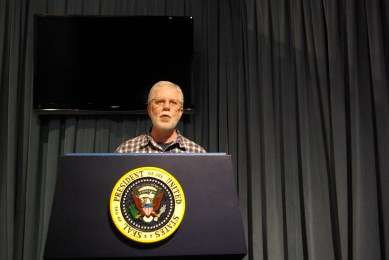
Ed Darrell practices with a teleprompter, to avoid writing on his hand.

Ed Darrell wrestling with the Presidential Seal and a balky teleprompter.


Civil War Sesquicentennial: 26 free books on the Civil War

June 22, 2011

Our librarian friend, Judy Crook, sent a link to the National Park Service website where you can download, free, 26 books on the Civil War.

150th Anniversary Civil War

Logo for 150th Anniversary Civil War - Copyright ©2010 Eastern National. All rights reserved.

Eastern National is celebrating the 150th Anniversary of the Civil War with electronic editions of eParks’ National Park Civil War Series of books. Read them online or own your own paper edition by visiting our Civil War Series store.

With a color printer, a teacher could assemble 26 readers for use in the classroom, or for homework assignments.  The books sell for $8.95 through the NPS bookstore.  The first listed volume, A Concise History of the Civil War, provides a good, brief summary, with some features in the .pdf version teachers should be happy to find:  A list of 25 battles of significance, and black-and-white maps of battle locations and the Confederacy, for examples.

Great idea to make this stuff available for free, online.  I wonder, how many people will really take advantage of the opportunity?

Buy paper copies here, at the eParks Store; here are links to the .pdfs of the 26 volumes, below:

book cover

Cover for A Concise History of THE CIVIL WAR


Schieffer: Education is our first line of defense – CBS News Video

June 22, 2011

Bob Schieffer plugs education and worries about last week’s NAEP report on what students know about history:

Schieffer is right:  Teachers deserve better pay, and that’s probably the quickest and best solution to get our kids up to snuff on history.

And history is our first line of defense.  Minutemen at Lexington and Concord knew why they were fighting, and fought to victory as a result.  Don’t our kids deserve as good an education today?

[I’m posting this on Wednesday — the YouTube version had only 54 views when I did.  Spread the word, will you?]


Punchline too brutal for work: Why it is that environmentalists are the real humanitarians

June 21, 2011

The fictional but very popular memes that environmentalists hate humans, humanity and capitalism wouldn’t bother me so much if they didn’t blind their believers to larger truths and sensible policies on environmental protection.

One may argue the history of the environmental movement, how most of the originators were great capitalists and humanitarians — think Carnegie, Laurance Rockefeller, Theodore Roosevelt, Gifford Pinchot, and all the early medical doctors who warned of the dangers of pollution-caused diseases — but it falls on deaf ears on the other sides.

Here’s the 30-second response, from Humon, in cartoon form:

Mother Gaia explains to humans that they will not be missed when they kill themselves off.

Facts of life and environmental protection – from Humon at Deviant Art

Mother Gaia explains why environmental protection is important, from Humon at Deviant Art

Facts of life and environmental protection – from Humon at Deviant Art

Tip of the old scrub brush to P. Z. Myers, and Mia, whoever she is.  Myers noted, “Environmentalism is actually an act of self defense.”