Obama’s birth certificate: Putting the sideshow freaks and carnival barkers on the hot seat

April 27, 2011

No, it’s not particularly important, especially since we knew from so many other sources that Obama was, indeed, Honolulu born.

The White House pried the old birth certificate out of the records of the State of Hawaii, and released copies to the world today.

The White House video:

ABC Television’s report:

View a .pdf of the form here:  President Obama\’s original Hawaiian birth certificate

I predict Orly Taitz, Donald Trump, and all the other sideshow freaks and carnival barkers, will continue to bark away.  Remember, when P. T. Barnum made a copy of the hoax “Cardiff Giant,” people paid a premium to see the fake of the hoax.  P. T. Barnum’s ghost stalks and stomps on Republican and birther grounds now.

More:

_____________

Boy, looking at this, you gotta know that Obama planned this all out, as Morgan claimed in comments below — just so he could get this story from Juan Williams and Shepard Smith at Fox News:

Oh, For Goodness Sake posted that video, without any other comment, as “National Mirror Moment.”  Birthers, Palinistas and Republicans must be choking on their dinners from that report.  Has the Fox turned on ’em?

Always a good site to expose the inanity and insanity of Obama’s critics, especially on the issues of Obama’s history, Oh, For Goodness Sake has a particular bead on the hypocrisy of those same critics:

How many times have you heard the promise: The president could end this today if he’d just release his long form birth certificate? So now they’ve got the f—ing long form birth certificate, is it done for the Birthers?

No. No. No. No. No. No. And Nope.

Bigots.  Probably no small amount of racism in there, too.  Plus, they’ve exposed themselves as genuinely opposed to America’s good health.  David Gardner and Milton Goldstein pegged it, even if we have to paraphrase them a bit:  Had a foreign government tried to do what the birthers are doing, we’d have considered it an act of war.  History is not kind to idlers, those who fail to call out injustice, nor idiots.


Pray that God will save Texas; it’s clear Rick Perry won’t

April 25, 2011

Texas doesn’t have a recall procedure for politicians in office.  If it did, would Texans have the guts to use it on Rick Perry?

You’ve probably seen it in the news:  Over the last ten days, Texas has been scorched by several large wildfires.  At least two firemen were killed.  Hundreds of homes and one state park burned away.  (See the Christian Science Monitor: “Texas wildfires:  Why this season is one of the worst in state history,” and “Can U.S. handle historic Texas wildfires?”)

Firefighters, mostly, come from small town, volunteer fire departments.  Most of the affected towns are too small to be able to afford a larger, professional fire-fighting department.

Gov. Rick Perry’s mathematical errors cost Texas $27 billion, a shortfall that Republicans propose to make up by cutting to the bone, and deeper, education programs, road building and maintenance, aid to the poor, and police and fire departments.

Yes, in the middle of one of the biggest fire disasters in Texas history, Rick Perry and the Texas Lege propose to cut the funding to the fire fighters.

If they don’t cut funding, they would have to roll back tax cuts to wealthy property owners granted six years ago, or dip into the states $9 billion “rainy day” fund.

Gov. Perry does have one other trick up his sleeve to help victims of the fires:  He’s asked Texans to pray for rain.  Fire departments need equipment, people and training, all of which cost money.  Gov. Perry asks for prayers instead.

Gov. Perry Issues Proclamation for Days of Prayer for Rain in Texas

Thursday, April 21, 2011  •  Austin, Texas  •  Proclamation

TO ALL TO WHOM THESE PRESENTS SHALL COME:

WHEREAS, the state of Texas is in the midst of an exceptional drought, with some parts of the state receiving no significant rainfall for almost three months, matching rainfall deficit records dating back to the 1930s; and

WHEREAS, a combination of higher than normal temperatures, low precipitation and low relative humidity has caused an extreme fire danger over most of the State, sparking more than 8,000 wildfires which have cost several lives, engulfed more than 1.8 million acres of land and destroyed almost 400 homes, causing me to issue an ongoing disaster declaration since December of last year; and

WHEREAS, these dire conditions have caused agricultural crops to fail, lake and reservoir levels to fall and cattle and livestock to struggle under intense stress, imposing a tremendous financial and emotional toll on our land and our people; and

WHEREAS, throughout our history, both as a state and as individuals, Texans have been strengthened, assured and lifted up through prayer; it seems right and fitting that the people of Texas should join together in prayer to humbly seek an end to this devastating drought and these dangerous wildfires;

NOW, THEREFORE, I, RICK PERRY, Governor of Texas, under the authority vested in me by the Constitution and Statutes of the State of Texas, do hereby proclaim the three-day period from Friday, April 22, 2011, to Sunday, April 24, 2011, as Days of Prayer for Rain in the State of Texas. I urge Texans of all faiths and traditions to offer prayers on that day for the healing of our land, the rebuilding of our communities and the restoration of our normal way of life.

IN TESTIMONY WHEREOF, I have hereunto signed my name and have officially caused the Seal of State to be affixed at my Office in the City of Austin, Texas, this the 21st day of April, 2011.

RICK PERRY
Governor of Texas

Perry’s call for prayer rightly earned ridicule.  Ed Brayton at Dispatches from the Culture Wars wondered about Jon Hagee and Pat Robertson weighing in, as they usually do, claiming big disasters to be the result of sinfulness in the local population.   P. Z. Myers at Pharyngula simply wonders about the effectiveness of a governor who does that.


Quote of the moment, and Rick Santorum: Langston Hughes, “Let America be America again”

April 25, 2011

Rick Santorum, CBS News image

Rick Santorum: Running with . . .

Harlem Renaissance poet Langston Hughes

. . . political philosopher, and Harlem Renaissance poet Langston Hughes?

News item: Rick Santorum is running for president. No, seriously — he is. In order to run, a candidate needs a catchy slogan.

Santorum’s campaign announced he is planning to use “Let America be America, again” as his slogan.

It’s a phrase borrowed from Langston Hughes.  One wonders if Rick Santorum reads any poetry, let alone someone from the Harlem Renaissance.

Did Santorum really intend to borrow from Hughes?  Does he think Hughes would approve?

O, let America be America again–
The land that never has been yet–
And yet must be–the land where every man is free.
The land that’s mine–the poor man’s, Indian’s, Negro’s, ME–
Who made America,
Whose sweat and blood, whose faith and pain,
Whose hand at the foundry, whose plow in the rain,
Must bring back our mighty dream again.

Sure, call me any ugly name you choose–
The steel of freedom does not stain.
From those who live like leeches on the people’s lives,
We must take back our land again,
America!

Full text of the poem here, at the American Academy of Poets.

No, it appears Santorum did not wish to affiliate with Langston Hughes. One more reason to vote against Santorum, as if anyone needed more.  Santorum even admits not being much of a poetry fan.

How about this for a Santorum slogan:  “All santorum, no guts or brains.”

Tip of the old scrub brush to Ed Brayton at Dispatches from the Culture Wars.


Two years, three months since the disaster . . .

April 24, 2011

Remembering, because we shouldn’t forget.  It was just two years and three months ago.  Rebuilding will take a long time.


Scary idea: Obama is now the greatest tax cutter in history

April 24, 2011

Why is that scary?  Because cutting taxes as a policy to fix our ills, doesn’t work.

Politicususa explains:

According to the Orange County Register, “For the past two years, a family of four earning the median income has paid less in federal income taxes than at any time since at least 1955, according to the Tax Policy Center. All federal, state and local taxes combined are a lower percentage of per-capita income than at any time since the 1960s, according to the Tax Foundation. The highest income-tax bracket is its lowest since 1992. At 35 percent, it’s well below the 50 percent mark of much of the 1980s and the 70 percent bracket of the 1970s.”

The problem is that the tax cuts have not promoted economic growth and have caused the federal deficit to explode, “Those lower taxes have helped give the U.S. government the lowest revenues as a percentage of gross domestic product of seven industrialized countries surveyed in 2010 by the Congressional Research Services. (The other countries were Japan, Canada, the United Kingdom, Germany, Italy and France.) The U.S. also had the lowest spending as a percentage of the GDP. But with the biggest gap between revenues (31.6 percent of GDP) and expenditures (42.2 percent of GDP), the U.S. also posted the largest deficit as a percentage of GDP – 10.5 percent.”

No conservative would dare give Obama credit.  Is Obama a noble enough leader to decline ownership of the tax cutting title?


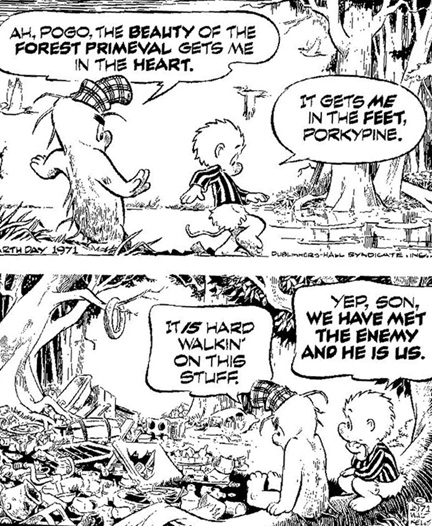
Walt Kelly: “met the enemy, and he is us”

April 23, 2011

Walt Kelly's Pogo cartoon, from Earth Day 1971

Walt Kelly's Pogo daily cartoon strip, from Earth Day 1971

Walt Kelly’s little cartoon possum Pogo turned out to have been a sage observer, and adviser, for much of the 20th century.  This classic cartoon, on the second Earth Day, in 1971, well summarizes the problems of pollution, making historical allusion to that famous message from Master Commandant Oliver Hazard Perry after the Battle of Lake Erie in the War of 1812:  “We have met the enemy and he is us.”

It is a mark of what the internet lacks that I could find just one quick copy of this cartoon on my first search.  All of Kelly’s work should be available, but it’s largely missing from internet searches.  I’m sure this is still under copyright, but I haven’t yet found the information.

_____________

Oh, of course:  The line is too good to have been used just once.  Kelly used the idea for the quote in the forward to a book in the 1950s, and used it on a poster for the first Earth Day.  The famous comic strip followed in 1971.


Pareidolia? No, there’s no link between Earth Day and Lenin

April 23, 2011

This is mostly an encore post — sad that it needs repeating.

You could write it off to pareidolia, once.  Like faces in clouds, some people claimed to see a link.  The first Earth Day, on April 22, 1970, coincided with Lenin’s birthday.  There was no link — Earth Day was scheduled for a spring Wednesday.  Now, years later, with almost-annual repeats of the claim from the braying right wing, it’s just a cruel hoax.

No, there’s no link between Earth Day and the birthday of V. I. Lenin:

One surefire way to tell an Earth Day post is done by an Earth Day denialist: They’ll note that the first Earth Day, on April 22, 1970, was an anniversary of the birth of Lenin.

Coincidentally, yes, Lenin was born on April 22 (new style calendar; it was April 10 on the calendar when he was born — but that’s a digression for another day).

It’s a hoax. There is no meaning to the first Earth Day’s falling on Lenin’s birthday — Lenin was not prescient enough to plan his birthday to fall in the middle of Earth Week, a hundred years before Earth Week was even planned.

My guess is that only a few really wacko conservatives know that April 22 is Lenin’s birthday (was it ever celebrated in the Soviet Union?). No one else bothers to think about it, or say anything about it, nor especially, to celebrate it.

Gaylord Nelson, Living Green image

Inventor of Earth Day teach-ins, former Wisconsin Governor and U.S. Senator Gaylord Nelson

Wisconsin’s U.S. Sen. Gaylord Nelson, usually recognized as the founder and father of Earth Day, told how and why the organizers came to pick April 22:

Senator Nelson chose the date in order to maximize participation on college campuses for what he conceived as an “environmental teach-in.” He determined the week of April 19–25 was the best bet; it did not fall during exams or spring breaks, did not conflict with religious holidays such as Easter or Passover, and was late enough in spring to have decent weather. More students were likely to be in class, and there would be less competition with other mid-week events—so he chose Wednesday, April 22.

In his own words, Nelson spoke of what he was trying to do:

After President Kennedy’s [conservation] tour, I still hoped for some idea that would thrust the environment into the political mainstream. Six years would pass before the idea that became Earth Day occurred to me while on a conservation speaking tour out West in the summer of 1969. At the time, anti-Vietnam War demonstrations, called “teach-ins,” had spread to college campuses all across the nation. Suddenly, the idea occurred to me – why not organize a huge grassroots protest over what was happening to our environment?

I was satisfied that if we could tap into the environmental concerns of the general public and infuse the student anti-war energy into the environmental cause, we could generate a demonstration that would force this issue onto the political agenda. It was a big gamble, but worth a try.

At a conference in Seattle in September 1969, I announced that in the spring of 1970 there would be a nationwide grassroots demonstration on behalf of the environment and invited everyone to participate. The wire services carried the story from coast to coast. The response was electric. It took off like gangbusters. Telegrams, letters, and telephone inquiries poured in from all across the country. The American people finally had a forum to express its concern about what was happening to the land, rivers, lakes, and air – and they did so with spectacular exuberance. For the next four months, two members of my Senate staff, Linda Billings and John Heritage, managed Earth Day affairs out of my Senate office.

Five months before Earth Day, on Sunday, November 30, 1969, The New York Times carried a lengthy article by Gladwin Hill reporting on the astonishing proliferation of environmental events:

“Rising concern about the environmental crisis is sweeping the nation’s campuses with an intensity that may be on its way to eclipsing student discontent over the war in Vietnam…a national day of observance of environmental problems…is being planned for next spring…when a nationwide environmental ‘teach-in’…coordinated from the office of Senator Gaylord Nelson is planned….”

Nelson, a veteran of the U.S. armed services (Okinawa campaign), flag-waving ex-governor of Wisconsin (Sen. Joe McCarthy’s home state, but also the home of Aldo Leopold and birthplace of John Muir), was working to raise America’s consciousness and conscience about environmental issues.

Lenin on the environment? Think of the Aral Sea disaster, the horrible pollution from Soviet mines and mills, and the dreadful record of the Soviet Union on protecting any resource. Lenin believed in exploiting resources, not conservation.

So, why are all these conservative denialists claiming, against history and politics, that Lenin’s birthday has anything to do with Earth Day?

Can you say “propaganda?”

Good information from 2011:

Good information from 2010:

Wall of Lenin’s Birthday Propaganda Shame from 2011:

Wall of Lenin’s Birthday Propaganda Shame from 2010:

Warn people not to be sucked in by the hoax:

Add to FacebookAdd to NewsvineAdd to DiggAdd to Del.icio.usAdd to StumbleuponAdd to RedditAdd to BlinklistAdd to TwitterAdd to TechnoratiAdd to Furl


Monday is World Malaria Day; watch out for the pro-DDT hoaxes

April 23, 2011

A letter to the editor of the Cape Cod Times:

DDT unnecessary to fight malaria

April 23, 2011

Monday, April 25,is World Malaria Day. Across the globe, public health and malaria experts will be highlighting the urgent need to do more to tackle this preventable disease that kills more than 800,000 people (mostly in Africa) every year.

Here in the United States, a small group of advocates will, once again, use the day to call for widespread use of the pesticide DDT to control malaria. This despite broad, global agreement that widespread spraying of DDT inside people’s homes is not the best way to tackle malaria and can harm human health.

Those pressing for DDT’s widespread use are few, but they are loud and persistent. They are not public health experts, and they are all closely affiliated with right-wing think tanks. These calls to “bring back DDT” are a dangerous distraction from true malaria prevention.

Debbie West
Barnstable

Ms. West is right.


True story of how a woman won Texas’s independence

April 21, 2011

This is mostly an encore post, for the 175th anniversary of the Battle of San Jacinto.

After suffering crushing defeats in previous battles, and while many Texian rebels were running away from Santa Anna’s massive army — the largest and best trained in North America — Sam Houston’s ragtag band of rebels got the drop on Santa Anna at San Jacinto, on April 21, 1836. Most accounts say the routing of Santa Anna’s fighting machine took just 18 minutes.

San Jacinto Day is April 21. Texas history classes at Texas middle schools should be leading ceremonies marking the occasion — but probably won’t since it’s coming at the end of a week of federally-requested, state required testing.

Surrender of Santa Anna, Texas State Preservation Board Surrender of Santa Anna, painting by William Henry Huddle (1890); property of Texas State Preservation Board. The painting depicts Santa Anna being brought before a wounded Sam Houston, to surrender.

How could Houston’s group have been so effective against a general who modeled himself after Napolean, with a large, well-running army? In the 1950s a story came out that Santa Anna was distracted from battle. Even as he aged he regarded himself as a great ladies’ man — and it was a woman who detained the Mexican general in his tent, until it was too late to do anything but steal an enlisted man’s uniform and run.

The San Jacinto Monument is 15 feet taller than the Washington Monument. Texas tourism brochure photo

The San Jacinto Monument is 15 feet taller than the Washington Monument. Texas tourism brochure photo

That woman was mulatto, a “yellow rose,” and about whom the song, “The Yellow Rose of Texas” was written, according story pieced together in the 1950s.

Could such a story be true? Many historians in the 1950s scoffed at the idea. (More below the fold.) Read the rest of this entry »


What sort of crazy is the warming denialist?

April 21, 2011

I’ve got to stop looking over there.

Goddard’s got a post up showing the great disregard he has for the facts, and the law, and history, etc., etc., etc.  It may be an unintentional showing, but there it sits, “like a mackerel in the moonlight, both shining and stinking.”

Jerome Corsi, that serial fictionalizer of vital issues, has a book out promoting his slimy schemes besmirch President Obama.  Goddard urges people to buy it.

But they really pile on in the comments.  It’s almost as if Casey Luskin had a whole family just like himself, and they got together to whine about Judge Roberts again.

Warming denialism, creationism and birthers — is it all just three minor variations on the same brain-sucking virus?  Or could three different diseases produce the same sort of crazy on so many different issues?

I’m reminded of the old saw that you cannot reason a person out of a position he didn’t reach by reason.  These guys will never see the light.  Heaven knows, it ain’t evidence that gets ’em where they are now.

Previous posts at Millard Fillmore’s Bathtub:

Special kind of birther crazy:


Lake Powell drought ended? Don’t trust the warming denialists’ predictions

April 20, 2011

Every once in a while a factoid crosses the desk and/or mind of an otherwise badly-informed person who denies global warming is a problem, and without bothering to check the significance of the factoid, the denialist world ramps up The Crazy Rant.

And so, Steve Goddard (who should need no introduction) seized upon a chart that shows a momentary uptick in water in drought-ravaged Lake Powell.  Ignoring more than 50 years of history of the river flows, Goddard pronounced the case for global warming dead.

Former AGW poster child Lake Powell water levels have been rising rapidly over the last few years.

Goddard’s claim is a grand example of the triumph of ignorance over experience, science, data, history and the law, in discussions of climate change.

Did Goddard read his own chart?  It shows a decline in lake level from 2010.

Lake Powell levels, charted by Steve Goddard?

Goddard’s own chart shows a decline in Lake Powell’s March 20 level, from 2010; did he look at the chart? Even Goddard’s source says, “Lake Powell is 89.99 feet below Full Pool (Elevation 3,700).”

“Full pool” level is 3,700 feet elevation (the height of the surface of Lake Powell above sea level).  Goddard’s chart shows the lake hasn’t been at that level since 2000 (and it was declining for some time prior to that).  Goddard’s chart shows four years of rise compared to seven years of decline.

The U.S. Bureau of Reclamation isn’t as optimistic as the warming deniers, noting that drought conditions continue on the Colorado Plateau.

 Upper Colorado River Basin Hydrology

In the Upper Colorado River Basin during water year 2010, the overall precipitation accumulated through September 30, 2010 was approximately 90% of average based on the 30 year average for the period from 1971 through 2000.  For Water Year 2011 thus far, the estimated monthly precipitation within the Upper Colorado River Basin (above Lake Powell) as a percentage of average has been: (October – 135%, November – 95%, December – 225%, January – 50%, February – 100%, March – 90%)

The Climate Prediction Center outlook (dated March 17, 2010) for temperature over the next 3 months indicates that temperatures in the Upper Colorado River Basin are expected to be above average while precipitation over the next 3 months is projected to be near average in the northern reaches of the basin while below average in the southern reaches of the basin.

Upper Colorado River Basin Drought

The Upper Colorado River Basin continues to experience a protracted multi-year drought.  Since 1999, inflow to Lake Powell has been below average in every year except water years 2005 and 2008.  In the summer of 1999, Lake Powell was close to full with reservoir storage at 23.5 million acre-feet, or 97 percent of capacity.  During the next 5 years (2000 through 2004) unregulated inflow to Lake Powell was well below average.  This resulted in Lake Powell storage decreasing during this period to 8.0 million acre-feet (33 percent of capacity) which occurred on April 8, 2005.  During 2005, 2008 and 2009, drought conditions eased somewhat with near or above average inflow conditions and net gains in storage to Lake Powell.  2011 will be another above average inflow year so drought conditions are easing somewhat in the Colorado River Basin. As of April 18, 2011 the storage in Lake Powell was approximately 12.73 million acre-feet (52.3 % of capacity) which is below desired levels.  The overall reservoir storage in the Colorado River Basin as of April 18, 2011 is approximately 31.40 million acre-feet (52.8 % of capacity).
Updated: April 19, 2011

Rick Clayton

Goddard isn’t the first denier to stumble down this path — but can’t they learn from the stumblings of others?  Remember Australia’s “Jo Nova,” who used a photograph of drought-stricken Glen Canyon Dam and environs to claim that warming was not posing problems?  Remember Anthony Watts claiming Lake Powell as a “good proxy” for water in the entire area, and seizing on a momentary uptick?  (Oh, yeah — Watts based his glee on a Goddard note — even repeating Goddard’s error that Lake Powell’s low levels were due to increased use of water in Los Angeles . . .)

Oy.  Do they ever learn?

More, Resources:

The sources from my earlier post on Lake Powell still edify those who bother to read them:

More current sources:


Remembering April 18 and 19: Paul Revere’s Ride, and the “shot heard ’round the world”

April 18, 2011

This is mostly an encore post.

April 18 19. Do the dates have significance? Paul Revere's ride, from Paul Revere House

Among other things, it is the date of the firing of the “shot heard ’round the world,” the first shots in the American Revolution. On April 19, 1775, American Minutemen stood to protect arsenals they had created at Lexington and Concord, Massachusetts, against seizure by the British Army then occupying Boston.

April is National Poetry Month. What have we done to celebrate poetry?

What have we done to properly acknowledge the key events of April 18 and 19, 1775? Happily, poetry helps us out in history studies, or can do.

In contrast to my childhood, when we as students had poems to memorize weekly throughout our curriculum, modern students too often come to my classes seemingly unaware that rhyming and rhythm are used for anything other than celebrating materialist, establishment values obtained sub rosa. Poetry, to them, is mostly rhythm; but certainly not for polite company, and never for learning.

Poems slipped from our national curriculum, dropped away from our national consciousness.

And that is one small part of the reason that Aprils in the past two decades turned instead to memorials to violence, and fear that violence will break out again. We have allowed darker ideas to dominate April, and especially the days around April 19.

You and I have failed to properly commemorate the good, I fear. We have a duty to pass along these cultural icons, as touchstones to understanding America.

So, reclaim the high ground. Reclaim the high cultural ground.

Read a poem today. Plan to be sure to have the commemorative reading of “Paul Revere’s Ride” in your classes next April 18 or 19, and “The Concord Hymn” on April 19.

We must work to be sure our heritage of freedom is remembered, lest we condemn our students, our children and grandchildren to having to relearn these lessons of history, as Santayana warned.

Texts of the poems are below the fold, though you may be much better off to use the links and see those sites, the Paul Revere House, and the Minuteman National Historical Park.

Read the rest of this entry »


Anecdotal evidence: Malaria spreads to Tanzania highlands, warming climate blamed

April 16, 2011

Here’s one story that critics of science and scientists who study global warming will try to avoid mentioning:  Malaria’s spread in Tanzania appears to be due to deforestation plus a warming climate that altered historic rainfall patterns.

It’s anecdotal evidence, partly.  The case reinforces the point Al Gore made in An Inconvenient Truth, that climate change can smooth the path for the spread of diseases like malaria.

Via AllAfrica.com, from The Citizen in Dar es Salaam (Sunday Citizen News):

Malaria Threatens Nation’s Highlands

Felix Mwakyembe, 6 March 2011

Opinion

Mbeya — Tanzania’s southern highlanders have long worried about pneumonia and other respiratory illnesses brought on by the cool, wet weather. But as climate change contributes to warmer temperatures in the region, residents are facing a new health threat: malaria.

In Rungwe, a highland district in the south-western Mbeya region bordering Malawi and Zambia, malaria is fast replacing coughs, fever and pneumonia as the most serious local health problem. The change has taken by surprise the region’s residents, who live over 1,000 metres (3,200 feet) above sea level and outside Tanzania’s traditional malarial zones.

Ms Asha Nsasu, 32, of Isebe village, had no idea she had contracted malaria when she was sent to Makandana District Hospital in late December. “I felt weak. I thought it was pneumonia,” Nsasu said. “Then they told me it was malaria.”

In 2009, health centres in Rungwe district reported 100,966 malaria cases, a jump of 25 per cent from 2006, hospital records show.

Malaria is now the biggest public health threat facing Rungwe district, which lies about 940 kilometres (590 miles) southwest of Dar es Salaam, according to the Tukuyu Medical Research Centre, part of the National Institute for Medical Research. One third of outpatients visiting the hospital were diagnosed with the mosquito-borne illness in 2007, according to records from that year, making it the most common disease for outpatients.

Most highland areas in Tanzania are experiencing a growing burden of malaria cases, officials at the Tukuyu Centre said. Climatic changes brought on in part by local environmental degradation are contributing to the growing prevalence of malaria in the district, said Mr Gideon Ndawala, Rungwe district’s malaria coordinator.

“People have cleared the forests, rain has decreased, temperatures have risen,” Mr Ndawala said in an interview. “(When) I first reported on the district in 1983, it was very cold and it rained throughout the year except from mid-September to early November. The weather was not favourable for mosquito breeding,” he said.

Now, however, temperatures are higher and rain more erratic, he said, and mosquito populations – which thrive on warmer temperatures and breed in pools of stagnant water – are on the rise. Worst hit by the surge in malaria are Tukuyu district town, Ikuti, Rungwe Mission and Ilolo, according to district health officials.

Half a century ago, these traditionally cool areas saw no mosquitoes and did not register any malaria cases, but now the weather is warmer, said Mr Ambakisye Mwakatobe, a 76-year-old man from Bulyaga village in Rungwe.

“In the past, we never saw mosquito nets here. I saw a net for the first time at the age of 20, when I joined Butimba Teachers College in 1957,” he said, in an interview at his village home.

Mzee Mwakatobe said cases of malaria began to appear several decades ago but residents did not relate them to warming temperatures, believing the mosquitoes instead were arriving on buses from lower regions.

“It was in the 1970s when we started getting malaria here. I thought it was the buses from Kyela and Usangu that brought mosquitoes,” he admitted. But “the weather also started to change in those years,” he said.

A half-century ago, “it was very cold here and it rained throughout the year. Three things were compulsory: a sweater, pullover or heavy jacket; an umbrella or raincoat; and gumboots,” he added. “There was frost all day long and cars had to put their lights on.

“But today things have changed,” he said. “Look, now we even put on light shirts. There is no need for sweaters, gumboots or umbrellas.”

Scientists agree that the changing weather is feeding into Rungwe’s worsening malaria problem.

“Up until 1960, districts like Rungwe, Mbeya, Mufindi, Njombe, Makete and Iringa in the southern highland regions were malaria free. Today is quite different – malaria prevalence is high,” said Mr Akili Kalinga, a research scientist at Tukuyu Medical Research Centre.

Malaria accounts for 30 per cent of the burden of disease in Tanzania and is a huge drain on productivity, according to a report produced by research scientists for the Sixth Africa Malaria Day in 2006. In response to the rising malaria caseload, the government is taking steps to stem the disease’s expansion.

Measures include public health education in newly vulnerable districts on home cleanliness and water storage, how to eliminate the places of still water where mosquitoes live and breed, and the use of mosquito nets and fumigation, said Dr Sungwa Ndagabwene, Rungwe’s medical officer.

“The government is taking serious measures to fight malaria. We started with a ‘mosquito nets for all’ campaign – saying every person should sleep under bed nets,” Mr Ndagabwene said.

The government also has begun spraying the inside of homes with insecticide, first in the Kagera Region and now throughout the Lake zone, near Lake Victoria, he said. It plans to expand the spraying programme, which has helped cut malaria transmission in Zanzibar, to the rest of the Tanzania’s malaria-affected regions.

Such spraying programmes aim to kill mosquitoes that land on the inside walls of homes. Spraying can protect homes for between four to ten months depending on the insecticide, according to the World Health Organisation (WHO).

WHO has approved 12 insecticides it considers safe for such spraying programmes, including DDT – a controversial endocrine disruptor that has proved one of the most effective ways to control mosquito populations but that has also been linked to environmental damage and health problems including cancer.

Mr Ndagabwene said spraying the chemical only indoors limited its environmental impact. WHO officials have said they believe the benefits of using the pesticide outweigh its risks. The Stockholm Convention bans the use of DDT but exempts countries that choose to use the chemical to control malaria.

Tanzania is one of the world’s worst malaria-affected countries, recording 14 to 18 million clinical cases annually and 60,000 deaths, 80 per cent of them in children under five years old, according to a 2010 malaria reduction plan put together by USAID.

Children under five and pregnant women are most affected by the disease, official health figures show. (AlertNet)

The author is a freelance writer based in Dar es Salaam

More:


Quote of the moment: Doug Sahm on Texas music

April 14, 2011

Doug Sahm, Magnet Magazine photo

Doug Sahm, 1941-1999, Magnet Magazine photo

“I’m a part of Willie Nelson’s world and I love it, but at the same time, I’m part of the Grateful Dead’s world. One night I might be playing twin fiddles at the Broken Spoke and the next night I’ll be down at Antone’s playing blues. In that way Texas is a paradise, because all that music is here.”

Doug Sahm, 1975

Tip of the old scrub brush to Un Perla, Por Favor.


You couldn’t make it up

April 14, 2011

Yeah, I know — Eagles sang about how things would “get down to the bone,” but I don’t think they meant it the way this birther said it:

I knowingly and of sound mind would ask as a.bonified Citizen of the United States of America request that our President “Barrack Hussein Obama ” step down from

Bonehead

"Bonified" genius

(That’s it.  No end to the sentence, no end to the clause.  No period.)

You think, maybe, he meant bona fide?”

Ick.  “Bonified” suddenly brings all sorts of ugly visions.  Others have thought of it, too.