Quick! Vote for Bill Adkins! Get a new printer for his classroom

May 16, 2012

We have a great art department at Molina High SchoolBill Adkins, and his colleagues, pull great work out of kids who too often are not expected to produce good art.

Adkins is in contest to get a fancy printer, based on votes from the internet.  Will you do Mr. Adkins, and especially his students, a great favor and go cast a vote for him right now?  Voting ends today, and he’s in the running but not in first.

Details:

I want to thank Mr. Rhee and Mr. Jones for their efforts encouraging their students to vote for my project.  I also thank the rest of you who have voted to help me win a new printer for the art department.  It’s still a very close race, I’m currently in 3rd place and voting ends tomorrow.  If you haven’t voted yet, I hope you will.  Your students are allowed to vote too.  Just go the this link:  http://www.weareteachers.com/teaching-ideas/grant/teaching-idea?app=24725&grantId=98 and click on vote for me.

Someday schools will provide equipment like this without contests on the internet — but not yet.   A vote for Adkins is a vote for educational excellence.

Thanks!

From an earlier post:


Still looking? Again, here’s how to find “separation of church and state” in the Constitution

May 16, 2012

It’s an election year. People get crazy. I’ve already heard from a dozen wacko candidates that “separation of church and state isn’t in the Constitution.”

Yes it is. Separation of church and state resides in the Constitution.  Here’s a post from 2010 to help them find it.

_____________

It’s been at least 20 years since I first heard the old canard of an argument that “there’s no separation of church and state in the Constitution.” I think I first heard it attributed to David Barton, which would make sense, since he doesn’t understand the Constitution, but neither does he fear sharing his misunderstandings.

It was an incorrect statement then, and it’s been incorrect since September 1787. Separation of state and church is woven throughout the Constitution, part of the warp and woof.

Recently, latter-day Constitution ignorami repeat the old canard.

Toles cartoon on dangers of marrying church and state

Toles cartoon on dangers of marrying church and state

I was surprised to discover I’ve not posted this before on this blog. So here’s a slightly-edited version of a response I gave many months ago to someone who made that silly claim, a basic description that I developed years ago to explain the issue, in speeches by members of the Senate Subcommittee on the Constitution:

Separation of church and state: It’s in the Constitution.

I don’t play a constitutional lawyer on television, I am one*, but it seems to me anyone can read the Constitution and see. Especially if one understands that the Constitution sets up a limited government, that is, as Madison described, one that can do only what is delegated to it. The Constitution is a short document.

Where should you look to find separation of church and state in the Constitution?

First, look in the Preamble. It is made clear that the document is a compact between citizens: “We the people . . . do ordain and establish this Constitution . . .” The usual role of God ordaining (in some western nations) is altered, intentionally. It is not God who establishes this government, but you and I, together. From the first words of the Constitution, there is separation of church and state. The power of our government grows out of a secular compact between you and me, and 308 million other residents of the nation. We have a government created by consent of the governed, as the Declaration of Independence said a just government should be. It is not a government created by the will of God directly (though some, including the Mormons, argue it is divinely inspired). We have no divine right kings or other monarchs. The government is not the grantor of rights from God, but is instead the protector of the rights of citizens, whatever the source of the rights.

Second, look in the key parts of the document itself. Start with Article 1. The legislative branch is given no role in religion; neither is any religion given any role in the legislature. In Article 2, the executive branch gets no role in religion, and religion gets no role in the executive branch. In Article 3, the judicial branch gets no role in religion, and religion gets no role in the judicial branch. In Article 4, the people get a guarantee of a republican form of government in the states, but the states get no role in religion, and religion gets no role in state government. This is, by design of the founders, a perfect separation of church and state.

Third, in Article 6, the convention wrote the hard and fast rule that no religious test can be used for any office in government, federal, state or local, means that no official will have a formal, governmental role in religion, and no religion can insist on a role in any official’s duties.

Fourth, Amendment 1 closes the door to weasling around it: Congress is prohibited from even considering any legislation that might grant a new bureaucracy or a new power to get around the other bans on state and church marriage, plus the peoples’ rights in religion are enumerated.

Fifth: In 1801 the Baptists (!) in Danbury, Connecticut, grew concerned that Connecticut would act to infringe on their church services, or teachings, or right to exist. So they wrote to President Jefferson. Jefferson responded with an official declaration of government policy on what the First Amendment and Constitution mean in such cases. Jefferson carefully constructed the form of the device as well as the content with his Attorney General, Levi Lincoln, to be sure that it would state what the law was. This “letter” is the proclamation. It’s an official statement of the U.S. government, collected in the president’s official papers and not in his personal papers. Make no mistake: Jefferson’s letter to the Danbury Baptists was an official act, an official statement of the law of the United States. Jefferson intended it to assuage the Baptists in Danbury, to inform and warn the Connecticut legislatures, and to be a touchstone to which future Americans could turn for information. It was only fitting and proper for the Supreme Court to use the letter in this capacity as it has done several times.

Sixth: The phrase, “separation of church and state” dates back another 100 years and more, to the founding of Rhode Island. It is the religion/state facet of the idea of government by consent of the governed without interference from religious entities, expressed so well in the Mayflower Compact, in the first paragraphs of the Declaration of Independence, and carried through in the Constitution (see especially the Preamble, above).

No, the phrase “separation of church and state” never appears in the Constitution. The principles of separation of church and state are part of the warp and woof, and history, of the document, however. The law is clear, the law was clear, the law has always been clear, and denying the Constitution says what it says won’t change it or make it go away. You could just as easily point out that the word “democracy” or “democratic” never appears in the document, though we rely on democratic mechanisms and institutions to make it work. You could point out that nowhere does it say that our national government is a republic, though it is. The Constitution doesn’t say “checks and balances,” nor does it say “federalism.” The Constitution doesn’t mention political parties. The Constitution was written before the advent of broadcasting, and makes no mention of radio nor television, nor of the internet — but the First Amendment freedoms apply there anyway. The Constitution doesn’t say “privacy,” though it protects your right to privacy.

You won’t find “separation of church and state” as a phrase in the Constitution. If you read it, you’ll find that the concept of the separation of state and church can’t be taken out of the document, either — it’s a fundamental principle of our government.

More, and Resources:

__________

* A non-practicing one. We have way more than 50,000 lawyers in Texas. That’s enough trouble for one lifetime. Someone has to look out for the welfare of the world.


One more time: Recognizing bogus history

May 14, 2012

2012 is an election year, a time when we make history together as a nation.  Potential turning points in history often get tarred with false interpretations of history to sway an election, or worse, a completely false recounting of history.  Especially in campaigns, we need to beware false claims of history, lest we be like the ignorants George Santayana warned about, doomed to repeat errors of history they do not know or understand.  How to tell that a purported piece of history is bogus?  This is mostly a repeat of a post that first appeared at Millard Fillmore’s Bathtub six years ago.

Recognizing bogus history, 1

Robert Park provides a short e-mail newsletter every Friday, covering news in the world of physics. It’s called “What’s New.” Park makes an art of smoking out bogus science and frauds people try to perpetrate in the name of science, or for money. He wrote an opinion column for the Chronicle of Higher Education [now from Quack Watch; CHE put it behind a paywall] published January 31, 2003, in which he listed the “7 warning signs of bogus science.”

Please go read Park’s entire essay, it’s good.

And it got me thinking about whether there are similar warning signs for bogus history? Are there clues that a biography of Howard Hughes is false that should pop out at any disinterested observer? Are there clues that the claimed quote from James Madison saying the U.S. government is founded on the Ten Commandments is pure buncombe? Should Oliver Stone have been able to to more readily separate fact from fantasy about the Kennedy assassination (assuming he wasn’t just going for the dramatic elements)? Can we generalize for such hoaxes, to inoculate ourselves and our history texts against error?

Bogus science section of Thinkquest logo

Perhaps some of the detection methods Park suggests would work for history. He wrote his opinion piece after the Supreme Court’s decision in Daubert v. Merrell Dow Pharmaceuticals, Inc., in which the Court laid out some rules lower courts should use to smoke out and eliminate false science. As Park described it, “The case involved Bendectin, the only morning-sickness medication ever approved by the Food and Drug Administration. It had been used by millions of women, and more than 30 published studies had found no evidence that it caused birth defects. Yet eight so-called experts were willing to testify, in exchange for a fee from the Daubert family, that Bendectin might indeed cause birth defects.” The Court said lower courts must act as gatekeepers against science buncombe — a difficult task for some judges who, in their training as attorneys, often spent little time studying science.

Some of the Daubert reasoning surfaced in another case recently, the opinion in Pennsylvania district federal court in which Federal District Judge John Jones struck down a school board’s order that intelligent design be introduced to high school biology students, Kitzmiller v. Dover Area School District.

Can we generalize to history, too? I’m going to try, below the fold.

Here are Park’s seven warning signs, boiled down:

Park wrote:

Justice Stephen G. Breyer encouraged trial judges to appoint independent experts to help them. He noted that courts can turn to scientific organizations, like the National Academy of Sciences and the American Association for the Advancement of Science, to identify neutral experts who could preview questionable scientific testimony and advise a judge on whether a jury should be exposed to it. Judges are still concerned about meeting their responsibilities under the Daubert decision, and a group of them asked me how to recognize questionable scientific claims. What are the warning signs?

I have identified seven indicators that a scientific claim lies well outside the bounds of rational scientific discourse. Of course, they are only warning signs — even a claim with several of the signs could be legitimate. [I have cut out the explanations. — E.D.]

  1. The discoverer pitches the claim directly to the media.
  2. The discoverer says that a powerful establishment is trying to suppress his or her work.
  3. The scientific effect involved is always at the very limit of detection.
  4. Evidence for a discovery is anecdotal.
  5. The discoverer says a belief is credible because it has endured for centuries.
  6. The discoverer has worked in isolation.
  7. The discoverer must propose new laws of nature to explain an observation.

Voodoo history

Here, with thanks to Robert Park, is what I propose for the warning signs for bogus history, for voodoo history:

  1. The author pitches the claim directly to the media or to organizations of non-historians, sometimes for pay.
  2. The author says that a powerful establishment is trying to suppress his or her work.  Bogus history relies more on invective than investigation; anyone with an opposing view is an “idiot,” or evil.
  3. The sources that verify the new interpretation of history are obscure, or unavailable; if they involve a famous person, the sources are not those usually relied on by historians.
  4. Evidence for the history is anecdotal.
  5. The author says a belief is credible because it has endured for some time, or because many people believe it to be true.
  6. The author has worked in isolation, and fails to incorporate or explain other, mainstream versions of the history of the incident, and especially the author fails to explain why they are in error.
  7. The author must propose a new interpretation of history to explain an observation.

Any history account that shows one or more of those warning signs should be viewed skeptically.

In another post, I’ll flesh out the reasoning behind why they are warning signs.

Save


Housekeeping, and college

May 13, 2012

James is scheduled to graduate from Lawrence University in early June; we’ll make the drive up to pick up his stuff.  Lawrence is chiefly a residence campus, but even there are stories about sloppy roommates.

Roommates, hell.  All college kids are sloppy as hell (except Ben Davidian — exceptions and pathologies are what they are).  We’ll expect to have to do some cleaning to get the place up to the level that the cleaning crew from the University will touch it.

Now, James’s older brother, Kenny, DID have some legendarily messy apartments at the University of Texas – Dallas.  But it got to him, and he became quite civilized on the cleaning front.  Just this past week Kenny and I spoke of his search for living quarters, probably in Connecticut, though he would like, sometime, to live in New York City.  One of his work assignments in in the Bronx, so it’s not totally ridiculous.

On the way to finding something else, I ran across a blog I used to read a lot, but haven’t lately, and found this story of legendarily sloppy apartments, and in New York City (yeah, I know — Queens ain’t the Bronx, but the whole five boroughs would fit in the footprint of DFW Airport, nearly).

From the last post on Michale Bérubé‘s now-dormant blog, a tribute to his friend Tom Buckley:

Like all great souls, Tom loved a good joke even when the joke was on him.  We hadn’t known him very long before he told us the story of when his Bayside, Queens apartment was burglarized (by which I learned that Tom and I grew up within a two or three miles of each other, back in the day).  Tom and his roommate called the police to report the missing stereo, and when they arrived the officers were flabbergasted by the ransacked state of the apartment.  “Wow, these guys really destroyed the place,” they said.  “Do you have any enemies?  This looks like a vendetta.” Tom didn’t admit to them—but cheerily admitted to us—that “this” was in fact the apartment’s natural state.

Yeah, well they grow up.

On sort of another topic, I was also reminded why I liked that blog, and Bérubé‘s writing in general.  Go read the piece.  You’ll lament the passing of Tom Buckley, too.  The one story above is the least funny and least emotional of several told there.  You’ll wish you’d known Tom.  This piece meets the requirements for a good story posed by John Irving in The World According to Garp, as good a requirement as any I’ve ever seen.

Bérubé‘s stuff may occasionally be found at Crooked Timber.  Not often enough, for my money.


Texas: No voter identification required for May 29 primary

May 13, 2012

Early voting for the twice-delayed* Texas primary elections opens this week.  The election is set for May 29.

Happy to see the Texas Democratic Party sending out notices that voters won’t be turned away from the polls.  It’s a clear effort to deflate the voting discouragement campaign of State Attorney General Greg Abbott, Gov. Rick Perry, and the Republicans of the Texas Lege.

Letter from the Texas Democrats:

TDP Banner

Dear Ed,

On Monday, the polls will open for early voting for the May 29th Democratic Primary Election. We’ll be selecting the Democratic nominees who will lead the charge towards taking back our state in 2012.

Here’s how you can make your voice heard:

Confirm that you’re registered to vote.  You can verify your registration on the Secretary of State’s website.

Find your early voting location by contacting your county elections office.  Early voting for the Primary Election runs from Monday, May 14th through Friday, May 25th.

Request to have a ballot mailed to you.  Your application for a mail ballot must be received no later than Tuesday, May 22nd.

Use the same documents that you’ve used in the past to vote. No photo ID is required! The photo voter id legislation is not in effect for this election. All you need is:

  • Your voter registration card;
  • A driver’s license or personal identification card issued to you by Texas or another state (even if the license or card has expired);
  • A form of identification that contains your photograph and establishes your identity;
  • A birth certificate or other document confirming birth that is admissible in a court of law and establishes your identity;
  • Your United States citizenship papers;
  • Your United States passport;
  • Official mail addressed to you by a governmental entity; or
  • A copy of a current utility bill, bank statement, government check, paycheck, or other government document that shows your name and address.

Want to know who’s on the ballot? A list of the Democratic candidates is available on our website.

Want to know more about voting in Texas? Visit VoteTexas.gov.

Want to help elect Democrats in your county? Have questions about local races? Contact your Democratic County Chair.

Sincerely,

Boyd L. Richie

Boyd L. Richie
Chairman
Texas Democratic Party

I’d be interested to see that the Republican Party in Texas is doing something similar. They keep booting me off their lists. Anybody got a similar letter from them, especially one showing how the Texas Voter Identification law does not apply to this primary election?

_____________

*  The elections were delayed by federal court orders.  Texas is a place that historically discriminated against minority voters, and so under the 1965 Voting Rights Act, reapportionments by the legislature must be approved by the Justice Department or a federal court as complying with the nondiscrimination laws.  AG Abbott tried to do an end run around Justice, suing for approval as a first step.  As part of its War on Democracy, the Texas Lege wrote a spectacularly Gerrymandered reapportionment plan, depriving Texas Hispanics from new representation despite the dramatic increase in their populations.  Consequently the federal courts balked at quick approval.  Instead, they asked for more information.  In the delay, the Washington courts ordered the federal court in San Antonio to draw up a more fair plan, giving at least three new seats to districts where Hispanics hold broad sway.

Litigation against the Texas Jim Crow Voter Identification law is separate.


Infographics creation by students, as a tool of learning

May 13, 2012

Infographic-a-Day describes this TEDx video (I added the links):

Perhaps one of the bigest and most listened to advocates of using infographics and data vis in the classroom is Diana Laufinberg, from The Science Leadership Academy. Diana, a History teacher, is a long time user of geographic information systems (GIS). She has recently, however, started helping her students to create their own infographics from complex issues that are part of her course of study and/or part of current events.

Here is a video of Diana’s talk at a recent TEDx…

Tip of the old scrub brush to David Warlick at 2¢ Worth.


I get e-mail from Barack Obama

May 10, 2012

He’s talking about marriage:

Ed —

Today, I was asked a direct question and gave a direct answer:

I believe that same-sex couples should be allowed to marry.

I hope you’ll take a moment to watch the conversation, consider it, and weigh in yourself on behalf of marriage equality:

http://my.barackobama.com/Marriage

I’ve always believed that gay and lesbian Americans should be treated fairly and equally. I was reluctant to use the term marriage because of the very powerful traditions it evokes. And I thought civil union laws that conferred legal rights upon gay and lesbian couples were a solution.

But over the course of several years I’ve talked to friends and family about this. I’ve thought about members of my staff in long-term, committed, same-sex relationships who are raising kids together. Through our efforts to end the “Don’t Ask, Don’t Tell” policy, I’ve gotten to know some of the gay and lesbian troops who are serving our country with honor and distinction.

What I’ve come to realize is that for loving, same-sex couples, the denial of marriage equality means that, in their eyes and the eyes of their children, they are still considered less than full citizens.

Even at my own dinner table, when I look at Sasha and Malia, who have friends whose parents are same-sex couples, I know it wouldn’t dawn on them that their friends’ parents should be treated differently.

So I decided it was time to affirm my personal belief that same-sex couples should be allowed to marry.

I respect the beliefs of others, and the right of religious institutions to act in accordance with their own doctrines. But I believe that in the eyes of the law, all Americans should be treated equally. And where states enact same-sex marriage, no federal act should invalidate them.

If you agree, you can stand up with me here.

Thank you,

Barack

A serendipitous campaign issue.  Something that actually was not planned!

Here’s an ABC-made YouTube clip of the critical part of the interview President Obama gave them yesterday:


More, and Related Articles


Quote Jeremiad of the moment: Sen. Bill Bradley, do the right thing, the moral thing

May 8, 2012

Former Sen. Bill BradleyRhodes Scholar, All-American college basketball player, NBA Champion with the New York Knicks, and all-around good guy — has a book out, We Can All Do Better.  I’m reading it now, and I hope thousands of others will read it before we vote in November.

Did you know Bradley is an Eagle Scout?  If you didn’t know that, you should be able to tell from this excerpt from his book that he shares the values of Eagle Scouts, and works to practice them.

This is excerpted with express permission.

We Can All Do Better

Adapted excerpt from WE CAN ALL DO BETTER, by Bill Bradley. Published in May 2012 by Vanguard Press. 

Just as no one guaranteed that the Greek, Roman, or Ottoman Empires would last forever, no one has guaranteed America its continued dominance in the world. If overreaching abroad and decay at home cause us to falter, the world will be a place with considerably less hope.

America’s idealism, optimism, and spirit of self-reliance — all these have created the unique American character, a character that has inspired people around the globe. But the America of today is in a state of confusion. We don’t see our problems clearly, or if we do, we often — out of inertia, fear, or greed — fail to deal with them. The federal government has amassed an enormous debt in just the last ten years. Many of our state and local governments, have pursued the “free lunch,” spending lavishly on pensions and health care and then handing on the bill to future state administrations. The corporate sector is consumed with the short term, trapped in a financial prison of stock buybacks and quarterly earnings reports, unable to invest or hire in its own long-term interest. Ten years ago, sixty-one U.S. companies had triple-A bond ratings; today there are four.

As long as you act a hair’s width within your lawyer’s definition of the law, you get a pass that exempts you from doing what is not just legal, but also right. I had a friend who worked at the highest levels in three major investment banks over twenty-five years. He told me that once when he refused to work on a deal because he didn’t think it was right, the head of the firm came to him and said, “I know what we’re doing is unethical, even immoral, but I can assure you it’s not illegal.”

Exacerbating these failings is a mass media that champions the superficial, sensational, and extreme view. Only a few major newspapers, all of them under relentless financial pressure and apparently unable to reinvent themselves in order to attain a level of profitability, still attempt to ferret out the truth, but reporting, the craft of going out to discover what isn’t known, too often gives way to opinion pieces.

The losers here are the people, who would like to know: What happened in the city council meeting? Or in the congressional committee room? How was the money for schools spent? How did that special-interest tax break make it into the tax code? Who agreed to the pensions that bankrupted our town? What did corporation X do for the ten thousand workers it just fired? How will the latest technological innovation affect jobs? These are the kinds of questions that rarely get answered, at least on television. If people in power are not held responsible for what they do, it will be easier for them to abuse that power. Without facts to challenge a government official or a CEO, the peoples’ questions and accusations are parried by elementary public relations tactics.

Copyright © 2012 by Bill Bradley

This is a busy, busy month for me.  I hope to finish Bradley’s book and have more to say, soon.  It’s in bookstores now, if you want to get a copy and beat me to it.


1950 Boy Scout National Jamboree, on film

May 7, 2012

Turn up the sound, the recorded level is not high:  Film showing a Scout’s trip to the 1950 National Scout Jamboree in Valley Forge, Pennsylvania.

Scouts traveling to the new Summit Bechtel Reserve site in West Virginia in 2013 will have a much, much different experience.  How many differences can a student find, just watching the film?

http://www.scoutinghotfinds.com (turn up the volume all the way!) This great video was shot by the Boy Scouts and was released as an old strip on 1″ magnetic film after the 1950 National Scout Jamboree. The original film was digitized by Scouter Rick Maples and he has given me permission to post it on YouTube for all to see. There are lots of great pieces of history here and any Scout who has had the Jamboree experience will appreciate this tale of American history. Watching this it makes you wonder how much have changed as the 2013 National Scout Jamboree at the Summit is coming up soon.

189

(This is labeled “Part 1.”  Is there a Part 2?)

It’s almost 20 minutes of film, but fascinating to watch just to see how much is different.  Trains?  No sunscreen?

President Harry Truman appears about 13 minutes into the film.  His speech would probably be considered too political by today’s standards, and it’s interesting to see the reaction of the Scouts and leaders Truman (who was  awarded the Silver Buffalo, Scouting’s highest honor for a leader).

Interesting to see the re-enactment of the retreat of Washington’s forces to Valley Forge.  Interesting way to learn history.

47,000 Scouts participated in the 1950 National Jamboree.  2013 will be a bit bigger, and in a more wild location.


4,000 posts, 3.4 million readers

May 6, 2012

Either that last post, or the one before it, was the 4,000th post at Millard Fillmore’s Bathtub.  (Two different post counters give two different tallies.)

Kathryn Knowles and Ed Darrell, at the Grassy Knoll, Dallas

Kathryn and me. checking out local history at the Grassy Knoll , next door to the Sixth Floor Museum in Dealey Plaza, Dallas, in 2011; photo by Darrell Knowles.  Really.

Thanks to gracious readers who have clicked 3.4 million times on those 4,000 posts.  Great thanks to the one-in-a-thousand who leave a comment. We work for accuracy here, and comments pointing us to new information and better information always help.

Please tell your friends to come over and give us a piece of their mind.  Surely they can find some topic here on which they have an opinion.


Jim Morin at the Miami Herald demonstrates why gasoline prices rise

May 6, 2012

Jim Morin of the Miami Herald, via the National Journal.  Here’s  a near-real-time demonstration of why gasoline prices rise so dramatically.

Vodpod videos no longer available.

Jim Morin at the Miami Herald demonstrates why …, posted with vodpod

51 years they’ve pursued this woman who marched with Dr. King . . .

May 6, 2012

. . . and now they’ve figured out how to keep her from voting:  A “voter I.D. law” in Pennsylvania.  Viviette Applewhite is suing to keep her right to vote.

From the website of ACLU of Pennsylvania:

On May 1, 2012, the ACLU of Pennsylvania, the Advancement Project, the Public Interest Law Center of Philadelphia (PILCOP), and the Washington, DC law firm of Arnold & Porter LLP filed a lawsuit in the Commonwealth Court of Pennsylvania to overturn the voter ID law passed by the General Assembly in March 2012.

The lawsuit alleges that the state’s voter photo ID law violates the Pennsylvania Constitution by depriving citizens of their most fundamental constitutional right – the right to vote. The plaintiffs are asking the Commonwealth Court to issue an injunction blocking enforcement of the law before November’s election. If the law is not overturned, most of the plaintiffs will be unable to cast ballots in the fall, despite the fact that many of them have voted regularly for decades.

Voter identification laws passed through several legislatures in the past half decade frequently cause more voters to lose their voting privileges than frauds prevented.  While there is no evidence of significant voter fraud caused by someone stealing another’s identity to vote — the only voter fraud voter identification laws is aimed at — there are thousands, or tens of thousands of people in every state where these laws are passed who cannot get suitable identification papers to vote.

Although these citizens often are long-time voters, good citizen parents who have raised outstanding children and performed their civic duties thr0ughout their lives, they often lack the technically picky identity documents to get a voter identification card.  Their stories are not unique, but surprisingly common, shared by millions of Americans:

  • Many were born outside hospitals, and lack birth certificates.  Though no one doubts their life history, the voter laws do not allow usual forms of identification to get a voter card.  These people can get credit cards, can buy and sell property, and can cash checks in their towns.  But the identification used to secure financial transactions do not satisfy the voter identification laws.
  • A significant portion of these people are simply elderly, and gave up driving.  Consequently they lack a current drivers license.  Clearly they cannot get a new drivers license, but they also cannot get a voter identification card without great effort, sometimes without great cost, and almost always, in time to vote in this year’s elections.
  • In Texas, the now-stayed-by-a-federal-court voter ID law allows a handgun license to be used as identification, but not a photo identification from a state college or university.  Among other arguments the courts found convincing in staying the law, in 81 of Texas’s 254 counties, there is no office of any state agency that can issue an accepted voter identification card.  In other words, in a third of Texas counties, it’s impossible to get a valid voter identification card if you don’t already have one.
  • (Updated; see comments) Young people — students, soldiers at basic training, high school graduates still living at home to save money while working to make money — frequently cannot produce the documentation the voter identification laws ask for, like a utility bill in their name.  See the story at Radula, where Dorid discusses one state’s rejecting another state’s birth certificates (as if we hadn’t known that would happen . . .) and other problems; young voters don’t vote as they should, and now we know many who want to vote, will probably be denied.

Meanwhile, from time to time a real case of voter fraud shows up.  I have yet to find one that could have been prevented by voter identification laws.

How many of the voter identification laws were drafted in the smoke-filled, alcohol-laced backrooms of ALEC conferences?

Resources: 

More (with help from Zemanta):


Bagley, and the thinking Republican’s fear that President Obama will say “God bless America”

May 5, 2012

Former Sen. Alan Simpson told Charlie Rose that he’s grateful President Obama didn’t offer the Simpson-Bowles budget balancing plan, since Republicans would then have to oppose every part of it, reflexively, as part of their “hate Obama completely” policy.

Pat Bagley uncoded the formula, too.

Pat Bagley, Primordial gas politics, Salt Lake Tribune, May 3, 2012

Pat Bagley, Primordial gas politics, Salt Lake Tribune, May 3, 2012

The danger?  The danger is Obama will propose something to save America, and the Republicans will oppose it in a knee-jerk fashion.  Some say it’s happened already.

And all of a sudden, you find yourself naked, cold and wet, and stuck in a swamp.  Can you console yourself that the flies are tasty?


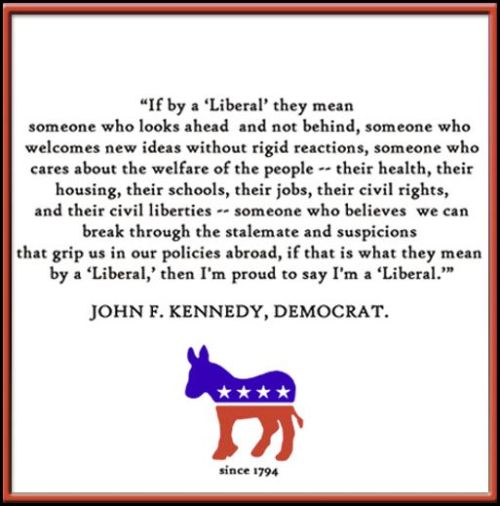
Proud to be a liberal, JFK

May 5, 2012

Somebody made a poster out of it:

JFK, proud to be a liberal

Quote from Sen. John F. Kennedy, September 14, 1960

You can read the entire original speech by Sen. John F. Kennedy here, at Millard Fillmore’s Bathtub.  There’s more defense of his being considered a liberal, and the good that liberals do.  It’s almost quaint the way he defends Adlai Stevenson.

Why do you wave the flag, help old ladies cross busy streets, keep children safe, and sing the “Star Spangled Banner?”

Tip of the old scrub brush to MoveOn.org, PBS and American Experience, and everyone who sent me a link to this today.


“And yet, here you stand.” Give Pat Bagley a hug, and a Pulitzer

May 1, 2012

Pat Bagley cartoon from the Salt Lake Tribune, May 2, 2012:

Pat Bagley cartoon, Salt Lake Tribune, May 2, 2012

Pat Bagley cartoon, Salt Lake Tribune, May 2, 2012

Wow.
More: